
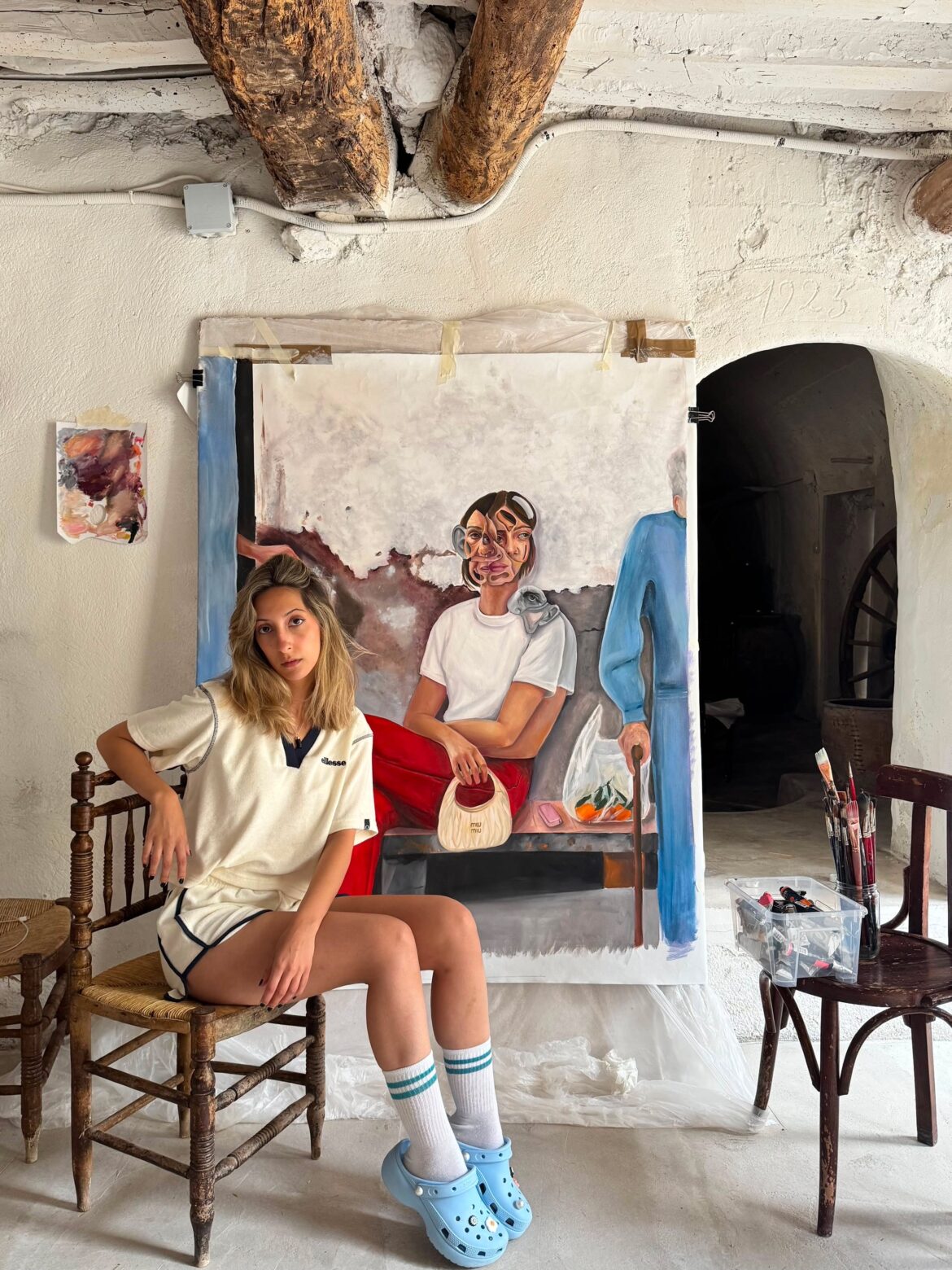
Celia Gallego (Valladolid, 1997) lives and works in Madrid. Her work stems from an interest in that which does not fully emerge into conscious awareness—an ambiguous territory where images appear without apparent logic yet hold a profound meaning we cannot yet name. She interrogates the construction of the self as a paradoxical space where the concept of autonomy coexists with inherited structures, manifesting in the deepest part of our being: the unconscious.
Through a fragmented, symbolic visual language, her paintings function as conceptual maps of a psychic life in motion. Her works act as evocations—images that do not narrate. In them, incomplete bodies, ambiguous spaces, and recurring elements form a unique visual grammar in which the intimate, the collective, and the imagined intertwine. The figures inhabiting her compositions are presences embodying states of transition, doubt, or transformation of the self; they can be understood as an attempt to give form to that which has not yet been integrated within us.
In this context, each painting serves as a space for self-observation—a place where the inherited, the lived, and the learned coexist without hierarchy. Her practice is thus defined by a continuous tension between permanence and change, erasure and persistence, the chosen and the imposed. Within that interval, her painting inhabits uncertainty without the need to resolve it. Celia Gallego’s works offer no definitive answers. Like dreams, they remain open, allowing each viewer to project fragments of their own inner landscape onto them.
Hi Celia! It’s a pleasure to sit down with you! First question that I always ask. How does a regular day look like for you in Madrid?
Celia: A normal day for me here in Madrid starts at around 8 a.m., which is when I usually wake up. I really like taking my time in the morning, so even if I wake up at eight, I can easily spend twenty minutes just lying in bed, staring at the ceiling and slowly waking up.
And of course, very importantly — coffee. Either I make one at home or I go downstairs to the café right below where I live. I’m incredibly lucky because my studio is only a few minutes away from my house, so if I get my coffee outside, I just grab it and begin my extremely long, two-minute journey to the studio! At the moment, I work there by myself.
I basically divide my working day into two parts: morning and afternoon. I dedicate the morning to one piece and the afternoon to another. I try not to spend an entire day working on the same piece unless it’s absolutely necessary because of deadlines or something specific I need to finish. I feel like if I spend too long looking at the same work, my brain gets completely saturated. I stop seeing it clearly and it becomes much harder to notice mistakes, problems or things that need changing. So I usually split my day between two works, and on particularly busy days, sometimes even three.
At around two, I go back home for lunch, and then I usually stay at the studio until about 7:30 p.m., when it’s time to take my puppy, Canela, for her walk. So, more or less, a normal day for me revolves around the studio. If there are gallery openings — Thursdays are usually a big day for that in Madrid — I might go to an opening around seven. And later in the evening, I like to read, let my brain rest, look for inspiration, explore ideas and things that interest me, but from a much more relaxed perspective. I try to experience that part of the day as something closer to pleasure than work.
I’m curious, growing up, what was life like there? And what kind of kid were you? What did you enjoy doing?
Celia: I was actually born in a city called Valladolid, which is about two hours from Madrid. My parents have told this story a million times, but they always say that I was basically born with a pencil in my hand. When I was very, very young, my parents would take me out for a walk or go somewhere for a drink, and my dad would give me the pen he always carried in his shirt pocket and a napkin to draw on. And that was it — it was almost as if I wasn’t there anymore. I would become completely absorbed in my little drawings and my napkins. I could spend hours in my own world.
I’ve always had a very vivid imagination too, and that’s something I still have today. As a child, I was constantly creating scenes in my head, inventing stories and imagining things. And I was very lucky because my parents never tried to correct the way I drew. They never said, “Why did you paint your mother’s face green? Her face isn’t green.” Of course I knew her face wasn’t green! But if I wanted it to be green in my drawing, they just let it be green. They always understood how much I loved creating and gave me a lot of freedom with it.
I was also a very calm child. Valladolid is a smaller city, so at the time I didn’t have the same kind of access to art and culture that I would have had growing up somewhere like Madrid, with so many museums and exhibitions around you. Because of that, I became quite self-taught from a very young age.
My father also thought it was really important for my education that I learned how to use a computer, so I had access to one when I was very young. That gave me this incredible window into other things — I could explore, play, read and learn on my own. So even though I didn’t necessarily have all that culture physically around me, I found my own ways of discovering art and learning about the things that fascinated me.
Do you remember approximately at what age your creative side started to show? And when did you start taking being an artist seriously?
Celia: I don’t think there was ever really a specific beginning for me. Art has always felt like an extension of who I am, of the way I see life and of what I’ve wanted to do since I was very young. A pencil or a pen almost felt like an extension of my arm. So there was never really a moment when I started making art.
But there was definitely a moment when I thought, “Wait, maybe this could actually be a viable way of making a living.” And that happened relatively recently. For most of my life, art had been something I considered a hobby — something I loved doing, and of course a dream, but a dream I never seriously allowed myself to consider because it felt so unattainable.
As I got older, though, I started to realise that maybe it wasn’t so impossible. Partly because I had built a community through social media, and partly because I could see that I was beginning to create my own artistic universe, with its own identity and language. Slowly, it started to feel like this could actually become something real.
The turning point came when I moved to Madrid seven years ago to study a Master’s in Cultural Management. I remember thinking, “Okay, there’s a question I’ve been avoiding because I’m scared of the answer: Do I want to be an artist?” And I realised it was finally time to ask myself that question and actually answer it. Deep down, of course, I already knew the answer. It was a very definite yes. And I think that was the first time I truly gave that desire the importance it deserved and allowed myself to take it seriously. That was when I finally decided to take the leap.
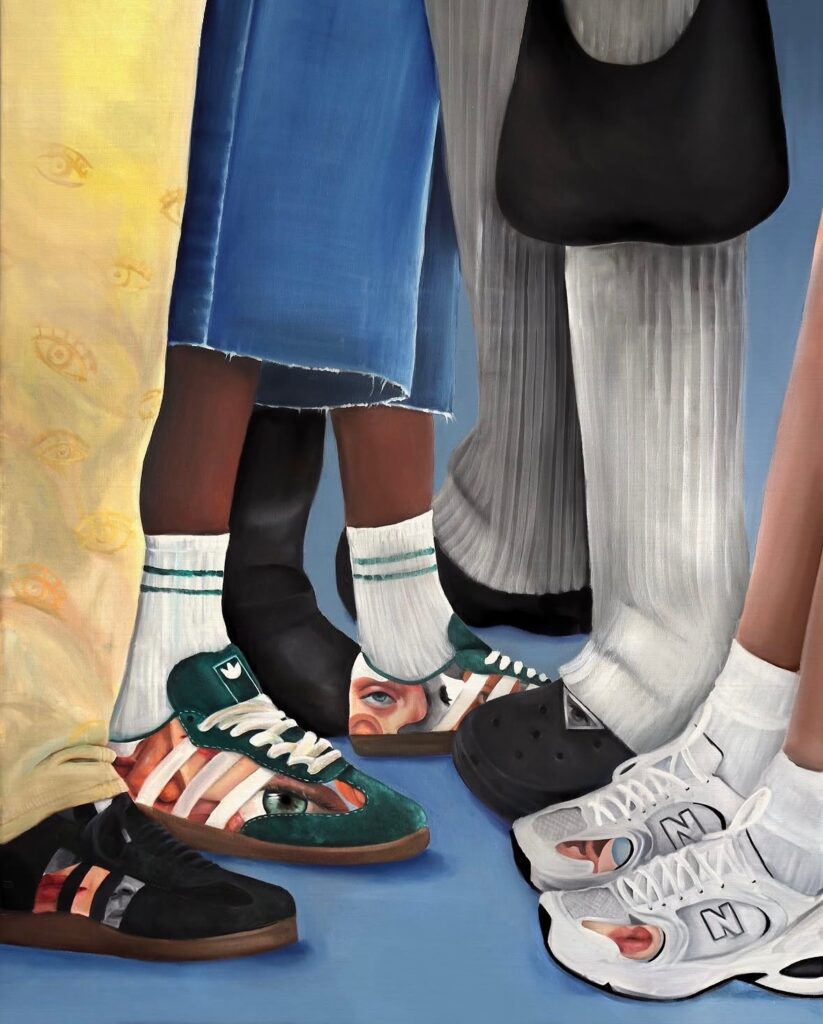
Ok Celia, with these next series of questions, I will try to delve into your work as best as possible. So…. Your work often begins with the idea that we are not entirely autonomous, that much of who we are is inherited, conditioned or unconscious. Does that idea make you feel less free, or does recognizing those forces actually create a different kind of freedom?
Celia: I think we tend to understand freedom as a social construct in very binary terms: either you are free or you are not, as if there were only black and white. But I actually see freedom as much more of a grey scale, and I think it depends on how conscious you are of yourself — of what you do, what you don’t do, and above all, why you do the things you do.
For me, that freedom begins to grow when you start looking inward, and when you actually learn how to look inward. A very important part of my work comes from the fact that, for many years, I was someone who found it extremely difficult to do that, partly because I didn’t even know it was possible. My unconscious was always very powerful and very present, but at the same time, somehow deeply hidden from me.
Realising that we are not completely autonomous beings has actually been quite liberating for me. We are born into the legacy of a particular family, a particular place, and a particular moment in time. All of those things shape us before we are even conscious of them. But I think a different kind of freedom appears when we begin to understand why we are the way we are.
The brain is incredibly plastic, and once we become more conscious of who we are and where certain parts of ourselves come from, I think we gain some ability to shape ourselves. I don’t mean becoming a completely different person, but rather choosing which parts of ourselves we want to nurture, strengthen or perhaps see differently — the way we understand ourselves, the world around us, and even the way we think.
So I don’t see all of these inherited or unconscious forces as a lack of freedom. I see freedom as something we can acquire to different degrees through awareness. And that space between what has shaped us and what we consciously choose to do with it is what I find really interesting.
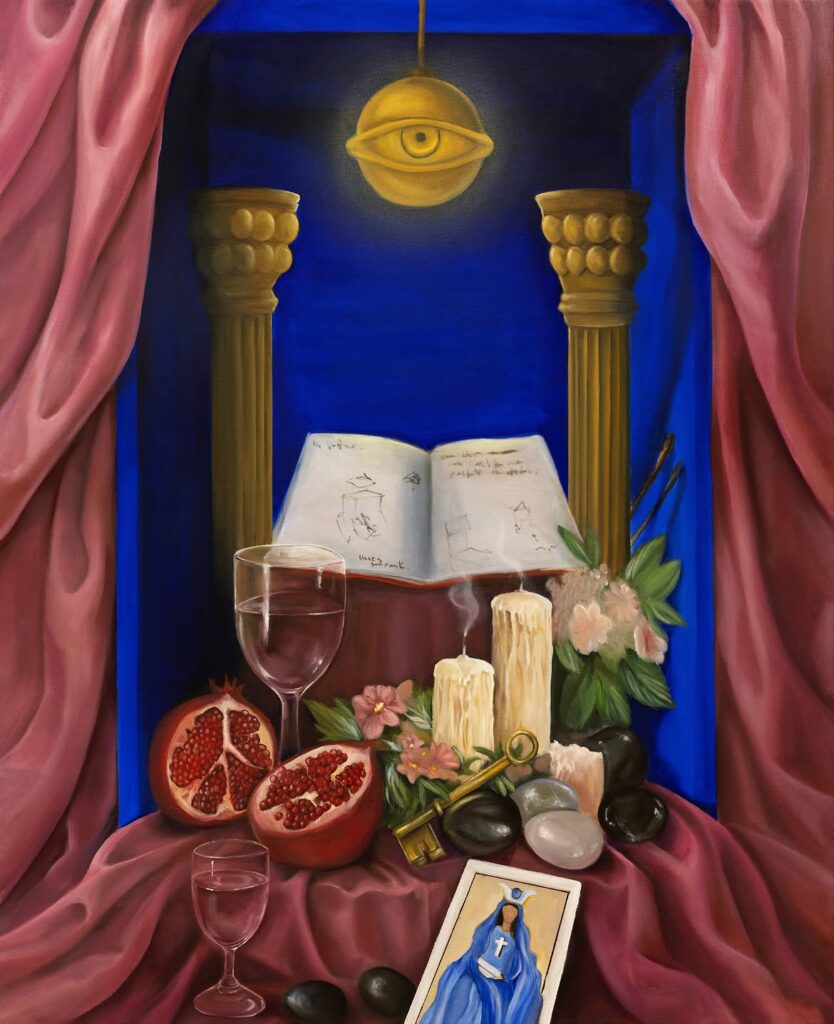
You describe your paintings as images that evoke rather than narrate. What can an image communicate that a story cannot?
Celia: I think that when you tell a story, words inevitably carry quite specific meanings. In Spanish, for example, we have such a rich vocabulary that each word can define something very precisely. But language can also reveal how difficult it is to contain a feeling within a direct translation. In Basque, for instance, maite zaitut is generally translated as “I love you,” but the expression carries its own emotional and cultural nuances that can’t be perfectly transferred into another language. You can translate the words, but something larger can remain underneath them.
And I think something similar happens with my work, and with the kind of painting I’m drawn to, particularly Surrealism. When you tell a story, there is usually a beginning and an end. Of course, you can continue thinking about it afterwards and interpret it in different ways, but the story itself has been told. With an image, even a figurative one, there is always something that remains unsaid. And I think that unsaid part can connect very directly with the unconscious and with emotion.
That’s why my paintings tend to be so dreamlike and open-ended. I like to think of them almost as unfinished maps. There is no clear beginning or end, and there is no X marking the place you are supposed to reach. Instead, the person looking at the painting moves through it, making their own associations. I hope it evokes something personal in them, because at that point the work begins to belong to them too.
When I look at one of my paintings, I know what it means to me, but I deliberately leave a lot of space for the unconscious. Even while I’m creating, sometimes I’ll think, “I want to include this simply because I like it.” And perhaps it isn’t really just because I like it. There is probably something much deeper happening unconsciously, but I prefer not to explain everything to myself immediately. I like to play with those impulses, see what happens, finish the work, and only then discover what has emerged.
Many of my paintings actually begin with pieces of writing, but even those texts tend to remain very open to interpretation. I think that openness — that space where neither I nor the viewer has to arrive at one definitive meaning — is one of the most important parts of my work.
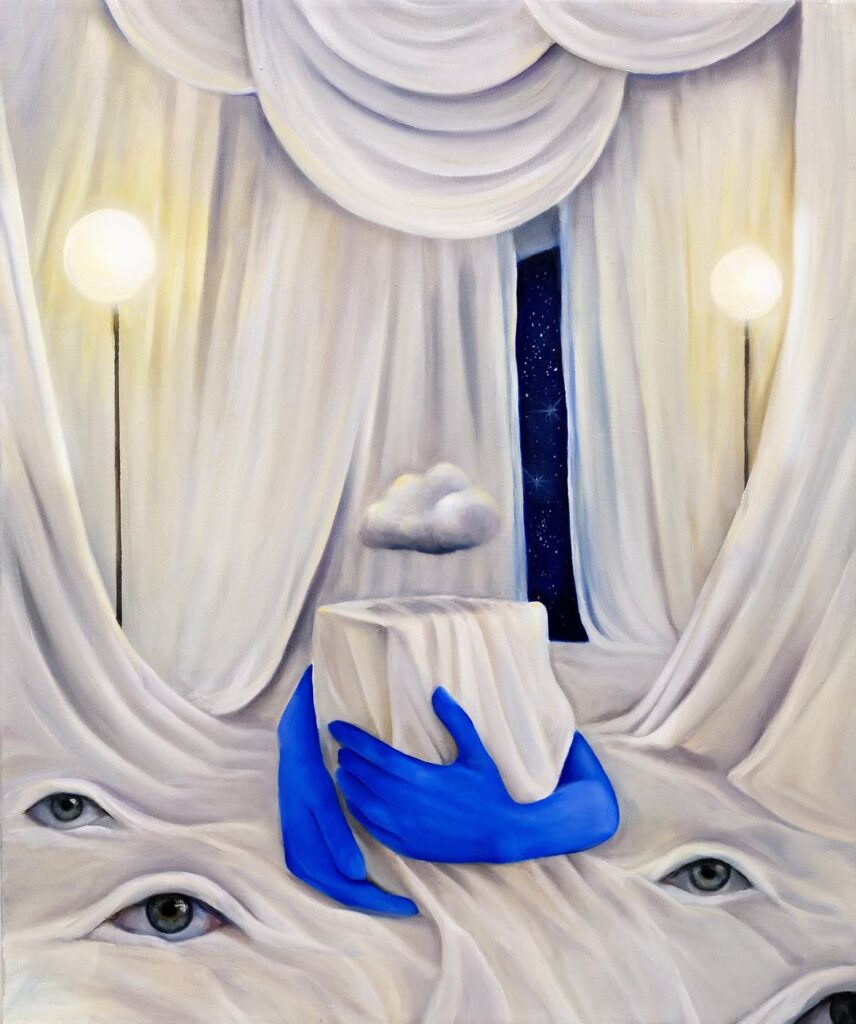
There is a contradiction at the heart of your practice: you are trying to understand yourself through painting, while also allowing the paintings to remain unresolved. Do you actually want to understand what is happening inside you, or is preserving some mystery important?
Celia: I think that contradiction is actually part of the game within my painting. I’m trying to understand myself, but there is always this kind of back-and-forth with myself. It’s almost as if I’m trying to figure out how a magic trick works, to discover the secret behind it, while at the same time I’m the one making sure that the secret can never be completely revealed.
I think that’s also a fascinating part of how the unconscious works. It plays between wanting to be seen and wanting to remain hidden. It reveals certain things because perhaps they are important for us to see, while keeping others concealed because maybe we don’t want to know them yet, or we simply aren’t ready to.
I’m quite certain that when I’m older and I look back at the paintings I’m making today, I’ll see things in them that I’m completely unable to see now. And perhaps I’ll discover things about myself that I’m not yet capable of understanding. That’s why I think it’s important, when creating something, not to close it completely.
I don’t believe we ever fully know ourselves, no matter how much we try. I genuinely use painting as a way of trying to understand myself, but I also know that, at some point, I probably never will entirely. And perhaps if I did, some of the magic would disappear.
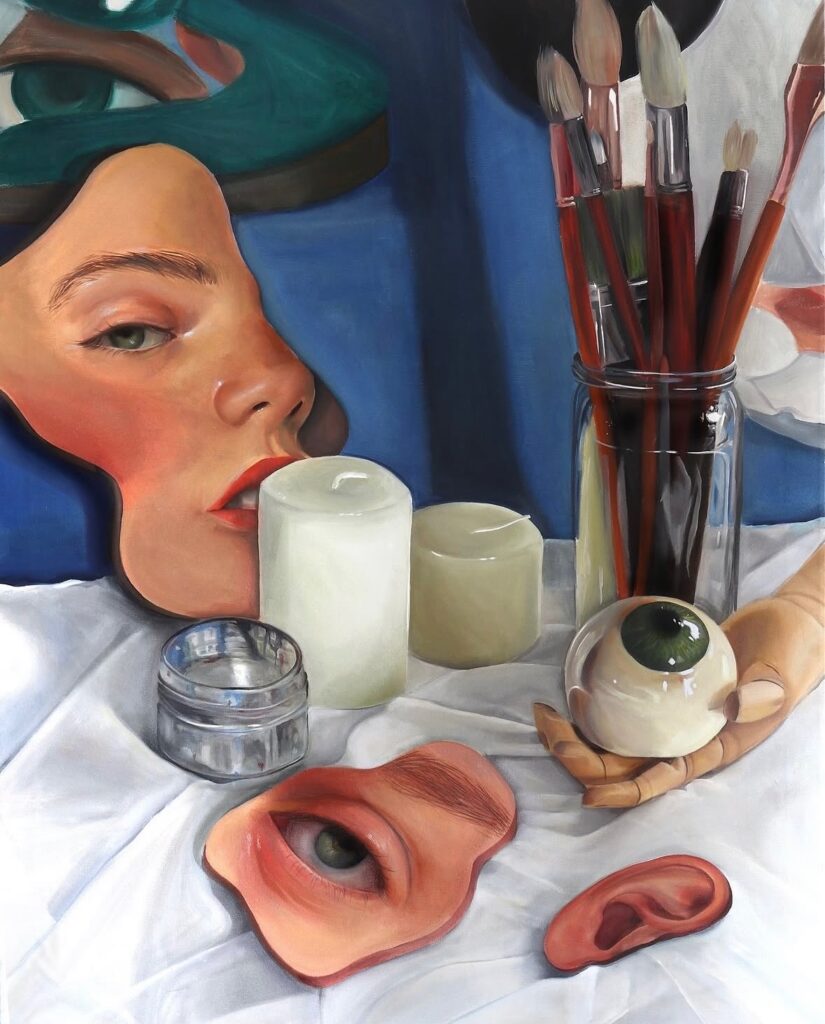
Your figures are frequently fragmented, doubled or made from several different bodies and faces. Do you see fragmentation as something damaged, or as a more truthful way of representing a person?
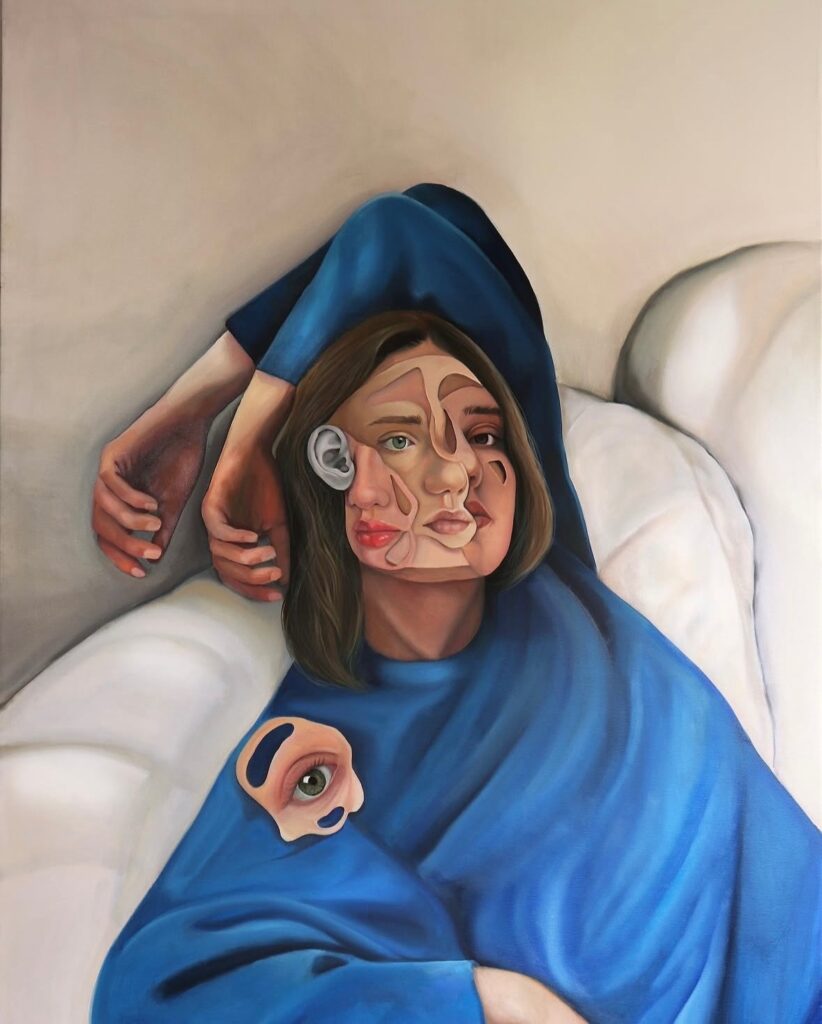
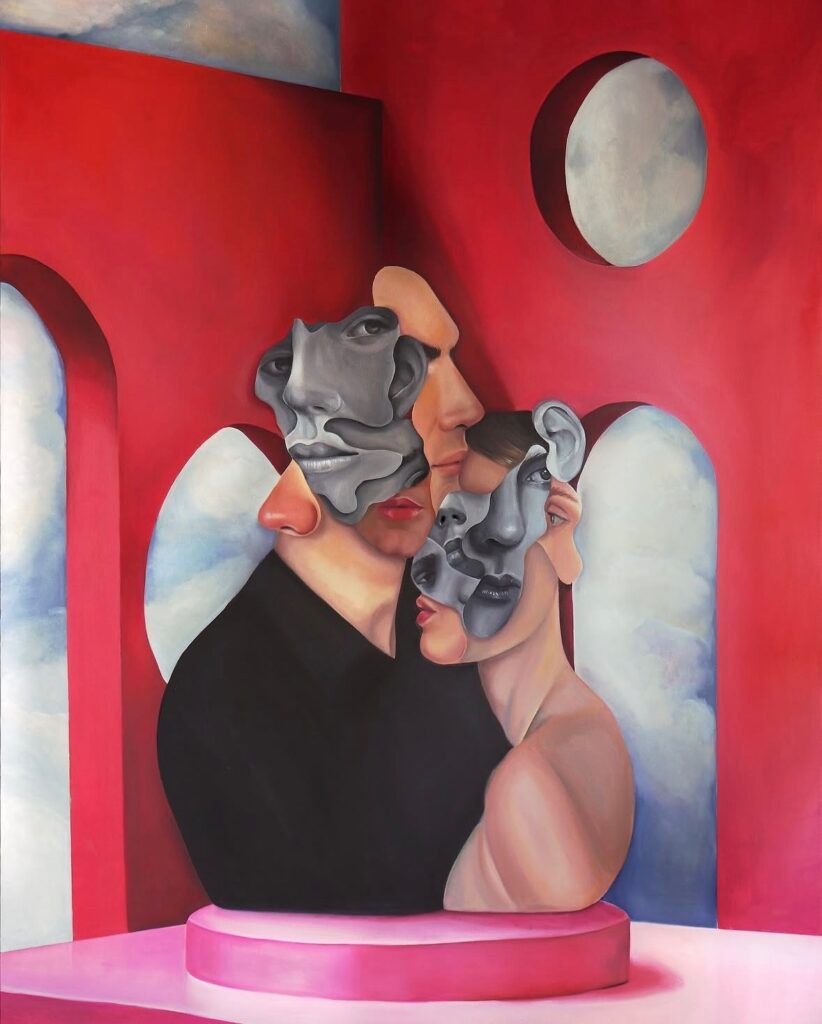
Celia: Not at all. I don’t see fragmentation as something broken. I see it as something that has simply been displaced from where it belongs. When I show duplicated or fragmented parts of the body, I think of them almost like pieces of a puzzle that hasn’t been solved yet. A puzzle isn’t broken — its pieces simply haven’t found their place. And that’s very close to how I understand fragmentation in my work.
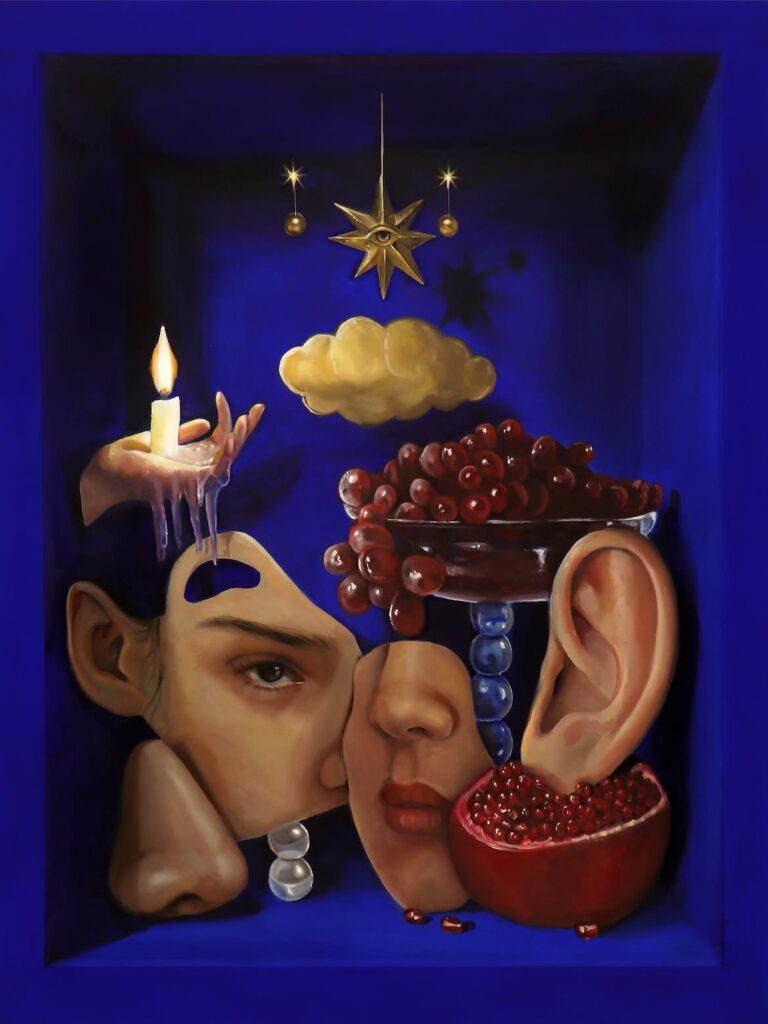
I often use eyes, noses and ears because they are very important parts of the human body to me. They are connected to our senses, to the ways in which we perceive, experience and feel the world. And I fragment them because there are things I feel without necessarily knowing where those feelings come from. There are things I see that trigger anxiety or unease in me, for example, without me fully understanding why. In that sense, I sometimes experience myself as a fragmented person: I can recognise the individual pieces, but I don’t always know exactly where they belong.
But fragmentation also relates to the way our identities are formed through other people. You grow up within a family, you absorb certain values from them, you are influenced by people throughout your life, and little pieces of those people somehow remain inside you. You don’t carry the entirety of another person within your psyche, of course, but you do carry fragments of them — certain values, ways of seeing the world, ways of thinking or feeling that they passed on to you.
So when I use fragmented or duplicated faces and bodies, I’m thinking both about my own internal fragmentation and about the way my mind and identity have been constructed from all these different pieces. To me, fragmentation isn’t necessarily a sign of damage. In many ways, it’s simply a more truthful representation of how we are made.
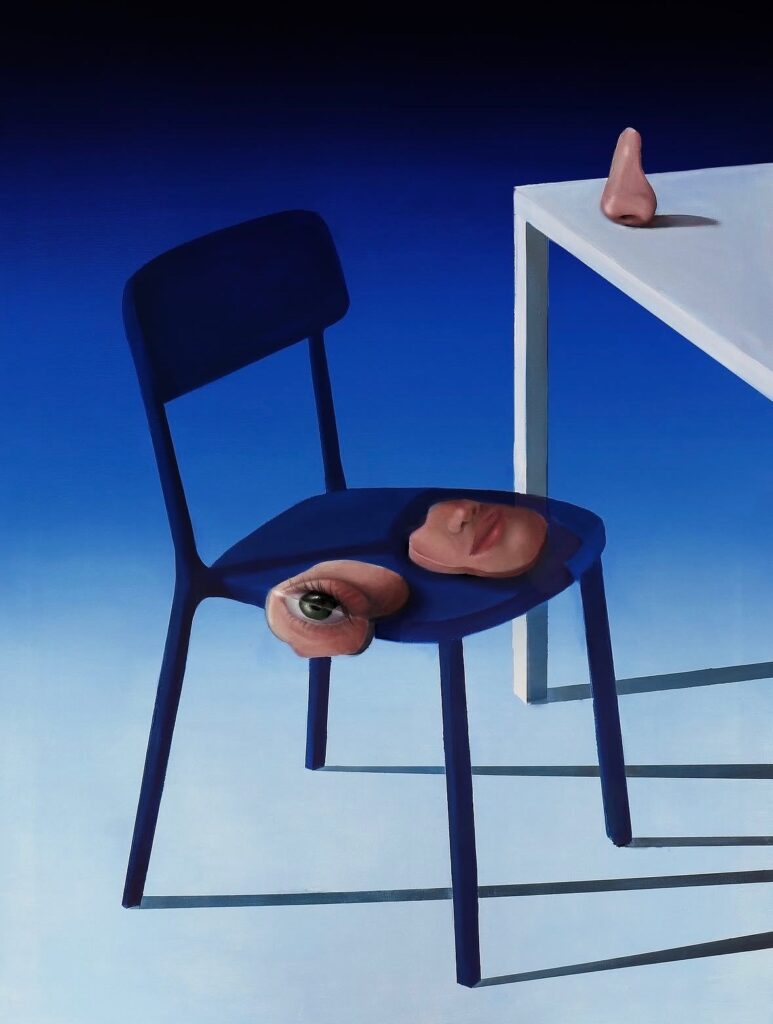
You’ve spoken about wondering which version of yourself is the “real” Celia. Do you still believe there is an original self underneath all those different versions, or have you stopped looking for one?
Celia: I used to ask myself the same question all the time: Who am I when I’m completely alone, with nothing but my own thoughts? And I thought that perhaps, in that solitude, I could find some kind of original Celia. But now I think it’s much more complex than that.
I still believe there might be a version of myself that is somehow more pure — not necessarily more original — when I’m alone. Because the moment we interact with other people, our fears and insecurities come into play, and they create different strategies and small shifts in our personality. We are still ourselves, of course, but we adapt in certain ways in order to coexist with others.
What has changed is that I’ve realised that all of those different Celias are also part of the most complete version of me. They’re not false versions of myself. I think of them more as layers, stages, floors, boxes or compartments within me. They exist for survival, for understanding, and simply to make navigating life a little easier.
So I wouldn’t say I’ve stopped looking for that self. I think I’ve simply realised that perhaps I was asking the wrong question. And now I’ve moved on to a new one.
There are motifs that recur throughout your work: eyes, fragmented anatomy, thresholds, strange rooms and altered bodies. Do their meanings remain stable for you, or can the same symbol become something completely different from one painting to another?
Celia: I’m trying to create a visual language so that someone who encounters the different works that make up my practice can gradually find a kind of map or guide through them, and begin to understand the universe they belong to.
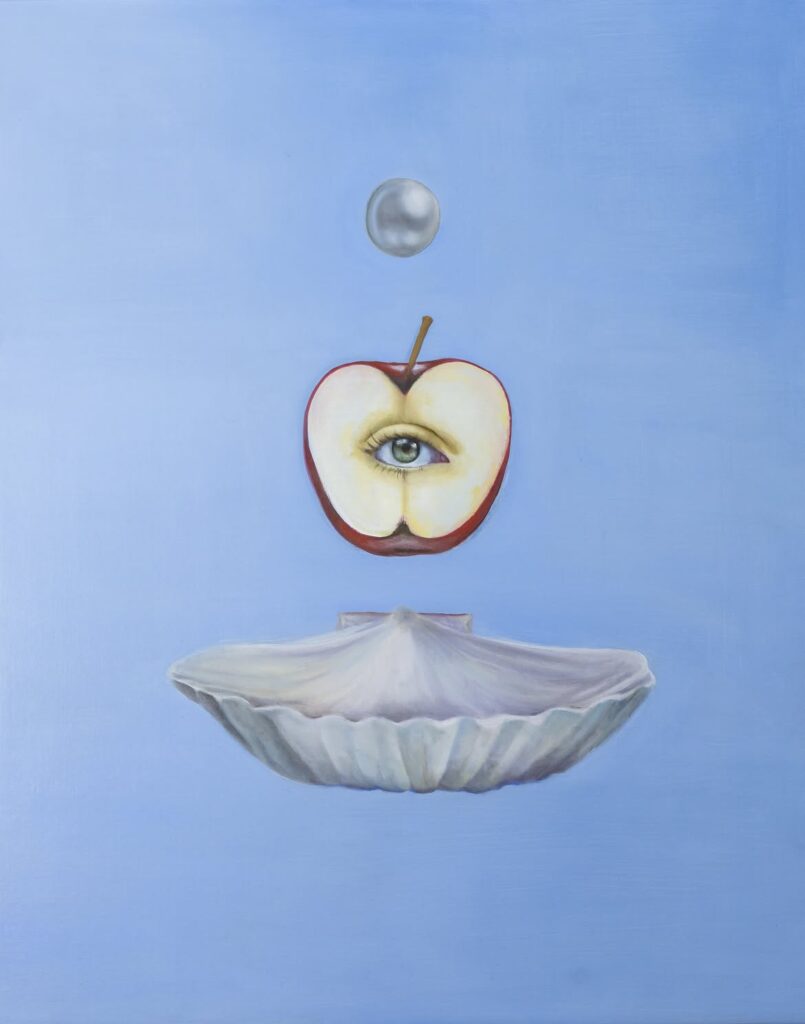
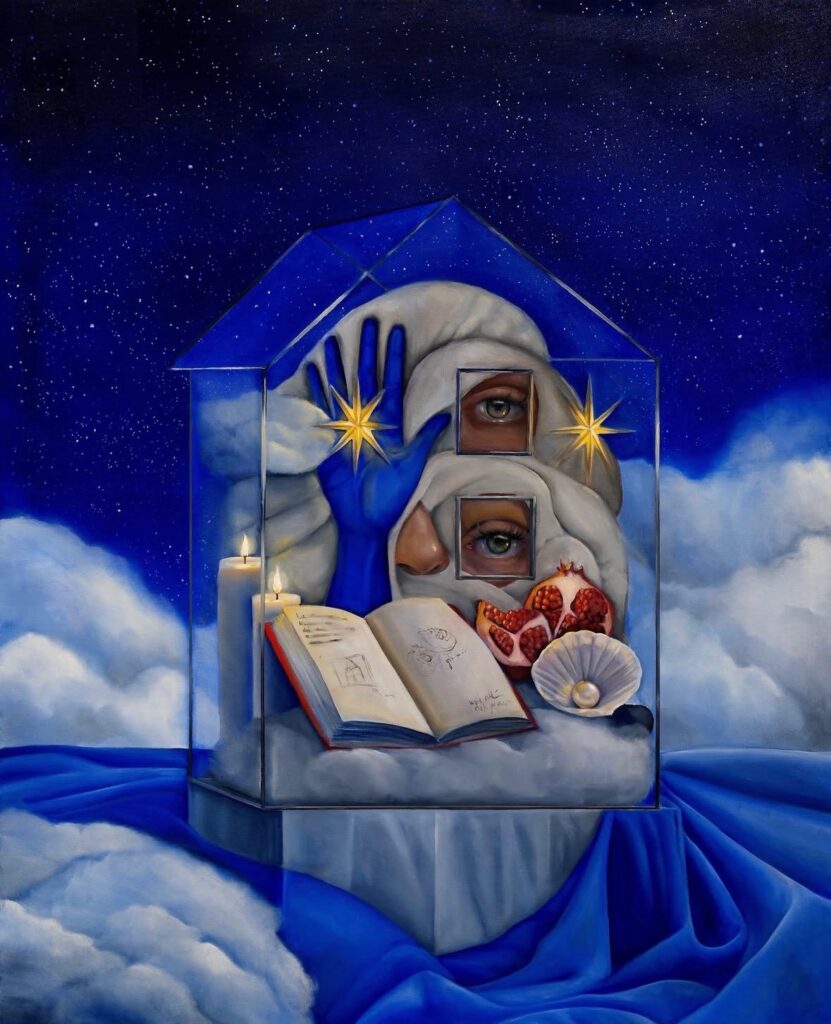
I often use symbols that already have a long cultural history. The pomegranate, for example, shares certain associations in my work with the apple or the fig. Within religious imagery and cultural tradition, these fruits can evoke the idea of forbidden fruit — something a woman chooses to eat despite a prohibition imposed on her. But I’ve also added another meaning that has become even more powerful within my own visual language: guilt. For me, that fruit is also the heart, vulnerability and guilt. So its core meaning tends to remain consistent throughout my work.
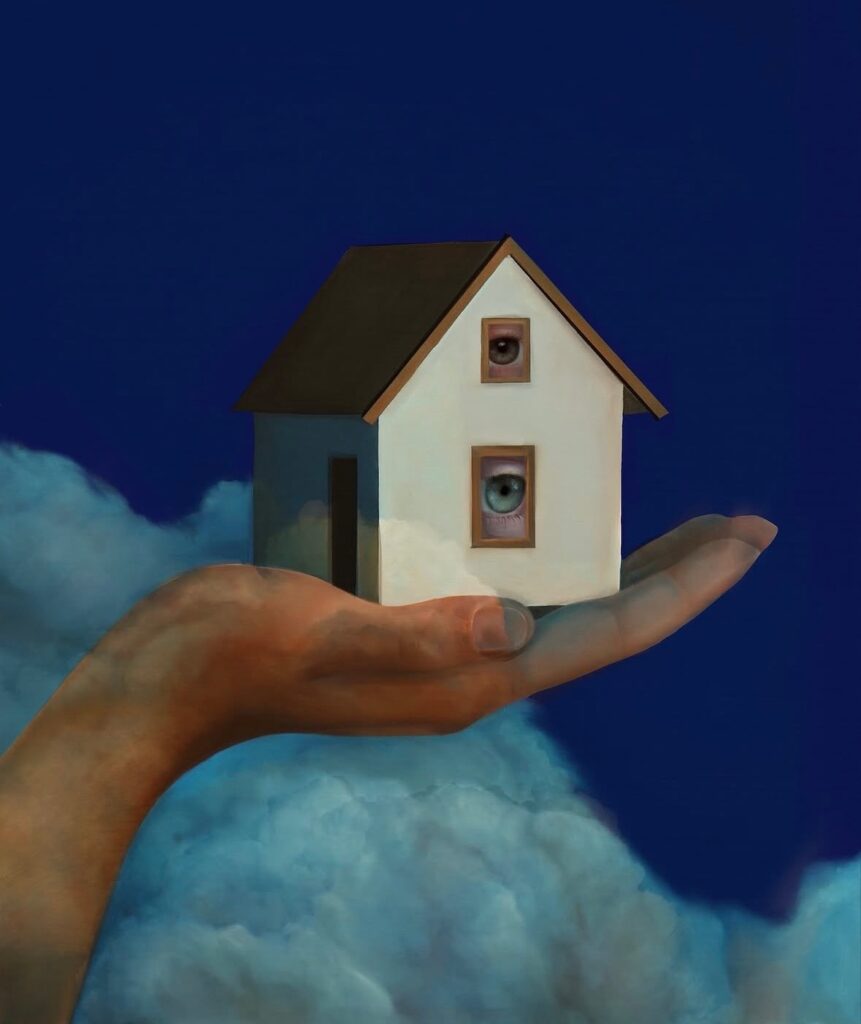
Something very interesting happened with the eyes, though. For a long time, I thought I painted eyes simply because I liked them. I thought I was fascinated by the gaze and by trying to understand the way another person looks at the world. But after a great deal of reflection, I eventually realised something quite different: I’m not the one looking at those eyes. Those eyes are looking at me.
They are inquisitive, observant eyes. They are constantly watching and judging what I do and what I don’t do, almost like a form of eternal surveillance.
So perhaps it isn’t really that the meaning of my symbols changes from one painting to another. It may be that their meanings are already there, somewhere beneath the surface, and I gradually discover them as I continue making new work.
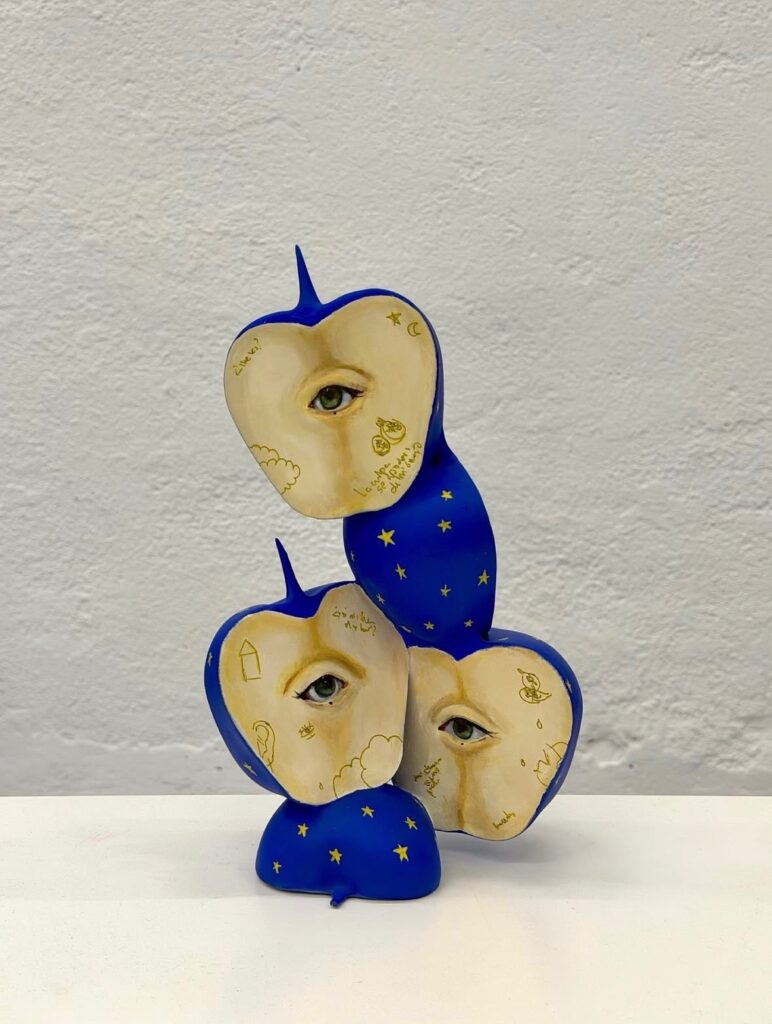
Your earlier paintings often concentrated very closely on the face, while your recent work seems to be opening outward into rooms, landscapes and entire psychological spaces. Has your idea of what a painting can contain changed?
Celia: I think I used to focus so much on portraiture because I believed that was what I needed in order to understand another person’s reflection, or even my own. But I eventually realised that you can’t really understand a person simply by looking at their eyes or their face. You need to understand the entire ecosystem around them.
And in order to understand myself, looking at my own face or my own portrait was never going to be enough. I needed to understand and give a voice to the spaces that exist inside me. Those spaces aren’t really part of a portrait — they belong to an ecosystem, almost a planet, an entire world that exists within me.
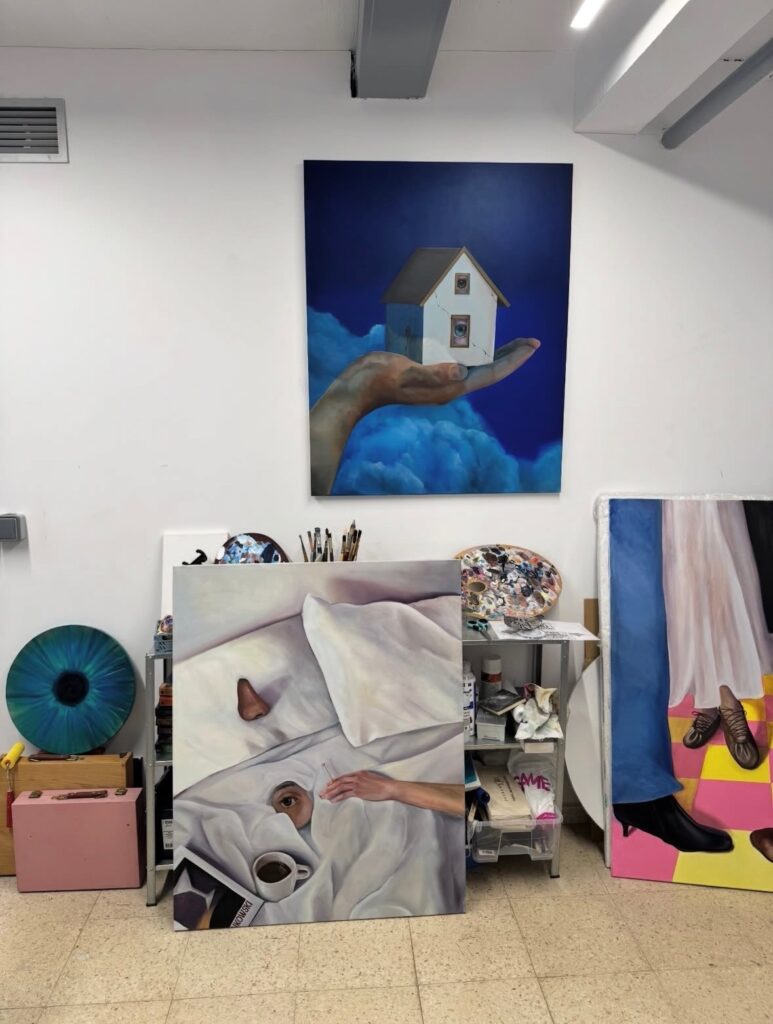
That’s why I’ve become increasingly interested in liminal spaces, in creating places that feel dreamlike but also slightly unsettling, and in exploring what can be communicated through landscape, architecture and geometry. Of course, some of that can also be achieved through portraiture, but I feel that these spaces allow me to build something much more complete.
In a way, they allow you to understand the lore of a person — if I can use that word — not only what they look like, but the whole internal world that surrounds them and makes them who they are.
You call your paintings conceptual maps of a psychic life. If they are maps, what are you hoping they might help you locate?
Celia: I’m actually not sure. I don’t know if there is one specific thing I’m trying to locate. Perhaps what I’m really looking for is simply the possibility of having the complete map in front of me and being able to see everything.
Maybe what I want to locate is the entirety of what exists inside me. I’m not searching for a treasure hidden at one particular point on the map. I want to be able to step back and observe the whole thing, in the same way you might look at a map of Spain or a map of the world and see the rivers, the mountains, the countries, the capitals, the cities — all the different elements and how they exist in relation to one another.
I think that’s what I’m searching for through painting: to understand the map and, ultimately, to be able to see the map as a whole. Not to find one hidden treasure or one definitive answer, but to understand the entire landscape of what exists within me.
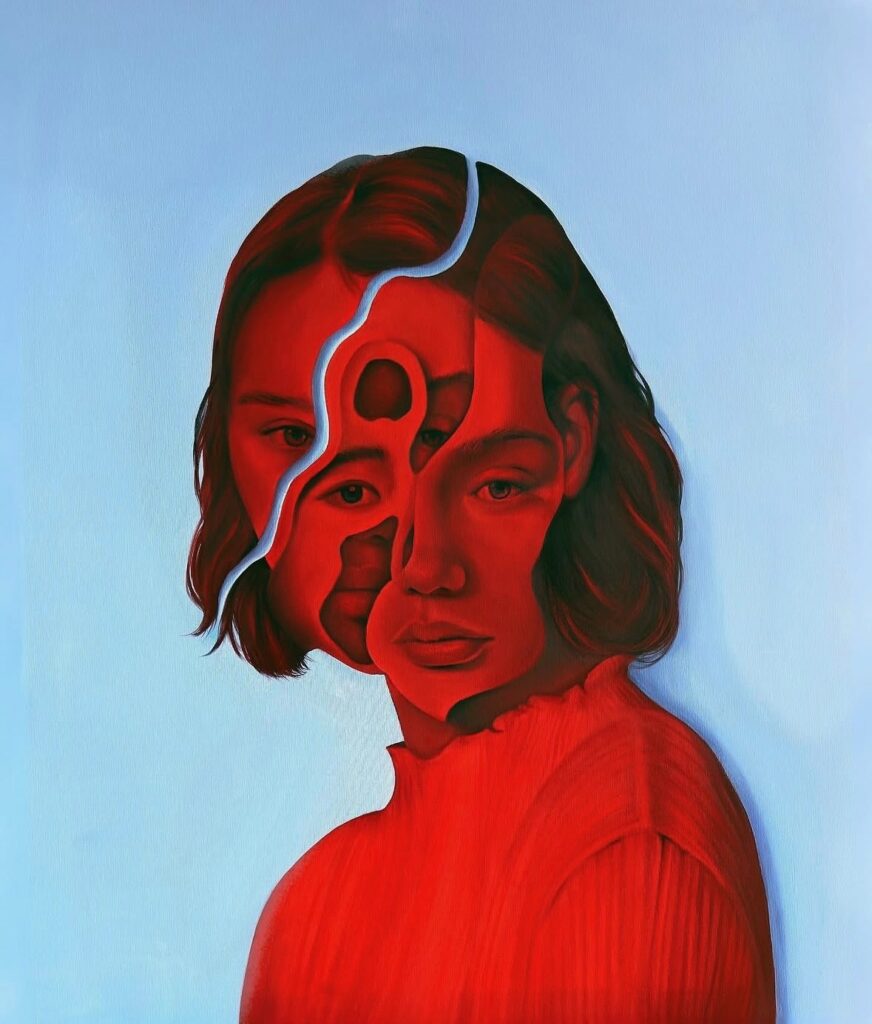
You often paint bodies that seem to be in the middle of becoming something else. What interests you about transformation before it has reached its conclusion?
Celia: Some time ago, someone told me that my own presence — and even my own hand — should somehow disappear into the painting, allowing the painting itself to emerge and take centre stage. That the person behind it should become less important, and the painting itself more important.
Perhaps that’s what I’m exploring through this process of transformation. The portrait gradually begins to disappear — not because the portrait itself is being erased, but because it starts to materialise as something else: a collection of symbols, something more dreamlike and less physically defined.
Because although we are made of flesh and we exist within physical bodies, such a large part of who we really are is intangible. You can’t touch the unconscious. You can’t point to exactly where it is or identify the precise place where it lives, and yet we know that it exists.
So I think that transformation in my work is moving in that direction. Little by little, the portrait stops being simply a representation of a physical person and begins to transform into something else — something that might be able to represent those invisible, intangible parts of us.
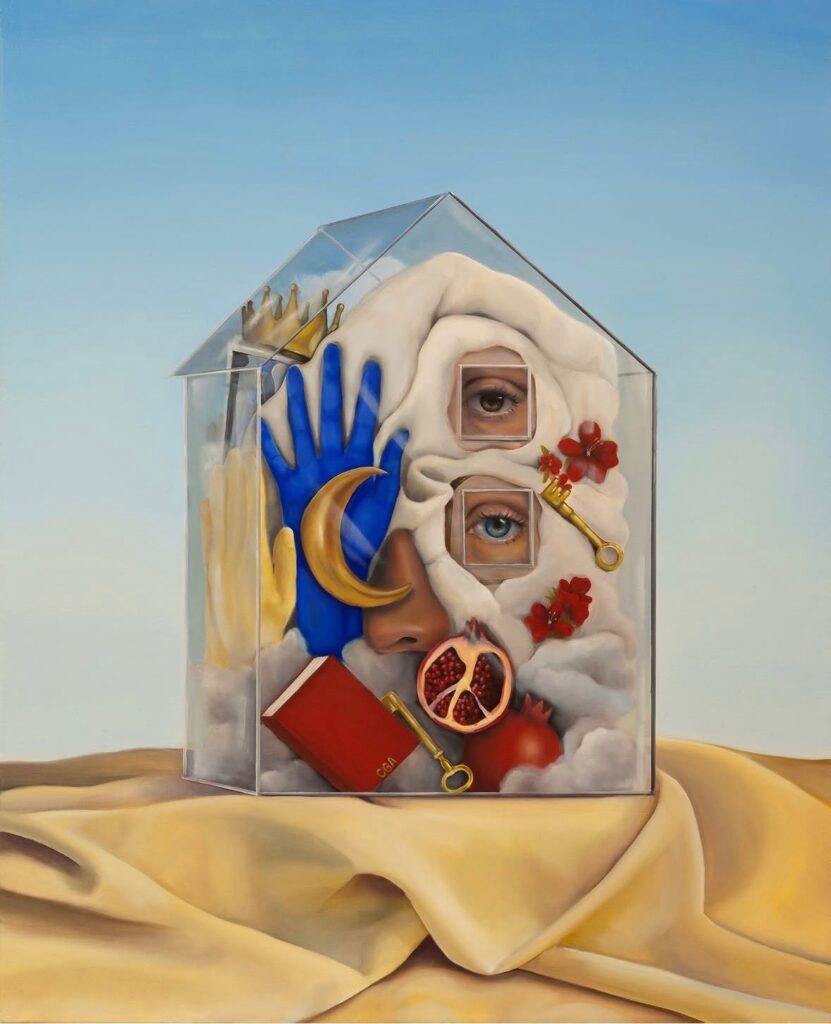
There is a lot of looking in your paintings — eyes looking outward, inward and sometimes directly at us. Are your figures more concerned with seeing, or with being seen
Celia: The figures I paint are always concerned with being seen, although that’s something I only realised relatively recently. For a long time, I thought that when I painted an eye looking outward, it was looking at the viewer because it wanted to see the viewer. But I eventually realised that it was actually the other way around: that gaze is deeply aware of — and concerned about — the person looking back at it.
Ultimately, what I reveal through my work is often extremely intimate, and there are things I’m genuinely afraid to bring into the open. Whenever I put a new piece out into the world, there is often a certain fear about how it will be received, precisely because these works contain things that are deeply personal to me. So the gaze in my paintings is never entirely neutral. It is always looking with a certain sense of fear — the fear of being looked at in return.
You have described uncertainty as something you have gradually learned to enjoy. Has painting made you more comfortable with uncertainty outside the studio as well?
Celia: I think it has worked in both directions. Little by little, I’ve learned to live with uncertainty through many, many hours of therapy. My therapist has been teaching me — and is still teaching me — not only how to tolerate uncertainty, but how to actually enjoy it, because uncertainty is also such an important part of any process.
And I think that learning has moved back and forth between my life and my painting. I’ve learned to accept uncertainty a little more in my everyday life, and at the same time, to allow more of it into the way I paint.
I still tend to be quite obsessive about the process. I still want to control every single detail, and I really have to push myself to enjoy the brushstroke itself, to enjoy the unexpected things that can happen while I’m painting, and to accept that some things are simply beyond my control.
So yes, I think it has been very much a two-way process. Therapy has helped me change my relationship with uncertainty in life, and painting has become another place where I can practice letting go of that control.
You’ve said that some things reveal themselves to you only after a painting is finished, can you elaborate on that please?
Celia: For example, there are the eyes. For a long time, I thought I simply enjoyed painting eyes because I’ve always been someone who pays a lot of attention to other people’s gaze. But it wasn’t until I began painting more seriously — painting again and again, creating all these scenes in which these eyes kept appearing — that I realised there was something else behind them.
I wasn’t painting them simply because I liked them. I think I needed that gaze to exist above me because, throughout my life, I’ve often felt very observed — at home, at school — and not necessarily in a positive way. Somehow, that feeling was already manifesting itself in my paintings before I was fully conscious of it. It was almost as if the paintings were saying, “Look, this sense of hypervigilance is here too.” And I didn’t actually become aware of that hypervigilance in myself until much later in life.
Something similar happened with pomegranates and apples. At first, I simply liked them. I knew certain things about their symbolism in mythology and, of course, religion, but then I started painting them almost obsessively. It was only through that repetition that I began to understand what I was really trying to express through them: guilt, vulnerability, and all the emotions that I had unconsciously attached to those symbols.
So sometimes I think the painting understands something before I do. I repeat an image or a symbol almost instinctively, and only later — sometimes after the work is finished, or after I’ve painted it many times — am I able to understand why I needed it to be there.
Much contemporary culture encourages us to define ourselves very precisely, through identity, personality, taste, politics, even algorithms. Your paintings seem to move in the opposite direction, towards unstable and contradictory selves. Do you think we have become too obsessed with knowing exactly who we are?
Celia: I think the idea of a stable identity is one of the biggest myths we’ve absorbed in recent years, partly because of the level of exposure we have on social media. The moment you have even a small platform, there can be this expectation that you should have a clear position on absolutely everything that is happening in the world.
And speaking personally, as someone with a relatively large platform, there are certain subjects I simply don’t feel qualified to speak about. Sometimes I just don’t know enough. I haven’t read enough, learned enough or thought deeply enough about a particular issue to have a meaningful opinion on it. And I think being able to say, “I don’t know enough about this yet,” is important too.
Because our identities are changing constantly. You read a book and learn something that changes the way you see the world. You read an article and your perspective shifts. You discover an artist and something changes again. You experience something traumatic and it can transform you completely. So I don’t think identity can — or should — remain entirely stable.
The person we are when we are born and the person we are when we die are completely different people, and I think that’s one of the wonderful things about being alive: we are constantly evolving.
Of course, you can have very specific tastes or convictions that remain with you for years. Maybe you decide that rice with tomato is your favourite food and, for whatever reason, you stubbornly keep it as your favourite for the rest of your life! But an entire identity cannot remain fixed. I think that’s simply impossible.
I’ve seen people in my own life — friends, artists — whose political ideas, for example, have shifted dramatically over the years, sometimes from one side of the political spectrum to the other. And the reverse can happen too. People change. We are not one single, fixed person for the entirety of our lives. And actually, I think that’s a good thing. Otherwise, how boring would that be?
The unconscious in your work is not portrayed simply as dark or threatening, it can also appear seductive, playful and beautiful. Do you think there are parts of ourselves that consciousness actually diminishes by trying to explain them?
Celia: t’s a little like watching someone perform a magic trick and becoming completely obsessed with figuring out how they did it — where exactly the trick is, where the rabbit was hidden inside the hat. The moment you know exactly how it works, I think you lose a great deal of the magic.
The unconscious is an almost infinite space where so many emotions and abstract things are stored. And I think that, in our collective imagination, we often treat the unconscious as something negative, as if it were the place where the worst parts of ourselves are hidden, and our conscious mind is somehow responsible for keeping all of that under control. But I don’t think that’s really the case.
Even if the unconscious can sometimes feel like an impossible horse to tame, it is also a place that, if you approach it carefully and with a certain sensitivity, can allow you to understand yourself much more deeply. And I think it is playful and beautiful precisely because it gives us access to things that cannot always be explained rationally. In a way, the mystical, the divine, the religious — even that sense of a magic trick being possible — all emerge from that space within us.
So I think that when we try to reduce the unconscious only to what we can understand, when we try to explain every single thing we feel or do and give everything a name and a label, we risk losing something along the way. We discover how the trick works, but perhaps we also lose some of the magic.
Can you walk me through your creative process from beginning to end result?
Celia: My creative process doesn’t always begin in exactly the same way. A painting can come from a conversation, from a dream — it certainly wouldn’t be the first time I’ve painted something I dreamed about, usually a painting that I actually saw myself painting in the dream — or from something I’ve read or experienced.
Once something catches my attention, I usually like to write about it first. Writing helps everything I’m feeling, and everything I understand — or am slowly beginning to understand — about what I want to express, start to materialise. At the same time, I normally make a very small, very rough sketch — honestly, sometimes it’s basically four lines! I keep these sketches in a journal where I also write about the ideas behind them, so it has become a kind of visual and written diary of my thoughts around each work.
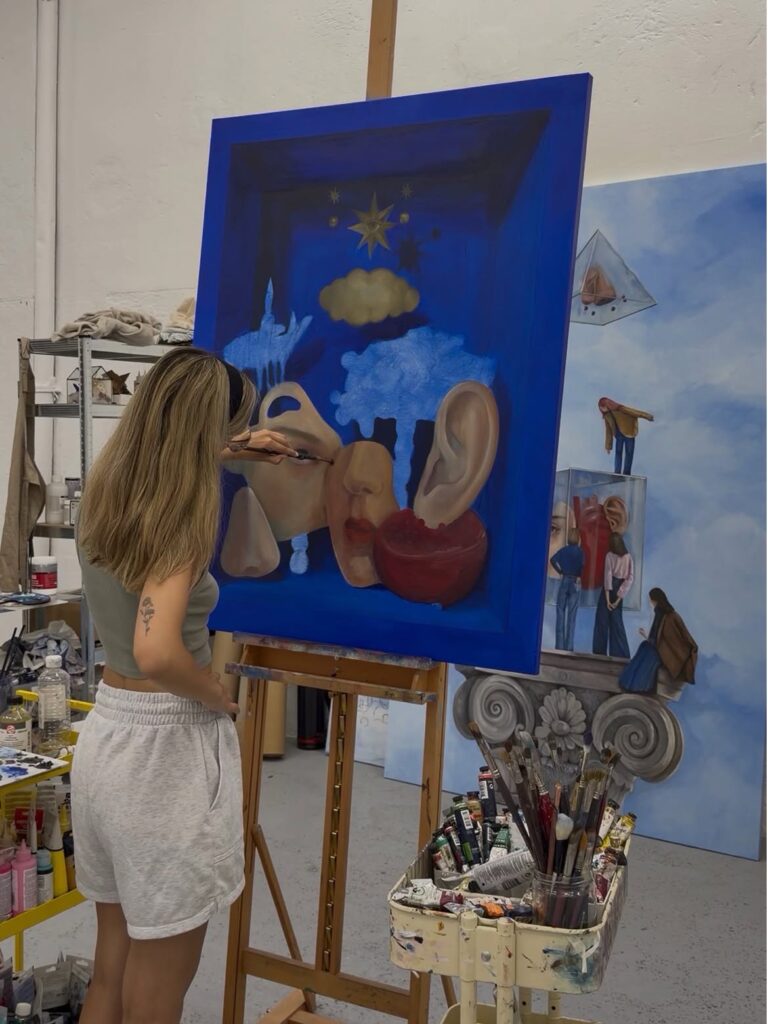
Once I have everything more or less defined, I begin making the actual sketch. Sometimes I work digitally on my iPad and sometimes by hand, although lately I’ve been trying to push myself to work by hand more often. When that sketch is fully developed and I have a clear idea of what I want the final piece to look like, that’s when I move into oil paint and spend however long the work needs to be completed.
In the past, I wouldn’t allow myself to change anything from the original sketch. Everything had to follow the plan exactly. Now I’m learning to enjoy the fact that things can change along the way. I tend to imagine my creative process as a very straight path, but I’m beginning to understand that I can take little detours, explore something unexpected, and then calmly return to the main path. And I think you can grow enormously through those detours. It took me many years to learn that.
Can you also tell me about your use of symbolism?
Celia: I grew up in a family that was relatively religious — not extremely practising, but religion was definitely present throughout my childhood. My grandmother used to sing and recite little prayers to me when I was very young. There’s a traditional Spanish children’s prayer that begins, “Cuatro esquinitas tiene mi cama, cuatro angelitos que me acompañan” — “My bed has four little corners, and four little angels accompany me.” I also went to a religious school, so although it wasn’t particularly strict, religion was part of my education.
For a long time, though, I felt quite disconnected from it. It didn’t really resonate with me, and there were many things about it that simply didn’t make sense to me. But as I got older, I became fascinated by everything that surrounds religion — its imagery, its rituals, its objects and its symbols. I find it extraordinary that human beings have been able to create such incredibly elaborate visual worlds around religion and belief.
And this goes far beyond Christianity. You can trace that human need to create symbols and rituals all the way from prehistoric practices to the enormous cathedrals, churches and altarpieces we have today. There are some extraordinary altarpieces in Valladolid, for example, and discovering them was one of the things that really sparked my fascination with symbolism. I also became fascinated by how much pagan symbolism survives within Christian imagery. Recently, I found mermaids in an altarpiece in Valladolid, and I remember thinking, “I can’t believe this — how incredible is that?” I love discovering those unexpected layers.
For me, symbolism has this ability to keep a feeling very close to the surface without explaining it completely. Your conscious mind sees the symbol, but something else is being processed by the unconscious. I’m very interested in that space between what is visible and what isn’t, and in everything that can be interpreted without being made completely explicit.
A house can mean several different things. A pomegranate can mean several different things. I can place a house on top of a hand, above a river, and instead of telling you exactly what that combination means, I can allow you to process it and make your own connections. I really love that tension between recognising something and not quite being able to explain why it affects you.
How do you approach color?
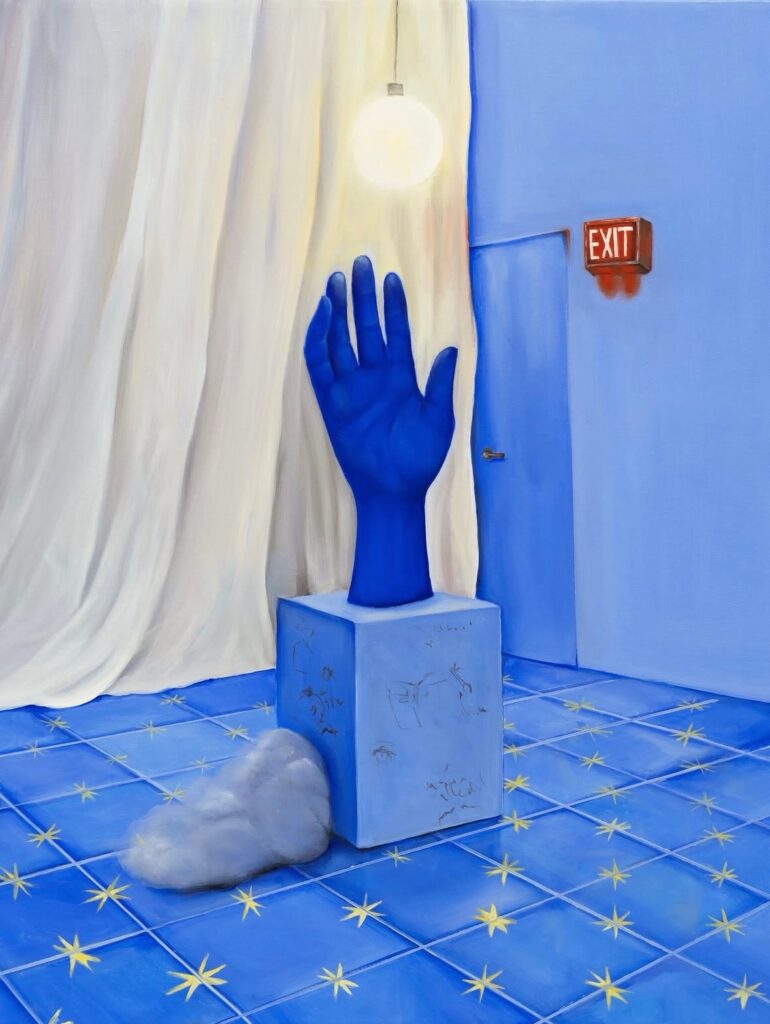
Celia: Almost all of my works begin with the same colour, and I think it’s probably quite obvious which one: blue. More specifically, ultramarine blue, although little by little I’m opening myself up to other blues and learning about all the different possibilities within the colour. Actually, just today I bought a tube of a blue I’ve never used before, so I’m very curious to see what happens with it.
But for me, everything somehow begins with blue. I think I’m still at a very instinctive stage when it comes to understanding why I use certain colours. I’m not entirely sure yet.
I’ve always said that my obsession with blue began when I became fascinated by Picasso’s Blue Period — despite the fact that Picasso himself is someone I really can’t stand. But as someone who studied communication, I have this idea that if you’re going to dislike someone, you should know absolutely everything about them first! So I became completely obsessed with learning about him, and particularly with the Blue Period.
But I still don’t completely understand the way colour operates within my own work. At the moment, my relationship with it comes from somewhere quite instinctive. I play with the colours I’m attracted to and with what they evoke in me, without necessarily needing to understand immediately why I’m choosing them.
At some point, I probably need to sit down and ask myself, “What on earth is actually going on with the colours I keep using?” But blue is different. Blue is just… blue. For me, it somehow exists in a category of its own.
So with what we just talked about, what are you hoping to convey?
Cell: I think, ultimately, I simply want to convey who I am, but in a way that is just as encrypted as I am to myself. If that complete map of myself were 100%, I think right now I probably understand about 20% of it — and little by little, I’m making my way towards 30%.
I also want to convey the idea that life is much more than what we can physically touch or see. There is this enormous sensory and emotional dimension to being alive, and I think what we feel — as well as everything within the unconscious that shapes us as people — is just as important as the tangible world around us.
I’m still not completely sure what I want to convey, and perhaps that’s part of the process too. But for now, I think it’s something close to that: trying to make visible a world within us that we can feel very deeply, even if we can’t always fully understand or explain it.
Ok Celia, now to something totally different. In a parallel universe who would you be? and what would you be doing?
Celia: I always make the same joke whenever someone asks me something like this: I’m absolutely convinced — completely convinced — that in another life I was a witch and I was burned at the stake for making my neighbour a cup of herbal tea. I genuinely believe that. So, in a parallel universe, that’s probably exactly what I’d be doing right now: being a witch, making herbal remedies for my neighbours, and probably getting myself into trouble for it.
Can you tell me a story about a time when a connection with someone had a big impact on you?
Celia: Perhaps it wasn’t a connection with someone physically, because that person is no longer with us. And honestly, I think meeting them in real life would have been an absolute shock for me — probably something incredible, maybe even mystical. But one of the strongest connections I’ve ever felt with another person actually happened through their work. There was an exhibition at the Thyssen Museum in Madrid where, for the first time, I was able to experience Surrealism in person, with my own eyes. I remember standing in front of those paintings and having this incredibly physical, immediate reaction. There was a moment when I simply thought, “This is me. Everything I’m looking at, all of these paintings — this is me.” I think that was one of the most powerful connections I’ve ever experienced with another person, even though it happened through art rather than through meeting them.
What qualities do you find most important in the people you choose to spend time with?
Celia: One of the things I pay the most attention to in a person, and probably one of the qualities I value most, is emotional intelligence.
Of course, I also appreciate intelligence in the more traditional sense — whether that’s knowledge of history, mathematics, literature, or anything else — but emotional intelligence is particularly important to me. I value people who genuinely listen to you, who know how to make you feel heard, and who, even if they don’t completely understand what you’re trying to say, still give you the space to express yourself and make that space feel safe.
I also really value people who are genuinely curious about your world and allow you to be curious about theirs in return. And above all, I think I’m drawn to people who are simply genuine.
Anybody you look up to?
Celia: One of the people I admire most — if not the person I admire most in the world — is my boyfriend, Jorge. He’s a musician and has been touring around Spain with his band for many years. They’ve been fortunate enough to build a successful career and make a living from their music. He has an extraordinary level of emotional intelligence. He’s an incredibly sensitive person, both emotionally and in the way he perceives the world around him. He isn’t afraid to show his feelings; in fact, he transforms them into his creative work and his music, and that’s one of the things I admire most about him.
He has also lived with obsessive-compulsive disorder since he was very young, which has brought many difficult periods throughout his life. Today, he has learned to live with it in the healthiest way he can, with a great deal of awareness and a constant effort to understand himself, his mind, and what he needs.
He’s someone I’ve learned an enormous amount from. I deeply admire his sensitivity, his resilience, and the way he continues to understand and overcome the challenges he faces. And the fact that he’s also an artist, that he uses music to transform his inner world into something creative, gives us another very special way of understanding each other. He’s someone I admire enormously.
What motivates you?
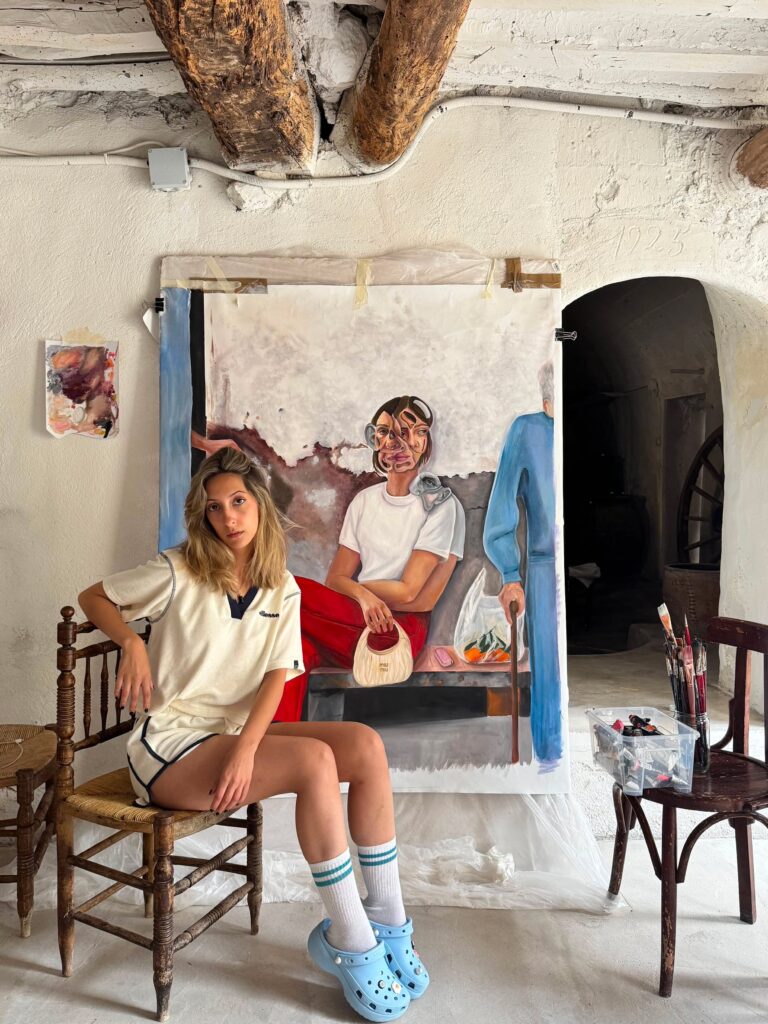
Celia: I think what motivates me most and keeps me moving forward is knowing that this is my life. There really isn’t anything else for me outside of painting. I don’t have another way of expressing myself, and I honestly don’t know another way of living. That’s what gets me out of bed every morning. It feels as natural and necessary to me as everything else I do: if I eat, I paint. If I breathe, I paint. It’s simply part of being alive for me.
How would you describe a perfect day?
Celia: A perfect day for me would start with not waking up early. I absolutely love sleeping. It’s genuinely one of my favourite things in the world — possibly my favourite thing of all. It would be a day when I could go to the studio without rushing and spend as many or as few hours painting as I felt like. I’d spend time with my partner and my dog, read together, go for walks, and hopefully enjoy beautiful weather in Madrid — just not quite as hot as it is right now!
I’d love to watch a really good film or visit a great exhibition, but with this feeling of complete calm. And ideally, I wouldn’t look at my phone at all. I’m actually trying to create more distance from it, which is a little contradictory because social media is also part of my work. But being able to take a day away from all of that and dedicate it to a more contemplative kind of life would be perfect for me. Just painting, being with the people I love, observing, and breathing.
Alright Celia, I always ask these two questions at the end of an interview. The first is. What’s your favorite movie(s) and why?
Celia: My favorite film is, without a doubt, Mother! by Darren Aronofsky. And I genuinely can’t explain what it’s about, because I think that would completely ruin the experience for anyone who hasn’t seen it. You really shouldn’t know what it’s about before watching it.
What I love about it is that you spend so much of the film not really understanding what is happening, and then something happens and suddenly everything clicks into place. It’s one of those moments where your mind just explodes and you think, “Oh my God — this is what I’ve been watching!“
It’s incredibly rich in symbolism, which obviously fascinates me, and at times it feels extremely claustrophobic and overwhelming. I think it’s usually classified as horror, although I personally don’t find it frightening at all. It’s more unsettling and suffocating than scary. I just love the fact that it keeps you in this state of uncertainty and confusion until you reach that particular moment when everything suddenly makes sense. It’s incredible.
The second is. What song(s) are you currently listening to the most right now?
Celia: What I’ve been listening to the most lately is Radiohead. I’d actually never really listened to them before because I was always much more of a Muse person — even though, historically, Radiohead came first and then Muse!
But recently I discovered OK Computer, and honestly, it completely blew my mind. And out of all their songs, the one I’ve been listening to the most is probably one of their most famous ones, but it is what it is: Karma Police.
There’s something about the piano in that song that I absolutely love. I’m a pianist myself, so whenever I listen to it, I immediately imagine myself sitting there, playing the piano and singing it. So right now, definitely: Radiohead, OK Computer, and especially Karma Police.