Share this
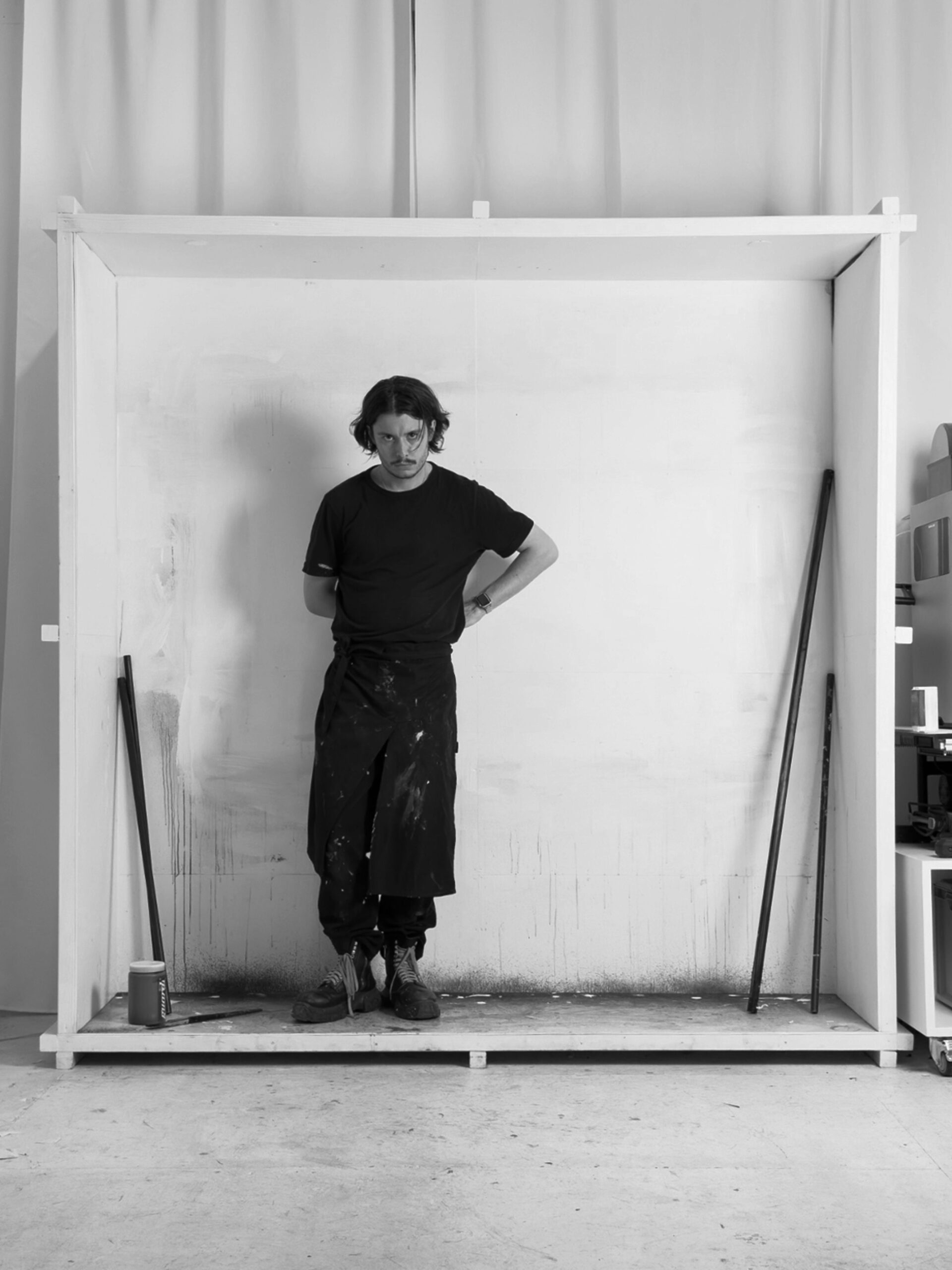
Anatoly Shabalin K. was born in 1995 in Izhevsk, Russia. Studied at Fine Art school in his hometown. School had a focus on applied arts with strong Soviet era influence. It involved producing tapestries, batik, ceramic and academic drawings. Later moved to London, UK and studied illustration at Central Saint Martins. Currently resides in Berlin, Germany.
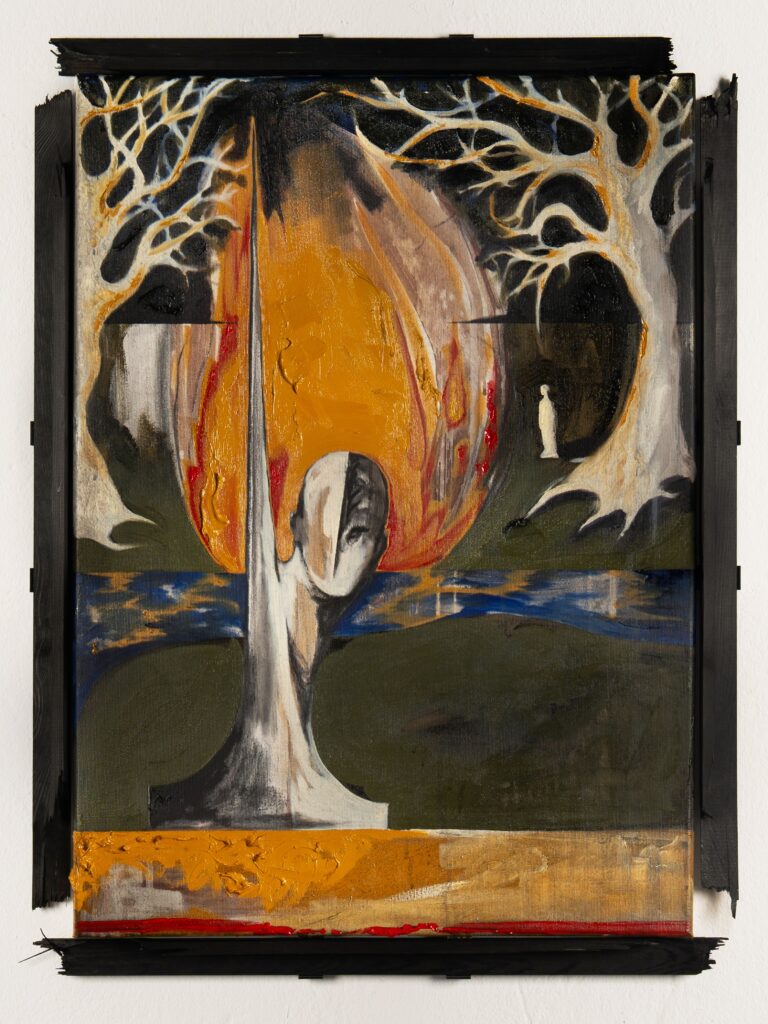
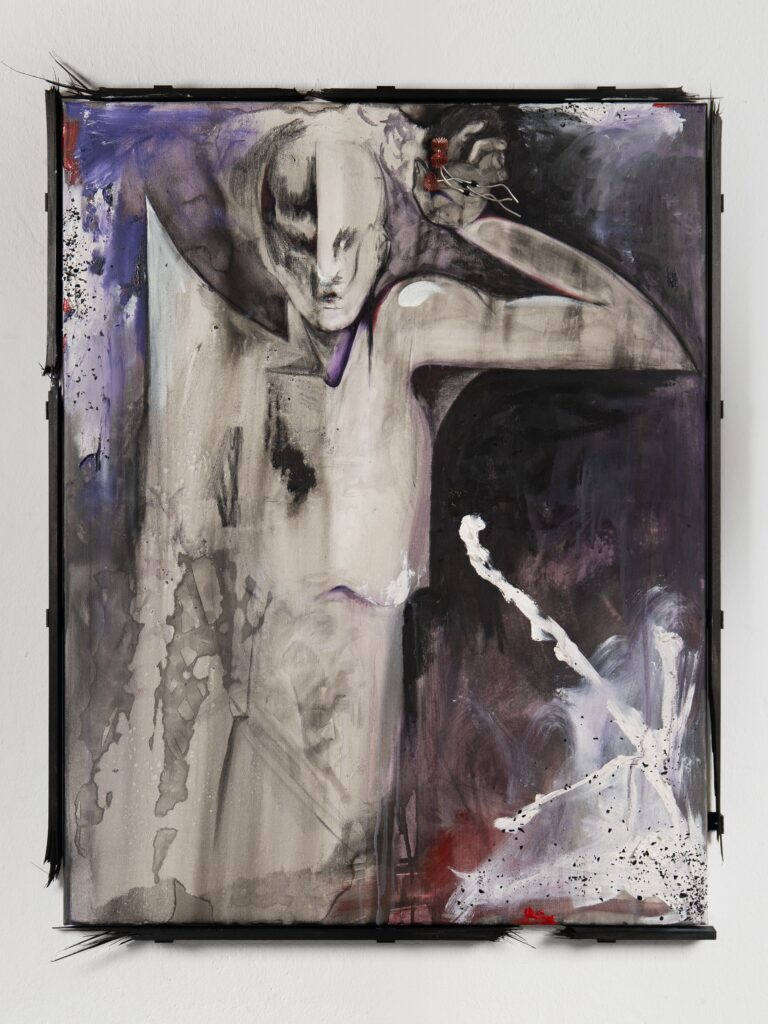
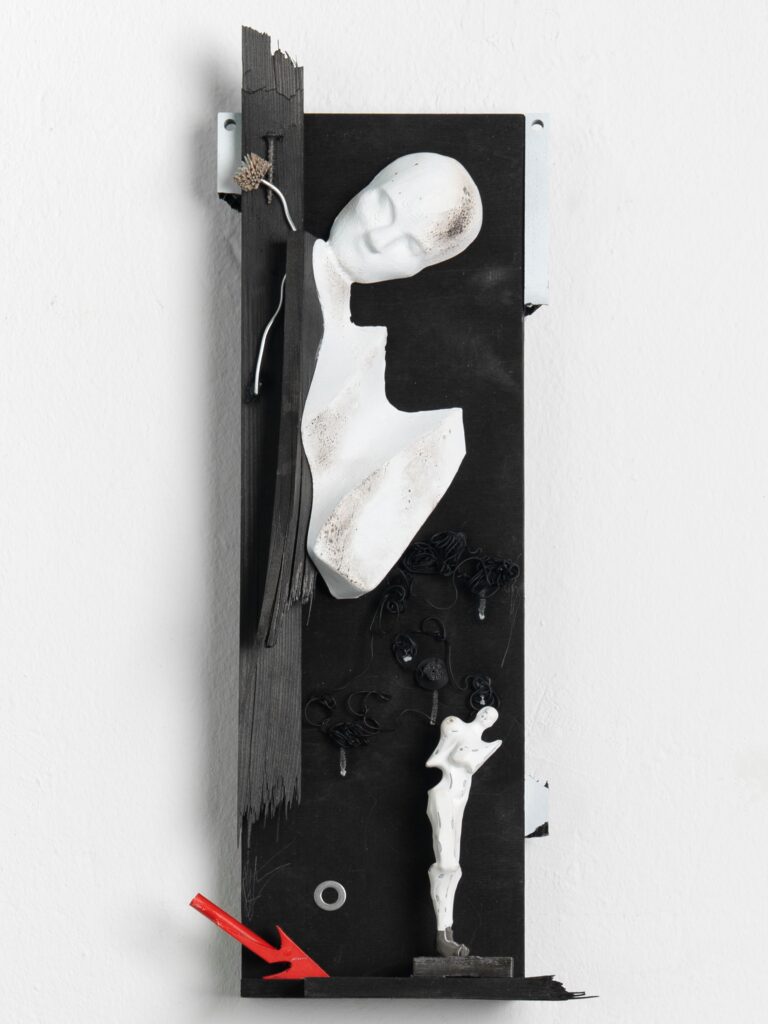
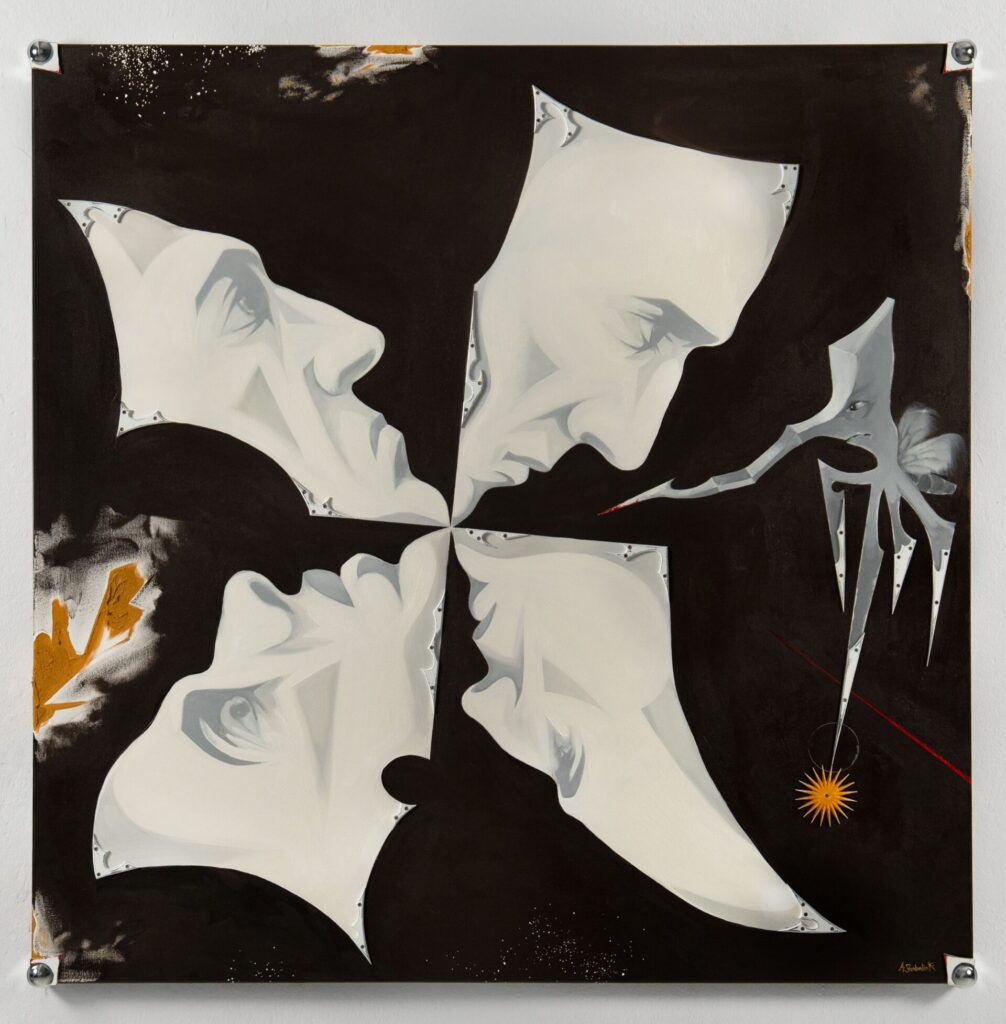
Departure from his own country and frequent relocation sparked reflection on the concepts of self-identity and the significance of home. Lost connection with native culture, fear of new space reflects in the artworks. Often portrays lonely characters trapped in empty rooms. They were born in a hostile world and learnt how to grow spikes as a means of self-defence. Structures of the pieces are also playing significant role in a storytelling. They either engineered in such a way that is easy to disassemble in order to easily continue the journey, or they have protective corners as a protection for further transportation.
Hi Anatoly! It’s a pleasure to sit down with you! First question that I always ask. How does a regular day look like for you in Berlin?
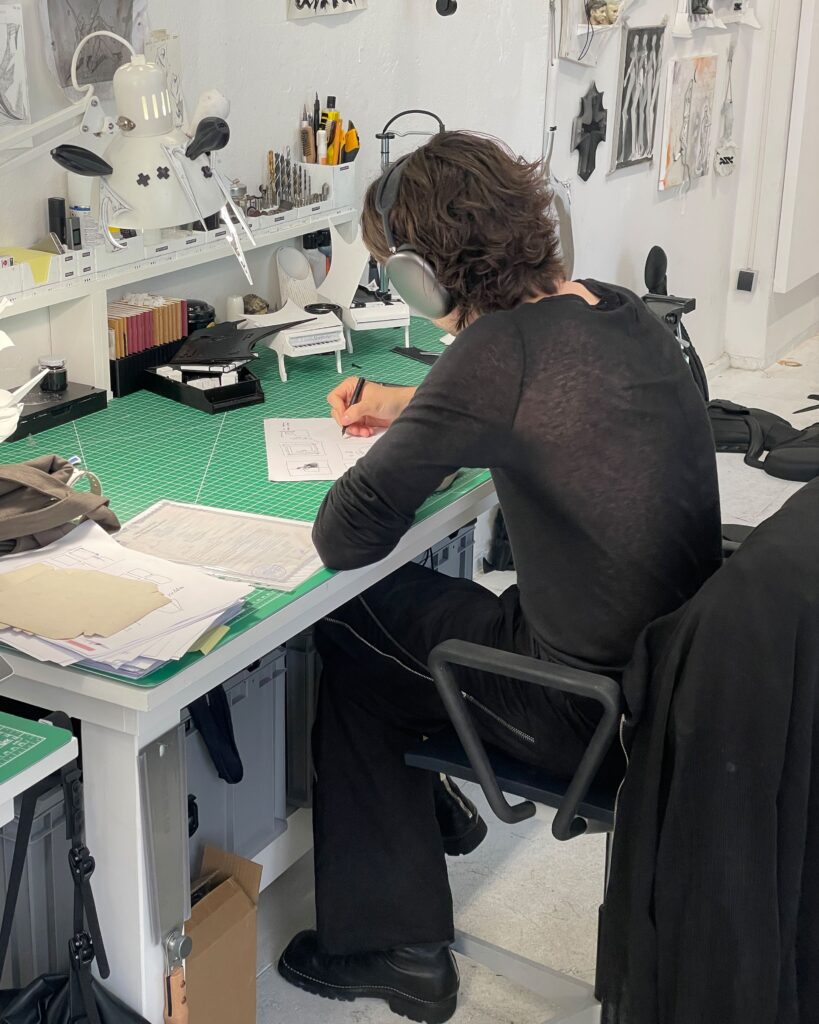
ASK: Every morning I go for a chill 6k run through Tiergarten. On my way to work I usually grab a flat white with an apricot croissant. I spend the first half of the day replying to emails and DMs, and the second half working on my own projects — it’s a constant tug-of-war between commercial work and my paintings. In the evenings I always try to do something fun: Mondays I play pool, Tuesdays I do life drawing, and other days it’s usually a bar or the cinema.
I’m curious, growing up, what was life like there? And what kind of kid were you? What did you enjoy doing?
ASK: I definitely had a happy childhood. Life was so offline back then — if you were bored, you just went outside, found a stick, and made new friends. I was a bad student, and I was pretty much kicked out of my first school. I was short, weak, and introverted, and I felt like a loser until I found my passion for graphic design. I listened to Gorillaz and Daft Punk, tried to learn tectonic dance and parkour, and always carried my PSP and iPod nano with me.
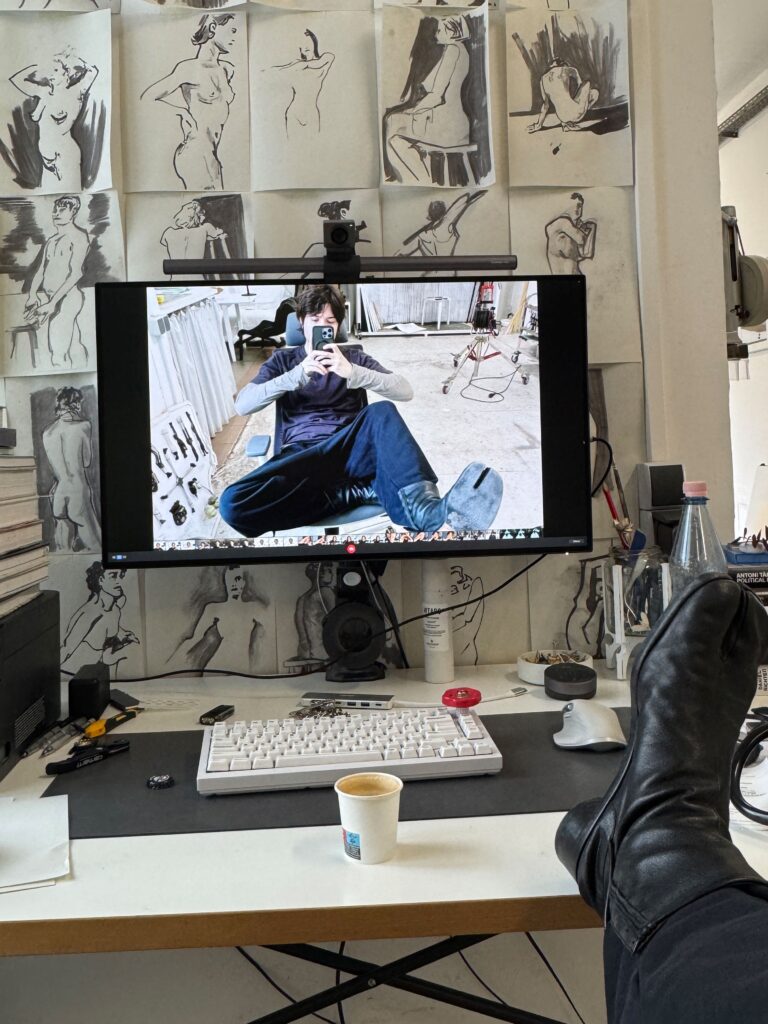
With that in mind. You’ve said that leaving your country and relocating often pushed you to think about self-identity and what “home” even means. What counts as home for you now: a place, a language, a routine, a person, a smell?
ASK: It’s something I keep trying to figure out through my work. Right now, home is a place where I don’t need to explain myself. Obviously that’s a utopia. You always have to explain why you’re here, fill out the paperwork that gives you the right to be here. But what’s clear to me is that home isn’t geography, it’s a feeling of freedom. Of course, it still takes time to get familiar with a place, to find your friends and your routines.
So why did you decide to leave Russia, and how did you end up in Berlin?
ASK: Life is a funny thing. Whenever you think you know something, the universe shows you otherwise. The first time I came to Berlin, in 2018, I hated it so much I said I’d never come back. In 2022, when Russia started the war against Ukraine, I left right away. I felt that my government does not represent my values and I didn’t want to participate in any way. At the time, Germany was pretty much the only country where I could enter on my tourist visa and change my status later. Four years on, I’m learning German, studying the history, and exploring the country. I fell in love with Berlin, and I think in return that love gave me the most wonderful people around me.
When you talk about “losing connection” to native culture, do you feel that loss as grief, freedom, or something more contradictory?
ASK: Native culture is the foundation of how you understand the world. That said, on one hand it’s painful to be outside a familiar context. On the other, it makes you stronger. You learn new cultures, you become more flexible and open, more aware. It’s also a kind of superpower to be in one place while holding a different perspective, because you notice things locals stopped seeing years ago.
Do you remember approximately at what age your creative side started to show? And when did you start taking being an artist seriously?
ASK: I’d been drawing a lot since early childhood, and I loved building Lego without instructions. When I was eight or nine, my parents sent me to my first fine art school and to origami classes — I hated both. A few years later I watched The Matrix for the first time, and it changed me. I really wanted to put my face over Neo’s. That’s how I started learning Photoshop, and I’ve been obsessed with making images ever since. After finishing Central Saint Martins I realised I will be an artist.
Ok Anatoly, with these next series of questions, I will try to delve into your work as best as possible. So…. Your rooms often feel like psychological containers, not just spaces, but states. What’s the first thing you decide: the room or the character inside it?
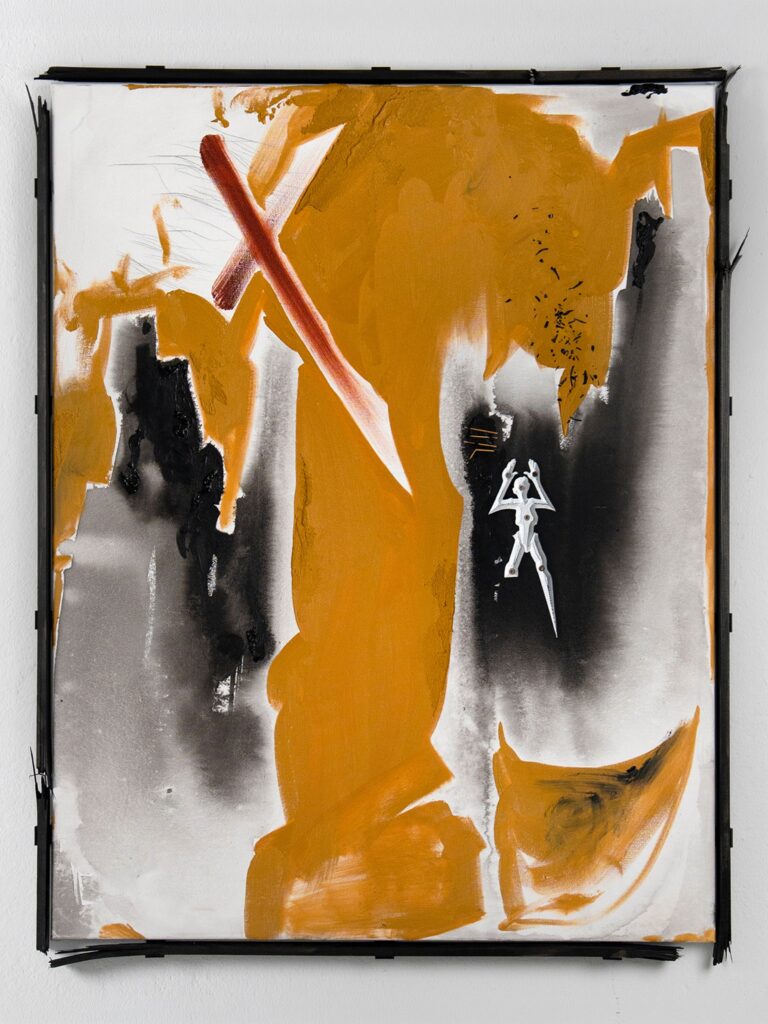
ASK: I always start with the character. In my sketchbooks I pretty much only sketch characters. In my universe, these people are all trapped inside boxes — which is simultaneously the world we live in, dark and lonely, and the inner state of mind, the limitations we place on ourselves.
Do you think the fear of a “new space” is mostly about geography — or about the way a new place forces you to perform a version of yourself?
ASK: It’s in our nature to be afraid of unfamiliar things — you need to learn them, and they might be dangerous. But being familiar with a place doesn’t require being physically there. Growing up on American pop culture, playing GTA, made me feel like I was coming to a place I’ve visited so many times, when it was the first time I actually arrived in New York. But you’re right that arriving somewhere new also puts pressure on you to choose which version of yourself you’re going to be there..
In your work, loneliness doesn’t read as quiet, it reads as pressurized. What’s the difference, for you, between solitude and loneliness?
ASK: Solitude describes an outer state, you’re alone, but you feel comfortable. Loneliness is an inner state, you’re also alone, but it hurts. For the longest time, I felt lonely even on my own. I need people in the studio making noise. I don’t want to stay home. I always need to go out somewhere with friends. It’s definitely something I should be working on in therapy.
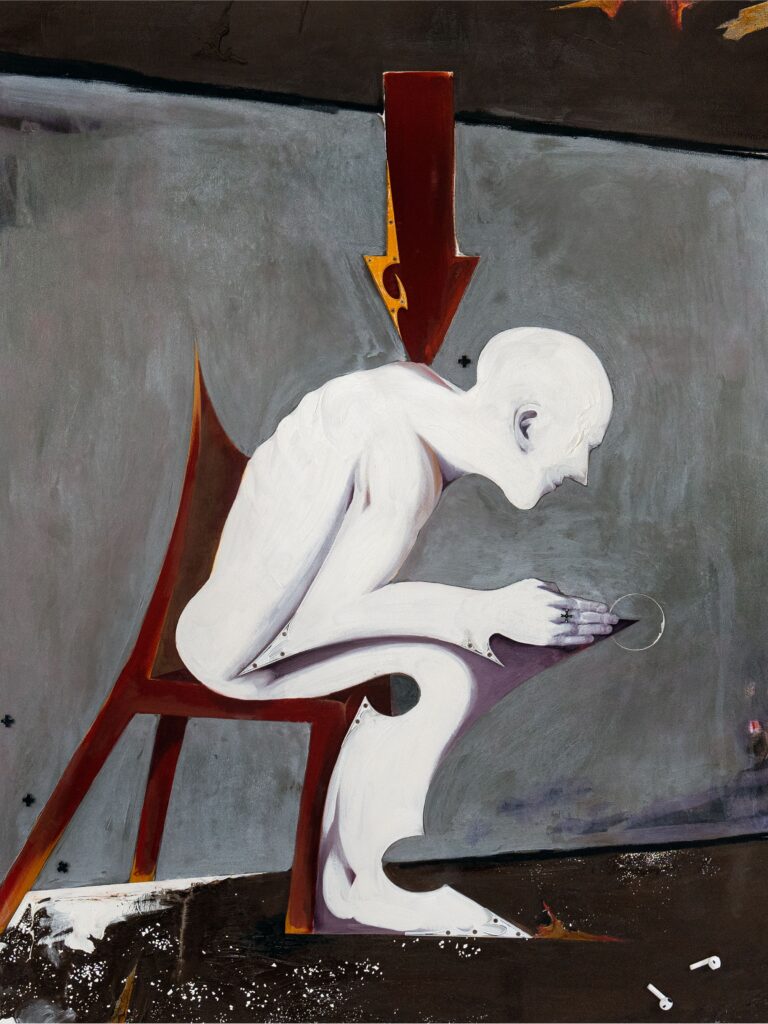
When did loneliness become a subject you recognised, was it tied to leaving home, or was it there earlier?
ASK: I don’t think loneliness began when I left home — moving to another country just made it impossible to ignore. It stripped away all the familiar structures: language, routines, people and suddenly loneliness had nowhere left to hide. Looking back, I think it had always been there, in quieter forms. I’ve always been someone who observes more than participates, and that creates a certain distance from the world. I feel like my inner world exists in a language, or a place, that nobody else can fully access.
Your figures “learn how to grow spikes” as self-defence. What are the spikes defending against: intimacy, humiliation, unpredictability, authority, history?
ASK: I don’t think the spikes are defending against one specific thing — they’re a response to vulnerability itself. We usually imagine protection as something solid, like a wall or armor, but spikes are different, they don’t hide you, they simply make it harder to approach you. For me, they represent the moment fear starts shaping your choices. They grow after repeated disappointment, displacement, rejection, or loss.
Are the spikes something you see as protective, tragic, or evolutionary?
ASK: Interesting question — I think it can be all three. They’re not symbols of aggression but of adaptation. My characters don’t want to hurt anyone; they just don’t know how to stay soft without being damaged again.
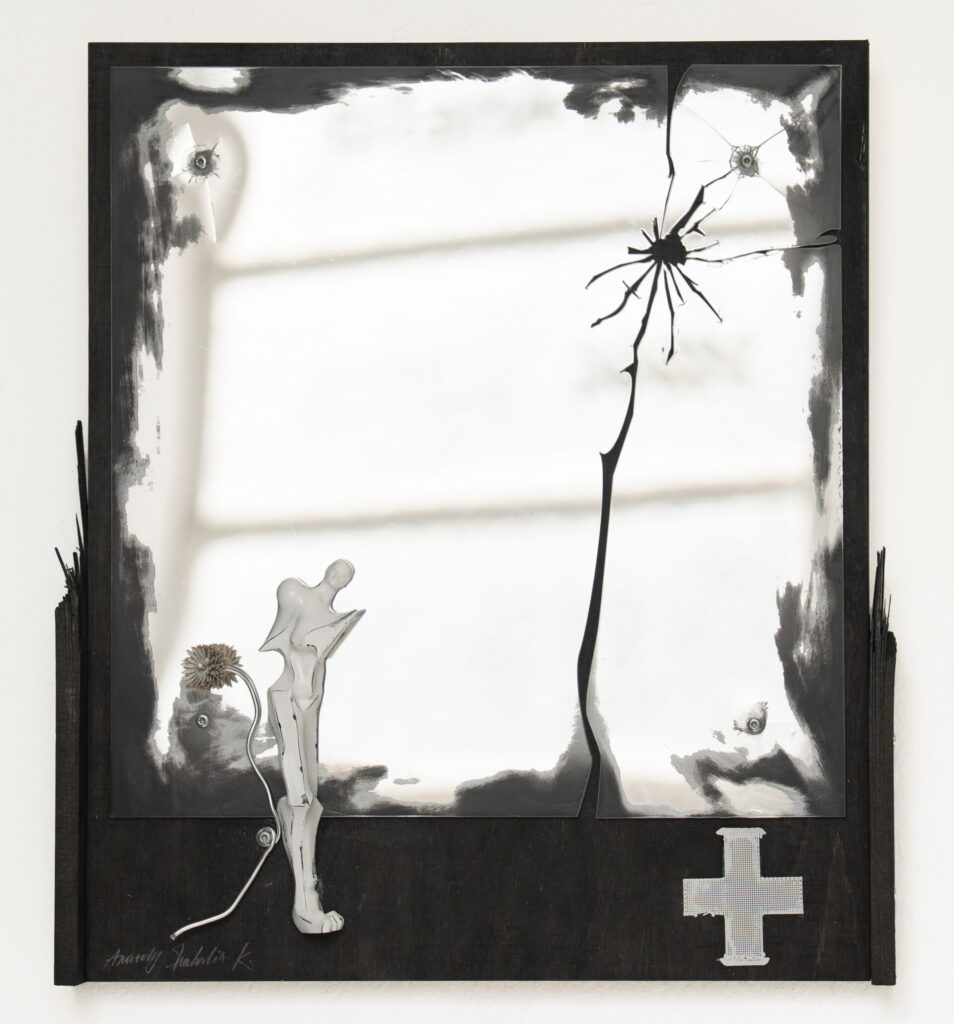
Have your own “defence mechanisms” changed since moving from Izhevsk to London to Berlin — and do you notice that shift showing up formally (composition, scale, materials)?
ASK: Each city changed me in its own way. I came from a place where I was verbally and physically attacked for how I looked, so in Izhevsk I triedto make myself smaller, invisible. Later I moved to Bristol — that city inspired me enormously, but I was so lonely there that I was forced to become more extroverted. I started approaching people in the street and in bars. London gave me so many people from such different backgrounds, and so many new experiences, that I learned to try new things. Currently I am staying in Berlin and it’s hard to say how it changed me until I leave the place.
When does protection become a prison in your visual world, and how do you show that line without spelling it out?
ASK: Every painting usually has only one figure, or sometimes two, kept at a distance. Spikes don’t let anyone come closer, they can’t have a dialogue.
You mention that the structure of a piece is part of the story, sometimes engineered to disassemble easily, sometimes built with protective corners for transportation. Is the artwork, for you, a kind of luggage?
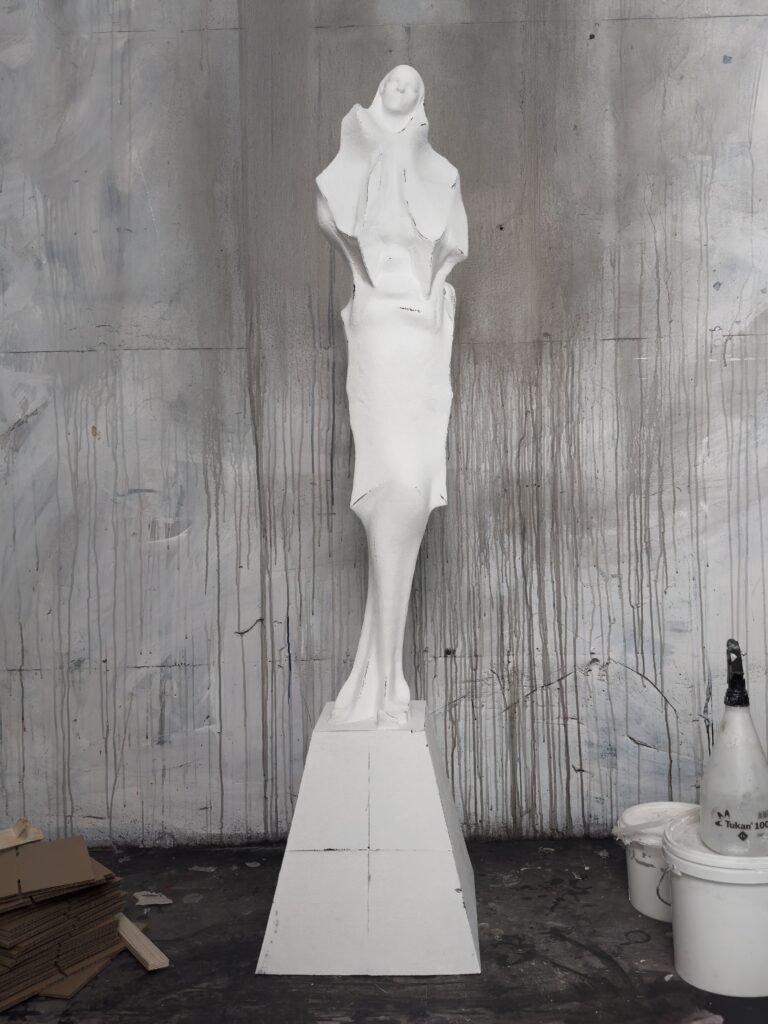
ASK: At one point I made a set of five suitcases. When you open one, you see a sculptural composition, like a comic strip. You open all five, and see the whole arc of a couple’s love story. But overall I don’t think of my artworks as luggage. Before painting, I was focused on sculpture and objects, and that just naturally led into integrating 3d elements and interactive bits into paintings. There’s something poetic in the fact that my works don’t quite know if they’re paintings or sculptures, a bit like our generation, lost in its own labeling.
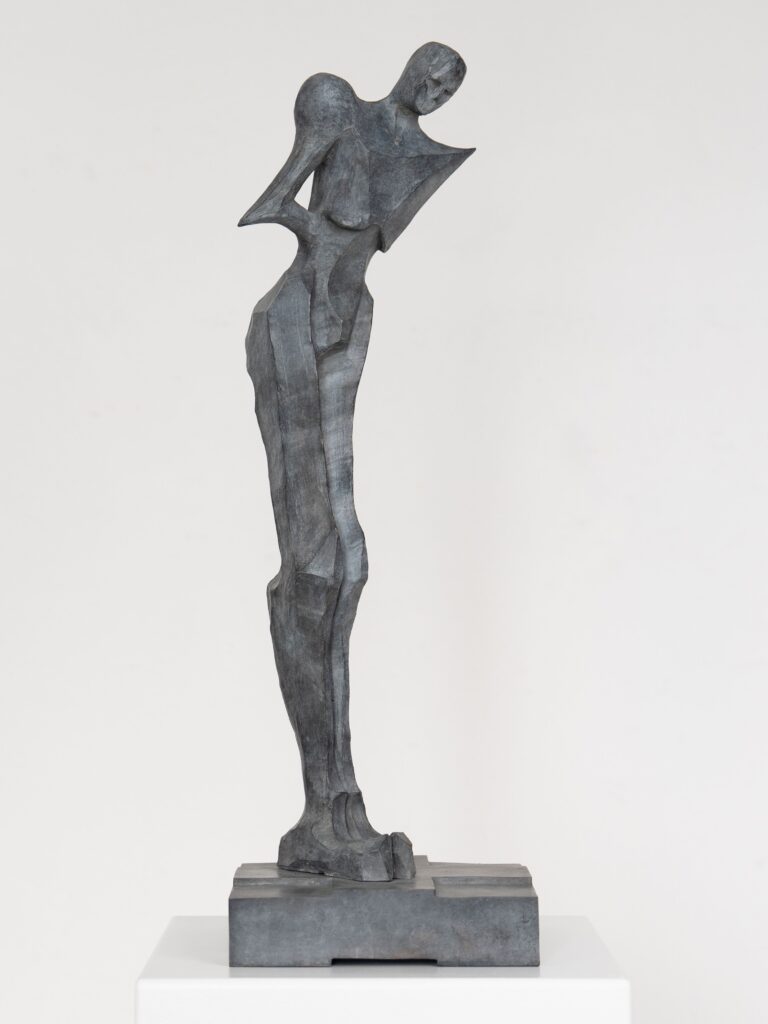
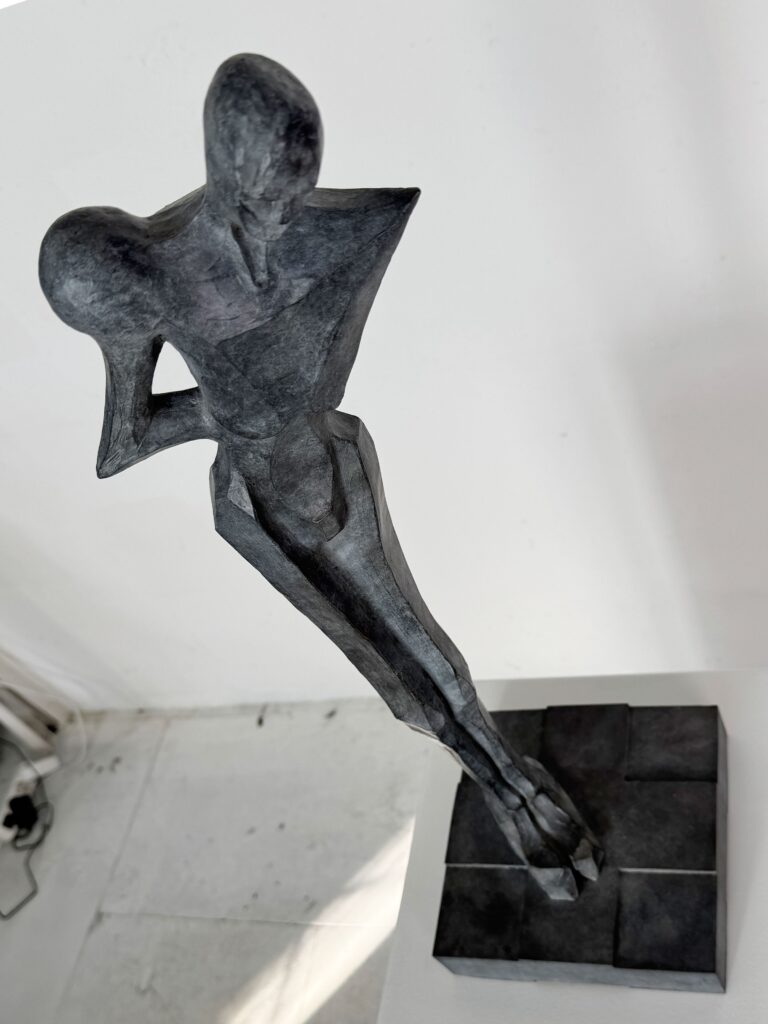
What does it mean to create objects that anticipate movement, is that a practical habit, or a worldview?
ASK: It’s part of my storytelling, another way of talking about migration. But it’s also an influence from my graphic design years: ideas of functional design carry over into the structural frames of my paintings.
Do you ever deliberately leave traces of engineering, joints, seams, edges, as a way of saying: this work has a history of being moved?
ASK: At some point I read an Adolf Loos manifesto in which he talks about Bavarian houses being honest because their structure is exposed. That inspired me to never hide screws or glue traces. I want the structure to stay visible, not to pretend to be something it isn’t.
Your early training had a strong applied-arts focus (tapestry, batik, ceramic, academic drawing). What did that education teach you about discipline, and what did you have to unlearn?
ASK: It taught me that finishing a piece means working on it bit by bit, without waiting around for inspiration. It taught me to appreciate craftsmanship. But artistically, it put me in a cage. Years later, I’m still trying to break some of what I was taught. My school focused on system rather than expression, which is why I now lean toward asymmetrical shapes and broken frames. Recently I picked ceramics back up. It was the only part of my fine art education I truly loved. I love the tactility of the material.
Do you feel the “Soviet-era influence” as an aesthetic imprint, a psychological imprint, or both?
ASK: Aesthetically, I try to avoid that influence, and when I see a Russian designer or artist exploiting it visually, it triggers me — I feel like they’re serving it up for a Western audience, which strikes me as a rather sad idea, probably rooted in trauma and propaganda. That said, other people might still see this influence in my work. As a psychological imprint, it’s impossible to avoid: growing up in Izhevsk, a city shaped by Soviet industrial history, you absorb certain ideas about space, function, and individuality. I think that’s actually where a lot of my formal decisions come from. Boxes, limited palette, the instinct to leave the construction honest instead of decorating it. I don’t reach for the aesthetic on purpose, but the psychology behind it is built into how I make things.
What does “craftsmanship” mean to you now, after CSM and after living in Berlin?
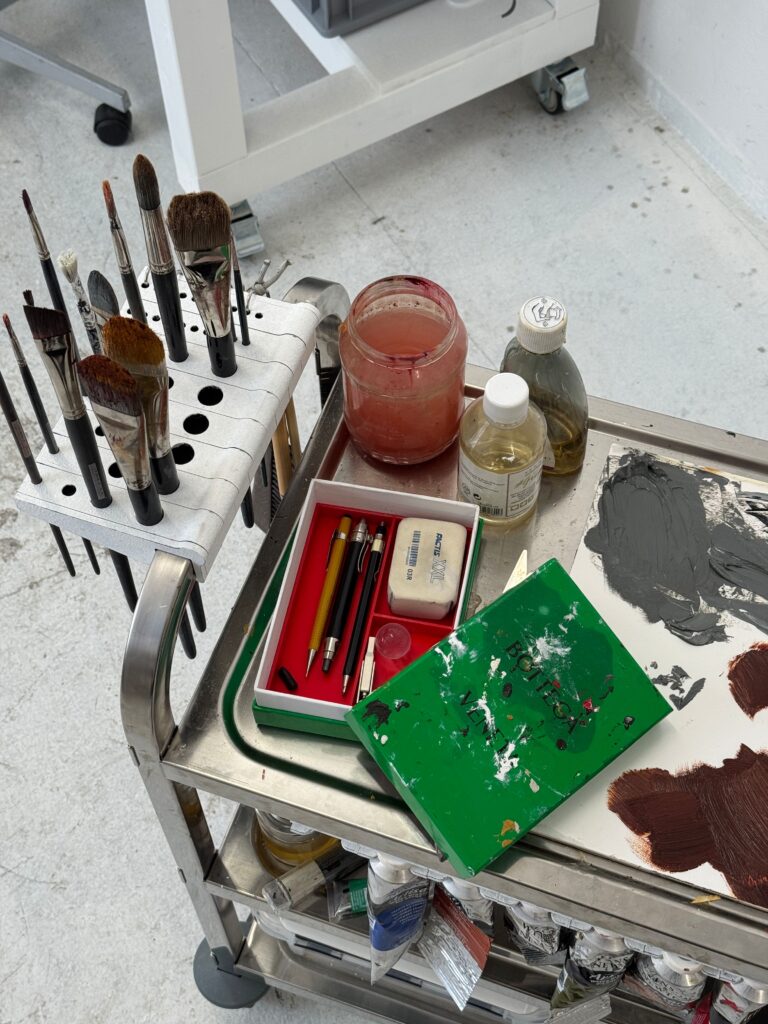
ASK: I was completely obsessed with 3D printing, CNC, and laser cutting, quick and cheap, perfect for a fast-paced life. Berlin somehow slowed me down, and I realized I’d rather make everything by hand, so it carries human traces and imperfections. It’s important to me to make everything myself, including the frames. Craftsmanship is a cure for world full of boring, flat things.
Your spaces can feel tight and airless. Do you want the viewer to feel like a witness, a rescuer, or an intruder?
ASK: The role is in the name. Viewer should observe, and ideally enter an inner dialogue, learn something new, and look at themselves from a new perspective.
When you’re making a piece, what’s the most important “signal” you’re trying to embed?
ASK: I’m not trying to embed a single message, or explain something to the viewer. I’m more interested in creating an emotional state, or tension, that the viewer can step into.
How has Berlin changed your relationship to your own “Russian-ness” , does it become sharper, blurrier, or more fragmented?
ASK: It’s an interesting place to reflect on my “Russian-ness. ” To me, our generation coming to Berlin closes a loop for Germany after WWII. Once the biggest enemy of our nation becomes something of a refuge. I don’t know how my great granddad would feel about that, if he were alive. This legacy, layered with the GDR era, creates a very specific context. It’s part of why there’s such a large Russian-speaking population here, alongside all the old Soviet “panelka” housing blocks. Being in Berlin, a city shaped by migration and layered histories, has made me more aware that identity isn’t a fixed category, it’s something constantly negotiated.
Do you think your work is ultimately about survival, or about learning how to feel safe enough to stop surviving?
ASK: Good question. I think right now it’s probably only about survival. But given that this whole perspective of fear lives in the heads of my characters, and in mine, I hope that at some point I’ll start finding ways to feel safer.
I’ve seen your name associated with type/design work as well, does typography/letterform thinking affect how you build a picture or a sculptural object?
ASK: Yes, that comes from my graphic design background. I always think in grids, and I’m always trying to balance out my compositions.
If you could collaborate with someone outside visual art (a novelist, choreographer, game designer), what part of your world would you want them to “activate”?
ASK: I recently became friends with Diego, a Tai Chi master, and watching him move made me think differently about movement in my paintings. I’d love to see a dancer bring my characters into our reality. But now that you mention a game designer — that gets me excited too. That would be wild.
What’s a question you wish interviewers would ask you, but they rarely do?
ASK: I like fantasy questions that make me visualize something I haven’t thought of before. Like what work I’d make with unlimited resources, or the question you asked about who I’d be in a parallel universe. They’re fairly obvious questions, but they pull you out of boring reality and remind you that you’re allowed to dream.
What would it mean for one of your characters to remove their spikes, and what would they need, emotionally, for that to be possible?
ASK: I don’t have a full answer for that yet, because right now the spikes are the basis of my characters’ identity. Protection is the purpose of their life. Removing the spikes might kill them. They’d need to open up emotionally, and learn to see the bright side.
Can you walk me through your creative process from beginning to end result?
ASK: I’m constantly observing life, watching films, scrolling through social media — all that endless information somehow recycles itself into visual concepts. Every day, on my way to the studio, I sketch and write down poetry and thoughts. I usually pick the best idea and turn it into a detailed final sketch, then redo that over and over on the canvas. For me, the process matters more than the result. It brings me more joy than seeing a piece finished, because it never ends exactly the way I wanted it to.
Can you also tell me about your use of symbolism?
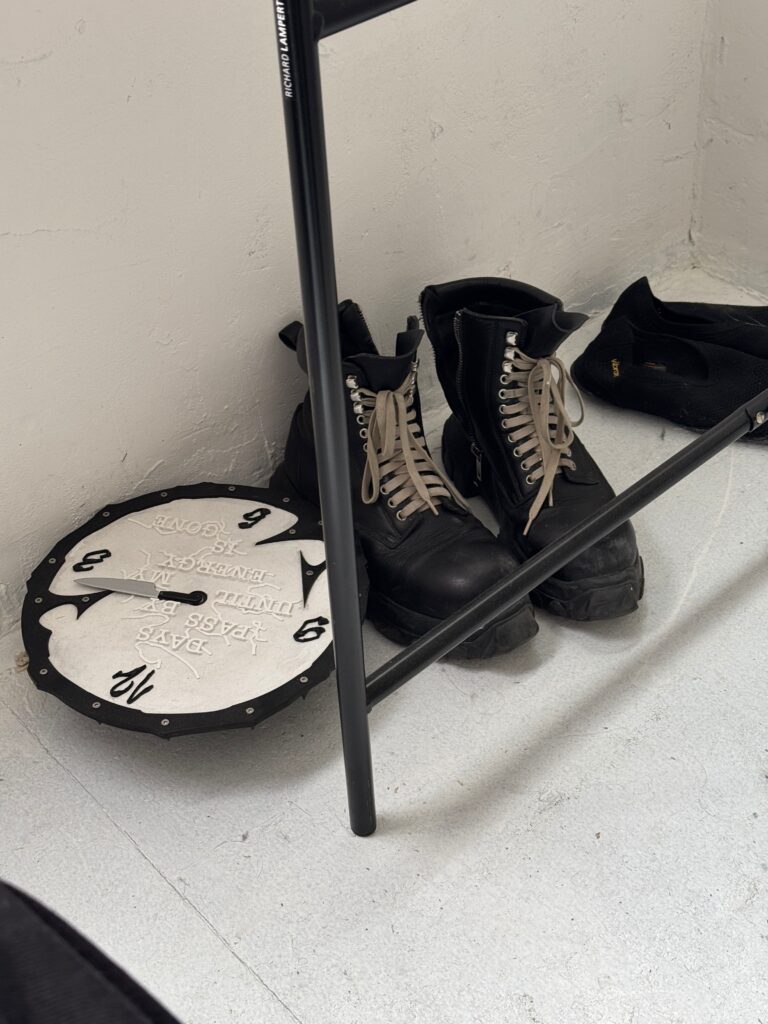
ASK: Symbolism matters a great deal to me. I don’t study it formally, but I try to invent my own kind of “alphabet” to help me say what I mean. The broken frames I use symbolize destruction and pain, but at the same time, I see my paintings as trying to break free of that frame-as-jail. I also produce an imitation eggshell texture in white and black, to me, that’s fragments of memory. Another element that I create is a tiny flower, for me it is a symbol of hope.
How do you approach color?
ASK: I’m honestly afraid of color. It puts a lot of pressure on me, which is probably why my palette is so limited. I feel like mastering color is far harder than mastering composition. Because of that, I sometimes feel like a bad artist, but then I remind myself that someone like Robert Motherwell made a minimal palette work beautifully.
So with what we just talked about, what are you hoping to convey?
ASK: I hope to create a moment of recognition. I’m not trying to hand the viewer a specific answer, or explain a particular experience. I want the work to open a space where people can encounter their own emotions and memories. A lot of my work comes from watching how people protect themselves, how we build identities, walls, and strategies to survive. But underneath all of that, there’s always a desire for connection, and a need to be understood. Through my characters, symbols, and materials, I’m trying to show that contradiction: that the things we build to protect ourselves can also cut us off from the world. For me, the most interesting place is somewhere between strength and fragility, between wanting to hide and wanting to be seen.
With that in mind, do you think the viewer becomes implicated, projecting their own adolescence onto your objects?
ASK: I think that’s one of the most important parts of the work. I don’t want the characters to exist only as representations of my own experience. Once they leave the studio, they open up to other people’s memories and interpretations. Adolescence is an important reference point because it’s a time when we’re constantly negotiating who we are. Vulnerable, trying to protect ourselves, building a version of ourselves that can survive in the world. In many ways, the spikes are a physical manifestation of that process. I hope viewers can recognize something personal in these figures — maybe not the exact same experience, but a similar feeling: the moment you first realized you needed some kind of protection, and the question of whether that protection still serves you now.
Ok Anatoly, now to something totally different. In a parallel universe who would you be? and what would you be doing?
ASK: I think it would be fun to be born in ’90s LA and work as a waiter in a typical diner while trying to become an actor. In that life, I wouldn’t have asthma, and I’d smoke a lot of cigarettes.
Outside of art, what’s something you’re obsessed with right now—maybe a hobby, a show, or even a food—that keeps you grounded or inspired?
ASK: My biggest obsession is my breakfast: half a paprika, half an avocado, two soft-boiled eggs, cherry tomatoes, Andechser stracciatella yogurt, and black tea. I’ve been eating this for a year now, and I look forward to the next day just because of it.
Can you tell me a story about a time when a connection with someone had a big impact on you?
ASK: I met the two most important people in my life when I was fifteen. The first is my ex-wife, Sofia. She taught me most of what I know and gave me all the space and support I needed to make my art. The other is my best friend Pasha. He taught me how to build a community, how to be the one who drives the atmosphere in a room. Luckily, after all these years, they’re both still in my life. It’s a different capacity now, but it still matters to me.
What qualities do you find most important in the people you choose to spend time with?
ASK: Honesty, freedom of thought, a willingness to have hard conversations, humor, and a readiness to share your worst moments with you.
What motivates you?
ASK: The things I don’t know, or haven’t tried yet. The unknown is truly my biggest driver. I always want to try new materials, techniques, colors — I have a thousand ways in my head to do the same thing differently, and I can’t help but try them all.
How would you describe a perfect day?
ASK: Wake up at 6am, do some sport, meet friends for a morning coffee, get work done, go to the cinema, and be asleep by 11pm. This happens three or four times a year.
Alright Anatoly, I always ask these two questions at the end of an interview. The first is. What’s your favorite movie(s) and why?
ASK: I really love movies, and it’s hard to pick just one, but right now my favorite is Perfect Days. It taught me how to be in the moment and appreciate what I already have.
The second is. What song(s) are you currently listening to the most right now?
ASK: Right now I’m listening to Evinha’s album EVA — beautiful, sunny Brazilian music, filled with love. This album is going to help me get through the next dark Berlin winter.