Share this
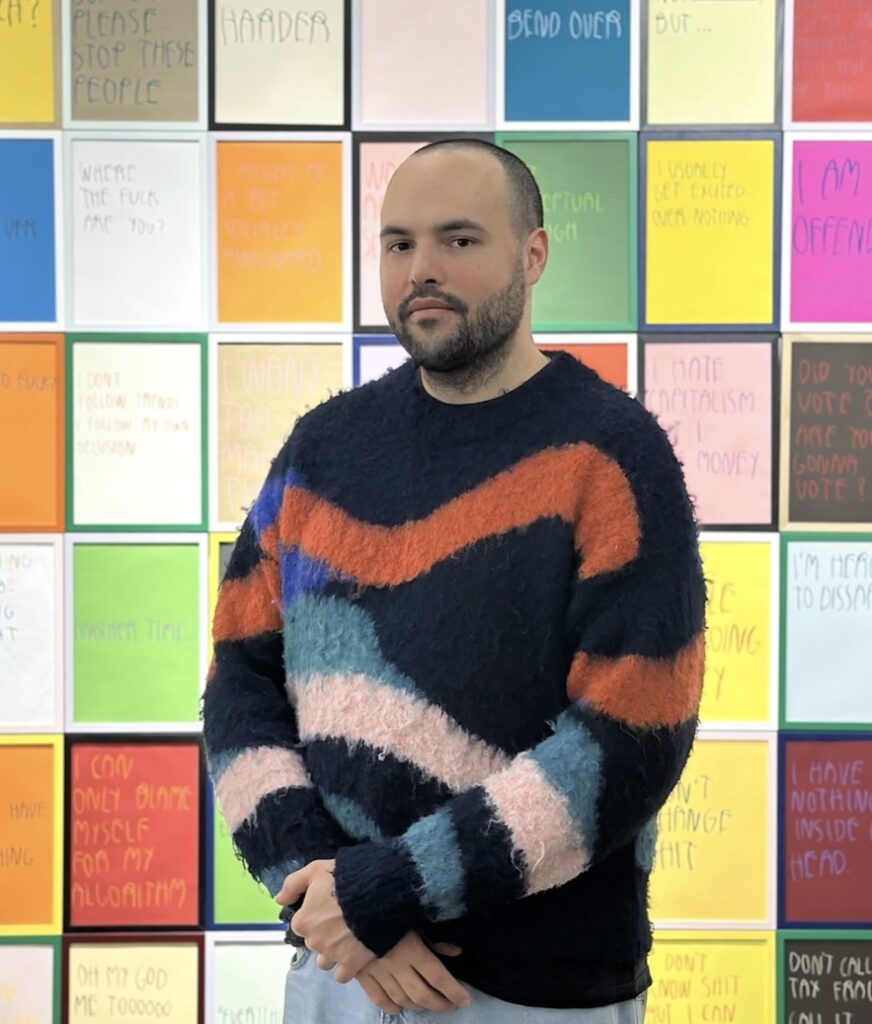
Born in Havana, Cuba, in 1995, contemporary artist CB Hoyo has built an internationally recognized practice around humor, irony, and the contradictions of modern life. Self-taught and dyslexic, Hoyo uses language as his primary artistic medium, challenging conventional ideas of authorship, authenticity, and value while exploring the complexities of human emotion.
Known for his Fakes series, which reinterprets iconic artworks, and Corny Quotes, featuring handwritten reflections on love, identity, and everyday life, his work moves between playful irreverence and genuine vulnerability. Drawing inspiration from internet culture and the ways we communicate, Hoyo transforms seemingly simple statements into thought-provoking observations about contemporary existence.
Having grown up between Cuba and the Dominican Republic before moving to Europe, Hoyo continues to expand his practice beyond painting into installation, sound, performance, and generative systems. In conversation with Dazed, he reflects on his unconventional journey into art, the relationship between humor and sincerity, the contradictions of the contemporary art world, and his evolving creative identity.
Hi CB! It’s a pleasure to sit down with you! First question that I always ask. How does a regular day look like for you in Europe?
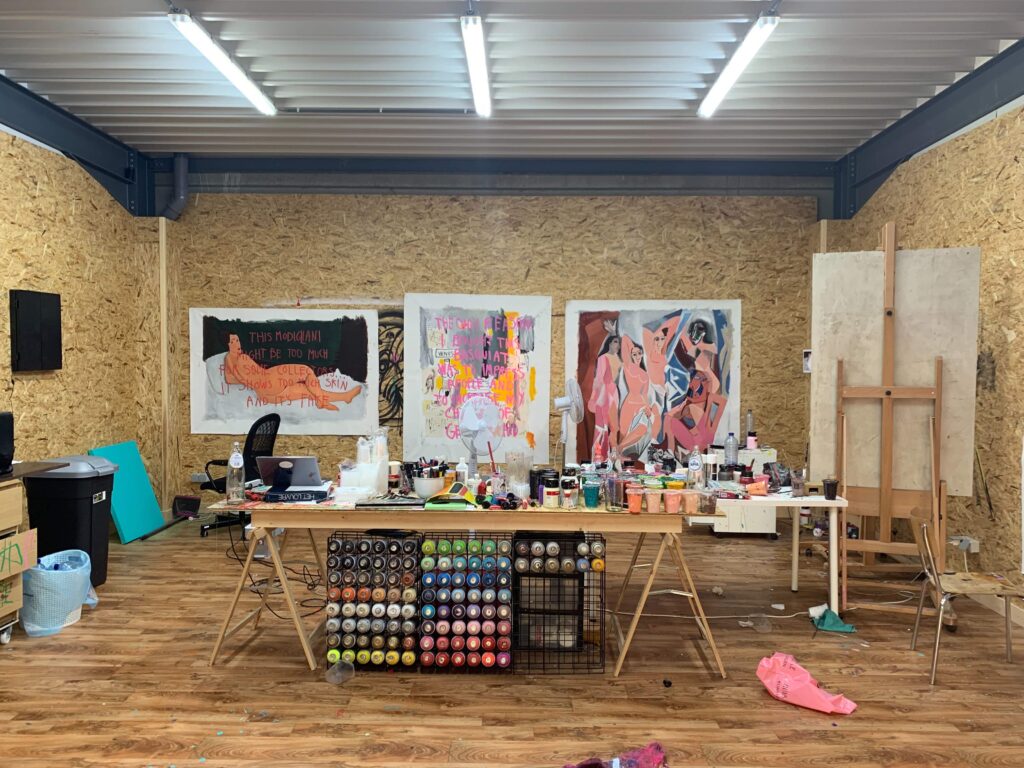
CB Hoyo: I don’t think I’ve had a regular day in years. I travel quite a lot, so my routine is constantly changing. When I’m home, I usually wake up, have coffee, catch up with whatever needs my attention, and eventually make my way to the studio.
I spend a ridiculous amount of time thinking about things that have absolutely nothing to do with what I’m supposed to be doing. Sometimes that’s where the best ideas come from. Other days, I can spend ten hours working on something and realize that I’ve accomplished absolutely nothing. But I think that’s also part of the process. My studio is where most of my life happens. I paint, write, experiment, make mistakes, destroy things, start over. Sometimes I have a very clear idea of what I’m doing, and sometimes I have no fucking clue.
I also love food, good conversations, and spending time with people I care about. I trained as a chef before becoming an artist, so cooking and eating have always been important parts of my life. I don’t really believe in separating work from life. Everything eventually finds its way into the work anyway.
I’m curious, growing up in the Dominican Republic, what was life like there? And what kind of kid were you? What did you enjoy doing?
CB Hoyo: I was born in Havana in 1995, but my mother and I left Cuba when I was very young, so most of my childhood memories are from the Dominican Republic. Growing up there was a very different experience from growing up in Europe. Life happens outside. People are loud, expressive, affectionate, dramatic. Everybody has an opinion about everything, and nobody is particularly interested in keeping it to themselves. I think that environment influenced my personality quite a lot.
My mother was a teacher, and I attended an international school where I was surrounded by people from all over the world. Looking back, I think that exposure to different cultures and ways of thinking at such a young age had a huge influence on how I see the world today. I was a weird kid, always curious, always hustling, always trying to figure out how to make something happen. I’ve never been particularly good at accepting that something has to be done a certain way simply because somebody decided so.
What I remember most about growing up in the Caribbean is the relationship between humor and hardship. People can be going through incredibly difficult circumstances and still find something to laugh about. That contradiction has stayed with me. Sometimes laughter is the only thing you have left.
Before becoming an artist, you spent time working as a chef. Looking back, what first drew you towards art, and was there a particular moment when you realized it was something you wanted to pursue seriously?
CB Hoyo: I didn’t grow up thinking I would become a professional artist. Actually, becoming an artist wasn’t even something I considered possible. But I’ve always made art. Ever since I can remember, I was doing something creative, drawing, experimenting, making things. Art was always there, even when I didn’t think of it as a possible career.
I studied culinary arts and restaurant management and worked in professional kitchens. Cooking made sense to me because it was creative but also practical. You make something, somebody experiences it, and there’s an immediate reaction. I loved that. But the reality of working in professional kitchens was very different. I was miserable. I found myself in an incredibly toxic work environment, working ridiculous hours, spending most of my life trapped inside a kitchen. It was driving me insane.
Kitchens are also incredibly hierarchical environments. There are rules, systems, traditions, and people who believe that because something has been done a certain way for fifty years, it should continue being done that way forever. Eventually, the only thing that was genuinely making me happy was making art. I would spend all those hours working in the kitchen and then use whatever little time and energy I had left to create something. Art became my escape.
In March 2017, I quit. I had no plan, no gallery, no financial security, no idea what was going to happen next. I wasn’t even sure I could make a living as an artist. I just knew that I was unhappy and that I didn’t want to spend the rest of my life feeling that way. I wanted to be happy. It sounds incredibly simple, but sometimes making a decision for your own happiness is the most difficult thing you can do.
It wasn’t some romantic revelation where I suddenly discovered my destiny. It was more like realizing that if I didn’t at least try, I would spend the rest of my life wondering what could have happened. I had very little to lose, apart from the possibility of embarrassing myself. And I’ve never been particularly afraid of that.
You were born in Havana, grew up in the Dominican Republic, and later moved to Europe. How did growing up between different cultures shape your identity, and do you think those experiences still influence the way you see the world and approach your work today?
B Hoyo: I’ve spent most of my life being a foreigner somewhere. I was born in Cuba, grew up in the Dominican Republic, and moved to Belgium when I was seventeen. I have Cuban, Dominican, and French nationality, and I speak several languages. Yet I don’t think I completely belong to any single place. For a long time, I thought that was something I needed to resolve. Now I find it quite liberating.
When you grow up between cultures, you realize very quickly that many things people consider universal are actually completely arbitrary. What’s polite in one country is rude in another. What’s funny somewhere can be offensive somewhere else. Even the way people express love, anger, or sadness changes depending on where you are. That made me question the idea of absolute truths.
I think it also explains why language became so important in my work. Language is supposed to connect people, but it can also separate them. A single sentence can mean completely different things depending on who’s reading it, where they grew up, or what they’re going through. I’m interested in that space between what we say, what we mean, and what somebody else understands.
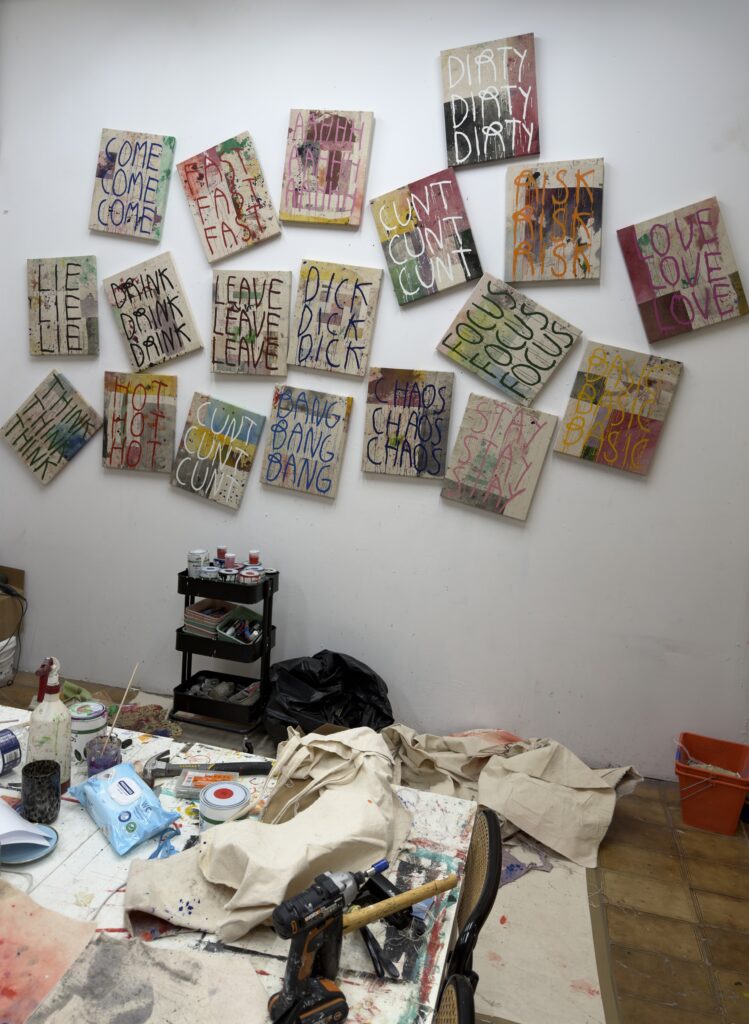
You’re completely self-taught, and entered the contemporary art world without following the traditional academic route. Do you think that gave you a certain freedom to experiment and challenge conventions, or did it also create obstacles along the way?
CB Hoyo: Both, absolutely. Not going to art school meant I didn’t have anyone telling me what art was supposed to look like, what materials I should use, or which artists I was supposed to admire. I approached art with a certain ignorance, and ignorance can be incredibly useful when you’re trying to make something new. You don’t know which rules you’re breaking because nobody explained them to you in the first place.
Of course, there were disadvantages. I didn’t have the institutional connections, the academic vocabulary, or the network that many artists develop through art school. I had to figure out everything myself, usually by making mistakes. But I also think the contemporary art world has a strange obsession with intellectual legitimacy. Sometimes people become so concerned with explaining why something is art that they forget to ask whether it’s actually interesting. I don’t think an artwork becomes more important because its explanation is difficult to understand. Being self-taught forced me to develop my own relationship with art rather than inherit somebody else’s. And I’m still learning. I just don’t think learning necessarily requires somebody giving you permission.
You’ve spoken openly about being dyslexic, which is particularly interesting considering how central language is to your practice. How has dyslexia shaped your relationship with words, and has it influenced the way you think about creativity, expression, and imperfection?
CB Hoyo: There’s something quite ridiculous about being dyslexic and deciding to build an entire artistic practice around words. I’ve always had a complicated relationship with writing. Spelling, grammar, the conventional structures of language. Things that seem completely natural to other people can require a disproportionate amount of effort for me. But I’ve never believed that being able to spell something correctly necessarily means you have something interesting to say.
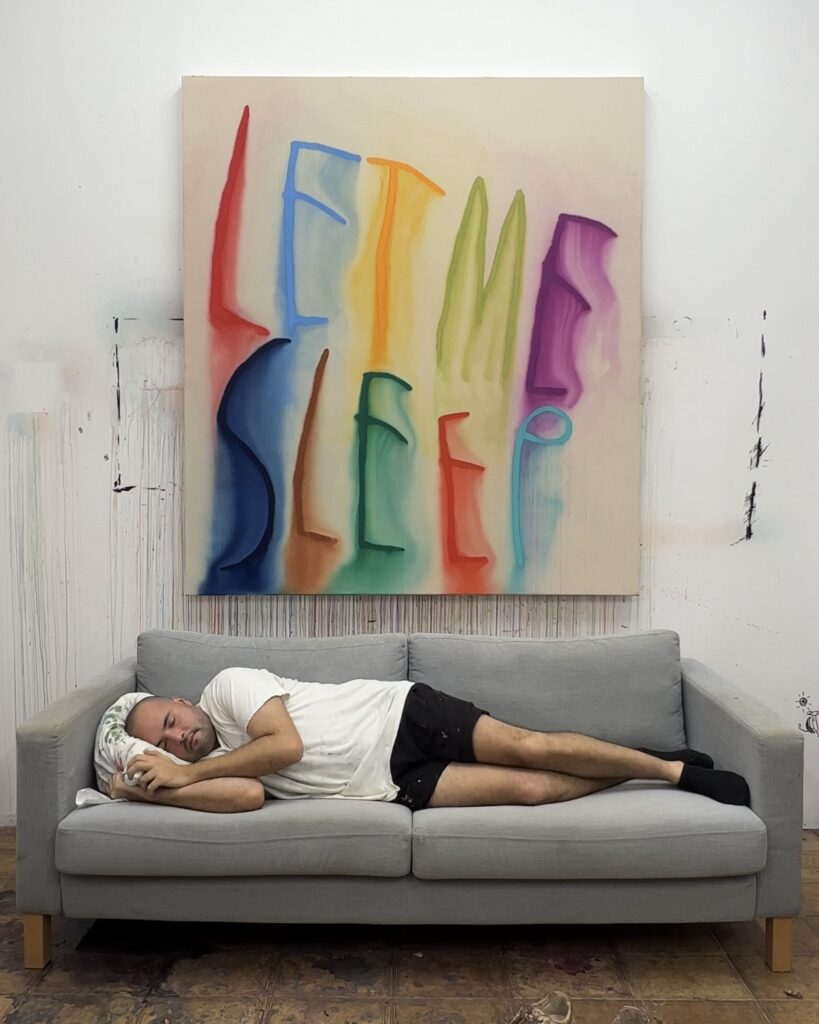
Dyslexia forced me to approach language differently. Sometimes I see words more as shapes than as grammatical structures. I pay attention to how a sentence looks, how it sounds, how it occupies space, and how it makes somebody feel. I think that relationship has made me more comfortable with imperfection.
There’s something very human about a mistake. Especially today, when everything is being corrected, optimized, filtered, and increasingly generated by machines. A perfectly written sentence can be completely empty, while a badly written one can make somebody cry. I’m much more interested in the second.
You describe language as your primary artistic material, using words the way other artists use paint or sculpture. What is it about language that fascinates you, and what can a few carefully chosen words communicate that an image sometimes cannot?
CB Hoyo: Language is probably the most democratic material in the world. Almost everybody uses it, and nobody really owns it. You don’t need to understand art history to understand a sentence. You don’t need to know who Rothko was, or what conceptual art means, or why somebody paid twenty million dollars for a painting. You can simply read something and feel something.
What fascinates me is how incredibly unstable language is. The same three words can be romantic, threatening, sarcastic, or completely meaningless depending on who’s saying them. Take “I love you.” Three very simple words. They can change somebody’s life, ruin a friendship, start a family, or mean absolutely nothing.
I also think words create images inside people’s heads. When you read something, you bring your own memories, experiences, and imagination into it. In that sense, the viewer becomes part of the work. I might write a sentence thinking about one particular situation, and somebody on the other side of the world might read it and connect it to something entirely different. Neither interpretation is necessarily wrong. That’s what makes language so interesting to me. The work stops belonging exclusively to me the moment somebody else reads it.
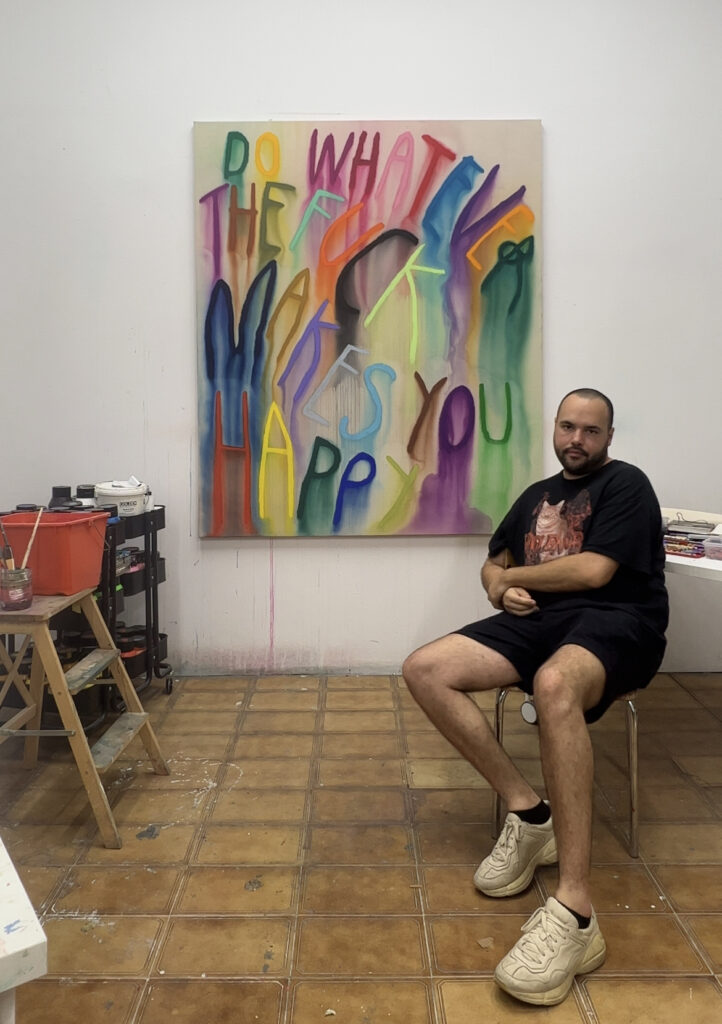
Your work often moves between humor, irony, and genuine emotional vulnerability. How do you navigate that balance, and do you think humor sometimes allows us to express feelings we might otherwise struggle to communicate?
CB Hoyo: I think humor is one of the most sophisticated ways humans deal with being alive. There’s that saying, “Trauma makes you funnier,” and I think there’s quite a bit of truth to it.
Life is incredibly absurd when you think about it. We’re all walking around pretending to know what we’re doing, falling in love, getting our hearts broken, worrying about money, making terrible decisions, and eventually dying. And somehow we’re expected to take the whole thing seriously. Life is way too short for that. The ending is going to be exactly the same for all of us anyway. We’re all going to die. So we might as well have a good laugh while we’re here.
I grew up in a culture where humor is present even in the most difficult circumstances. Sometimes especially in those circumstances. I genuinely believe humor makes almost everything in life a little easier to deal with. It softens the blow. It allows us to approach things that would otherwise be uncomfortable. You can make somebody laugh about loneliness, and two seconds later they realize that what they’re laughing at is actually something they’re experiencing. I love that moment when laughter becomes recognition.
But I don’t consciously sit down and decide that something needs to be funny or vulnerable. I just try to be truthful about how contradictory human emotions are. You can love somebody and hate them at the same time. You can be incredibly happy and deeply miserable in the same afternoon. I don’t see why art should pretend otherwise.
Many of your works capture thoughts and emotions that feel deeply personal, yet remarkably universal. Where do these ideas typically come from? Are they drawn primarily from your own experiences, conversations with others, or simply observing the world around you?
CB Hoyo: All of the above. I’m constantly collecting things. Conversations, thoughts, misunderstandings, ridiculous situations, things people say when they’re drunk, things I overhear in restaurants, things I think about at three in the morning. A lot of what I write also comes from things I’ve personally felt or experienced. I think we all end up experiencing more or less the same emotions at different points in our lives. The circumstances might be different, but the feelings are often surprisingly similar.
And, unfortunately, we live in an era where we’re all chronically online, lol. So the internet has inevitably become one of my muses. Memes are genuinely an essential part of my thought process. I spend a ridiculous amount of time looking at them, especially the comment sections of edgy or controversial memes. Some of the most unhinged, absurd, and unexpectedly brilliant things I’ve ever read have come from complete strangers arguing in an Instagram comment section. The internet is a fucking goldmine of human stupidity, and I mean that in the most affectionate way possible.
I have years of notes. Thousands of sentences, fragments, and ideas that I’ve collected without necessarily knowing what I would eventually do with them. What’s interesting is that time changes the meaning of those observations. Something I wrote five years ago might mean something completely different to me today. And when I turn it into an artwork, it becomes another thing entirely.
I don’t think my experiences are particularly unique. Most of us experience variations of the same emotions. We just convince ourselves that nobody else could possibly understand what we’re going through. Sometimes all it takes is one sentence to remind us that we’re not nearly as original in our suffering as we’d like to believe. Which I find both comforting and a little depressing.
You’ve said that your texts are meant to be read quickly and felt later, reflecting the way we communicate through memes, messages, and social media. Do you think our increasingly fragmented, digital way of communicating has changed how deeply we experience or understand our emotions?
CB Hoyo: I don’t think we necessarily feel less. I think we’ve become incredibly efficient at avoiding what we feel.
We’re constantly bombarded with information, images, videos, notifications, and visual stimulation. There’s so much coming at us every second that I genuinely wonder how much of it we’re actually capable of absorbing. At least for me, I feel like my capacity to process information is becoming more selective. The vast majority of what I see online disappears from my memory almost immediately. My brain seems to keep whatever genuinely interests me, and the rest is completely forgotten. Total amnesia.
We have access to more information, more people, and more ways of communicating than any generation before us. Yet somehow, having a meaningful conversation can feel more difficult than ever. You can tell somebody you love them with an emoji. You can end a relationship with a text message. You can communicate an entire emotional breakdown through a meme. There’s something fascinating and slightly terrifying about that.
But I don’t think we should romanticize the past either. People have always struggled to communicate their emotions. We’ve simply invented new ways of doing it badly. What interests me is working within that reality rather than pretending it doesn’t exist.
If somebody spends two seconds looking at an artwork, those two seconds are still an opportunity. Maybe they laugh and keep scrolling. Maybe they remember the sentence three days later. Maybe it means absolutely nothing to them until something happens in their life that suddenly makes it relevant. I don’t think the amount of time somebody spends looking at something necessarily determines how deeply it affects them. Sometimes a sentence you read in five seconds stays with you for twenty years.
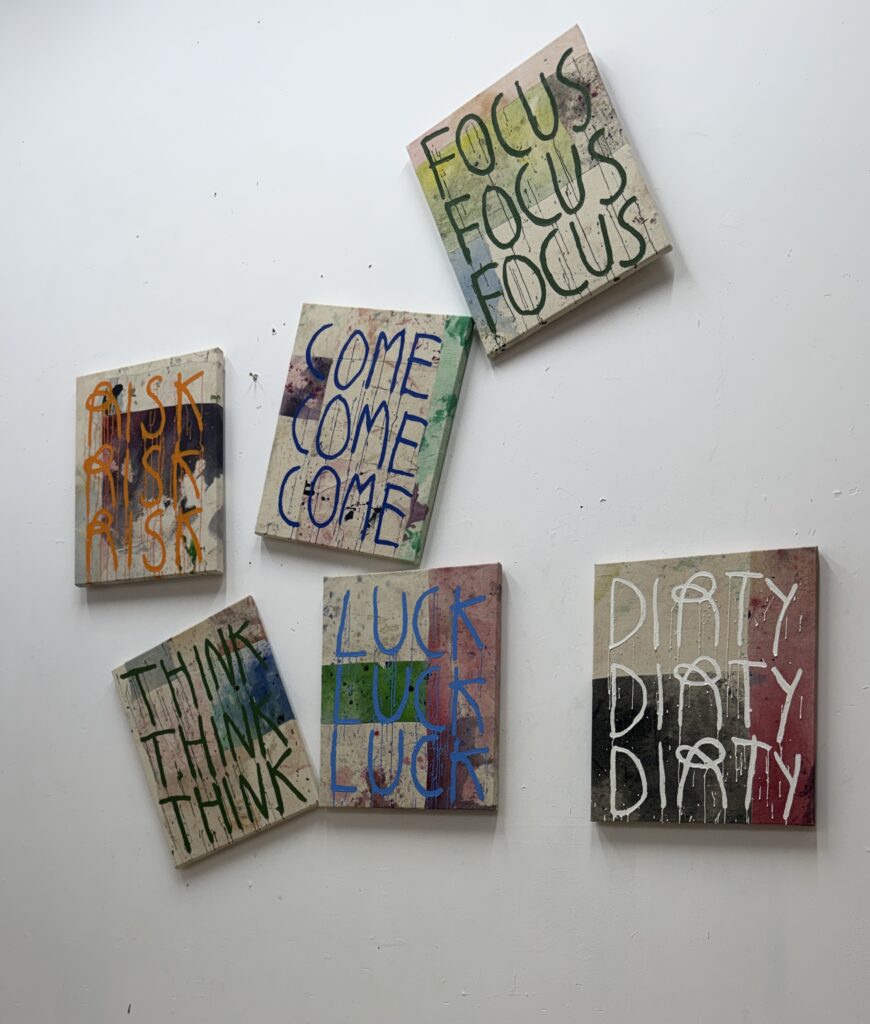
Your work frequently touches on loneliness, intimacy, identity, and the contradictions of everyday life. Do you see art as a way of processing your own experiences, or are you more interested in creating something that allows other people to recognize themselves?
CB Hoyo: I think those two things are inseparable. Everything I write comes from something I’ve thought about or felt at some point in my life. But that doesn’t necessarily mean it reflects my state of mind at the moment I make the artwork or share it publicly. Actually, I’d say that ninety percent of the things I post on Instagram have absolutely nothing to do with how I’m feeling that particular day. I might post something incredibly depressing while having the best day of my life, or something ridiculously romantic when romance is the last thing on my mind.
Making art is inevitably a form of processing the world around you, whether you’re conscious of it or not. But I’m not particularly interested in turning my work into a public diary. I don’t think the audience needs to know exactly what happened to me, who I was thinking about, or what inspired a particular sentence. Actually, I think explaining those things can sometimes destroy the work.
If I tell you that a painting is about a specific relationship I had ten years ago, suddenly you’re looking at my relationship rather than thinking about your own. I prefer leaving that space open. The most interesting thing happens when somebody recognizes something of themselves in an artwork that was never specifically about them. It’s a strange kind of intimacy between two people who might never meet.
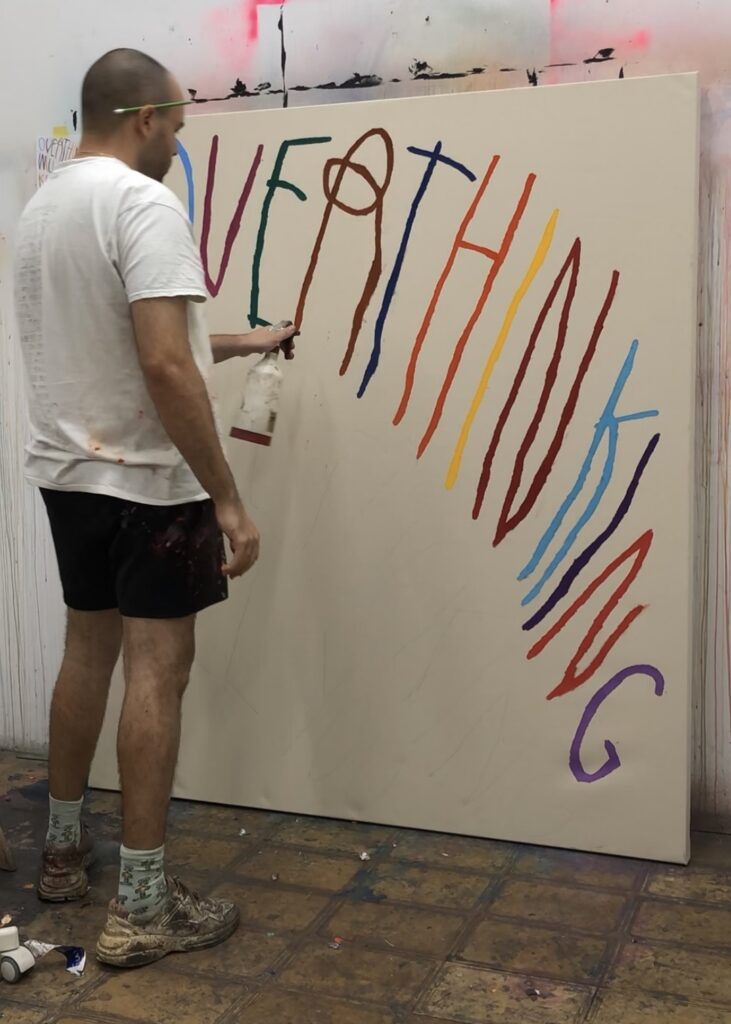
Your Fakes series reinterprets iconic artworks by some of history’s most celebrated artists, questioning ideas of originality, authorship, and value. What initially inspired the series, and what were you hoping to challenge through it?
CB Hoyo: The Fakes started in 2017, completely by accident, when I was still trying to understand what the contemporary art world actually was. I was trying to forge an Andy Warhol Mao painting at home, just for fun, using my printer. I tried over and over again, and every single attempt was a complete disaster. I kept fucking it up until eventually I got so frustrated that I thought, fuck it, I’m done trying to make this thing look real.
Coincidentally, that same week I’d read an article about forgery in the art world, about how the market was full of fakes and how many artworks circulating around the world weren’t necessarily what people believed them to be. And this was also around the time when everything was about fake news, fake information, fake everything. The word “fake” was practically everywhere.
So there I was, looking at this incredibly fake Warhol Mao that I’d completely failed to reproduce, and suddenly something clicked. Instead of trying to hide the fact that it was fake, why not make that the entire point? Why not openly acknowledge the falsification? So I took the painting and wrote directly over it, declaring that the Warhol was fake. And just like that, the first Fake was born.
I posted it on Instagram, and people went absolutely crazy for it. I remember thinking, holy shit, I think I have something on my hands. So I started making more, and what began as a completely failed attempt at forgery eventually became an entire series.
What fascinated me was how much importance people placed on names, signatures, provenance, and institutional validation. You could have two visually identical paintings, but if one was made by a famous artist and the other by somebody nobody had heard of, their financial and cultural value would be completely different. I found that absurd. Not necessarily wrong, but absurd.
So I started recreating recognizable works by artists like Rothko, Warhol, Basquiat, Picasso, and others, while making it very clear that they were fake. I wasn’t trying to deceive anybody. Quite the opposite. The deception was already part of the system I was questioning.
I wanted people to think about what they were actually looking at. Were they attracted to the painting itself? To the artist’s name? To the possibility of owning something associated with cultural prestige?
There’s also something funny about an artist who nobody knows making a fake of an artist everybody knows, and then eventually having collectors pay money for that fake. At what point does the fake become an original? I think that question is still relevant, perhaps even more today than when I started.
You’ve built a career partly around questioning the structures and conventions of the art world, while simultaneously becoming part of that very system. How do you personally navigate that contradiction, and has your perspective on the art market changed as your career has developed?
CB Hoyo: I’m completely aware of the contradiction. I criticize the art market, and I participate in it. I question the importance of money in art, and I sell paintings. I make fun of collectors, and I’m a collector myself. Some of my closest friends are collectors too. I don’t think pretending otherwise would make me more authentic.
The art world is an extraordinary ecosystem. It produces incredible things, supports artists, preserves culture, and creates opportunities that wouldn’t exist otherwise. It’s also full of vanity, speculation, insecurity, and people who confuse financial success with intellectual importance. Both things can be true.
When I started, I saw the system much more from the outside. It was easy to criticize something I didn’t fully understand. Over time, I’ve developed a more nuanced relationship with it. I’ve met incredibly generous people who genuinely care about art, and I’ve met people who couldn’t care less about the work as long as its value increases.
What has changed is that I understand the mechanisms better. But I don’t think understanding a system means you have to stop questioning it. Actually, the closer you get to something, the more responsibility you have to recognize its contradictions. And occasionally laugh at them.
In an era where almost anything can be reproduced, digitally manipulated, or generated by artificial intelligence, what does authenticity actually mean to you as an artist?
CB Hoyo: I don’t think authenticity has anything to do with whether something is handmade, original, or technologically assisted. You can make something entirely by hand and still be completely dishonest. And you can use a machine to create something that expresses a genuinely human idea. For me, authenticity has more to do with intention.
Why are you making something? What are you trying to communicate? Are you making decisions because they mean something to you, or because you think they’re what people want to see? Of course, even that becomes complicated, because we’re all influenced by our surroundings, our experiences, and the things we consume. Nobody creates in a vacuum.
I think the obsession with absolute originality is somewhat ridiculous. Human culture has always developed through imitation, reinterpretation, and transformation. What matters to me is what somebody does with those influences. Authenticity isn’t the absence of influence. It’s what happens when those influences pass through an individual and become something that couldn’t have existed in exactly the same way without them.
The contemporary art market often places enormous emphasis on exclusivity, reputation, and financial value. Do you think we’ve reached a point where the price of an artwork sometimes matters more than the work itself?
CB Hoyo: Absolutely. But I don’t think this is a particularly new phenomenon.
We’ve been attaching financial value to cultural objects for centuries. The difference today is how visible and accelerated the entire process has become. An artwork sells for ten million dollars, and suddenly everybody wants to know why it’s worth ten million dollars. Very few people are actually discussing the work itself. Price becomes part of the artwork’s identity. Sometimes it even becomes the most interesting thing about it, which is a little tragic.
I think a lot of this comes down to ego and that strange, almost voyeuristic fascination we humans have with money, status, and things we’re told we can’t have. We love knowing how much something costs, who owns it, who can afford it, and who can’t. There’s a certain morbid curiosity surrounding wealth and exclusivity. Sometimes people are more fascinated by the fact that somebody paid fifty million dollars for a painting than by the painting itself. The artwork becomes almost secondary to the spectacle surrounding it. It’s human nature, I suppose. We’re incredibly curious creatures, especially when it comes to other people’s money.
I’ve always been interested in challenging that relationship. With my exhibition Dislyxec Poet in Milan, I presented around 1,500 original works on paper and experimented with pricing, including works available for as little as one euro. I wanted to see what happened when the usual relationship between price, desirability, and perceived artistic value became unstable. Does somebody enjoy a drawing more because it costs €1,500 rather than €15? Does knowing the price change what they see? Unfortunately, I think the answer is often yes.
Personally, when I buy art, I buy what I like. I couldn’t care less about the price as a measure of whether something deserves to be on my wall. I could have a Warhol hanging next to a painting I found in the fucking trash. If I like it, I like it. It’s that simple. Of course, I also understand the market, and most of the things I collect tend to appreciate in value or at least hold their value. I think I have a pretty good eye, haha.
But financial value and personal value are two completely different things. A painting that costs fifty euros might mean more to somebody than a painting that costs five million. The market can’t measure that. And I hope it never can.
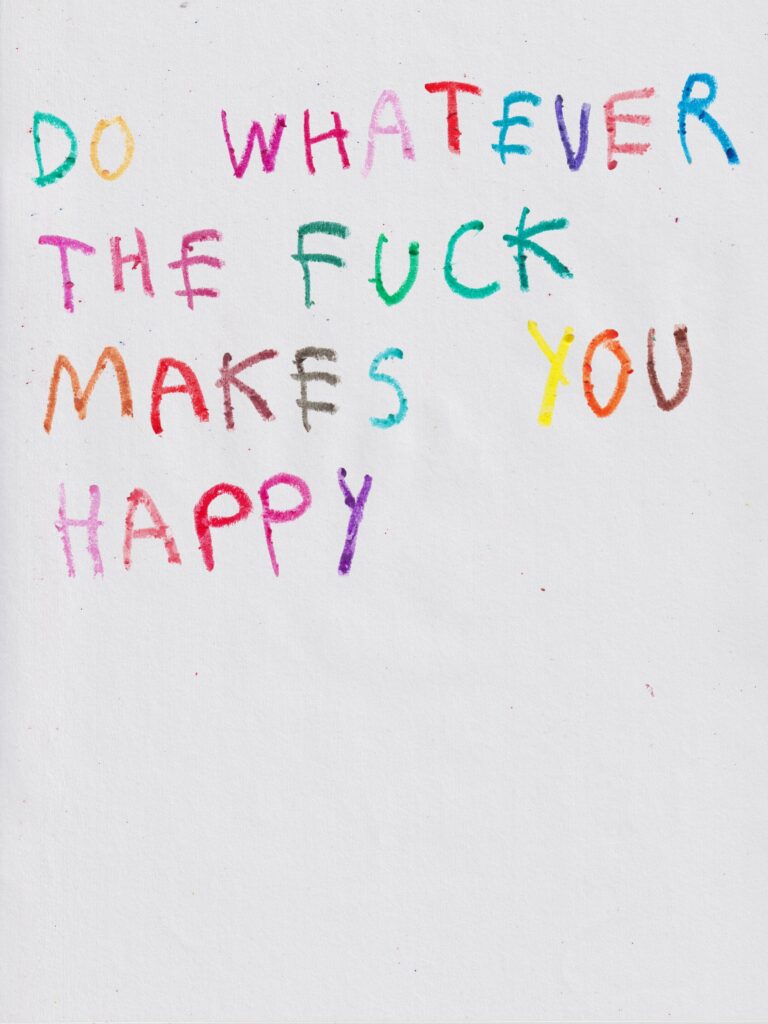
Your Corny Quotes became one of the most recognizable aspects of your artistic identity. What originally drew you to that format, and did you ever anticipate that these seemingly simple handwritten observations would resonate with so many people?
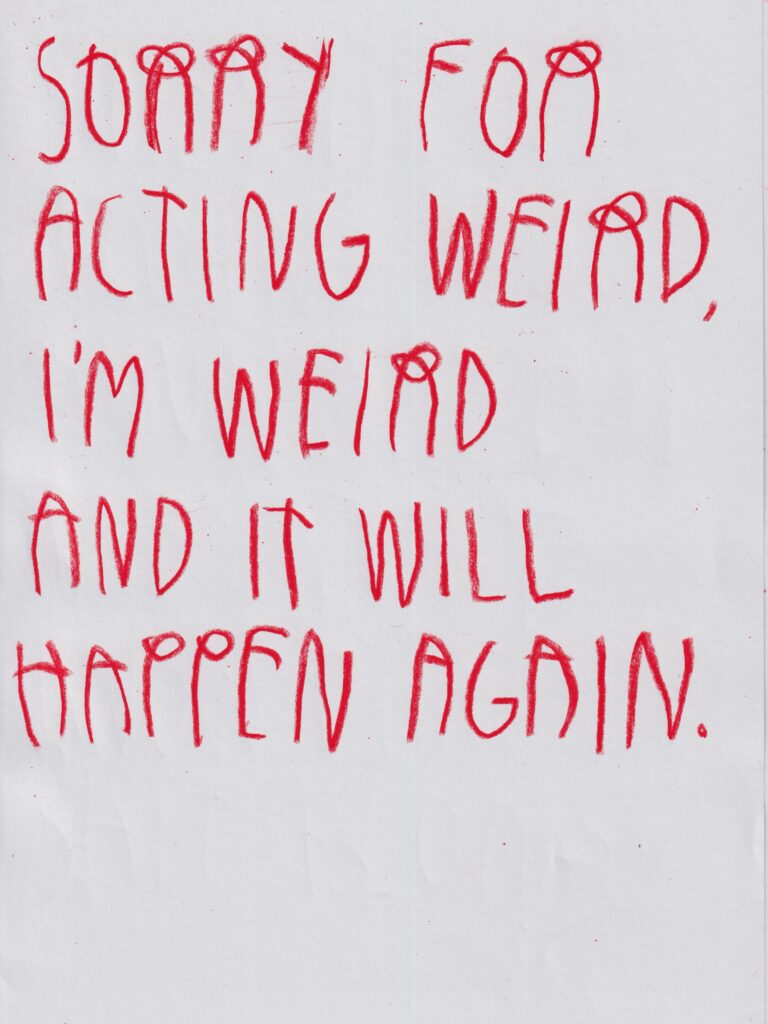
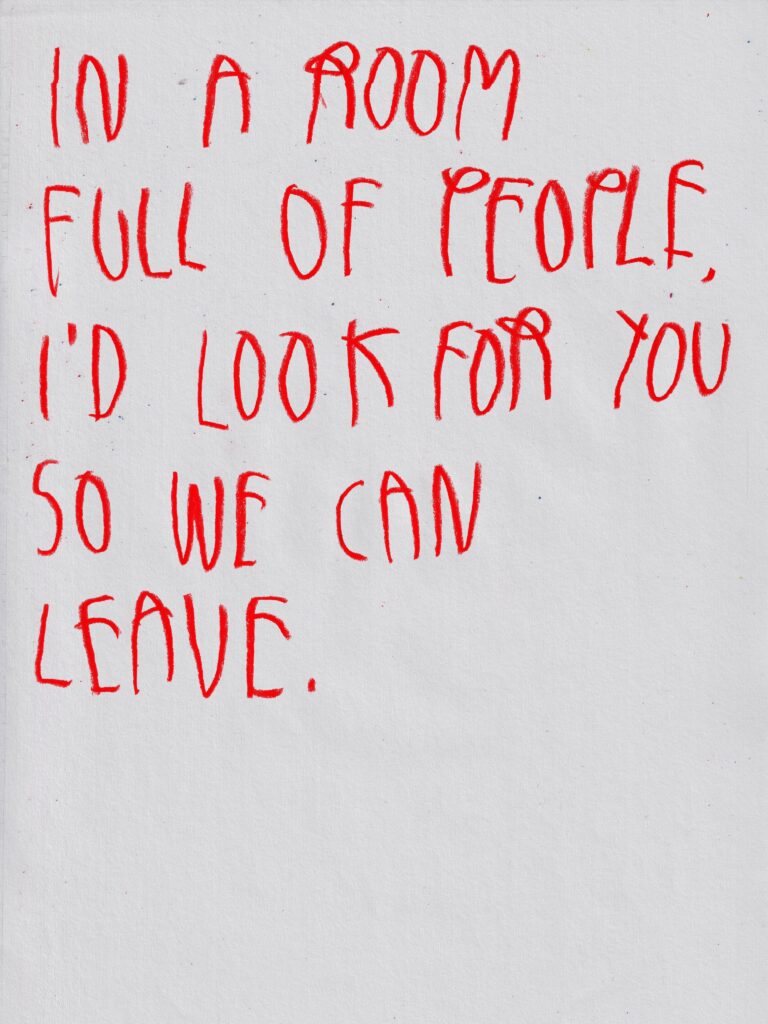
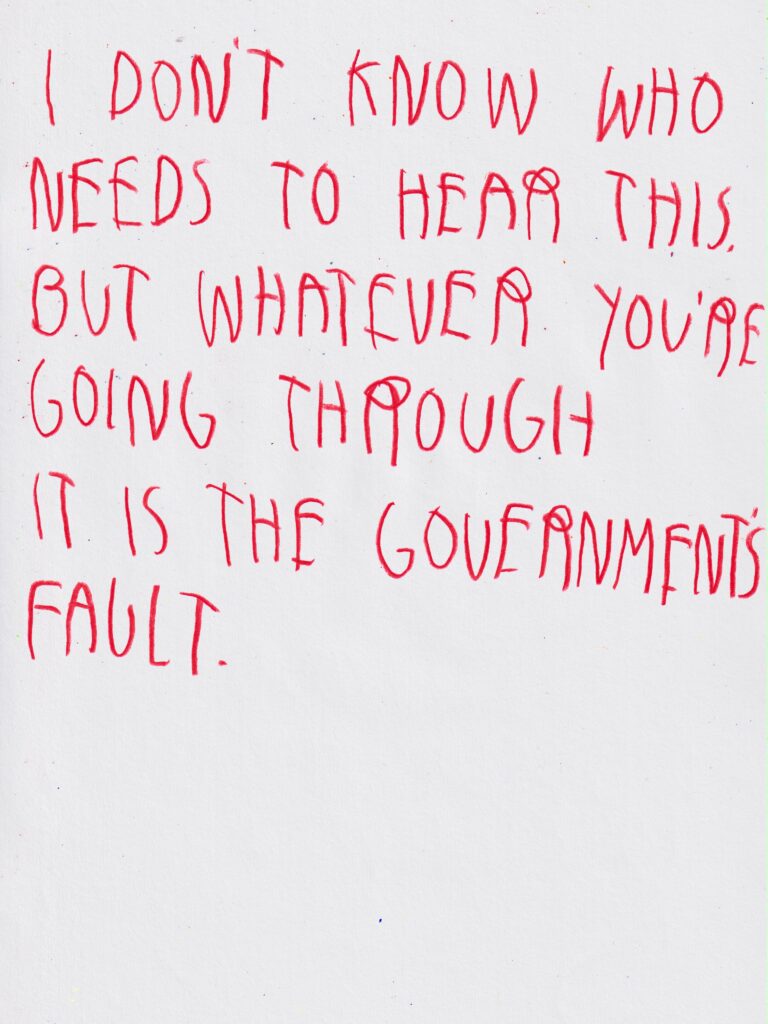
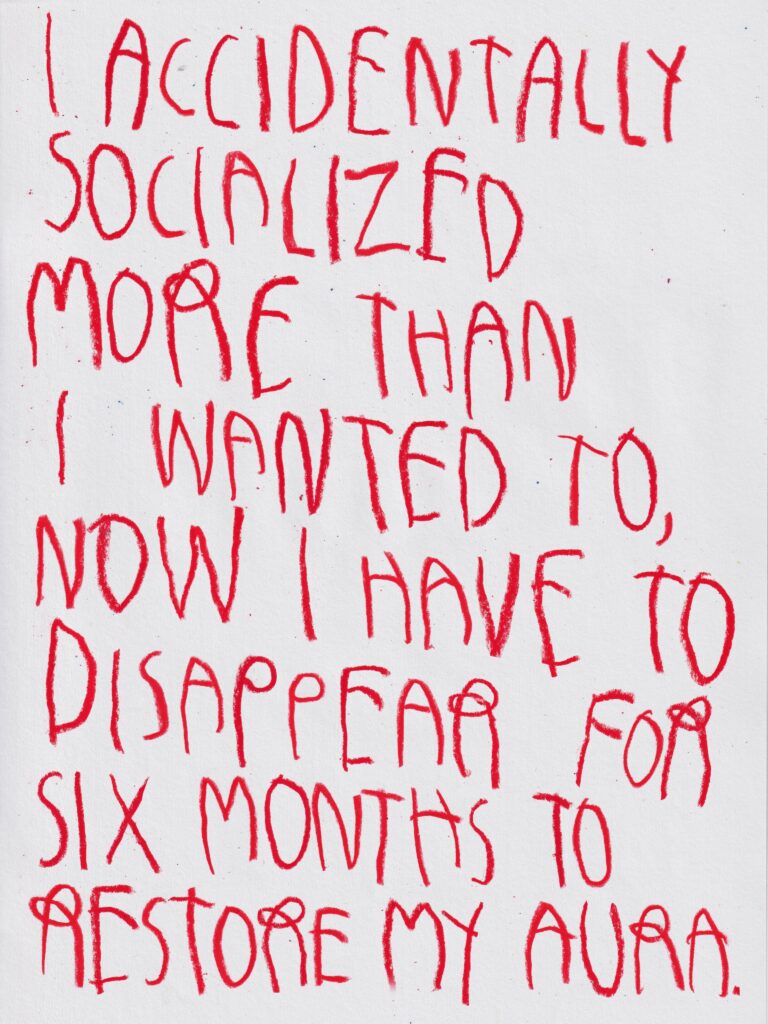
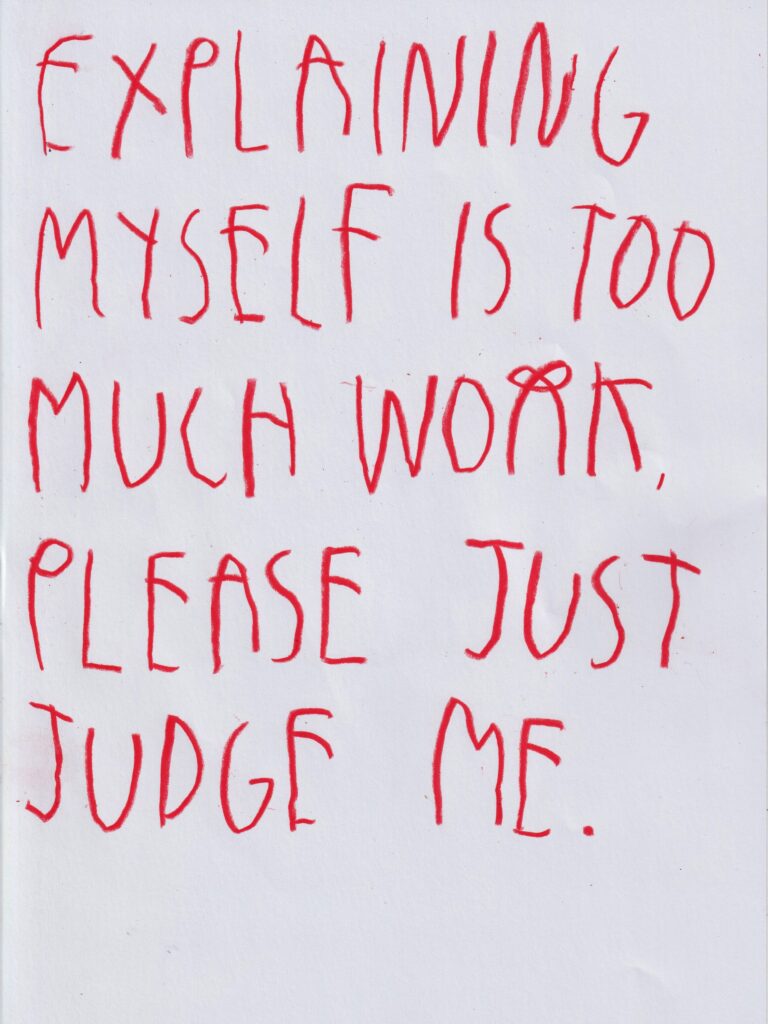
CB Hoyo: Funny enough, the Corny Quotes also happened almost by accident.I’ve always written things down. For years, I kept notes, thoughts, observations, stupid sentences, whatever came into my head. Most of it was completely private. Occasionally I’d post something I’d written on Instagram, usually just black text on a white background, but I wasn’t really doing anything with those writings artistically.
Then, in 2019, I was visiting my grandfather and had bought a box of crayons in Miami. Around that same time, I’d recently visited my grandmother in the Dominican Republic, and she’d shown me some old papers from when I was a little kid. On one of them, I’d written my name with each letter in a different color. Something about seeing that childhood handwriting stayed with me.
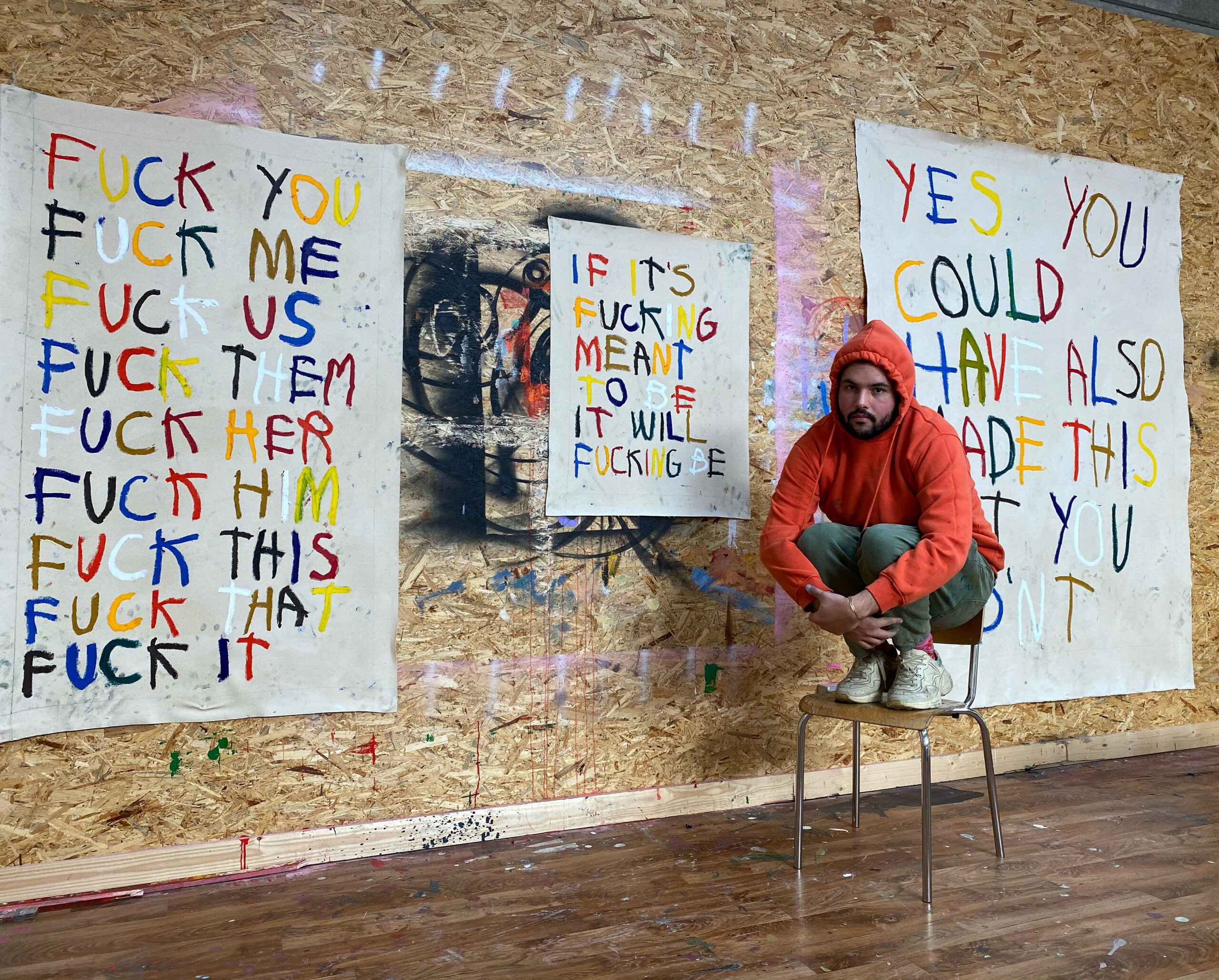
So there I was, with a box of crayons and that memory in my head, and I started writing some of my thoughts on A4 sheets of paper using different colors. That’s essentially how the Corny Quotes were born. There was no elaborate conceptual plan behind it. It was a very spontaneous experiment that connected something I’d been doing privately for years with a visual language that came from my childhood.
I was interested in the idea of taking ordinary thoughts, the kind of things people might say in a conversation or write in a message, and presenting them as artworks. There’s something almost ridiculous about putting a sentence on a piece of paper and asking people to take it seriously, especially when the sentence itself might be stupid, sentimental, sarcastic, or embarrassingly honest. I liked that contradiction.
And then the internet did its thing. The Corny Quotes exploded online in 2019 and introduced my work to a much broader, more mainstream audience. I certainly hadn’t anticipated that something so simple would become one of the most recognizable parts of my practice.
Over time, the materials evolved. I started working on raw canvas, using water-soluble oil sticks, experimenting with scale, texture, and the physical presence of the handwriting. But the underlying idea remained relatively simple. I wanted to make work that people could engage with without needing an explanation.
At the same time, I’ve never wanted the Corny Quotes to become the entirety of my artistic identity. They’re one part of a much larger practice. I think one of the biggest dangers for an artist is becoming so associated with something successful that they stop allowing themselves to evolve.
You’ve increasingly explored different mediums, including installation, sound, performance, and generative systems. What excites you most about taking language beyond the canvas, and how do you envision your practice evolving over the coming years?
CB Hoyo: What excites me is that language doesn’t necessarily need to be read to be experienced. It can be heard, repeated, projected, whispered, shouted, touched, or even felt through vibration. A word can become an object. A sentence can become an environment. A sound can communicate something without belonging to any particular language.
I’ve been developing a long-term body of work around onomatopoeias, which I find fascinating because they exist somewhere between language and instinct. Think about laughter. Almost everybody laughs, but the way we represent laughter in writing changes dramatically between cultures. In English you might write “hahaha.” In Spanish, “jajaja.” In other languages, the representation is completely different. The sound is human, but the written language is cultural.
I’m interested in exploring that through neon, painting, sculpture, sound, movement, and installations that respond to the presence of viewers.
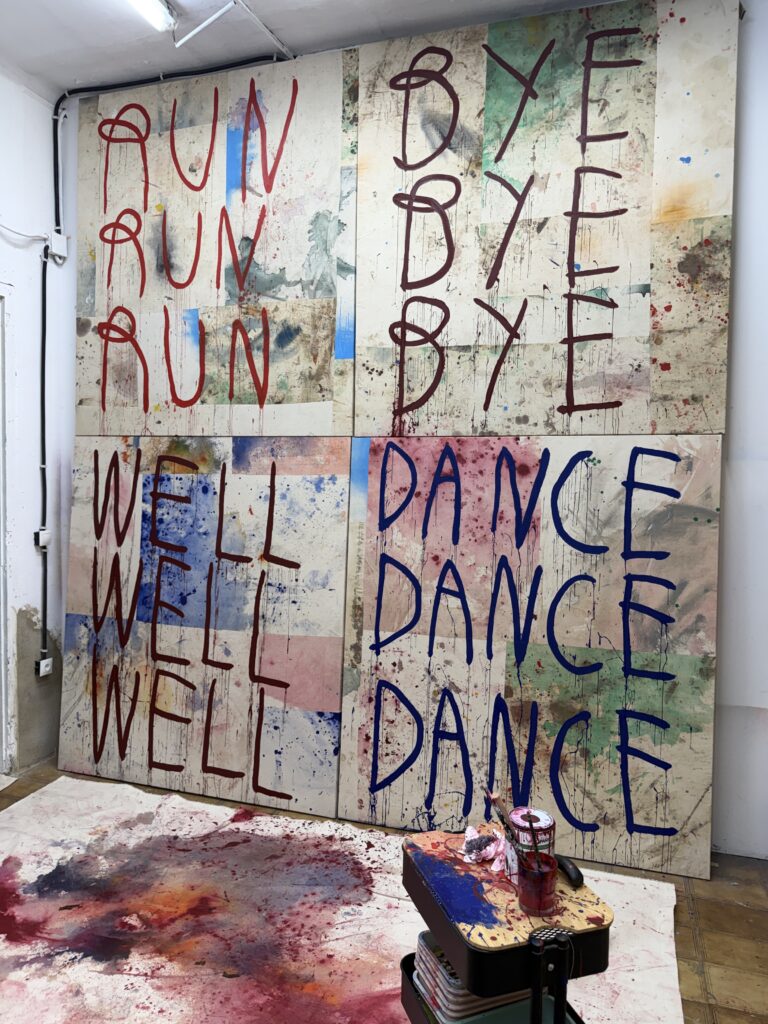
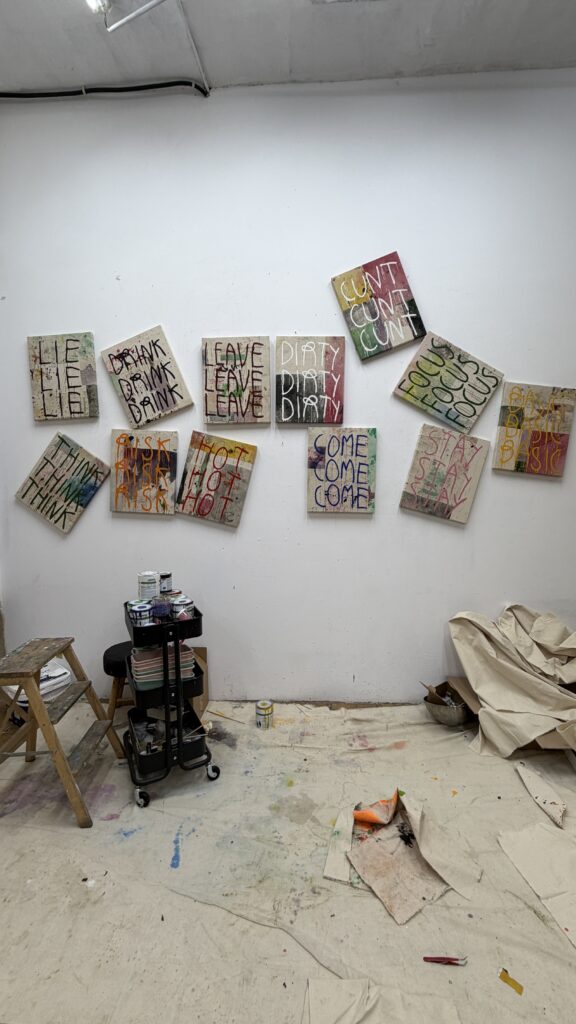
Another major direction in my practice right now is a new series of paintings based on repetition, memory, and transformation. It started with a dream. I woke up with this very specific image of a painting in my head and felt an almost uncontrollable urge to make it immediately. The paintings are constructed from fragments of old canvases that have been covering my studio floors for years. These materials have absorbed paint, dirt, accidents, and traces of countless artworks that were made on top of them. I select sections, cut them apart, and sew them together to create entirely new canvases.
There’s something beautiful to me about taking a material that was never intended to become an artwork, something that was literally there to protect the floor, and giving it a completely new life. Every fragment already contains a history. When they’re sewn together, those separate histories become something else.
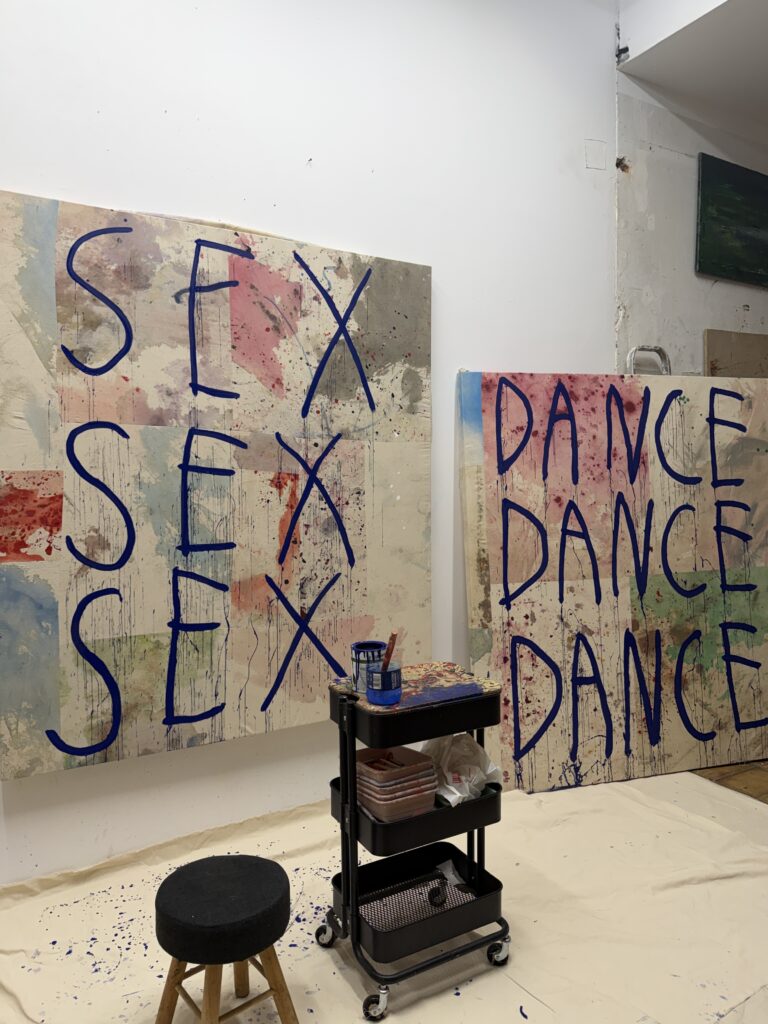
On top of these surfaces, I paint a single word repeated three times. I’m interested in what happens when language begins to lose its conventional function through repetition. A word that initially communicates something specific can slowly become a rhythm, an image, a pattern, or a ritual. Its meaning can become stronger, weaker, or completely different depending on the repetition and the person looking at it.
I also love the contradiction between the repetition of the language and the uniqueness of the material. The word might be identical each time, but the surface underneath it can never be repeated exactly. It’s made from years of accidents, decisions, and accumulated traces of my own practice. In a way, the paintings are constructed from the physical memory of the studio.
I don’t want to spend the next thirty years making the same painting in different colors. I’m interested in what happens when the work begins to exist beyond the boundaries of a conventional artwork, and when ideas I’ve been exploring for years begin to take completely different physical forms.
Social media played an important role in bringing your work to an international audience. How has your relationship with platforms like Instagram evolved over time, and do you think the constant pressure to remain visible online can become creatively restrictive?
CB Hoyo: Instagram has played an enormous role in my career, and I would be ridiculous to pretend otherwise. When I started, I didn’t have a gallery, collectors, institutional connections, or any of the traditional structures that usually help artists become visible. I had a phone and an internet connection. Social media allowed me to bypass a lot of the gatekeeping that exists in the art world and communicate directly with people who were interested in what I was doing. That’s an extraordinary thing.
But I have an incredibly toxic relationship with social media. I actually hate it. If it were entirely up to me, I probably wouldn’t be on any of these platforms. Unfortunately, a significant part of my career and livelihood is connected to them, so sometimes you have to make sacrifices. I find our collective addiction to phones genuinely disgusting. The amount of time we spend staring at these little screens, constantly looking for stimulation, validation, or something to distract us, is quite disturbing. If I could throw my fucking phone away and never look at it again, I probably would.
The relationship becomes even more complicated when visibility starts turning into an expectation. Platforms reward consistency, repetition, familiarity, and immediate engagement. Artistic development doesn’t necessarily work that way. Sometimes the most important thing an artist can do is disappear for a while, experiment, make terrible work, and figure out what comes next. An algorithm doesn’t particularly appreciate that.
There’s also the issue of censorship. I have so many things I’ve written, made, or thought about sharing that I simply can’t post because Instagram would probably shut down my account. And that’s a very real creative restriction. When a platform becomes one of your primary ways of communicating with the public, its rules inevitably start influencing what you’re allowed to say and show. There are things I’d love to share that will probably never appear on my Instagram, not because I don’t stand behind them, but because the platform wouldn’t tolerate them. That’s a problem.
I think the danger begins when artists start making decisions based on what will perform well rather than what they genuinely want to explore. I’ve definitely felt that tension. But I try to remind myself that Instagram is a tool. It isn’t the work, and it certainly shouldn’t be the reason the work exists. I’d much rather make something that interests me and performs terribly online than spend the rest of my life producing things simply because I know they’ll get likes. Although, obviously, it’s nice when both things happen.
Your practice explores repetition, variation, and generative systems, including handwriting databases and machines. What interests you about allowing technology or systems to participate in the creative process, and at what point does authorship become something shared rather than individual?
CB Hoyo: I’ve become increasingly interested in the idea that an artist doesn’t necessarily have to physically execute every element of an artwork. We’ve accepted this in art for centuries. Artists have worked with assistants, fabricators, printers, foundries, and entire workshops. Yet when a machine becomes involved, people suddenly become very concerned about authorship. I find that contradiction interesting.
I’ve been exploring systems that can reproduce, interpret, or transform elements of my handwriting and language, potentially allowing the work to continue generating variations beyond my direct physical involvement. There’s something both exciting and uncomfortable about that.
Handwriting is usually considered one of the most personal forms of expression. It’s almost like a fingerprint. So what happens when a machine learns to reproduce it? Is the result still mine? Does it become something else? And does the distinction even matter?
I also find the idea of creating a digital clone of myself quite fascinating. Imagine developing a system that could reproduce aspects of my personality, my handwriting, my way of thinking, and my relationship with language. Eventually, when I’m no longer here, some version of me could theoretically continue existing, interacting with people, generating ideas, or producing work. Obviously, it wouldn’t actually be me, but perhaps it could preserve something of what I was. There’s something beautiful, absurd, and slightly terrifying about that possibility. A kind of digital afterlife.
I think authorship becomes more complicated when the system starts producing results that the artist didn’t specifically anticipate. At that point, the artist is no longer simply making an object. They’re creating the conditions under which something can happen. I’m interested in that shift from controlling every outcome to designing a system that allows unexpected outcomes to exist.
Artificial intelligence is increasingly capable of generating images, texts, and entire artistic styles. As someone whose work explores originality and authorship, do you see AI as a creative opportunity or a threat to artistic identity?
CB Hoyo: Both. And I think pretending it’s only one or the other is intellectually lazy.
I love innovation. I think one of the most important things we can do is remain curious and learn to adapt to the new tools that become available to us. Technology has always changed the way humans create, communicate, and understand the world, and artificial intelligence is simply another part of that evolution. It’s clearly a double-edged sword, but I don’t think ignoring it is particularly productive. This is the direction the world is moving in, whether we like it or not, so we might as well learn how to use it intelligently.
AI is an extraordinary technological development. It gives people access to creative tools that would have been unimaginable a few years ago. It can also produce an infinite amount of completely meaningless garbage. But humans were already doing that long before artificial intelligence existed.
I use AI as a tool, not as a replacement for my own creativity. It can help me develop renders, visualize installations, explore technical possibilities, or accomplish tasks that previously would have required an enormous amount of time and resources. That’s incredibly useful. But I’m not interested in having artificial intelligence do my thinking for me. The machine isn’t going to become the artist on my behalf. The ideas, the decisions, the mistakes, and the intentions still need to come from somewhere.
What concerns me isn’t necessarily that machines can generate images or texts. It’s that we’re increasingly confusing the ability to produce something with the ability to have something worth saying. Just because you can generate a thousand paintings in ten seconds doesn’t mean any of them need to exist.
At the same time, I think artists who dismiss AI entirely are missing an opportunity to question some very interesting ideas about authorship, labor, creativity, and identity. I’ve been interested in exploring the possibility of creating systems that can imitate aspects of my own artistic language.
There’s something almost existential about the idea of building a machine that can reproduce your handwriting or generate sentences that sound like you. If a machine can convincingly imitate the way I express myself, what exactly makes me irreplaceable? I don’t think that’s a question artists should be afraid of. I think it’s a question we should be making art about.
We live in a culture where irony and humor often seem easier to express than genuine sincerity. Why do you think vulnerability can feel so uncomfortable today?
CB Hoyo: Because sincerity exposes you to rejection. If you tell somebody you love them and they don’t love you back, that hurts. If you tell somebody you love them ironically, you can always pretend you were joking. Humor gives us an escape route.
For some reason, we’ve become afraid of feeling things. Or perhaps even more afraid of letting other people see that we feel things. We constantly restrict ourselves because we’re worried about what other people might think. What will they say? Will I look stupid? Will I seem desperate? Will somebody judge me? We end up censoring our own emotions before anybody else even has the chance to react to them.
I think we’ve become very good at protecting ourselves from embarrassment. We hide behind sarcasm, memes, jokes, and carefully constructed versions of our personalities. Nobody wants to be the person who cares too much. But I think that’s incredibly sad, because caring too much is also what makes life interesting.
Falling in love is embarrassing. Being enthusiastic about something is embarrassing. Admitting that somebody hurt you is embarrassing. So what? I’d rather be occasionally ridiculous than spend my entire life pretending nothing affects me. And I say that as somebody who uses irony constantly. I’m very aware of my own contradictions.
Your work often reflects the anxieties, contradictions, and absurdities of contemporary society. When you look at the world today, what concerns or fascinates you most, and how do those observations find their way into your practice?
CB Hoyo: I’m fascinated by how much information we have and how little certainty it seems to give us.We have access to practically everything, yet we seem increasingly confused about what to believe, who to trust, and what actually matters. We’re constantly connected, but loneliness is everywhere. We talk about authenticity while carefully curating our identities. We celebrate individuality while allowing algorithms to influence what we think, buy, wear, and desire. And we’re developing machines that can imitate human creativity while many humans seem increasingly afraid of expressing themselves imperfectly. The contradictions are endless.
I’m also interested in our obsession with productivity, success, and optimization. Everything needs to have a purpose. Every hobby becomes a potential business. Every experience becomes content. Sometimes I wonder when we decided that simply existing wasn’t enough.
I don’t necessarily approach these questions by making explicitly political or explanatory work. Often they appear through something much smaller. A ridiculous sentence, a repeated word, a familiar expression placed in an unfamiliar context. I like the idea that a very simple artwork can contain a much larger contradiction without needing to explain it.
There’s a saying in Spanish, “Yo tiro el zapato, y al que le sirva, que se lo ponga.” Basically, I throw the shoe out there, and whoever it fits can put it on. I love that approach. I’m not necessarily interested in attacking somebody directly or telling people what they’re doing wrong. But I do think it’s important to make people uncomfortable sometimes. To put a mirror in front of them and let them take a good look at themselves. If somebody recognizes themselves in something I’ve made and doesn’t particularly like what they see, perhaps that’s worth thinking about.
I don’t need to tell people what to think. Sometimes it’s enough to make them question what they already believe.
There’s an interesting tension in your work between making people laugh and making them uncomfortable. Do you think art needs to provoke or unsettle people to have a meaningful impact, or can something seemingly simple and humorous be just as powerful?
CB Hoyo: I don’t think art needs to do anything in particular. That’s one of the things I love about it. An artwork can change somebody’s understanding of the world, or it can simply make their afternoon slightly better. Both are valid experiences.
I think there’s sometimes a tendency in contemporary art to associate seriousness with importance. As though something has to be intellectually complicated, emotionally exhausting, or politically confrontational to deserve attention. I don’t agree.
Making somebody genuinely laugh is not necessarily easier than making them uncomfortable. And sometimes the most powerful works are the ones that do both. I’m interested in that moment when somebody laughs at something and then realizes that perhaps they shouldn’t have. Or when something that initially appears stupid begins to reveal a more uncomfortable truth.
But I don’t want to force a reaction. If somebody looks at one of my paintings and simply thinks it’s funny, that’s perfectly fine. Not every experience needs to become a philosophical revelation. Sometimes a joke is just a joke. And sometimes it isn’t.
Looking back at your journey from a young, self-taught artist to someone whose work is now recognized internationally, how has success changed you personally?
CB Hoyo: Success has given me freedom, which is probably the thing I value most. The freedom to choose what I work on, who I collaborate with, where I live, and how I spend my time. Coming from a background where those possibilities weren’t necessarily guaranteed, I don’t take that for granted.
But success also changes the way people perceive you. When nobody knows who you are, you can do almost anything without anybody paying attention. Once people start recognizing your work, expectations appear. People develop ideas about who you are, what you should make, and what your career is supposed to look like. Sometimes those expectations can become more restrictive than the limitations you had before.
There’s also something dangerous about becoming comfortable. When you’re starting out, you’re hungry. You want to conquer the fucking world. You have very little to lose, so you take risks without overthinking them. I sometimes miss that feeling. Not because I’ve lost my ambition, I definitely haven’t, but because the hunger was different back then. It was more urgent. In some ways, I think that urgency pushed me to accomplish things that were much bigger or more ambitious than what I might attempt today under similar circumstances.
Once you reach a certain level of success, it’s very easy to settle into a comfortable routine. You know what works, you know what sells, you know what people expect from you. And that comfort can become a huge problem. It can slowly turn into a prison without you even realizing it. You stop innovating because there’s no immediate reason to take risks anymore. I think that’s one of the biggest dangers for any artist.
I’ve also learned that recognition doesn’t magically resolve your insecurities or make you a more interesting person. You still wake up as yourself. You still have bad days, make stupid decisions, question your work, and occasionally wonder what the fuck you’re doing.
I think the most important thing for me has been trying to maintain the curiosity I had when I started. I don’t want to become somebody who spends the rest of his career protecting what he’s already achieved. I’d rather risk failing at something new.
You’ve said you’re less interested in offering answers than in creating moments where people feel recognized and understood. Can you walk me through your creative process from beginning to end result?
CB Hoyo: I wish I could give you a beautiful, structured explanation of my creative process, but the reality is much more chaotic. Most things begin with an observation, a thought, a conversation, or something completely unexpected. I write things down constantly. Sometimes it’s a complete sentence. Sometimes it’s a single word. Sometimes it’s an idea that makes absolutely no sense until years later. I have an enormous archive of notes and fragments collected over time.
When I’m working, I go through them, revisit things, change them, combine them, or simply use them as starting points. But not everything begins with language. Sometimes the material comes first.
For example, my recent series of repetition paintings began with a dream. I had this incredibly strong image of what the paintings should look like, and I felt an almost physical urgency to make them. I started looking at the old canvases that had been covering my studio floors for years. They were full of paint, stains, dirt, and traces of previous works. I began cutting them into fragments and sewing them together, creating entirely new surfaces from materials that had already accumulated years of history.
Then I started introducing repeated words. What interested me was how repetition could transform something familiar into something almost abstract. A word repeated three times begins to behave differently. It becomes rhythm, image, or even a kind of ritual.
I experiment constantly with scale, colors, materials, and composition. Sometimes I know immediately when something works. Other times I spend days changing things, only to realize that the first version was better. And sometimes I destroy the whole thing.
I don’t believe every idea deserves to become a finished artwork. Part of the process is knowing when to stop, when to continue, and when to accept that something simply doesn’t work.
You’ve said you’re less interested in offering answers than in creating moments where people feel recognized and understood. With this in mind, what are you hoping to convey through your work?
CB Hoyo: I don’t think there’s one particular message I’m trying to communicate. Actually, I become suspicious of my own work when I can explain exactly what somebody is supposed to take away from it. I’m more interested in creating a space where people can bring their own experiences.
A sentence that makes one person laugh might make somebody else uncomfortable. A word that feels romantic to one person might remind another of something painful. I like that instability. I don’t necessarily want people to agree with me, or even understand what I was thinking when I made something. I’d much rather they discover something about themselves.
I think we’re all desperately trying to make sense of our lives, our relationships, and the strange circumstances of being human. Art doesn’t necessarily provide answers to any of that. But occasionally it reminds us that somebody else is asking the same questions. And sometimes that’s enough.
Alright CB, alongside your work as a contemporary artist, you’ve also ventured into tattooing. How were you first introduced to the world of tattoos, and what initially sparked your interest in working with skin as a canvas?
CB Hoyo: My relationship with tattooing started in October 2018, completely by accident. Or perhaps not exactly by accident, but certainly not something I had planned.
I went to get my very first tattoo from an artist whose work I really admired, Iván Casabó, who’s now a very good friend of mine. He tattooed me, and when he finished, he looked at me and said, “Now it’s your turn.” I was like, “What the fuck do you mean?” And he said, “You’re going to tattoo me.”
I’d never held a tattoo machine in my life. I had absolutely no idea how the thing worked. He basically gave me a quick explanation of how to use it and told me to figure it out. So, on the same day I received my first tattoo, I also made my first tattoo. On the guy who had just tattooed me. Which, looking back, was a pretty ridiculous situation.
And, naturally, I fucked it up.
The sentence was supposed to say “Artists are not people.” But I’m dyslexic, and I accidentally wrote “Artist are not people.” I forgot the S. The worst part is that I didn’t even realize it until the following day, when I was looking at a photograph of the tattoo and suddenly noticed the missing letter.
I told Iván, and he said he’d assumed I’d done it intentionally. He actually liked it that way. But I couldn’t leave it alone. Years later, when I went back to get another tattoo from him, I added the missing S in red ink, like a correction on a school paper.
I think that story perfectly summarizes my relationship with tattooing. It began with a mistake, involved my dyslexia, and somehow became another way of expressing myself artistically.
What fascinates me about working on skin is the relationship between the artwork and the person carrying it. A painting exists independently of its owner, but a tattoo becomes part of somebody’s body, their history, and eventually their identity. It ages with them, changes with them, and accompanies them throughout their life. There’s something incredibly intimate about that.
And also something quite absurd about the fact that people voluntarily want my handwriting permanently tattooed on their bodies. I don’t even have any of my own work tattooed on myself, and I certainly never will. I genuinely don’t understand why anybody would want to do that, but I’m very happy they do, haha.
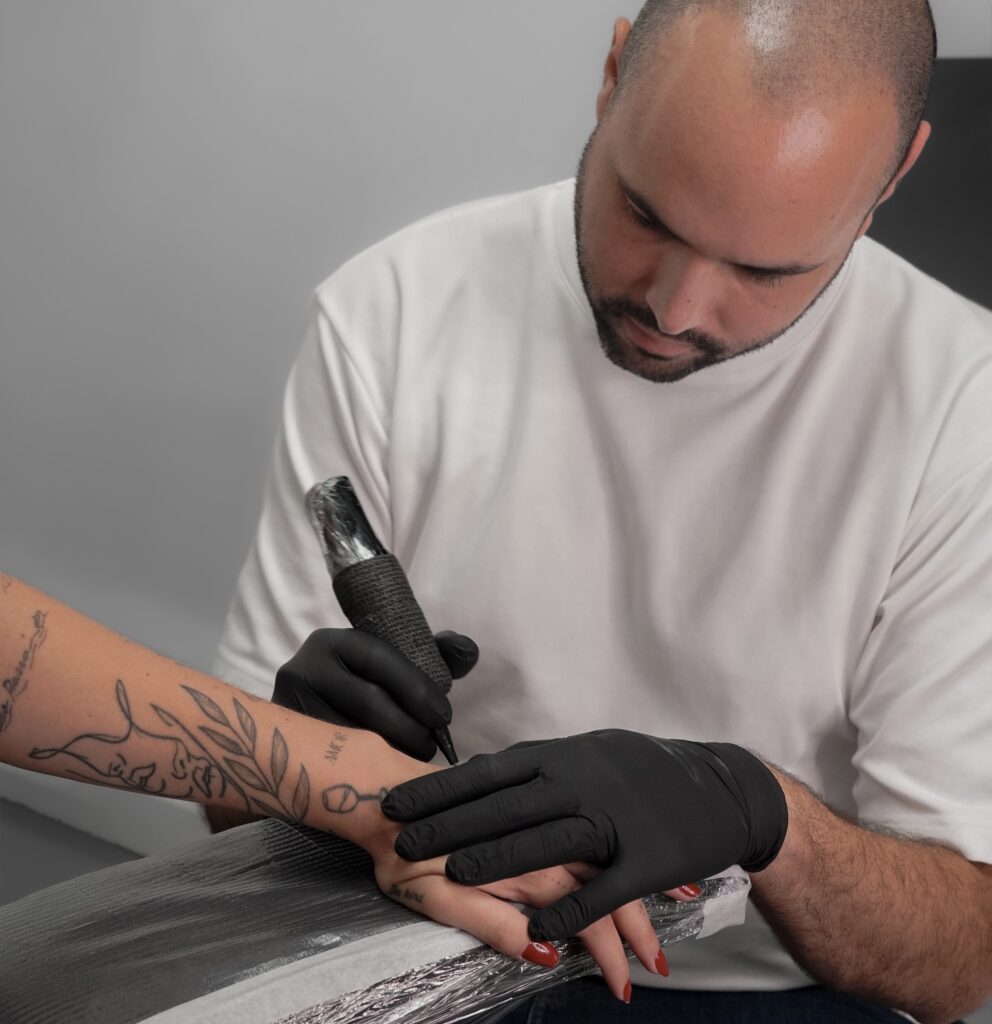
How did you go about learning the craft of tattooing? Was it something you approached independently, much like your painting practice, or did you learn from other tattoo artists along the way?
CB Hoyo: I learned by tattooing people. That’s basically it. After that first experience with Iván in 2018, I started tattooing friends, fans, collectors, and pretty much anybody who was willing to let me practice on them. And for years, I never charged anybody. Every tattoo was completely free. It was something I did for fun, out of curiosity, and because I wanted to understand how to work with a material that was completely different from anything I’d used before.
The locations were probably the most entertaining part. Between 2018 and the beginning of 2026, I tattooed people in nightclubs, hotels, galleries, private parties, bathrooms, and even the back of a gallery’s storage facility. Pretty much anywhere you can imagine. Sometimes I’d organize a party and end up spending the entire evening tattooing whoever wanted one. It was all incredibly informal and spontaneous.
Around 2020, I briefly entertained the idea of tattooing in a proper studio. Not because I wanted to become a professional tattoo artist, but honestly, because I was bored and thought it might be fun. I asked a friend who owned a tattoo studio whether I could come in and tattoo people one day, and he explained that I needed the appropriate certification.
So I took a course covering hygiene, sanitation, and some basic theory. But my actual practical education came from tattooing people over the years. I’ve always been somebody who learns by doing, and tattooing was no exception.
It wasn’t until 2026 that I decided to give the whole thing a slightly more professional structure. I started doing occasional guest spots at tattoo studios around Europe, usually combining them with trips I was already taking. Now I charge for the sessions, but it’s still something I do occasionally, whenever I feel like it.
I also make something very clear to everybody who comes to me: I’m not a tattoo artist in the traditional sense. I’m a contemporary artist who happens to tattoo. They’re not coming to me because I’m some extraordinary tattoo technician. They’re coming because they want a piece of my work, made by me, directly on their skin. And I think it’s important to be transparent about that distinction.
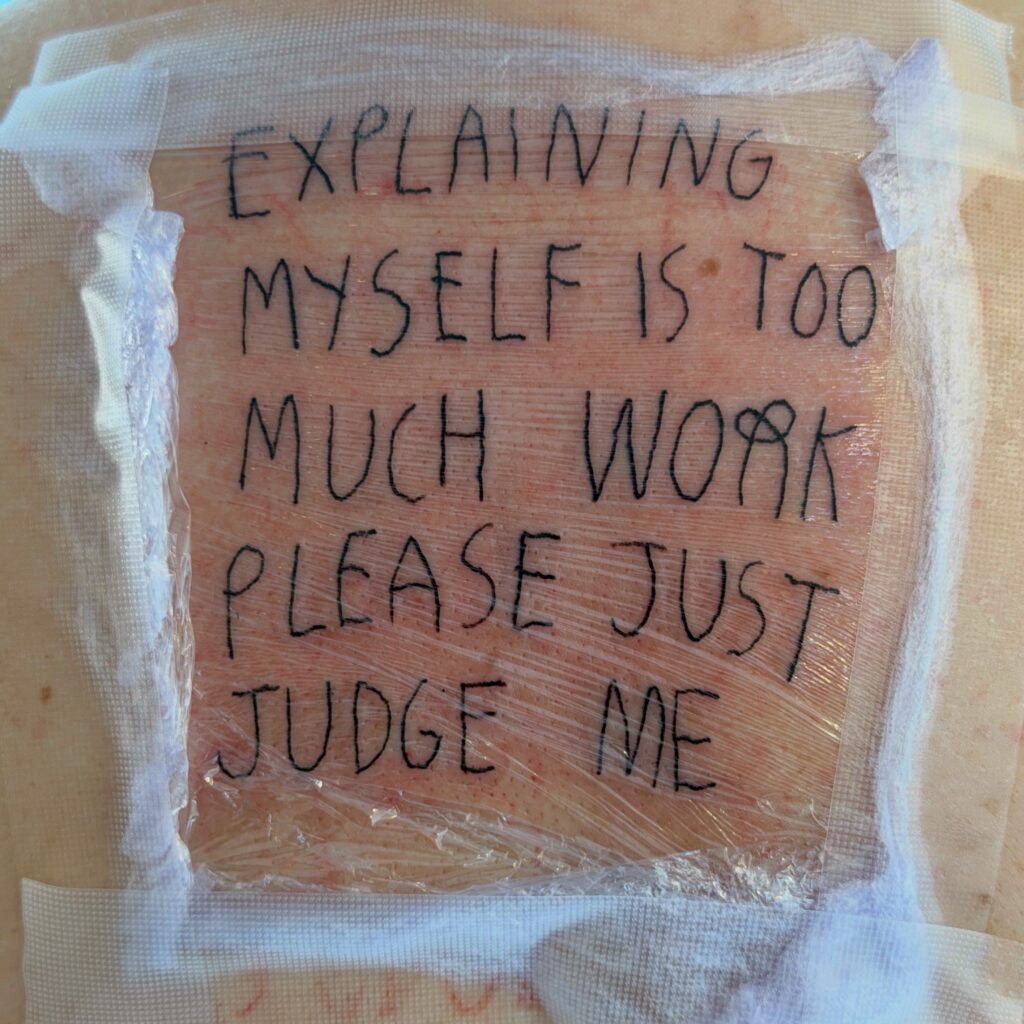
Your artistic practice revolves around language, humor, and personal expression. How does that translate into your tattoo work, and do you approach designing something for someone’s body differently from creating a painting?
CB Hoyo: The visual language is essentially the same as in my paintings. I work primarily with words, sentences, and my own handwriting. But the creative process is much more collaborative.Usually, somebody comes to me with an idea. Sometimes they already know exactly what they want. It might be a sentence from one of my existing works, a particular quote they’ve connected with, or a word that means something to them. We discuss it, and if I like the idea, we move forward. If I don’t, I simply won’t do it.
I think that’s an important distinction. Just because somebody wants something tattooed doesn’t automatically mean I want to make it. I still approach it as an artwork, and I need to feel comfortable with what I’m creating.
I also have a little book where I collect words, sentences, and ideas that I’d personally love to tattoo. So if somebody comes to me without a particular idea, I give them the book and let them explore it. Sometimes they find something that immediately resonates with them, even though it was originally written without that person in mind. I find that quite beautiful.
What interests me is how the same sentence can acquire completely different meanings depending on who’s carrying it. Somebody might choose a word because it reminds them of a person they love, while somebody else might choose exactly the same word because of a terrible experience they had. The language remains identical, but the emotional meaning changes completely.
I also enjoy the conversations that happen during the process. Sometimes people tell me incredibly personal stories about why they want a particular sentence. Other times, the explanation is so stupid and ridiculous that we spend half the session laughing. Both are equally interesting to me.
The difference from painting is that the person receiving the tattoo participates in the creation of the work from the very beginning. There’s a dialogue, an agreement, and a shared decision. I’m not simply producing something for somebody to consume. We’re creating something together, even though the artistic language remains mine.
Your work often explores ideas of authenticity, authorship, and artistic value. Do you think tattooing challenges traditional distinctions between fine art and other forms of creative expression?
CB Hoyo: Absolutely. I think the distinction between fine art and other forms of creative expression has always been somewhat arbitrary. The art world loves putting things into categories. Painting, sculpture, design, craft, illustration, tattooing. As though the medium automatically determines the artistic value of something. I’ve never really understood that.
For me, skin is simply another surface. I can write something on paper, paint it on canvas, put it on a wall, or tattoo it onto somebody’s body. The artistic intention doesn’t suddenly disappear because the material changes.
That’s also why I don’t really sell what I do as a conventional tattoo service. I sell it as art. The person isn’t simply paying for a word permanently written on their skin. They’re commissioning an artwork in my handwriting, created specifically for them, on a surface that happens to be their own body.
And I think tattooing raises some fascinating questions about ownership. If I tattoo an artwork on somebody, who owns it? I created it, but they carry it. I can’t take it back, put it in an exhibition, or sell it to somebody else. And they can’t exactly hang it on their wall. Unless they do something incredibly disturbing, which I’d strongly advise against.
There’s also this beautiful contradiction between permanence and impermanence. A tattoo is supposed to last for the rest of somebody’s life, but eventually, it disappears with them. In an art world obsessed with preservation, provenance, financial value, and creating objects that will survive for centuries, there’s something almost poetic about an artwork that exists only for the duration of a human life.
I think that makes tattooing a particularly interesting medium. It challenges the idea that art needs to exist as a collectible object in order to have value.
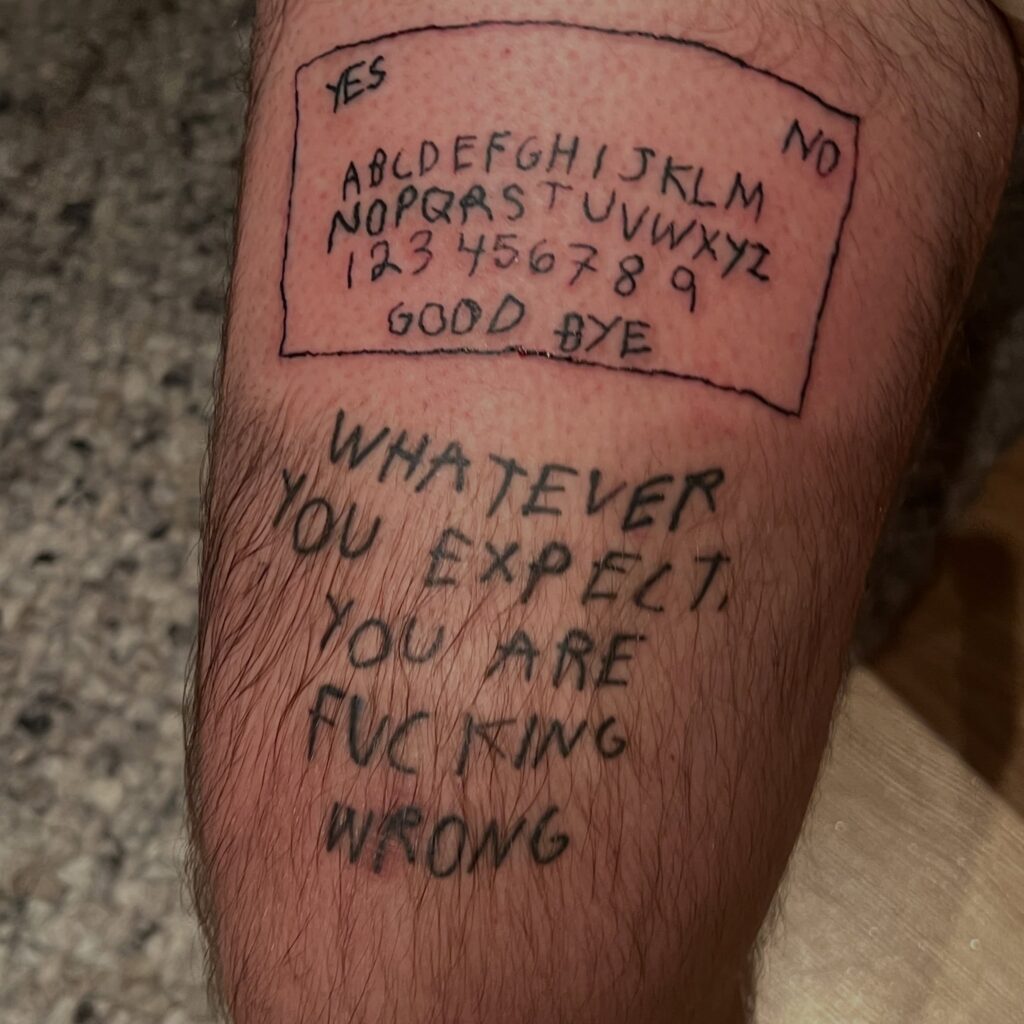
Looking ahead, is tattooing something you’d like to explore more extensively as part of your artistic practice, or do you see it as a separate creative outlet?
CB Hoyo: I think the beauty of tattooing, at least for me, is that I don’t have any particular expectations of where it should go. I’ve never been particularly interested in planning every aspect of my artistic career. Some of the most interesting things I’ve done happened because I was bored, curious, or simply wanted to try something new. Tattooing is a perfect example of that.
What I enjoy about it is the human interaction. There’s something quite special about spending a few hours with somebody, hearing their stories, sharing a few laughs, and knowing that this rather ordinary encounter will leave a permanent trace on their life. It’s a very unusual kind of relationship between an artist and an audience.
I also like the fact that every tattoo eventually develops a life of its own. I might create something for somebody today, but I have absolutely no control over what that sentence will mean to them in ten, twenty, or fifty years. The person changes, their circumstances change, and perhaps the meaning of the artwork changes with them. I find that fascinating.
As for the future, who knows? Maybe one day I’ll incorporate tattooing into a performance or a larger artistic project. Maybe I’ll experiment with completely different approaches. Or maybe I’ll get bored of it next year and move on to something else. I wouldn’t rule out any of those possibilities.
I think the moment I start feeling obligated to do something is usually the moment it becomes less interesting to me. I’d rather allow things to evolve naturally, without having to turn every curiosity into a five-year business plan. For now, I’m enjoying it. And that’s a perfectly good reason to keep doing it.
Ok CB, now to something totally different. In a parallel universe who would you be? And what would you be doing?
CB Hoyo: Probably a chef. Or a very successful dictator. I actually think about parallel lives quite often. There are so many versions of ourselves that could have existed if we’d made one different decision at some completely insignificant moment. If I hadn’t left the kitchen in 2017, I could probably be running a restaurant somewhere, screaming at people because somebody overcooked a piece of fish. I still love cooking, and I think there’s something beautiful about creating an experience that disappears almost immediately after somebody enjoys it.
But I’d also love to be an explorer. Somebody who spends his life traveling, discovering strange places, meeting people, eating things he probably shouldn’t eat, and getting into situations that make absolutely no sense. Although, now that I think about it, that’s not particularly different from my current life. Maybe in a parallel universe I’d just be somebody with a normal job, a healthy sleeping schedule, and absolutely no desire to make art. That sounds quite exotic to me.
Outside of art, what’s something you’re obsessed with right now, maybe a hobby, a show, or even a food, that keeps you grounded or inspired?
CB Hoyo: Right now? Wine. I’ve fallen into a very deep rabbit hole with wine, and I don’t think I’m coming out anytime soon. Food has always been one of my biggest obsessions. I spent years working in professional kitchens, and even though I left that world, my fascination with cooking, ingredients, restaurants, and the culture surrounding food never disappeared. But lately, wine has become a whole new universe for me. I’m discovering just how complex and fascinating it is, from the people who make it to the places it comes from, the history, the geography, and all the little details that can make two bottles of wine completely different experiences.
I have a tendency to become obsessively interested in things for periods of time. Right now it’s wine. In two months, I might wake up and decide that I need to start collecting rocks. Then perhaps watches. Who knows? I have several collections and interests that remain constant throughout my life, but I also go through these intense, temporary obsessions where I want to learn absolutely everything about something until another subject comes along and steals my attention.
Another thing I’ve been particularly interested in lately is religious art from before the nineteenth century. There’s something fascinating about the craftsmanship, symbolism, devotion, and history behind those objects. I’m not necessarily interested in them from a religious perspective, but rather in the way humans have used art for centuries to give physical form to things they couldn’t fully explain or understand. I think curiosity is probably the closest thing I have to a permanent hobby. The subjects just keep changing.
Can you tell me a story about a time when a connection with someone had a big impact on you?
CB Hoyo: I think one of the most important relationships I’ve developed throughout my career is with Marcello and Nick, my gallerists at Plan X. We met back in 2018, when all of us were more or less just beginning our journeys in the art world. None of us really came from the traditional art establishment. We were outsiders trying to figure things out, and I think that’s part of what brought us together. We shared a genuine love for art, a certain curiosity, and perhaps a healthy disregard for how things were supposedly meant to be done.
We organized a pop-up exhibition together in 2018, and that experience eventually led them to establish Plan X as a gallery. It’s quite funny to think that something we did together when we were all just starting out became the beginning of something much bigger. Over the years, we’ve grown together. They’ve opened an enormous number of doors for me, and we’ve experienced so many important moments in our respective careers side by side. But what makes the relationship particularly meaningful to me is that it has gone far beyond the professional side of things.
They’re not simply my gallerists. They’re genuinely some of my closest friends. We’ve shared successes, frustrations, difficult moments, ridiculous experiences, and countless conversations that had absolutely nothing to do with selling paintings. There’s a level of trust and understanding that you can’t manufacture through a business relationship.
I think the art world can sometimes become incredibly transactional. People meet because they want something from one another, and relationships are often measured by what they can provide professionally. So finding people with whom you can build something meaningful, while also developing a genuine friendship, is incredibly valuable. Looking back, I think one of the most beautiful things about our relationship is that none of us knew exactly where we were going when we met. We just believed in what we were doing and, in many ways, helped each other grow into the people we are today. That’s something I appreciate enormously.
What qualities do you find most important in the people you choose to spend time with?
CB Hoyo: Curiosity, honesty, humor, and the ability to not take themselves too seriously. I love people who are genuinely interested in the world. People who ask questions, who have strange ideas, who can have a conversation about absolutely anything without worrying about whether they sound intelligent.
I also have a particular weakness for people with a completely fucked-up sense of humor. The darker, more twisted, and more inappropriate, the better. I tend to get along extremely well with people who have that kind of humor, especially when they’re intelligent enough to understand the difference between making a joke and actually believing something horrible. I also appreciate people who are comfortable being themselves. There’s nothing more exhausting than spending time with somebody who’s constantly performing a version of who they think they’re supposed to be.
And I love people who know how to enjoy life. People who love eating, drinking, sitting around a table for hours, and appreciating the small pleasures. You don’t need to be wealthy or particularly sophisticated to enjoy a beautiful meal, a good bottle of wine, or an interesting conversation. You just need to know how to appreciate those moments.
I don’t particularly care what somebody does for a living, how successful they are, or how many important people they know. I’d much rather spend an evening with somebody who has an interesting perspective on life than somebody whose entire personality revolves around their achievements. I also value people who can disagree with me. I don’t want to surround myself with people who constantly tell me I’m right. That sounds incredibly boring.
Anybody you look up to?
CB Hoyo: I admire people who have the courage to follow their own curiosity, even when it takes them somewhere completely unexpected. People who aren’t afraid to reinvent themselves, question what they’ve already achieved, or abandon something successful because they no longer find it interesting. I find that much more impressive than somebody who becomes very good at doing one thing and then repeats it for the rest of their life.
I also have enormous respect for people who create things without needing recognition. There are incredibly talented, intelligent, and imaginative people all over the world whose names we’ll never know. And I think it’s important to remember that visibility and significance aren’t necessarily the same thing.
Some of the people I’ve learned the most from have absolutely nothing to do with the art world. I don’t really believe in putting people on pedestals. The moment you start treating somebody as though they’re incapable of being wrong, you stop seeing them as a human being. I’d rather admire particular qualities in people than turn anybody into an unquestionable authority.
What motivates you?
CB Hoyo: Curiosity. And probably a certain inability to leave things alone. I’m constantly wondering what would happen if I tried something differently. What happens if I take this idea and make it ten times bigger? What happens if I repeat the same word a hundred times? What happens if I give a machine the ability to reproduce my handwriting? What happens if I make an artwork that costs one euro?
Sometimes those questions lead somewhere interesting. Sometimes they’re a complete waste of time. But I think the possibility of discovering something unexpected is what keeps me going.
I’m also motivated by the simple pleasure of being alive. As corny and clichéd as that sounds, I genuinely want to be happy. I want to enjoy my life, do whatever the fuck I want, whenever I want, and however I want. That freedom is incredibly important to me. I don’t want to spend my entire existence working toward some imaginary future where I’ll finally allow myself to enjoy things.
And, of course, my son and my cat. They’re both incredibly important to me, and in very different ways they remind me that there’s a whole world outside of whatever ridiculous problem I’m obsessing over in the studio that day. I’m also motivated by the fact that there’s so much I haven’t done yet. I don’t want to look back at my life and realize that I spent most of it repeating things I already knew how to do. Success is nice. Money is useful. Recognition opens doors. But none of those things would be particularly interesting to me if I lost the freedom to remain curious and enjoy the life I’m building.
How would you describe a perfect day?
CB Hoyo: First of all, absolutely no alarm clock. I want to wake up whenever my body decides it’s time to wake up. That’s already a fantastic start. Then I’d go straight to a spa. A proper spa, with a sauna, steam room, maybe a pool, and absolutely no reason to rush anywhere. Ideally, I’d have a really good back massage somewhere in there. I love a good back massage. And a nap. A nap is absolutely essential. Preferably after the sauna, when you’re so relaxed that you can barely remember what day it is.
Then, around three in the afternoon, I’d have a beautiful, long lunch with good company. People who have something interesting to say, who love talking about life, who can have intelligent conversations without taking themselves too seriously. Really good food, excellent wine, and absolutely no pressure to be anywhere else.
I love lunch. I’m not particularly interested in breakfast, and I’m not a huge fan of dinner either. But a proper lunch that starts at three and somehow continues until six or seven in the evening? That’s perfection. You eat, you drink, you talk, you laugh, somebody opens another bottle of wine, and the conversation goes somewhere completely unexpected.
Ideally, we’d wrap things up around seven, and I’d spend the rest of the evening doing absolutely nothing. Maybe another little nap, why not? And then finish the day watching a really good movie, somewhere comfortable and cozy.
The location isn’t even that important. Of course, if I’ve spent weeks somewhere freezing cold and suddenly find myself on a beautiful beach, I’m not going to complain. But the real luxury for me is having the freedom to enjoy those little pleasures without constantly worrying about what comes next. No alarms, a spa, a massage, a nap, a magnificent lunch, good wine, interesting people, and a cozy movie. I genuinely don’t need much more than that.
What’s your favorite movie(s) and why?
CB Hoyo: I don’t think I have a favorite movie. Or maybe I just haven’t found it yet. I’ve watched so many films that I’ve genuinely loved, but I can’t point to one particular movie and say, “That’s it. That’s my favorite film of all time.” I think it also depends enormously on my mood. Some days I want to watch something intellectually stimulating, something that challenges me or makes me think about life differently. Other days I just want to disconnect my brain completely and watch something absolutely stupid and ridiculous. Both can be equally enjoyable.
I do really like Quentin Tarantino, though. I think his films manage to combine many of the things I enjoy about cinema. There’s storytelling, history, action, incredibly dark humor, absurdity, violence, and this wonderful ability to make completely ridiculous situations feel strangely compelling. He balances those elements in a way that I find very entertaining.
But I have a complicated relationship with the idea of choosing one favorite anything. I think the things we love change depending on who we are at a particular moment in our lives. There are films you watch when you’re young that completely change the way you see the world, and then you revisit them ten years later and wonder what the hell you were thinking. And sometimes the opposite happens.
What interests me most about cinema is its ability to make you emotionally invested in the lives of people who don’t actually exist. You can spend two hours watching a fictional character make terrible decisions and somehow come away understanding something about yourself. I think that’s quite extraordinary.
So no, after almost thirty-one years on this planet, I still can’t tell you what my favorite movie is. Maybe I’ll watch something next month that completely changes my mind. Life has a funny way of surprising you. Perhaps my favorite movie simply hasn’t been made yet.
What song(s) are you currently listening to the most right now?
CB Hoyo: My musical taste is an absolute roller coaster. If somebody analyzed my playlists, they’d probably think I had about fifteen different personalities. I can be listening to opera, and the next track will be hardcore techno, followed by salsa, then some 1990s gangsta rap, and suddenly we’re listening to Arabic disco. There’s absolutely no logical progression. It’s a complete emotional roller coaster, and I love it.
I don’t have a favorite genre. If the music is good and it connects with whatever mood I’m in, I’ll listen to it. Growing up in the Caribbean and later living in Europe exposed me to very different musical cultures, so I’ve never felt particularly attached to one particular style. But if I had to name one piece I’ve been listening to obsessively lately, it would be Chucho Valdés’s interpretation of La Comparsa by Ernesto Lecuona. I absolutely love that version. I think I’ve been listening to it at least once a day.
There’s something about that piece that I find incredibly beautiful. The melody, the emotion, the way Chucho interprets it. It has this extraordinary ability to feel nostalgic and alive at the same time. Of course, I have this terrible habit of becoming completely obsessed with a particular song, listening to it on repeat until I’ve practically burned it into my brain, and then suddenly moving on to something completely different. So ask me again in two months, and I’ll probably be listening to some obscure electronic track from a country I’ve never visited.