
Share this
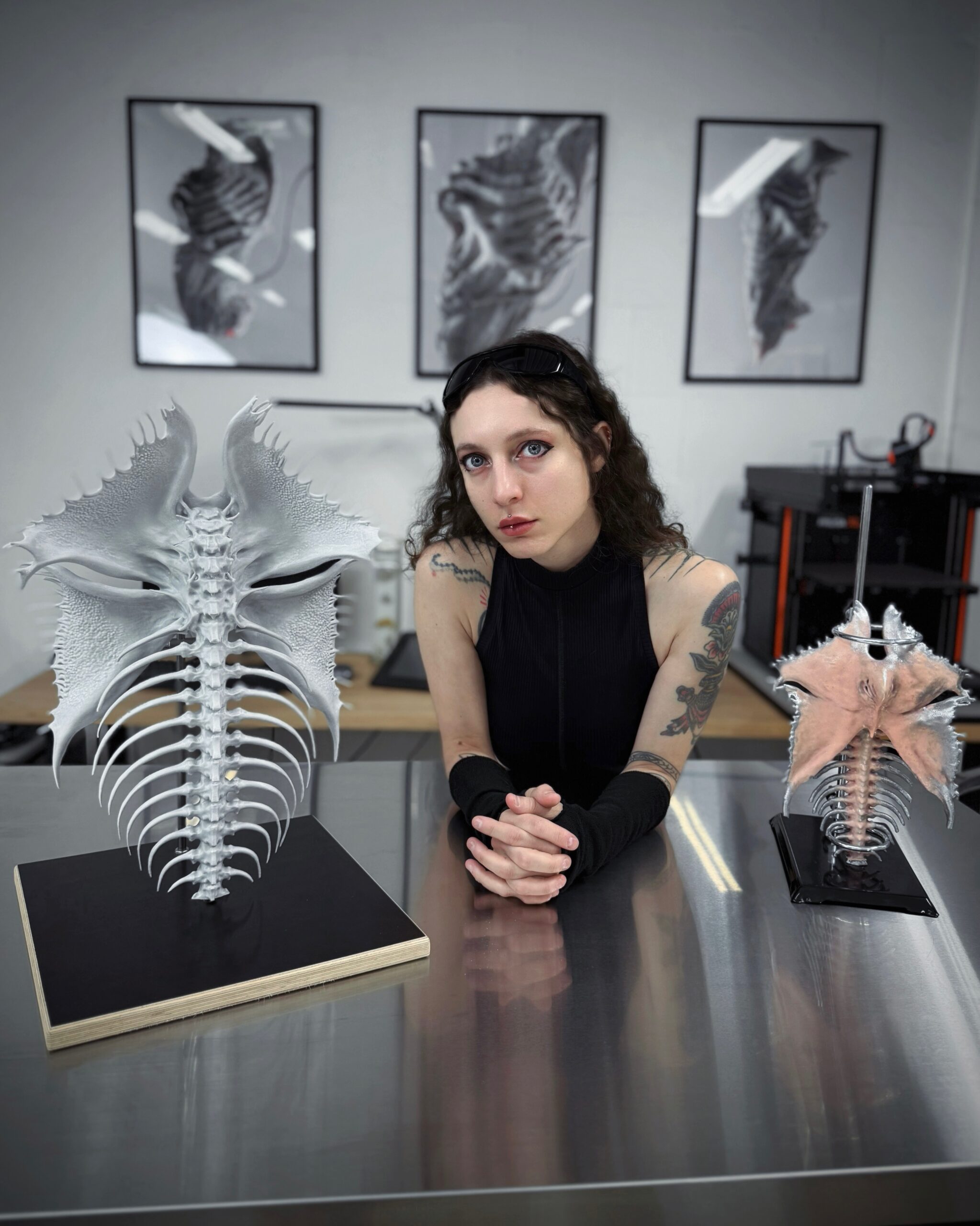
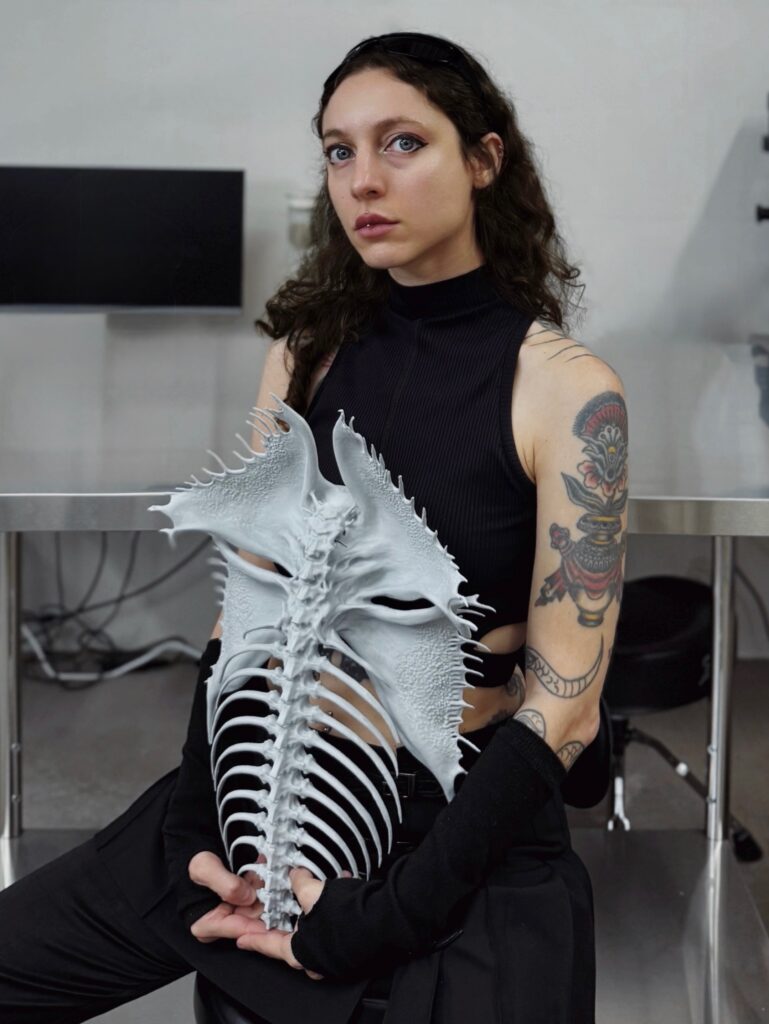
Giusy Amoroso, also known as Marigoldff, is an Italian visual artist based in Berlin, working across digital and physical sculpture, moving image, XR and immersive media. Her practice focuses on how life adapts within synthetic environments through what she refers to as “Hybrid Anatomies” — speculative organisms where organic and artificial systems merge into posthuman forms.
Alongside her artistic practice, she has collaborated on and directed visual projects across electronic music, fashion, and gaming with partners including Nike, Afterlife, Anyma, Riot Games, Harper’s Bazaar, Sony Music, and Cartoon Network.
She is a recipient of the Digital Vanguard Award at Videocittà (2022) and has delivered two talks for TEDx on digital culture and aesthetics.
Her work has been presented at NXT Museum, Printworks London, Videocittà, MIRA, Immersive Tech Week (VR Days), Amsterdam Dance Event, CTM Festival and Pukkelpop, among others, and featured in live performances at Coachella and Red Valley Festival in collaboration with electronic musicians.
Hi Giusy! It’s a pleasure to sit down with you! First question that I always ask. How does a regular day look like for you in Berlin and what originally brought you here from Italy? Do you feel like that shift in environment changed the way you think about bodies, technology and transformation?
Giusy: Hi Rubén , thanks a lot for inviting me. There is no really regular day for me. I try to work simultaneously on many different projects, so what I focus on shifts depending on the day and I like that variability. I do so many different things and try to avoid fixed routines because they tend to slow down my motivation and focus. 😉
But there are a few constants. I always start with a cappuccino with oat milk and take care of my cats before anything else. Beyond that, a day can go in a lot of directions .A long walk, time at the studio, an exhibition opening. I like that the city gives me that range without much planning involved.
I moved to Berlin in late 2018. Before that, I had already been coming here often, visiting friends and going to exhibitions and clubs. I felt a strong connection to the city early on. I think the moment I knew I wanted to move here actually goes back to a high school trip. After finishing university, I decided to make it happen. It is hard to explain exactly what drew me in, but there was a specific energy I responded to. I can be quite impulsive in the sense that when something clicks for me, I tend to act on it quite quickly. The decision to move felt like that kind of moment, so I did not overthink it.
The shift definitely shaped my perspective. My interest in bodies, adaptation, and technology existed long before Berlin, but it was a gradual process that needed a different environment to fully unfold. Moving here gave that research space to take form in a more concrete way. Growing up in Italy, you are surrounded by a very strong classical and historical heritage, where form and tradition are deeply embedded. Berlin feels almost the opposite: raw, experimental, constantly in flux. That contrast created a kind of friction that allowed my ideas to develop and eventually crystallize into the work I am doing now.
What did your earliest encounters with computers, video games or digital images give you that traditional art forms perhaps did not?
Giusy: One of my earliest memories of this was playing Pokémon as a kid. What stuck with me was the mechanic of evolution. The idea that a creature could fight, gain experience, and at a certain threshold transform into something stronger and more complex. It wasn’t a fixed identity; it was a body in progress, defined by what it had been through.
That was probably my first sense that a form didn’t have to be static: that something could change shape or capability depending on accumulated pressure and decisions, rather than just existing as one unchanging object.
What stayed with me from those early encounters was less the medium itself and more a way of thinking. Digital environments were built on systems . Bodies, identities, and spaces could transform according to rules, interactions, or accumulated experience. That concept of form as an active process stuck with me and eventually became central to my own practice.
More than anything, those experiences changed how I thought about imagination. I became interested in building worlds with their own internal logic, where every element feels connected as part of the same whole. That is still how I approach my work today, whether I’m making a digital animation or a physical sculpture.
I’ve never seen digital and physical media as opposing categories. They’re just different ways of exploring the same questions. Ideas often begin digitally because it lets me experiment freely, but they can just as naturally become physical objects. What stays constant is my interest in transformation, adaptation, and the idea that forms are never truly finished.
You have spoken about biology, contamination, and adaptation. When did those ideas first become emotionally important to you, rather than simply visually interesting?
Giusy: It became emotionally important to me very early, though it was not something I could immediately articulate. Growing up near Naples, in the Terra dei Fuochi, I was exposed to the illegal dumping and burning of toxic waste in a very direct, everyday way. The smell in the air and the scorched land were simply integrated into our normal routines.
What stayed with me most was how this reality was perceived. There was a strange, constant coexistence between what I could instinctively sense as wrong, and the fact that it was treated as entirely ordinary. That contradiction created a fracture in my mind that I did not fully understand at the time, but became highly sensitive to.
Over time, I realized that my attention was not only on the contamination itself, but on how both perception and the body adapt to it. How environments can reshape what is felt, what is tolerated, and eventually what is considered normal. It made me think about adaptation not just as an external process, but as something that happens through living systems themselves, through our own anatomies and ways of being in the world.
Only later did I find a language for these questions through biology. It offered a way to think about systems under pressure, and how living organisms respond to conditions that are not ideal but unavoidable.
What I am interested in now is not only transformation as a biological concept, but the moment where adaptation becomes internalized, when extreme conditions stop being external events and start to actively reshape the structure of living systems themselves.
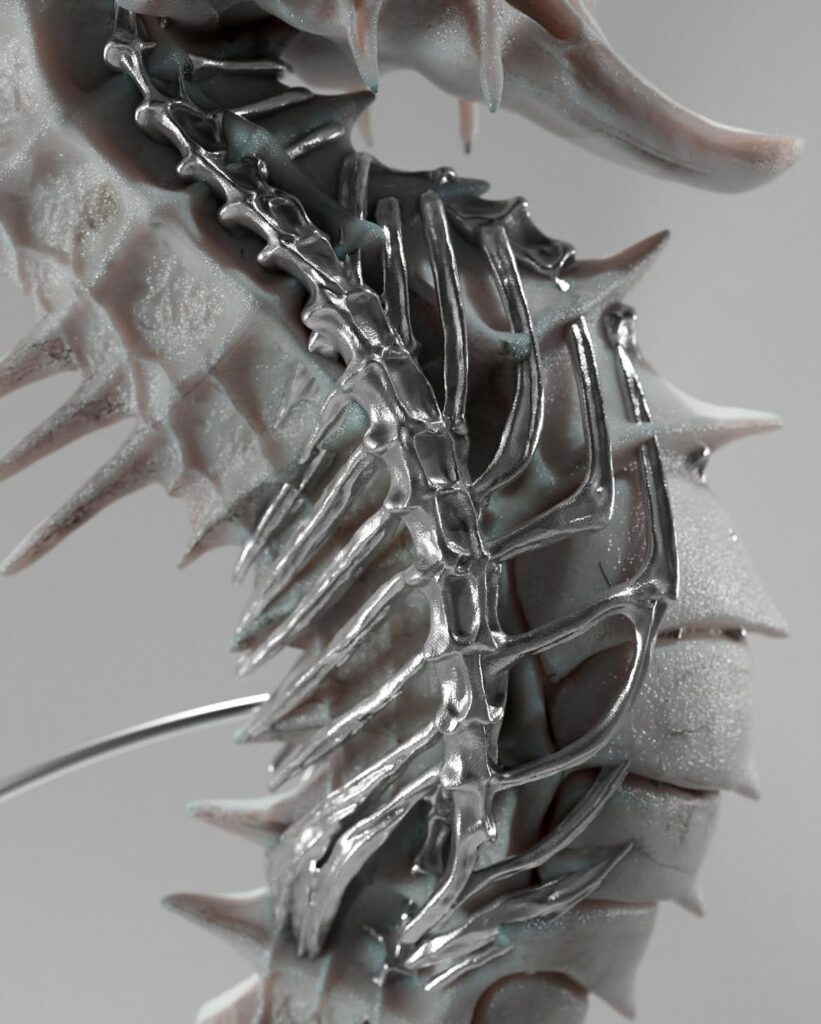
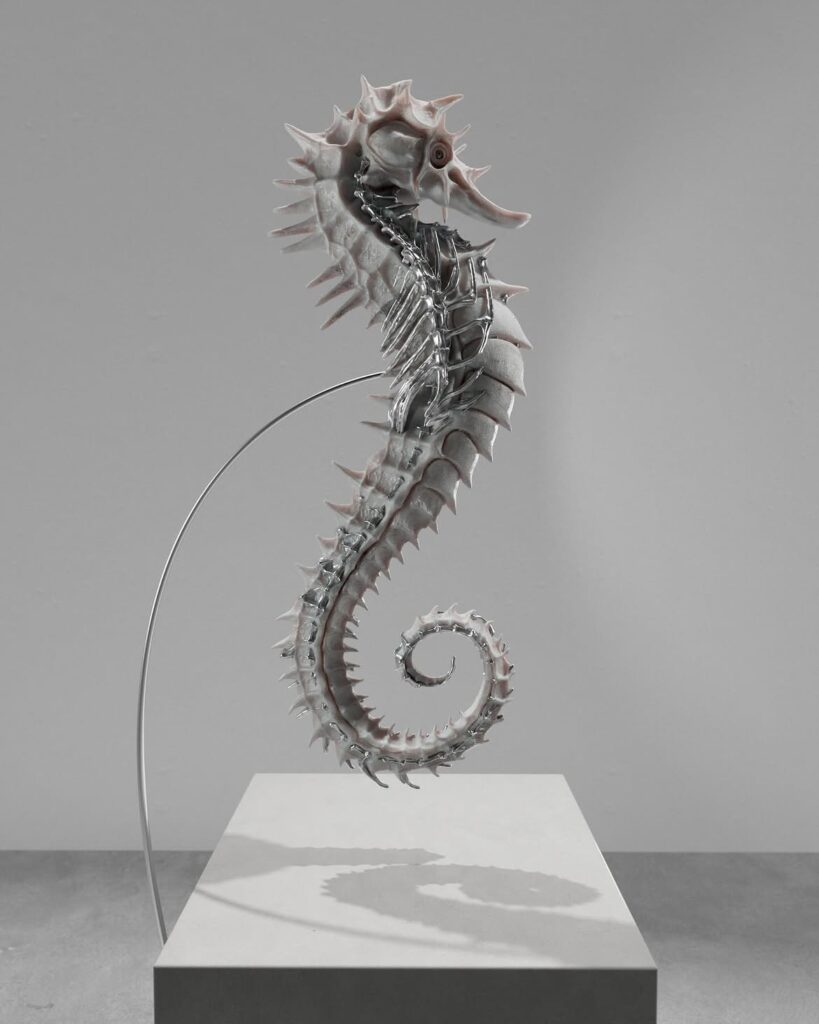
You describe some of your work through the idea of “Hybrid Anatomies.” What does that term mean to you today?
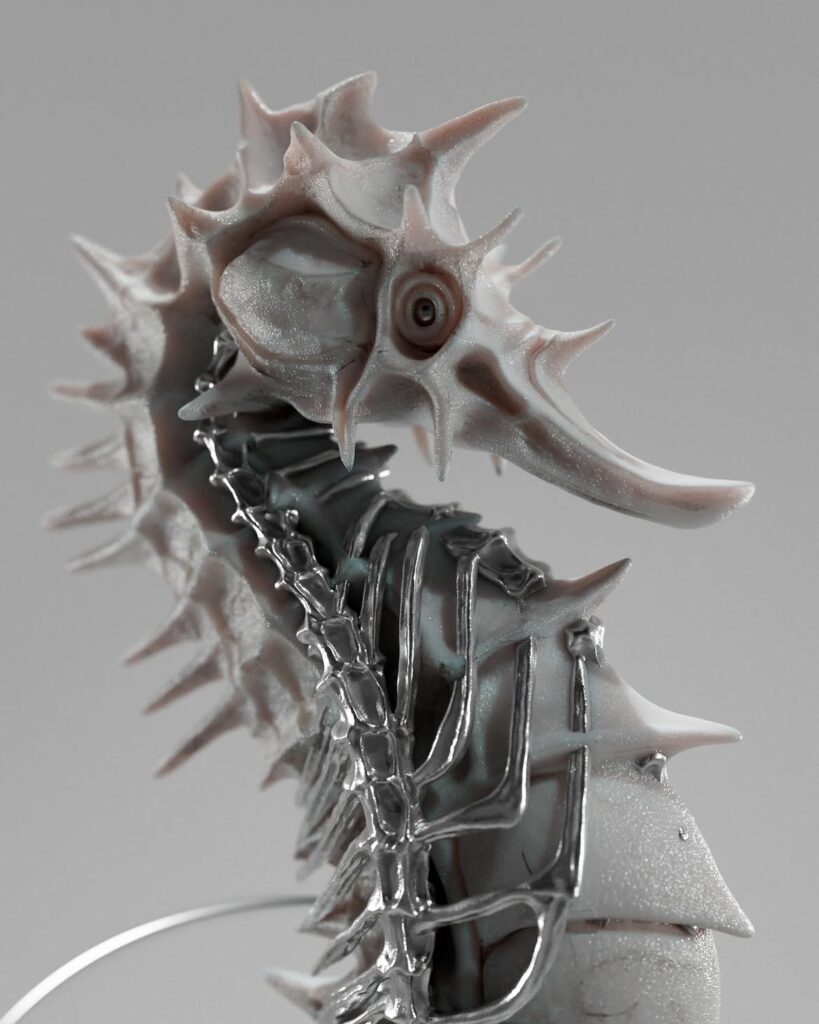
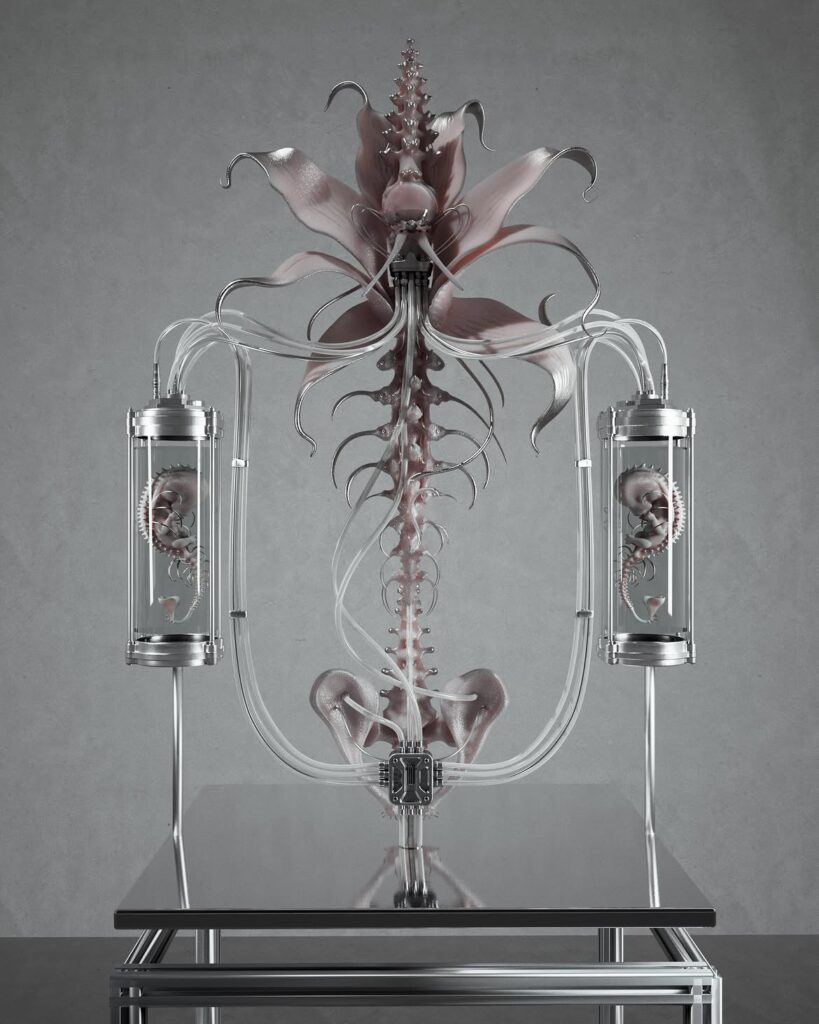
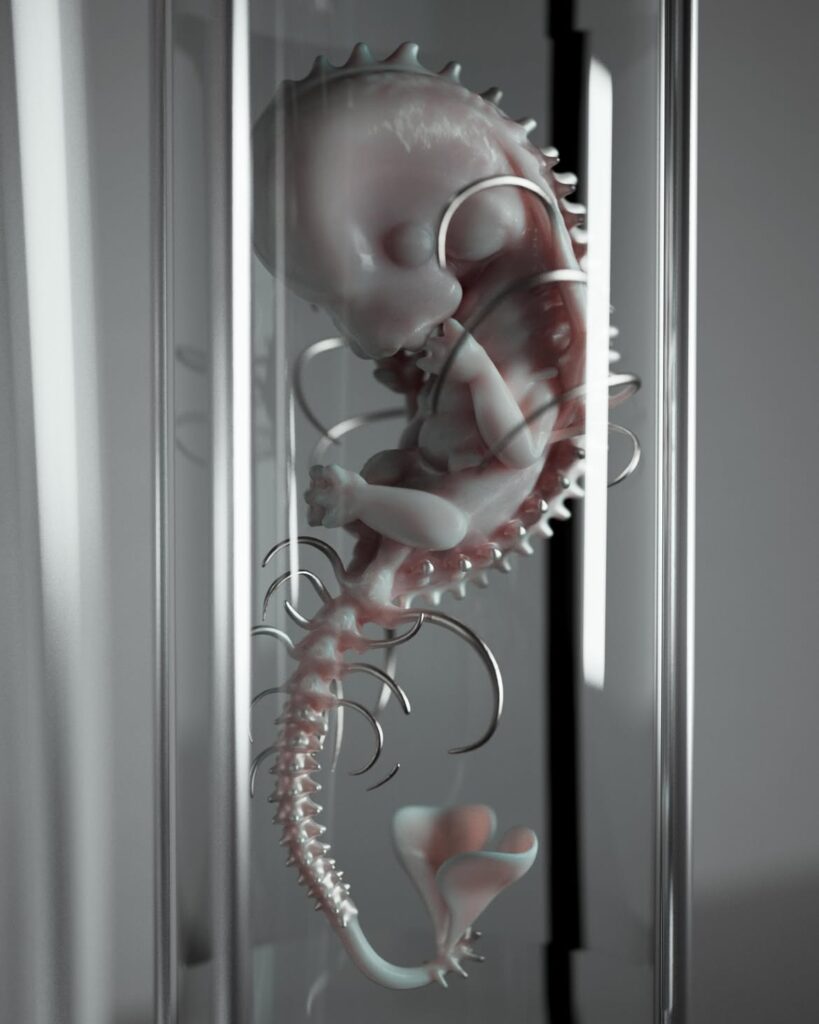
Giusy: The term ‘Hybrid Anatomies’ represents a body under pressure. An organism that has been forced to reconfigure its own structure in order to remain functional within a hostile environment.
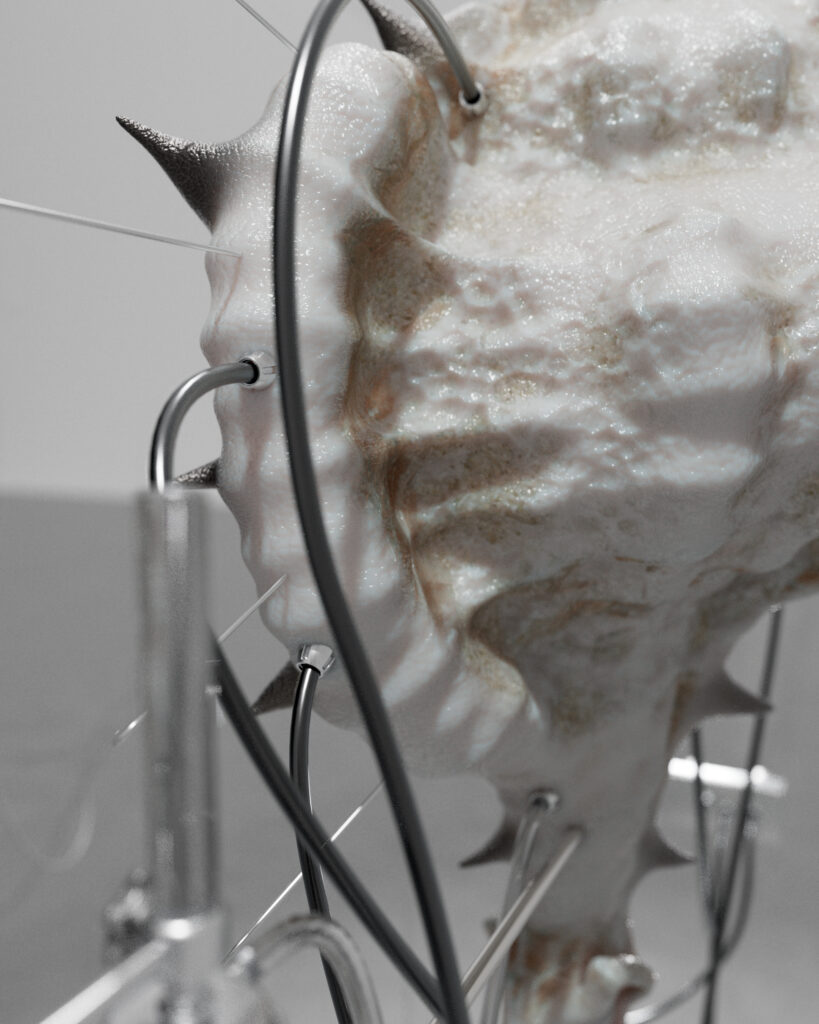
It is important to clarify that the artificial elements I introduce into these forms are never purely aesthetic. Materials like metal and synthetic polymers do not function as accessories added to the outside of the body; they operate as direct extensions or replacements of biological systems. I am interested in the moment where the distinction between an organism and a constructed object becomes entirely blurred.
Today, the term means looking at the body not as a static biological truth, but as an open system. It is a speculative framework for thinking about a future where nature has completely absorbed the industrial world, turning synthetic waste and technology into its own skeleton, its own skin, and its own means of survival.
Many artists use technology to create perfection and smoothness. Your work often seems more interested in mutation, tension, and transformation. Why is the imperfect or unstable body so important to you?
Giusy: Digital tools naturally carry an underlying tendency toward precision and control right? They easily produce smooth surfaces, clean geometries, and symmetrical forms. But what interests me is not that default outcome, but what happens when you introduce friction into the process.
To me, that frictionless smoothness can feel completely disconnected from the reality of living systems. Life is never static or fully resolved; it is shaped by vulnerability, pressure, and constant adjustment.
When I focus on an unstable or transforming body, I am interested in anatomy as evidence of interaction with an environment. Mutation and tension are not visual distortions to me; they are the physical traces of a system responding to conditions.
This is also why I am drawn to digital sculpting tools that replicate the logic of physical clay. They allow me to work with a sense of resistance and accumulation, where forms develop through layers of decisions and interventions rather than clinical, clean construction. I find that process aligns much more closely with how I think about living structures.
An unstable body feels more alive because it is actively negotiating itself—absorbing, resisting, and reorganizing in real time. And through digital tools, I try to work with that state rather than against it, using distortion, strain, and transformation as ways of making that internal process visible. What I am trying to approach is not a fantasy of the body, but a body understood as something continuously shaped by the systems it exists within.
In your work, artificial materials do not feel like accessories added to the body. They often feel absorbed by the body. Is that a hopeful idea, a disturbing one, or both?
Giusy: I don’t see it as either hopeful or disturbing. I am more interested in the ambiguity between the two.
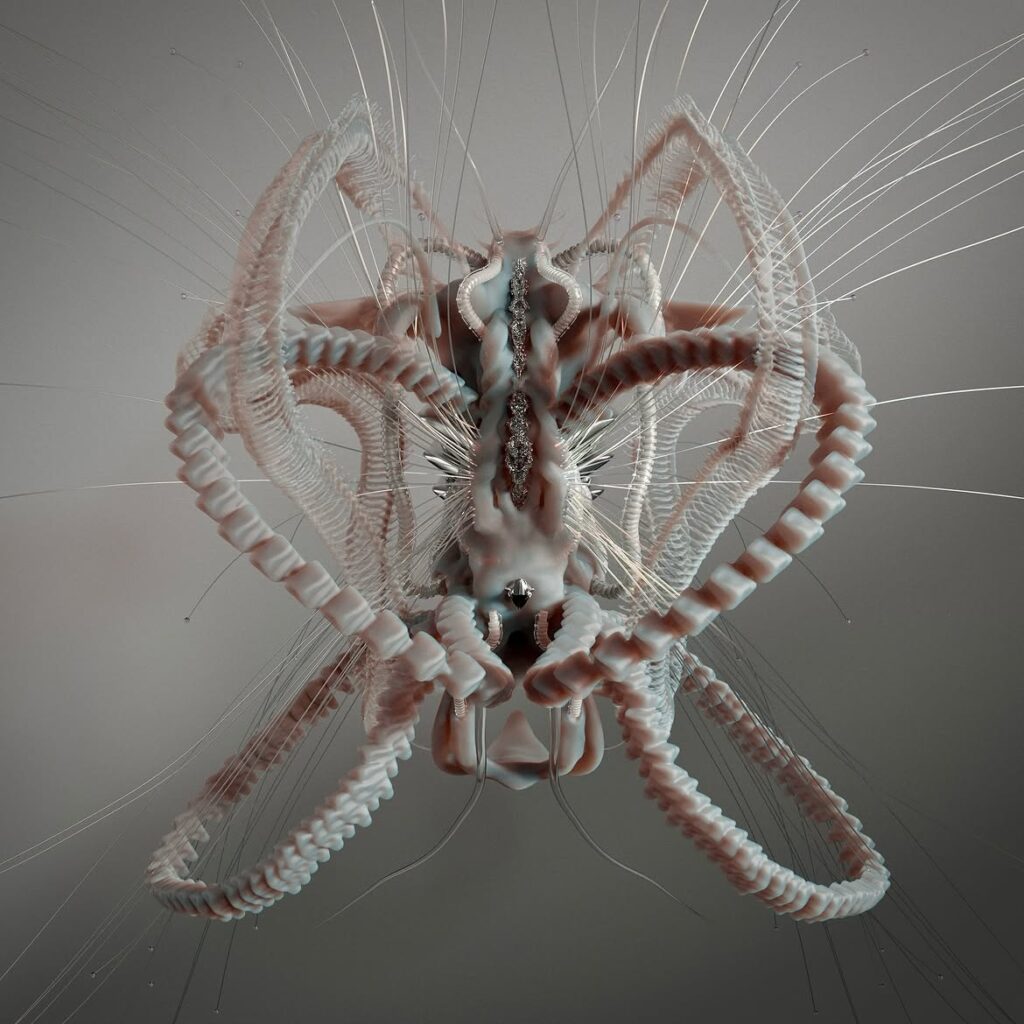
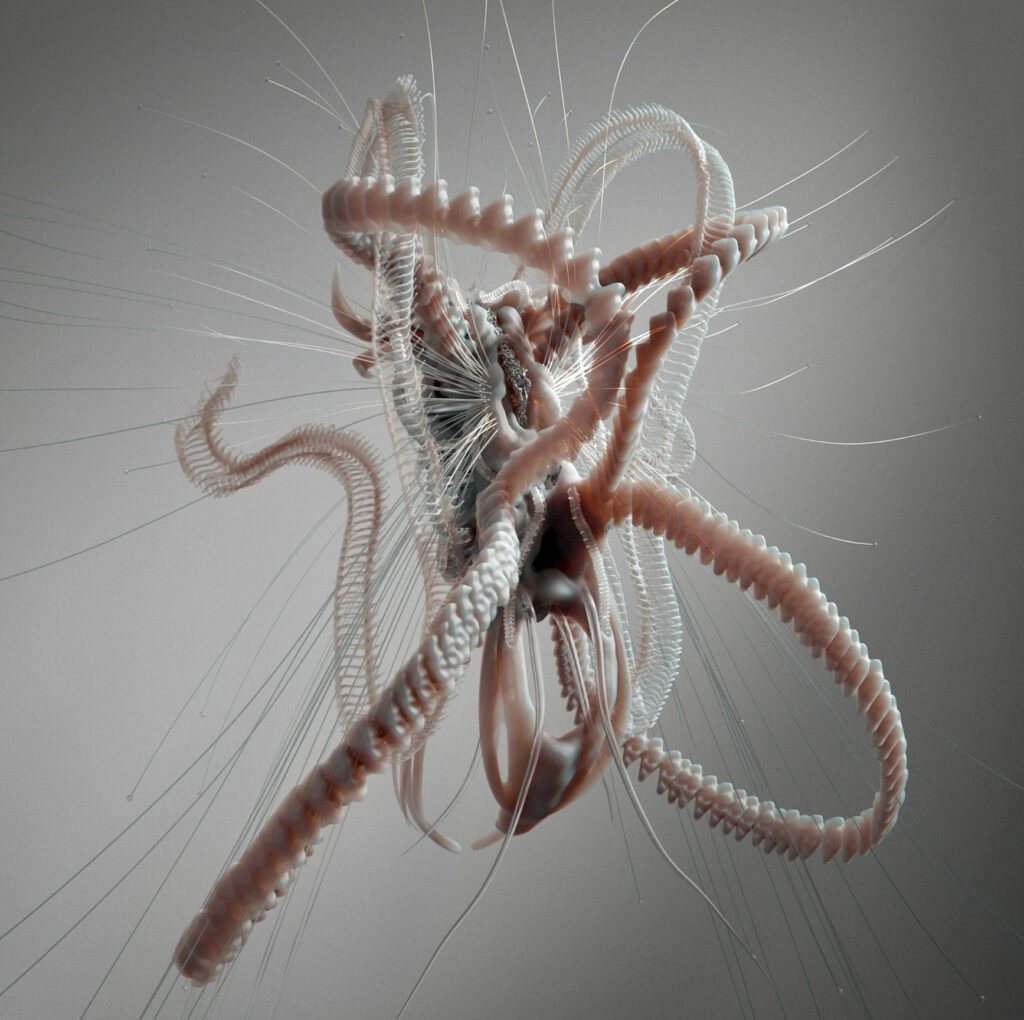
Do you imagine your hybrid organisms as survivors of damaged worlds, or as beings that have already gone beyond our human categories of damage and survival?
Giusy: I see them as beings that have moved past those categories. To describe them as survivors of a damaged world implies a kind of nostalgia. It judges their current state against a past ideal of purity that, for them, does not exist.
The conditions we view as toxic or catastrophic are simply their baseline reality. These organisms do not experience the environment as an external threat to resist; they have already internalized it, converting synthetic matter into functional anatomy.
Because of this, human concepts of ‘damage’ and ‘survival’ do not really apply. They aren’t lingering in a state of trauma or decay. They are fully adjusted, operational systems operating under a new set of ecological rules.
Your forms can be beautiful, but also unsettling. How do you work with that balance between seduction and discomfort?
Giusy: Bringing beauty and discomfort together is a way to challenge perception directly. Our classical heritage has always tied beauty to ideas of purity, symmetry, and preservation — that’s the inheritance I’m pushing against. I believe beauty can be found in anything, particularly in things we tend to overlook, reject, or consider altered.
I’m interested in a different kind of aesthetic value — one found in the unexpected equilibrium of these hybrid structures. There is an uncanny, overlooked elegance when materials that should naturally reject each other reach a kind of harmony instead. Beauty isn’t about perfection; it’s about the compelling logic of a form that has successfully redefined its own boundaries.
Your work asks what life might become when it can no longer separate itself from synthetic or contaminated environments. Do you think adaptation is always a form of survival, or can adaptation also become a kind of surrender?
Giusy: It depends entirely on how you define surrender. If surrender means defeat or giving up, then no, it isn’t surrender. It is the ultimate act of resourcefulness. But if you look at it through the lens of systems and boundaries, it is a form of surrender, but a highly strategic one. It is the surrender of a boundary.
In a traditional biological framework, an organism survives by keeping the outside world out. It fights to maintain its internal purity. When these organisms stop fighting and start absorbing, they are surrendering the illusion that they can remain separate from their environment. They give up their original identity to safeguard their actual existence.
In your body of work, Formae Evolutae, contamination isn’t just a dead end—it becomes a catalyst for the organism’s future. Without downplaying the catastrophe of pollution, why was it important for you to focus on how life mutates and adapts to survive within it?
Giusy: If we only look at contamination as a dead end, we get stuck in passive grief or apocalyptic spectacle. It limits the timeline because it stops at the moment of destruction.
I want to be clear that the catastrophe itself is not in question — what has happened to places like Terra dei Fuochi is real, ongoing harm, not a narrative device. But the reality is that toxic waste is already permanently embedded in the earth’s crust and our biological cycles. It isn’t an abstract metaphor; it is a concrete, material fact. When an organism cannot leave the conditions that are destroying it, rejection is no longer an option.
Focusing on mutation is a way to look at what happens next. It is about documenting the cold reality of biology’s raw persistence. Nature isn’t going to just disappear or pause for our grief — it is going to keep going, even if it has to become completely unrecognizable to do so.
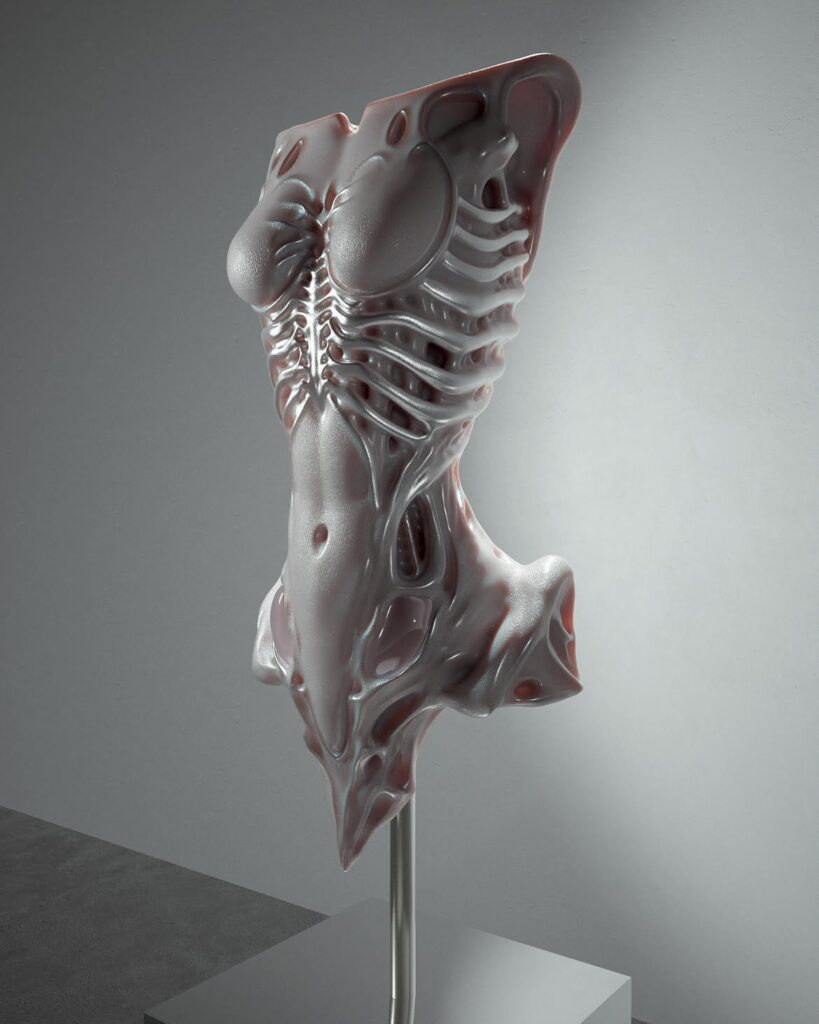
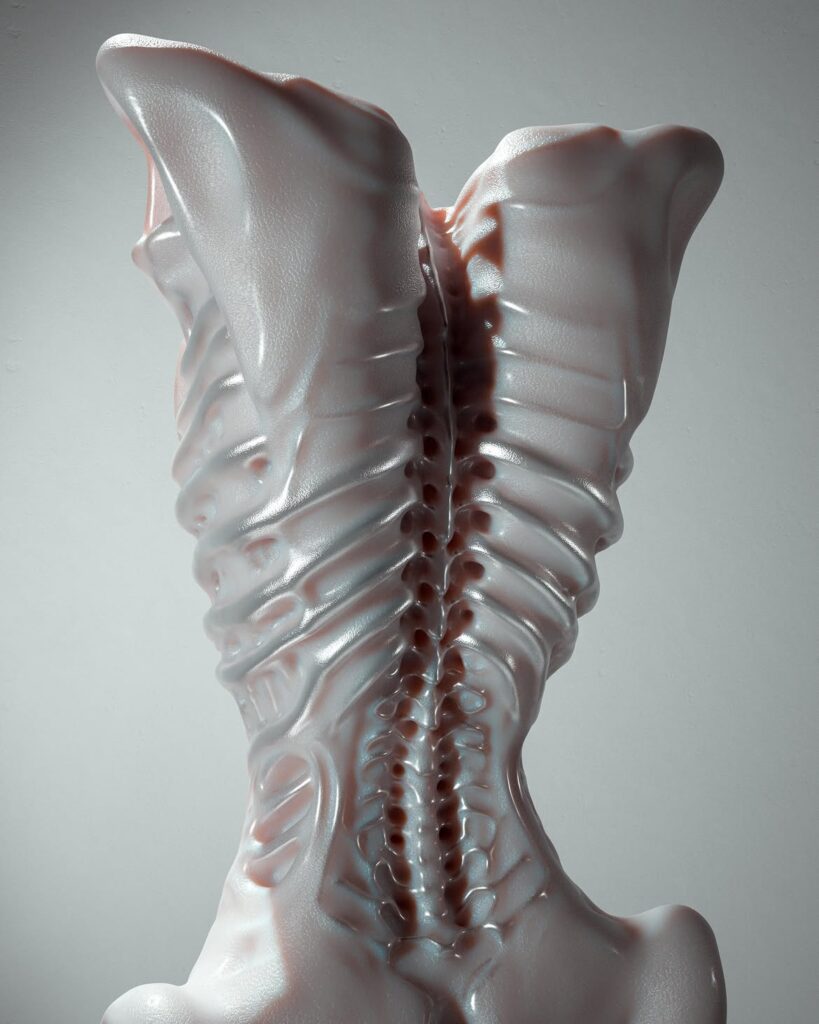
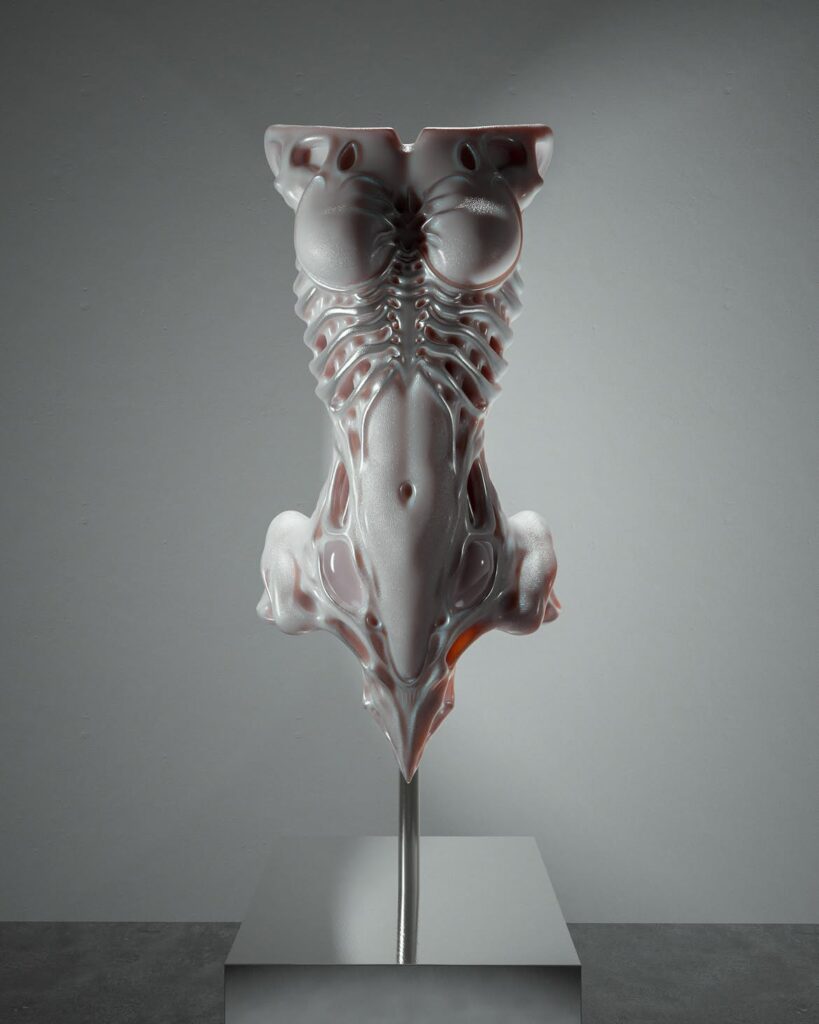
The title Formae Evolutae suggests evolved forms. But evolution is not always progress. What kind of evolution are you interested in here?
Giusy: I am looking at an evolution that is completely blind. It isn’t a forward march; it’s just an opportunistic reaction to a new baseline. In this project, evolution means a forced merger — nature having to digest the synthetic world just to keep existing. Look at plastic-eating bacteria.
They aren’t evolving as a magical upgrade; they are doing it out of sheer necessity because plastic represents a massive, untapped source of carbon and energy. Over just a few decades, these microbes have repurposed enzymes they originally used to break down cutin — a natural polyester found on plant leaves — and turned them into chemical scissors that dismantle synthetic polymer chains instead. They are literally treating our pollution as a survival resource.
There is no moral or biological upgrade here; it’s a strictly horizontal restructuring. Integrating synthetic materials doesn’t make these organisms “superior” to what they were before. It’s not progress; it’s just what happens when the artificial becomes a structural necessity because it’s the only material left to work with.
Your project seems to ask whether life can metabolize the artificial. But emotionally, do you think humans can metabolize the synthetic world we have created?
Giusy: We already do, but we do it through normalization, which is almost terrifying. Human beings have an incredible capacity to adjust to hostile conditions and just accept them as the new normal. When your environment becomes toxic, your emotional baseline shifts along with it. You continue your daily routines, you go to work, you swim in polluted waters, and the crisis becomes background noise because your mind literally has to filter it out so you can function. Just like a bacterium hacks its enzymes to digest plastic, our brains hack our perception to digest horror.
But it comes at a real psychic cost. It is a vital survival mechanism, but it leaves behind a quiet, persistent alienation. We manage to metabolize the synthetic world, but only by allowing it to quietly rewrite what we are willing to tolerate.
In the clinical phase of the project, the organisms appear more dependent on external systems. What interested you about that shift from autonomous survival to technological dependency?
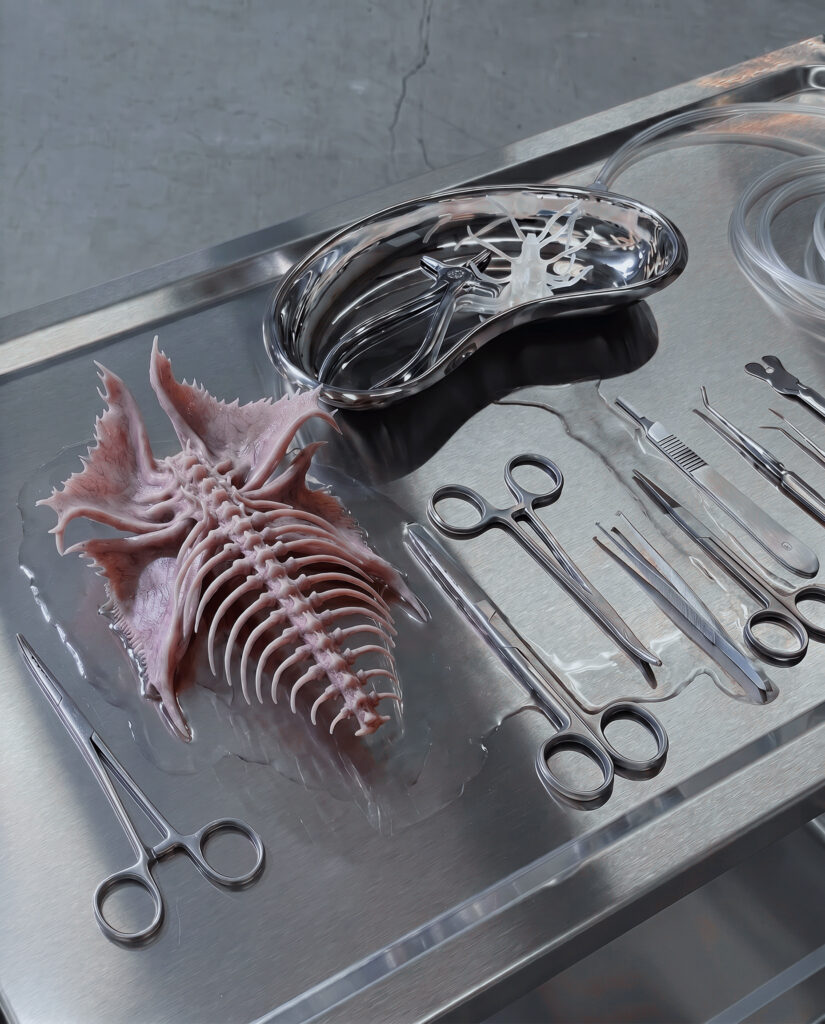
Giusy: This shift marks a specific phase in the project, moving from observing spontaneous mutations in the wild to looking at what happens when these forms are extracted and placed under a clinical lens. It connects to a framework I call Palliative Ecology. It’s the realization that we can no longer “restore” or “cure” nature to bring it back to an untouched past. Instead, preservation becomes about managing a reality where technology and biology are permanently tethered.
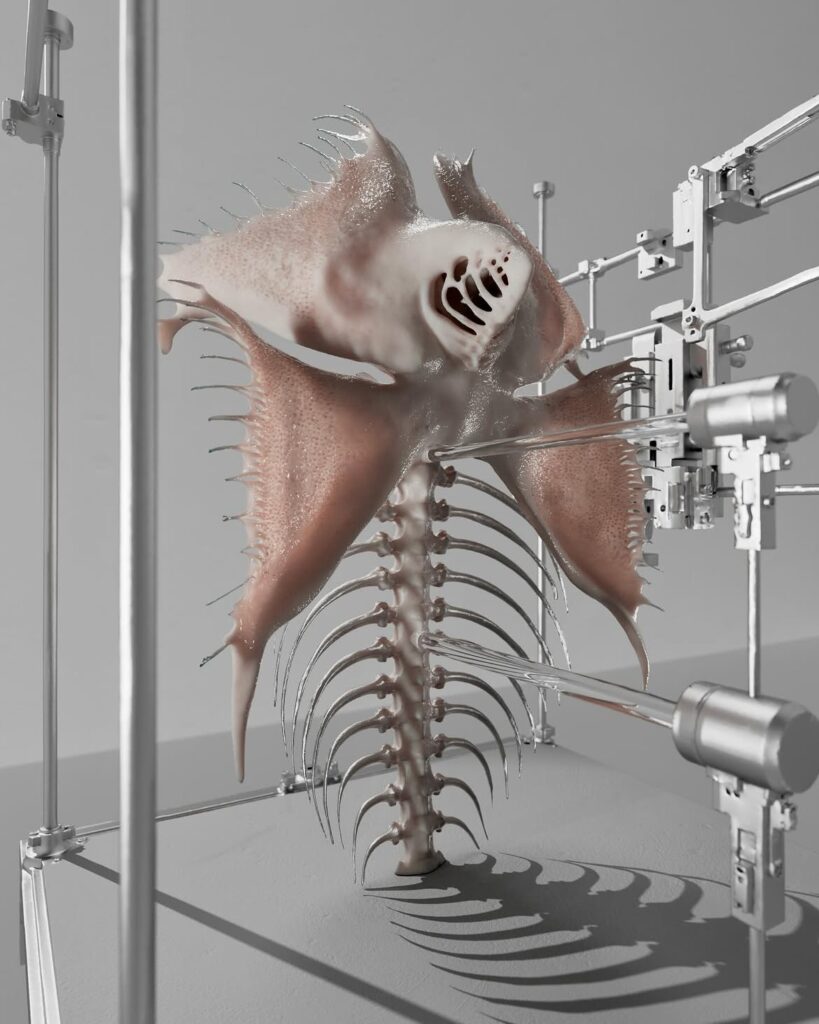
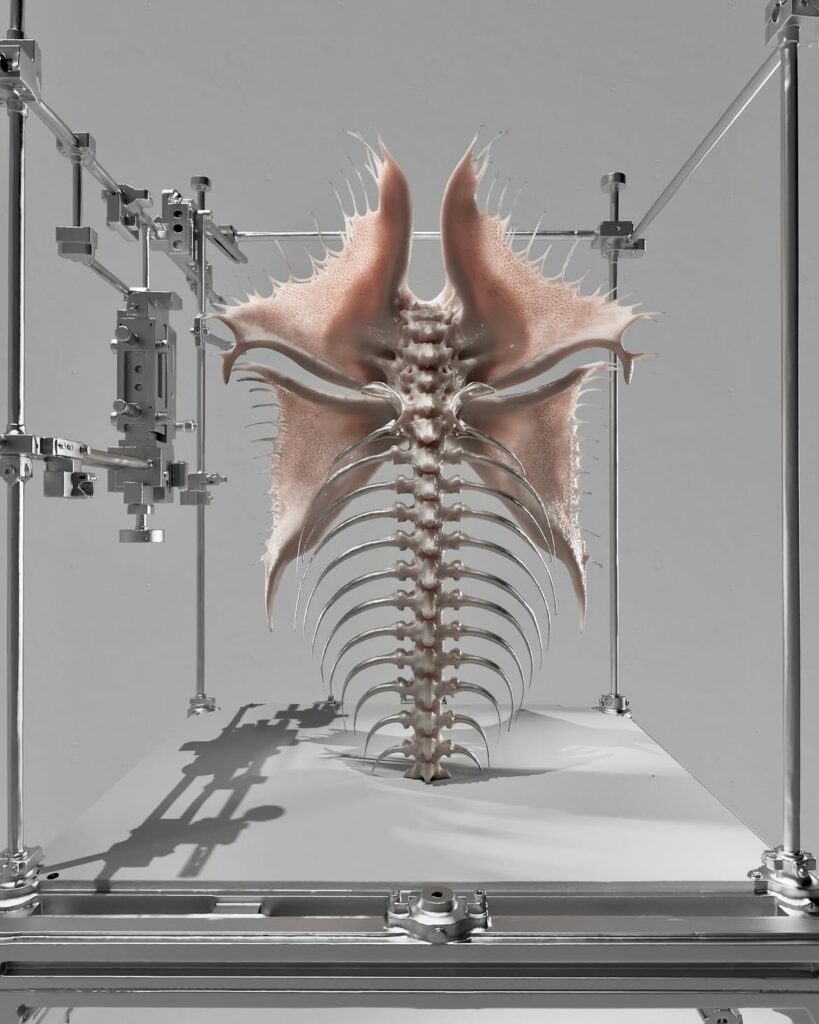
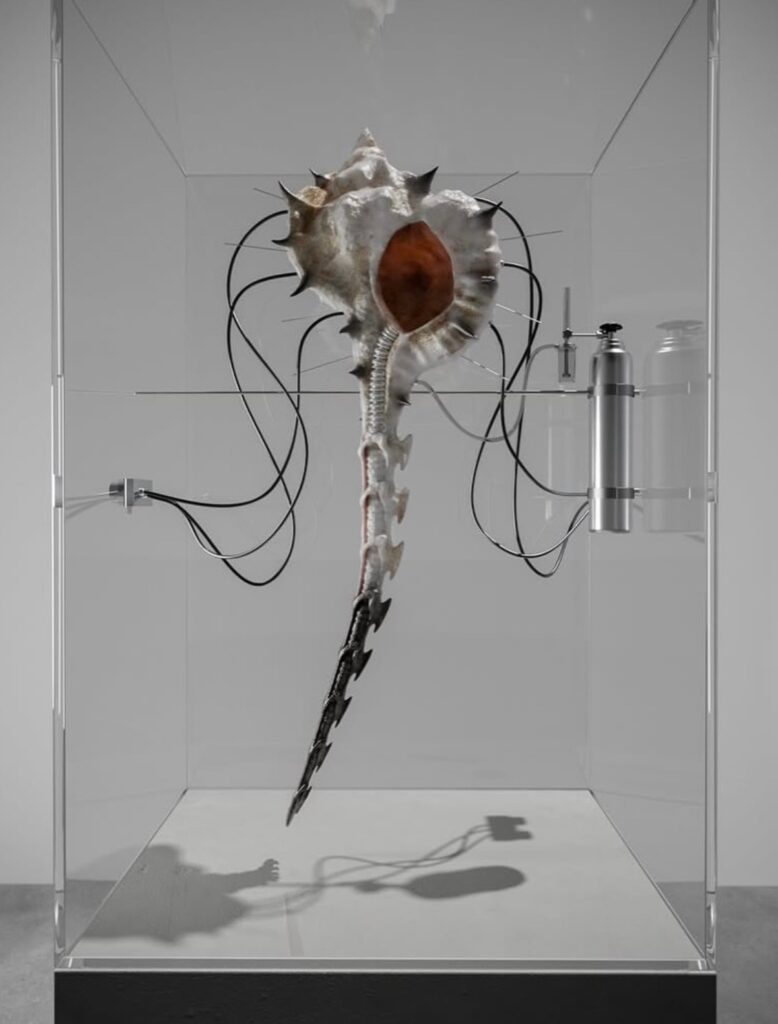
In Specimen 01, the Prosthetic Shell — a one-meter form inside the glass vitrine — the robotic animatronic tail isn’t a separate machine controlling the creature. It functions as an essential, integrated organ supporting its balance. What interests me here isn’t a story of decay, but how far the organism’s architecture can stretch. Once the organism is placed inside an artificial archive, the technological infrastructure and the external cables literally become its new internal architecture. It shows that survival under pressure doesn’t stop; the organism just starts using our machines as its own means of functioning.

If these organisms were displayed in a museum centuries from now, what would they reveal about the world that produced them?
Giusy: They would reveal that we lived in a world where nature and industry stopped being separate systems entirely. They wouldn’t look like tragic monuments of a dead planet or symbols of a crisis; they would look like the starting point of something new growing in its place.
You have worked with electronic music, fashion, gaming, and major cultural brands. How do those collaborations feed back into your independent artistic practice and how do you protect the deeper, more personal language of your work?
Giusy: I see these collaborations as a dynamic extension of my creative field. Industries like gaming, fashion, and electronic music operate on intense, high-level production pipelines, and working within them has been incredible training for my artistic practice. It keeps me sharp structurally. Managing these massive, fast-moving commercial projects has taught me how to organize complex workflows and direct large-scale productions entirely on my own, without needing external management help. You learn a lot by executing projects at that level of rigor, and that discipline feeds directly back into my studio. It gives me the structural backbone to pull off ambitious independent installations.
As for protecting my personal language, I don’t view it as a defensive act. My independent research is the root system. The collaborations are the branches. When a brand or partner approaches me, they are coming to me precisely because of that distinct, deep root system. There is mutual respect. The commercial projects allow me to apply these highly organized production tools in diverse, high-energy contexts, while the independent work remains the foundational space where the core concepts are built and tested.
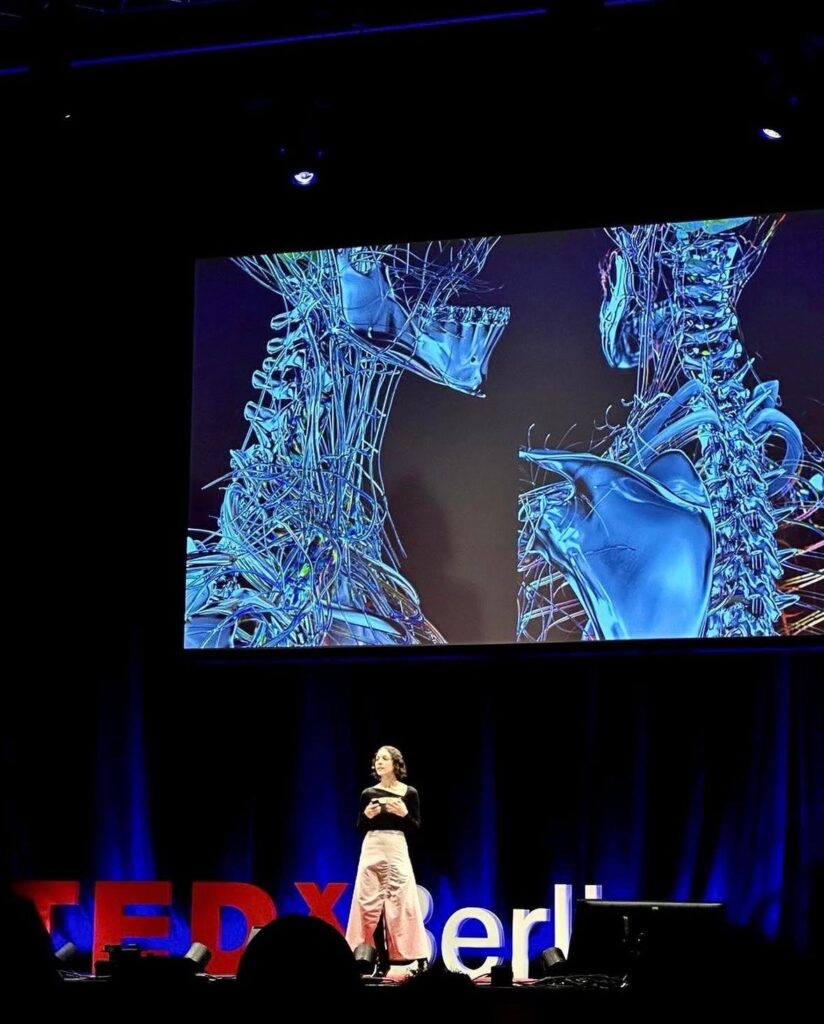
You have given TEDx talks on digital culture and aesthetics. What do you think people still misunderstand about digital art?
Giusy: The biggest misunderstanding I think is the idea that digital art is immaterial or detached from real effort, simply because it exists on a screen. There is often an assumption that the digital is effortless or automated, when in reality it is a highly constructed process. You are building entire environments and defining the logic they operate under, often working through layers of decisions, adjustments, and technical constraints.
What interests me is that digital space is not less material, it is just structured differently. Its materiality comes from data, parameters, and the relationships between elements rather than physical matter. Within that, there is still a lot of tension, resistance, and precision involved in shaping something that does not naturally resolve itself. For me, digital art is not a simulation of physical processes, but another way of constructing conditions where form can emerge.
As you said, Digital art is sometimes dismissed as immaterial, but your work often feels intensely bodily. Is that a misconception you are trying to challenge?
Giusy: Yes, but I’d say the bodily quality comes less from defending digital art against that idea, and more from how I actually build the work. Even when I’m modeling something on a screen, I’m thinking in terms of tension, weight, resistance.. The anatomy has to behave as if it were under real physical conditions, even though none of it exists in physical space. That’s where the bodily feeling comes from — not the material itself, but the internal logic governing it.
What interests me more is what happens after that: how people react. Some respond with fascination, some with discomfort, and often it’s both at once. That ambiguity is closer to what I’m actually after than a clean resolution either way.
You work across digital sculpture, physical sculpture, moving image, XR, and immersive media. How do you know which form a particular idea needs? With that in mind, can you walk me through your creative process from beginning to end?
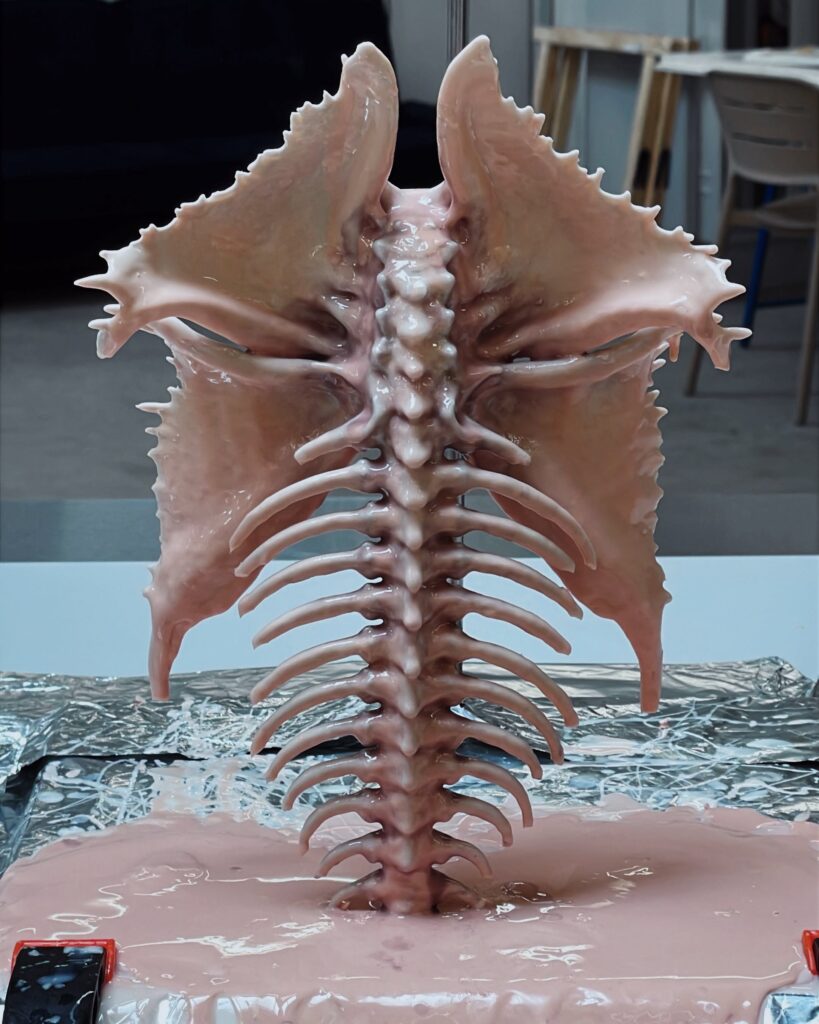
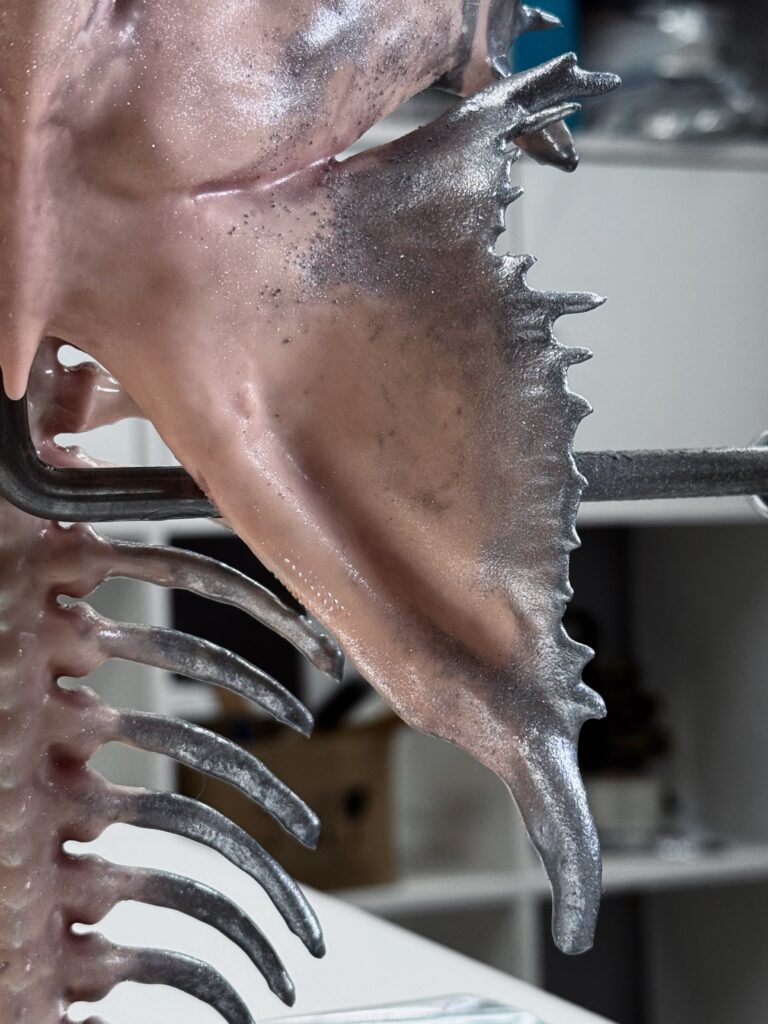
Giusy: I use a completely hybrid approach. For me, these mediums don’t exist in separate categories; they are different entry points into the same system. The process usually starts digitally, but physical sculpture comes from a necessity to feel materiality. It’s a natural progression. For the past year, I’ve been 3D printing my digital work and finding ways to give it a synthetic, organic feel. I use platinum-cure silicone and hand-embed fine, reclaimed aluminum powder that I harvest from salvaged industrial scrap metal. This physical side is about the intimate, tactile reality of the specimen.
But a standalone object can only tell part of the story. That’s where the moving image and spatial technologies come in. Because of my passion for cinema, animation allows me to give these forms a sense of time and behavioral life. From there, working with VR, XR, and immersive media allows me to build the actual dimension they inhabit. They all operate on the same spatial principle: you just cannot experience total environmental scale through a static object alone. By combining them, the sculpture becomes the specimen you observe, while the immersive environment becomes the contaminated biosphere you are forced to step inside of.
Ok Giusy, now to something totally different. In a parallel universe who would you be? and what would you be doing?
Giusy: In a parallel universe I think I would be less defined by doing, and more by perceiving. Something closer to a state than a role.
Outside of art / design, what’s something you’re obsessed with right now, maybe a hobby, a show, or even a food—that keeps you grounded or inspired?
Giusy: Outside of my work I am very into food and cooking. I have been passionate about it since I was young. I like experimenting with ingredients and combinations, and I also enjoy the process of presenting a dish in a very considered way. There is something about composition and attention to detail in cooking that feels similar to working with materials, even if it is much more immediate and intuitive.
I also go to the cinema a lot. Berlin has an incredible range of film programs, and I especially like screenings of older films and silent cinema with live orchestras. There is something very immersive about that format. Beyond that, I often go to classical music and orchestral concerts as well. It is a way for me to step out of my own visual thinking and just experience time and structure differently.
I try to spend time outdoors, usually long hikes with my partner, or underwater — diving, snorkeling, anything that puts me in an environment I don’t fully control. Those are the moments that feed back into the work most directly, even if it takes a while to see how.
What qualities do you find most important in the people you choose to spend time with?
Giusy: I value inclusivity, care, understanding, and direct communication. I look for people who are empathetic but also completely straightforward. I really appreciate clarity—when people say exactly what they think and mean, without games or pretense. It creates a grounded environment where you can actually build a genuine, supportive connection.
What motivates you?
Giusy: Instability. It keeps things alive.
Alright Giusy, I always ask these two questions at the end of an interview. The first is. What’s your favorite movie(s) and why?
Giusy: This is always a difficult question because cinema is a major reference for me, particularly body horror and surreal psychological films. If I had to choose three that I return to often, it would be The Fly by David Cronenberg, Possession by Andrzej Żuławski, and Mulholland Drive by David Lynch.
What connects them for me is not only their distinct visual language, but the way they address transformation and instability—whether on a physical, emotional, or perceptual level.
In The Fly, I am fascinated by the slow, irreversible progression of a body becoming something entirely else, completely beyond human control or repair. In Possession, the focus shifts to emotional and psychological mutation, where the body becomes a literal site of conflict and internal collapse. And Mulholland Drive interests me because of how identity itself becomes unstable, as if reality is continuously shifting and reassembling. They all explore thresholds where fixed structures break down, which aligns closely with how I think about form.
The second is. What song(s) are you currently listening to the most right now?
Giusy: Guggenheim Wax Museum by Have a Nice Life