Share this
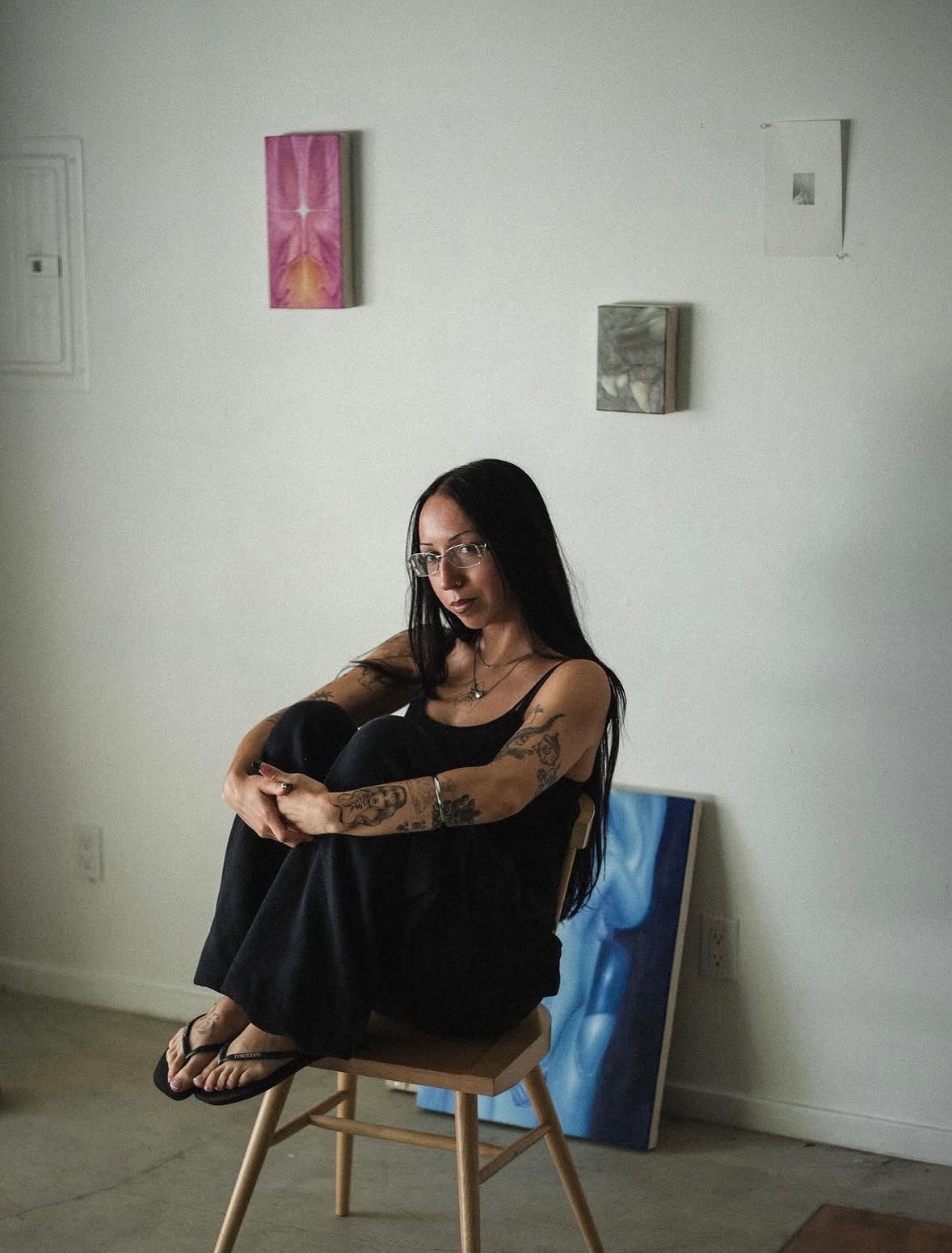
Alejandra Moros (b. 2000, Miami, FL) utilizes painting, drawing, and found objects to explore themes of transformation, science fiction, and adaptation, stemming from an interest in the ways that body modification can serve as a marker of time, place, and intention. She continues to live and work in Miami, exploring the ways in which these themes connect to Florida’s landscape.
Profile picture by Luis Mathison.
Hi Alejandra! It’s a pleasure to sit down with you! First question that I always ask. How does a regular day look like for you in Miami?
Alejandra: I work as a florist a couple days a week, but if I’m not at the shop that day, I’ll try to have a slow morning, since I’ve accepted that I work better at night. I’ll sit outside for a bit, have a coffee, read, and then head to the studio. I love having really long painting sessions, so my ideal day would mean just painting for the rest of the afternoon until late at night.
I’m curious, growing up, what was life like there? And what kind of kid were you? What did you enjoy doing?
Alejandra: I grew up around 40 minutes west of what people envision when they think of Miami, so closer to the swamp than the beach. My parents took my sister and I to the Everglades a lot, and we spent a lot of time outdoors in general. I was a pretty quiet, studious kid. I’ve always loved reading and drawing; I was obsessive and curious and loved having a task. I don’t think my demeanor has changed much.
Do you remember approximately at what age your creative side started to show? And when did you start taking being an artist seriously?
Alejandra: Some of my earliest memories are of drawing with my mom, so thanks to her it’s been a constant. I think she put a pencil in my hand as soon as I could hold onto one. I studied graphic design in college, mostly because I loved (and still love) hand-drawing script, took a painting class while I was there, and pretty immediately realized that I was very drawn to that as a medium.
Ok Alejandra, with these next series of questions, I will try to delve into your work as best as possible. So…. You describe body modification as a marker of place, time and intent. What can a modified body tell us about someone that an unmodified body cannot?
Alejandra: I think I approach it more through the lens that all bodies are modified. Everything has history; everything has something to reveal. I’m much more drawn to the blurring of the line between the body and the changes it’s undergone than the idea of categorizing an individual as “modified.”
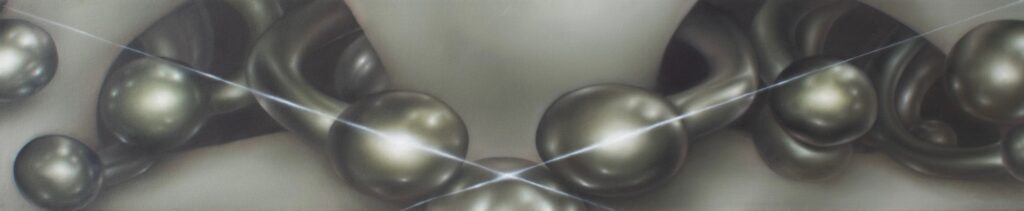
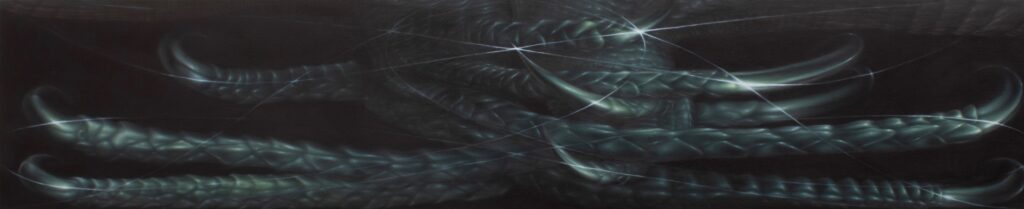
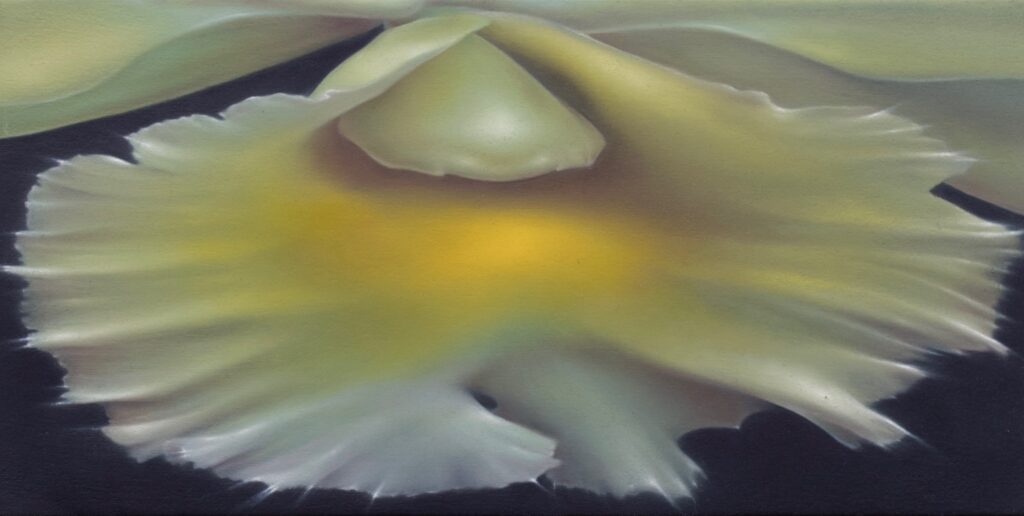
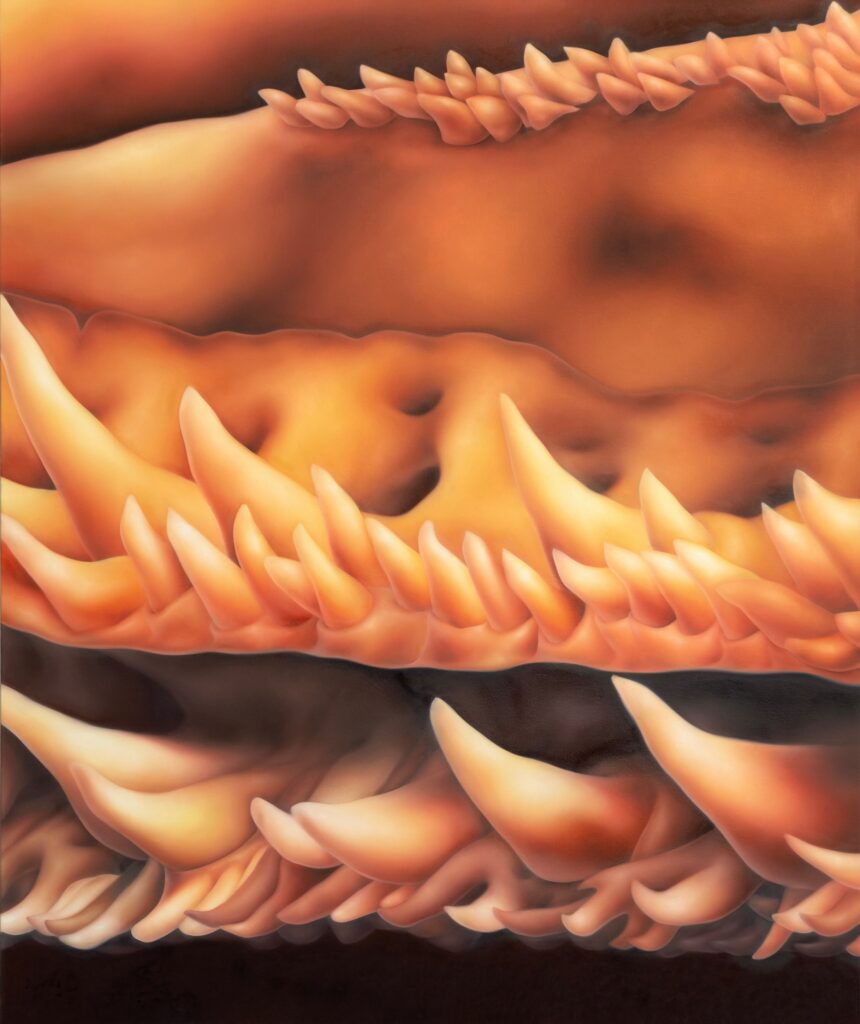
There’s often something seductive and slightly unsettling about your paintings, you’re drawn in before you necessarily understand what you’re looking at. How important is that tension between attraction and discomfort to you?
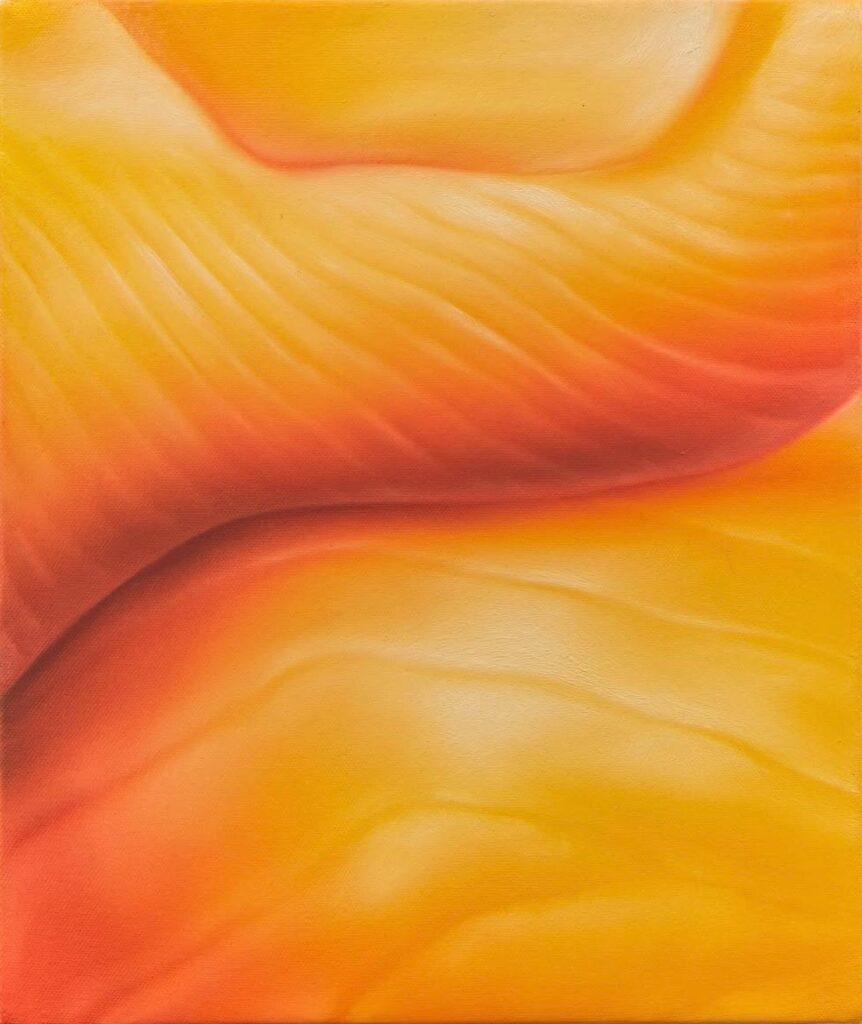
Alejandra: I think the unsettling feeling for people comes from the uncertainty of the subject, or maybe from being so close to an unknown thing, which is something I never feel. I never lose the grasp on what the image is; it never falls so fully into abstraction that I feel detached from the source. But I do think a lot about the idea of the monstrous or alien “other”, which the cropping and distorting allows me to get closer to. The body becoming something more/something different/something changed, which is what drives my search for subjects, becomes mirrored by people’s assumptions about what the work depicts in the first place. The discomfort, and the desire to create context where there is none I guess, creates space for fiction, and that’s just as interesting and fascinating and strange as the source material sometimes.
Piercings, jewellery, scars, prosthetics and other interventions appear throughout your visual world. What is it bout those things that resonate with you?
Alejandra: The adaptability and resilience of the body is a crazy thing. I think the body’s acceptance of something is what gets me. And again, the delineation, or lack thereof, that determines when something is the “other.” What’s no longer considered part of the individual vs what is.
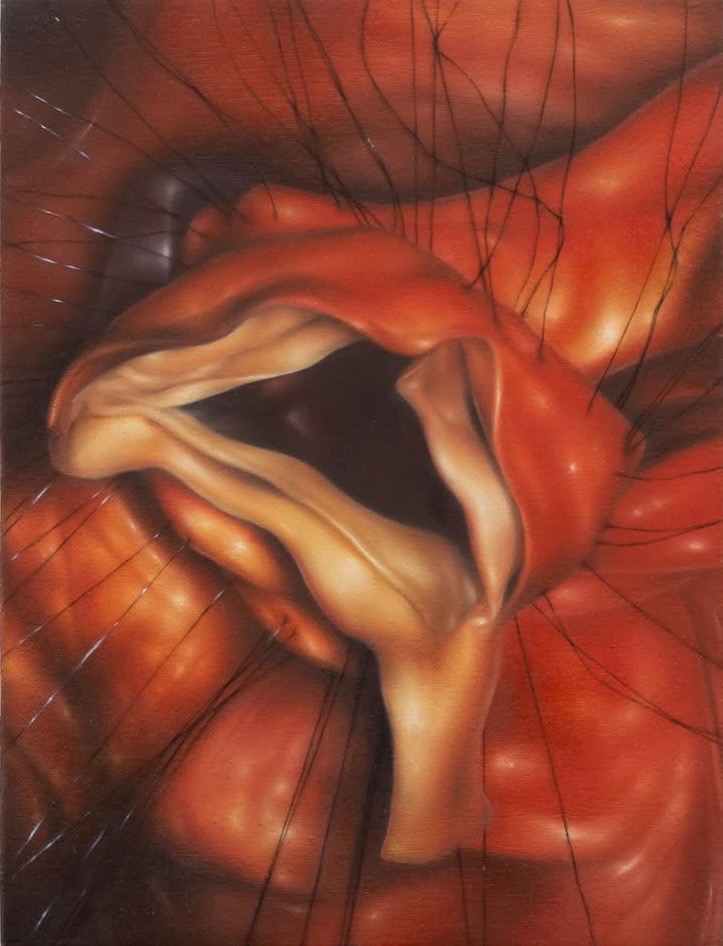
With that in mind… Your work increasingly moves between human bodies, plants, animals and objects. What is it bout those things that resonate with you as well?
Alejandra: All of it is connected; it all has some kind of tie to a body, human or otherwise. I think I treat it all the same, by distorting and cropping and framing similarly, which kind of neutralizes all of it. It exists on the same plane. Everything has tried very hard to be and stay alive, and strange specificity is proof.
You’ve recently been collecting references as varied as Victorian prosthetics, shedding reptile skins and orchid pollination. What connects those things in your mind?
Alejandra: When I’m searching for images one thing will just lead me to the next, although I double back often. The bodies are in Florida, which contains other bodies, which have altered themselves in x way, which has led to their interaction with y, which I saw the same day I saw z, etc.
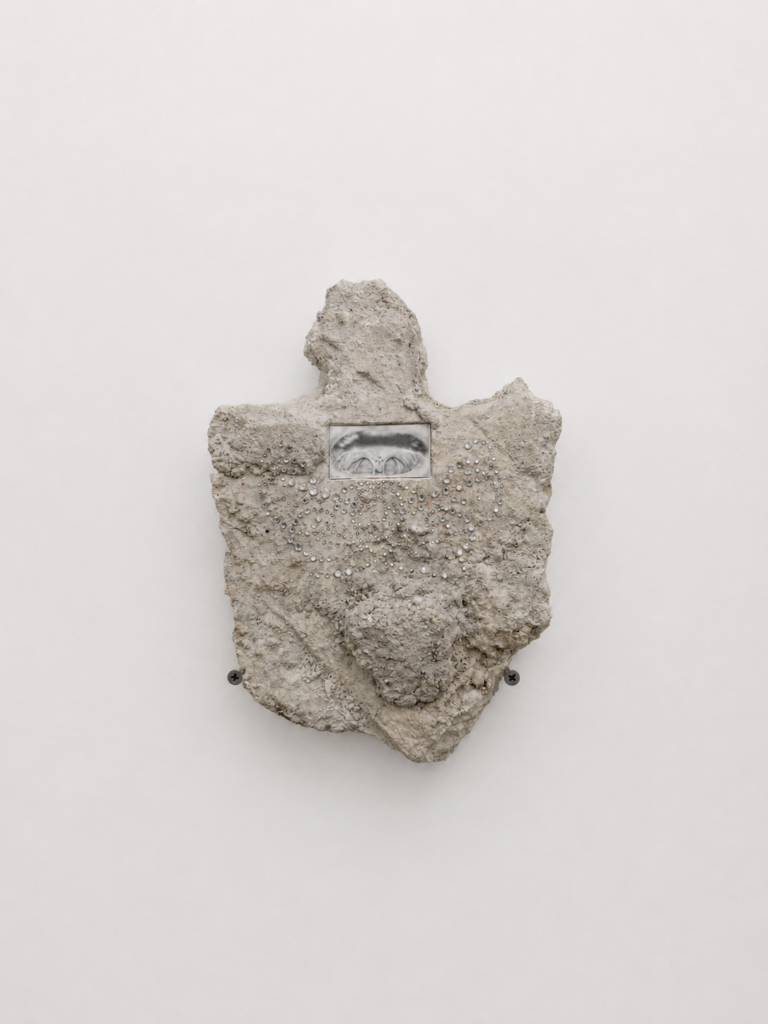
You’ve said that you hope conversations around your work don’t remain human-centred. What becomes possible when we stop treating the human body as the main point of reference?
Alejandra: Whatever I answer here in the general sense was already said much more eloquently and extensively by Haraway, to be honest. But less human-centric thinking opens the door to the reality that none of this is insular. All of it affects all of it.
Florida seems almost like another organism within your practice, humid, unstable, artificial, overgrown and constantly adapting. Do you think growing up there changed the way you understand what a body is?
Alejandra: I was recently talking to my friend about things he’s noticed about figurative painting here– the bodies’ borders are fuzzy and melting, the colors are deep, the scenes feel dreamy and unstable. Florida is so particular and beautiful; I think it’s impossible to live here and know it deeply and feel any sense of stability. Things are always shifting and invading and in danger and growing and dying. The things that are fleeting almost feel like a myth. Have you seen a ghost orchid in bloom…a Florida panther…that building before it was torn down? I think it gave me these same ideas about the body, any body, and has kept me from seeing anything as too fixed, too sterile, too permanent, but still incredibly stubborn and alive.
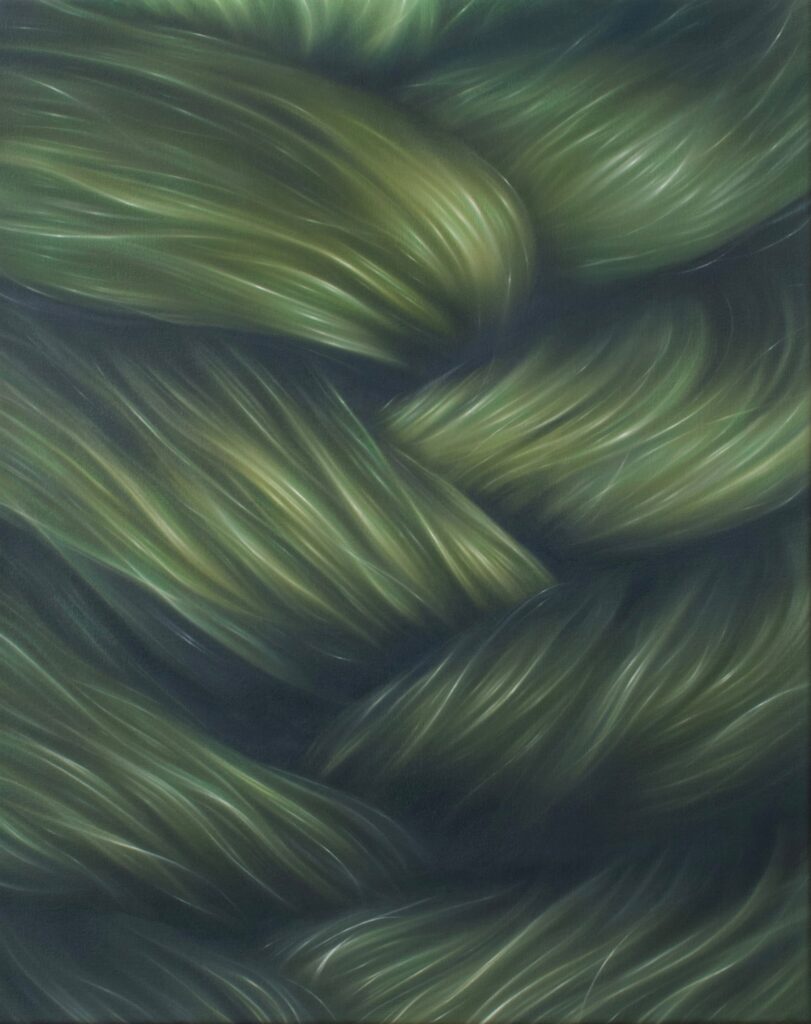
There’s something very Floridian about the collision of the natural and artificial, swamps beside highways, invasive species, manicured lawns, cosmetic culture. Does that contradiction enter your work consciously?
Alejandra: This one is hard. I think some of my work ends up being nostalgic or in memory of something, so the contradiction comes in consciously in that way, if we’re thinking of the broader, harmful side of the artificial. There are some things that I don’t really want to consciously give so much time to without honoring what’s consequently lost or affected.
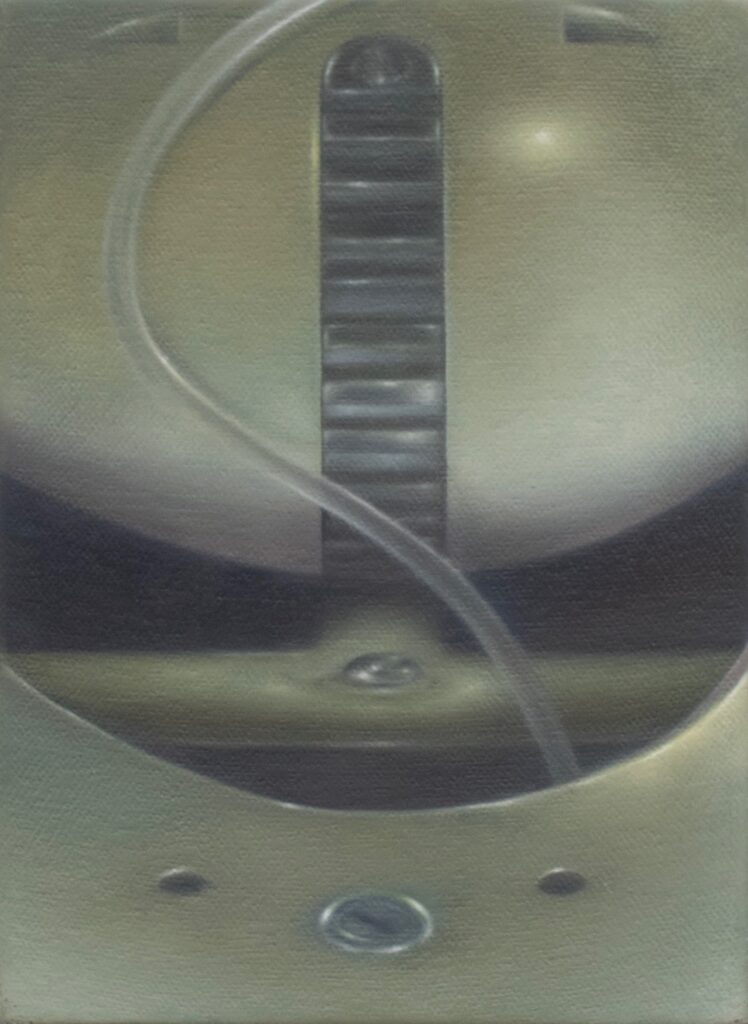
Your paintings can make skin resemble landscape, machinery, plant matter or something completely alien. When does a body stop looking like a body to you?
Alejandra: I don’t think whatever I’m looking at ever stops being a body to me, but rather that it gains countless other associations that become just as present as what it actually is. The limb is also alien, is also a ship, is also the sun, is also the Giger painting I looked at while making it, is also the text I pulled the title from, is also the song I listened to on repeat for 12 hours straight while working on it.
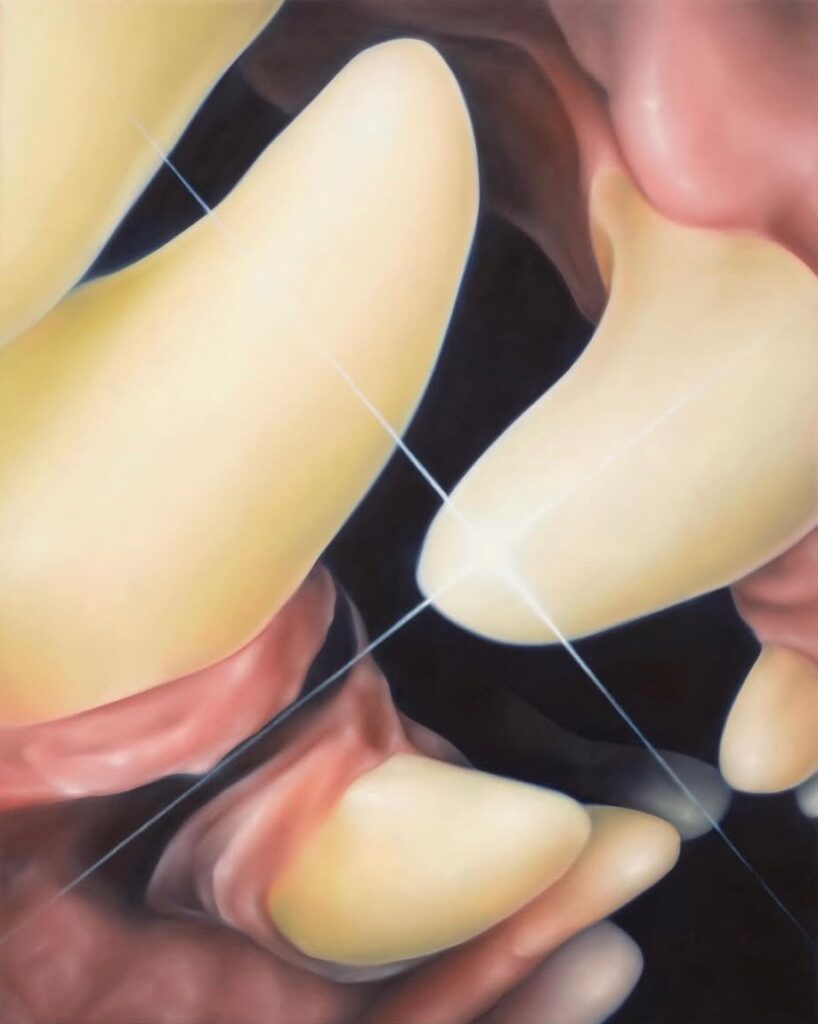
Science fiction has become increasingly present in the way you describe your practice. Are you interested in science fiction as prediction, or more as a way of imagining that the body does not have to remain what it currently is?
Alejandra: Both, for sure. I’m interested in science fiction, in a general sense, as a way of imagining something that may not be better or worse but simply different. I think living in an unstable place/time makes imagining different forks in the road inevitable, even if they’re not the most realistic. And like I said earlier, a lot of things here already feel like a myth, so it’s not a far jump.
Your paintings sometimes feel almost clinical, while others feel erotic or tender. Are those distinctions meaningful to you, or can those states exist simultaneously?
Alejandra: They’re definitely simultaneous for me. Like I said earlier, none of it ever loses its connection to what it is, and I wouldn’t be painting it if I didn’t feel some kind of interest or fascination with that initial idea. It has to mean something to me, even if it’s only to me. But the process of painting definitely feels clinical sometimes. I like that it’s both – I can’t let myself be too practical or too much of a romantic.
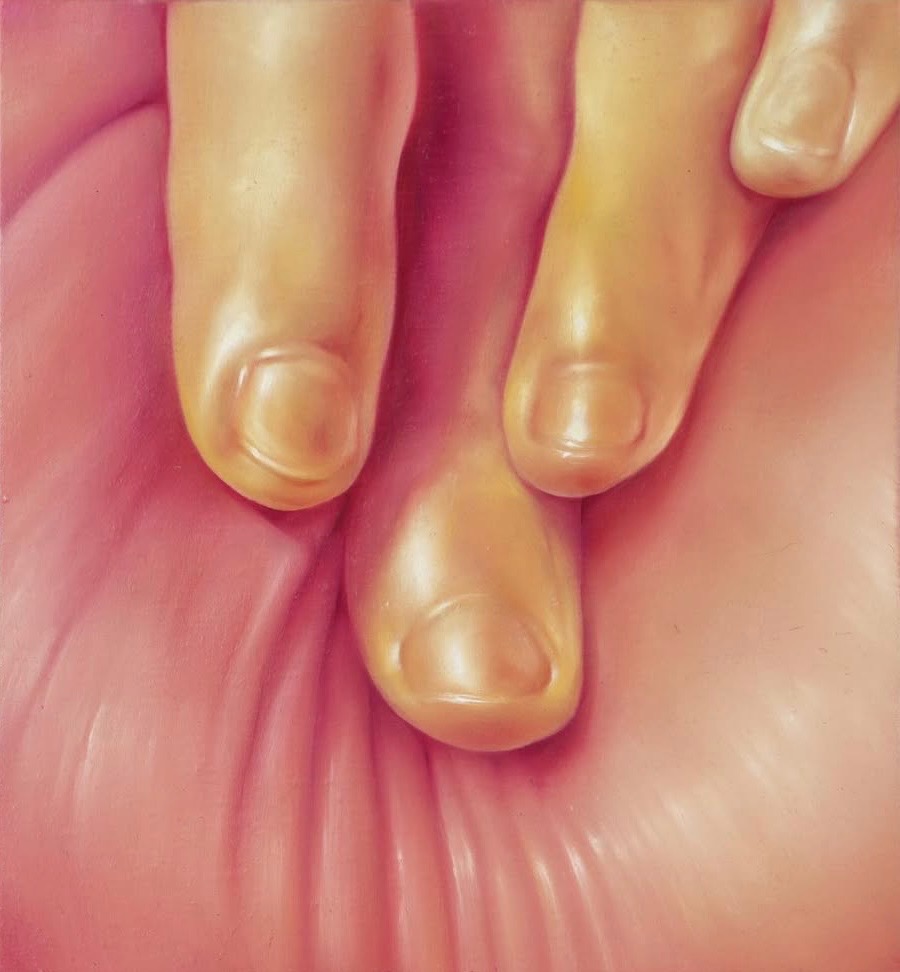
You studied graphic design before developing this painting practice. Do you think that background still shows up in the way you crop, enlarge and control information within an image?
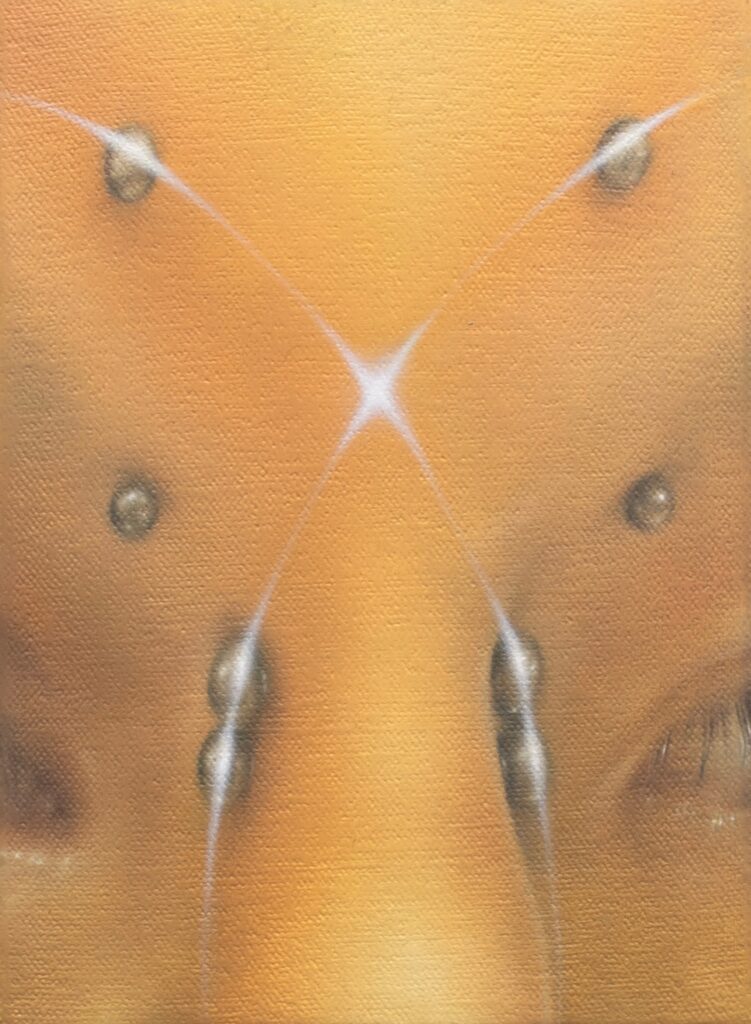
Alejandra: Design is a huge part of it; I think my process still looks very similar to when I was working primarily as a graphic designer. It’s collecting – collecting images, words, patterns – and figuring out where to put it all. The cropping, distorting, and framing is definitely just intuitive design brain now. I’ve recently been having a lot of fun treating the highlights like a puzzle – I need to get the design or symbol I want, which is based on something real, to hit the points I need it to while being symmetrical and still looking right.
Painting gets most of the attention around your work, but you also use illustration, writing and found objects. What can those forms do that painting cannot?
Alejandra: Like I said, it’s all collecting. I’m always taking photos and writing things down and taking things from wherever I’m at. All of it is souvenirs, I just need to figure out where to put it all. Sometimes those things make the most sense as a painting, or I can sneak them into a title, and that’s definitely the most publicly accessible part of it. But a lot of it still has to go somewhere, even if it’s years down the line.
What makes you keep a found object? What do you look for?
Alejandra: I don’t know, it feels childish sometimes. You put something in your pocket because it’s there and you can grab it and you’re drawn to it for some reason. Sometimes it’s another extension of the “this looks like x which reminds me of y” and on and on, but sometimes it’s entirely on impulse or for nostalgic purposes. I took a brick from the block I walk down every day because how could I not?
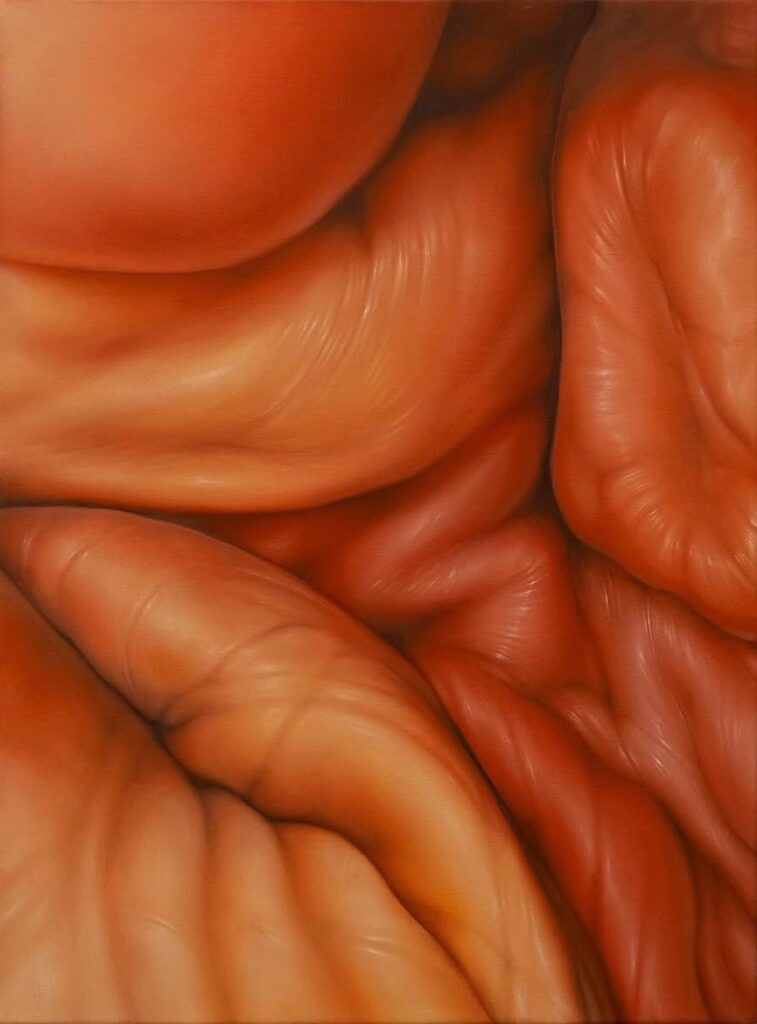
Your current exhibition, Common Skin Fantasy, circles around the idea of skin as the boundary between ourselves and somebody else. Do you experience skin more as protection, separation or a point of contact?
Alejandra: Alicia Bilbao, the other artist in the show, phrased it as “a failure of the skin to act as an envelope,” which I really loved. In planning the show, we were thinking a lot about this permeability, this blurring of where the body begins and ends. The constant in all of our work is that lack of clear separation between the body and what it’s exposed to, or what it creates.
Common Skin Fantasy, what’s the story behind that title?
Alejandra: The first time we met to talk about the show, Alicia mentioned the idea of the “common skin” fantasy – mentioned in Didier Anzieu’s The Skin Ego, it’s the infant’s assumption that it and its mother share a common skin, as a result of daily skin-to-skin contact, care, and dependence. The “skin-ego,” or awareness of the “self” and the “other,” begins to take shape through the process of detachment, or the tearing of that “common skin.” As soon as Alicia explained the phrase we began referencing it constantly and using it as a title for the show. It’s really beautiful, and I began thinking of the fantasy as an aspiration…the desire to not be an insular body. The concept seemed to link both of our practices really eloquently. The whole show was born from there, and our friend and collaborator Catherine Camargo, who runs Queue Gallery here in Miami, wrote a beautiful text and poem to accompany it and tie it all together even further.
Can you walk me through your creative process from beginning to end result?
Alejandra: I spoke briefly about collecting, but the search for images is usually harder and more drawn out than the most technical painting struggle. Once they’re found and I’m painting it’s just very tunnel vision-y. Usually the titles come from songs or books or phrases that float around during that time, and they usually have some personal tie to the image that only really makes sense to me.
Can you also tell me about your use of symbolism?
Alejandra: The light flares I add sometimes are always based on some other image/text. It’s become a way to do something that feels a bit more encrypted.
How do you approach color?
Alejandra: I’m obsessive about color. I use the same four tubes of paint for everything. It started because I was trying to figure out exactly how dense/transparent/slow drying these different pigments were when I started painting, and I gravitated towards the slow drying ones because I do a lot of areas in one sitting so that they’re as smooth as I want them to be. Now I’m stubborn about it and I really only use those four that I really liked (+ the occasional extra addition), but I like the tone they give everything.
So with what we just talked about, what are you hoping to convey?
Alejandra: This show with Alicia felt so honest because it’s what I’ve been trying to get to anyway – all of it is all of it.
With that in mind, do you think the viewer becomes implicated, projecting their own adolescence onto your objects?
Alejandra: I hope so! I like being more secretive about my bit sometimes. Keeps things feeling precious. So I hope there’s still something to latch on to.
Ok Alejandra, now to something totally different. In a parallel universe who would you be? and what would you be doing?
Alejandra: I think I would have liked to study something relating to entomology. But I also daydream a lot about properly learning how to weld and only doing that forever.
What qualities do you find most important in the people you choose to spend time with?
Alejandra: Disciplined romantics.
What motivates you?
Alejandra: Learning…the next thing always feeling more exciting…the people around me.
How would you describe a perfect day?
Alejandra: Wake up early, the sun’s out, read by the water for a bit, coffee with friends, walk to the beach with them for a couple hours, cook a meal, go to the studio. Painting goes well.
Alright Alejandra, I always ask these two questions at the end of an interview. The first is. What’s your favorite movie(s) and why?
Alejandra: Alien is the easy answer. Mindgame I’ve watched with my sister three times in the past year – it’s so silly and beautiful. Recently rewatched El pez que fuma and fell in love with the music and the lighting all over again. Carpenter’s Prince of Darkness. And I don’t know if this counts but I’ve cried through so many rewatches of Charlie Ahearn’s Portrait of Martin Wong.
The second is. What song(s) are you currently listening to the most right now?
Alejandra: Always Esclavo y amo – Los Pasteles Verdes. Right now specifically, Te Daré – Bad Gyal.