
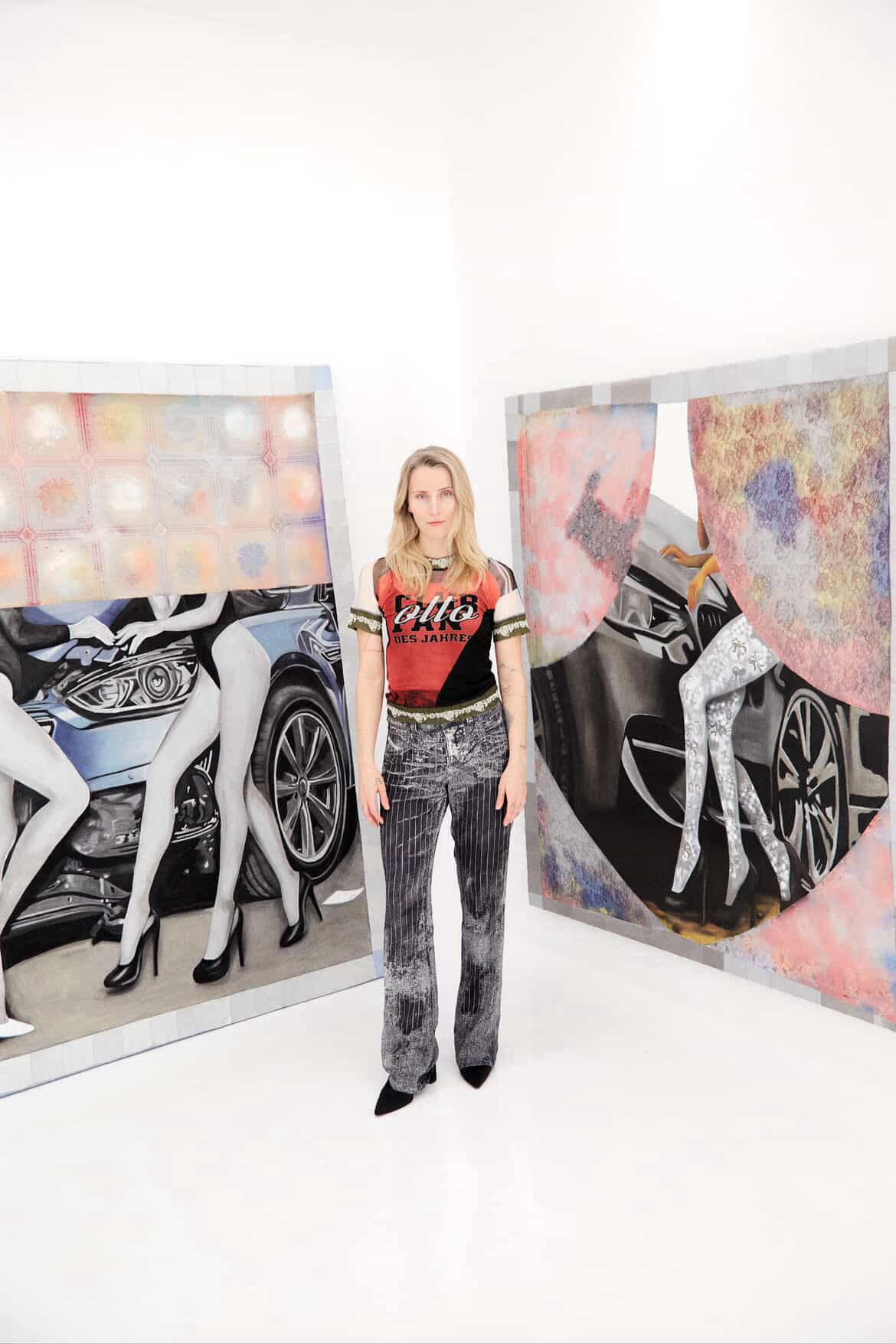
Based in Athens, the Czech-born painter and mixed media artist Bety Krňanská is tearing down the perceived barrier between “feminine” craft and “masculine” machinery, stitching together the digital and the handmade. We sat down with her to discuss her latest exhibition title ‘CRUSH’ and delve into how motherhood and David Cronenberg’s vision inspired her work and why she believes we’ve already become the partial cyborgs we’re waiting for.
Text: Lisa Boudet
Profile photo: Thanassis Gatos
Work photos: Leonidas Germanopoulos
How has your journey as an artist evolved, and what milestones have been most significant for you?
Bety: The most important milestone was becoming a mother. That was the moment I had to decide whether art was truly my path or just a hobby. I chose the harder road. In recent years, I’ve found a rhythm that allows me to focus fully, especially since my son, Alva, started school. That gave me the freedom and time to immerse myself in my practice.
Another major turning point was moving from Prague to Athens. Leaving behind family, friends, and starting from scratch. It was both liberating and destabilizing: it gave me the freedom to expand my perspective, but it also meant losing a sense of identity. It took a lot of effort to build a new focused space, and through that process, I began developing new techniques inspired by this completely different way of life.
I’ve also learned not to focus only on the struggles, which are always there, but to celebrate every small success along the way. Those moments of progress are real achievements, and no one can take them away.
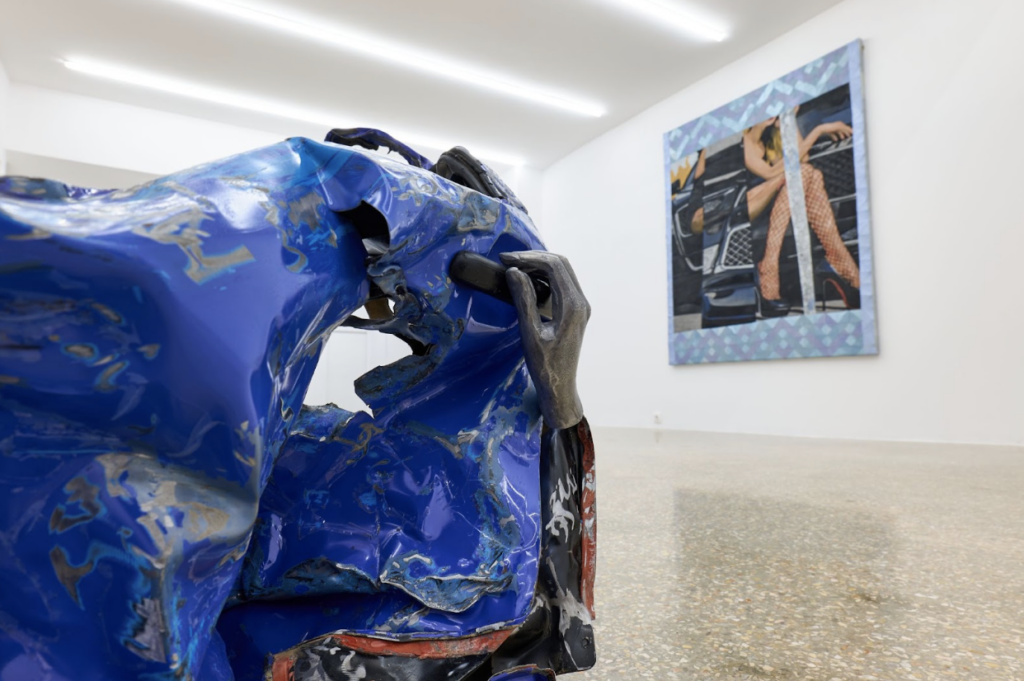
Can you elaborate on your fascination with old crafting techniques and how you integrate them into a modern artistic context?
Bety: Crafts have been with me all my life. As a child, I saw crochet doilies only as decoration. Later, I realized that each piece carries history: time, culture, and gender roles. What fascinates me is how, in our fast and chaotic lives, we still return to repetitive crafts like sewing or crocheting. They ground us. In my practice, they meet technology, creating a dialogue between the handmade and the digital. For me, the thread itself becomes like Ariadne’s thread, something to hold onto so we don’t lose ourselves completely in the digital world.
Your vision is deeply shaped by maternity and feminine sensitivity. How has being a mother and an artist influenced your creative process?
Bety: Motherhood changes everything. You can’t really understand it until you live it. The struggle to balance professional life, care, and personal identity is something many of us share. Sensitivity also comes with fear—the constant fear of failure or of the threats your child will face in the world. Being both mother and artist is demanding, but when you manage to build a system that works, the struggle makes you stronger. I’ve learned to be much more efficient with my time and energy and have made much more progress in my art career since I became a parent. Through parenthood, you are also learning a lot about yourself.
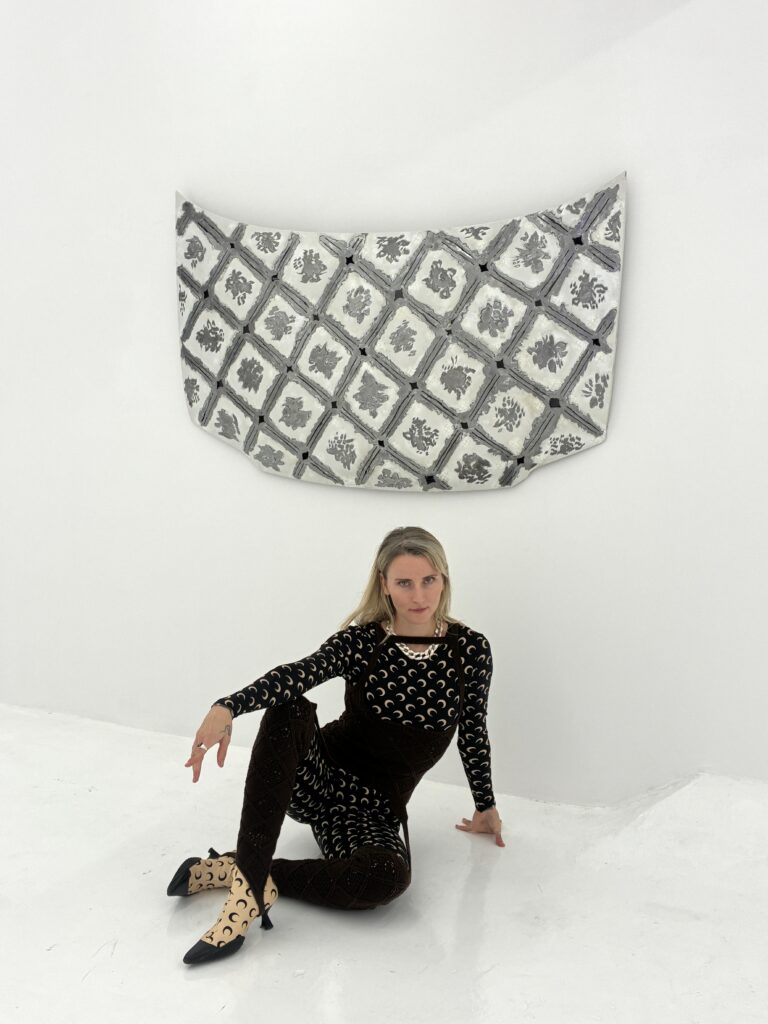
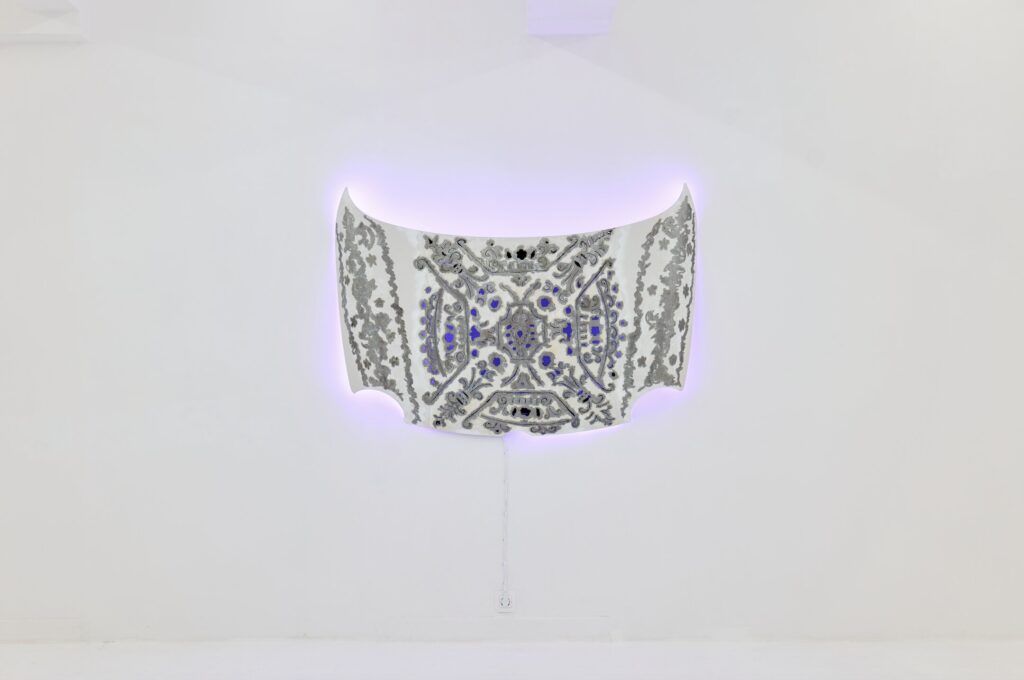
Your recent exhibition, CRUSH, is inspired by David Cronenberg’s Crash. What initially drew you to this film, and how does it translate in your show?
Bety: In my thirties, childhood memories began resurfacing, many of them connected to cars. One memory that stayed with me was the day we traded in our old car. I was watching how the car was being picked up by a car dealer to be crashed into a cube. My mother was sleeping inside, and I was terrified they would forget her and crash her along with it.
Another recurring thought is how I’ve always felt when I had the chance to sit in or drive a fast, luxury car. The psychology behind it fascinates me. Drivers often feel more powerful in such cars and tend to become more aggressive on the road. If you look at how the design of luxury cars and SUVs has evolved, it becomes clear: today they feature more aggressive headlights, sharper curves, and an overall dominant appearance.
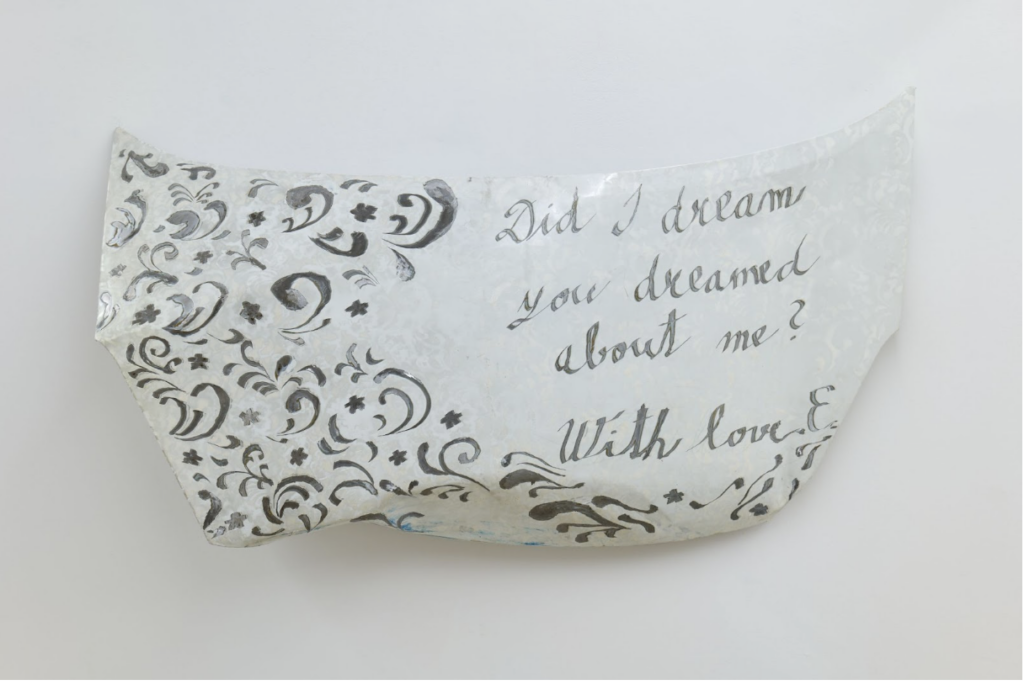
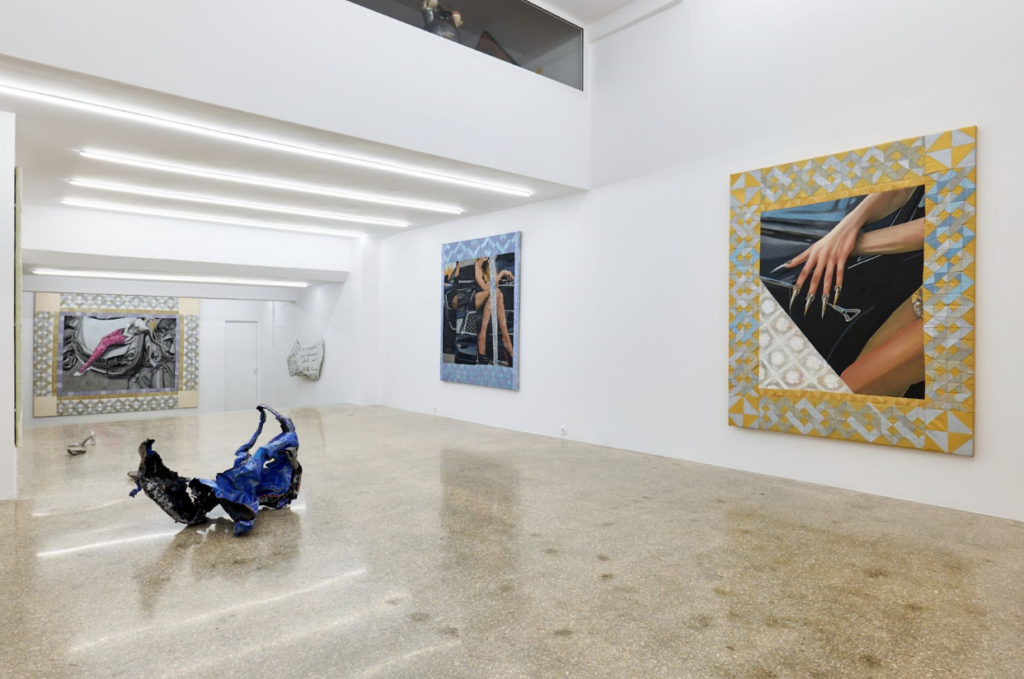
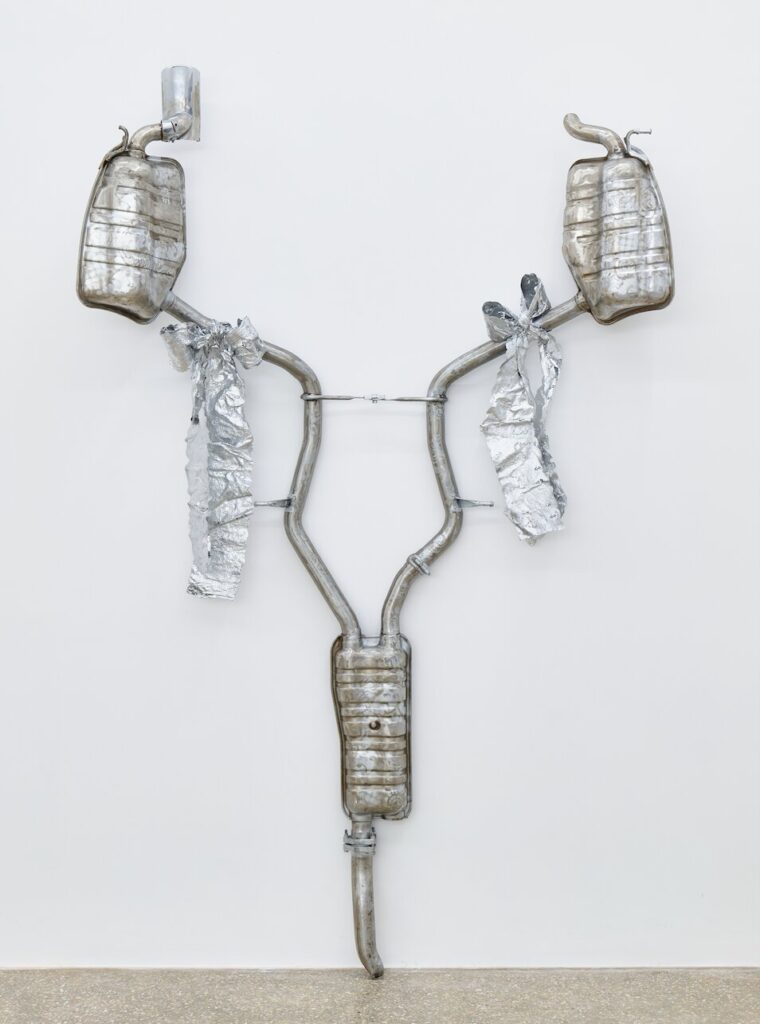
For the exhibition the original title Crash I replaced by CRUSH, shifting the focus toward falling in love at first sight, an attraction sparked purely by appearance. What fascinates me is how emotionally charged cars are despite being industrial objects. They promise freedom and protection, yet they’re also fragile, dangerous, and easily destroyed. I’m drawn to that contradiction. In CRUSH, the car exists as both projection and fetish: a surface into which desire, care, and vulnerability are invested, and where intimacy can quickly turn violent or uncanny. At the same time, I’m drawn to the car’s physicality, Its curves and polished surface, the speed. Approaching this from a female perspective is essential to the work, reclaiming attraction not as a masculine fantasy of power, but as something sensual, intimate, and ambivalent, shaped as much by unease as by desire.
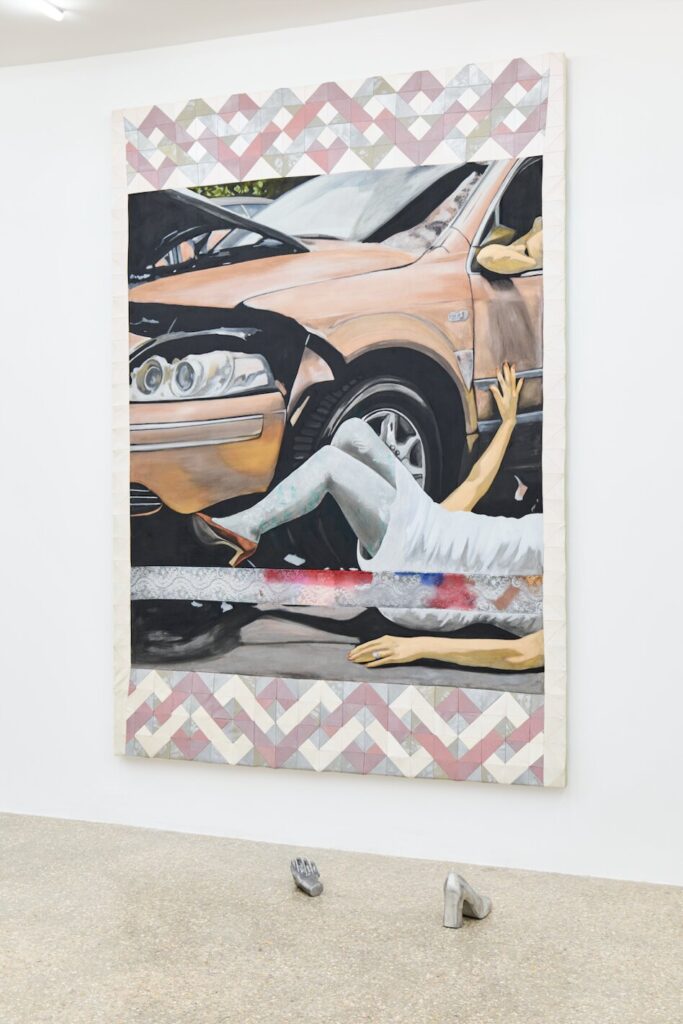
Are you personally into cars or movies?
Bety: I love cars, their shapes, reflections, and metallic surfaces.They are designed to seduce us. Even the metallic polish used in car manufacturing shows something about desire and attraction. Now we want the same shimmer on our nails. I’m also very inspired by film, especially directors who put cars at the center of their stories. They are often twisted visionaries, and I like how they distort ideas.
Cronenberg’s film delves into the “fetishistic collision of flesh and machine.” How do you reinterpret this entanglement today?
Bety: Today we don’t even realize how much we’ve already merged with machines and technology. We are constantly on our phones, laptops, and in cars. We’ve already become cyborgs in a way, even while we are waiting for robots to walk the streets. It’s happening, just in a more subtle way than we imagined. More and more, people form attachments to objects, AI, or non-living entities, sometimes because they’re afraid of each other, sometimes because machines feel safer and more controllable. But there’s a darker side: what appears cute, user-friendly, and harmless often ends up controlling us. We’re gradually losing control, and that tension is what fascinates me.
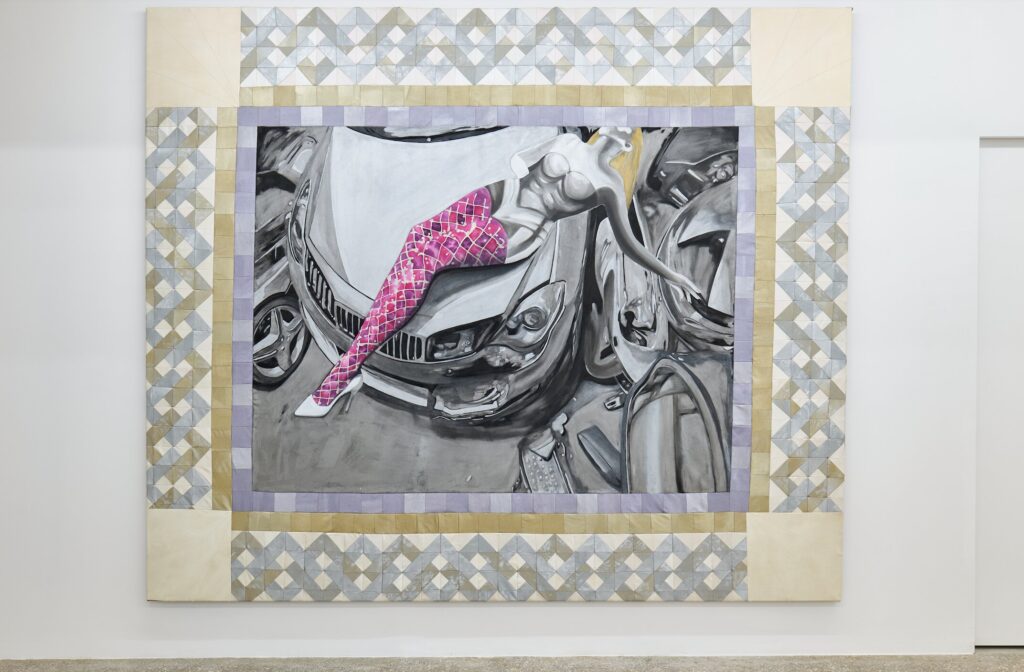
You integrate painting with patchwork, crochet, and AI imagery. Could you walk us through the technical and conceptual process?
Bety: My work is created in stages. The process begins on my laptop. I use AI as a tool for research and for inspiration with new images. The technology evolves quickly, and I want to capture that change, how images shift from rough, distorted appearances to something that seems real.
I combine these digital explorations with painting and textiles. By layering fabrics, stitching fragments, and painting, the AI imagery gets into direct dialogue with the handmade.
What does the reappropriation of mechanical aesthetics through traditionally female crafts like patchwork and crochet signify for you about the relationship between gender, labor, and technology?
Bety: It speaks to how women see themselves today: confident, independent, and unbound, surrounded by what they love, like luxury cars, without compromise. By merging craft with machines, I challenge conventional “feminine” stereotypes and highlight the complex relationship between desire, manual labor, and technology. It’s a way to question who defines femininity and to show that women can assert their identity in spaces, both physically and culturally, traditionally coded as masculine.
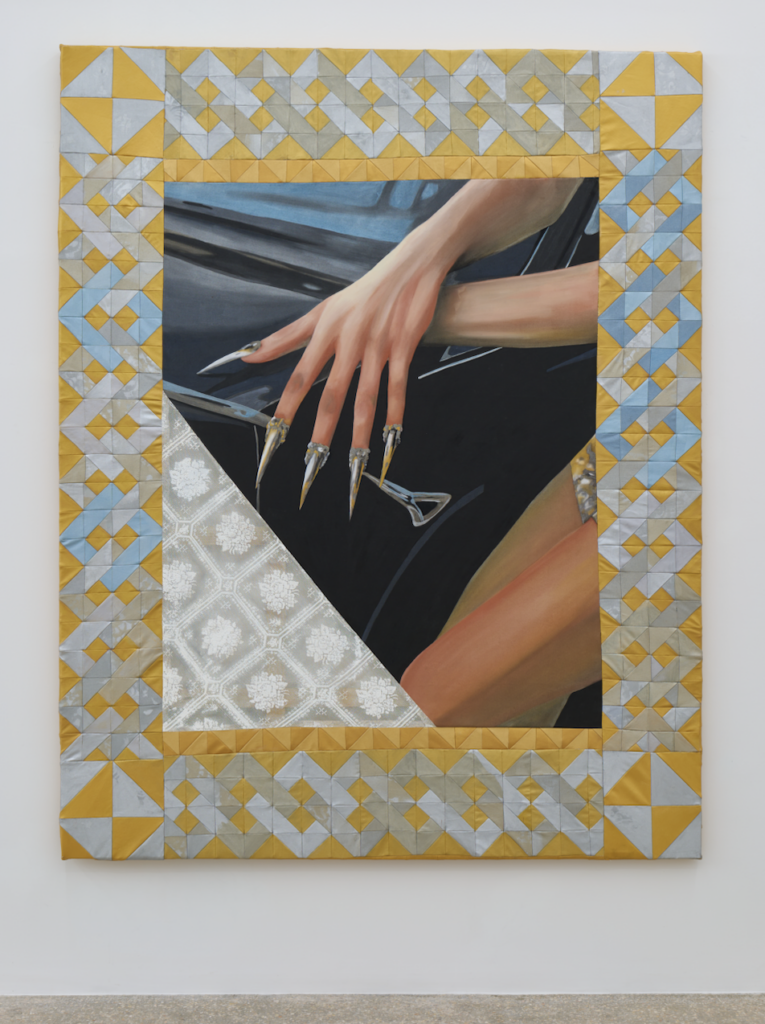
The inclusion of AI imagery is particularly intriguing. How do you harness artificial intelligence as a creative tool, and what new dimensions does it bring to your traditional craft techniques?
Bety: For me, AI is a tool for experimenting with visual ideals. Interestingly, It holds on certain biased imagery It’s been fed onto and merging it with its own “ideas”, we haven’t seen before, feeding our evolving imagination.
At the same time, I believe it’s vital to hold on to certain practices, like manual crafts. If we surrender everything to digital systems, we risk forgetting how to use our hands and minds in a physical, intuitive way. Repetitive crafts are valuable because they quiet the mind, letting you focus on the simple rhythm. Japan shows how advanced technology can coexist with centuries-old craft traditions. That balance inspires me: embracing new tools while keeping practices that connect us to our human history.
‘CRUSH’ aims to blur the boundaries between chaos and intimacy. Where do you find this balance in your life and pieces?
Bety: Balance is a beautiful idea, but in my life, it’s more about constant adaptation. For me, life has always been about moving between chaos and intimacy. That tension itself is what I try to capture in my work.
What other projects do you have coming up?
Bety: Following a recent residency in Taiwan and the closing of my solo exhibition ‘CRUSH’ at George Benias Gallery in Athens. I am currently developing two solo exhibitions in Prague alongside several group shows, making for a highly productive year ahead.