
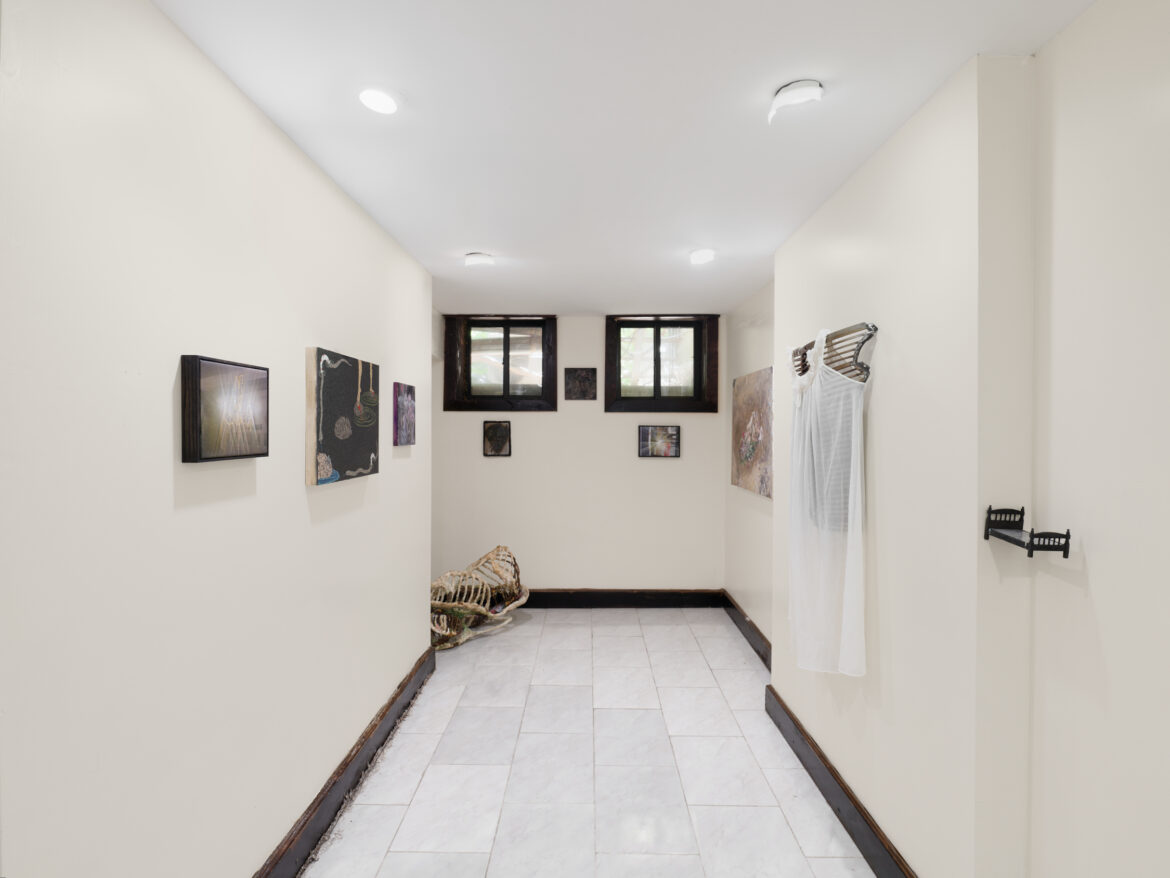
Photo: Installation View of Concessions to Impurity, The Sue Tear, 2026. Photo: Shark Senesac / New Document
It was a hot sunny day when I made my way to The Sue Tear, an artist-led exhibition space in a basement in Brooklyn. The exhibition on view, Concessions to Impurity curated by Shirley Lai, is a meditation on the particular grief that accompanies survival. The slow shedding of innocence that occurs through heartbreak, trauma, memory, and the simple passage of time. Across painting, sculpture, mosaic, and multimedia installation, the exhibition is deeply concerned with longing: longing for an earlier self untouched by disappointment, longing for softness in a world that hardens us, longing to hold onto fleeting moments before they disappear into memory. The exhibition does not offer resolution; it instead approaches these themes through quiet feeling, resulting in a show that feels intimate and emotionally exposed, like reading someone’s old journal entries or stumbling upon a memory you thought had long dissolved.

Rei Xiao’s unsettling yet intimate painting is among one of the first pieces viewers are confronted with when entering the space. Itsy bitsy spider (2026) depicts a fetus suspended from its mother within a web, transforming the umbilical cord into both literal and psychological tether and immediately evoking a suffocating entanglement. Neither figure can escape the other. The mother bears the physical and emotional weight of the child while the fetus remains wholly dependent on her existence for survival. Xiao turns motherhood into something far more psychologically complex than sentimental depictions often allow. The web itself becomes symbolic of inherited trauma and invisible structures that bind families together even as they wound them. The work possesses an overwhelming emotional density, even despite its small scale. Similar to much of the exhibition, Xiao’s work understands love and burden as inextricable from one another.
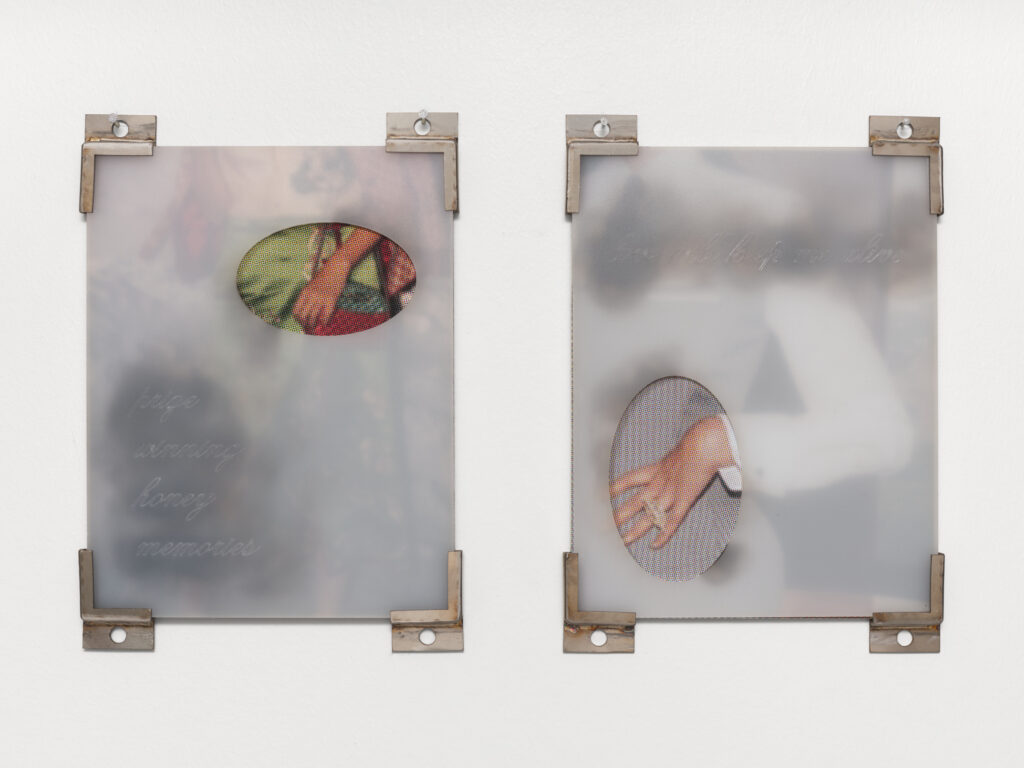
Ketty Haolin Zhang’s multimedia works similarly explore the emotional fallout of inherited aspiration and longing, though through a distinctly contemporary lens. In love will keep me alive and prize winning honey memories, Zhang merges nostalgic imagery and references to Wendi Deng Murdoch, whose mythologized social ascent becomes emblematic of the promises and failures of the American Dream. Zhang’s works feel almost ghostly, as if memory itself has begun deteriorating. Torched acrylic glass partially obscures the imagery, creating a sense of distortion and distance that mirrors the instability of nostalgia and desire. What remains poignant is the repeated image of Wendi’s hand reaching outward. The gesture is universal. A hand grasping for upward mobility, success, security, or fulfillment, yet never quite able to fully hold onto it. Zhang transforms deeply personal reflections on immigrations, ambition, and identity into broader meditations on desire itself and the emotional compromises that often accompany it.
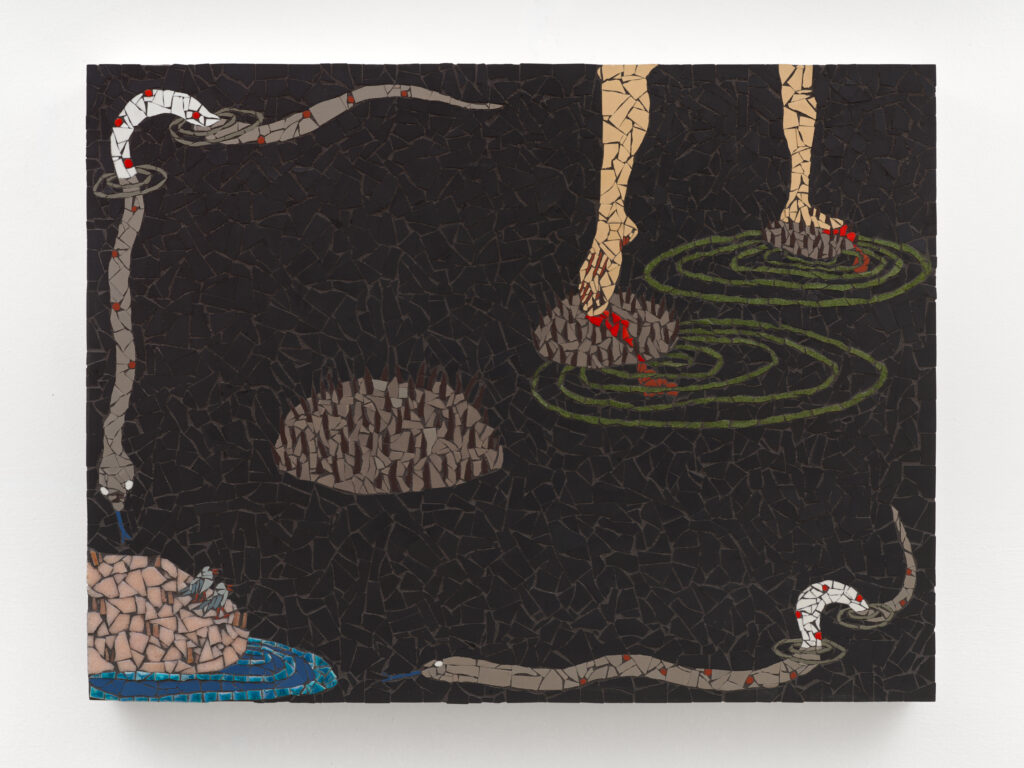
Constructed from fractured pieces of glass, porcelain, and concrete, Jihyun Hong’s stunning mosaic works physically embody fragility. The cracked surfaces are carefully reassembled, echoing the emotional labor of holding oneself together after damage has already been done. In In Dark Water, Hong’s imagery of two small blue birds navigating threatening environments stems from her anxieties surrounding motherhood and the inevitability of her children encountering pain in the world. Snakes slither towards the birds while bleeding limbs stain forward despite visible injury. There is something particularly agonizing in the work’s quiet perseverance. Rather than dramatizing suffering, Hong focuses on endurance. The exhausting act of continuing onward while carrying fear for both oneself and others is not concealed but celebrated here. Every shattered fragment sealed back into place mirrors the exhibition’s broader fixation on surviving brokenness while still presenting a composed exterior to the world.
What ultimately makes Concessions to Impurity so resonant is its refusal to flatten grief into spectacle. Instead, the exhibition approaches emotional pain with remarkable tenderness and restraint. Across each artist’s distinct visual language, there is a shared understanding that innocence is not something we lose all at once, but something that erodes slowly through lived experience. The exhibition becomes less about purity itself and more about the impossibility of preserving it. What remains afterward are fractured memories, inherited wounds, and fleeting moments of beauty that continue to linger long after that have already passed.