

Share this
A mysterious 25-foot statue of a flag-blinded figure has appeared in Waterloo Place, but the artist has yet to confirm whether it is really his
London woke up this week to a very Banksy-shaped question: who put a 25-foot statue of a suited figure, blinded by a giant flag, in the middle of Waterloo Place?
The sculpture appeared overnight in central London, installed on a plinth in the historic St James’s area, close to the Crimean War Memorial and other official monuments. It shows a sharply dressed figure mid-stride, stepping forward as a large billowing flag completely covers their face. The image is blunt, theatrical, and immediately political: a person marching under a symbol they can no longer see beyond.
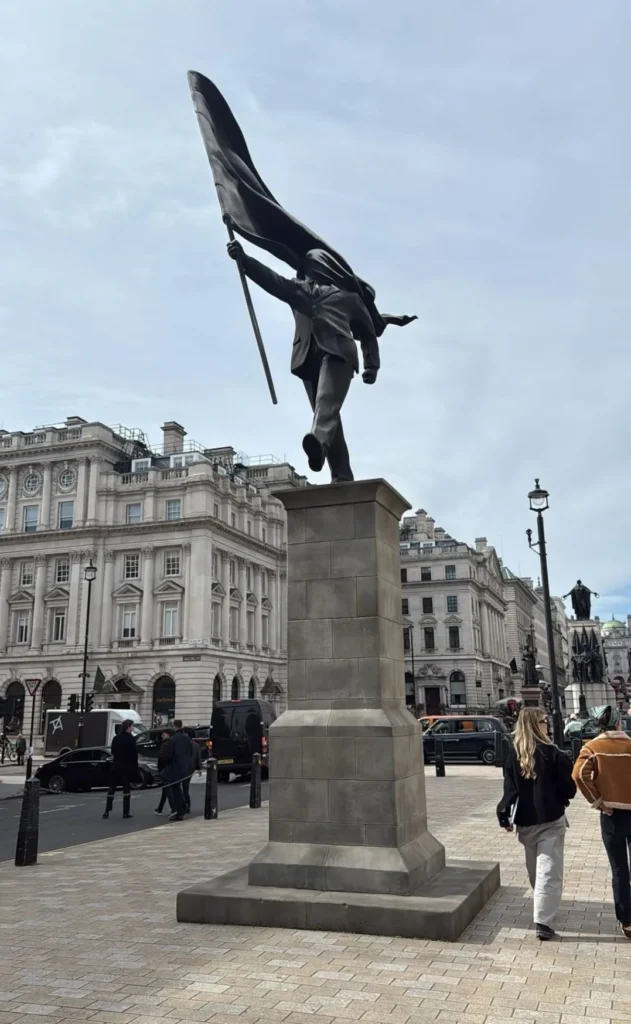

Naturally, speculation moved fast. A signature resembling Banksy’s was reportedly found on the reverse of the plinth, prompting rumours that the elusive artist may be behind the work. But there is one important detail: Banksy has not confirmed the piece through his usual channels, and recent London works attributed to him have typically been verified via his Instagram rather than by signature alone.
That uncertainty is part of the spectacle. Banksy’s work has always lived between public intervention, media frenzy, and collective guesswork. The moment something strange appears on a wall, a bridge, or now a monument-like plinth, the city begins performing its own ritual: photograph it, debate it, protect it, doubt it, monetise it, meme it.
Whether or not the statue is genuine, its symbolism feels almost too perfect for the current moment. A suited body, possibly a politician, blinded by a national flag and walking straight off the edge of a plinth: it reads as a compact little essay on patriotism, power, and the danger of mistaking symbols for sight.

The location sharpens the point. Waterloo Place is already dense with official memory: statues, memorials, imperial stone, national history made solid. To place a figure there who cannot see because of the very flag they carry is to interrupt that language from inside it. The work doesn’t need to shout. Its joke is architectural.
Still, the question remains unresolved. Is this Banksy, or simply a work smart enough to mimic the conditions of Banksy? At this stage, without confirmation, it sits in that strange in-between state: not quite authenticated, but already public, already photographed, already functioning.
And maybe that is what makes the piece feel so contemporary. In 2026, the artwork does not only exist as bronze, resin, plaster, or whatever material it is made from. It exists as rumour. It exists as attribution. It exists as the moment the city stops, looks up, and asks whether the ghost has returned.
The statue appeared at Waterloo Place, London, in late April 2026. Banksy has not confirmed authorship.