Share this
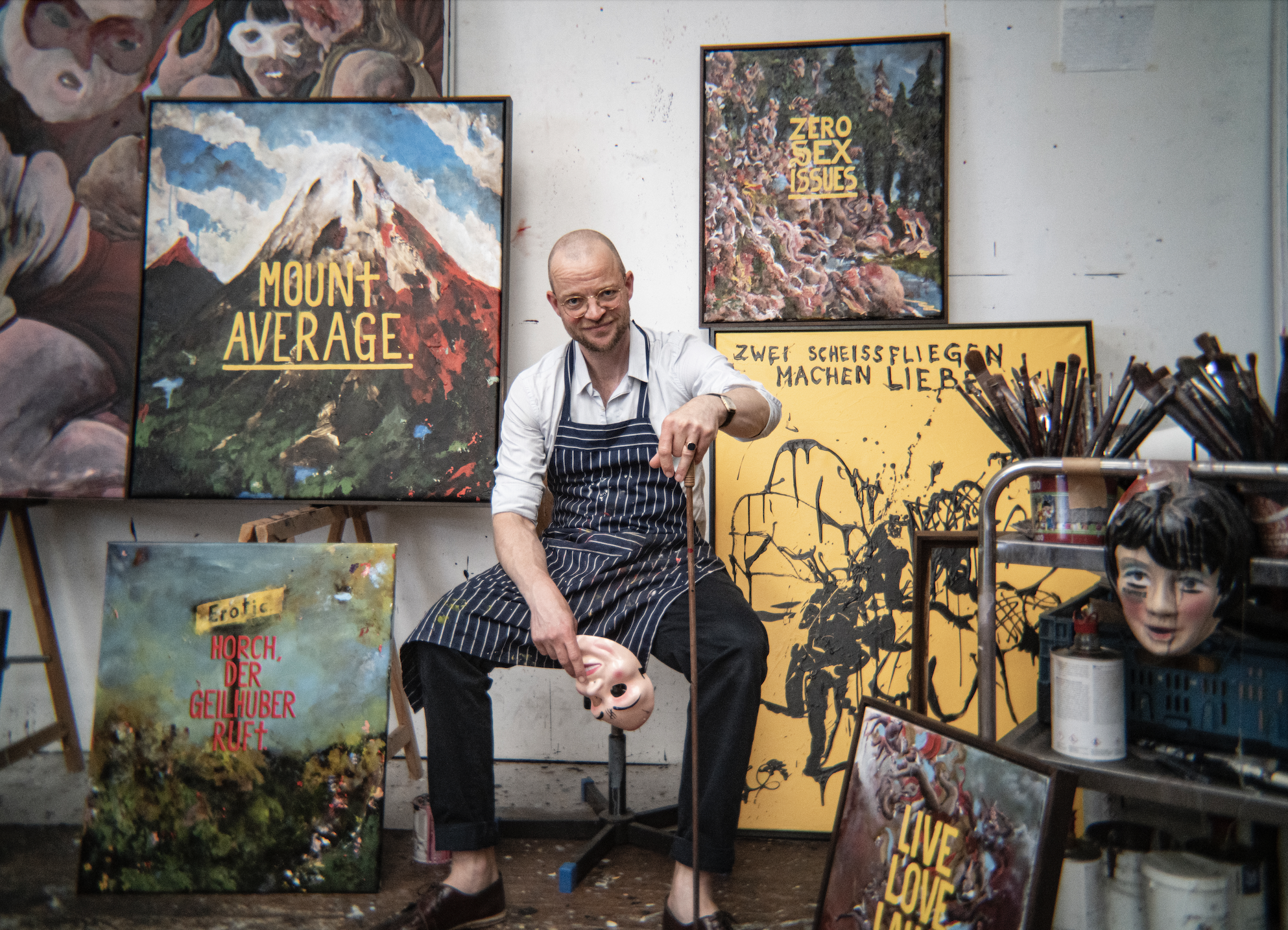
The last time I sat down with Willehad Eilers, aka Wayne Horse, was back in May, 2025, where we talked about his show, at the Musée de l’Hospice Comtesse. Now, to commemorate his current show, titled “BORED TO BE ALIVE“, at Galerie Droste, I’ve had the pleasure of sitting down with Willehad once again, to talk about what he’s been up to since then, as well as deep diving into moving from characters to landscapes to push himself out of comfort, the cycle of freedom, frustration and breakthrough in his process, and how influences from Munch, Friedrich, Bob Ross and punk music shaped this new work. He reflects on mixing text and image, embracing imperfection over AI perfection, and blurring high art with IKEA-style kitsch. Themes of nature, sexuality, humor, and politics run through the show, all tied to his ongoing focus on human flaws, vulnerability, and finding the right emotional tone across painting, text, and zines.
Willehad Wilers, “BORED TO BE ALIVE“, at Galerie Droste, runs until October 4th, 2025.
For more information, please check out the Galerie Droste website.
Check out our previous interview with Wayne HERE.
Willehad works with Galerie Droste and Harlan Levey Projectcts.
Hi Willehad! It’s always a pleasure to sit down with you! The last time we talked was when you has your show at The Musée de l’Hospice Comtesse. For this interview I’ll be focusing on your new solo show at Galerie Droste. So, first question, what’s your inspiration behind this new body of work?
Willehad: I had a very intense first part of the year. Next to the show at Musee de l’hospice comtesse in Lille I had another Museum presentation in Breda, and a release with KPM Berlin. I was working on the edge of what was possible for me. So, after that period, my plan was to work without restrictions, solely for joy. It is a bit of a problematic thing in my head. The cure for being over worked is work. Other work, but still work. No pre-set subject. I wanted to cut myself of the places I could hide in.

This is why there are hardly any characters in this body of work. I am too comfortable with them. I know how to safe myself. I recognise tricks I use to hide behind. That is why I decided to focus on landscape this time. To stand out in the open again. Without any armour. Of course, after about a month of working this way, freedom turns into feeling lost.
Did you do any form of specific research for these new works?
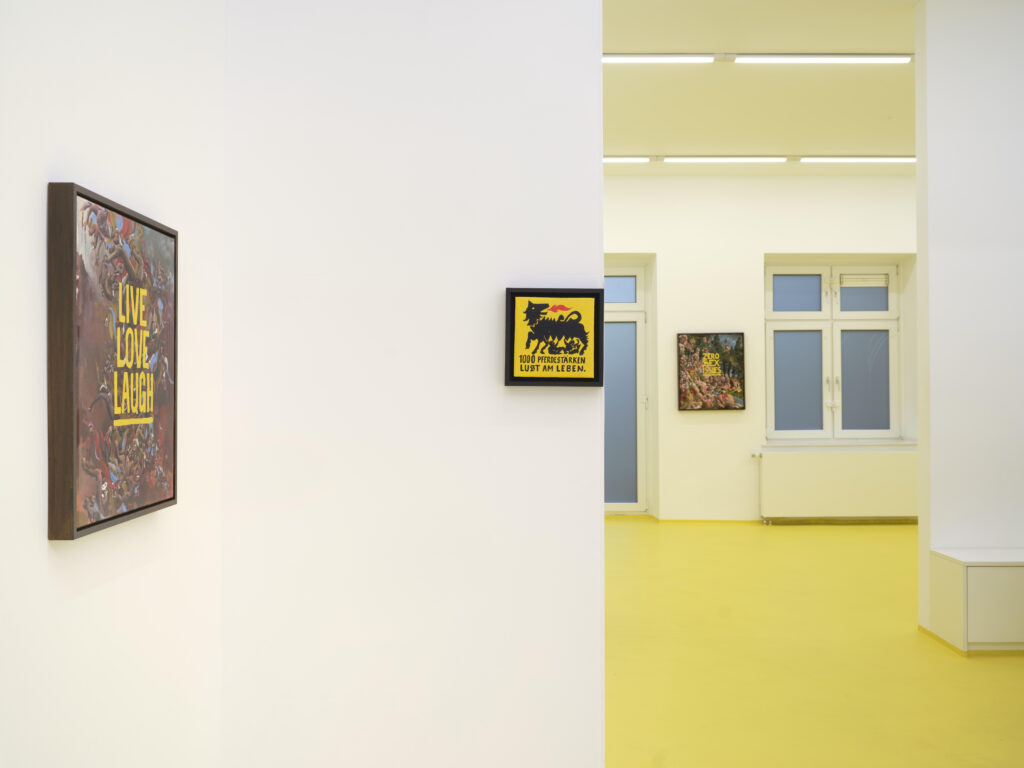
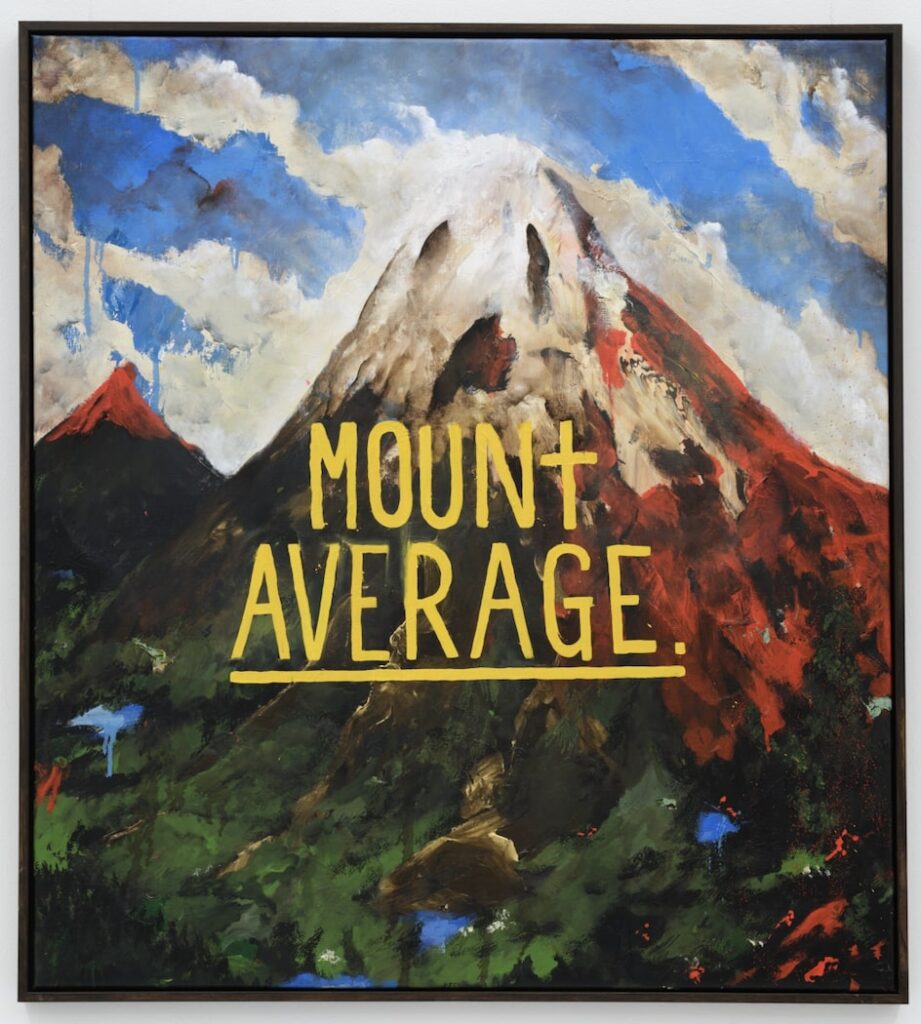
Willehad: I wanted to create emotional landscape works. In my preparation I looked at Munch, with his naturescenes that appear like cut open bodies. I looked at Bob Ross, for the dreamlike joy of disappearing in a work. Not caring about the result, just letting it happen in front of your eyes.
But mostly, I looked at Caspar David Friedrich, who went into nature to find human traits. Read human characteristics into natural scenes. In the end the human is always the most interesting subject to me. There is no escaping it. Whatever I see, I witness through the eyes of a human. All this, combined with an action painting approach.
“I tried to violently smash some scenes onto the canvas. To the music of the album ‘kicked in the teeth’ by ZEKE. Later, I discovered that I was more in need of some soothing Bob Ross-ish fantasy travel. In addition I could not decide weather to deal with mislead success driven lifestyle coaching, sexual issues or desasters of war. I decided to do everything parrallel, like we are all forced to anyway, these days.”
You describe beginning this series with the intention of working calmly and intuitively, without pressure—but instead finding emptiness and frustration. Can you tell me more about that? And how did that shift shape the direction of the work?
Willehad: Eventually, this is the normal cycle of any work I do. Small or big. It starts with enthusiasm and freedom. Then gets lost on the way. Goes through a period that feels like walking through clay. Forcing myself to keep working, until at some point, the work will start talking to me. Dictating its own boundaries. From that point on I follow the works rules.
What was new to me, is that this time this cycle applied to a whole body of work instead of an individual one. It took some time here. I knew I needed to mess with my landscapes, to make them acceptable to my eye. I applied words. Something of being pushed in the background made me stop doubting them. A psychological effect. If I start an extra layer, this indicates that the lower layer is finished.
I do love the game of words and image. The way the two should not describe each other, but carry their own worlds and together with the viewers associations create a third thing.
Still, after creating two text/landscape pieces, I thought: ‘I like these, but impossible to do a show only with this type of work.’ I was afraid it would come across as too ‘gimmicky’. That the viewer would scan each work for its gag and walk on. That the perception would get narrowed down by the works shape.
The title of the show is “Bored to be alive”, what’s the story behind that title?
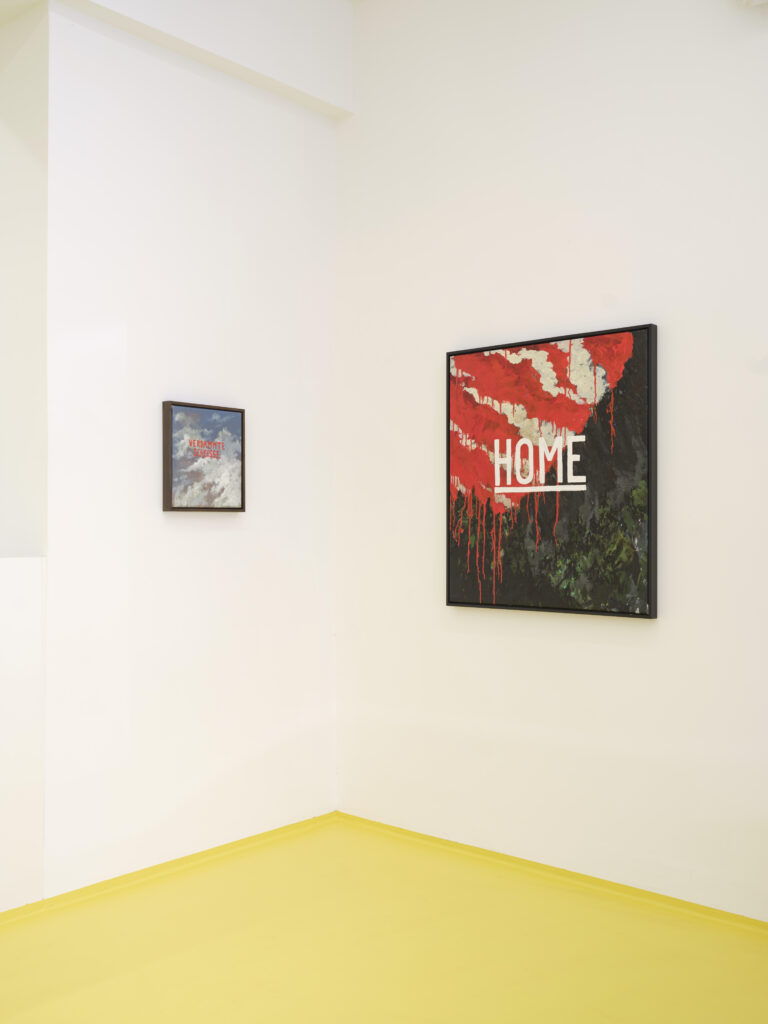
Willehad: I was listening to Patrick Hernandez debut album from 1979, as one does. The sentence came to me as the disco-hit ‘Born to be alive’ was playing.
I asked a friend of mine to do a grunge version of the song, called ‘Bored to be alive’. He never did. I carried the sentence in my head for weeks, until I angrily painted it over an unsuccessful attempt at nature painting.
Something about it summed up the mix of emotion I carried with me. Such a privileged statement. Ungrateful in a magnificent way. Being alive is the only thing that allows for adventure. The only thing that matters. Yet it does not fulfill our expectations anymore. Or we are disappointed because we do not live up to our expectations, and hence point our fingers at life itself. God forbid something is our fault. You always need a scapegoat.
With that in mind, the title suggests a kind of nihilism, yet you’ve also said: “It’s okay to cry again.” Do you see this exhibition as more despairing, or more liberating?
Willehad: Allowing yourself to despair is liberating in itself. Giving up can be the most liberating, freeing feeling. Let go. Let it be. Surrender. Stop fighting. Give in. It is all too much. The antithesis to glory. But once you brake, and recognize failure. All the weight is gone.
Capitulate. Sometimes, most times, it is ok to not have a solution. To not know the way. Just to stop. And give in to your incompetence. Make no secret of it. Wave it like a flag above your head.
You often use imperfection and “trembling lines” as an artistic choice. What does imperfection mean to you in an era obsessed with AI-driven perfection?
Willehad: I think that ‘failing’ or imperfection will grow to be a great human quality. Something that is searched for and appreciated. Japan already has a culture of this, ‘Wabi Sabi’.
Some of these new works feature text and words. Why did you decide to add text to your portfolio?
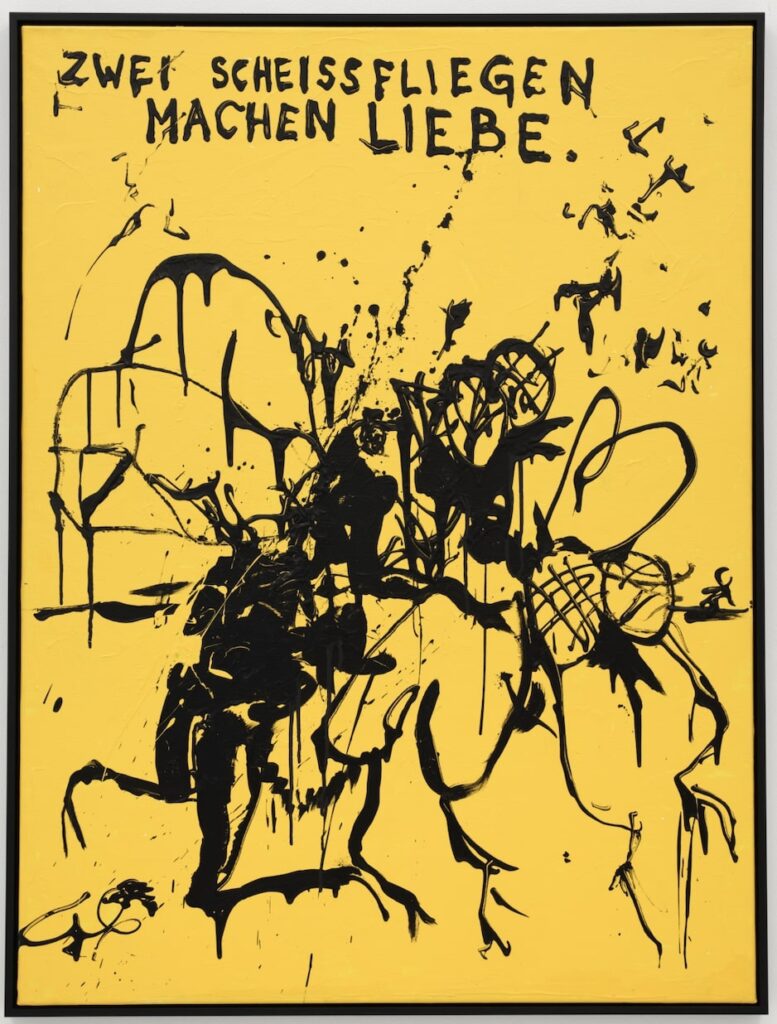
Willehad: Text is not a new thing to me. Even though, my shows in the past 5 years were mainly focused on big oil painted sceneries. I have released a lot of zines that showcase my drawing and text based works.
To me, my work is about tone, rather than a medium. So a sentence can be just as, or even more intense than a painting. Writing, painting, drawing, video, installation or other projects are all ways to reach a certain tone.
The text in these works functions almost like a bulletproof glass layer over the paintings. How do you decide what words to use, and at what point in the process do they enter the canvas?
Willehad: They are the very last step. As one can probably easily assume. Sometimes the words come to me while working on the piece. Sometimes a piece lingers in my studio for so long, that my frustration reaches a level at which I do not care anymore. I just go with the first thing that comes to mind. As if to punish the canvas.
Working on a show takes usually a period of around 5 months. So during this time I am likely to circle around the same topic in my head. The words arise out of that. At some point I feel that the friction between painting and word is blunt enough.
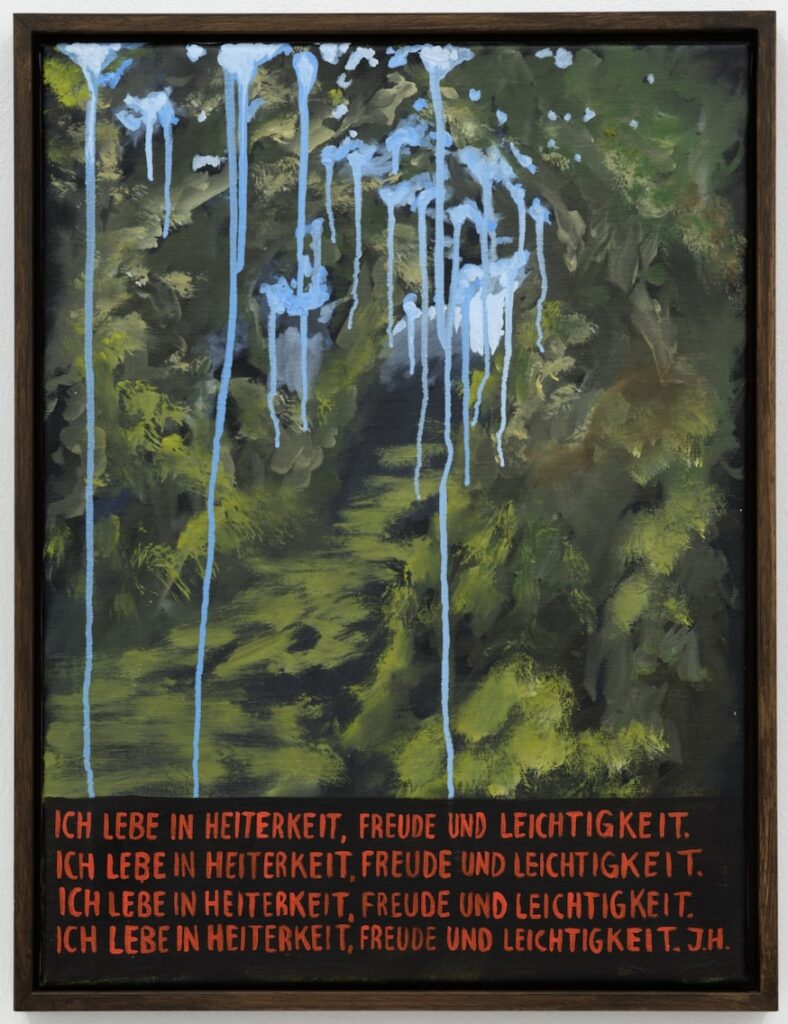
Do you see the words as antagonists to the images, or as accomplices?
Willehad: The words are overly present. But they are not only there for their informative value. I need them to make the painting acceptable. In fact sometimes I would wish they were purely aesthetic elements. But they are not. They are text. Information. As a consequence, word and image need to have some strings that bind them. Even if, at some point, that could be them being polar opposites. Everything gets close eventually. If not on the canvas, at least in the viewers head. I try to not follow the same method. Each painting goes through its own struggle to find words.
Many of the texts, like “Everyone can see it” or “Love Family Hate Enemy”, could almost stand alone as slogans. How do you balance their readability as language with their weight as a visual element?

Willehad: Those two texts differ a little from the other texts. They are more direct. Almost political. I am more interested in what happens in humans, loss of actual world political events or conflicts. I do not think that I have sufficient insight into that to give statements or spread truths. I am not offering solutions or advise here either. I am just stating ‘Everyone can see it’. Combined with the title of the work ‘Wir haben es gewusst’, I think my position is clear. I find it unbearable to see the suffering inflicted.
Love Family / Hate Enemy is a type of slogan that has been bouncing around my head for a while. It intrigues me, because at first sight most people would sign this. While it is the root of the problem. There is no enemy.
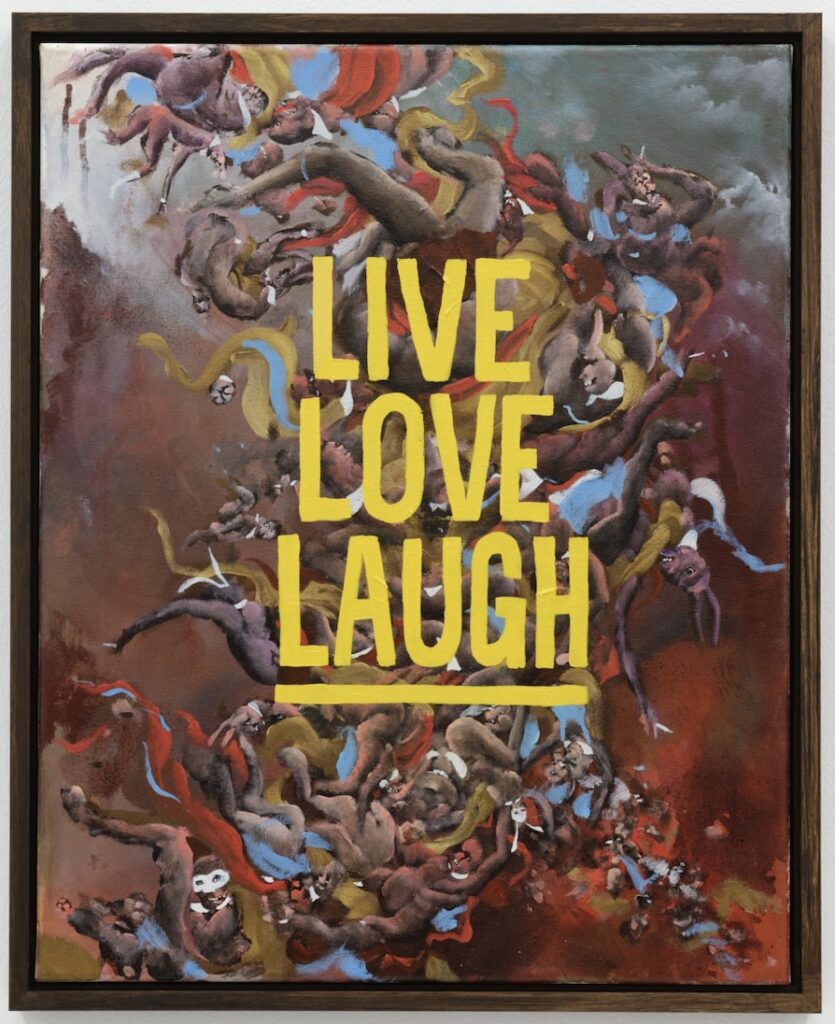
As you mentioned earlier, you weave together references to Bob Ross, Caspar David Friedrich, and Edvard Munch, alongside IKEA-style home décor art. What fascinates you about mixing “high art” and “kitsch” in this way?
Willehad: It always annoys me when something is regarded as higher or lower. Especially when public opinion is that something is ‘not done’, that intrigues me. It makes me want to do it anyway. Drag it to the dinner table. I think it is because I have a problem with etiquette. I find it silly and foolhardy. If you are confident of what you do, there is no need to only play your cards in the safe room.
Can you talk about your relationship to mass-produced visual culture—what some might dismiss as “IKEA art”—and why it remains such a rich source for you?
Willedhad:I found the medium interesting. Maybe the most hung art in the world. The go to option for any empty apartment wall. No long back and forth. ‘HOME’. There you go. I like how this especially in the ‘HOME’ piece in the show can just by what it is, symbolize how our wealth and comfort is someone else’s misery.
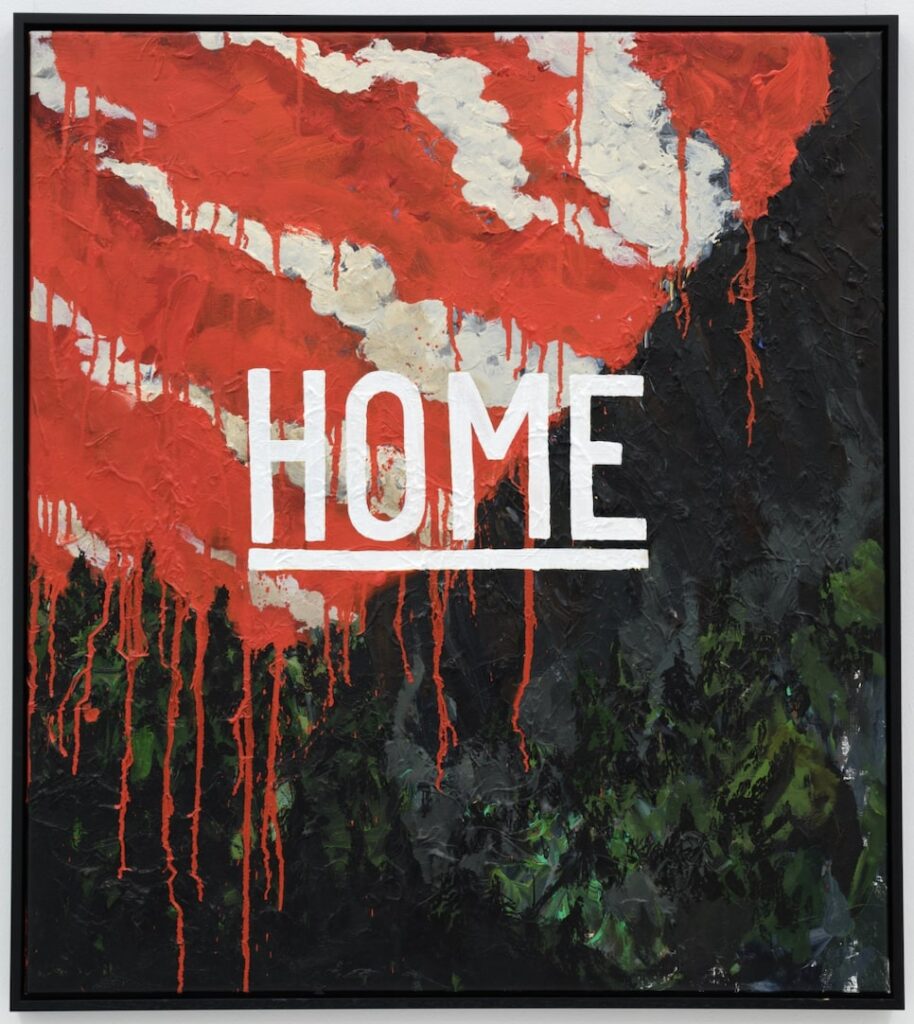
Do you see your work as parodying these aesthetics, or as reclaiming them
Willedhad:Neither nor. I am trying to use them for my own purpose. I enjoy playing with the format and try to figure out how I can best work it to my desired effect. The most important thing about the aesthetics to me is that they exist prior to my work and thus bring their own associations along.
You write that nature, often a place of retreat, here becomes a projection surface for inner restlessness. Can you elaborate on that restlessness? And what role does nature play in your personal life versus in your art?
Willedhad: Nature is a very different place than society. I know how to function in society, which is like a glass bubble floating in nature. Doing its best to remain unaffected by it. Nature has very different rules. And especially very different expectancies.
We spoke about it at another point. Sex is something that keeps cracking this bubble. Puts us back to instinct and urge. Personally I love to go into nature. But I sit there like securely wrapped up. Vacuum wrapped. It takes a long time until I can let nature in. I force myself to draw it, just to have proof of the time I spent. It demands such a different mind.
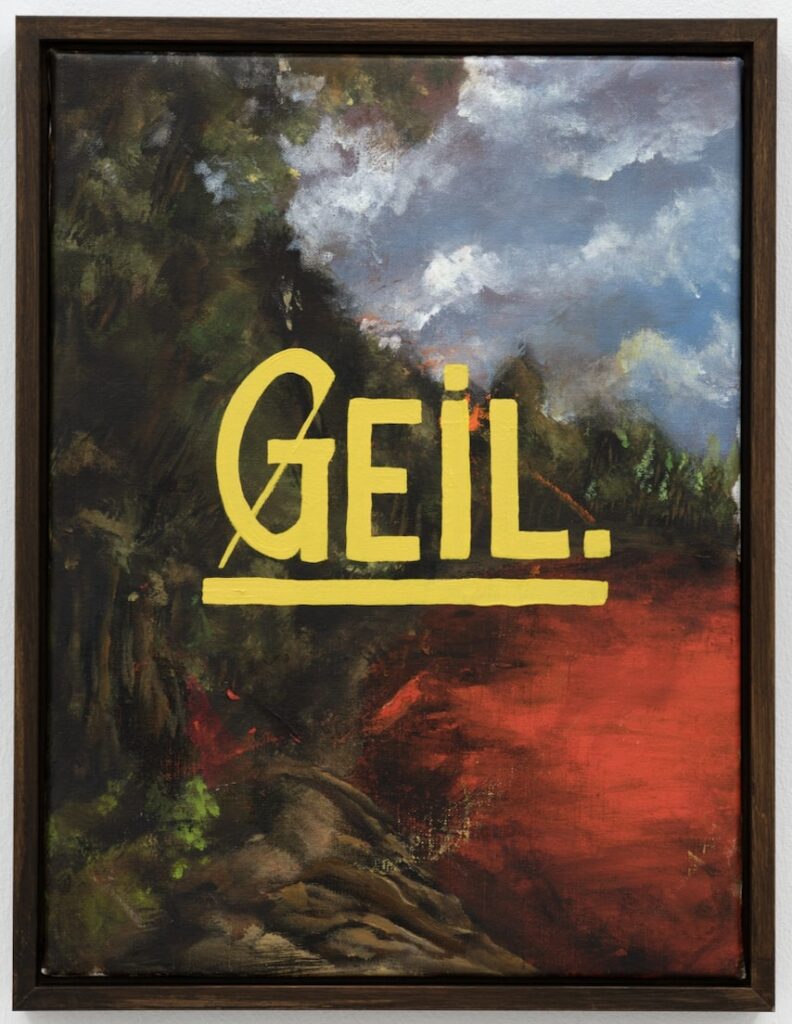
Works like We Knew It and Love Family Hate Enemy carry heavy social and political undertones, yet you avoid direct didacticism. Can you tell me more about that? And how do you strike that balance?
Willehad: Like I tried to put into words before, I do not believe in an Us vs Them world. I think we are all lost together. Facing a big unanswerable question. None of us has done this before. I think masses and power corrupt, but I do not believe in evil people. This is why I try to keep my voice true to my own position. I do not know more than anyone else. I experience it all together with everyone else.
Sexuality in the exhibition is fractured, exaggerated, sometimes grotesque. What drew you to confront sex as performance, parody, and loss of essence in this body of work?
Willehad: Sexuality is maybe the strongest driving force behind what we do. I think the fewest of us have a healthy relationship with it. Me neither, btw. I find it interesting how it is ever-present, and at the same time taboo. That status alone is worth to think about it all the time. As we do.
Our biggest shame, our clear connection to nature and the animal world. This is not how we want to be portrayed. But it is impossible to shake it.
When Lovecraft speaks of sex as ‘boring animalistic details, utterly uninteresting to someone whose preferences lead him to the fields of fairytales, golden cities shining in exotic sunsets’, that sentence alone sounds to me like a soft-erotic film setting. I work to address my unresolved issues. So I cannot get around this one.
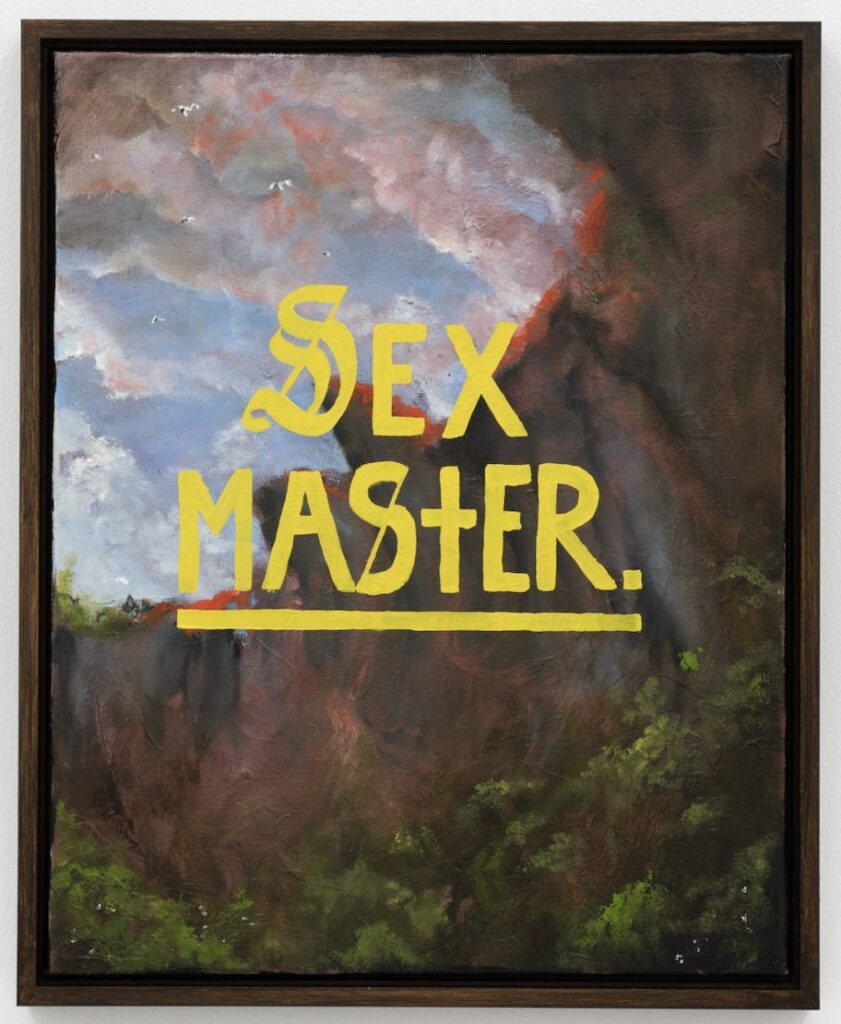
Your work often combines grotesque imagery with humor and irony. Do you see humor as a protective shield, or as a way to cut deeper?
Willehad:A bit of both. I think it serves a similar purpose as religion or any other believe does. It is a way to experience joy and companionship in youth. Which is the time that you first sharpen the blade of your humor.
Later in life, when fate starts striking is when you will need this blade. Humor is a tool that allows to deal with horrors that are inevitably coming our way, the higher we build this jenga tower that is life.
You’ve previously explored the fragile realities of togetherness. What new insights did this series bring you about human relationships and contradictions?
Willehad:I have recently been looking back at some of my work from around 20 years ago. Or even the work I finished my study with. It turns out that the topics I deal with were already present then. They morph during the years. But reading the older works it became clear to me that this is an ongoing investigation. A steady exploration of our life together, with very little conclusions. A catalogue of facts.
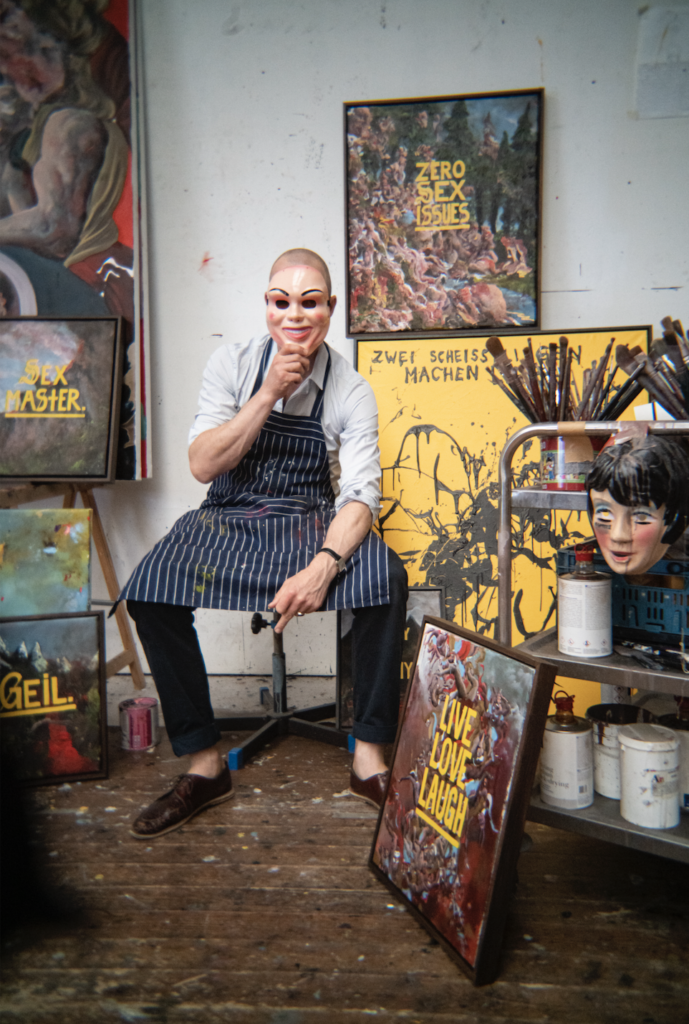
Do you think this body of work represents a new chapter in your practice, or is it more of a side path in your ongoing exploration?
Willehad: In my opinion it was time for me to walk on a little. I would not go so far to call it a new chapter. But I am opening the door to new possibilities. My work was very diverse when I started painting in oil in 2019. The medium captured me in a way, that for the period of almost 5 years I hardly did anything but paint.
Writing, drawing, filming etc have always been a strong part of my work. To give people a chance to understand this, I kept publishing ‘The Horse Diaries’, a series of zines, which comprise my drawing, text and street-photography work. In fact I just released issue ten, and am now working on a big book release that has all issues plus some extra text in it.
This new body of work is making a step to further blend my worlds. My work is about tone, not technique. During the opening of my show at Galerie Droste, I got the feeling that the people were ready. We had a spectacular opening that outdid our expectations. I am also planning a new exhibition with Harlan Levey Projects in Brussels, that revolves around the Horse Diary issues.
If the exhibition could leave viewers with one lingering feeling rather than an intellectual conclusion, what would you hope that is?
Willehad:I hope they feel sympathy for their flaws.