Share this
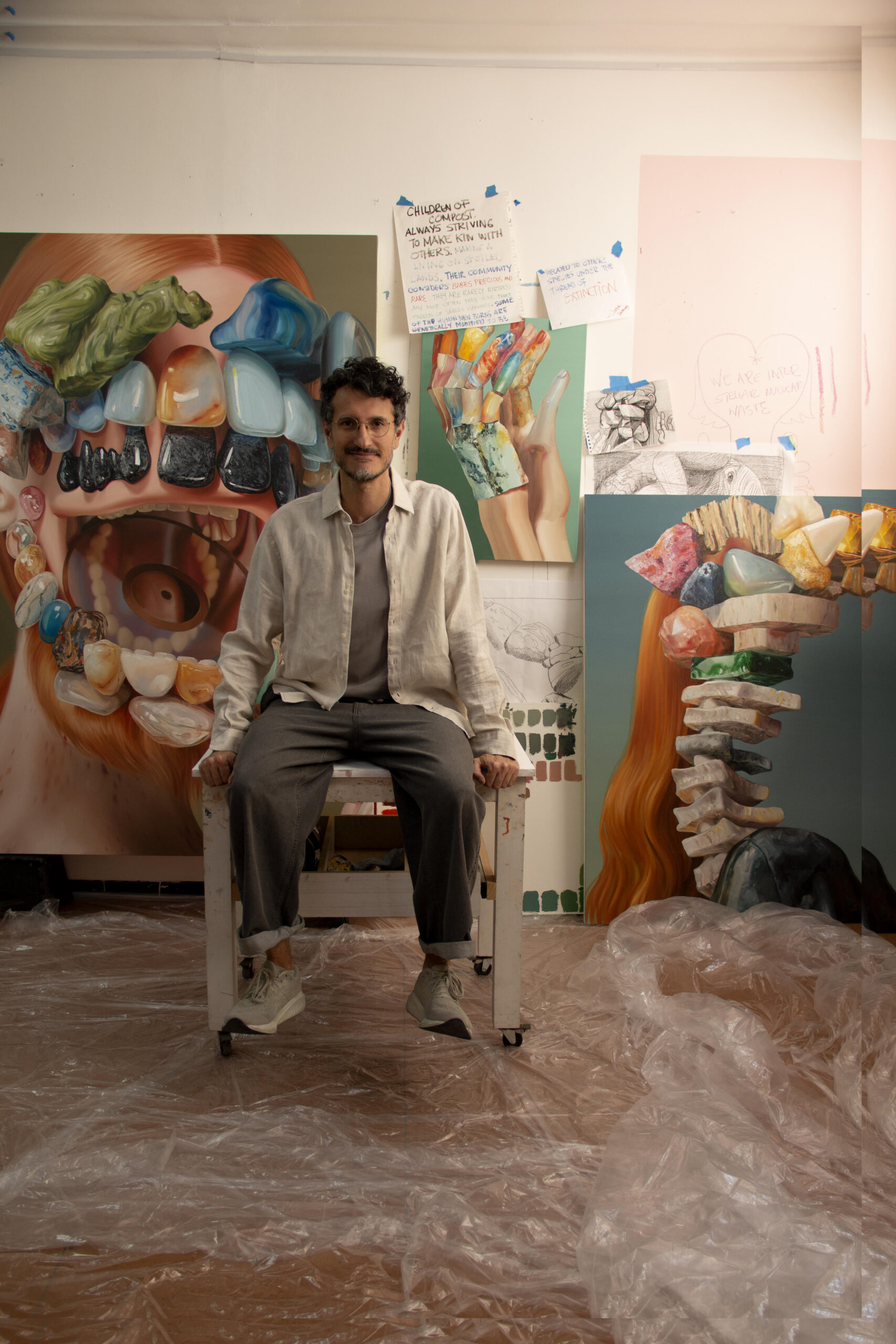
Horacio Quiroz’s rich painterly depictions of the human body unravel a world of hybrid states and dynamic desires. With a background in international advertising, the self-taught painter began his artistic career in 2013, and has since built up a body of work that straddles the line between the beautiful and grotesque, utopian and dystopian, the familiar and otherworldly. Informed by queer and ecological theory, Quiroz’s corporeal worlds reveal a cosmological consciousness that expands the relationship between gender, identity, bodies, and environments.
His highly detailed yet fantastical paintings radiate a queer optimism that’s paradoxically rooted in constant change. Based in Mexico City, Quiroz (b. 1977) earned his Graphic Design BFA from Universidad Iberoamericana in Mexico City. Three years in to his career as a painter, Quiroz’s work was selected for the prestigious 15th Rufino Tamayo Biennial of Painting in Mexico. Quiroz quickly built up a reputation for mind-bending paintings revealing queer representations of the body, nonbinary understandings of gender, and dream states.
Hola Horacio! It’s a pleasure to sit down with you! First question that I always ask. How does a regular day look like for you in Mexico City?
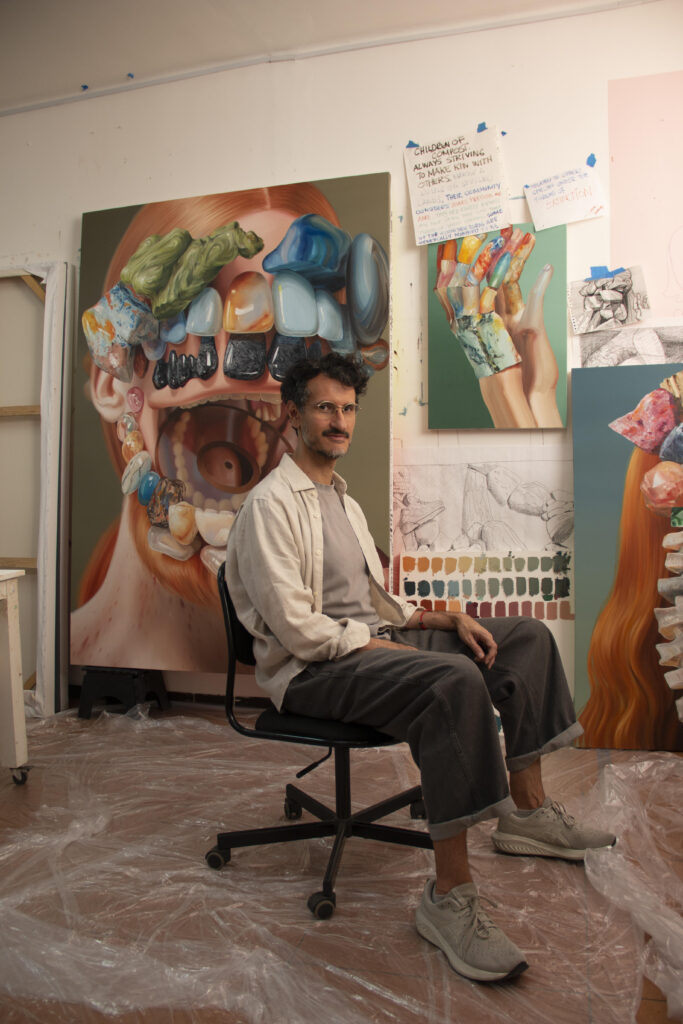
Horatio: Well, a typical day for me starts very, very early. The first thing I do is stretch my body. My physical body is deeply connected to the way my mind works, so I head to my daily Pilates, functional training, or yoga class. It’s a way of waking up my muscles, my skin, and my awareness, while tuning into the energy of the day. Then, after a substantial breakfast, I prepare my meals for later and head to the studio, where I map out my working day and immerse myself completely in the creative process.
I’m curious, growing up, what was life like there? And what kind of kid were you? What did you enjoy doing?
Horacio: (Laughs.) Oh, that could easily fill a very long conversation. I grew up in Mexico City, a tremendously chaotic place, but also incredibly rich, exotic, and full of life. It’s a city with an overwhelming energy, where the streets, the people, and the culture are constantly in motion. I don’t know what it’s like to grow up somewhere else, but I do know that the extroverted nature of my country often felt at odds with who I was.
I was a shy boy trying to find his place in the world. I was very thin, grew tall quickly, and felt awkward in my own body. As I got older, I struggled to understand where I belonged and how to inhabit both that body and the city around me. Looking back, I realize that many of the questions I explore in my work today were already present then: How does a body exist within a particular context? How does it expose itself, adapt, and ultimately find a sense of belonging?
Drawing became one of the ways I navigated those questions. I loved drawing and would spend hours doing it in front of the television. It was both a refuge and a way of making sense of my existence. Growing up within a deeply orthodox Catholic family and an extremely traditional society, I often felt that the video didn’t match the audio—that something about the world I was being shown did not align with what I felt inside.
I spent much of my childhood alone, imagining, dressing up, creating things, and inventing games with whatever I could find around the house. Those solitary hours were never lonely; they were formative. I believe it was during those early years that the inner world I continue to explore through my work today was first built—a space where imagination, identity, and possibility could exist beyond the limits of the world around me.
Do you remember approximately at what age your creative side started to show? And when did you start taking being an artist seriously?
Horacio: Well, I think I’ve always been a very, very creative person, from a very young age. And it’s not so much that I made a conscious decision to take it seriously, but within my storytelling there is something very important: I spent many years working in creative and advertising agencies as a designer, as a creative. And that experience taught me to understand the creation of projects in a very different way. I have a deep understanding of the elements needed, and the diverging lines that come together to create something new.
For me, the thinking behind it is profoundly important, the concept, the development, how an idea ultimately becomes a work of art. Those were years of tremendous learning, hugely important years, that eventually led to a leap of faith into my own identity as an artist, as a painter. And fortunately, that leap was accompanied by galleries and projects that very quickly wanted to support my creative work.
So, taking it seriously? I think from a very young age. Because for me, creation and art are among the most important things that exist within humanity, within society. I truly believe it is a fundamental part of how this world should function.
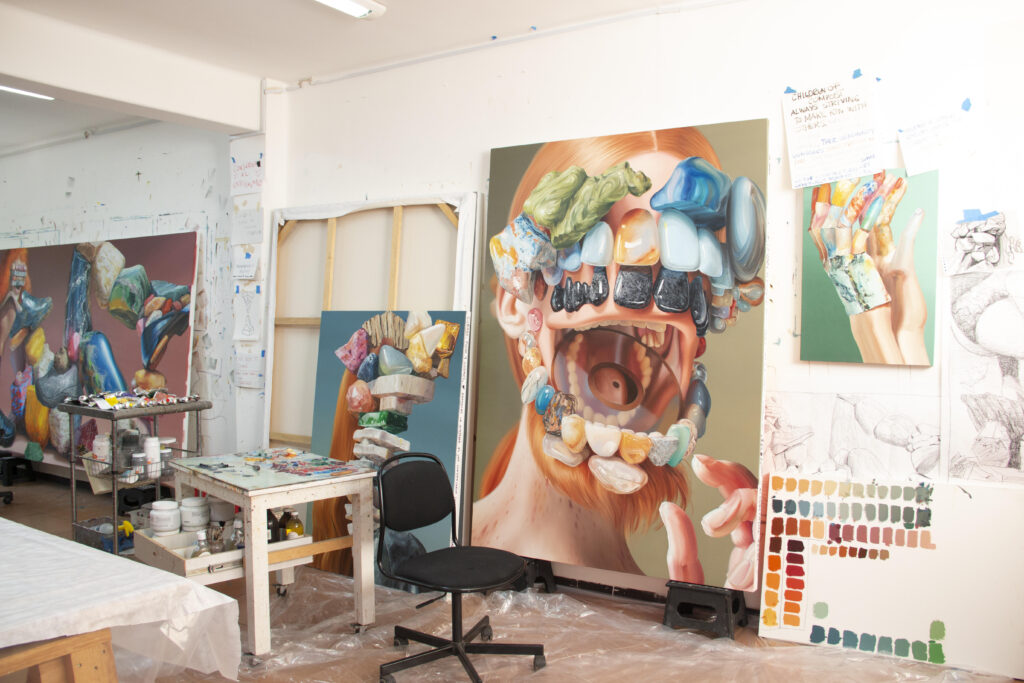
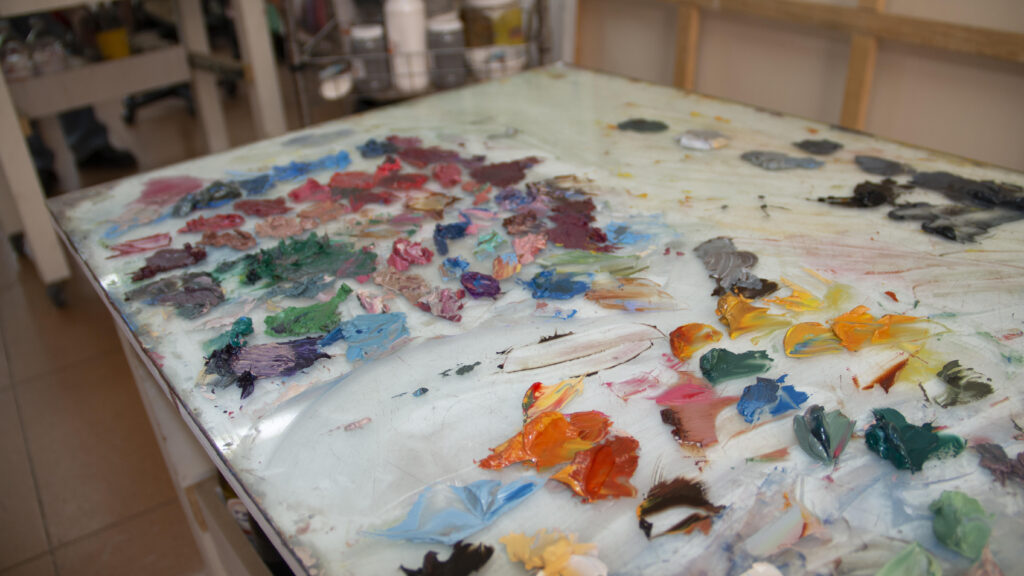
You began painting after a career in international advertising. What did painting give you that advertising couldn’t?
Horacio: Well, creative processes are important, each one has its own ritual, its own process, its own time. But yes, the sheer number of hours you spend in front of a painting, the respect you must have for each and every layer, the oil, the manual process, everything that creation involves when it comes from time… it is something very different from advertising, where, wow! everything moves so fast.
Sometimes you’ve spent entire months working on something that then happens in three days. In that sense it’s actually quite similar to exhibitions, but the process itself is entirely different. Painting has given me immense things, in terms of inner development, and in terms of growth as a human being
Do you remember the first painting where you felt: “this is my world, this is my language”?
Horacio: I’m not sure exactly which painting it was, but I do know exactly what the thread was. From the very beginning I was strongly defined by something I continue to do, though in a different aesthetic language, and that is hybridisation. And that connects deeply to my questioning of identity, of our body within this society, and how that body has been expected to be established, canonical, how it is supposed to respond to a certain social need.
Hybridisation is very important to me because it relates strongly to sexuality, to who I am and how I relate to the world, and to how I want the world to understand that labels are, quite often, very far removed from actual reality.

Ok Horacio, with these next series of questions, I will try to delve into your work as best as possible. So…. Your paintings often feel as if the body is not a fixed thing, but a place where many forces are passing through. When did you first begin to understand the body that way?
Horacio: I think the body, for me, has never been a fixed or closed thing. From very early on I understood it as a territory, a place where forces pass through, where the visible and the invisible coexist in constant tension. The exhibition itself is built on that paradox: the invisible exerts its force upon the visible, transforming absence into a presence that reshapes our understanding of existence.
Beneath appearances lies something transcendent, and it is in that zone where what I call ontological weight unfolds its full power, the self acquires material density precisely through what remains hidden. That is where my figures are born: cyborg subjects, hybrid configurations that understand hybridisation as the very essence of the contemporary self. These presences that I portray don’t inhabit the margins, they place themselves at the centre of a new narrative about what it means to have a body, a consciousness, and desire in the 21st century.
These forms dissolve the boundaries between the human condition and the machine, moving through a space where traditional categories reveal themselves as insufficient. The body, for me, has always been that, a threshold. Never a fixed answer.

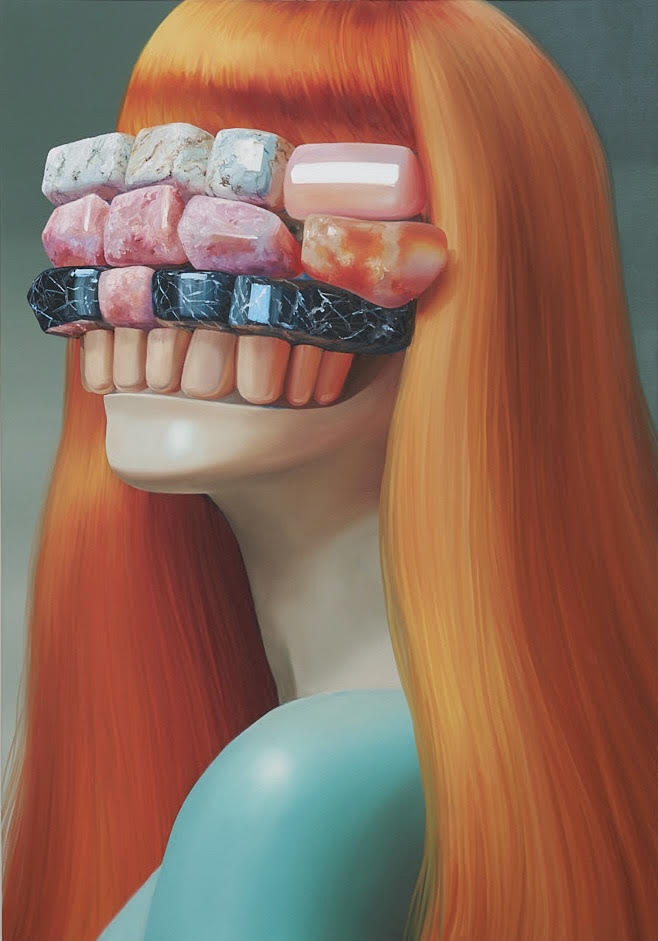
Stones and teeth appear repeatedly in your paintings. What do those forms hold for you symbolically?
Horacio: These forms, stones, teeth, flesh merging with clay, with liquid metal, are not aesthetic choices alone. They reflect a process of interior transformation, a gesture of openness toward the void from which something new can emerge.
Teeth are primal. They are the part of the body that changes, that transforms. Stone carries geological time, weight, memory. When I fuse flesh with these elements I am talking about the protean body, a posthuman body that challenges binary dualities and flows with an intersexual freedom that never asked permission to exist.
For me, painting is a privileged space where the invisible takes form, where the intangible becomes incarnate with density and gravity. Each of these forms channels archetypes that live within the collective unconscious of our time, the digital shadow, the algorithmic anima, the cyborg self. The psyche becomes code, and code becomes soul.
Teeth are such intimate things: they belong to the mouth, to hunger, speech, sex, fear, aggression, and childhood. What draws you to them as an image?
Horacio: Teeth are one of the first visible signs that we are growing during childhood. They are perhaps the clearest evidence of transformation at such an early age: letting something go so that something new can emerge. They embody both growth and loss, and remind us that change is often accompanied by discomfort or pain.
There is also something deeply primal about them. They are bones protruding through our skin—the inner material of the body made visible to the outside world. In that sense, they exist at a threshold between interior and exterior, hidden and exposed.
They also sit at the intersection of hunger and desire, tenderness and aggression. That ambiguity, that coexistence of seemingly opposing forces, is precisely the territory where I like to work.
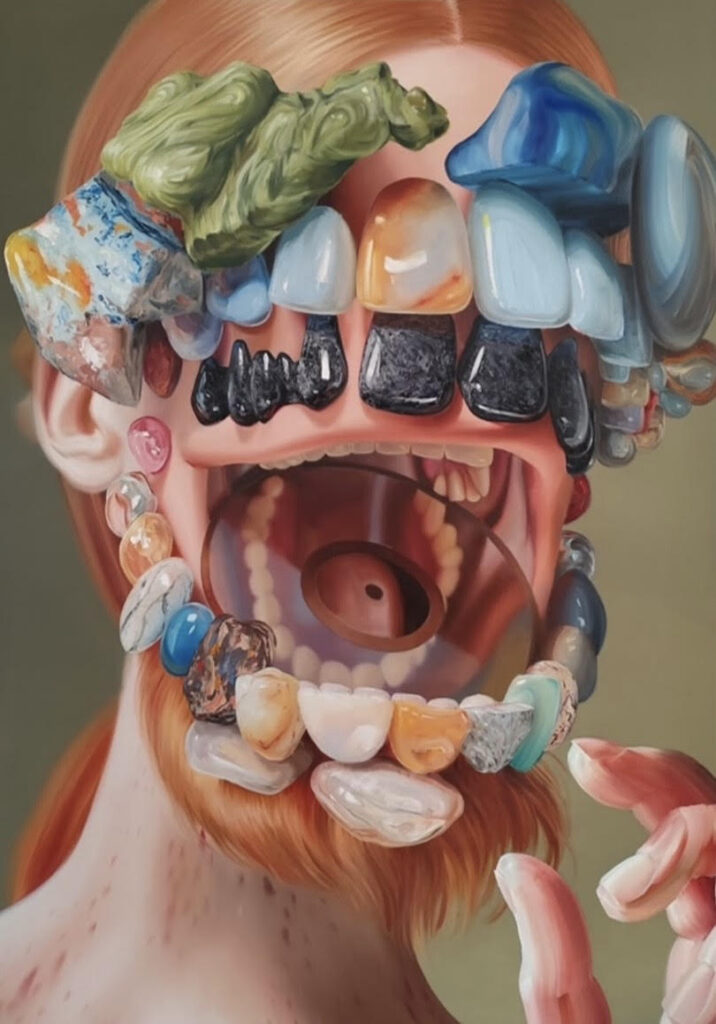
Stones feel almost opposite to flesh: hard, ancient, silent, enduring. When you place them near or inside bodies, are they a burden, an armor, a fossil, or something sacred?
Horacio: All of those things at once, I think. That tension is precisely what interests me, the impossibility of choosing just one meaning. Sometimes a stone inside a body feels like memory that cannot be released. Sometimes it feels like protection. The body decides.
There is something archaeological in the way stones and teeth appear in your work, as if the body is also a ruin or a future relic. Do you think of your paintings as recording what remains after transformation?
Horacio: Yes, absolutely. I think of the body as a site of accumulation, layers of experience, of identity, of time. Transformation doesn’t erase what came before, it sediments it. The painting becomes a kind of excavation.
Both stones and teeth carry time differently from skin: they survive, resist, and remember. Are you interested in the parts of the body, or the world, that outlast us?
Horacio: Very much so. I believe that what outlasts us is also what defines us. The parts that resist, whether in stone, in bone, or in the collective unconscious, those are the parts that carry the most truth
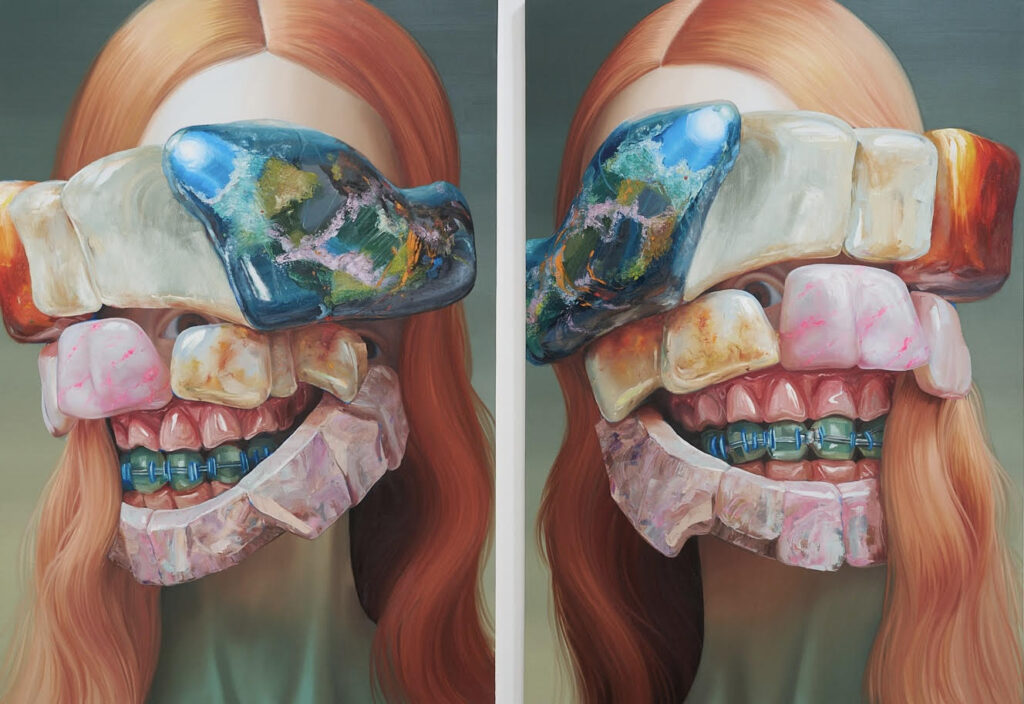
Your work often moves between beauty and grotesquery. Are those opposites for you, or do you see them as part of the same experience?
Horacio: They are absolutely the same thing for me. Beauty without tension is decoration. The grotesque is where beauty becomes honest, where it stops performing and starts telling the truth.
There is something intensely seductive in your paintings, but also something unstable, almost dangerous. How important is desire in the way you build an image?
Horacio: Desire is the engine. Without it there is no image, there is only form. I want the person looking at the painting to feel something shift inside them, something they perhaps weren’t expecting. That instability is intentional.
Your bodies often resist easy categories: gender, species, anatomy, even environment seem to blur. Is that fluidity a fantasy, a political position, or something closer to how you actually experience life?
Horacio: It is how I experience life. It has always been that way for me, existing between categories, never fully belonging to one definition. The political dimension is there, yes, but it comes from something much more personal and lived.

A lot of queer art deals with pain, exclusion, or survival, but your work has been described as carrying a kind of queer optimism. What does optimism mean to you, especially when the body is always changing?
Horacio: Optimism for me is not the absence of pain, it is the decision to transform it into something generative. The body changes, yes, but change is not loss. Change is the most honest thing a body can do
Did growing up queer in Mexico shape the way you imagine bodies, intimacy, or transformation?
Horacio: Enormously. Growing up shy, thin, tall, a little awkward, and queer, in a city as extroverted and intense as Mexico City taught me very early that my body and the world around me were in constant negotiation. That negotiation never ended. It became my work.
Your figures often seem to exist beyond shame. Was painting ever a way of undoing shame for you?
Horacio: Yes, and is a lifetime progress for me. Painting gave me a space where the body didn’t need to justify itself. Where I could simply be, hybrid, fluid, excessive, tender, strange. That freedom was something I had to build slowly, layer by layer. Much like the paintings themselves.

When you paint nonbinary or hybrid bodies, are you thinking about identity as something personal, cosmic, ecological, spiritual, or all of these at once?
Horacio: All of these at once, always. For me they are not separate registers, the personal is cosmic, the ecological is spiritual. The cyborg body and the ancient stone are part of the same conversation.
What part of yourself do you think your paintings reveal before you are ready to say it in words?
Horacio: The parts that still don’t have a name. The paintings arrive before the language does, they know things I am still in the process of understanding.
Is there a fear that keeps returning in your work?
Horacio: The fear of not belonging. Of being too much and not enough at the same time. But I’ve learned that that fear is also a doorway, it’s where the most interesting work begins.
You often paint bodies that look powerful, vulnerable, erotic, monstrous, and divine at the same time. Which of those states feels closest to you personally?
Horacio: Vulnerable. Everything else, the power, the eroticism, the divinity, comes from having the courage to be vulnerable first.
Your work connects the body to environments, ecosystems, and nonhuman forms. Do you see the body as part of nature, or as something nature is constantly rewriting?
Horacio: Nature is constantly rewriting us and we are constantly rewriting nature. That dialogue is what my work lives inside. The body is never separate from its environment; it is always in the process of becoming something it hasn’t been before.

Some of your recent descriptions mention posthumanism, spirituality, artificial intelligence, and the self. Are you interested in the future of the body, or in something older and more mythic returning through new forms?
Horacio: Both, and I don’t think they are separate. Every time an algorithm generates an image, it activates the psychic echo of everyone who ever imagined that path. The mythic and the technological are not opposites, they are the same human impulse reaching across different centuries. I am interested in where the ancient archetype meets the digital shadow.
Mexico has such a powerful visual history around death, transformation, ritual, myth, Catholicism, folk imagery, and surrealism. Do you feel connected to any of those traditions?
Horacio: Deeply. You cannot grow up in Mexico and not be shaped by that relationship with death, with ritual, with the sacred and the profane existing side by side. It lives in my body, in my color, in the way transformation is never tragic in my work , it is always also a kind of ceremony.
Do you feel your work could only have emerged from Mexico, or is it more connected to a global queer imagination?
Horacio: Both are true simultaneously. The roots are absolutely Mexican, the chaos, the richness, the intensity, the relationship with the body and the sacred. But the language speaks to something global, because the experience of existing between categories, of building your own body and identity, is universal. Mexico gave me the soil. The world gave me the conversation.

Can you walk me through your creative process from beginning to end result?
Horacio: It always begins with thought, with concept. I need to understand what I am trying to say before I touch the canvas. Then comes a period of accumulation: images, references, feelings, fragments of ideas. When I arrive at the studio, very early in the morning, I let the atmosphere do its work. Oil painting demands patience, each layer requires time, respect. You cannot rush it. The painting tells you when it is finished, not the other way around.
Can you also tell me about your use of symbolism?
Horacio: Symbolism for me is never decorative, it is structural. Every element carries weight: stones hold memory and time, teeth hold primal truth, hybrid bodies hold the question of identity. I work with archetypes because I believe they live in the collective unconscious,they are recognized before they are understood. That recognition is what I am after.
How do you approach color?
Horacio: Color is emotion before it is thought. I use it to create atmosphere, to signal states of being, tension, tenderness, desire, the sacred. I am drawn to combinations that shouldn’t work but do, because that tension mirrors what I am painting: bodies and identities that exist in contradiction and find their own beauty there.
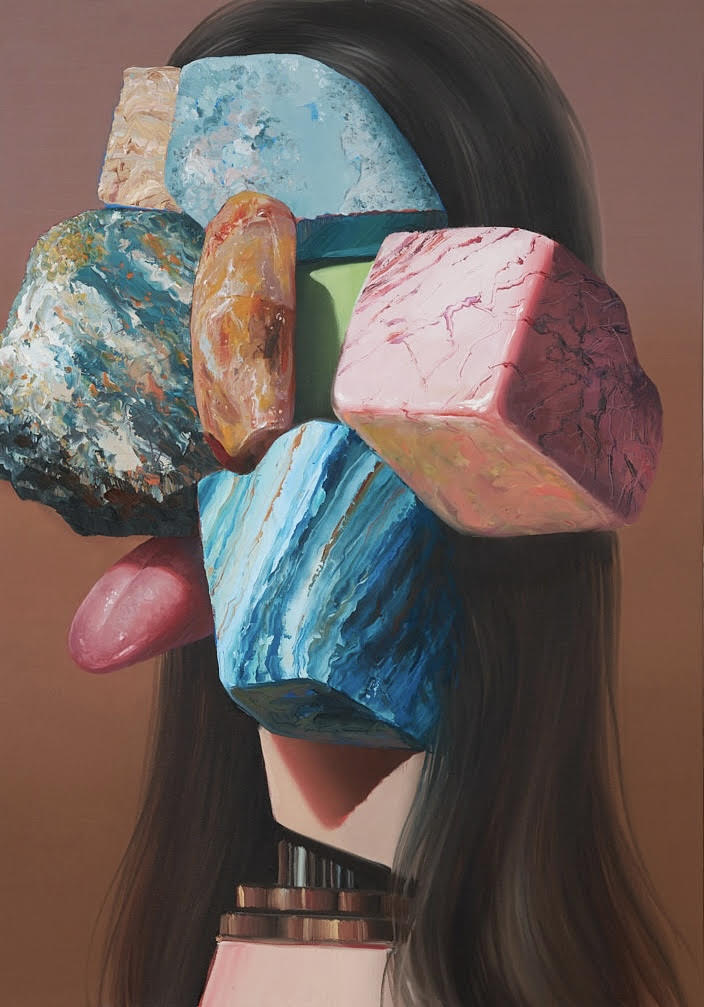
So with what we just talked about, what are you hoping to convey?
Horacio: Ultimately, that the invisible is the most real thing there is. That the body is not a fixed answer but an open question. And that existing between categories, between human and machine, between flesh and stone, between the ancient and the future, is not a limitation. It is freedom.
Ok Horacio, now to something totally different. In a parallel universe who would you be and what would you be doing?
Horacio: Horacio: I think it would be acting. I would love to lend my body to the construction of fiction and to experience other realities through the embodiment of different characters. The idea of becoming someone else for a moment, of stepping beyond the boundaries of who you are and transgressing your own identity, is deeply appealing to me.
At the same time, I could also imagine myself somewhere between a somatic therapist, an osteopath, a bodyworker, and a healer. I’m fascinated by the body and by helping others develop a deeper awareness of their own physical presence. There is something profoundly meaningful about guiding people back into a relationship with their bodies and helping them discover what is there.

Outside of art, what’s something you’re obsessed with right now that keeps you grounded or inspired?
Horacio: My body, honestly. Yoga, movement, the physical ritual of the morning. The way the body knows things before the mind does. That connection keeps me sane and keeps me curious.
Can you tell me a story about a time when a connection with someone had a big impact on you?
Horacio: I think every gallery that believed in my work early on changed something in me. Because when someone sees you, really sees what you are trying to do, before you are fully able to articulate it yourself, it gives you permission to go further. Those moments of being truly seen have been the most transformative of my life.
What qualities do you find most important in the people you choose to spend time with?
Horacio: Curiosity and honesty. People who are genuinely interested in the world, who ask real questions and aren’t afraid of real answers. And people who understand that time, investing time in things, in relationships, in ideas, is the most valuable thing we have.
Anybody you look up to?
Horacio: Many people, artists, thinkers, people I have met briefly who carry an extraordinary inner life. I am drawn to anyone who has had the courage to build their own language, regardless of the field. That act of building something entirely your own, from the inside out, is what I find most admirable.

What motivates you?
Horacio: To be frank, fear motivates me. Fear of standing still, of becoming complacent, of repeating myself. Fear can be uncomfortable, but it also keeps me searching, questioning, and evolving. In many ways, it pushes me to take risks and venture into places I don’t fully understand yet.
At the same time, I’m motivated by the feeling that something hasn’t been said yet. That there is still a form, a color, a body that hasn’t existed before and needs to exist. That sense of necessity—that the work needs to be made—is what gets me to the studio every morning. Somewhere between fear and curiosity is where most of my work begins.
How would you describe a perfect day?
Horacio: Early morning, yoga, then straight to the studio. Hours of painting with good light and no interruptions. A long lunch with someone I love. A long walk in nature. An interesting conversation in the evening. Simple, but full of time.
What’s your favorite movie(s) and why?
Horacio: The NeverEnding Story. It completely blew my mind when I saw it at six years old. The Rock Biter, the giant sphinxes with their enormous breasts, the concept of The Nothing consuming everything in its path, and the Childlike Empress as a creative force—all of it fascinated me. I was especially captivated by the symbiotic relationship the film proposes between the real world and human imagination, the idea that one cannot exist without the other.
Another favorite film would be Disney’s The Little Mermaid, because she is ginger and her body transforms. (Laughs.) From the very first time I saw it, I was completely captivated—almost obsessed with it—and I’ve watched it hundreds of times ever since.
What song(s) are you currently listening to the most right now?
Horacio: Dance the pain away by Haute and Freddy,
Babieca! by Guitarrica de la Fuente,
Or any Healing Frequency video of YouTube (Laughs.)