
Share this
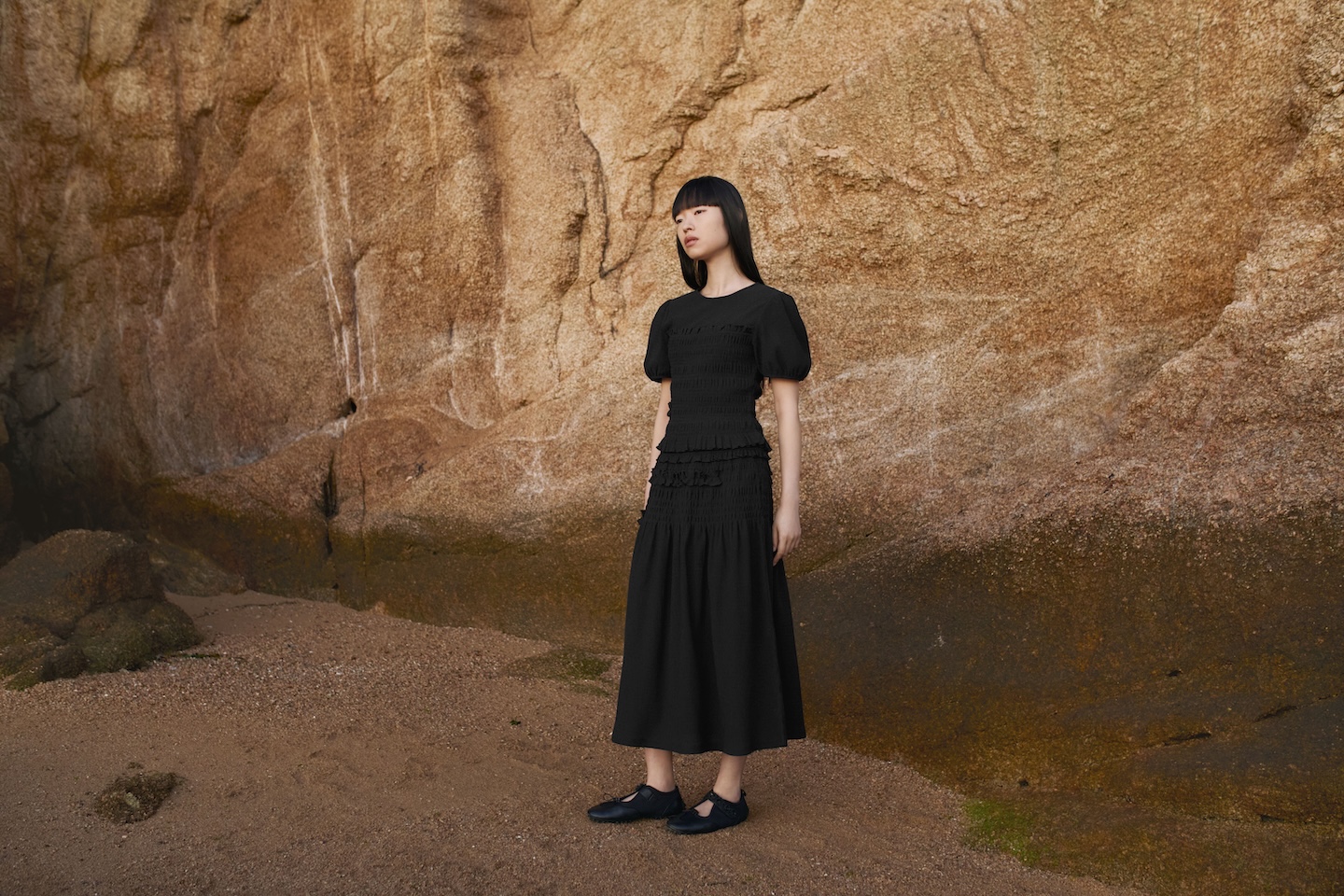
Not every designer survives the jump to mass retail with their identity intact. Too often, the details get flattened, the strangeness disappears, and what made the work feel specific in the first place ends up diluted into “wearable.” The appeal of Cecilie Bahnsen’s new UNIQLO collaboration is that it seems to resist exactly that problem. Titled Shapes of Poetry, the collection folds Bahnsen’s signature world — all floral textures, generous sleeves and sculptural softness — into the framework of UNIQLO’s Spring/Summer 2026 season.
That alone makes the project feel interesting. Bahnsen’s design language has always been unusually recognisable: a very particular idea of femininity built through volume, delicacy and surface detail, often balancing sweetness with something more structured and exacting. According to the original report, those codes remain central here, with floral motifs, measured ruffles, and elevated takes on basics that push the collaboration beyond simple wardrobe filler.
The collaboration also carries a backstory that feels almost too neat not to mention. Seven years ago, when UNIQLO opened its first store in Copenhagen, Yukihiro Katsuta — the company’s head of R&D and a key figure behind partnerships with names like Jil Sander and JW Anderson — reportedly crossed paths with Bahnsen by chance. That conversation seems to have lingered until now, finally materialising as a collection that brings her more rarefied visual world into one of fashion’s biggest global retail systems.
And maybe that is what makes Shapes of Poetry feel legible right now. Fashion is deep in a moment where softness is being revalued, but not in a vague, passive way. Bahnsen’s work has always offered a more deliberate version of romance — one that can feel tender, but also architectural. Bringing that into UNIQLO gives the collaboration a useful tension: the meeting point between fantasy and function, between a designer known for emotional, highly stylised silhouettes and a brand associated with everyday clarity. That last point is an interpretation based on how the collection is framed and on the contrast between the two brands’ established identities.
There is also a practical milestone tucked into the launch. This is said to be the first time in Bahnsen’s career that she has designed a children’s collection, which adds another layer to the collaboration’s softness. Rather than simply scaling down an adult line, the move suggests a widening of her universe — one that treats her aesthetic not just as runway language, but as something that can move into daily life more broadly.
That shift feels bigger than it might first appear. Bahnsen has already shown she can translate her world across categories through collaborations with brands like ASICS and The North Face, but UNIQLO presents a different challenge: not just cross-category design, but scale. If the earlier partnerships tested how her codes behave in sportswear or performance outerwear, this one tests whether her sensibility can survive true accessibility. Based on the way the collection is being presented, the answer seems to be yes — not because it abandons her signature, but because it reduces it carefully rather than erasing it. This is an inference drawn from the article’s description of the collection’s recurring design elements.
The collection is set to launch on May 28, 2026, in UNIQLO stores worldwide and online.


Photos: UNIQLO