
Share this
Julia de Ruiter (b. 2003) is a Toronto-based oil painter. She recently graduated from OCAD University with a BFA and will begin her MA in Painting at The Royal College of Art this fall. De Ruiter’s practice examines internet and incel culture, informed by her unsupervised exposure to online spaces during her formative years. Through her work, she investigates grotesque behaviours and ideologies that emerge within digital communities, with a particular focus on predatory behaviours and toxic masculinity within the manosphere and parallel communities.
Drawing from a continually expanding personal archive of collected online imagery, De Ruiter transforms found digital material into paintings that interrogate the psychological and cultural impact of contemporary internet culture.
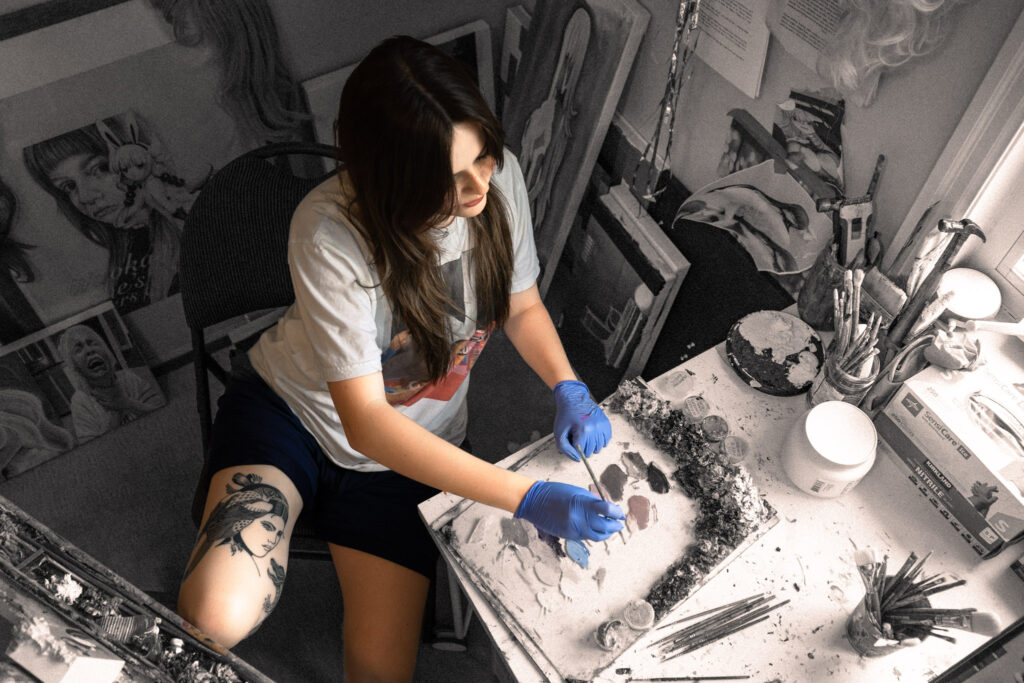
Hi Julia! It’s a pleasure to sit down with you! First question that I always ask. How does a regular day look like for you in Toronto?
Julia: Hello! Thank you for your time! I wake up, preferably with the sun shining through my curtains, and start my day with a nice cup of joe. I then get ready and always have to make my bed. I’ll craft my to-do list for the day and paint. Then if it’s a perfect day I’ll make a BELT bagel with some chipotle aioli on that for brunch, and paint some more until I’m sick of looking at my work. Emails, reading, chores or errands follow suit until it’s time for dinner and to watch TV or a movie. I always end my night washing my paint brushes because it’s my least favourite thing to do.
I’m curious, growing up, what was life like there? And what kind of kid were you? What did you enjoy doing?
Julia: I actually moved to Toronto to do my BFA, but I grew up in the GTA (Greater Toronto Area). Very much a suburbia bubble. It was nice and comfortable but I always wanted more around me. I was a polite and shy kid, but more of a menace at home. My mom says that I was always leaving little messes everywhere. I really liked to keep my cards close to my chest in terms of my interests and hobbies at school. I did my best to dull my personality down to be more likeable, taking on the interests and traits of those around me. I feel as though only a few friends truly knew me in childhood. I enjoyed crossing the street to play Minecraft with my best friend and her little brother after school, reading, watching anime and making video edits of my favourite characters.

Do you remember approximately at what age your creative side started to show? And when did you start taking being an artist seriously?
Julia: I have always been someone who wants to create, I’m unable to put an age on it. I used to make food for my dolls out of upcycled materials, which would get used in my stop motion animations of them. I have so many drawings of my Warrior Cat OCs, minecraft too. I taught myself After Effects in elementary school so I could get better at making anime edits. During high school I was unsure if I wanted to go into film or fine arts. I decided to go into fine arts after having a handful of conversations with my art and film teacher.
To be honest I didn’t think that I could actually be an artist until 2024. I felt that the things I was painting were just fulfilling assignment requirements. After letting go of trying to create academically sound art is when I accepted that I could and want to be an artist seriously.
Ok Julia, with these next series of questions, I will try to delve into your work as best as possible. So…. Your work draws from a personal archive of found online imagery. When you save an image, what tells you that it has the charge or toxicity you want to bring into painting?
Julia: I save so much. My phone is littered with memes, unruly anime girls, GIFs, ads, and screenshots from reels. If it piques my interest in the slightest I will save it. There is no method to the madness, and no organization to the photos after they’ve been saved. Thousands of images I have will never be turned into work. I will only decide to paint an image if something I’ve read, people I talk to, or a video essay jogs my memory of something in my camera roll. The ideas and emotional charge snowballs from there.

You’ve described your work as looking into the underbelly of internet and incel culture. What first made you want to start documenting those topics?
Julia: I began painting about weird crap on the internet because of my experiences growing up with unlimited access to it. I spoke to a slew of different people. Saw a lot of gross stuff. Dealt with a lot of weirdos. I was navigating these spaces as a young girl who didn’t know much about the world, but thought she knew everything. I knew I wanted to start diving back into this world more when old chat logs got completely erased and a part of my history went along with it. That moment when my past got erased from me I began researching and looking into incels, the manosphere, pedophiles/predators, and red-pilled misogynistic men.
There is often a strange tension in your work between humour, disgust, fear, and fascination. How do you decide how much of each emotion a painting should hold?
Julia: I do my best to try to balance the emotions out in a piece, I like to pull on what inclined me to save the image in the first place. Most times the image declares how it wants to be emotionally represented. However, after a piece is finished, I feed it back into the algorithmic cycle I peeled it out from. Which then becomes completely out of my hands and people then project their own feelings onto it. I only have so much control over it.


Do you see your paintings as a form of critique, documentation, exorcism, or something more ambiguous than that?
Julia: My work is both a way of critiquing these groups and their ways of thinking as well as a form of documentation. But heavy on the critiquing.
A lot of artists deal with internet culture through irony, but your work seems to push into something more psychologically uneasy. What do you think irony can and can’t do when dealing with online misogyny and extremism?
Julia: When delving into these extremist groups and ideologies, I think that it is easiest to make fun of and crack jokes at these people. I am all for laughing, it is second nature to me. However, with lolcows and individuals who identify as incel online are real people. Most of them in these communities actually believe these things, it’s not a joke to them so I don’t make one out of them. Enough people are doing that so I don’t feel inclined to. I take what they say and the hate they spew at face value. Leaning into the grossness, the uneasiness is harder to stomach as the person painting it for hours. But really allows others to see it how it really is, and to ask the harder questions. But I also like to paint unserious things from time to time…How 2 Survive & You’re No Better Than a Fart Joke. It is nice to take a break from all the disturbing things.

Incel and manosphere spaces often turn loneliness, sexual frustration, and insecurity into ideology. Are you more interested in the ideology itself, or in the emotional wound beneath it?
Julia: Both parts fascinate me. But what really strikes me is the space between the emotional wound to the ideology. A time where a person will go searching for community, or a place to justify the thoughts they are having. There’s a deep longing to be reassured. They will find it, and the community will make them feel so good they keep on coming back. Slowly they begin to mask their emotional wounds with their ideologies. That sweet spot fascinates me the most.
What do you think these online male communities reveal about power, shame, and control?
Julia: Everything is one big interworking web of shame and power and the desire for control. It’s one giant ecosystem that is self sustainable, like an evil terrarium. I pray that the lid doesn’t open up all the way.

Your work seems to understand that the grotesque online is not separate from real life — it leaks into relationships, desire, politics, and the body. How do you think the internet has changed the way people experience intimacy?
Julia: Intimacy is now created online by the micro-actions we take online. Every post we swipe past, save, share, like, without even giving a second thought to, creates these algorithms that curate our tastes for us, which in turn influences our desires. The intimacy we see online is served to us, and only the best is highlighted. I think a lot of younger people are missing the small everyday acts of love around us to seek out the grandiose gestures or heavy extremes that are fed to us online.
Do you think we still underestimate how much porn, gaming, memes, algorithms, and online forums shape young people’s ideas of sex and gender?
Julia: Subconsciously we underestimate it. It’s like our eyes are always eating and absorbing. But I think this topic is being spoken about more, which is fantastic. I really hope that there will be age-appropriate education about it in schools in the future because it’s definitely not going away.

When you depict or reference toxic male online spaces, how do you avoid simply reproducing their imagery or giving it more power?
Julia: The last thing I want is to give these people more power. To avoid this I play with distortion, or paint two images side by side so they commute with each other. Now I am exploring painting with thick and heavy textured paint to create a more tactile experience to push my work further.
Is there a point where looking at this material becomes emotionally or ethically dangerous for you?
Julia: Emotionally dangerous yes, but ethically no. My heart just breaks so often when reading other women’s experiences. The disgust I feel sometimes looking at reddit and reading some of the things these men will type is horrifying. My heart definitely hurts a lot. But I don’t put myself in risky situations.
You’ve spoken about formative, unsupervised exposure to online spaces. When you look back at that period now, do you see it more as damage, education, escape, or initiation?
Julia: Those years of my life felt like an escape, but I actually walked into a Looney Tunes never ending hole it seems like. I don’t know when or if I’ll hit the bottom and feel the extent of the damage.

What did the internet give you as a young person that real life couldn’t — and what did it take from you?
Julia: The internet gave me the ability to express my interests and participate in my hobbies in spaces that didn’t make me fear criticism, or feel shameful. I taught myself so much just through youtube videos. But it took away so much of my innocence much earlier than it should’ve.
Was there a moment when the internet stopped feeling like a place of freedom or curiosity and started feeling more predatory?
Julia: When I was a minor I didn’t feel anything but freedom online. I even chose a slightly different name from mine to go by, almost like a twin persona to myself. I didn’t realise all of the grooming and predatory behaviours I was exposed too until years after they took place.
Your work deals with communities that can be frightening, violent, and deeply misogynistic. What does it feel like to spend so much time visually and mentally inside that material?
Julia: It’s so heartbreaking and emotionally taxing. I think that’s why I don’t plan my next painting until I’m halfway done with my current one. There is a limit that I definitely don’t like to cross in terms of time spent researching and looking at images. There have been countless times I have had to stop looking into something because I cannot stop crying or I feel sick to my stomach. I know what I can emotionally withstand now, but it definitely took me some time to get there.

You’ve said that some of the work is connected to embracing the “weird stuff” that shaped you. How much of your practice is about shame — and transforming shame into image?
Julia: I used to hold a lot of shame with my interests and the weird stuff. I was watching MLP religiously in high school and didn’t tell a soul about it, same goes for accepting the “weird stuff” too. But I’m not embarrassed about my interests anymore, or the experiences I have had growing up. If there is any transformation of shame, it is mainly for my younger self.
Has making this work changed how you relate to men, masculinity, or online desire in your own life?
Julia: Yes, as much as I wouldn’t like it too it absolutely does. These are real men, and a lot of them are working full time and are a part of society. Not all of them are basement dwelling vampires that don’t go outside. Two men in New York were just charged for creating deep fake porn. Another person in Canada who lives and works in the GTA was just caught as a key person behind the site MrDeepFakes, which is another porn site that just got taken down. Sometimes it feels hard to escape it all when these are everyday people are living around us.

Why oil painting for material that is so digital, disposable, and degraded? What does that historical medium do to memes, screenshots, avatars, and algorithmic images?
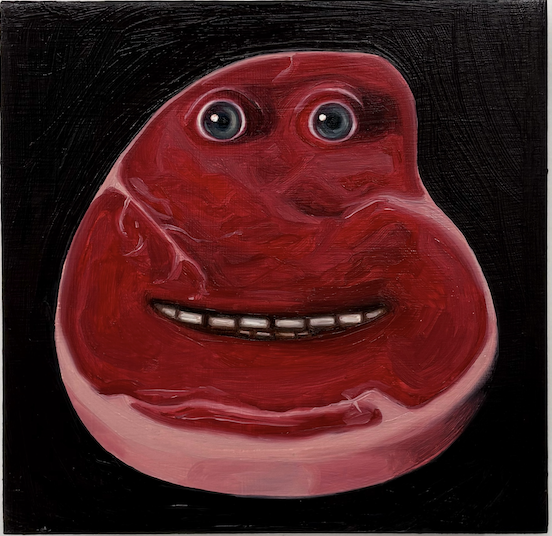
Julia: Oil painting is such a notoriously slow medium. I love to contrast between a low class media aka. memes, and historically viewed as a high class medium oil painting. My work is an interference with the algorithm. I pluck things out and plop them back in but painted. It makes people question and ask …why? I love that because it’s an opening of a conversation. Painting memes and digital images lowers the barrier to entry to my work.
The grotesque in your work doesn’t feel purely shocking — it feels culturally diagnostic. What does the grotesque allow you to say that a cleaner image couldn’t?
Julia: I think the topics that my work speaks about doesn’t need to have a neat and pretty ribbon around it. It wouldn’t be doing a service to the severity of some of the things that happen online. The internet isn’t clean so why would I paint it as such.
Do you think internet culture has created new kinds of bodies — bodies shaped by avatars, porn, memes, filters, and fantasy?
Julia: ABSOLUTELY. You either need to be slim-thick with beautiful curves, no cellulite, no stretchmarks. Or skinny and thin. I was convinced I needed a boob job in high school. Like what???
Do you see incel culture as a fringe phenomenon, or as an exaggerated version of ideas already present in mainstream culture?
Julia: I think that incel culture is a fringe community, but the roots of it isn’t. It is a totally exaggerated and extremist way of thinking that is built on ideas presented in mainstream media and culture. They established this whole world that is centered around their own victimhood and extreme hostility. But you can see smaller examples that are milder across social media that dribble into the minds of impressional men. Like a hamster water bottle they lap it up.

A lot of manosphere content sells itself as self-improvement, but often produces resentment and control. What interests you about that contradiction?
Julia: The manipulation and brainwashing. When I was groomed you don’t realise that it is actually happening. It’s like a gas leak in your brain and can happen to anyone.
Do you think the internet has made people more honest about their desires, or has it created more distorted performances of desire?
Julia: Hmm I think that the internet has curated this entanglement of desire, and exposed people to things that they didn’t even think to want and desire, but now they crave it like there’s no tomorrow.
How do you think young women learn to read danger online?
Julia: I think reading danger is so inherent to being a woman, it’s a survival skill that gets hardwired into us at seemingly younger and younger ages. We hear stories from others, and also tend to pick up shifts in tone or messaging before things go too far.
Is your work partly about the loss of innocence, not in a nostalgic way, but in the sense of realizing how early people are exposed to adult violence, sexuality, and ideology?
Julia: Yes 1000%.

What is the most difficult thing for you to admit about your relationship to the internet?
Julia: That maybe it is that goddamn phone.
What still scares you about the online world?
Julia: Almost everything.
What still seduces you about it?
Julia: Almost everything.
Can you walk me through your creative process from beginning to end result?
Julia: I will save an image to my phone and most likely forget about it for a while. While I’m midway through my current work I’ll remember its existence and start piecing it together in my mind how I want it to look. I’ll then use picsart on my phone or procreate and start playing around with stretching the image, and placing it beside other pictures until I’m happy with it. I used to use a projector, but now I will print out my reference to scale and transfer the image over. And bam I start painting!
Can you also tell me about your use of symbolism?
Julia: I’ve started exploring transforming thick impasto paint alongside my blended style of oil painting, in this clumpy super textural way. Motivated by “tributes” that men will post of themselves pleasuring and releasing onto anime figures, their tablet screens of their favourite characters or images of real life people. Other men will then consume as content and for pleasure, it is kinda meta lol. But I use this thick paint to represent entrapment, crusty goop, as a way of visually creating the sensory experiences of what it was like to be minor on the internet.
How do you approach color?
Julia: There is not a lot of rhyme or reason to how I approach color. I use my iPad to refer to my images so I can stay as true to the digital colors as humanly possible.
So with what we just talked about, what are you hoping to convey?
Julia: Paint whatever you want to paint as long as it’s true to you, and don’t be a creep on the internet because I might paint you one day.
Ok Julia, now to something totally different. In a parallel universe who would you be? and what would you be doing?
Julia: I would love to be a dog. More specifically a dog that lives with a performative millennial so I would wear cute sweaters that they bought off of targeted instagram ads, and be able to hangout with the other office dogs when they bring me to work. Maybe on a nice day I get to sit at a bar patio in the sun basking.
Outside of art, what’s something you’re obsessed with right now, maybe a hobby, a show, or even a food—that keeps you grounded or inspired?
Julia: Stardew Valley, Calico Critters, eating cream cheese pasta on the couch and not feeling guilty after.
Can you tell me a story about a time when a connection with someone had a big impact on you?
Julia: It was my high school art teacher’s last year of working before she retired. I adored her and all of her class tremendously. She was the first teacher that had taught in a way that just clicked. So kind and compassionate and wanted everyone to succeed and do their best. On one of the last days of classes I told her that I’m going to post secondary school for art, and that I am considering being an art teacher one day. She then proceeded to give me this wooden bird sculpture that her art teacher gave to her many years ago when she told her that was going to become an educator. She said when it is my turn to pass it onto another student. I still have the sculpture on my desk. I see it everyday and am reminded of the impact she had on my life. I don’t think I’d be where I am without her.
What qualities do you find most important in the people you choose to spend time with?
Julia: I love to be around people who I can buzz off of. It’s special when you connect with people who have the ability to make one another happier the more time you spend with them. I love people who are passionate too.
Anybody you look up to?
Julia: Christine Tien Wang, Jesse Morsberger, Bram Bogart, Marina Van Raay, and the people I love.
What motivates you?
Christine Tien WangThe fact that I cannot see myself doing much of anything else but make art.
How would you describe a perfect day?
Christine Tien WangWaking up with my window open and my room smelling fresh, birds are chirping and I maybe see one at my bird feeder. Clean house and fresh sheets. Having a banger breakfast sandwich, and perfect cafè weather, the milk to coffee ratio is perfect, I get to drink it outside. Connecting with the people I love in a way that is effortless. Windows down in the car. Having a crisp patio beer or two with the people I love, and people I’d like to get to know more. Watching a movie that hits right without knowing anything about it beforehand. Eating cream cheese pasta. Getting to pet a dog or two. Going to bed under my weighted blanket.
Alright Julia, I always ask these two questions at the end of an interview. The first is. What’s your favorite movie(s) and why?
Christine Tien WangEverything, Everywhere, All At Once is spectacular. So funny, so emotional, and beautifully shot on top of that. Crazy, Stupid, Love I love Ryan Gosling, this movie is my most rewatched.
The second is. What song(s) are you currently listening to the most right now?
HALO Tiffany Day’s album
Here I Am The Hellp
Eyelid Movies Phantogram’s album
Other artists worth mentioning are BETWEEN FRIENDS, Bassvictim, and Laundry Day.