Share this
For years, Moncler had one of the most desirable problems in fashion: it owned winter. The puffer, the mountain, the snow fantasy, the expensive promise of warmth. But when a brand is so deeply tied to one season, the real challenge is not survival. It is expansion.
That is exactly what the Moncler Group appears to be doing. In the first half of 2026, the company reported revenues of €1.29 billion, up 5% from the same period in 2025, or 9% at constant exchange rates. Net profit rose 7.3% to €164.7 million, while operating profit climbed 9.1% to €245.4 million. In a luxury market where many players are slowing down, Moncler is still finding room to move.
The numbers matter, but the strategy matters more. Remo Ruffini’s group has spent years trying to loosen Moncler from its original winter-only mythology. The challenge is obvious: a luxury giant built on outerwear needs to stay relevant when the snow melts. That means expanding into lighter categories, year-round storytelling, direct retail, collaborations, and lifestyle language without diluting the cold-weather authority that made the brand powerful in the first place.
So far, the balance seems to be working. The Moncler brand itself reached €1.09 billion in sales during the first six months of the year, up 5%, with growth driven by the direct-to-consumer channel. Asia remained the strongest engine, rising 13% to €592.9 million, supported by China and South Korea. Europe was weaker, down 4% to €349.7 million, partly because of softer tourist flows, while the Americas showed growth at constant exchange rates but slipped slightly at reported rates.
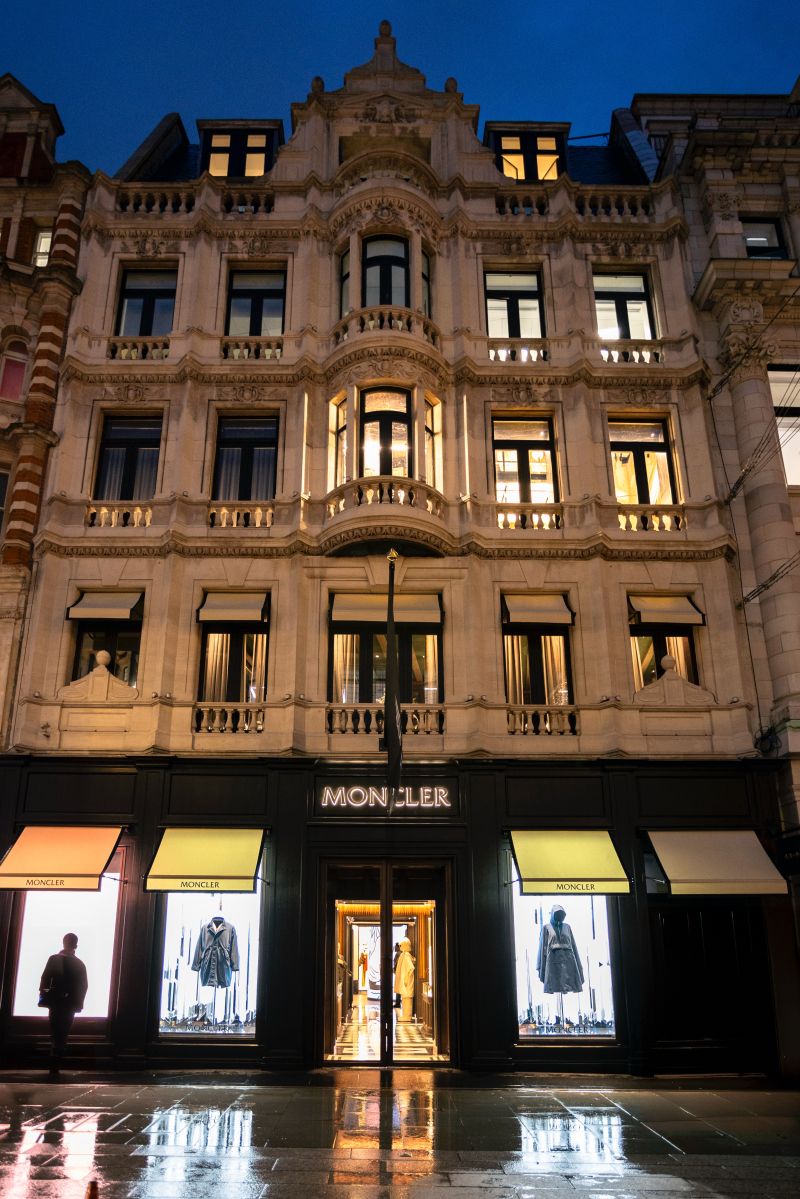
That direct relationship with customers is becoming the group’s real power structure. Direct-to-consumer sales grew to €933.2 million, with physical stores still outperforming online. Moncler now operates 298 directly managed stores, and the next symbolic move is already planned: the brand is set to open its largest store in the world in New York during fashion week this September.
Then there is Stone Island, the group’s sharper, more subcultural weapon. Smaller in scale but carrying enormous cultural heat, the brand brought in €200 million in the first half of 2026, up 7%. Its direct channel continued to grow in double digits, while Asia rose 15%, Europe increased 2%, and the Americas jumped 28%. In the second quarter alone, Stone Island’s global sales reportedly accelerated by 49%, making it feel less like a side asset and more like a serious growth engine.
What makes the pairing interesting is that Moncler and Stone Island solve different parts of the same problem. Moncler gives the group scale, luxury credibility, alpine mythology, and technical polish. Stone Island gives it cult energy, material obsession, football-terrace memory, youth relevance, and a more natural route into lifestyle dressing.
The leadership context adds another layer. The results arrive alongside the first official statements from new CEO Leo Rongone, the departure from the board of Alexandre Arnault and Geoffroy van Raemdonck, and the arrival of Sidney Toledano as a new director. In other words, this is not just a strong semester. It is a transitional moment for a group that seems to understand that luxury’s future belongs to brands that can behave like worlds, not just labels.
Photo: Moncler