
Share this
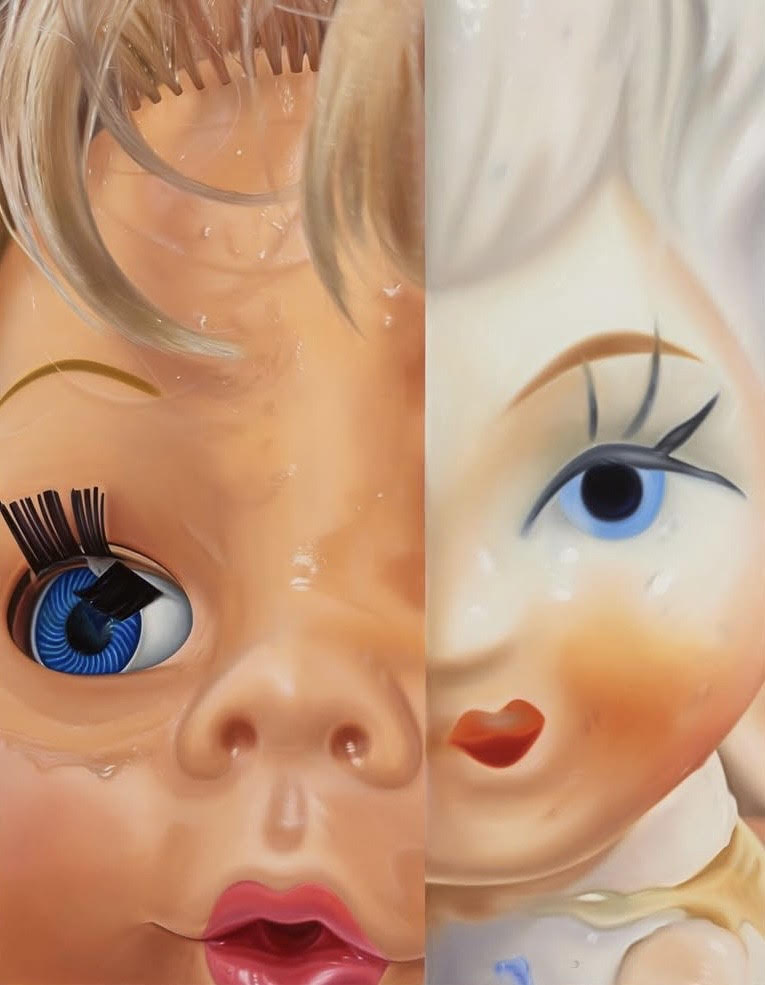
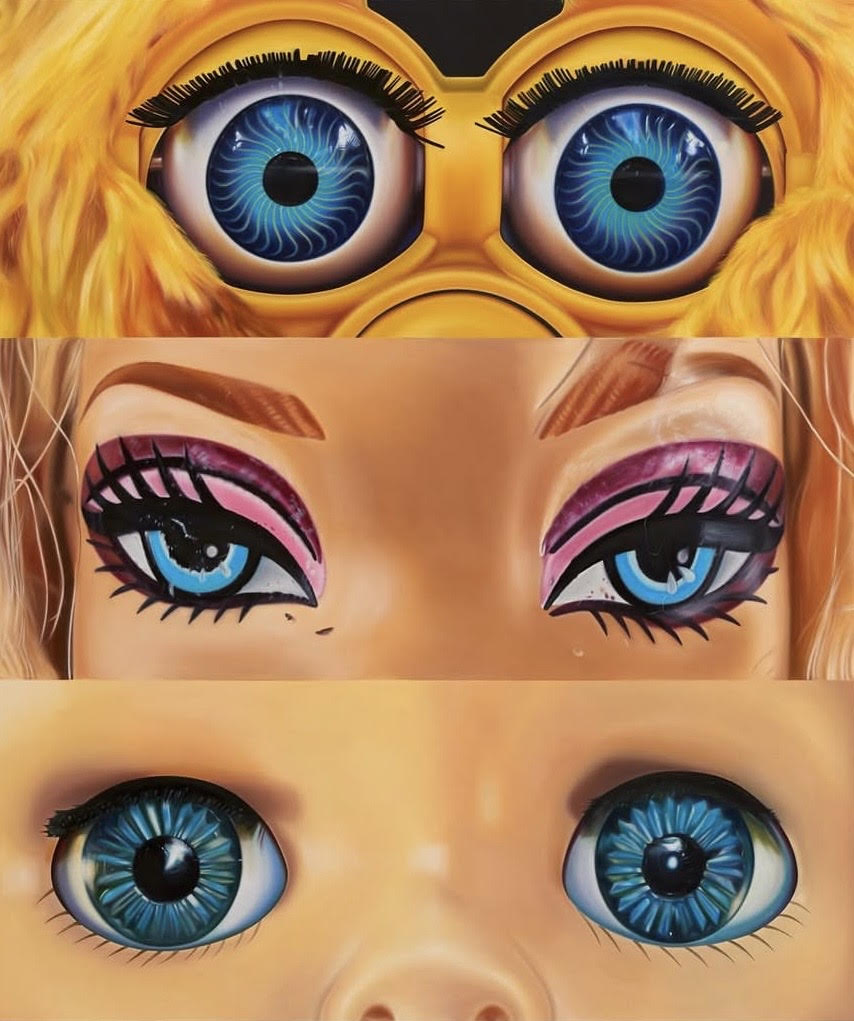
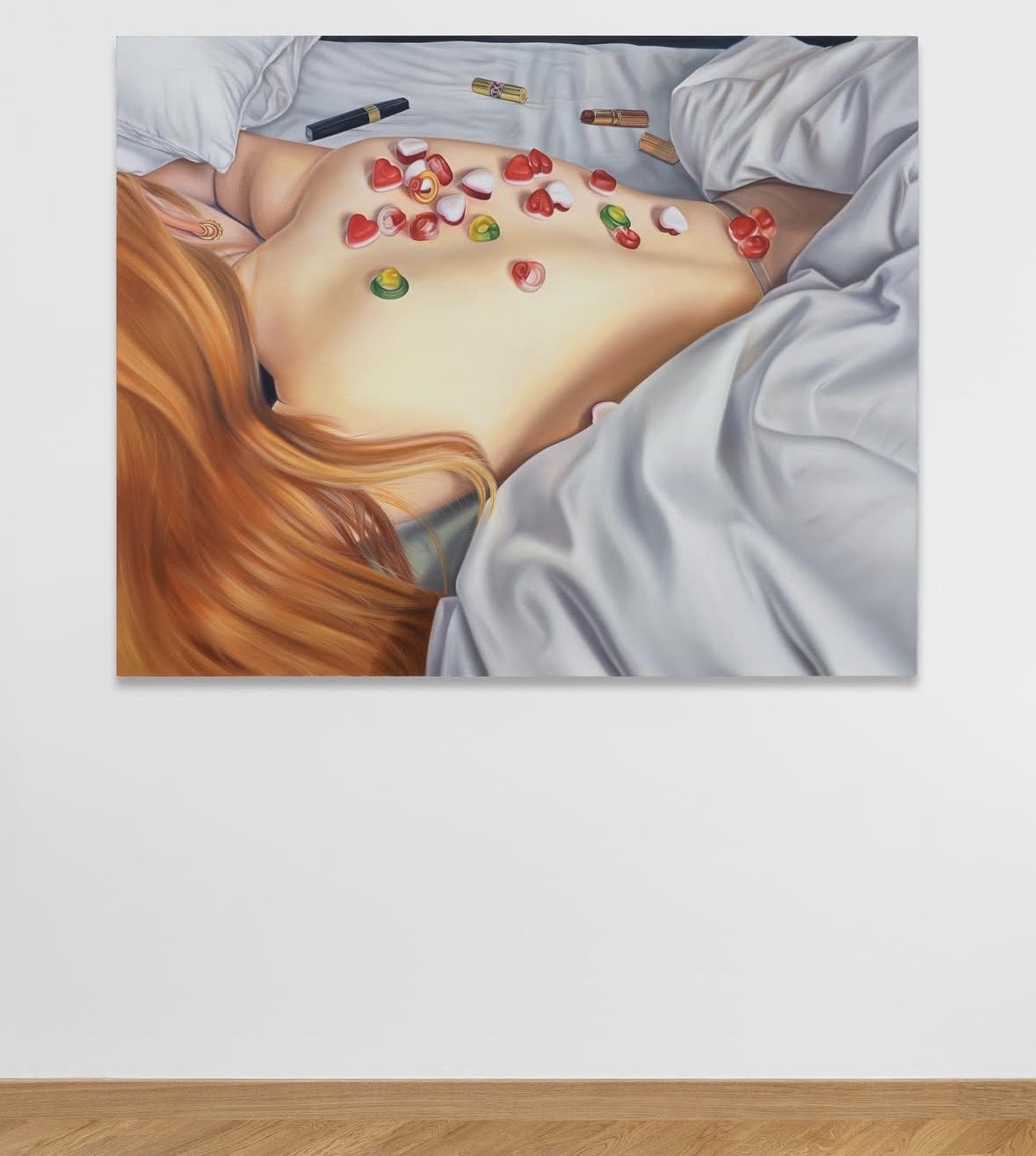
The Scottish painter Rachel Hobkirk makes work that lives in the split-second where the familiar turns strange: dolls that carry the residue of girlhood, and candy that clings to memory like sugar on skin. Her hyperreal paintings pull at a paradox — how “cute” can tip into something disturbing, how innocence can be both real and imposed, and how femininity gets rehearsed long before anyone knows the script.
In this conversation, Hobkirk reflects on growing up in rural Aberdeenshire, reconstructing adolescence through object-surrogates, and why disgust and delight might be closer than we like to admit. We also talk about the symbolism of sweets, the Madonna/Whore complex resurfacing through contemporary misogyny, and the strange solace of painting itself.
Hi Rachel! It’s a pleasure to sit down with you! First question that I always ask. How does a regular day look like for you in London?
Rachel: I just moved back to Scotland. However, a regular day in London would have looked like intensive periods of painting in the studio, mixed in with frantic phone calls to my mum.
I’m curious, growing up, what was life like there? And what kind of kid were you? What did you enjoy doing?
Rachel: I grew up in a tiny village in rural Aberdeenshire, Scotland. My childhood was spent outside on bikes and bluetoothing ringtones via Motorola flip phones in the park. I spent a lot of time playing the Sims 2 and I was not the kind of reckless Sims player who let them set fire to the kitchen or took the ladder out of the pool whilst they were swimming. I used the Sims to carefully play out all my heteronormative fantasies, making sure their needs were always in the green.
Do you remember approximately at what age your creative side started to
show? And when did you start taking being an artist seriously?
Rachel: My Dad recently said that making art is something I have been doing since I was three. It wasn’t until I moved to London to study my postgrad that I realised it had the potential of becoming a career.
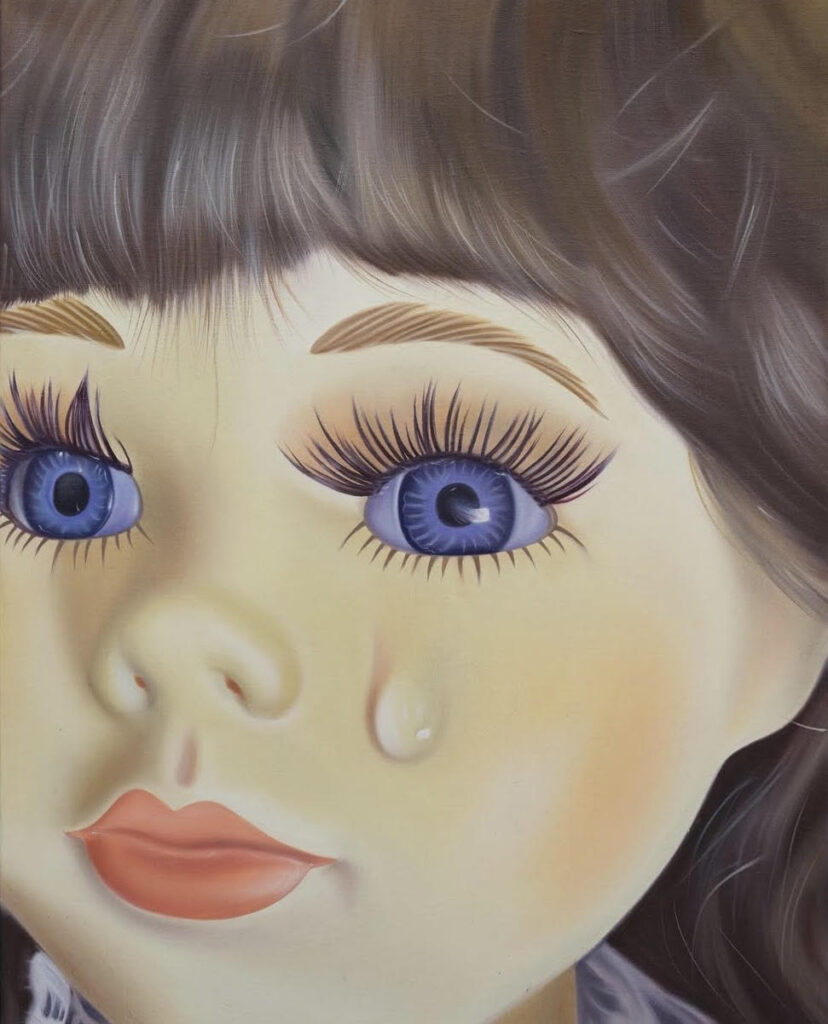
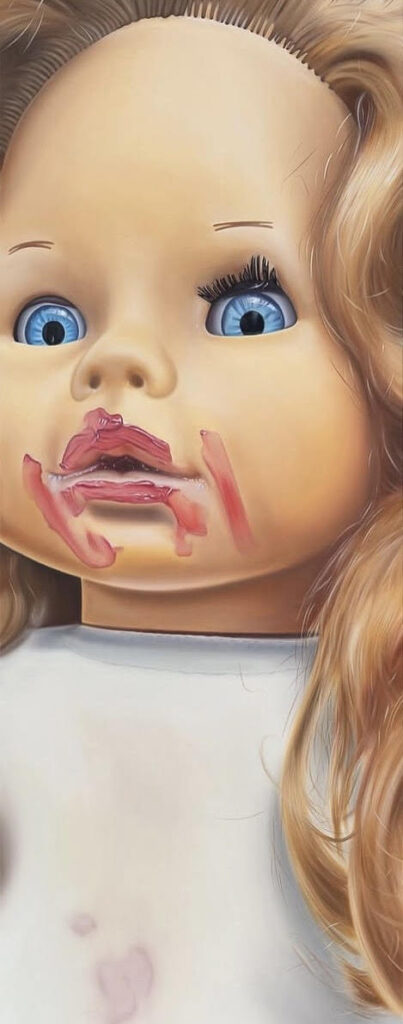
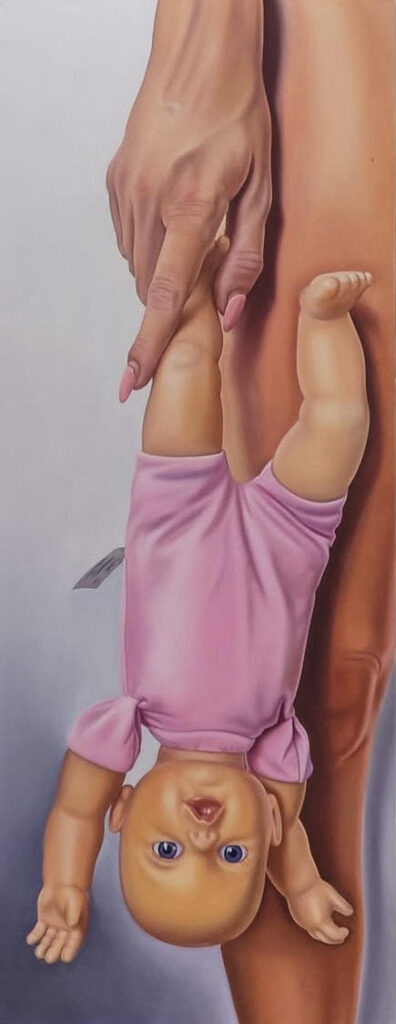
Ok Rachel, with these next series of questions, I will try to delve into your work as best as possible. So…. Your Doll series revisits adolescence through object-surrogates. When you look back now, is that period something you’re trying to reclaim, critique, or reconstruct?
Rachel: I think reconstruct. I’m reexamining memories from my childhood and adolescence as a way to make better sense of my identity as a woman today.
Do your dolls represent specific memories, or are they more like emotional
residues?
Rachel: They feel more like emotional residues, I really love that phrase.
Adolescence is often romanticized as a time of innocence. Do you see innocence as something that truly existed, or as something culturally projected onto girls?
Rachel: I think it is both. Children, as they transition into adulthood, experience a loss of innocence that is real and not necessarily culturally imposed. I cannot speak for others but growing up I was met with life experiences that slowly eroded my sense of innocence in terms of how I perceived the world. It was like my childlike wonder and hope dissipated as the pressures and realities of adultlife grew. I am searching for that lost, childhood innocence through painting.
I don’t think this type of loss of innocence is so gendered. On the other hand, a socially constructed type of sexual innocence is imposed on girls and women. I remember learning about the Madonna/Whore complex whilst reading Tess of the D’Urbervilles in English at school – a story set in the late 19th century, Victorian era. It is distressing to see, with the rise of misogynistic, manosphere culture, how these darker value systems still permeate society and affect women today.
You speak about passing traces of yourself into these dolls. Do you see that gesture as empowering, or is there also something unsettling about splitting yourself into an object?
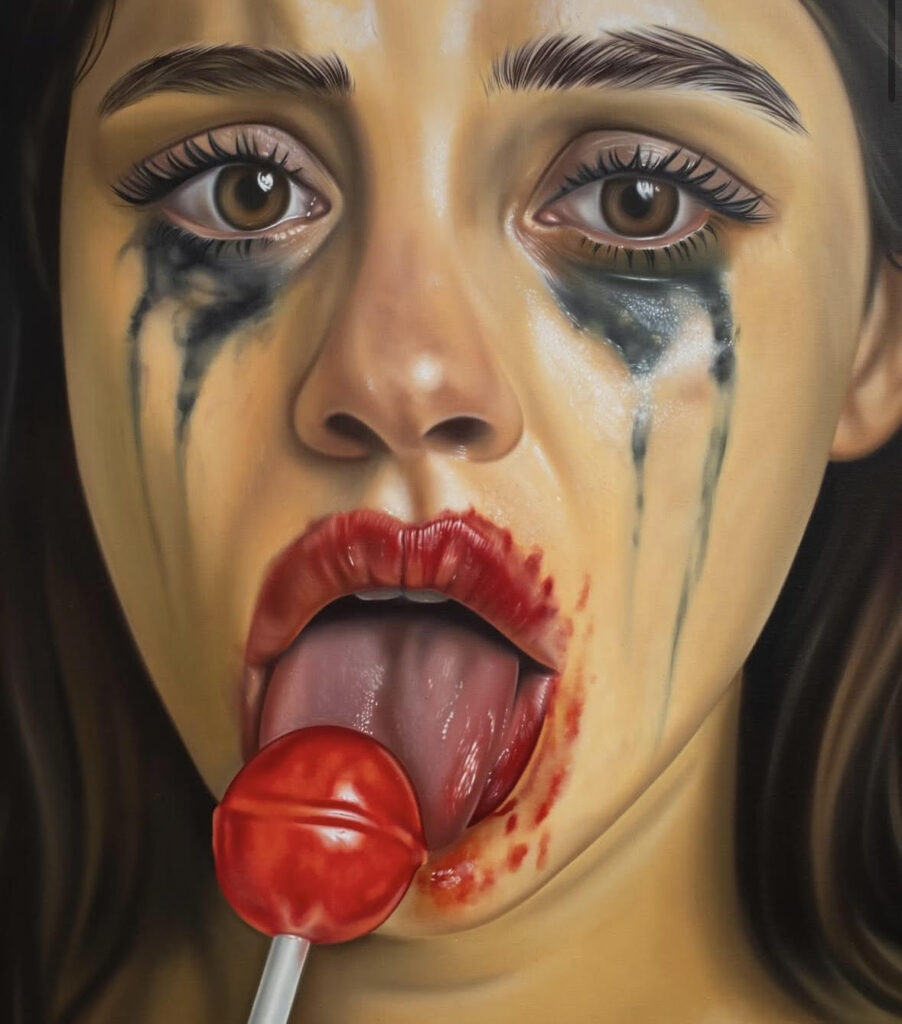
Rachel: Using the object of the doll helps to create space between myself and the work. They function as a kind of mask. I don’t necessarily see the gesture as empowering or unsettling but more as a protective measure.
Dolls are traditionally controlled, styled, and posed by someone else. How does that dynamic intersect with your thinking about female autonomy?
Rachel: It’s funny to me that young girls often act out their future childcare and domestic labour responsibilities during playtime with their dolls. Play becomes an unknowing form of self- conditioning. We place, pose, style and stage our dolls like we will do to our future selves. Seemingly inconsequential moments of play during childhood reveal socially conditioned, self- imposed restrictions on female autonomy.
Your work sits in that thin space where something ‘cute’ tips into something disturbing. What draws you to that threshold rather than to either side of it?
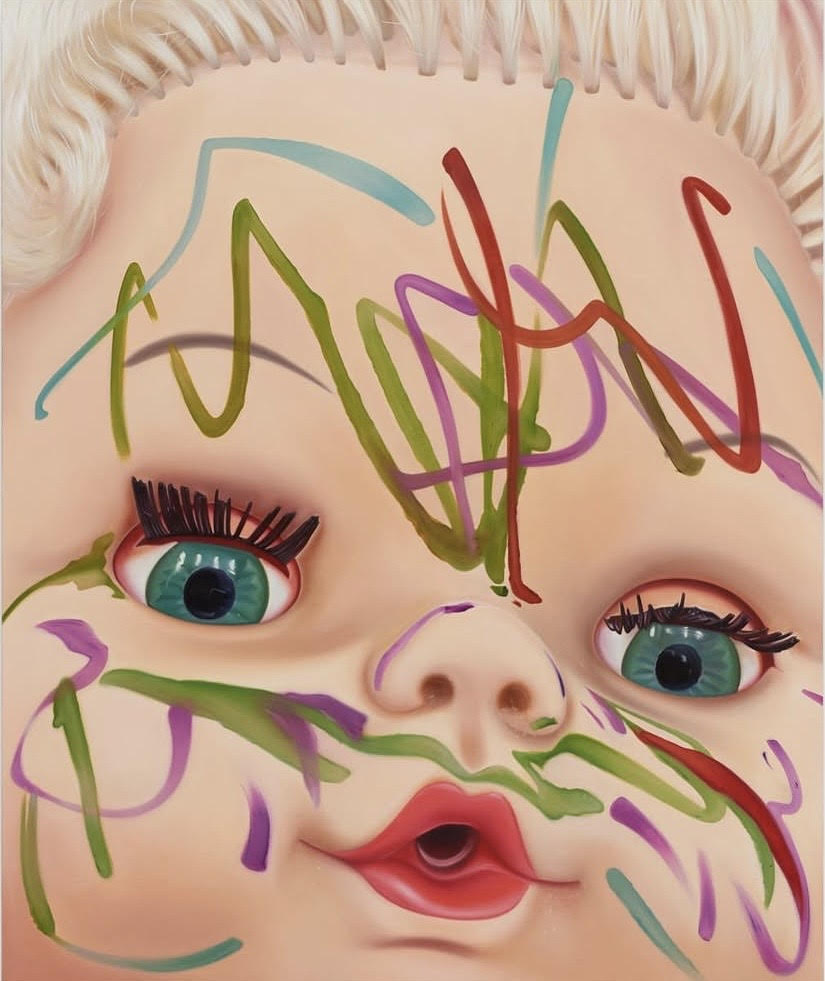
Rachel: Girlhood sits at that threshold between two reactive states. It’s a transitional phase, where you are not quite one thing or another; you are in a state of becoming. I think I am drawn to the tension that arises from these ambiguous, in-between states because it reflects the contradictory, duality of human nature. In my practice, I think I am attempting to reconcile with the fact that something or someone can be two opposing things at once: cute and crude, desirable and disturbing, innocent and sexual, threatened and threat.
The uncanny often makes us uneasy because it feels familiar but wrong. What do you think your work reveals about the instability of identity itself?
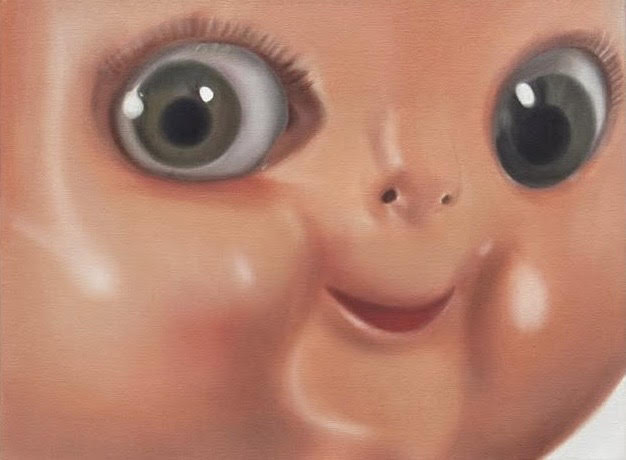
Rachel: We go through life experiencing slippages of the self that remind us of how unstable and fragile our sense of identity is. Adolescence, in particular, is a life stage that brings about feelings of the uncanny because such significant and rapid changes are happening to our bodies that we can fail to fully recognise ourselves. I think my work reveals that things are never really as they seem and that our sense of self will constantly be disrupted and put into question throughout our lives.
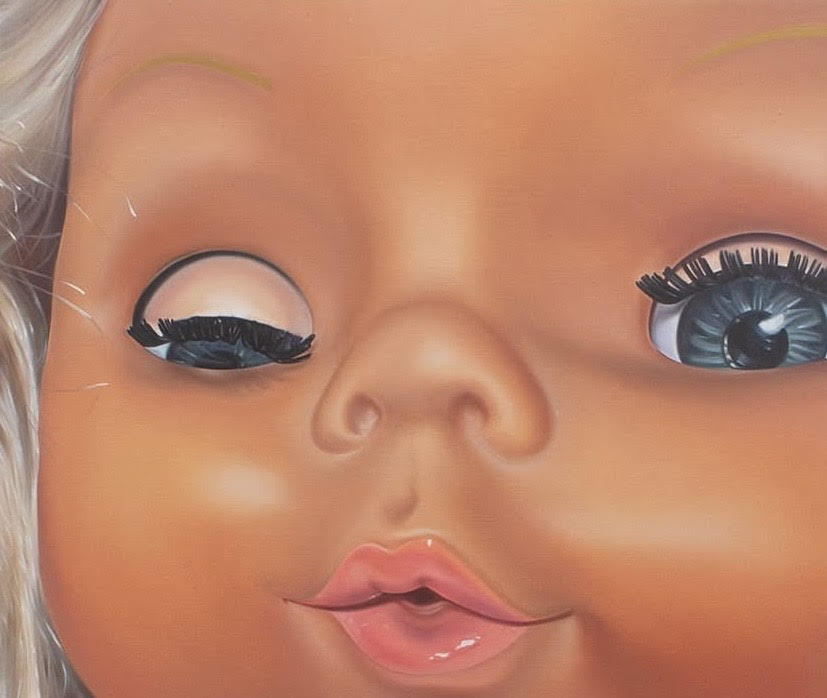
Do you consciously construct that uneasy feeling, or does it emerge
instinctively through the process?
Rachel: I think the unsettling feeling of some of my work naturally emerges. I had a writer once describe the paintings as ‘harrowing’, which really surprised me. I have never experienced an uneasy or disturbing response to the paintings when I am making them in the studio, if anything, I have felt the opposite. But I think that in itself is quite interesting. Spending weeks or sometimes months alone in the studio with a painting is quite an intimate experience and so it’s unlikely that I would read or feel the work in the same way that a first time viewer would. The paintings are strangers to them but not to me.
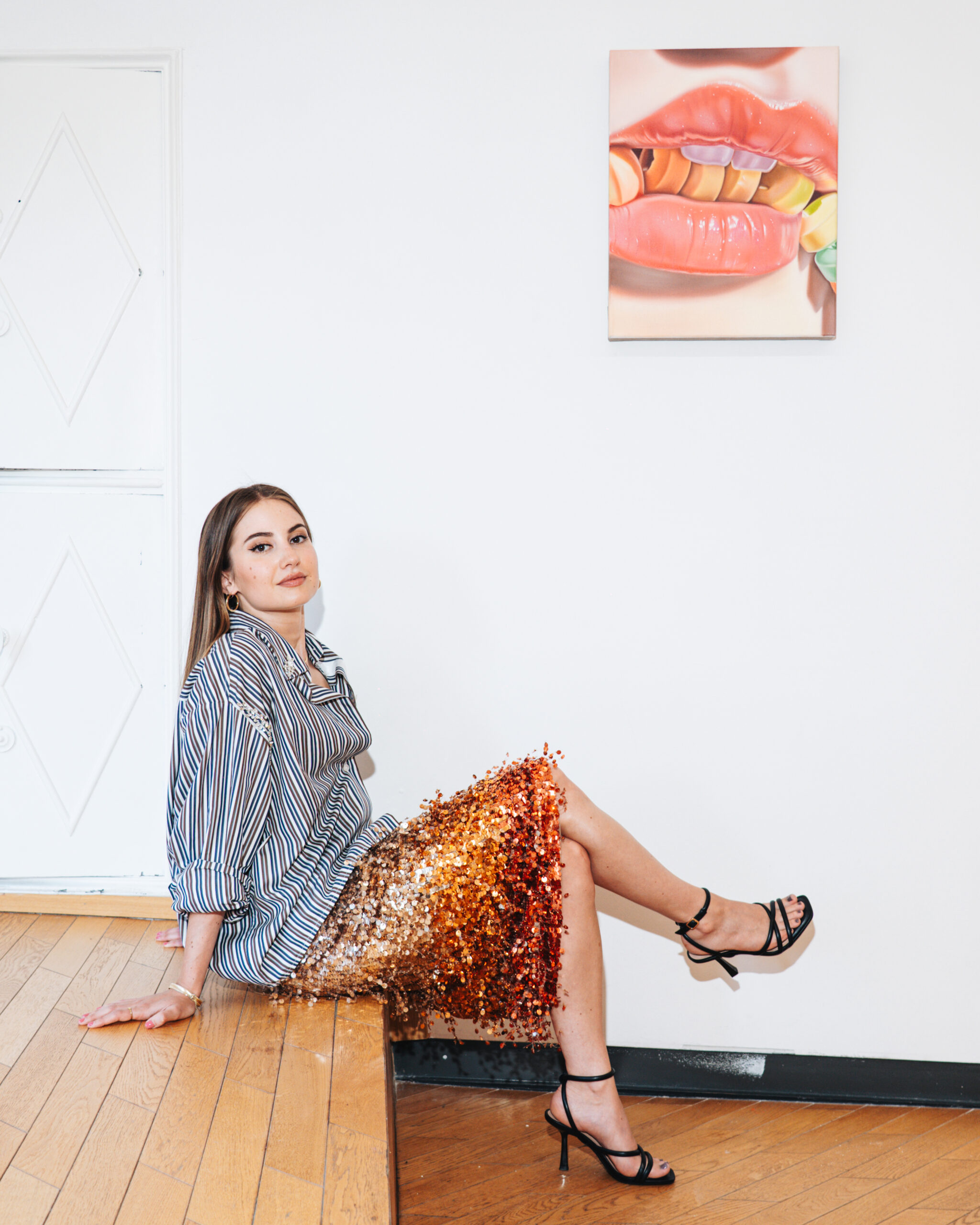
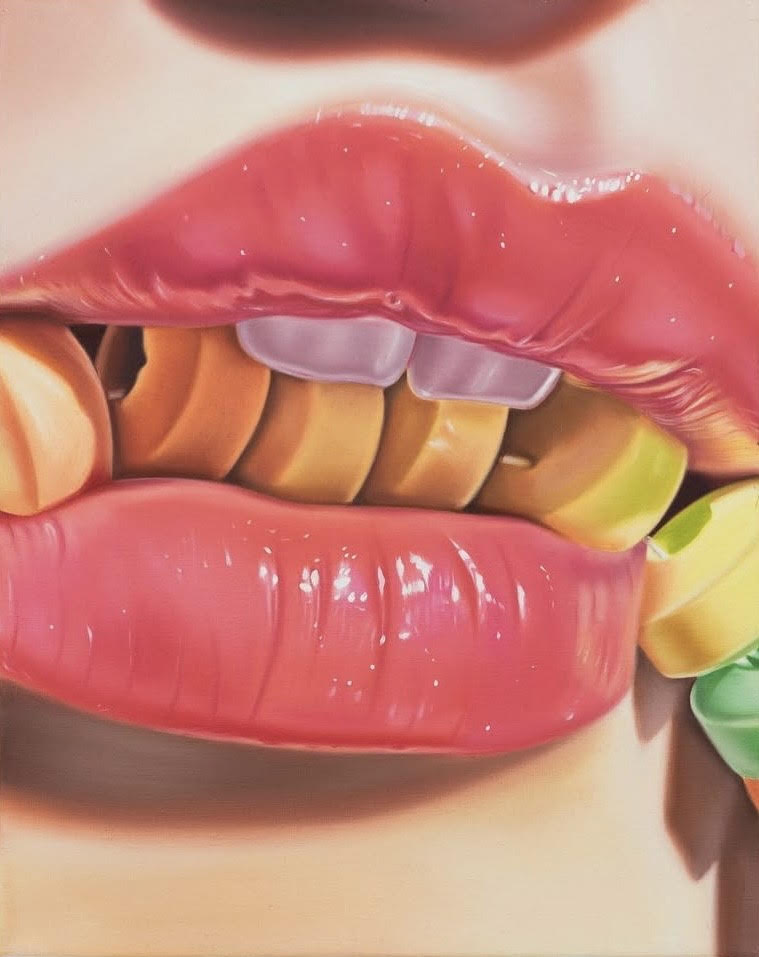
The Haribo rings are such a potent symbol, playful but loaded. When did you realize those childhood rituals were rehearsals for adult expectations?
Rachel: I’d say it’s only in recent years that I have been picking apart memories from my childhood and adolescence and trying to understand their meaning. We used to stack Haribo rings on our left ring finger and then lick and chew them off until all that was left was a sticky, sugary residue.
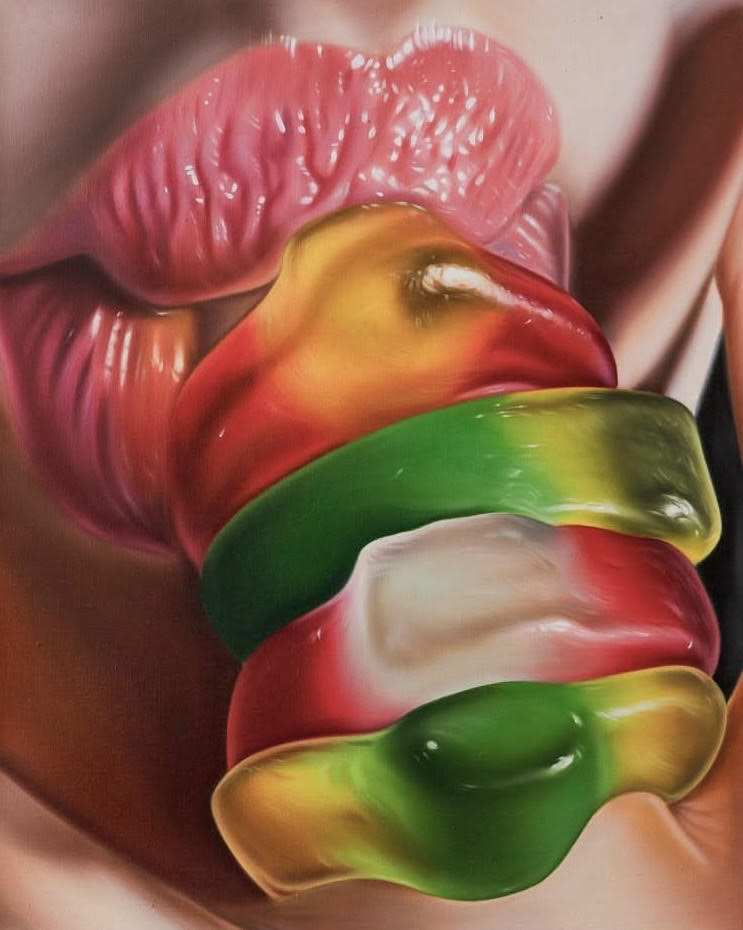
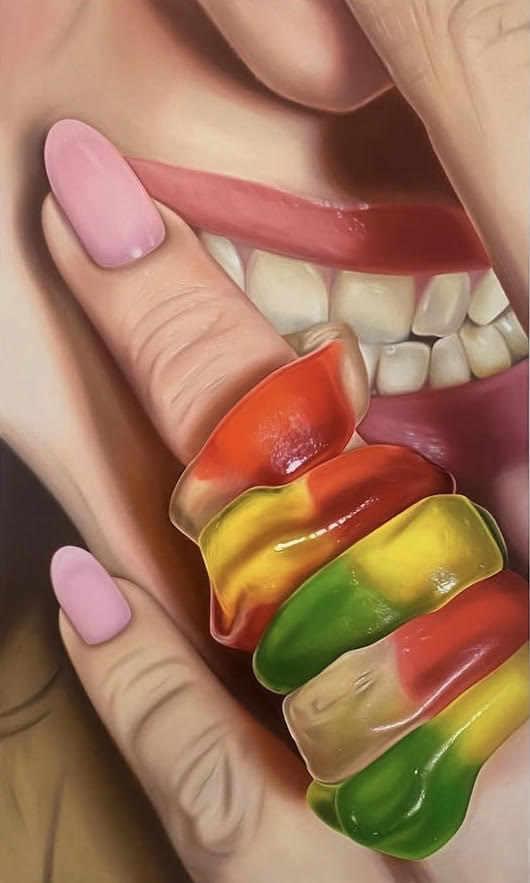
Do you see sweetness as a gendered expectation placed on girls? And if so, how does your work resist or complicate that expectation?
Rachel: As a woman, I’ve often times felt that I’ve had to use sweetness as a tool to placate others. Constantly having to bend and mould myself to the harsher whims of others. I do think there is a gendered expectation on girls and women to appease others, still. It’s like we are constantly living in response to others rather than just for ourselves. I have witnessed, with admiration, how some women use a kind of soft power to navigate through life. They reclaim these more quiet, feminine attributes and use them in a manner to get others to concede to them instead. There is an inherent power in softness and sweetness that I’m trying to convey through my work.
Candy is sticky, seductive, consumable. Is there a commentary there on how young women are socialized to be ‘consumed’ emotionally or visually?
Rachel: I think there has been a long standing cultural association between women and candy. I like the the use of candy as a kitsch symbol for desire and pleasure. There is something unbearably shallow and tragic about reducing women down to a cliché.
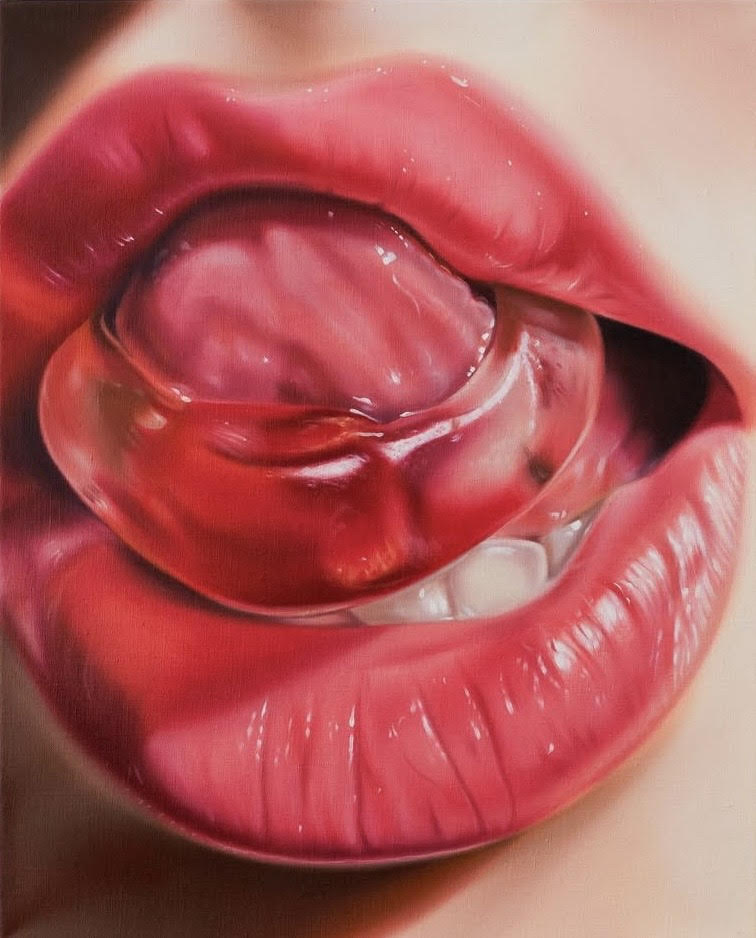
The metaphor of sugar, something desirable but potentially harmful. feels powerful. Is that tension central to how you think about desire?
Rachel: Yes, I am interested in when our overindulgence in pleasure and desire can lead to feelings of shame, disgust and fear. What are we left with in the anxiety-riddled aftermath? That’s the space I want to explore.
You explore the pull between attraction and disgust. Do you think those two emotions are more closely related than we like to admit?
Rachel: Disgust and delight live around the corner from each other. In childhood, disgust is a primal reaction that helps us to avoid or escape something. We react with disgust to the sour taste of a lemon, for example. However, when we reach adulthood, one of the great paradoxes of sexuality is that disgust can stimulate desire. We experience sudden shifts from abjection to excitement, unsure of which emotion came first.
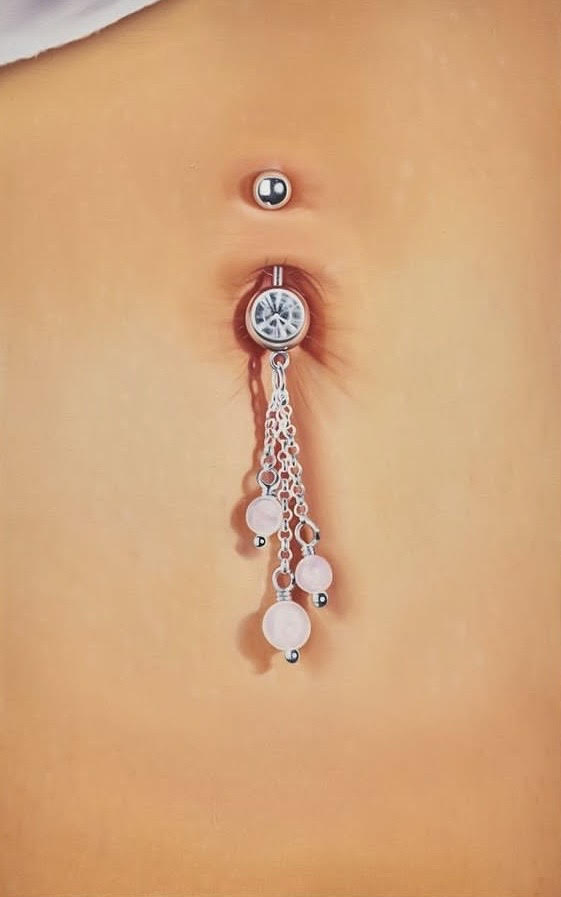
Is there a risk that viewers misread your work as purely ‘cute’? And does that misreading matter to you?
Rachel: No, because we are drawn to the cute because of the way it makes us feel. The feeble, helpless nature of something cute draws attention to our potential to have power or dominance over it. One minute we could be smothering it in kisses and in the next, crushing it in the palm of our hand. It’s this sly, perverted undercurrent to aesthetic of cute, which means that nothing can ever be experienced as just purely cute.
Have you ever felt physically uncomfortable in the making of a piece, repelled by your own materials?
Rachel: I have felt tired and frustrated when making a painting. And recently, I have been experiencing a lot of resistance to painting in general but I think this stems more from a place of self doubt rather than not innately enjoying the process of painting. When I eventually get to into it, it becomes an almost meditative process, the hours just slip by. Painting is a place of solace for me.
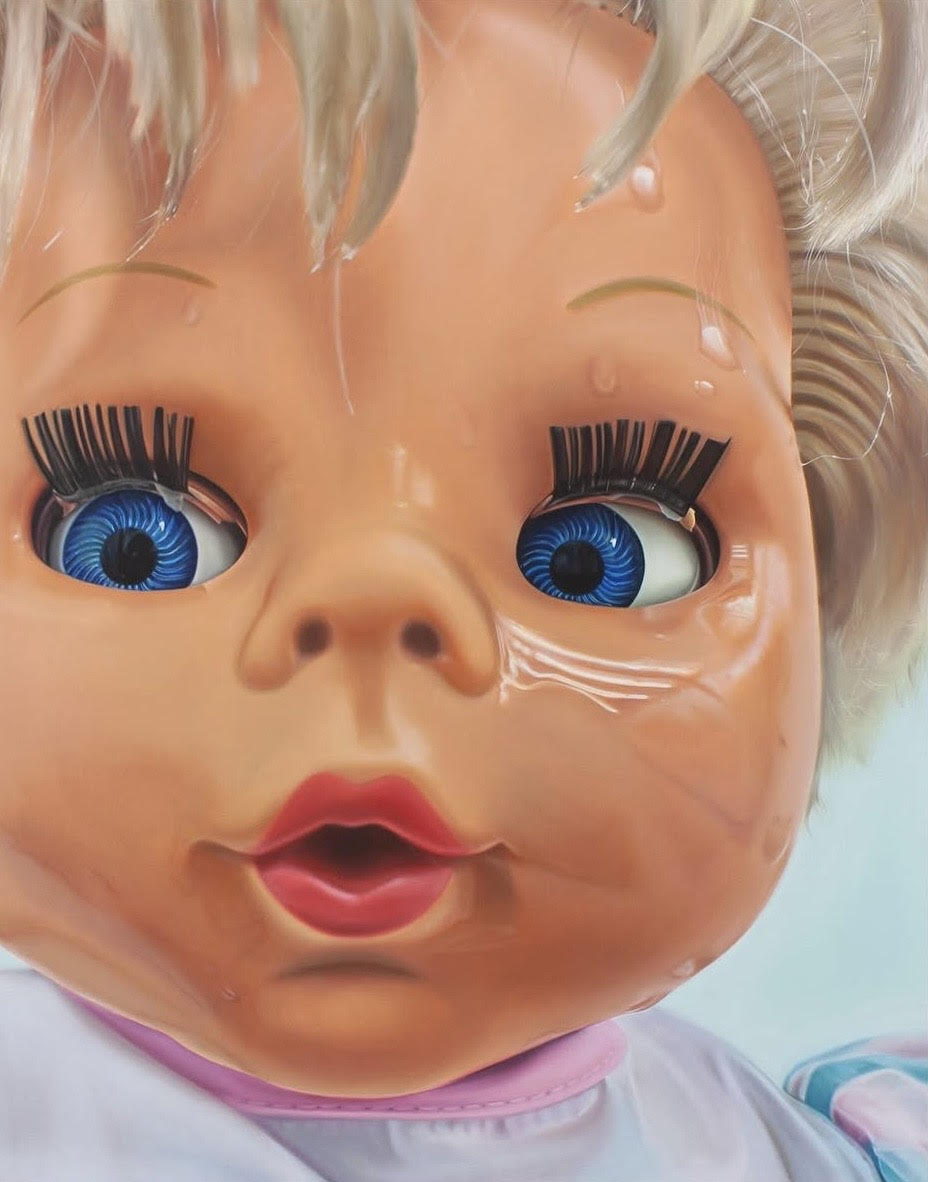
Your work seems to question how femininity is rehearsed through play. Do you see childhood as the first stage of performance?
Rachel: Childhood feels like the improv performance. It’s spontaneous and unaware of the cultural scripts that are slowly being imposed, but these scripts are still subtly informing the play from behind the scenes.
Do you think girls are taught to aesthetics themselves before they even
understand what that means?
Rachel: Yes, for me, it was through the alchemy of makeup. As a child I used to always watch my mum apply Chanel makeup. I was fascinated by the broken powders, crusty mascara brushes and pink smears of lipstick, all seductively packaged in black. It was this strange, daily ritual that I observed the women in my life perform but I didn’t really understand why. I remember, in a desperate attempt to imitate my mum, I persuaded her to buy me a kid’s makeup set from Claire’s Accessories. I think this is one of the first instances of me unknowingly rehearsing my femininity as a child.
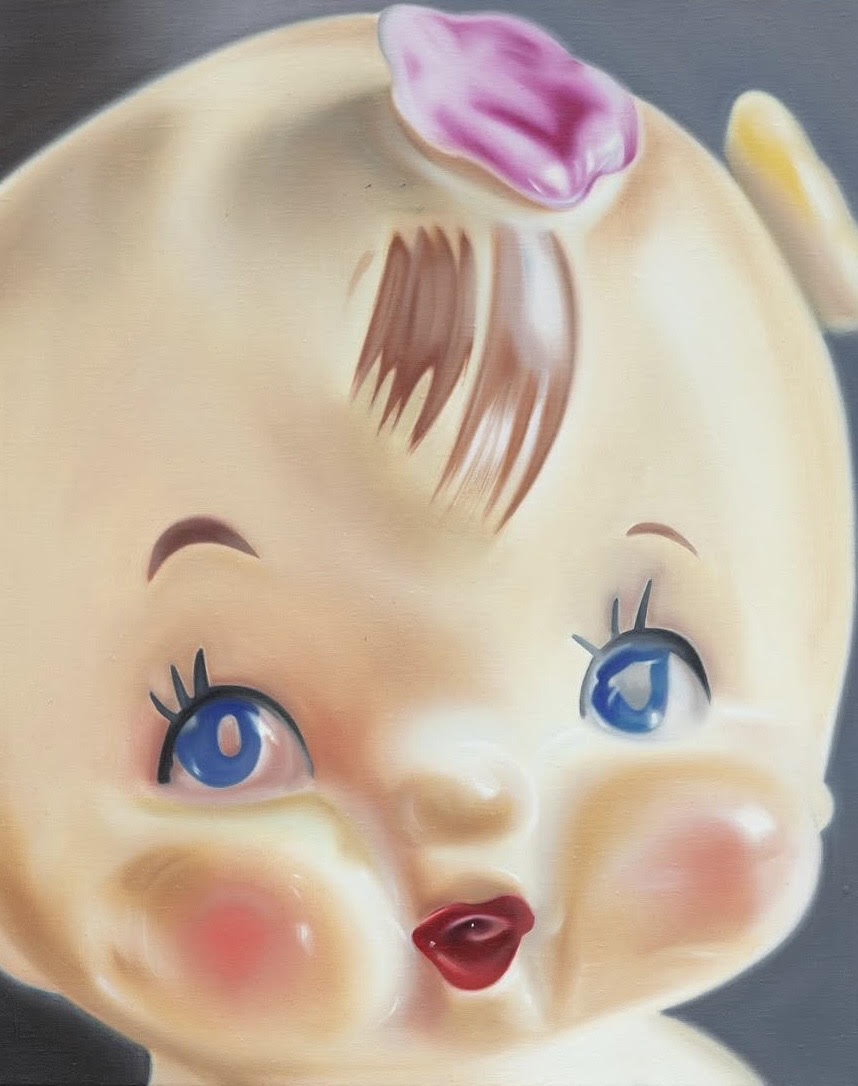
Are you interested in dismantling these cultural scripts, or simply exposing
them?
Rachel: I think it is simply realising that I grew up with and live with these cultural scripts and that is reflected in the work. I am not trying to be overly dogmatic because I am still in the process of figuring out what all this means to me.
You describe an unstable relationship we have with ourselves. Has making this workclarified your own relationship to your younger self, or complicated it further?
Rachel: It just complicates things further and it makes me really miss her.
Can you walk me through your creative process from beginning to end result?
Rachel: It usually starts with an image in my head and if it keeps flashing in my mind long enough, then I know it probably needs to be turned into a painting. Then I’ll try to think about how I can reconstruct the image in real life using certain objects or, more recently, using my friends as models. This is where the theatrical staging or play happens during the creative process. Then, hopefully, I find a resulting image that I can make a painting from.
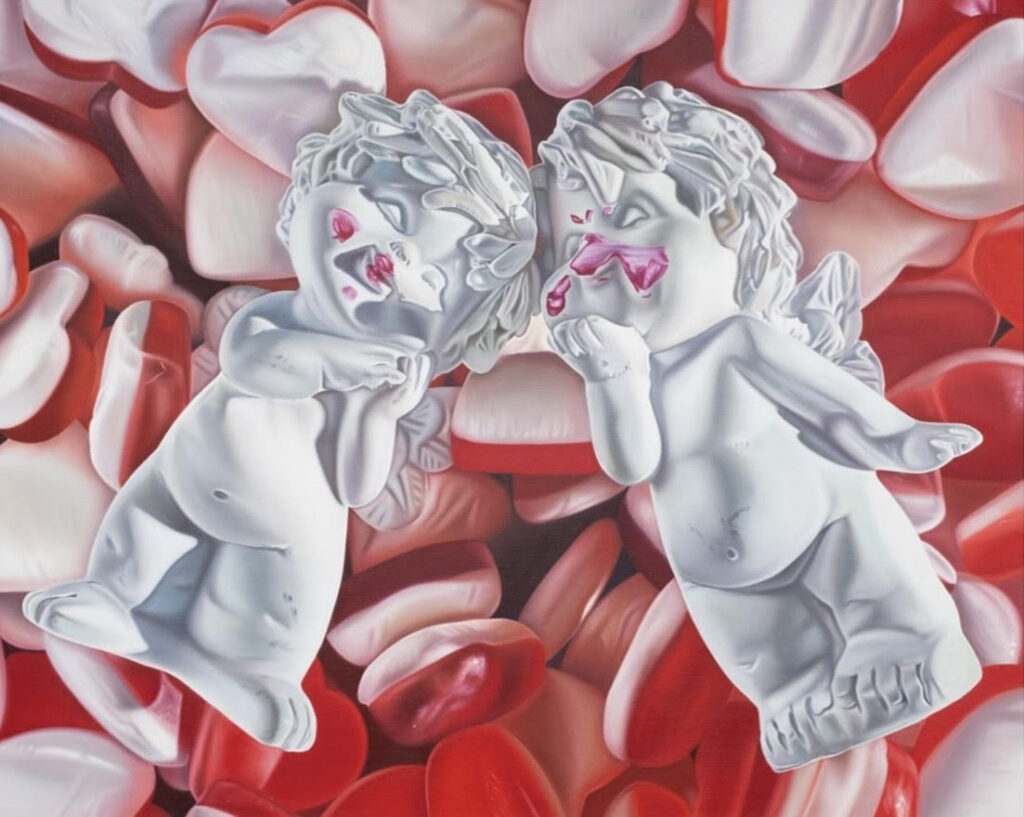
Can you also tell me about your use of symbolism?
Rachel: I tend to use obvious symbols, like a doll or sweets, as a way to distill the personal into the universal. I don’t want to pretend like I know any better than that. I can’t relate to the symbolism of a pomegranate but I can understand the meaning of a Haribo love heart because I’ve eaten hundreds of them. I’ve also owned enough Barbie and My Scene dolls to know that eventually you get sick to death of them, cut all their hair off, and scribble over their faces with pen.
How do you approach color?
Rachel: I actually have quite a restricted palette and I only introduce new colours every few months or even years. As a photo/hyperrealist painter, colour is very closely related to the image. However, my approach is not as systemic and methodical as I think some would imagine. I mix colour as I go and by the end of a session, I can have hundreds of different tones on my palette.
So with what we just talked about, what are you hoping to convey?
Rachel: I think I’m trying to articulate the dark edges that surround perfection and sweetness.
With that in mind, do you think the viewer becomes implicated, projecting their own adolescence onto your objects?
Rachel: I like the idea that the viewer can find remnants of their own adolescence through my work. I think some viewers can feel implicated in reenacting the sordid male gaze when viewing my paintings. However, I am not consciously trying to implicate or trick them into this.
Ok Rachel, now to something totally different. In a parallel universe who would you be? and what would you be doing?
Rachel: I think I would have made a good psychotherapist or councillor. Although, part of me also regrets not becoming a Sims Youtube streamer.
Outside of art, what’s something you’re obsessed with right now—maybe a hobby, a show, or even a food—that keeps you grounded or inspired?
Rachel: I recently read Meditations by Marcus Aurelius, so I have been on a bit of Stoicism and general self-help journey, as I am really trying to spend less time worrying about the future and stay more grounded in the present moment.
Can you tell me a story about a time when a connection with someone had a big impact on you?
Rachel: Probably my relationship with my ex but I definitely do not want to talk about that.
What qualities do you find most important in the people you choose to spend time with?
Rachel: I have been thinking about this a lot recently. I don’t like covert, passive aggressive people. I hate feeling like I’m being manipulated or insulted when the other person has a smile on their face. So, I think qualities that are important to me are honesty, a sense of humour and genuine kindness.
Anybody you look up to?
Rachel: I mean I love my mum, like a lot.
What motivates you?
Rachel: I actually really don’t know how to answer that!
How would you describe a perfect day?
Rachel: As long as I find myself at the end of the day in my dressing gown with a cup of herbal tea then it has been a good day.
Alright Rachel, I always ask these two questions at the end of an interview. The first is. What’s your favorite movie(s) and why?
Rachel: I love Arrival and Ex Machina. A newly added favourite is The Worst Person in the World because I think it really beautifully reflects the anxiety of aging and the ways in which our decisions catch up with and close in on us.
The second is. What song(s) are you currently listening to the most right
now?
Rachel: Hush by Cobrah and Chopiana Grande by Slime Dot.