
Share this
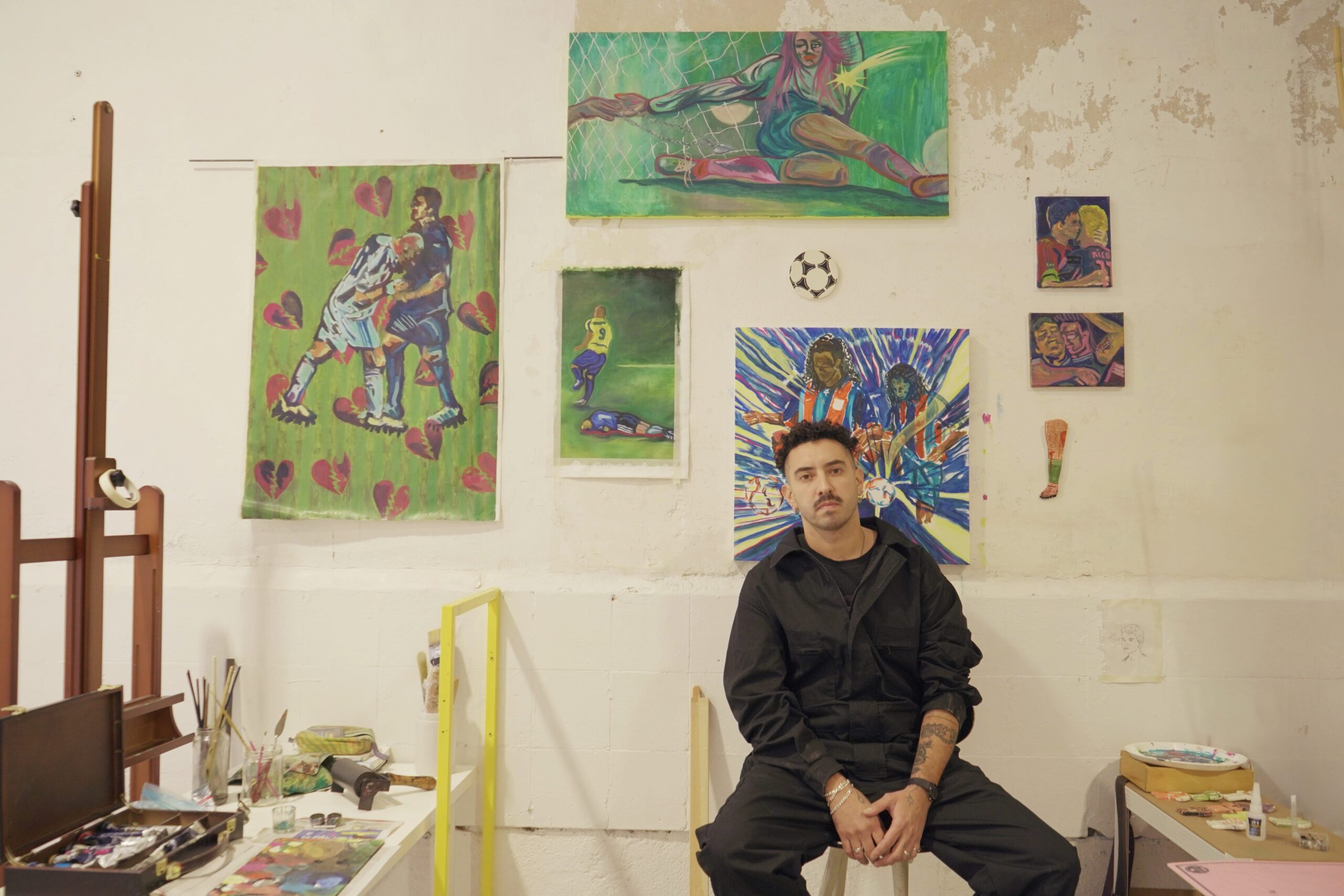
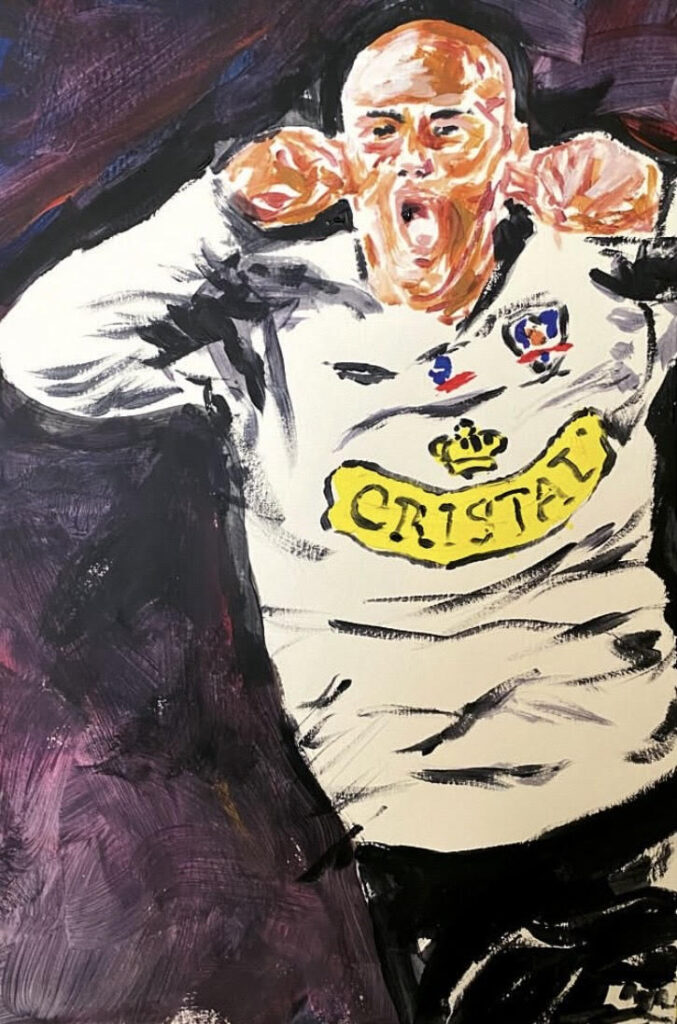
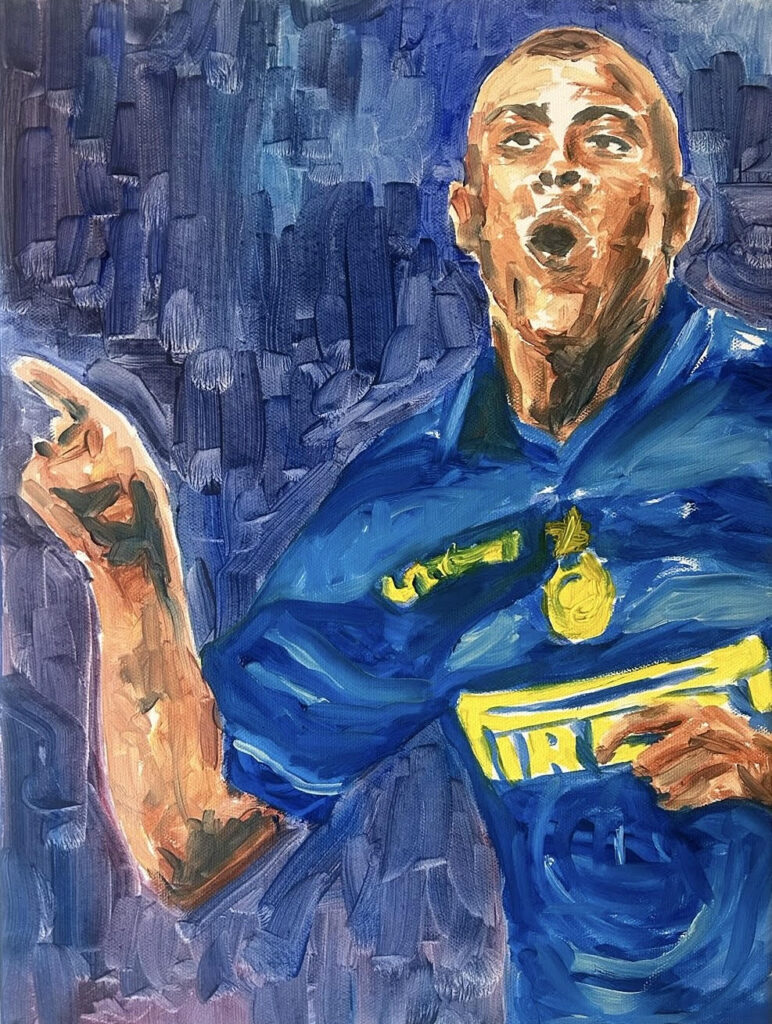
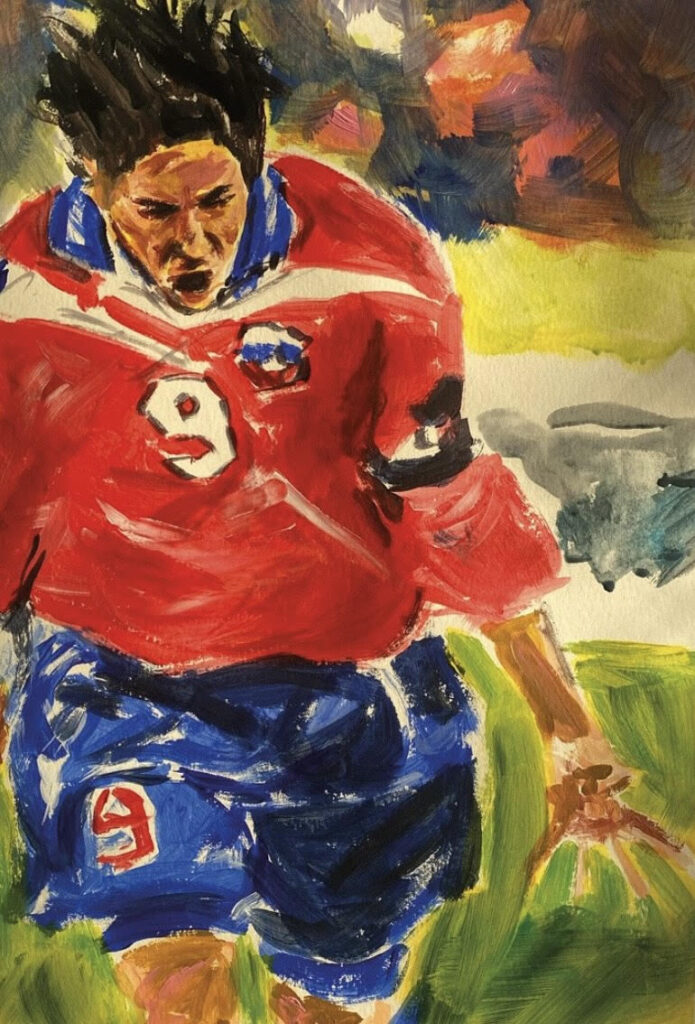
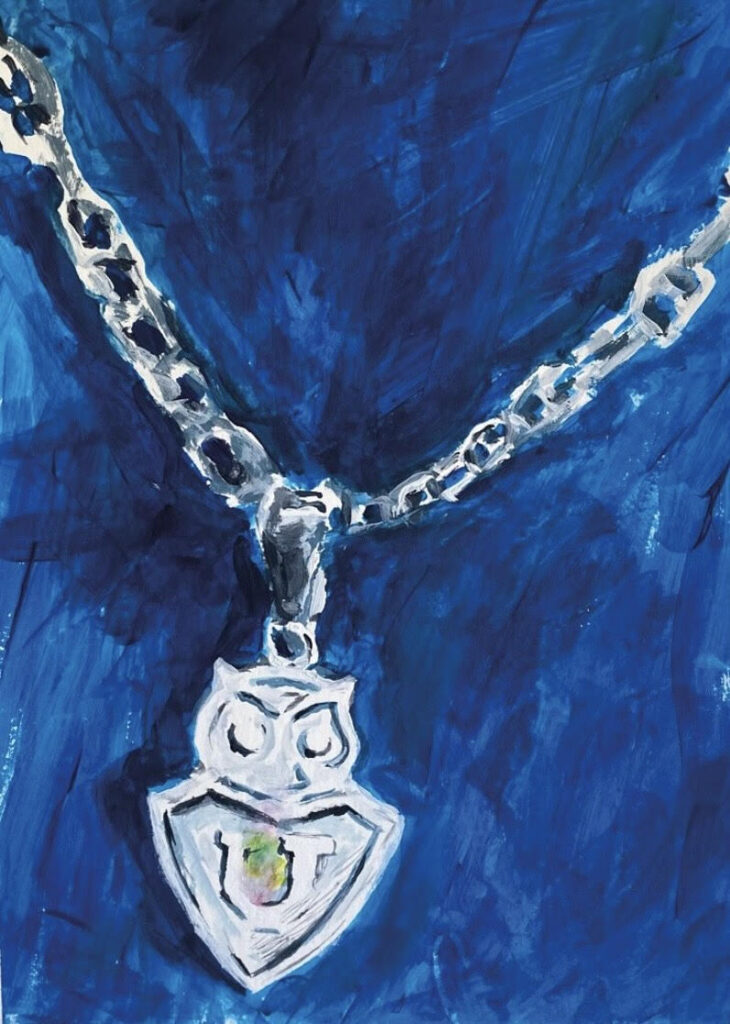
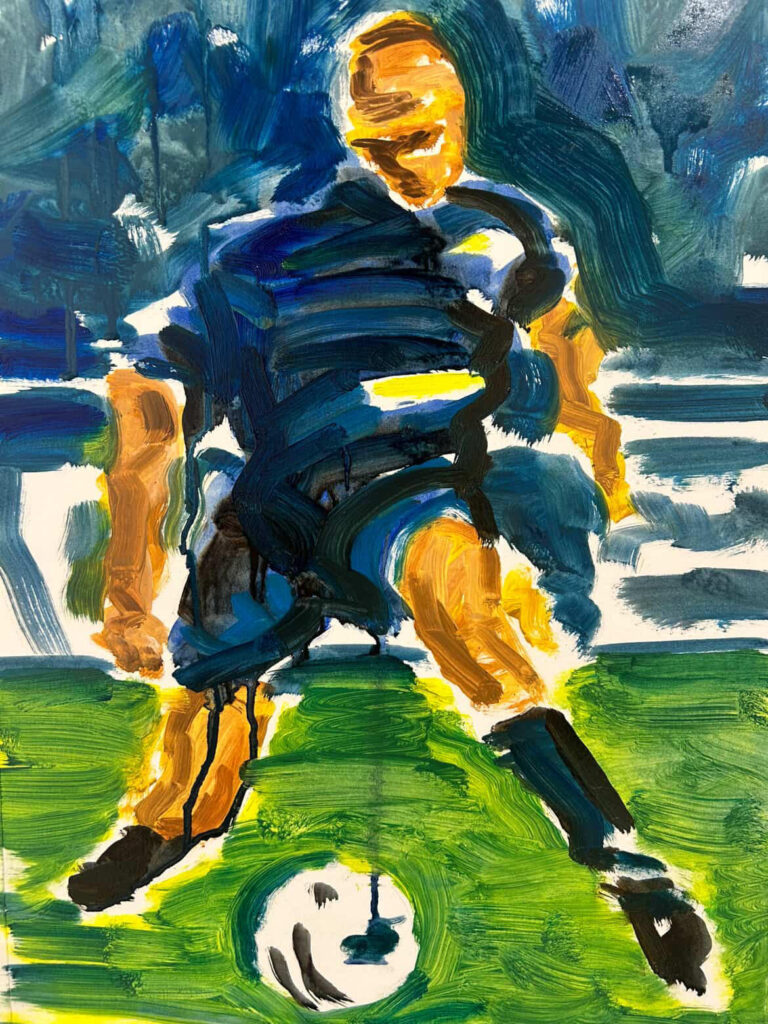
The pictorial work of Camilo Ortiz is rooted in a reflection on the football imaginary as a territory of identity, emotion, and memory. His practice appropriates the visual language of football to explore how this collective phenomenon articulates social, emotional, and cultural narratives. Far from limiting himself to representing the sport, Ortiz approaches football as a symbolic space where bonds of belonging and structures of power are projected, offering a critical perspective on its resonances within popular culture.
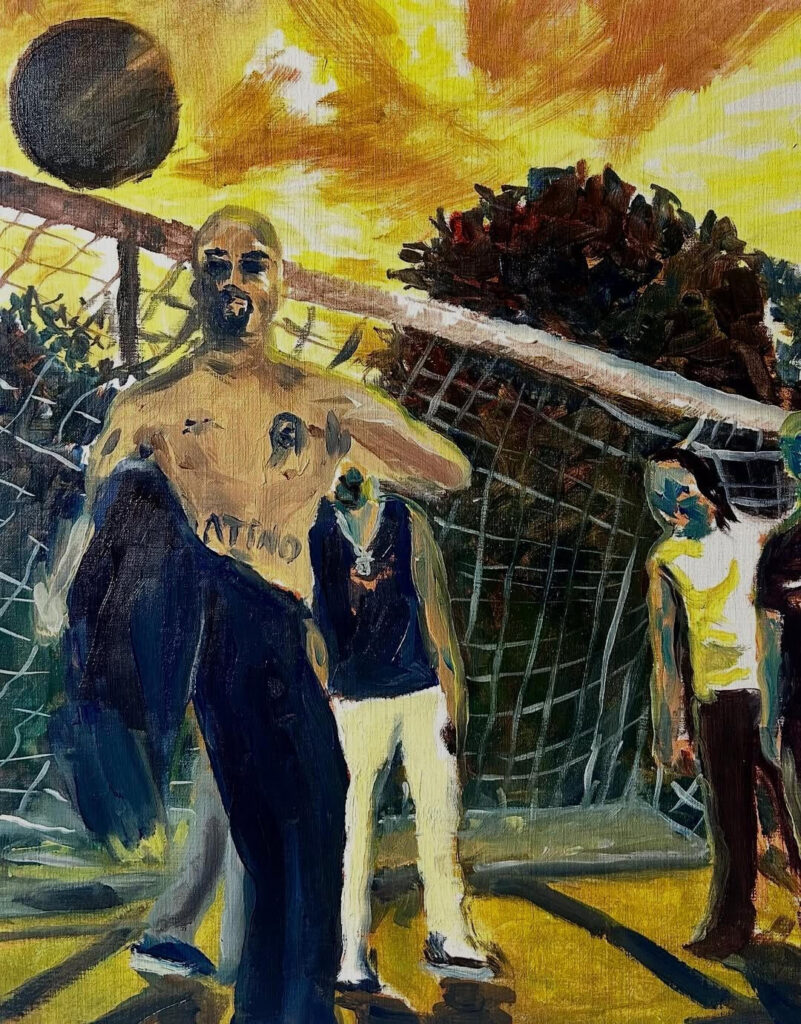
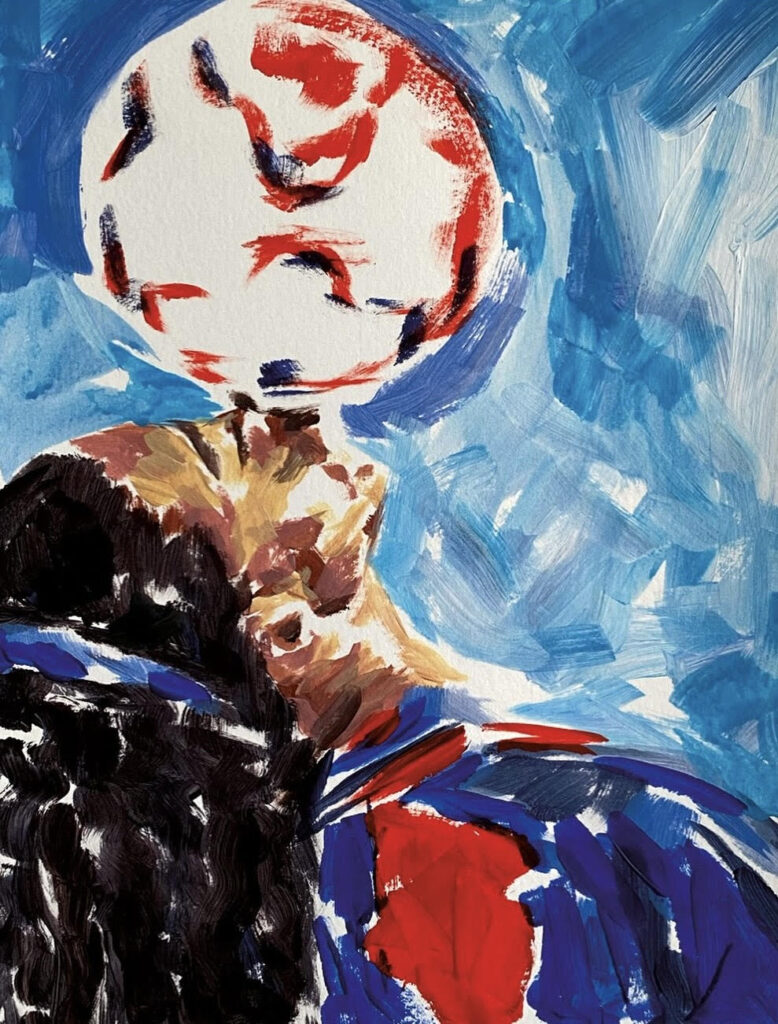
Through a painting style that combines expressive gestures, vibrant palettes, and references to the aesthetics of the 1990s and 2000s, Ortiz revisits popular iconography with a contemporary sensibility. In his work, the everyday acquires a poetic dimension that revalues the common and the communal as legitimate sources of creation.
The artist conceives visual practice as a means of mediation between individual memory and collective experience. In this sense, his work positions itself in dialogue between art, sport, visual culture, and the politics of emotion, activating a reflection on the ways in which affect and imagery build community. Painting, printmaking, and other media, for Camilo, become spaces of encounter — places where nostalgia, identity, and gesture come together to shape a shared memory.
Hello Camilo! A pleasure to chat with you! The first question I always ask: What does a normal day look like for you in Barcelona?
Camilo: I usually wake up at 6:40 to go exercise, then I come back home, make breakfast for my family, and together with my wife, we take the kids to school. Right after that, I either go to my Catalan classes 🙂 or to the workshop to work like any regular mortal. Around 4 p.m. I start moving again, pick up my daughter from school, then go home to my favorite place — the kitchen. That’s usually a weekday in my life routine, nothing out of the ordinary.
I’m curious, what kind of child were you growing up in Chile? What did you enjoy doing, and how did you spend your time?
Camilo: I was pretty hyperactive. I used to spend all day outside playing, either alone or with my group of friends — we were a big gang. I lived across from a church and a small football field, in a neighborhood called “Vista Hermosa.” I loved being out on the street all day watching neighbors go by or just sitting on a sidewalk until my friends came out to the field to play. I had a pretty privileged childhood, being able to play from 9 a.m. to 8 p.m. without anyone worrying. I didn’t like school, so I’d rather not talk about that hahaha.
So why did you decide to move to Barcelona?
Camilo: Basically because my daughter Celeste came to live here with her mother, and it happened to coincide that my current partner was also moving here with her son — so we built a beautiful family here. In any case, I had always felt the urge to leave Chile.
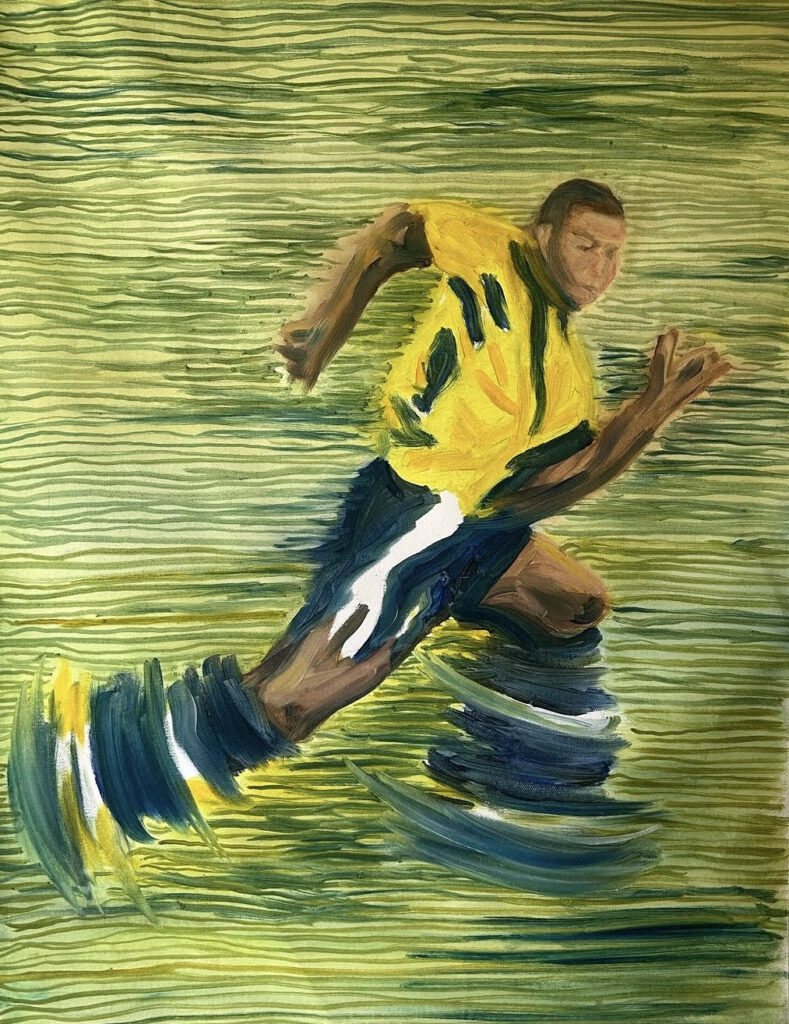
Alright, when did you start painting, and when did you begin taking your artistic side seriously?
Camilo: Painting as such started during the pandemic or shortly after, because when I finished art school I always focused on printmaking. But the artistic side — I’ve always taken it very seriously. It’s the place where I find myself, and it makes me truly happy.
Okay, Camilo, with this next series of questions, I’ll try to go deeper into your work as much as possible. So… Football is such a vast emotional territory… When did you first realize it could also be a visual language?
Camilo: Right after finishing university, around 2014, I made a series of works called Finales — twenty color woodcuts. After that, I realized that the result of the images was quite interesting, and linking them to the world of football even more so. That’s where I began a series of works dealing with football fan groups and iconic plays.
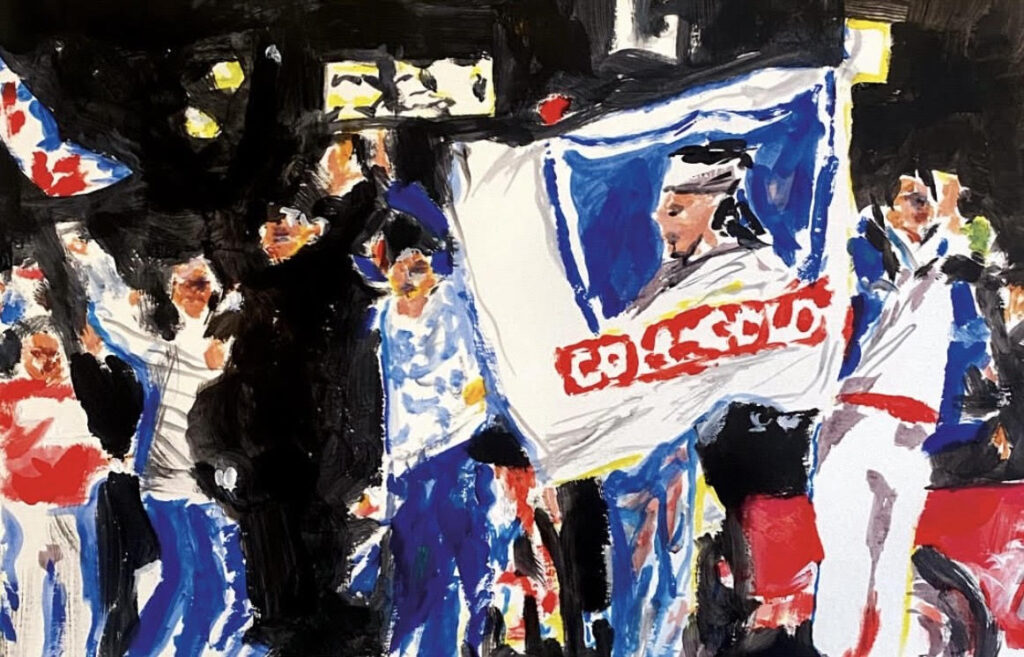
Your paintings don’t depict football matches but rather convey their energy and atmosphere. What interests you more: the game itself or what it represents socially?
Camilo: Both are interesting. The idea of a piece is that the more layers of meaning it has, the more powerful it becomes, whether I achieve that or not is another question. Reviewing the game through videos or photographs gives me different interpretations and analyses, a way of seeing football in another dimension that in turn becomes social — perhaps that cohesion is what I seek. But there are many things that catch my attention, and little by little I break them down and build a discourse within the work.
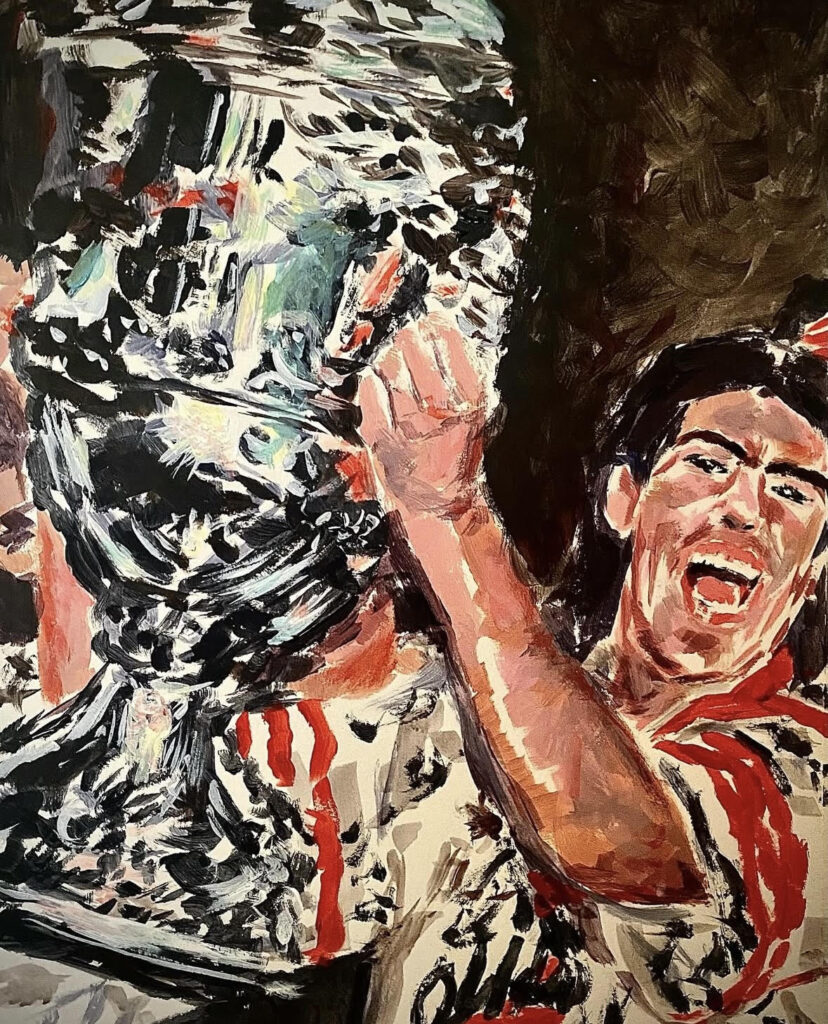
In your opinion, what does football reveal about belonging and power?
Camilo: The sense of belonging and identity it generates is undeniable. For example, here in Barcelona most of the population supports FC Barcelona, and you see kids everywhere wearing jerseys with Yamal or Pedri on them — figures that transmit symbols children and young people adopt, from clothing brands and styles to haircuts. In my time, it was unthinkable for a boy to let his hair curl naturally, and now kids want to look like their idols. That’s belonging, and the search for identity.
Do you consider your work a critique of football culture or rather an act of affection toward it?
Camilo: More than a critique, it’s a social and political evidence of what happens in the football imaginary. I see it as affection — people’s connection to what the sport gives them. People engage with and consume football in many ways because it’s such a powerful sport. Some see fan groups as a refuge, a meeting place to cope with life in general. Others see it through aesthetics — fashioning wardrobes. Then you have the general fans who always orbit around it, the ones who are living encyclopedias… and I could go on.
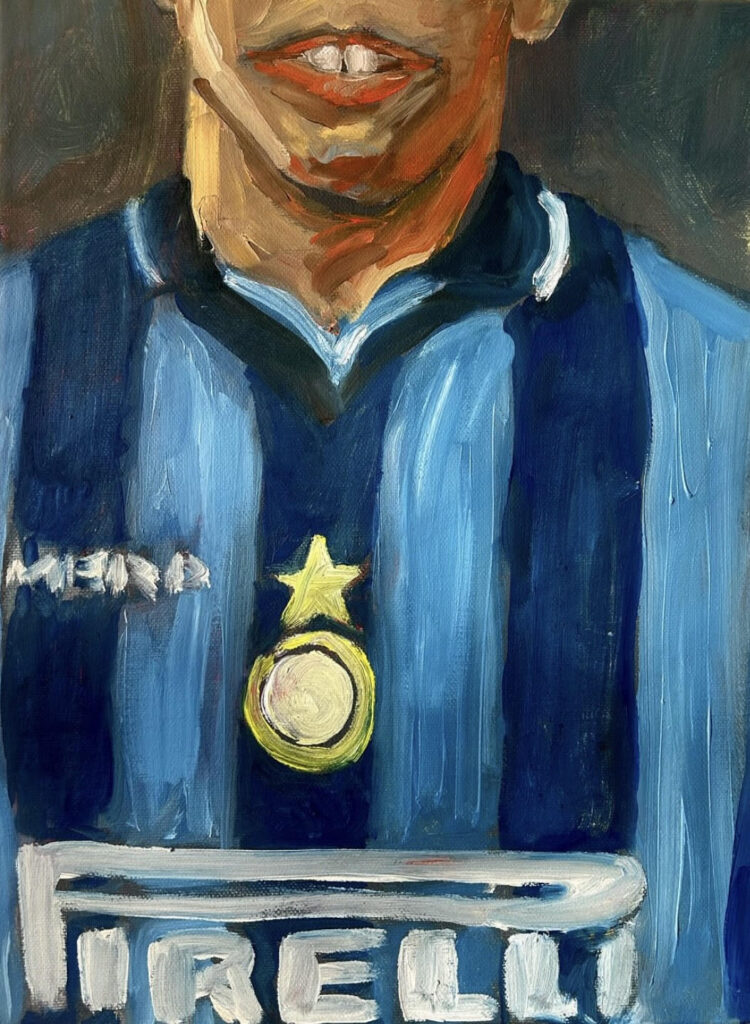
The golden era of football in the ’90s and 2000s clearly marks your visual references. What attracts you to that period?
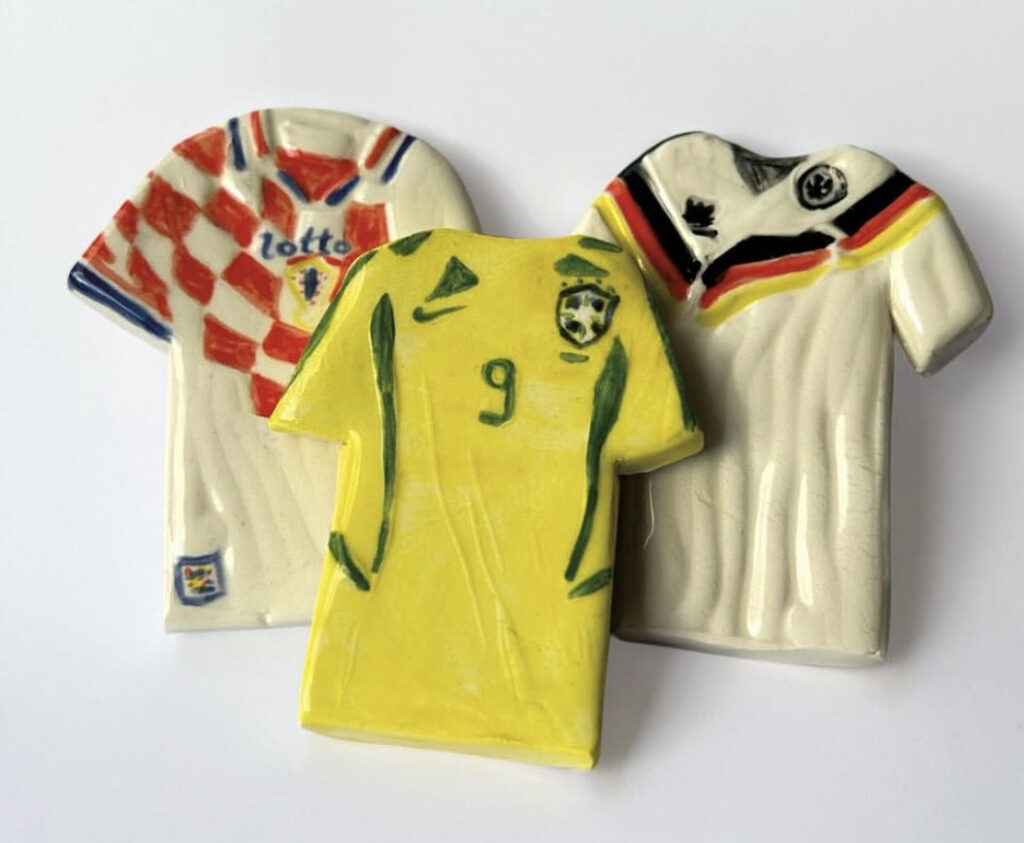
Camilo: It’s no coincidence that the aesthetics of jerseys shifted then — everything now tries to recreate those retro ’90s or 2000s vibes. Humans always want to relive memories, and maybe that’s what’s happening now. In 30 years, we’ll probably revisit 2025 — it’s a constant back-and-forth. Personally, when you link beautiful memories with images, they create nostalgia and a happy recollection. I think that’s where my choice to work with those years comes from. The graphics and visual aspects of that era are just beautiful to me.
Your work turns popular images into something poetic. How do you choose which visual memories to revisit?
Camilo: I have an image bank on my computer that I’m always updating. I love this exercise because new things keep appearing — things I didn’t know or had buried deep in the last drawer of my brain.
Nostalgia can be both warm and painful — how do you balance those emotional tones in your paintings?
Camilo: Maybe before I linked my emotions more strongly with my work, but I realized that being able to process melancholy and move in and out of it through my art whenever I want is a privilege. Now I regulate both aspects so I can view the work from a distance and step in only when necessary.
Do you believe collective memory can be rewritten through art?
Camilo: Absolutely, we’re constantly contributing to that collective history.
You often refer to painting as a space for encounters. What kind of encounters do you hope to create?
Camilo: The viewers’ interaction with the work is already an act of encounter and contemplation, but usually, we’re surrounded by formal exhibition spaces that few people access. I’d love for those meeting points to reach broader spaces, that’s something I did a lot in Chile, and I hope to replicate it here: exhibitions and shows in various social contexts.
Do you think art can still function as a form of collective ritual — similar to football?
Camilo: It’s difficult because art operates within very elitist logics and codes that only the art world often understands. I keep saying that as agents and workers of art we have that responsibility day by day, but we also get wrapped up in a kind of creative individualism that blinds us.
Have you noticed how audiences from different countries or cultures interpret your football images differently?
Camilo: Yes, that’s natural, given the codes of belonging or symbolic gestures passed on to them by family or friends. That clearly enriches the cultures we weave together to share and understand each other.
Images have always played a key role there.
What does community mean to you today, both inside and outside the art world?
Camilo. In both football and society, it’s what remains for us to connect solidly — to create collective experiences that make us feel part of a whole. Politics, sports, and culture intertwine to create these spaces of competition, which in turn I use to leave artistic records.
What’s next for you? Will you explore new themes or continue expanding this emotional cartography of football?
Camilo: I’ve always been interested in the act of cooking and the imagery created around food. I hope to dive into that at some point, but for now, I need to finish and cherish more football projects. Though it’s always possible to work in parallel.
If you could paint one decisive moment in football history, what would it be and why?
Camilo: The kick Cantona gave to a neo-Nazi fan, it’s such a powerful football and political act. Everyone knows that image and praises it.
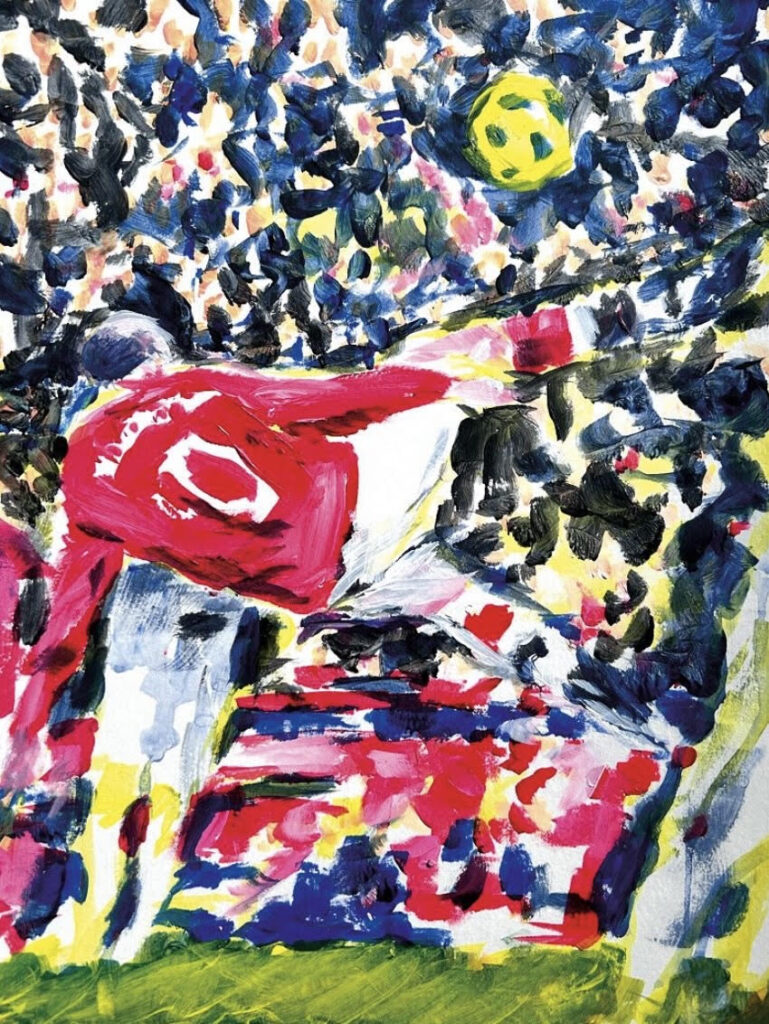
What do you like most about football?
Camilo: The team uniforms and the creation of artistic symbols by the fan groups.
Who is your favorite football player of all time, and why?
Camilo: Zidane and Rivaldo, watching their plays gives me great satisfaction.
And what are your favorite football moments, and why?
Camilo: I think I always give different answers hahaha. Maybe I’m still not entirely sure. The header by Salas against Italy is one I remember vividly, and also Zidane’s headbutt to Materazzi.
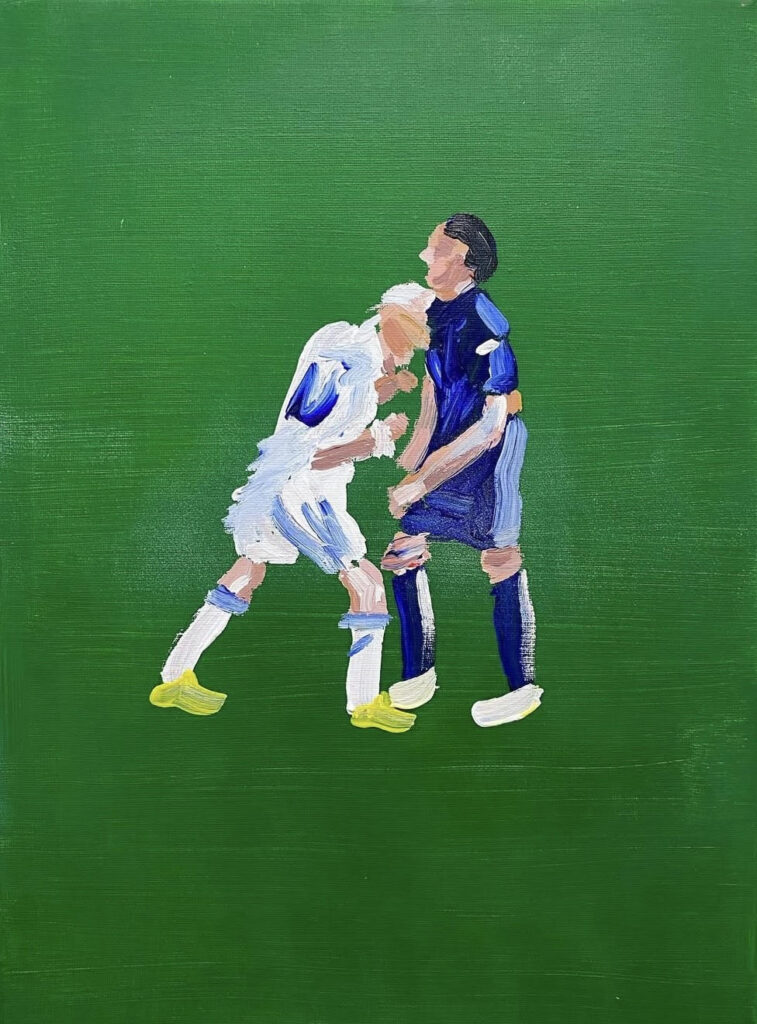
Could you walk me through your creative process, from start to finish?
Camilo: I start by looking at images and things that might serve me — magazines, sticker albums, pins, flags, etc. Then I project images, and sometimes I draw randomly until I reach compositions that interest and convince me. I paint and paint until I stop — and sharing and asking for opinions from those close to me helps a lot.
Your color palettes feel both expressive and nostalgic, how do you approach color?
Camilo: I almost always work with a lot of yellows and pinks. From there I build the color palettes I intend for the paintings. This part of the process is the hardest for me, so I get advice from other painters and look at many pictorial and cross-disciplinary references that aim for smart solutions.
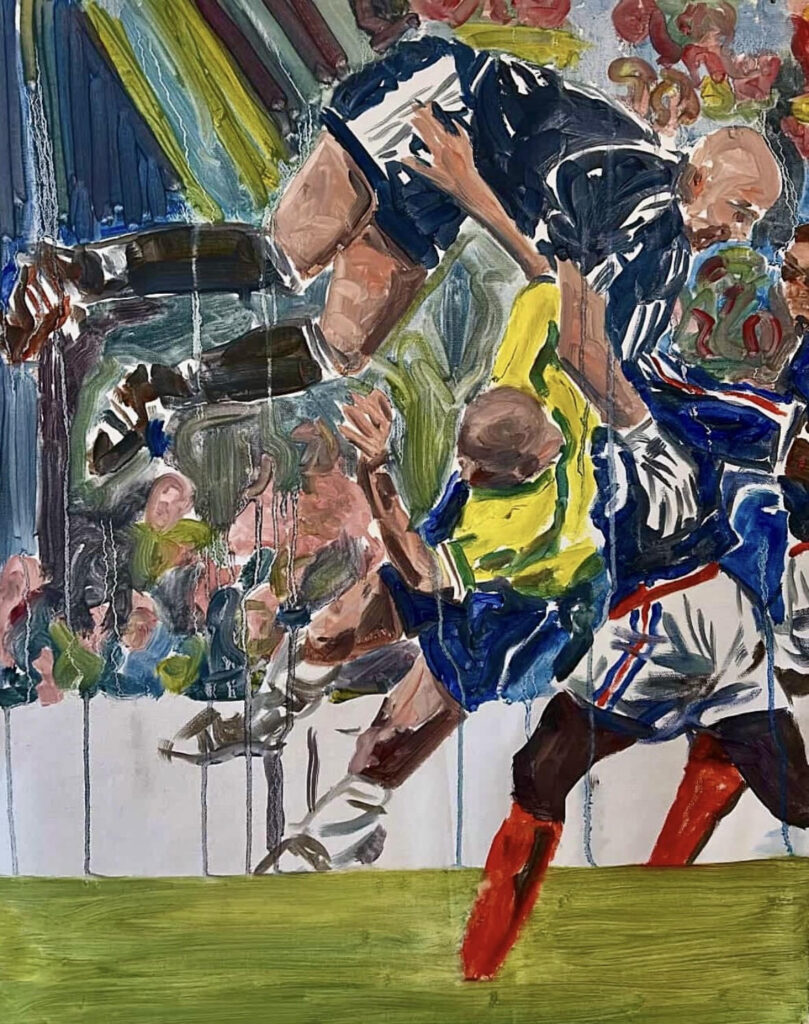
So, with everything we’ve just discussed, what do you hope to convey?
Camilo: To enjoy my work and offer many cultural tools to those who can appreciate it. I’m very generous in sharing my research and techniques.
Alright, Camilo, now let’s completely change the topic. In a parallel universe — who would you be, and what would you do?
Camilo: A cook in search of emotional stability 🙂 I really like a chef named Virgilio Martínez from Peru, his project is incredible. Maybe I’d send my résumé there in that parallel world.
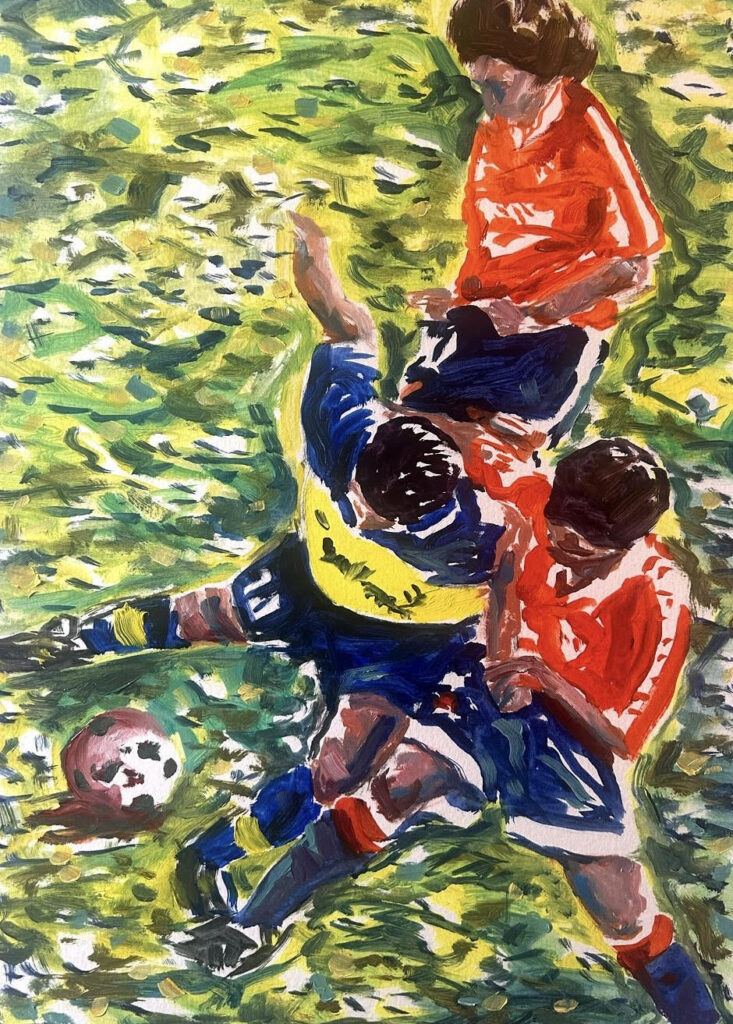
Aside from art, what are you passionate about right now, maybe a hobby, a show, or even a food, that keeps you grounded or inspires you?
Camilo: Cooking day and night gives me a sense of security and calm that honestly moves me just thinking about it.
Can you tell me about a time when a relationship with someone had a great impact on you?
Camilo: Human relationships always impact me, I’m quite sensitive. But being a father has connected me deeply with the world of raising a child, and my strongest relationship is with my daughter Celeste. It grounds me, keeps me lucid, and with my feet on the ground.
What qualities do you value most in the people you choose to spend time with?
Camilo: Several things, but intelligence is something that “the Almighty” (God) didn’t give me much of hahaha, so I look for it in others. My wife is a clear example, she’s incredibly intelligent and constantly surprises me. And people with good jokes.
Is there someone you admire?
Camilo: My daughter, my wife, my mom, dad, my daughter’s mom, and my sister — they’re mostly women. And my group of friends — they’re so amazing that I miss them a lot right now.
What motivates you?
Camilo: Art.
How would you describe a perfect day?
Camilo: Cooking a good barbecue, swimming in a lake, and being with family and friends — hopefully ending the day camping.
Alright, Camilo, I always ask these two questions at the end of an interview. The first one: What’s your favorite movie (or movies), and why?
Camilo: That’s difficult, but I think Melancholia by Lars von Trier — it’s a film I really enjoy. Although, in the past year, I’ve watched so many great films that I should probably rethink that answer.
The second: What song(s) are you listening to the most right now?
Camilo: Waiting for Tonight by Jennifer Lopez — and everything by Erika de Casier.