
Share this
Yayoi Kusama has passed away at the age of 97, leaving behind one of the most recognisable, obsessive, and emotionally charged visual universes in contemporary art.
Her companies, Yayoi Kusama Inc. and Yayoi Kusama Studio Inc., announced that the artist died at a hospital in Tokyoon August 14, 2026. In their statement, they described a life “devoted entirely to artistic creation,” noting that Kusama continued painting until her final days.
Few artists have transformed inner life into public image with the same force. Kusama’s world was built from polka dots, pumpkins, Infinity Mirror Rooms, hallucinated fields, endless nets, bright colour, repetition, obliteration, and the fragile desire to dissolve the self into something larger. Her work was instantly recognisable, but never simple. Beneath the pop surface was fear, compulsion, trauma, longing, and a lifelong attempt to turn psychological intensity into form.
Born in Matsumoto, Japan, in 1929, Kusama began making art from an early age, shaped by visions and hallucinations that would later become central to her practice. She moved to New York in the late 1950s, entering the city’s avant-garde scene and developing a language that moved across painting, sculpture, installation, performance, writing, fashion, and political happenings.
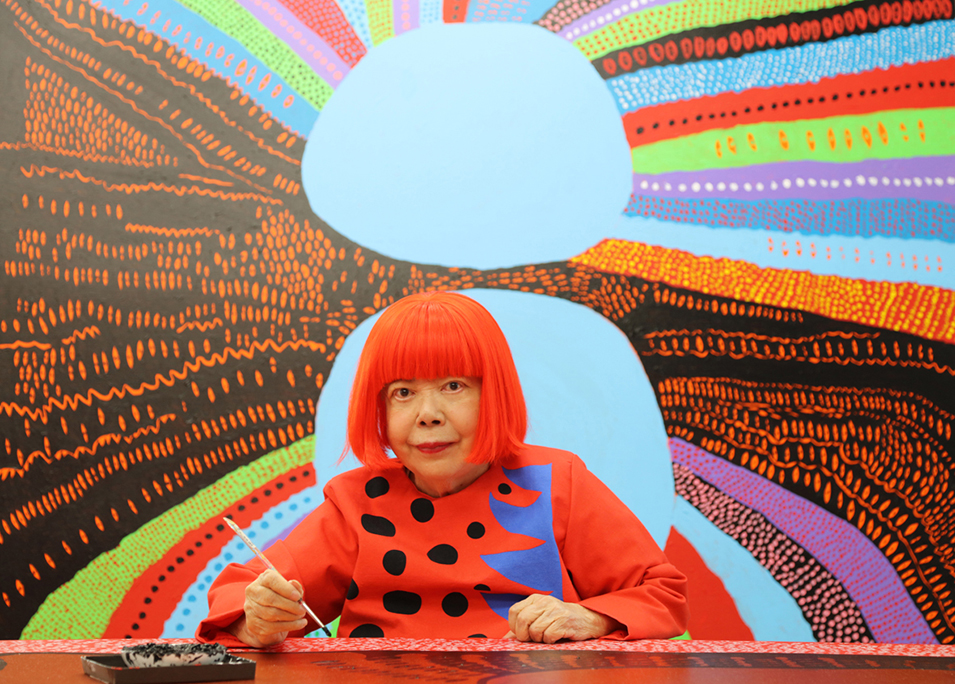
Her Infinity Nets paintings, obsessive soft sculptures, body-painting performances, and mirrored environments placed her at the centre of some of the most radical artistic conversations of the 1960s. She worked near and alongside figures such as Donald Judd, Andy Warhol, and Claes Oldenburg, while developing a language that remained unmistakably her own: intimate, cosmic, and almost violently repetitive.
After returning to Japan in the 1970s, Kusama voluntarily lived in a psychiatric hospital from 1977 onwards, while continuing to work from a nearby studio. That fact has often been repeated as biography, but it should not reduce her art to illness. Kusama was never only an artist of suffering. She was an artist of survival, control, invention, humour, spectacle, and radical self-mythology.
In later decades, her work reached an almost unimaginable global audience. Her Infinity Mirror Rooms became pilgrimage sites for a generation raised on images, while her pumpkins, dots, and immersive installations entered museums, public spaces, fashion collaborations, and popular culture without losing their strange emotional charge. The Yayoi Kusama Museum opened in Tokyo in 2017, further cementing the scale of her legacy.
What made Kusama extraordinary was not simply that she created a visual language people could recognise instantly. It was that she made repetition feel like both wound and universe. A dot could be a symptom, a star, a cell, a planet, a body disappearing, or a body trying to survive by becoming part of everything.
With Yayoi Kusama’s passing, contemporary art loses one of its most singular imaginations. But the world she made remains difficult to exit: mirrored, spotted, infinite, vulnerable, and still expanding.