Share this
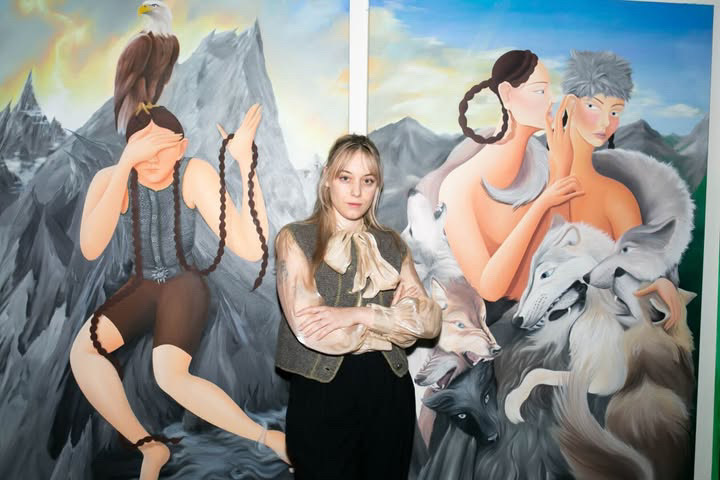
I first encountered Melanie’s work in late 2023 whilst visiting the Academy of Fine Arts Vienna. I stepped into the painting studios and onto the dark wooden floor, artists’ cubicles surrounding me on all sides. Tall windows flooded the room with an even, crisp light and, beyond them, Vienna revealed itself in fragments: rooftops, church spires and the upper reaches of grand buildings stretching across the city.
The studios felt alive. Students painted as I wandered between the cubicles, the air carrying the smell of wood, coffee, turpentine and oil paint. I looked from left to right, taking everything in.
Then I looked to my right and saw her paintings.
Before I really knew Melanie, I knew her work.
The paintings seemed to shimmer in the light. Reds, pinks and whites glowed from the canvases. They were bright, vibrant and inviting. I stepped closer and spent time with them. Even then, I had the feeling that there was something there. Not a finished language, but the beginnings of one. The paintings hinted at a world still in the process of being discovered.
Not long afterwards, I met Melanie, and over the next three years I repeatedly found myself drawn back to her work at the Academy of Fine Arts Vienna. With each visit, the paintings grew more assured. Her technical ability deepened, and the world within them became increasingly distinct and recognisably her own. The universe that had only been hinted at during that first encounter was slowly revealing itself.
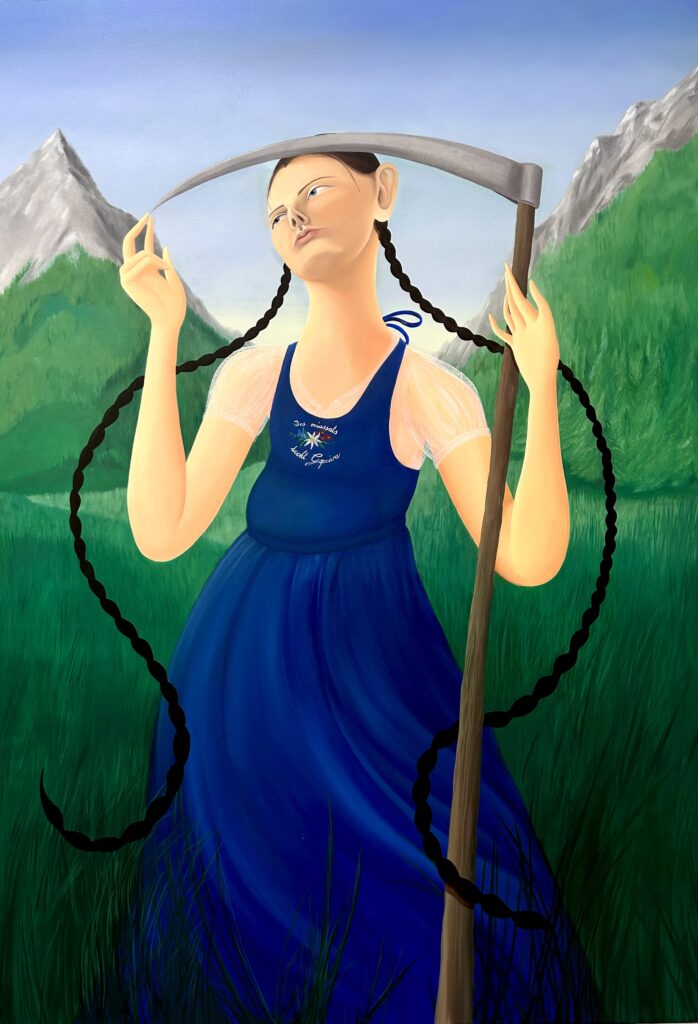
People would often tell me that Melanie came from a magical place in Austria, high in the mountains of the Tyrolean Alps. “It’s very special there,” they would say. “Almost magical.” As I continued to follow her work and get to know her, I became increasingly curious about the relationship between that landscape and her paintings. There seemed to be traces of another world running through them: forests, mountains, animals, mythology and memory.
Now, as Melanie graduates from the Academy of Fine Arts Vienna in 2026, three years after I first encountered her work in its studios, it feels like the right moment to sit down with her and speak about her practice, her upbringing, and how the landscapes of her childhood continue to shape the universe she is building through painting.
How’s your day been today?
Melanie: Currently, I’m sitting in the car on my way back to Vienna from Tyrol. I am listening to a podcast about Werner Herzog and why he is not so well known in Germany/Austria. It’s always hard to say goodbye to my family, our dog and the nature. So I feel a bit Melancholic, I think Werner Herzog is really fitting the theme.
You grew up in Zams in the Tyrolean Alps, which is such a specific and beautiful part of Austria — what was it actually like growing up there? What was your favourite thing about it?
Melanie: My childhood was very connected to nature. I was practically outside every day, playing and discovering things in nature. Right behind my grandparents’ house was the forest, and there was a small clearing by a lumberyard where there were enormous roots. Well, at least they seemed enormous to me, now that I’m grown up, they’re not so big anymore. Anyway, each root represented something different to me. There was a fire truck, a kitchen, a slide, just about anything you could imagine. It was the best playground for me. And sometimes, as if by magic, a new root would appear in the clearing. A few years ago, I learned that it was my grandfather who had placed them there.
What’s a story from growing up there that might surprise people?
Melanie: Well, there is one special tradition around Christmas time and it’s called: Krampus. In early December, entire villages fill with these terrifying creatures wearing carved wooden masks with horns, blood, animal fur, chains and giant bells. They run through the streets at night, screaming and chasing people. As children, you’re told that Saint Nicholas rewards the good kids, but Krampus comes for the bad ones.
What was it like moving to Vienna for the first time?
Melanie: Overwhelming! Well, the village where I grew up had 300 inhabitants, and then suddenly, overnight, I was in a metropolis. I remember that in the beginning, I would just wander around Vienna for hours, fascinated by the sheer amount to discover and how it just seemed endless. It gave me an incredible feeling of freedom, and I loved being able to go anywhere at any time. Back in our village, there was only one bus to the next small town, and the last one left at 6:30 in the evening.
Billy Joel was right…Vienna really waited for me haha.
When did you first realise you wanted to become an artist?
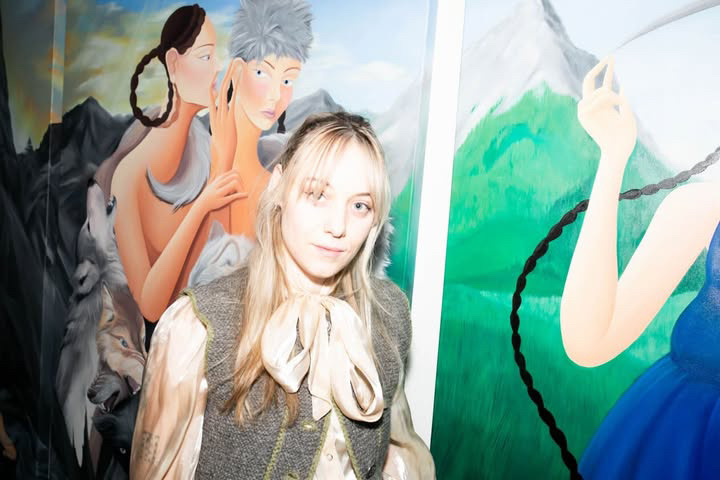
Melanie: It took me a very long time to see myself as an artist. Where I grew up, I had almost no contact with secular or contemporary art. But I loved drawing and painting from the very beginning. I was and still am almost obsessed with it. My parents always say that all they had to do, was give me paper and pencils, and I would spend hours completely immersed in it. There was never really a specific moment when I realized that this was what I wanted to do. It was simply always there. Something very natural and deeply rooted in me. Almost like a calling or a destiny I had been following without even knowing it.
Your paintings keep getting stronger technically. How are you learning, and can you feel yourself improving?
Melanie: Before studying at the academy, I attended a higher technical school for painting, design, and restoration. I’m very grateful for the technical knowledge and craftsmanship I learned there, because it continues to shape my artistic practice today and allows me to experiment with the knowledge of the material.
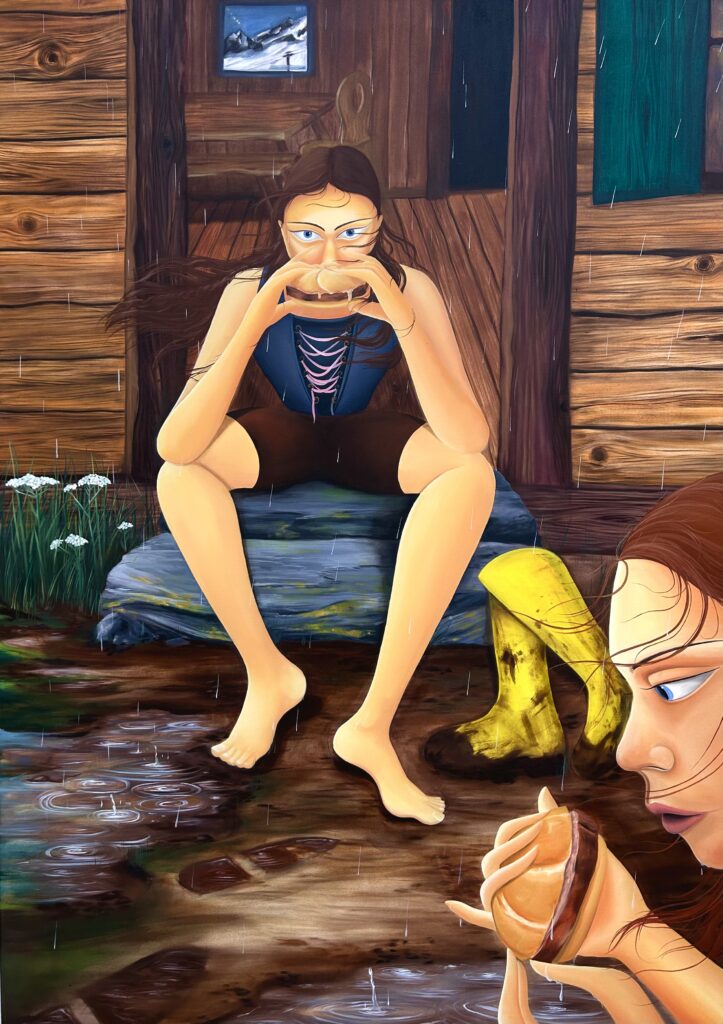
Over the last few years, I’ve realized that painting requires both time and patience. I work in many layers, allowing the colors to slowly develop their full depth and intensity. In a way, my process is similar to the techniques used by the old masters, where paintings were built gradually over time rather than completed in a single gesture.
Learning to accept this slowness and to give each painting the time it needs has become an important part of my practice. It constantly pushes me to observe more carefully and continue improving.
What does a normal day look like for you at the academy at the moment?
Melanie: I usually start my day with a coffee and a little bit of office work. Around 8 a.m. I arrive at the studio and immediately start working on my paintings. Since I’m currently in my last semester and already finished all of my courses, I can finally focus entirely on my diploma works. At around 10 a.m. I take a small coffee break. Then I continue working until lunchtime. I usually get fresh food from the Mensa, and together with some classmates I sit by the large Schiller statue in front of the academy. We eat in the sun, talk about art, life, and deadlines, and then return to our studios. In the afternoon I keep painting until around 4 or 5 p.m., when I finally clean my brushes.
You mentioned that at the academy you can study for as long as you want. You’re graduating now at 27 — why does now feel like the right time?
Melanie: I think for a long time I didn’t really experience studying as something that has a fixed endpoint. At the academy, you are given this unusual freedom, which can be both beautiful and a bit overwhelming at the same time. For me, now feels like the right moment because I can feel a shift in how I work and think. Over the past years, I’ve built a strong foundation, and at some point I started to realize that learning alone is not enough anymore, I need to fully take responsibility for my own artistic position. Finishing now doesn’t feel like a conclusion, but more like a transition. I feel ready to step out of the protected space of the academy and into a more independent context. And I think that change is what makes this moment feel right.
What are some of the biggest things you’ve learned while studying there?
Melanie: One of the most important things I learned during my studies came from a drawing course with Professor Veronika Dirnhofer. She really changed the way I look at drawing and painting. In her class, I was encouraged to experiment freely and to trust the process rather than aiming for perfection. That experience was very liberating for me. It opened up a new sense of freedom in my work and allowed me to take risks in my painting without being afraid of failure.
I’m British and our university system is so different — can you explain what the academy system in Austria is actually like?
Melanie: At the Academy of Fine Arts Vienna, students mainly work within a professor’s so-called “master class.” For example, I studied in the figurative painting class, where each student is assigned their own studio space, accessible 24/7. This becomes our artistic base, where development happens through studio practice, dialogue, and regular critique rather than formal teaching.
You are expected to develop your own artistic practice quite independently, while the professor acts more as a mentor than a traditional lecturer. Alongside this, there are theoretical and practical courses that we are required to attend. However, we have a lot of freedom in choosing which courses to take and where to set our focus. As a painter, for instance, I can also attend a sculpture class, which allows for a very open and interdisciplinary way of working.
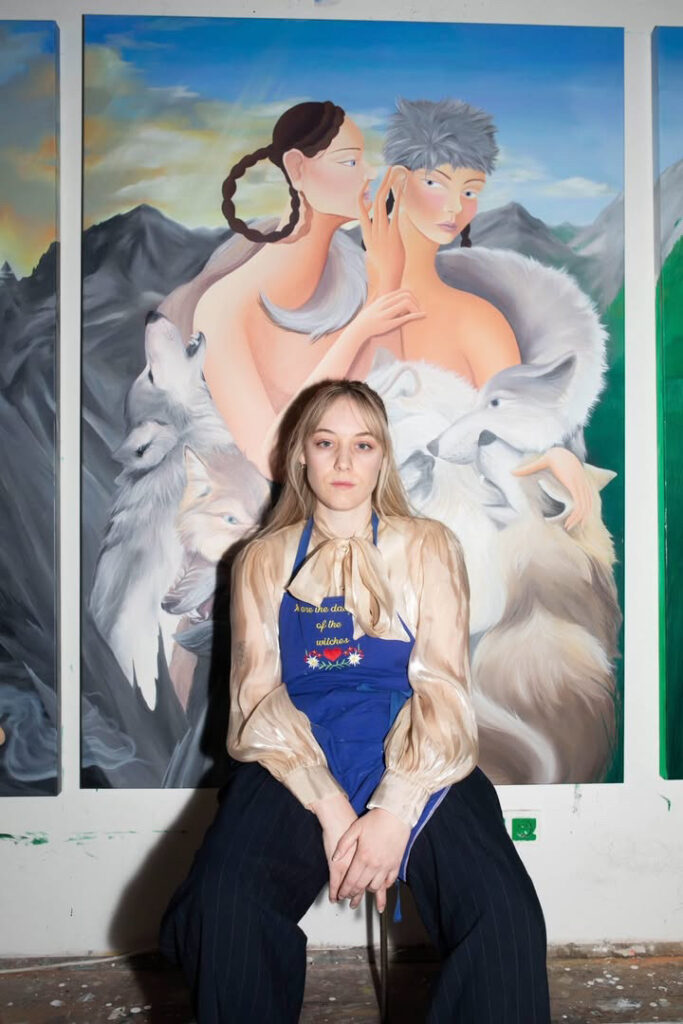
Last time we spoke you mentioned wolves being reintroduced into the Austrian countryside. Can you tell me more about that, and what it’s like for people living around them?
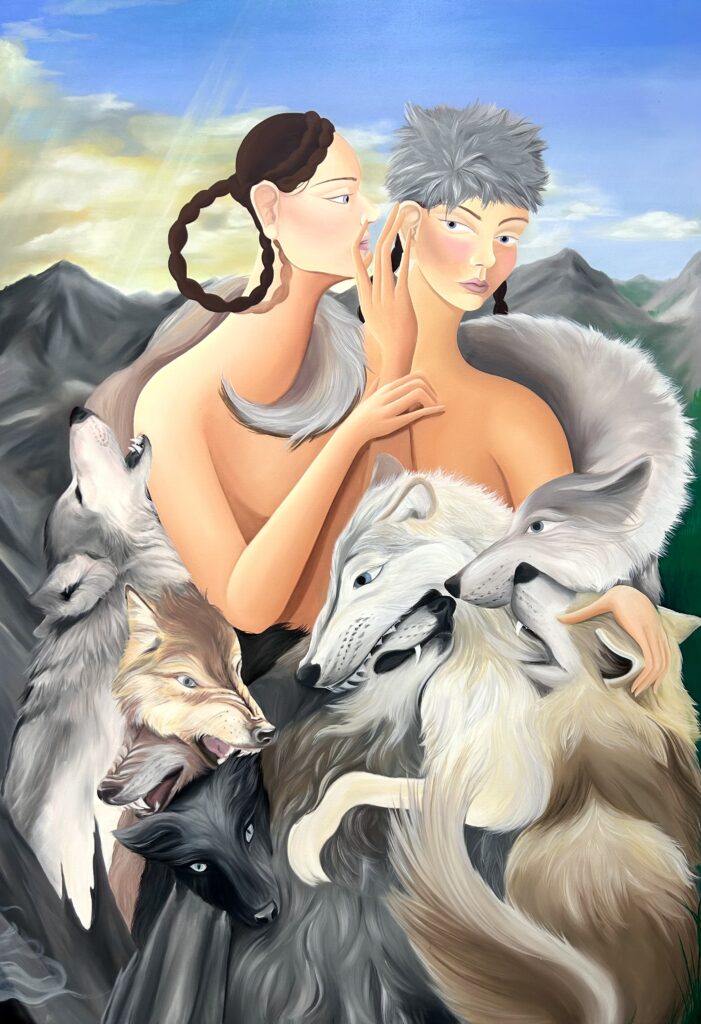
Melanie: For people living in rural areas, especially farmers, this can be quite a sensitive topic. On one hand, some see it as a sign of a wilder, more ecologically balanced landscape returning. On the other hand, it also creates very real challenges for livestock farming, especially on alpine pastures. Farmers fear for their sheep, who spend the summer up on the mountains. So it’s less an abstract debate and more something that directly affects everyday life in the mountains, where nature, tourism, tradition, and modern land use constantly overlap.
You paint women alongside animals a lot in your work. Do those figures come from people you know — friends, family, yourself — or are they more imagined characters?
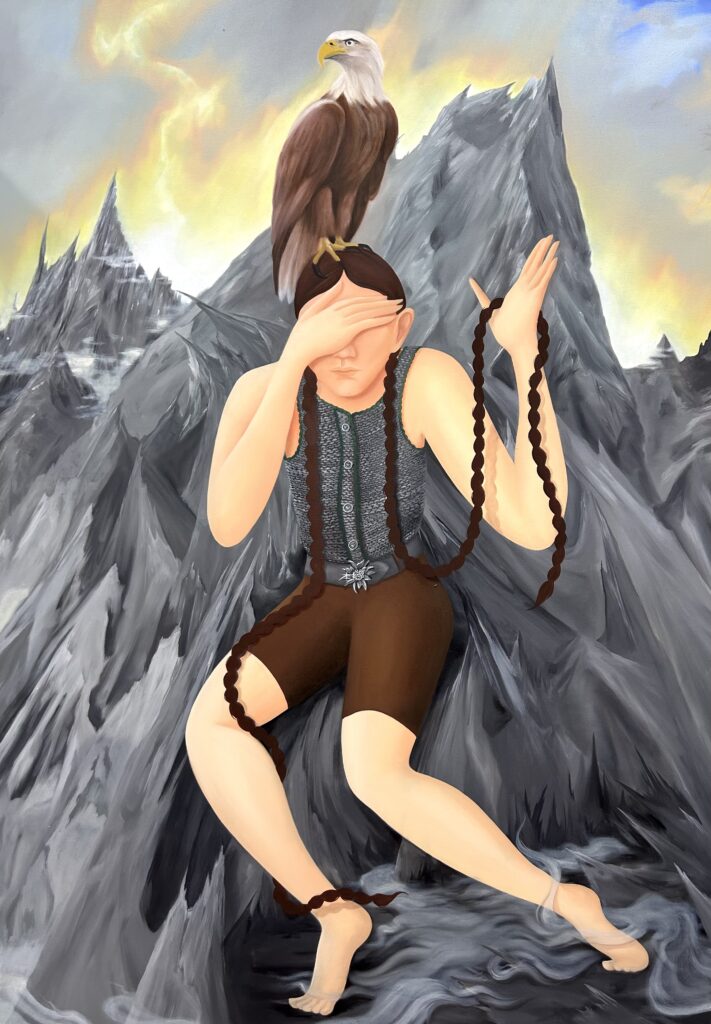
Melanie: I am often asked whether the figures in my paintings are self-portraits, and my answer is always no, but I would also not say that they have nothing to do with me. These characters are not direct depictions of myself or people I know, but they carry many aspects of my own inner world. In a way, they reflect fragments of my thoughts, emotions, and experiences, translated into another form. So while they are not literal portraits, they are still very personal. A lot of what I feel or observe somehow finds its way into these figures, even if it is transformed and no longer directly recognizable.
What’s the best book you’ve read recently?
Melanie: One of the most recent books I read is „The Collini Case” by Ferdinand von Schirach. His writing is very precise, almost minimal, but still extremely powerful. The story of the legal case gradually opens up into larger questions about justice, responsibility, and how the past continues to shape the present. It’s also a reflection on moral complexity and the limits of legal systems. It stayed with me because it raises questions that don’t have easy answers.
What’s the best film you’ve watched recently?
Melanie: I would say „Stand by Me”, it’s one of my favorite movies, but recently I rewatched it. It’s a coming-of-age story, but it captures something very universal about friendship, childhood, and the moment when you begin to understand the world in a more complicated way. There’s a kind of quiet honesty in the way it portrays the boys and their journey nothing feels exaggerated or overly sentimental, even though it is an emotional story.
If you could disappear somewhere tomorrow just to paint, where would you go?
Melanie: There’s a small hut in the mountains, where my family and I go every summer for some weeks, since I’m a child. I love it there. Time seems to move differently up in the mountains everything slows down, and things feel more immediate at the same time. You inevitably learn to live in closer cooperation with nature, adapting to its rhythm rather than imposing your own.
And what’s been the hardest thing about it so far?
Melanie: The hardest part so far has been finding a balance between my artistic practice and all the practical work that comes with it, especially office work and the administrative side of things. It often feels like two very different worlds that I have to constantly switch between, and learning to move between them without losing focus on the actual studio work has been a challenge.