
Share this
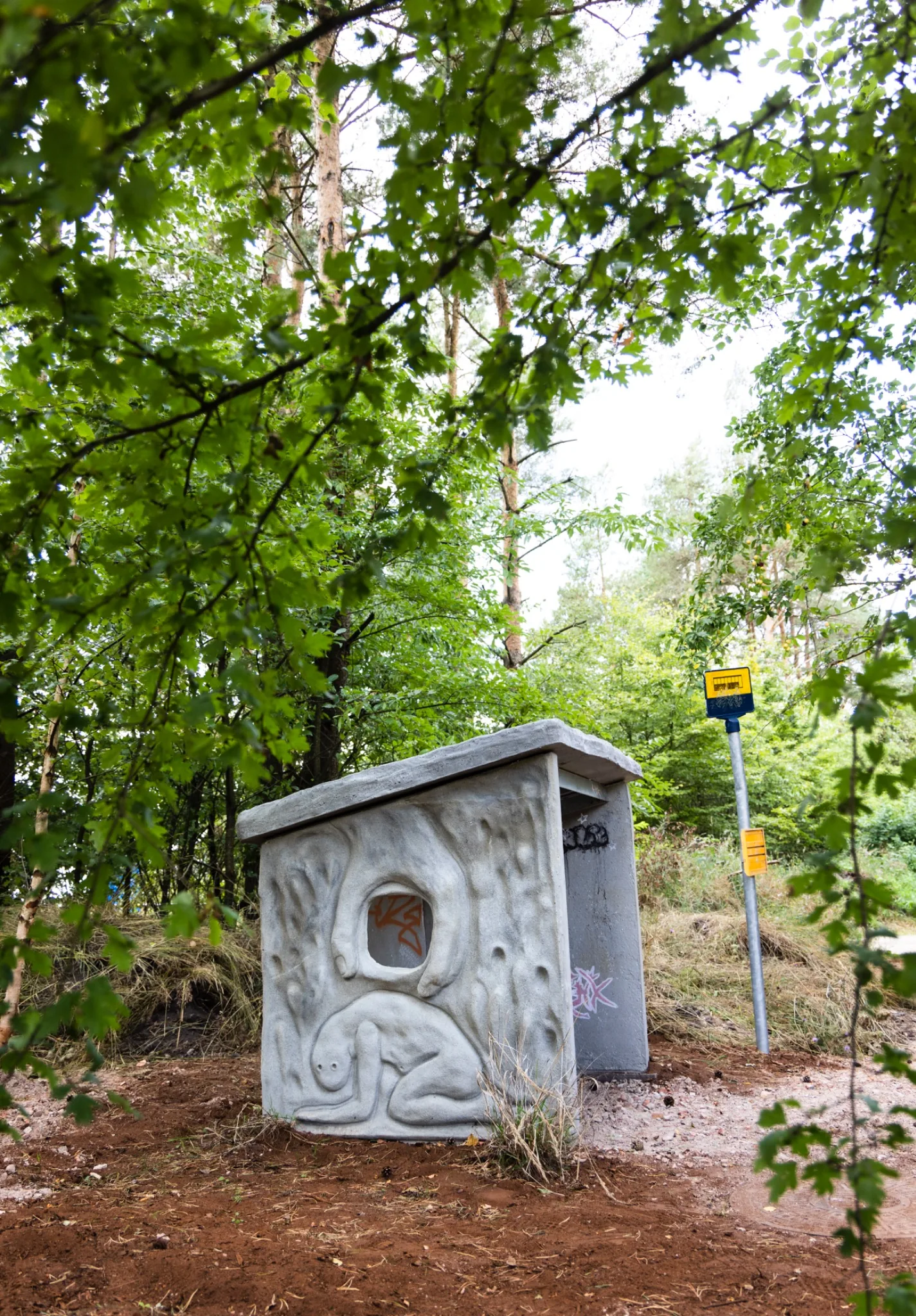
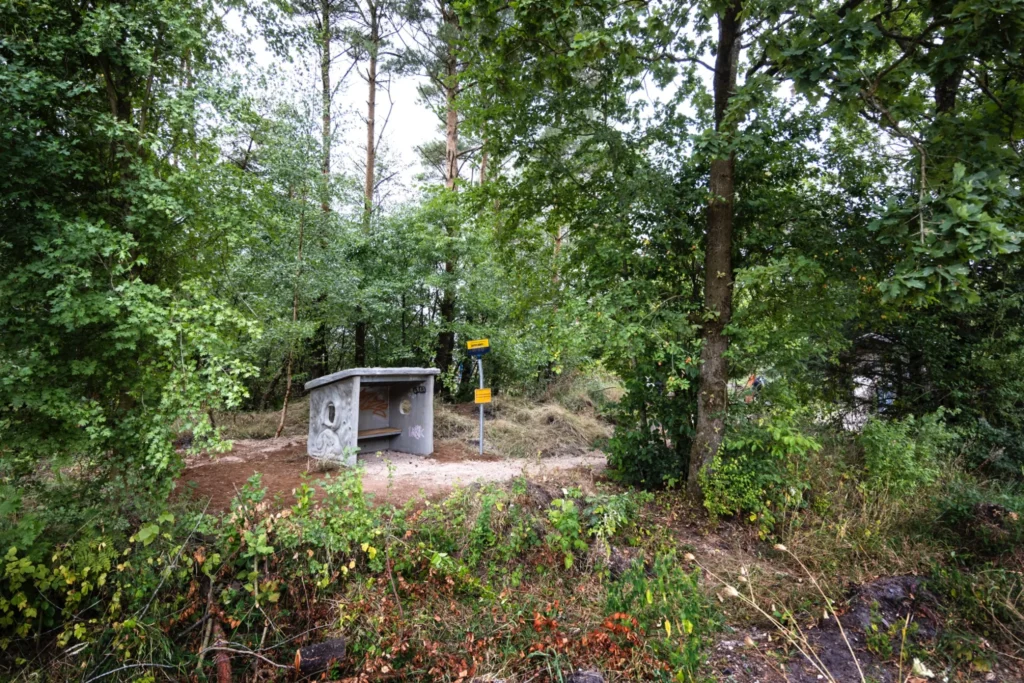
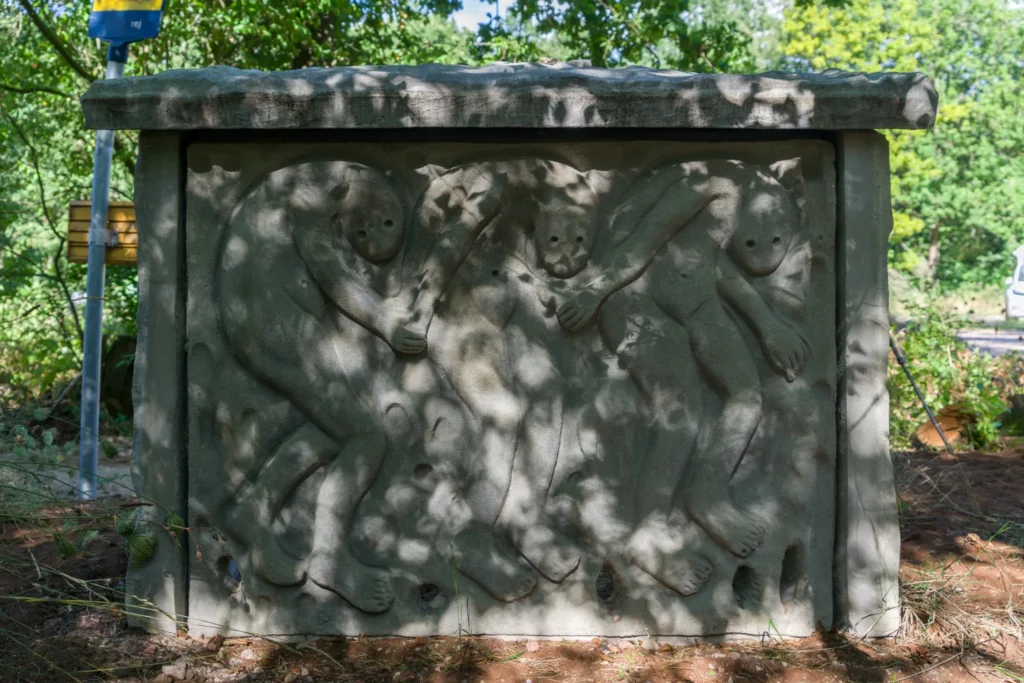
A bus shelter stands in a small clearing in the forest – too low for adults, too big for children, erected as a small concrete structure that has fallen out of its own time. Or as if past, present, and myth had all been pressed into its layers.
In the layer of the past, the story begins with the Copenhagen fire of 1728, in which large parts of the city were reduced to ashes. The fire also destroyed the rune stones that had been hauled from villages across Denmark as part of a project to centralize historical knowledge in the capital’s Rundetårn. The stones proved too heavy to be carried up the tower’s spiral ramp and were left standing on the street outside instead, where they still stood when the fire reached them. Among them was the Vamdrup Stone, a medieval gravestone inscribed “Here lies Ebbe’s son.” It had left its home region but never made it into the national collection before it was lost in the fire. Ebbe’s son – already nameless at the time – was thus forgotten, just as his grave was. Had he been cast out, or was he simply not worth mentioning? An outsider, someone that people would rather forget?
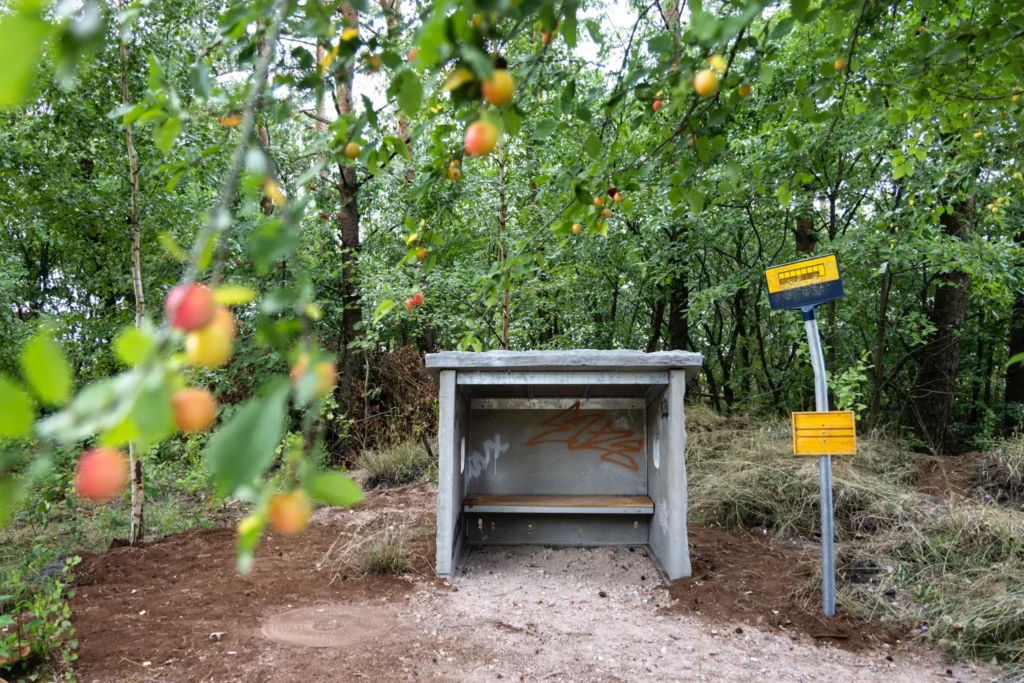
Olivia Rode Hvass used the story of this stone as the starting point for Path of Desire, when they took part in the exhibition The Lost Rune Stones at Rundetårn in 2025. Only the roof panel was shown at the time, as the rest of the bus shelter was too heavy for the space. The work thus repeated the movement of the Vamdrup Stone: what made the stone too big for the tower now split the work in two. The artist’s finished work also never reached Copenhagen, and only found its final form in Deep Forest Art Land, a short stretch north of Vamdrup, where the Vamdrup Stone originally stood. As if the grave of Ebbe’s unnamed son had finally found its way home.
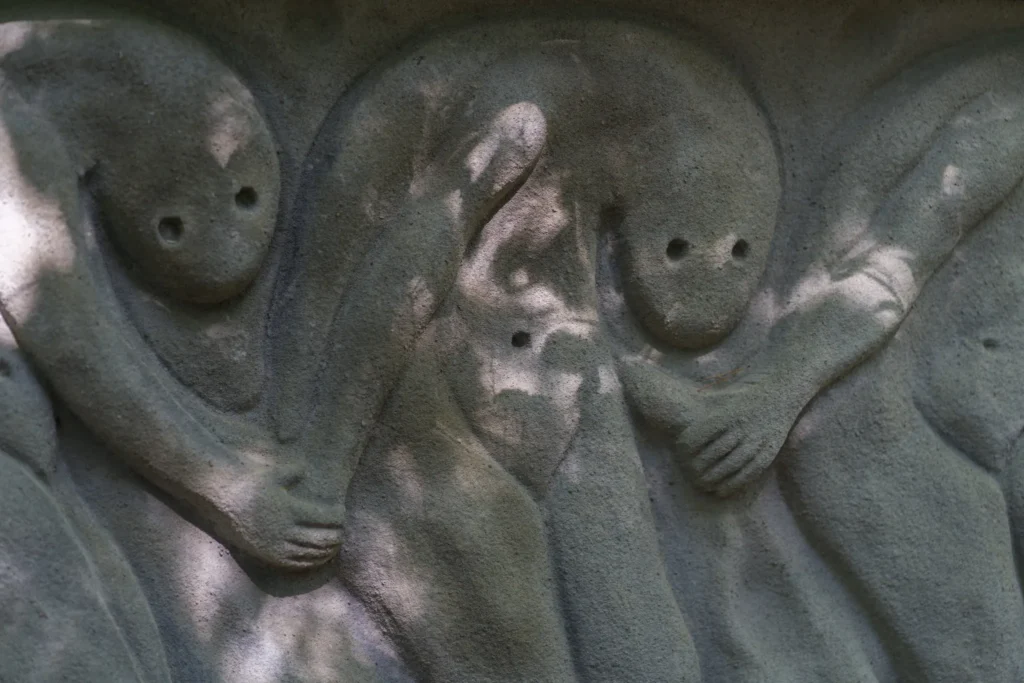
The sides of the bus shelter consist of four concrete reliefs, each portraying creatures in different compositions; together or apart, in a row holding each other’s hands, or lying close side by side, their legs intertwined in an intimate moment. A relief is neither a freestanding sculpture nor a flat image, but a form that insists on being both at once – a surface that pushes outward from, while remaining bound to, its background. It is a liminal state that thinkers throughout art history have used to understand the relationship between body and image, and it is reflected in the figures of Hvass’s work: they are neither wholly human nor wholly animal, and their expressions have an ambivalent effect on the viewer – they are at once slightly unsettling and slightly endearing, appearing friendly, caring, anxious, and tragic all at the same time.
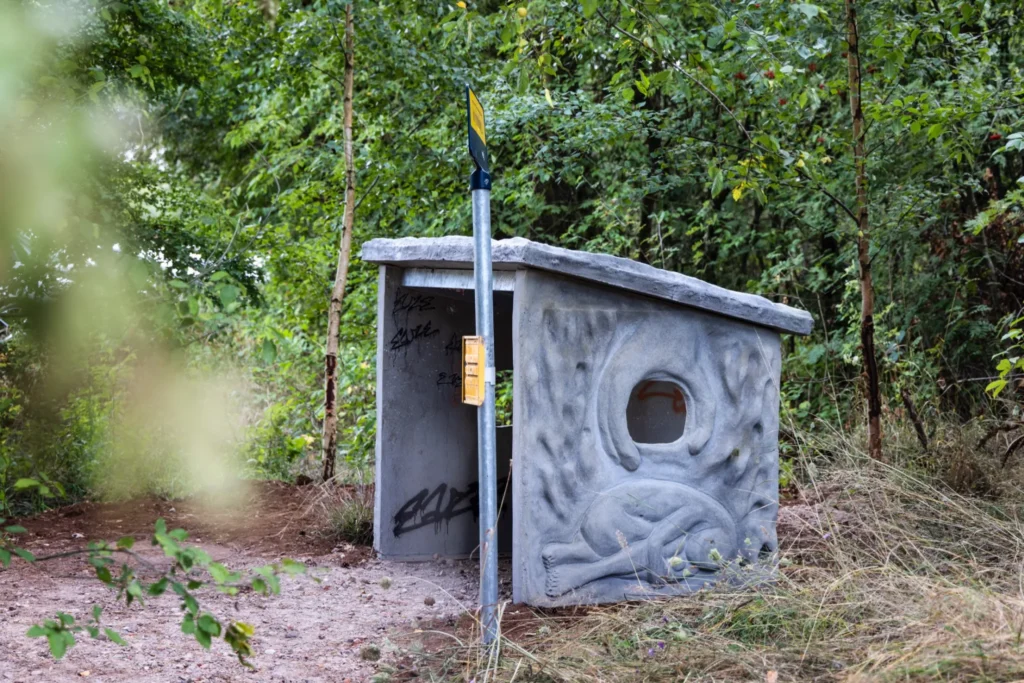
Across the four panels, the bodies repeat each other’s postures in small displacements – one curls up as another curls up; one back repeats the curve of another back. In one place, queer theorist Leo Bersani calls these recurring bodily displacements a ‘correspondence of forms’: a kinship that arises through the visual echoes bodies create between one another, independent of how they look or are related. It is a relational dynamic in which subjects connect with the outer world through shared aesthetic patterns rather than through power, domination, or appropriation.
The creatures’ ambivalent affects leave it up to the visitor whether to sit in the shelter in a cozy or uneasy state – anything is possible. All that is required is a willingness to dwell on the unresolved, rather than immediately wanting to reveal or categorize what one sees or is part of. In the same unresolved way, the figures’ relational forms refer to archaic communities, but are filtered through an open, queer gaze on the patriarchal order that has historically organized them. This is a point Hvass works with throughout their artistic practice – namely, that folk tales and mythological narratives can be reworked and observed in new ways. They are far less unambiguous than posterity’s ordered and normative narratives of family, heroes, and inheritance have wanted to make them. Hvass’s figures insist on this disorder. They cannot be sorted into fixed categories – only into closeness, emotional weight, touch.
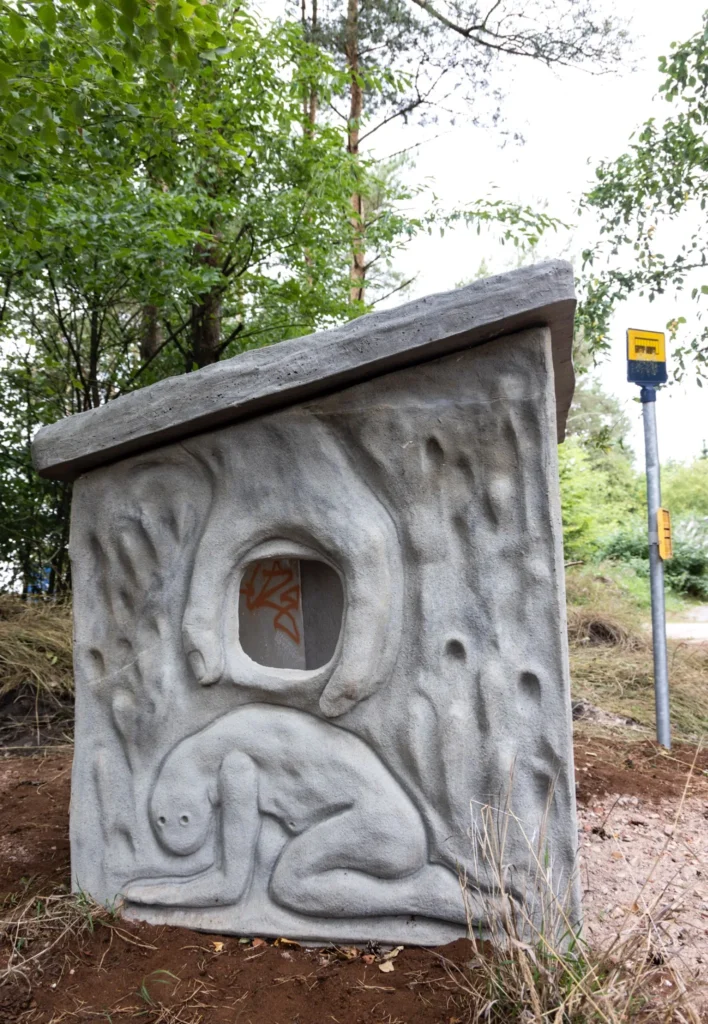
This bodily closeness, which refuses to be either explicitly erotic or friendly-affectionate, can be read through what queer theorist Elizabeth Freeman calls ‘sense-methods’: bodily, non-linguistic modes of attachment that bind bodies together across time and despite the identities, languages, and kinship systems that would otherwise subordinate them. Freeman draws her own concept of being ‘beside’ from queer theorist Eve Sedgwick and her shift away from an interpretive mode grounded in the “underlying” toward one grounded in what is ‘beside’ – a spatial relation in which bodies orient themselves toward one another without being subordinated to a single center or a single interpretation. This is the relation the reliefs stage: the figures lie and lean beside one another, carrying and supporting, without any one of them becoming the center of the work or the story.
Freeman finds a historical example in the eighteenth-century Shaker communities, known for radical equality, celibacy, deep pacifism, and ecstatic dance rituals, whose physical presence created forms of belonging outside marriage and reproduction. These were bodies that, in Freeman’s words, ‘had sex without having sex, engendering new kinds of subjects, bodies, and families.’ The shift from a reproductive to a non-reproductive mode of coexistence and temporality is also what the work’s figures practice: they sleep, carry, and curl together in configurations that resemble family and partnership without necessarily being either in the traditional sense. In this way, Path of Desire refuses to let the bodies of the past be organized solely around procreation, inheritance, and a forward-driving, growth-oriented temporality.
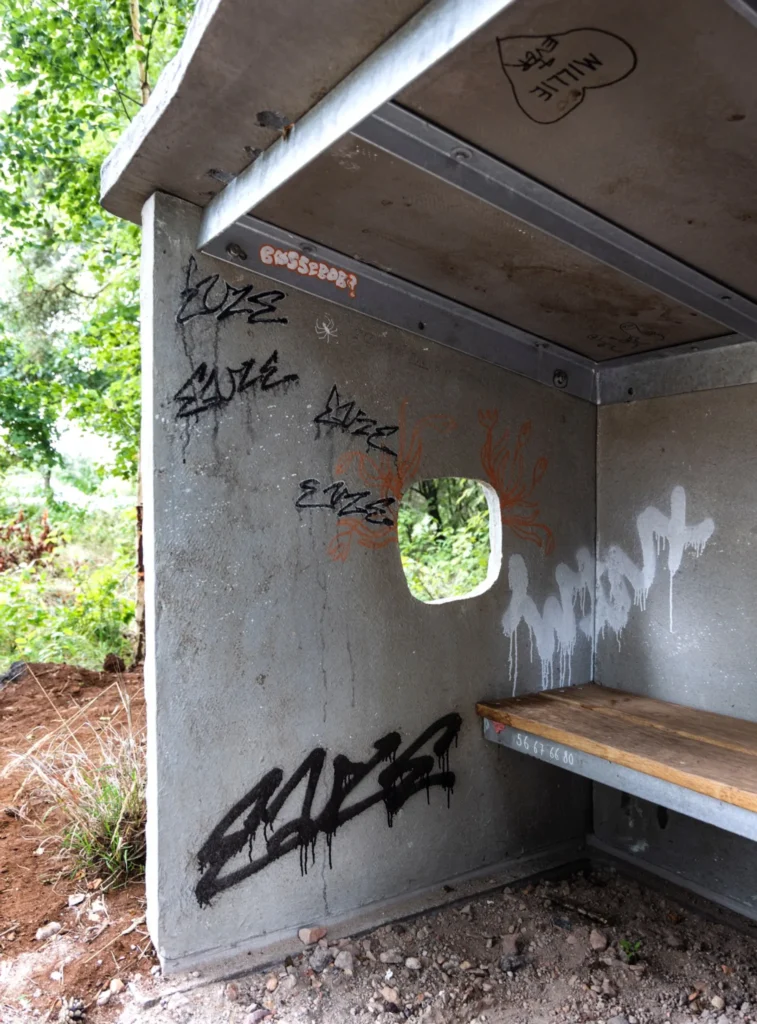
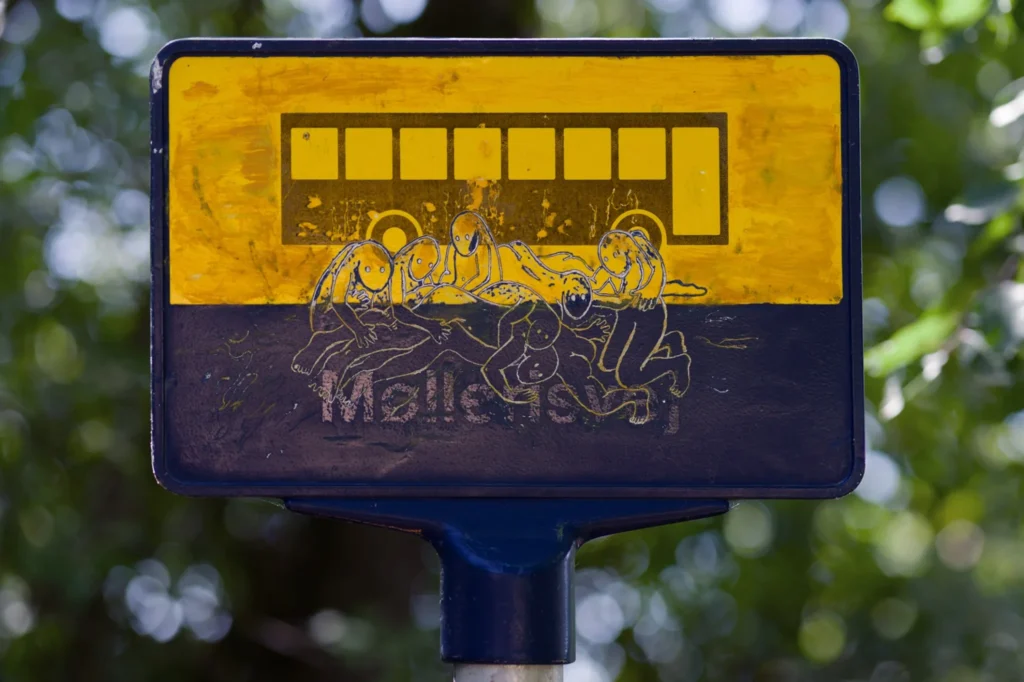
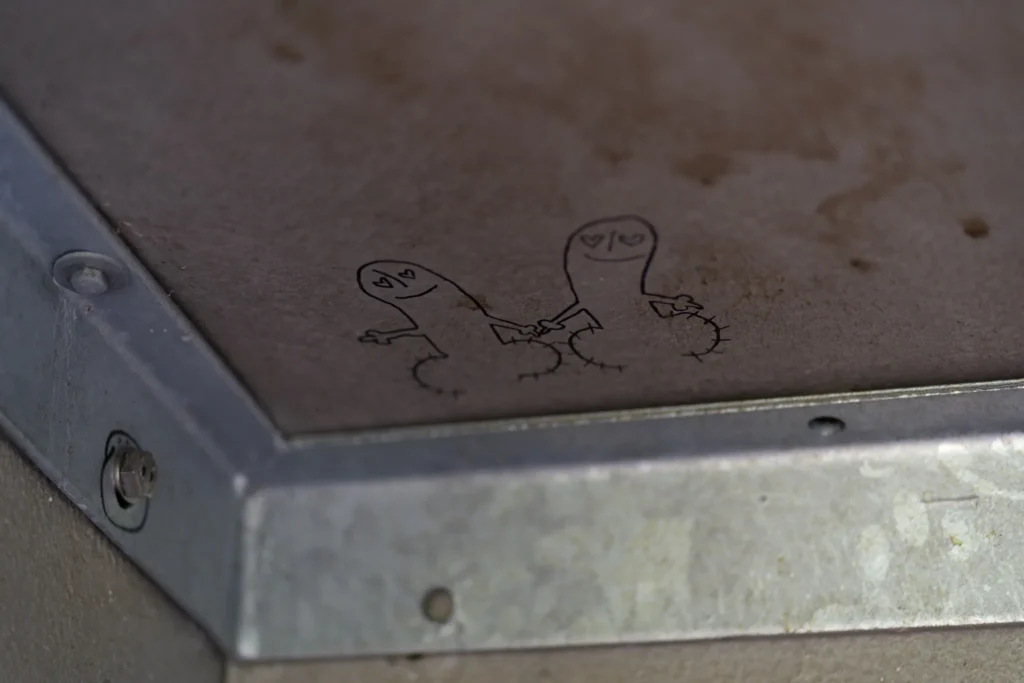
The work is also marked by the present: inside the bus shelter are spray-painted tags, symbols, and classic graffiti inscriptions that could have appeared on any bus shelter in the provinces. Although the marks look like random traces left by passing forest visitors, the graffiti is an integral part of the work. Beside the shelter stands a worn bus sign of the kind familiar from the yellow buses and their routes, which are increasingly being discontinued in provincial Denmark today. The sign stirs memories of youth: trips to and from school, parties, friends, and significant others, reinforcing the impression of the bus shelter as an alternative meeting place. This gesture adds yet another layer to the work’s temporality: the staging of an interaction that has not actually taken place yet – a kind of anticipated or fictive memory pointing forward to the lived life the bus shelter might invite. By applying these graffiti traces themself, the artist pokes at our expectations of the work’s history and ownership, bringing Path of Desire into dialogue with its own past and future.
The work’s title points to the unofficial paths that emerge in the landscape because someone, again and again, chooses a different route than the one laid out – created by desire, not by planning or duty. ‘The other path’ is a familiar figure in queer thought. It is understood as the alternative to the normatively “correct” path through life, walked by those who insist on going a differently way out of inner necessity. Among the many tags in the bus shelter is the name “EBBE” in screaming orange: an echo of the boy whose grave was never found. Here, the name becomes an image of the lives that could not take another path, because at the time it was either an impossibility or simply a way into the fog of loneliness and oblivion. In this way, the work writes Ebbe’s son forward into the present and into the closeness the shelter’s creatures invite – lying curled into one another in a community larger than the couple, the nuclear family, and other reproductive forms that otherwise lay claim to life’s closest relationships. Here, tenderness exists on equal footing with them – but within an excessive, branching sociality that needs no center to hold together.
The project is supportet by:
15. Juni Fonden, L. F. Foghts Fond, Hielmstierne Rosencroneske Stiftelse, Statens Kunstfond, Deep Forest Art Land and The Round Tower
Credits:
- Curated by: Søren Taaning and René Schmidt / Kaellingstenen
- Artwork, idea and production: Olivia Rode Hvass
- Documentation by: Luna Lund Jensen and Deep Forest Art Land/Tom Laursen
- Text: Joachim Aagaard Friis
- Concrete castings by: Magnus Holm Fiberbeton
- Molds and 3D scan: Vestsjællands Arbejdende Kunstnerværksteder
- Producer and studio technician: Claus Hvass
- Production assistants: Jonas Rode Hvass, Johan Mondrup Hvass
- Bussign: Movia
- Tags: LC, Leon, Bella, Ida, Olli, Mads and Lyca
- Sparring: Maria K T, Lotte L, Uno, Birgitte
Opening Hours:
All days from 10:00 – 17:00
Deep Forest Art Land
Sdr Ommevej 29a, 6933 Kibæk, Denmark