
Share this
The first time I met Arang Choi was at the opening of her solo show for Sotheby’s Artist Quarterly in Vienna.Earlier that day, I had stepped off a plane into Central Europe for the first time. Walking through Vienna, I found myself mesmerised by the grandeur and beauty of the city.
Sculptures emerged from the sides of buildings, spiral staircases disappeared high above me, and cobbled streets stretched through the warm evening light. Different languages filled my ears as people passed by around me. It all felt very beautiful, truly beautiful, in a way I had never really experienced before.
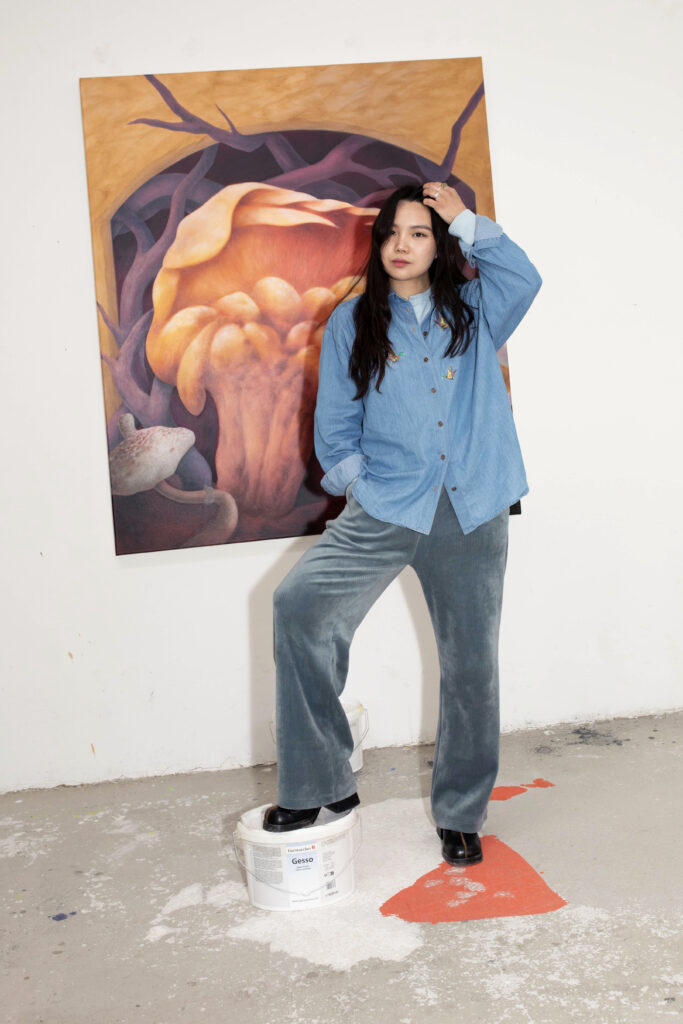
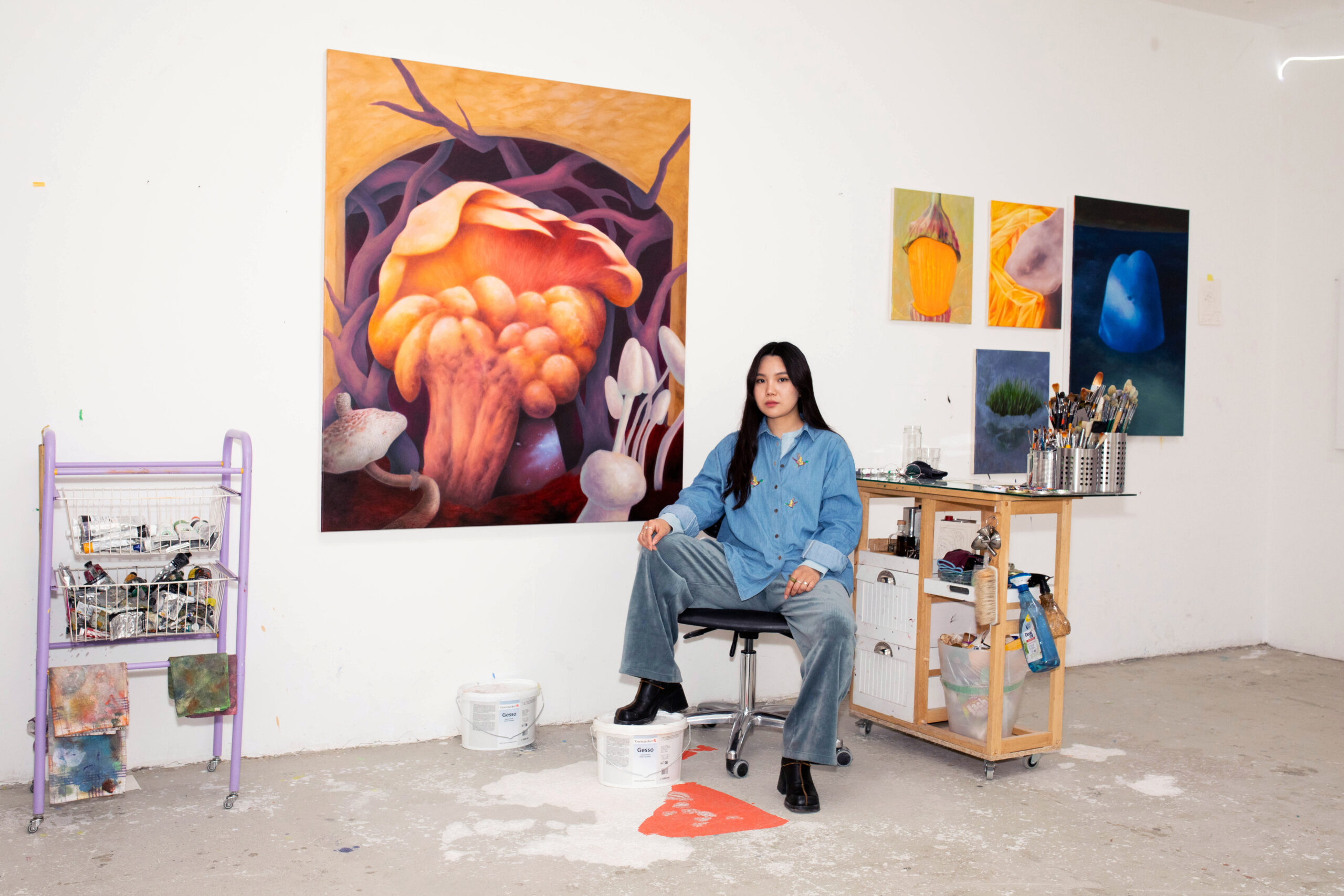
That feeling stayed with me as I climbed the spiral staircases leading up to Arang’s exhibition that evening.Inside, I was immediately drawn towards her paintings, finally encountering the famous Emulb figure that I had seen and heard so much about before meeting her.
Her work felt emotionally alive, intimate, playful, and entirely contained within its own universe. As the evening progressed, the gallery slowly filled with artists, curators, students, collectors, and admirers. Voices, accents, and languages merged together as people drifted between the paintings.
Looking across the crowd that evening, I eventually spotted Arang standing by the bar, speaking with the curator and gallerists. I made my way over to her. As I approached, she turned towards me with a smile and, in a perfectly delivered British accent, said: “You alright, mate?” I laughed immediately.
Hearing something so unmistakably British in the middle of a country I had never visited before felt strangely comforting, and it stayed with me long after the evening ended. What stayed with me most from that night was not only Arang’s dedication to painting, but also the sincerity of her character.
There is something special about encountering an artist whose work feels so original while they themselves remain so warm, grounded, and genuine. Arang is a truly brilliant artist and an original person, and I feel very honored to be able to interview her for this feature.
Interview by Brynley Odu Davies.
How has your day been so far?
Arang: Very quiet and focused. After breakfast on the balcony surrounded by greenery, I rode my bicycle to the studio and spent a long time looking at unfinished paintings before continuing to paint at all. Sometimes the day begins more with observing than with painting.
You studied at both the Academy of Fine Arts Vienna and the Kunstakademie Düsseldorf. Looking back now, what do you think those environments gave you as a painter?
Arang: Vienna gave me space to slowly build an inner world and develop myself as a painter. Düsseldorf, on the other hand, introduced a different kind of tension – more awareness and also more courage to experiment with different materials. Both places gave me freedom in their own way.
You’ve built a life in Vienna around painting – long days in the studio, cycling through the city, constantly making work. What is it about Vienna that allows you to create in the way that you do?
Arang: Vienna has a rhythm that protects concentration. The city is calm without feeling empty. I can spend many hours alone in the studio and then suddenly find myself surrounded by history, music, gardens, or old architecture. This mixture of quietness and liveliness feels very close to me.
Your paintings often centre around the recurring figure of Emulb. For someone encountering this character for the first time, who are they?
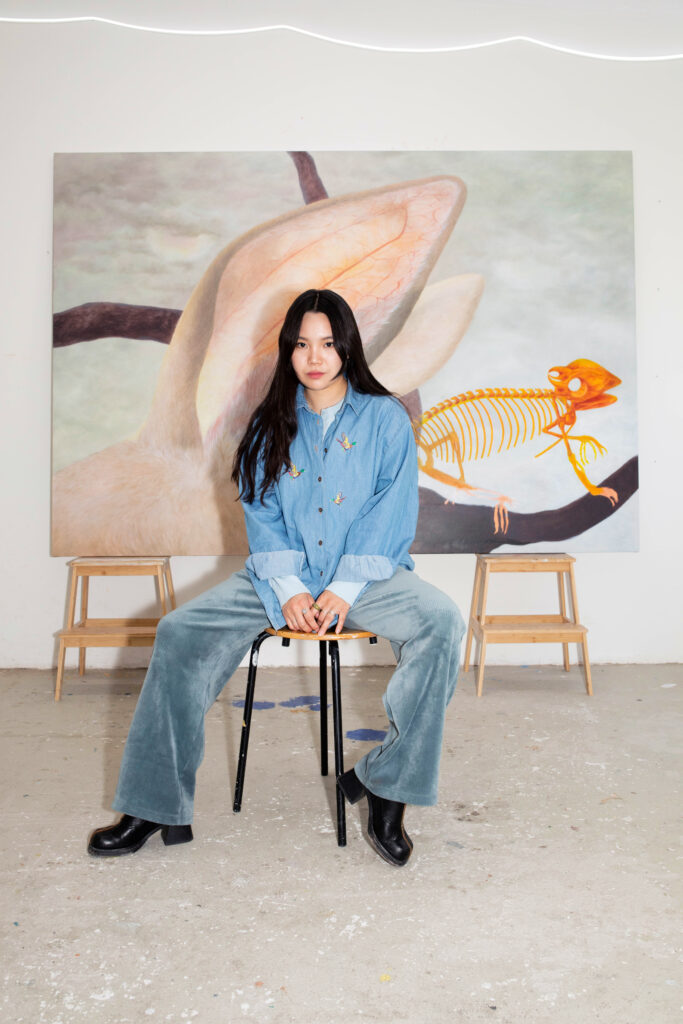
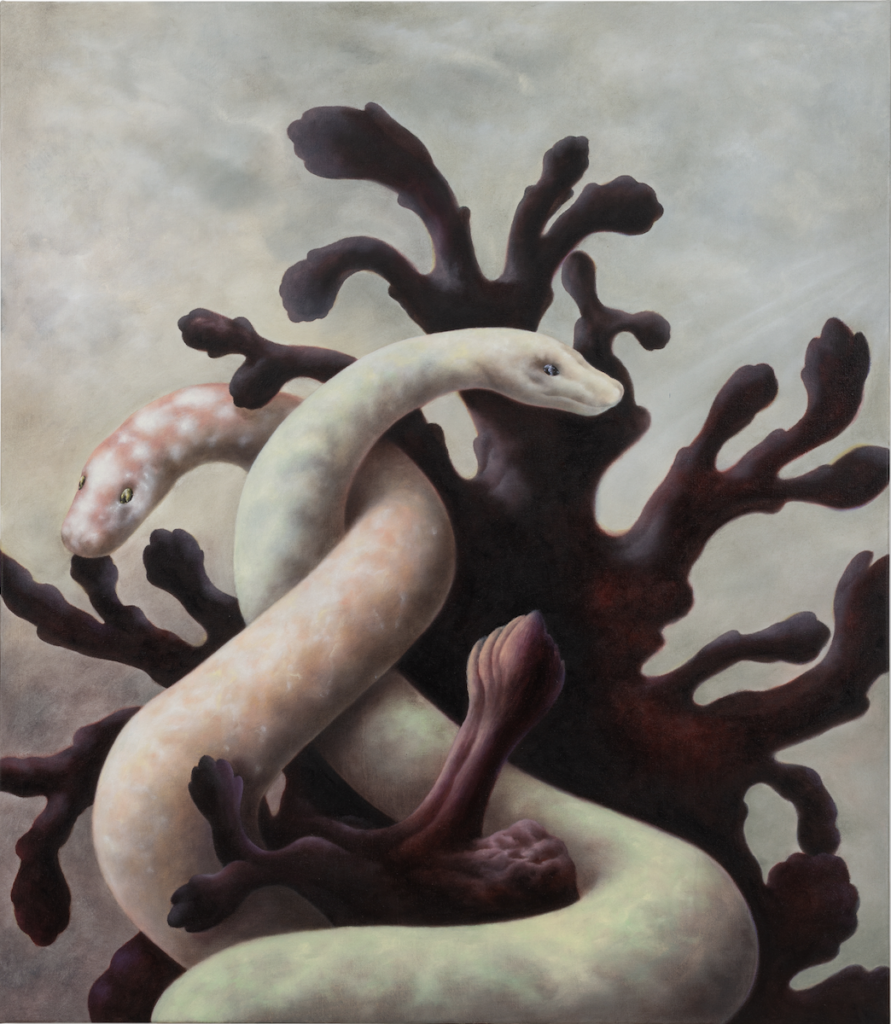
Arang: Emulb is not really a single being. The figure is constantly transforming. Sometimes it appears as a flower, sometimes as an animal, a spirit, or an emotional state. For me, Emulb is more like a living presence moving through different worlds and absorbing experiences. The core remains the same, even though Emulb always appears differently.

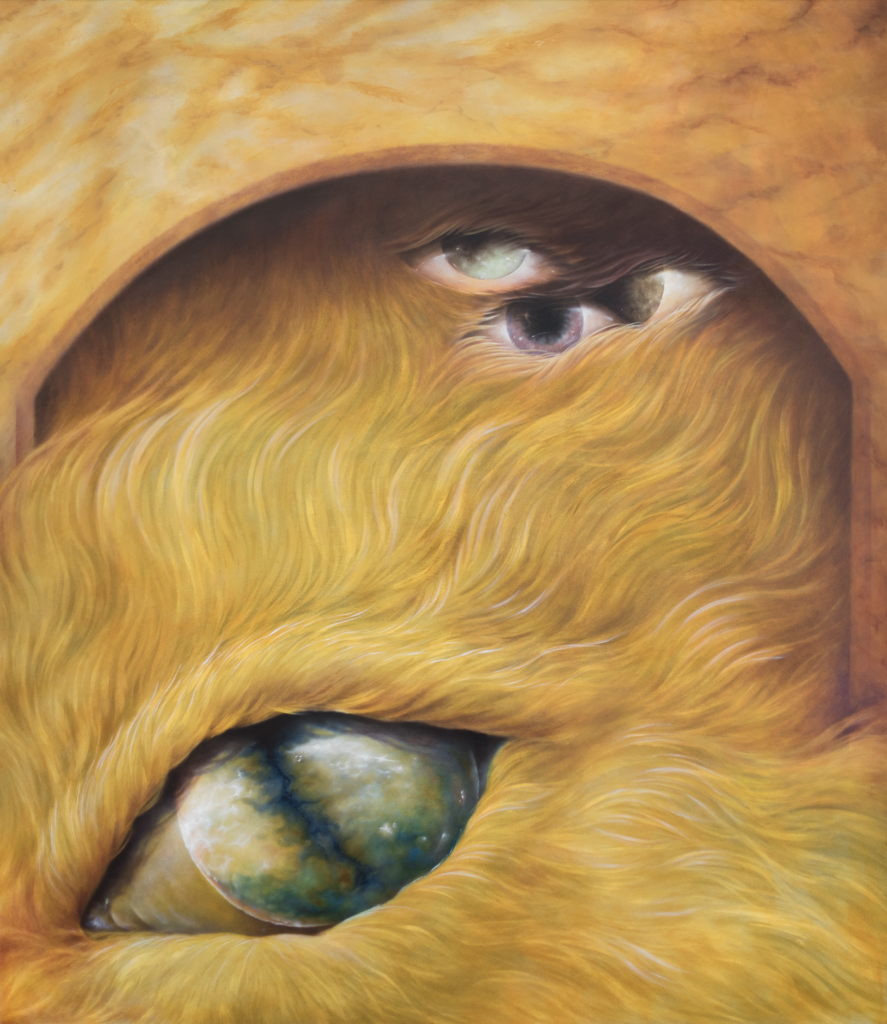
Your work feels deeply connected to nature, animism, and transformation. Why do you think those themes continue to pull you back in?
Arang: Because I don’t experience nature as something separate from us. In my hybrid beings, the clear boundary between “myself” and “world” disappears. The figures are not separated from plants, animals, or landscapes – they are transitions. Within them, something can grow that we often suppress in everyday life: vulnerability, wildness, instinct, or stillness. Perhaps they remind us that we ourselves are far more porous than we think. Animism interests me because it allows everything to possess a presence and its own consciousness. Painting becomes a way of making relationships between different forms of life visible – relationships that can hardly be explained through language.
You spend a lot of time collecting and looking through old books about plants, animals, and history. What is it that you’re searching for inside those books?
Arang: Not only knowledge in the classical sense. I am searching for forgotten ways of seeing. Old illustrations often contain something scientific, fantastical, fearful, and longing all at once. Sometimes a drawing of an animal from centuries ago feels more emotional than a photograph. I collect fragments – textures, gestures, colours, or symbols – and eventually they reappear unconsciously in the paintings.
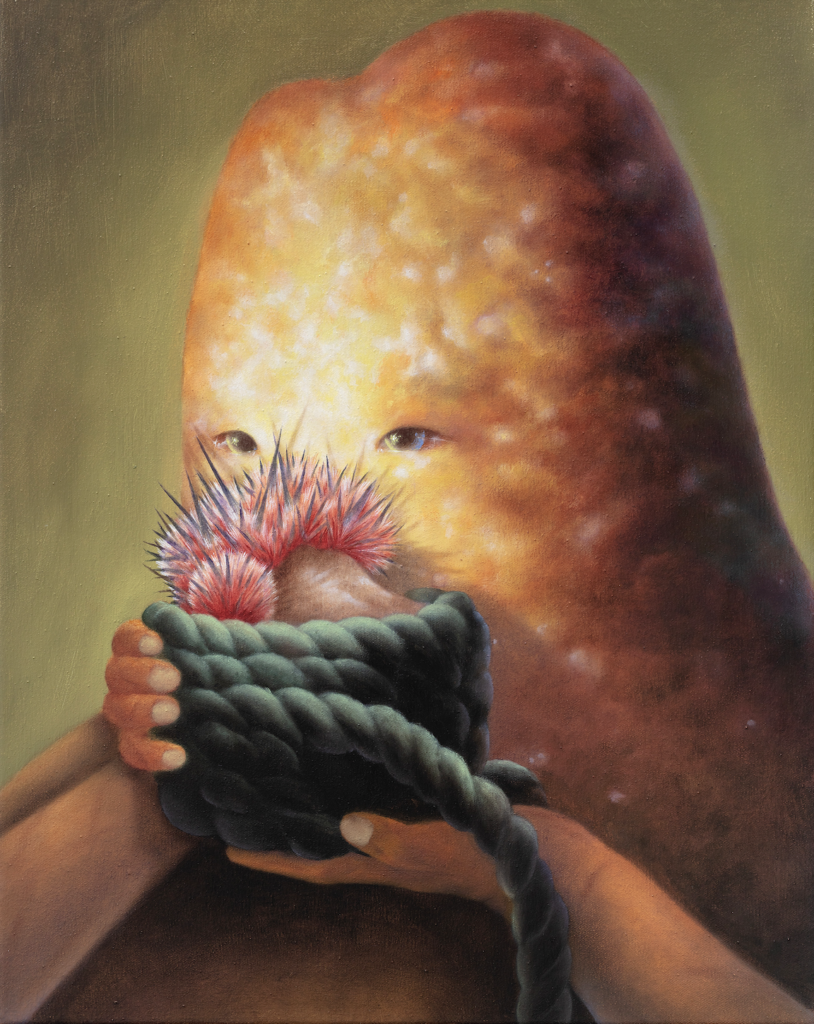
Your figures often communicate immense emotion through their eyes and body language. What is it about that emotional tension that interests you as a painter?
Arang: I believe emotions become most intense when they are restrained. I’m interested in unresolved moments – when a figure appears gentle and disturbing at the same time, or vulnerable yet defensive. The body often reveals more than language does. I do not necessarily try to depict one specific emotion, and yet viewers often sense a very distinct atmosphere. I find it fascinating how differently – and often how self-reflectively – people interpret art. Basically, I do not feel the need to explain my visual world completely. I do not want to reveal every secret to the viewer, nor guide or limit their perception through my own interpretation. For me, the potential of art lies precisely in existing within a space that resists a fully rational explanation.
The freedom of art belongs not only to those who create it, but equally to those who encounter it. Every person carries their own inner landscape – and should be able to enter into a relationship with the images without my spoken guidance.
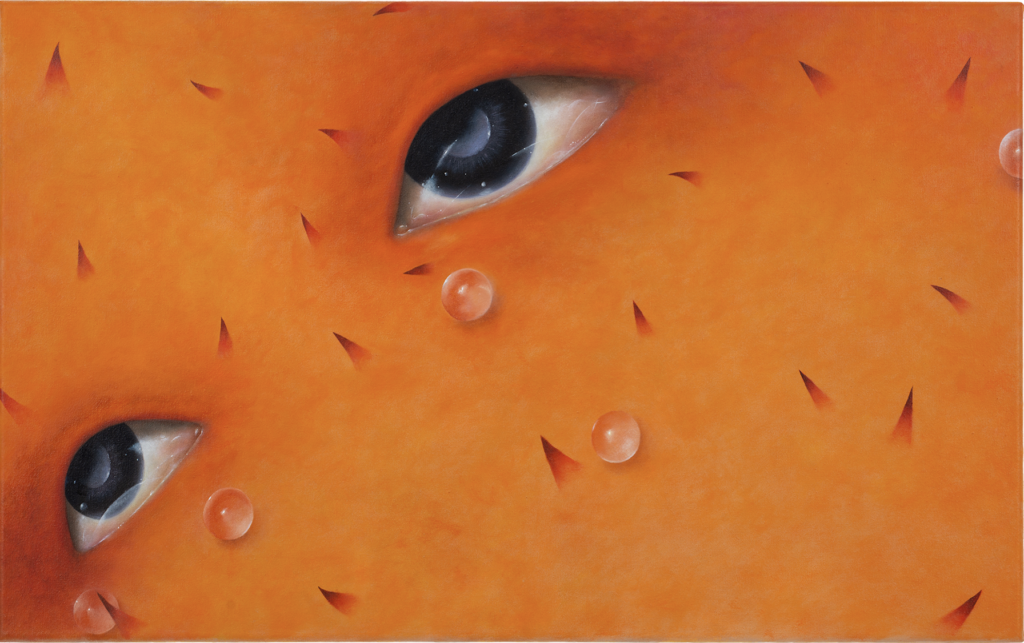
How do your painting ideas first arrive? Do they begin as sketches, flashes in your head, or do they slowly emerge while painting?
Arang: I draw very often, mostly just with pencil – no matter where or when. Then I choose a drawing that fits the format of a canvas, but much of the work only emerges during the painting process itself. I like it when a painting resists my original plan and suddenly begins to tell something of its own.
You spend so many hours in the studio every day. What keeps you returning to painting again and again?
Arang: Painting remains something mysterious to me. Even after many years, I never fully understand how a painting becomes alive. Some days nothing works at all, and then one small decision suddenly changes the entire atmosphere. That unpredictability keeps drawing me back. Painting is also my way of emotionally processing the world.

What’s one painting secret or technical detail that you don’t mind sharing with the world?
Arang: I spend a great deal of time adjusting temperature differences between colors – even in areas that appear grey or neutral. Small shifts between warm and cool tones can completely transform the emotional space of a painting.
If you could only paint with three colors for the rest of your life, which colors would you choose?
Arang: Probably a violet – because it’s my favorite color – an earthy green, and a soft blue-grey.
Ok my friend, last question, what does a perfect day look like for you outside of the studio?
Arang: Cycling slowly through Vienna without a destination. Whenever I see a patch of nature, I stop, walk around, and examine tiny living creatures or plants with my magnifying glass. Afterwards, simply lying on a meadow and enjoying the quietness away from the noise of the city.