
Share this
Lisa Barnard: You Only Look Once / Isadora Romero: Notes on How to Build a Forest Crespo Open Space, Frankfurt am Main 13 March – 31 May 2026
By Joachim Aagaard Friis
There is a photograph in Lisa Barnard’s You Only Look Once at Crespo Open Space that at first glance seems oddly inconspicuous: a lone stop sign rising from cracked desert ground, its blank octagonal yellow face catching a last stroke of light against a bruised Californian dusk. The location is an autonomous vehicle testing range – one of the sites near San Francisco where companies like Waymo train their robot cars on road infrastructure. The sign was made to be read by machines. There is no other intended audience. A sign without a human reader, built in anticipation of a different kind of reader altogether. The image distils the show’s central preoccupation in a disturbing way: who, or what, is doing the looking, and what can the act of looking ever reliably know?


The Salton Sea, a toxic accidental lake in Imperial County formed by an irrigation collapse in 1905, now sustained by agricultural runoff laced with ammonium sulphate and heavy metals, functions as one of Barnard’s primary site of inquiry. It is a landscape of compounded failures: ecological, infrastructural, and economic. A place where the fish have died, the birds are declining, and the geothermal brine that sustains the lake is also, it turns out, one of the world’s richest lithium deposits. The “clean-energy transition”, in other words, will pass directly through one of America’s most contaminated bodies of water. Barnard is drawn to this irony, but as a phenomenologist: what does it mean to see a crisis of this magnitude, and who or what has the authority to do so?
The YOLO of the title, “You Only Look Once,” is borrowed from a real-time object detection algorithm widely deployed in autonomous vehicles and military targeting systems. The reference reads as a provocation and extends the above question: what does it mean when machine vision becomes the dominant mode of environmental apprehension? Barnard’s photographs, often printed large and in cool, information-dense resolution, overlay this question onto documentary imagery. Stills of the lake’s surface at dawn read simultaneously as beautiful landscape photography and as screenshot – a sort of structural ambiguity. Elsewhere in the show, the YOLO algorithm appears not as method: Barnard trained a custom model on over a thousand stills from bat footage, then applied it to moving image work filmed at the Yolo Causeway in Sacramento, where some 250,000 Mexican free-tailed bats nest beneath the concrete bridge each summer. The resulting images, in which individual bats are isolated from the swarm by glowing yellow detection boxes, make the diagnostic gaze viscerally explicit: this is what it looks like when a living cloud is processed as data. The bat – simultaneously Thomas Nagel’s canonical figure for the irreducibility of subjective experience in his seminal essay “What Is It Like to Be a Bat?” – recurs throughout Barnard’s research as both a symbol and a subject. Her engagement with Daniel Kish, the Los Angeles-based blind advocate who navigates the world via echolocation, extends this line of almost hopeful thinking: there are ways of knowing the world that machine vision has no interface for – at least not yet.


The work’s historical reach is longer and darker than it might appear. The catalogue includes imagery from the aerial documentation of Hiroshima and Nagasaki after the atomic bombings of August 1945, overlaid with graphics from one of the earliest examples of flowchart-based decision architecture. The arc from WW2 aerial targeting logic to contemporary YOLO object detection to lithium extraction from the Salton Sea brine (lithium potentially destined for batteries of the autonomous vehicles learning to read stop signs); Barnard lays the connections close enough together that you assemble them yourself, with a mounting sense of both overwhelm and unease. The night vision photographs of the Salton Sea geothermal plants – shot using a PVS14-3 military camera of the type deployed by US Customs and Border Protection for surveillance in low-light conditions – extend this entanglement of military optics and civilian landscape into the present tense. Perhaps the most concentrated single image in the show is a self-portrait Barnard made using the Helm.ai semantic segmentation system, photographed in front of the Facebook campus in Menlo Park. The system renders her as a blocky, pixelated figure against electric blue: a human body processed as data, classified and flattened into a threat / non-threat assessment. That the portrait was taken in front of one of the world’s largest data corporations, using the perceptual architecture of another, gives the image extra charge.


The accompanying bilingual publication (Hartmann Books) frames Barnard’s argument in terms that feel newly scary and urgent: climate crisis and technological solutionism have collapsed into one another at precisely the moment when machine mediation has become the dominant structure of human cognition. The drone footage of dead trees standing in the Salton Sea’s shallows, or the spectacular ribbons of bats emptying from beneath the Yolo Causeway at dusk maintains a formal restraint that resists easy sublimity. These are not images designed to overwhelm at first sight; they are images designed to make you think critically and feel uncomfortable with the very act of watching.
If Barnard’s show is cool, structural, epistemological, Isadora Romero’s Notes on How to Build a Forest is warm, porous, cheeky, and relational, located on the lower floor together with part of Barnard’s work. Instead of focusing on machine vision, Romero asks what human perception, particularly the Western scientific gaze, has historically refused to incorporate: indigenous plant knowledge and the non-human agency of Ecuadorean cloud forest ecology. The two shows together constitute a kind of stereoscopic argument for perceptual plurality.


Romero’s practice is collaborative in a way that challenges the authorial conventions of photography exhibitions. Developed alongside communities, scientists, ethnomusicologists, and textile artists moving between the Andean highlands and the Pacific coast, the work deploys photography, textile printing, sound, and video to think through the forest as a resource – as a political and ecological subject in its own right.
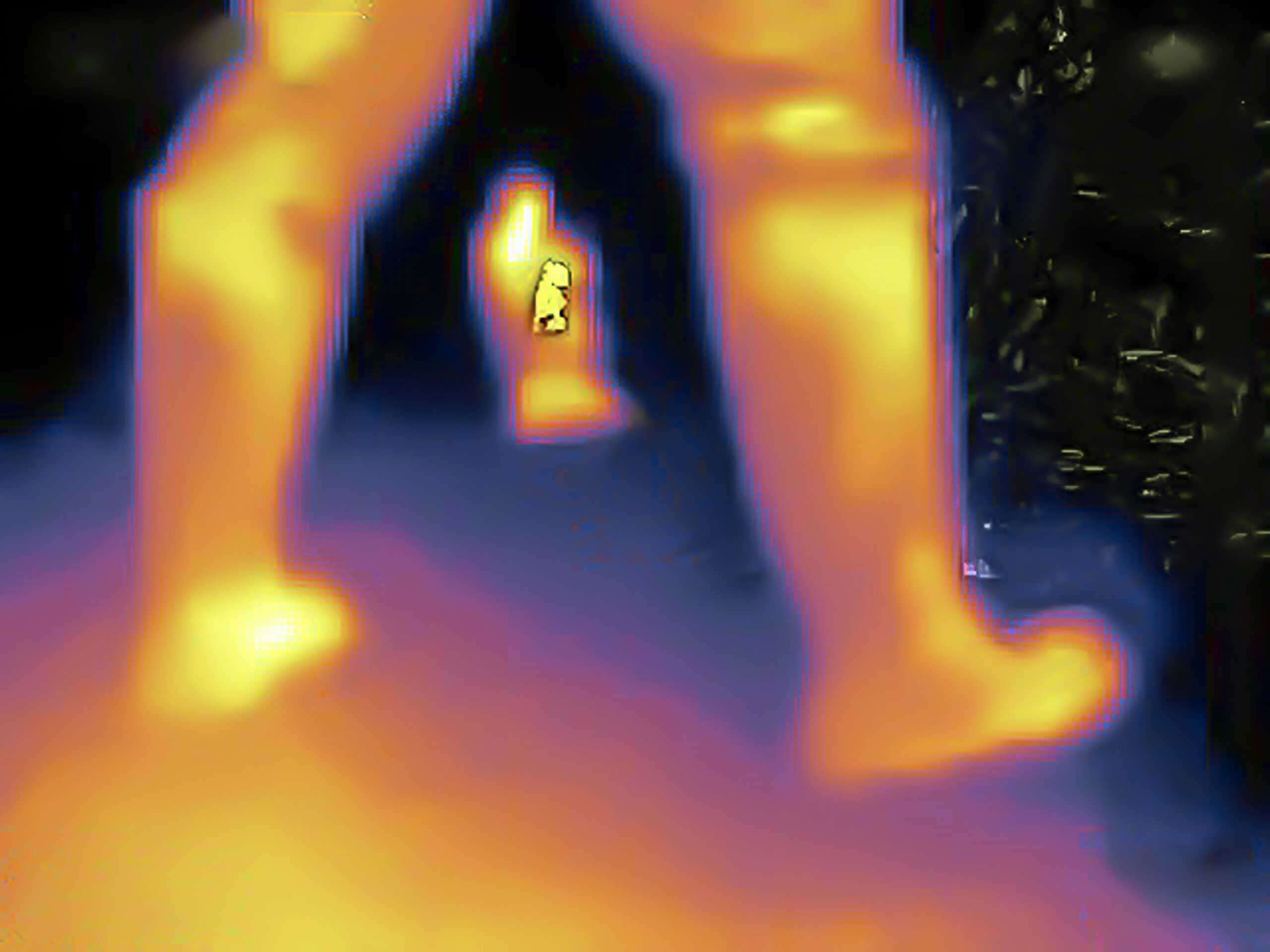
The photographs are striking precisely because of their technical strangeness. Romero used ultraviolet light and film, alongside thermal cameras, to render the Mache-Chindul forest in wavelengths invisible to unaided human eyes. The results pulse with alien intensity: a red leaf reads like a fever, insects phosphoresce blue-green against flower trumpets of deep magenta, bark textures resolve into something halfway between topography and skin. The work draws deliberately on scientific research into nonhuman visual systems – certain spiders, insects, and birds perceive ultraviolet as a navigational and reproductive signal – and proposes photographic representation as a mode of multispecies translation.
The small textile works press this ethics of attention into a different register. Printed on rough linen with botanical motifs and fragments of text in Spanish describing traditional plant uses, they carry knowledge that resists traditional archivisation. The text is partially obscured by dark, irregular blotches, as if the knowledge has already been in the process of erasure – or as if to show that it’s not that easy to pass it on. It is the show’s most formally vulnerable gesture, and perhaps its most politically acute: what is being lost is not simply biodiversity but the networks of use, exchange, and meaning through which particular plants remain legible to communities.
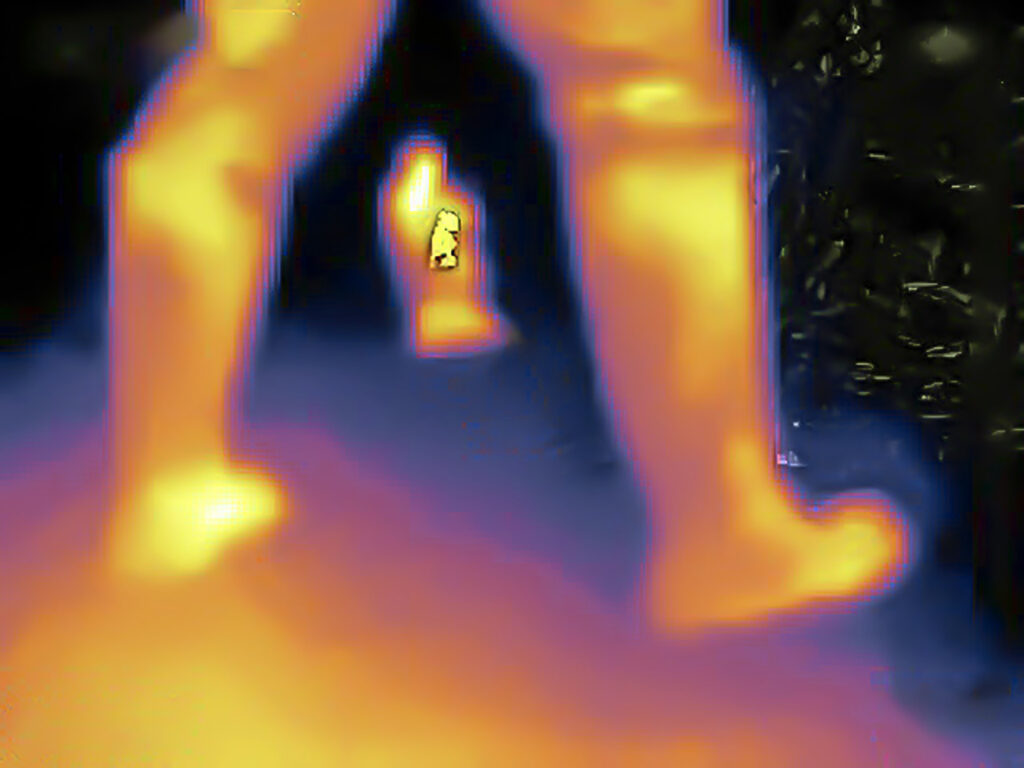
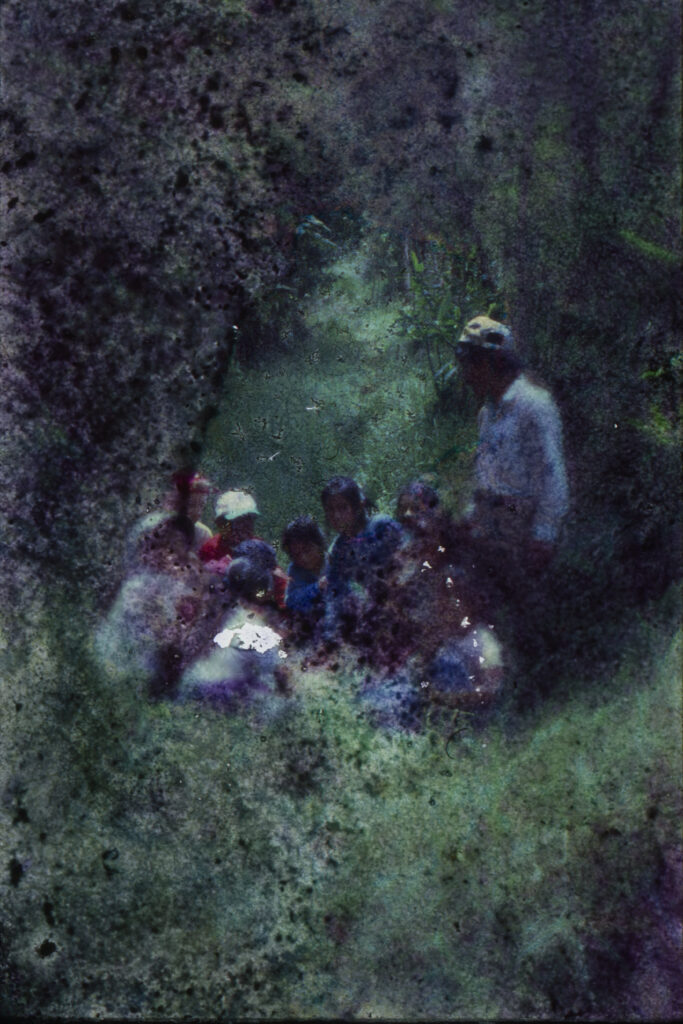

The pre-Columbian ceramic figures that appear in some of Romero’s photographic still-lives are shown with a reverence that refuses exoticization. Romero is not reaching backward to an imagined prelapsarian ecology in these works, rather she is tracing the continuities between ancestral material culture, living pragmatics of the modern communities in the forest, and the urgent political question of Ecuador’s constitutional recognition of the Rights of Nature. The forest is not just a site of beauty, neither of loss; it is a legal subject with territorial rights but its also a necessary source of life for the humans living there, particularly emphasized by a photograph of a local carrying a chainsaw between the trees.
After Nature poses questions across both exhibitions that are not simply ecological, which is what would be expected from the title. They are also urgently that, but even more so epistemological, asking: by what perceptual regimes do we come to know environments, and who gets to authorise those regimes? Barnard locates the crisis in the colonisation of perception by contemporary computational systems that process without empathy or embodied experiencing. Romero finds it in the exclusion of indigenous and nonhuman knowledge from the category of the scientifically legible. Neither position is nostalgic, but constructively critical and alerting.
There are moments where the institutional frame feels slightly removed from the material urgency of either practice. The Ulrike Crespo Photography Prize is generously endowed and its jury formidably credentialled, yet the clean and suave rooms of the Crespo Open Space occasionally impose a neutrality that works against both Barnard’s sharp conceptualism and Romero’s collaborative warmth. I begin to wonder how these works might have stood out in a less polished, less institutionally tidy setting. Perhaps this is an enduring contradiction of the contemporary art world itself: staging the planet’s most pressing crises and dead-ends with cutting edge aesthetics and within environments defined by smoothness, wealth, and aesthetic control. Still, this remains more an aesthetic tension than an ethical failing. Crespo Open Space is radically community-oriented – free to all visitors and offering coffee and snacks to anyone who stops by – which gives its institutional framework a generosity and openness often absent from comparable spaces.
That heightened awareness of my own position while moving through the exhibition feels, in the end, like a testament to the artists’ achievement. At its best, the show accomplishes something more difficult than advocacy: It makes the viewer conscious of the poverty of their own perceptual habits. You leave having been briefly taught how to look differently, or at least how to distrust the habits of looking you arrived with.
After Nature. Ulrike Crespo Photography Prize (Lisa Barnard: You Only Look Once / Isadora Romero: Notes on How to Build a Forest) is on view at Crespo Open Space, Frankfurt am Main, until 31 May 2026. Accompanying publications are available from Hartmann Books.