
Share this
When I first encountered Dana Robinson online, I had the strange feeling of already recognizing something, her warmth, perhaps, or a certain kind of clarity. Not familiarity exactly, but proximity. As if her images had already done the work of reaching me before we ever spoke.
Robinson’s practice moves through fragments: cut images, gestures, surfaces that seem to hold something just out of reach. Drawing from the visual language of 1970s Ebony magazine, her work revisits a moment of Black American optimism, one suspended between aspiration and constraint, between visibility and construction. But rather than fixing that moment in place, she keeps it open, unresolved, alive.
As she tells me, her process is “a very conscious decision to love over and over again”. A gesture that is at once intimate and political. And perhaps this is where her work lingers most powerfully: in that space where desire, memory, and history meet, where there is always something left to uncover, and something that can never be fully held.
Profile picture: Olivia Morgan

Hello Dana, it’s a pleasure to speak with you. Where are you writing from today, and what does that place feel like right now?
Dana: I am writing to you from my cozy room. It is bright and warm, and I feel like I’m right on the brink of sweating which is just how I like it.
If you had to describe yourself in one sentence {avoiding biography or labels} what would you say?
Dana: Getting over a mild cold, and thinking of how my dreams for the weekend may be whittled down to laying on my back and reading. Could be worse!

These past days I’ve been thinking about the idea that we are defined more by the love we give than the love we receive, that we are shaped by how we treat others, not by how others treat us. At the same time, this feels contradictory, since others inevitably shape us too, how do you navigate that space between the self and the other? How does care unfold within the histories that have shaped who is visible, desirable, or protected?
Dana: When I create my work I am dissolving the space between myself and the other. My process of creating art is making the very conscious decision to love over and over again. I very carefully cut apart the images I find in the magazines I work with, or make copies of them through applying paint onto a surface. They are so precious to me. I keep all the scraps, and all the monoprint transparencies I paint on. I think this love I am able to give radiates out into how I interact with the world. Care unfolds in histories as the world people want to see regardless of their level of desirability.
We are a product of our experiences, and the experiences of others. We exist as independent beings that are reliant on each other to make the right choices. I think about this on the train, the way we are all moving through space together but we also have an expectation that most of us will be civil because we share this space and need to have a certain level of respect for each other and the space that contains us for this space to function. We move together like different cells of an organ.
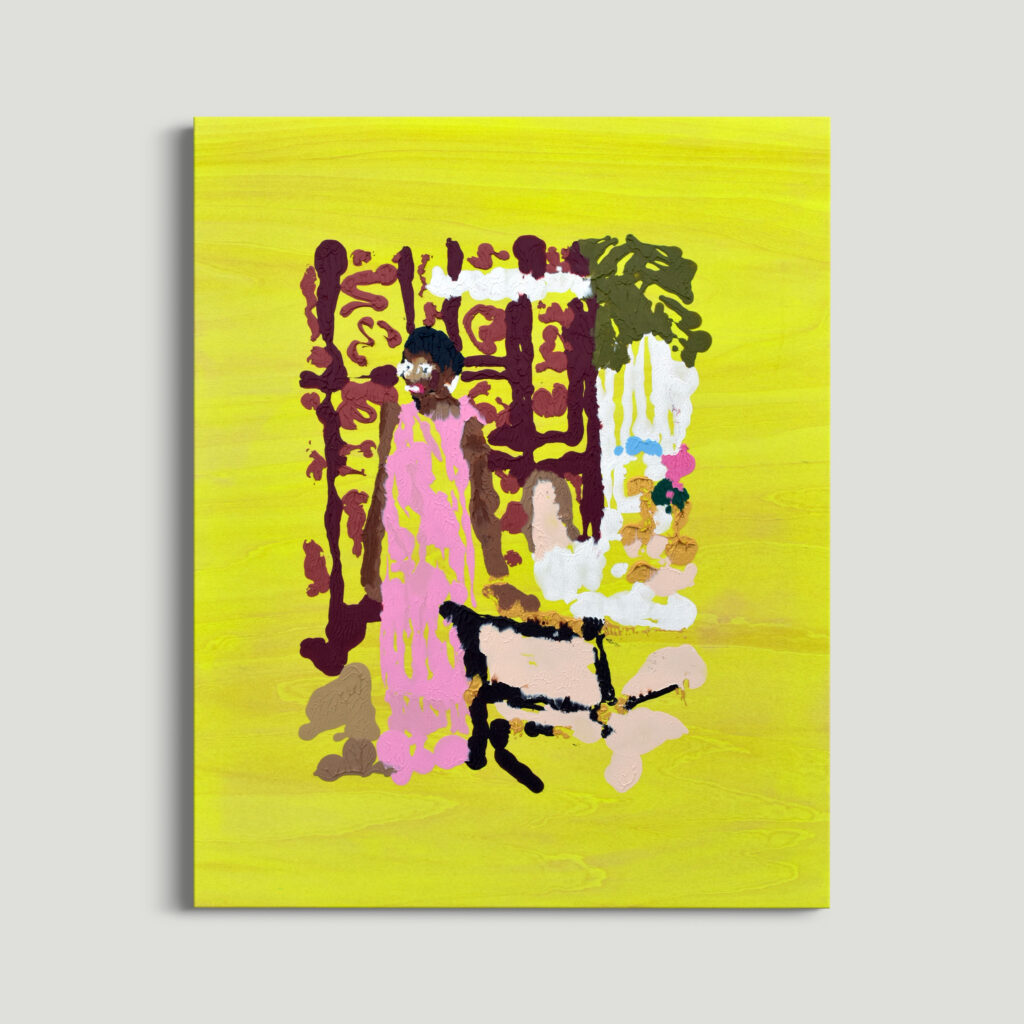
Do you think the diffusion of identity into color, into gesture, into sometimes sensation, can be understood as a form of release, or a different way of holding the body?
Dana: It’s a way of dissolving the body and seeing it in a way you haven’t before. In my work I have always dissected the bodies of the people as a way of releasing them from the pages. An act of freedom, a process of release. When the body dissolves it can’t be used to work. I have moved from including facial features and larger portions of people to almost removing them all together. I think about it a little like how beaches are made. The more the shells are thrown against the surf the more they disintegrate and become a seamless part of the land around them. A piece of a hand, floating between two tiny paintings on a collage and a flash of skin tone pressed and smeared in a field of colors. I’m making my own beaches.

The emergence of Ebony magazine, which I discovered through you—, can be understood as a kind of symbolic materialization of the Black American Dream. It points to a moment of very specific historical optimism, raising questions about whether it reflected a form of real emancipation or an adaptation to white norms and capitalism. what does it mean for you to return to that moment /not as nostalgia, but as something still unfinished or open? In your opinion what is the relationship between the struggle for women’s liberation and the class struggle? Do you believe the first must be subordinated to the second? / On Women, p.58
Dana: So many things are coming up for me with this question. I have questions around if emancipation is even possible. The US runs on slavery, even if it is abolished on paper it materializes in new forms. Prisons are just one of them. Regardless, the reality of being Black possesses a certain infinite freedom that can’t be taken away. Also are white norms, and capitalism the same thing?
But yes, returning to this moment. It’s complicated seeing it through Ebony because on one side of a page there can be a serious article about incarcerated women and on the facing page is an advertisement about skin bleaching cream. I really love the way the magazine can hold multitudes. I love it for how it does shy away from how multifaceted and complicated the world is.
The advertisements are asking us to live a certain way that aligns more with an aspirational life that could align with white standards but the Black people in the ads bring something completely different. It’s not emancipation, they are asking for a cool homogeny. Capitalism promises freedom through consumption and many of the ads in Ebony do that in a direct way but there is something else happening in them that can not be recreated. Even after I cut them up, that ‘thing’ remains. That is the thing that I keep going back to, that’s the thing that remains and it’s infinite. I think the fight for gender equality and class struggle are the same struggle. These fights are interconnected and rely on each other, a subordination of one is a disservice to all.
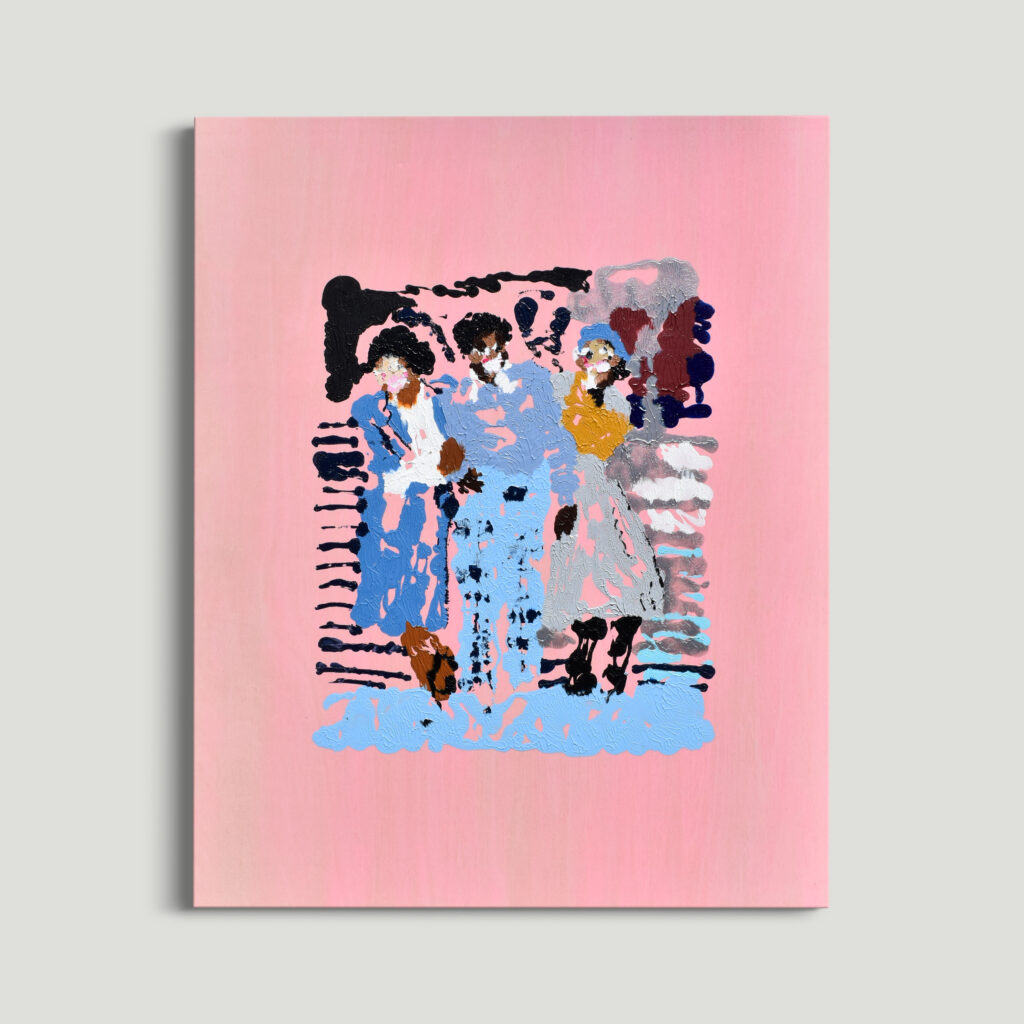
Instead of asking what your work reveals about you, I’m curious about its limits… is there something in your work you’re not yet ready to confront directly?
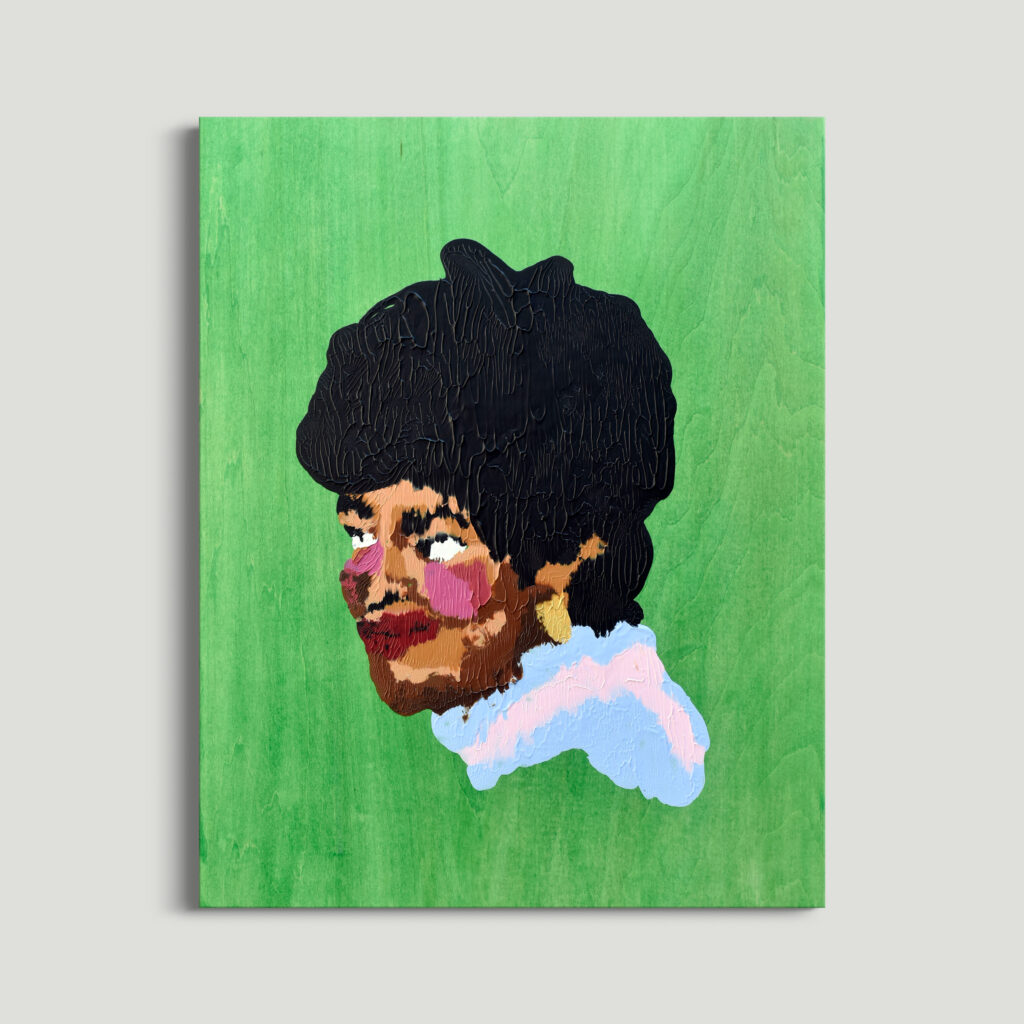
Dana: I make work to address the difficult issues that are hard to confront. I create tension between the fluffier and the more difficult topics in the work. The portraits I make are often of these beautiful independent women looking into the camera with their armor of make up, ready to take on the world.
I love them but I also understand that the moment they represent is fleeting. Like black excellence, I can aspire but what I achieve will be different and will change the moment it materializes. I blur their images, and sometimes they look silly. I’m concealing and protecting their identity but also question the adherence to gender norms. I question my deviations and adherences to gender norms, which is to say white norms created under a system of capitalist domination. The work I make is layered. The process of making the work is a process of vulnerability and looking at the contradictions I embody and the hard subjects.
About that suspended moment “before a decision is made, before the glass breaks, before the confetti hits the ground”, if it were a movie, which one would it be?
Dana: My first thought was the Usual Suspects, I don’t remember it super well but I remember that scene. Where the cup breaks, and the other bits of what’s happened fall into place. Also the movies Read My Lips, My Brothers Wedding, and Moonstruck are crossing my mind. Haha now I’m really just naming movies I like.
I think the suspended moment is really that, and it happens in all these movies. That moment before things click into place even if a second later everything is in disarray again. It’s that moment of perfection. This is a pretty literal example but in Mystery Train, Cinqué Lee who plays a bellboy sweeps up some glass from the hotel lobby and then throws it out into the street instead of putting it in the trash. It was a perfect, and bizarre moment. I thought that was hilarious. After thinking more about this, I may be more interested in the moments that move from order to disorder.

The rage of the oppressed is never the same as the rage of the privileged. /Bell Hooks How do you think emotion… anger or longing… is shaped by historical and social conditions in your work?
Dana: Art is the expression of emotion. And within a single work a range can be present. In the portraits, the emotions change the longer you sit. In the collages there can be a cacophony of emotions that circulate and ask for your attention or shy away at different points in the piece. There is an expression of rage in some pieces that is quieter. Growing up, if I was caught doing something I wasn’t supposed to be doing, I always knew I was really in trouble when my parents would be calm when first confronting me. I think some of my pieces represent the “calm before the storm” the tipping point. There have been many moments in history, where lines were crossed, where the scrap of dignity of who one was has been snatched away and there is no choice but to move into the unknown and a new way of being. Pushed towards a new world we can no longer deny.
Do you see pain, sensuality, and madness, or perhaps hysteria, as separate states, or as different intensities of the same force? Do these move through your work, and how if at all?
Dana: All these move through my work. The monoprints create such an atmosphere of desire through the way the images are concealed, there is a need to uncover the unknown that seems attainable but a madness in the knowledge that it can never be caught. In some work it manifests as bits and pieces, suggestions, whispers, symbols in conversation.
I really love playing with the hysteria of life, and the moment when someone snaps and all ideas of self preservation, and the desire to be accepted in society go out the window. The, “If I can’t have it then no one can.” mentality is my favorite unhinged state to try to bring across because it is a heightened manifestation of all four of those states you mentioned.

If the only person we are guaranteed never to lose is ourselves, what does it mean to build a relationship with that self through an artistic practice?
Dana: Haha nothing is a guarantee, but if the world is kind and I don’t lose myself I think it means a wider understanding of the world. A greater appreciation and acceptance, a slowing down, a care at a deep level.
What’s the latest book or text you’ve read? Has it altered the way you see images? Has it shaped your world in any way?
Dana: I just finished reading The Salt Eaters by Toni Cade Bambara, it was an experimental book with a lot of streams of consciousness from all the characters. It reminded me a little of The Waves by Virgina Woolf in that way, Bambara’s book is way different. What I learned is that you have to want to get better. We can hold onto past hurts like a piece of our personalities, like badges of honor, but we can learn to let them go and become the people we are supposed to be.
What is the question that would make you slightly uncomfortable, but that you secretly wish someone would ask?
Dana: Any question having to do with something that is generally not talked about publicly. Like, what’s the strangest thing I’ve done for money? Anything about money can be uncomfortable to ask or talk about, but I like to test my boundaries, and I think those questions have the potential to build intimacy and I like the idea of that.