

Share this
At Green-Wood in New York, Celadon Landscape turns nearly two tons of Korean ceramic shards into a meditation on rupture, diaspora, and collective remembrance
Memory is rarely whole. It arrives in fragments, surfaces, names, gestures, objects we no longer use but somehow still carry. In Jean Shin’s hands, those fragments become material.
For Celadon Landscape, now on view at The Green-House at Green-Wood in New York, the artist gathers nearly two tons of discarded Korean ceramic shards into a large-scale installation that thinks through breakage not as an ending, but as a form of continuation. The exhibition runs from April 18, 2026 to January 17, 2027.
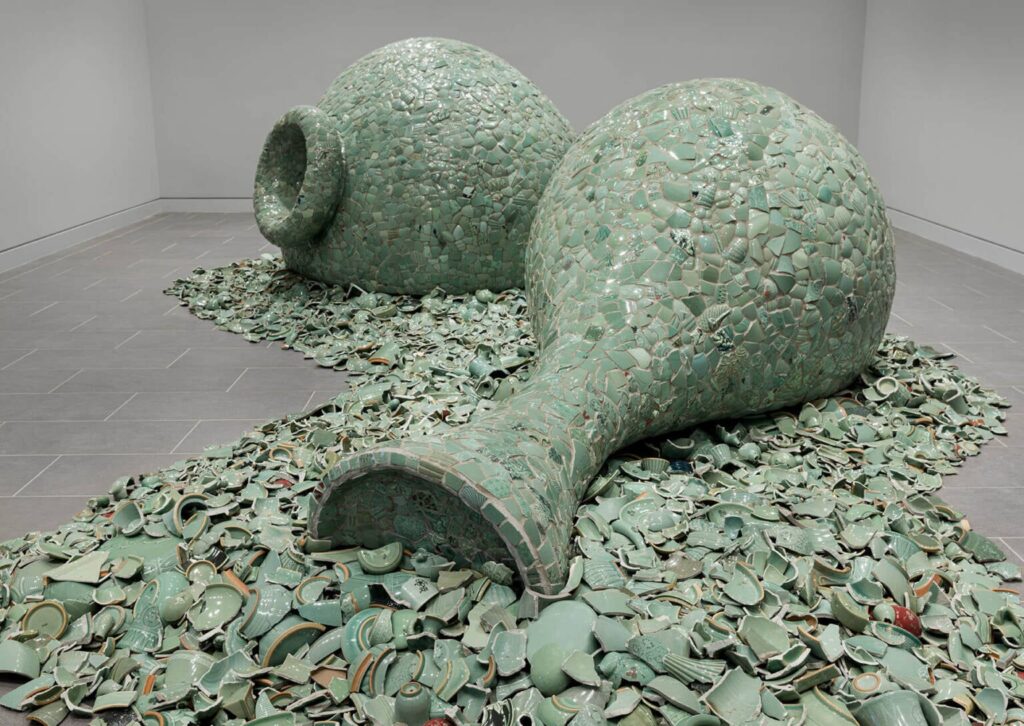
The shards come from ceramic studios in Icheon, South Korea, a city deeply associated with Korean ceramic tradition. Once part of cups, bowls, and everyday vessels, they have been separated from their original forms, gathered, and reassembled into two monumental horizontal structures. Their broken edges remain visible. Nothing is smoothed over. Nothing pretends to have returned to its original state.
That refusal of seamless repair is what gives the work its force. Celadon Landscape does not sentimentalise damage. It lets fracture become a language. The ceramic pieces still carry the soft, pale glow of celadon glaze, but they also carry interruption: the evidence of use, failure, discard, travel, and survival.
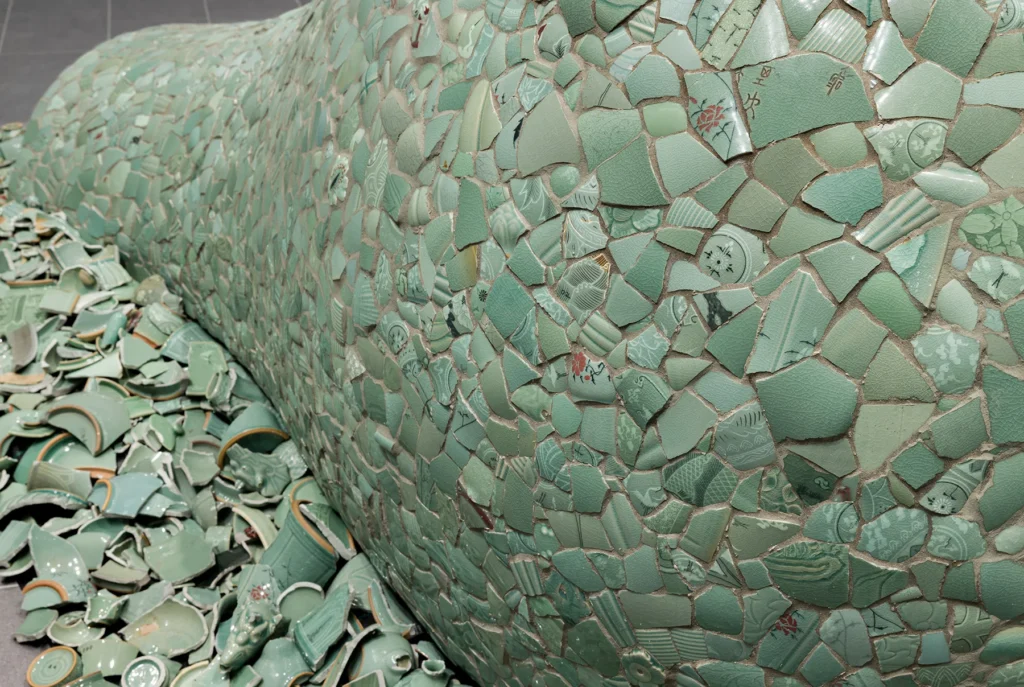
For Shin, this becomes a way of thinking about diaspora too. Materials removed from their first context do not become empty. They keep traces of origin, touch, labour, and cultural memory. In the installation, the broken ceramic fragments become a landscape of displacement and return — not restored, but reconnected.
The work also extends beyond sculpture into participation. Visitors are invited to answer a simple question: who do you carry with you? Their responses are written as names on torn sheets of mulberry paper printed in celadon tones, which Shin gradually assembles into a growing scroll. The installation becomes not only an object to look at, but an archive that accumulates with each visitor.
That gesture feels especially powerful at Green-Wood, a cemetery already shaped by memory, names, mourning, and the presence of those who remain through the people who remember them. In that context, Shin’s work does not treat loss as something sealed in the past. It becomes active, communal, and still forming.
Presented alongside her long-term earthwork Offering, Celadon Landscape continues Shin’s interest in discarded matter as a carrier of shared meaning. Across her practice, obsolete objects and overlooked materials are not simply recycled. They are asked to speak again — differently, collectively, and with all their damage still showing.