
Share this
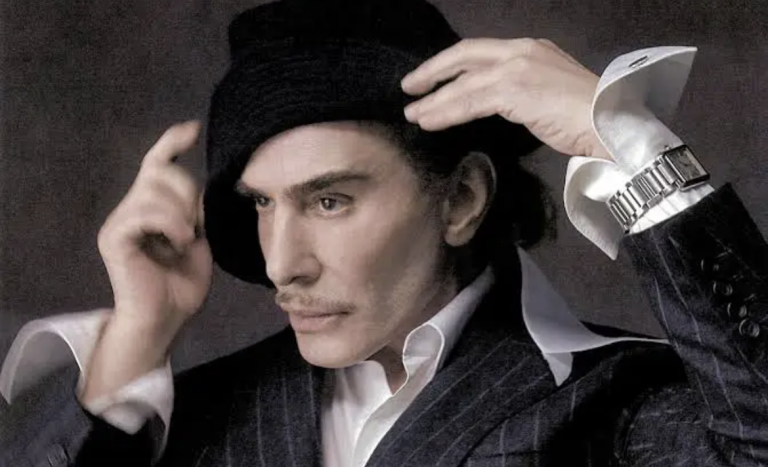
PHOTO CREDIT: Szilveszter Mako
Fashion loves a comeback story. It loves redemption arcs, mythology, spectacle, genius, applause, and the idea that beauty can somehow rearrange the damage around it. But John Galliano’s cancelled Met exhibition shows that not every legacy can be smoothed into a museum narrative.
The Metropolitan Museum of Art and John Galliano have announced that John Galliano: Horizons, the Costume Institute’s planned spring 2027 exhibition, will no longer go ahead. The show had been scheduled to open in May 2027and was set to examine more than four decades of Galliano’s creative output, spanning his own label, Givenchy, Dior, and Maison Margiela.
The decision follows significant backlash after the exhibition was announced in late July. For many, the problem was not whether Galliano’s influence on fashion mattered. It clearly does. The problem was whether one of the world’s most visible museums should stage a major institutional celebration of a designer whose career remains marked by the antisemitic and racist remarks that led to his dismissal from Dior in 2011.
That tension was always going to sit at the centre of the show. Galliano is one of fashion’s most imaginative image-makers: a designer of historical excess, theatrical ruin, bias-cut romance, broken aristocrats, cinematic runways, and couture as fever dream. But the brilliance of the clothes cannot erase the public history attached to the person who made them.
In its official announcement, the Met said it had reached the decision together with Galliano following “thoughtful discussions.” Galliano, in turn, said that after reflection and conversations with the museum and everyone involved, he had decided it was best for the exhibition not to take place “at this time.”
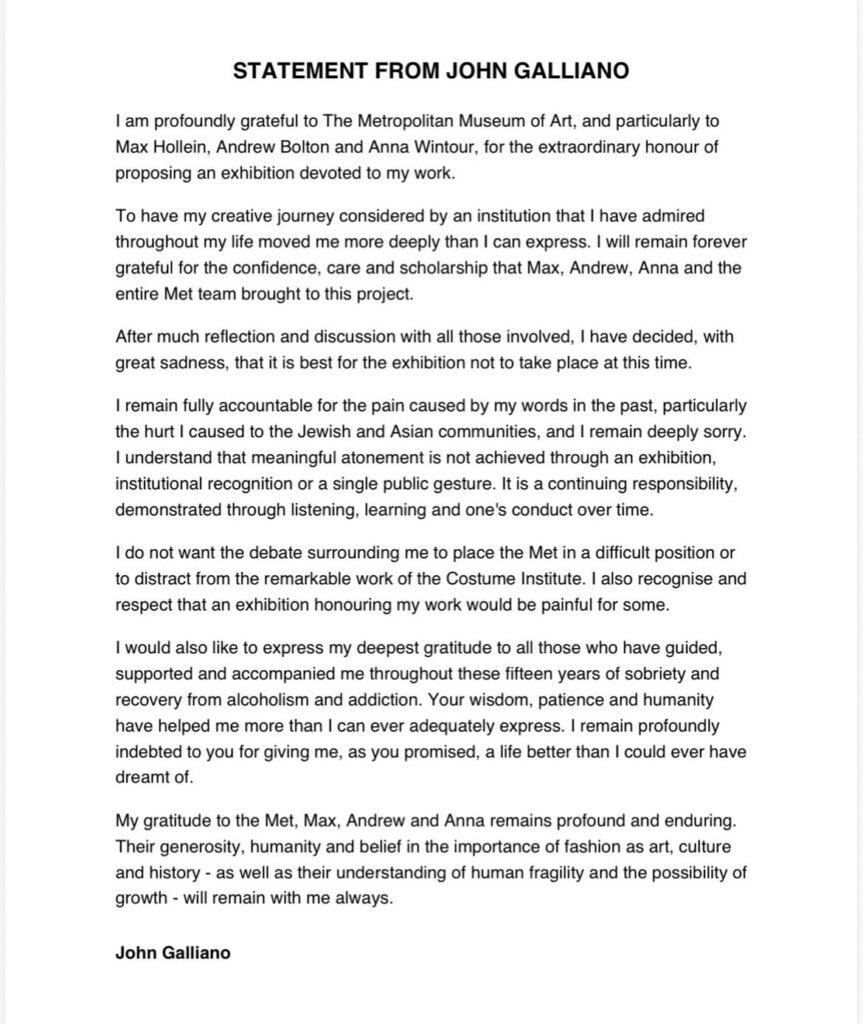
That phrasing matters. The cancellation does not end the argument around Galliano’s legacy. It exposes it. Fashion has often struggled with how to separate work from conduct, influence from harm, admiration from accountability. A retrospective does not simply display clothes. It creates meaning. It tells the public what deserves to be remembered, celebrated, contextualised, forgiven, or questioned.
The exhibition would have been one of the Costume Institute’s most high-profile endorsements of Galliano since his fall from Dior. According to Reuters, it would also have been only the third Costume Institute retrospective dedicated to a living designer, following Yves Saint Laurent in 1983 and Rei Kawakubo of Comme des Garçons in 2017.
That status is exactly why the backlash carried such weight. A Met exhibition is not a neutral platform. It comes with the force of the Met Gala, global media attention, celebrity performance, fashion money, and cultural legitimacy. To give Galliano that stage was never going to be read as a quiet scholarly exercise. It was always going to look like fashion’s largest red carpet offering him a form of consecration.
Now, with Horizons cancelled, the question remains unresolved. How should fashion history hold a figure whose work changed the industry, but whose public actions caused real harm? What does accountability look like when the clothes are extraordinary? And who gets to decide when, or whether, a comeback becomes too grand?
Galliano’s Met exhibition may no longer be happening, but the debate around it has already done something important. It has forced fashion to look at its own appetite for genius, spectacle, and forgiveness — and to ask whether some stories require more than beautiful clothes to be told responsibly.
PHOTO CREDIT: Szilveszter Mako