

Share this
At Kunstsilo in Kristiansand, a former grain silo turned cultural landmark on Norway’s southern coast, modernism is not presented as a clean march towards abstraction, progress, or aesthetic certainty. Instead, Mellom drømmer og virkelighet — Between Dreams and Reality — enters the unstable territory where the visible world begins to fracture, where emotion distorts form, and where the subconscious becomes as real as the landscape outside the museum walls.


The exhibition, drawn from the Tangen Collection, takes as its starting point two of modernism’s most charged artistic currents: Expressionism and Surrealism. Both emerged in the first half of the twentieth century, both reacted against inherited artistic conventions, and both sought to expand what art could contain. Yet they did so through different routes. Expressionism pushed outward through colour, gesture, deformation, and emotional intensity. Surrealism turned inward, towards dreams, desire, chance, erotic symbolism, irrational associations, and the uncanny logic of the subconscious.
What makes Between Dreams and Reality compelling is that it does not treat these movements as imported European styles simply adopted by Nordic artists. Rather, the exhibition suggests a more complex story: Nordic modernism was never isolated from the international avant-garde, but neither was it merely derivative. Artists from Norway, Denmark, Sweden, Finland, and beyond were in close contact with Berlin, Paris, and other centres of artistic experimentation, yet they transformed those influences into languages shaped by their own climates, histories, psychic tensions, political realities, and inner mythologies.


The result is a show that feels less like a survey than a psychological map. Across works by artists including Rita Kernn-Larsen, Wilhelm Freddie, Rolf Nesch, Sigurd Winge, Sigrid Hjertén, Isaac Grünewald, Asger Jorn, Bendik Riis, Hannah Ryggen, Per Kirkeby, Arne Ekeland, Lena Cronqvist, and others, the exhibition moves between inner and outer worlds: the body, the city, the dream, the wound, the political image, the private hallucination, the collective nightmare.
A key image for the exhibition is Rita Kernn-Larsen’s Valmue from 1935. A poppy rises from a strange organic base, at once botanical, bodily, and fantastical. It is a flower, but it is not only a flower. Its stem seems too fragile for its apparition-like bloom; its base appears almost animal, aquatic, or psychological. In that tension, the work becomes a doorway into the exhibition’s central question: what happens when the world we recognise begins to behave like a dream?
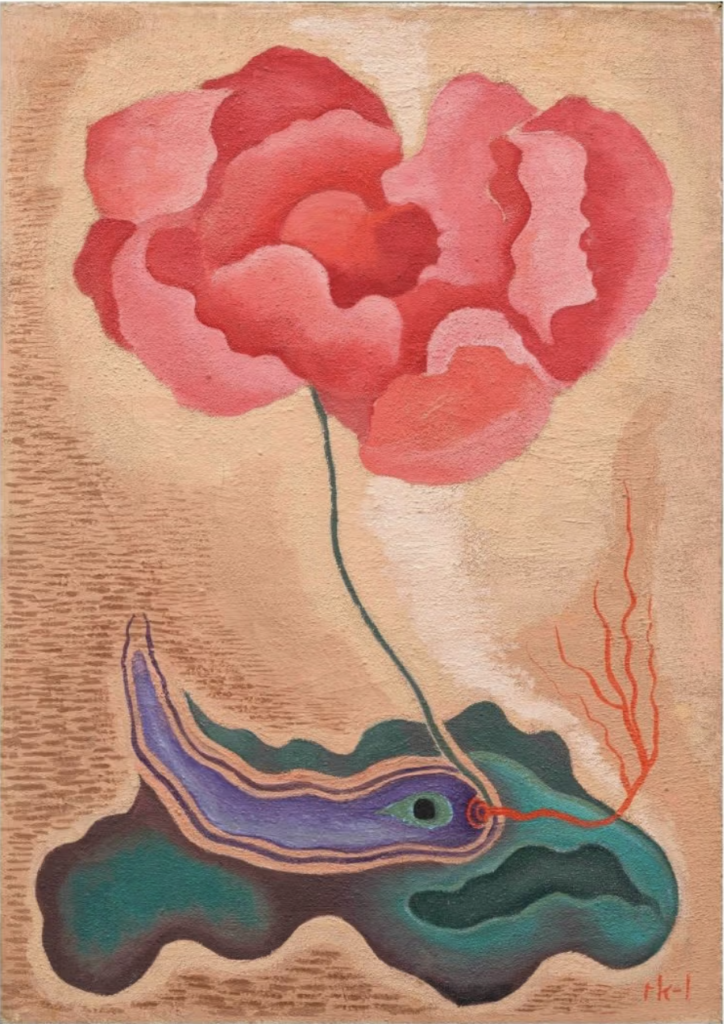

Kernn-Larsen is an important presence in this context. One of Denmark’s major Surrealist artists, she was part of an international scene in which women artists often found in Surrealism both a space of possibility and a field of contradiction. The movement opened doors to dream imagery, transformation, sexuality, and anti-bourgeois rebellion, but it was also often structured through male fantasies of the female body. Kernn-Larsen’s work complicates that history. Her figures, flowers, landscapes, and hybrid forms do not simply submit to Surrealist desire; they reclaim metamorphosis as a language of female agency, ambiguity, and imaginative force.
Wilhelm Freddie, another crucial figure in Danish Surrealism, enters the exhibition from a darker angle. His work often fused eroticism, social critique, censorship, and nightmare. Freddie’s Surrealism was not escapist; it exposed hypocrisy, repression, and violence within respectable society. In the context of Between Dreams and Reality, his presence helps position the subconscious not as a decorative realm of fantasy, but as a dangerous archive. Dreams can seduce, but they can also accuse.


That accusatory force runs through other parts of the exhibition as well. Kunstsilo notes that the show includes works with a social and political edge, and this is essential to understanding its scope. Expressionism and Surrealism were not only private languages of emotion and fantasy. They developed in a century marked by war, authoritarianism, class conflict, displacement, technological acceleration, and psychic rupture. To distort the body or fracture reality was not necessarily to withdraw from the world. It could also be a way of showing the world more truthfully.
This is where Nordic modernism becomes especially rich. In the hands of artists such as Sigrid Hjertén and Isaac Grünewald, colour becomes emotional architecture. Their relation to Expressionism was inseparable from the liberation of colour and form, but also from the difficulty of being modern in societies where new art was often met with suspicion. Hjertén’s psychologically charged modernism, long under-recognised in comparison with many of her male contemporaries, now appears increasingly central to any serious understanding of Scandinavian modern art. Her work shows how the domestic, the intimate, and the interior can become radical pictorial spaces.

Rolf Nesch brings another kind of intensity. German-born and later based in Norway, Nesch became known for experimental approaches to printmaking, pushing the medium beyond conventional graphic surfaces into tactile, material, almost sculptural territory. In a show concerned with dream and reality, his work can be understood as a bridge between psychic pressure and physical process. The image is not only seen; it is pressed, scratched, built, and embodied.
The inclusion of CoBrA-related impulses adds a further layer. Founded after the Second World War by artists from Copenhagen, Brussels, and Amsterdam, CoBrA rejected academic restraint in favour of spontaneity, collective energy, childlike mark-making, and so-called primitive expression. In the work of Asger Jorn and others, painting becomes a living organism: unruly, playful, monstrous, and political at once. CoBrA’s presence within the exhibition expands the dream beyond classical Surrealism. Here, the irrational is not only hidden in the unconscious; it erupts through the hand, through gesture, through colour, through the refusal to behave.
Bendik Riis, meanwhile, gives the exhibition one of its most fragile and haunting dimensions. Riis developed a deeply personal practice shaped by poverty, trauma, psychiatric experience, poetry, and an intensely autobiographical imagination. His work sits uneasily beside formal art-historical categories, and that unease is precisely what makes it powerful. In Between Dreams and Reality, the boundary between modernist experimentation and psychological vulnerability is not treated as marginal. It becomes one of the exhibition’s central zones of meaning.


This is also reinforced by Kunstsilo’s parallel S-Lab presentation of Riis’s Seks pærer from 1950, which transforms the painting into an immersive experience through light, sound, and movement. That curatorial decision is revealing. Rather than freezing Riis inside biography or pathology, Kunstsilo invites viewers to enter the atmosphere of the image. The work becomes a room, a state, a sensorial event. It suggests that some paintings do not simply represent inner life; they become environments where inner life can be felt.
The broader institutional frame matters. Between Dreams and Reality is part of Stories from the Tangen Collection, a three-part exhibition project developed in collaboration with art historian and external curator Steinar Gjessing. Together with Pictures for a New World and Rebellion and Optimism, the show forms part of a larger attempt to rethink the Tangen Collection not simply as a storehouse of Nordic modernism, but as a set of interwoven narratives. One exhibition looks to early twentieth-century abstraction and the new visual languages demanded by modern life; another turns to postwar experimentation, material rebellion, and changing ideas of what art could be. Between Dreams and Reality occupies the psychic and emotional centre of that story.

It is also significant that the exhibition presents, for the first time, a substantial number of works recently acquired from the Canica Collection. Built by Norwegian businessman and collector Stein Erik Hagen, the Canica Collection added depth to the Tangen Collection through key Nordic works from the twentieth century. Its integration into Kunstsilo’s programme strengthens the museum’s ability to tell a more layered story of Nordic modernism — not only through famous names and movements, but through correspondences, tensions, gaps, and rediscoveries.
Kunstsilo itself adds another resonance. The museum opened in 2024 inside a transformed 1935 grain silo on Odderøya. Its architecture already carries a powerful metaphor: a structure once built for storage, weight, and industrial function has become a container for memory, imagination, and cultural transformation. Inside that building, Between Dreams and Reality feels especially apt. The exhibition asks what modernism stored within itself: not only progress and formal innovation, but fear, fantasy, eroticism, alienation, social critique, madness, humor, and desire.

For a contemporary audience, the show arrives at a moment when reality itself often feels unstable. Political anxiety, digital image culture, ecological dread, and renewed interest in spirituality, dreams, and mental health have made the old modernist division between inner and outer worlds feel newly insufficient. The artists in Between Dreams and Realityunderstood that the psyche is not separate from history. Dreams are shaped by the world. The world is interpreted through dreams.
This may be the exhibition’s most urgent insight. Expressionism and Surrealism are sometimes treated as historical movements, securely placed in the first half of the twentieth century. But at Kunstsilo, they feel less like closed chapters than recurring human strategies. When ordinary representation fails, colour intensifies. When rational language collapses, symbols appear. When the world becomes violent, absurd, or unbearable, artists invent new bodies, new landscapes, new monsters, new flowers.
Between Dreams and Reality does not offer Nordic modernism as a calm regional variant of European art history. It presents it as something stranger, more restless, and more alive: a field of images where the North looks outward to the international avant-garde, inward to the subconscious, and directly at the social and political fractures of its time.