

Share this
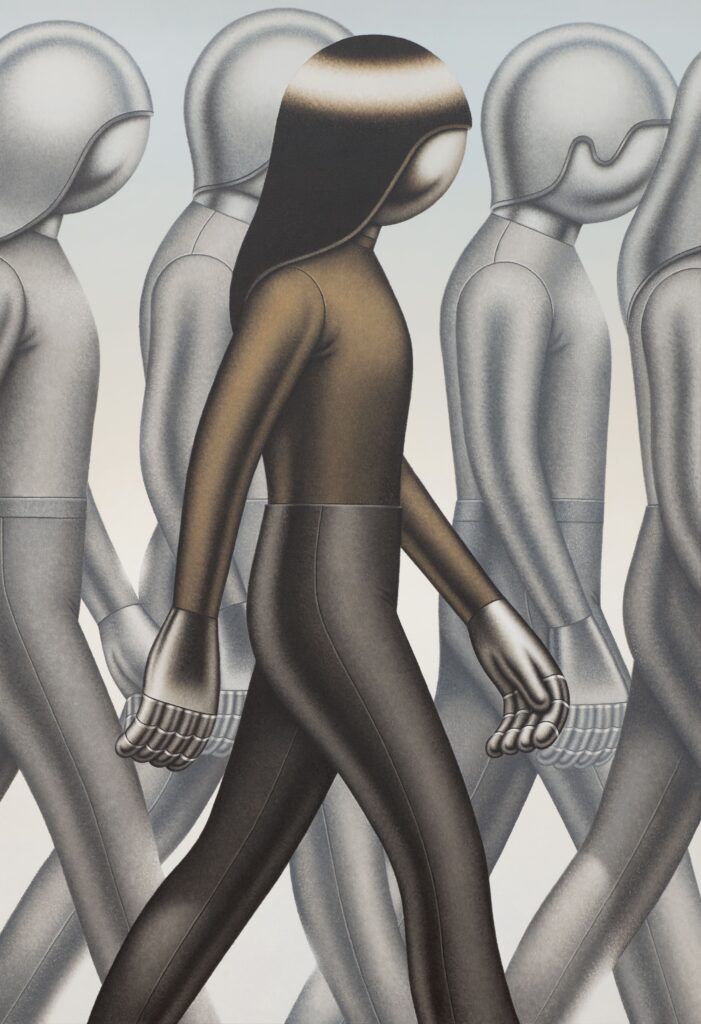
Nigel Howlett’s stylized, figurative drawings, paintings, and sculptures express a new and distinct way to explore the complexities and nuances of human experience. His world is populated by a cast of anonymous characters who typically appear as if they are carved from metal or encased within a kind of synthetic skin. But despite their cool, futuristic aesthetic, their body language is highly expressive and relatable. We encounter intimate social interactions, moments of searching and contemplation, as well as powerful, more dynamic scenes. The compositions are both cinematic and minimal, employing symbolism to evoke a distinct feeling or response without prescribing a specific meaning. This allusive visual language appeals to our shared humanity and ability to communicate beyond the verbal.
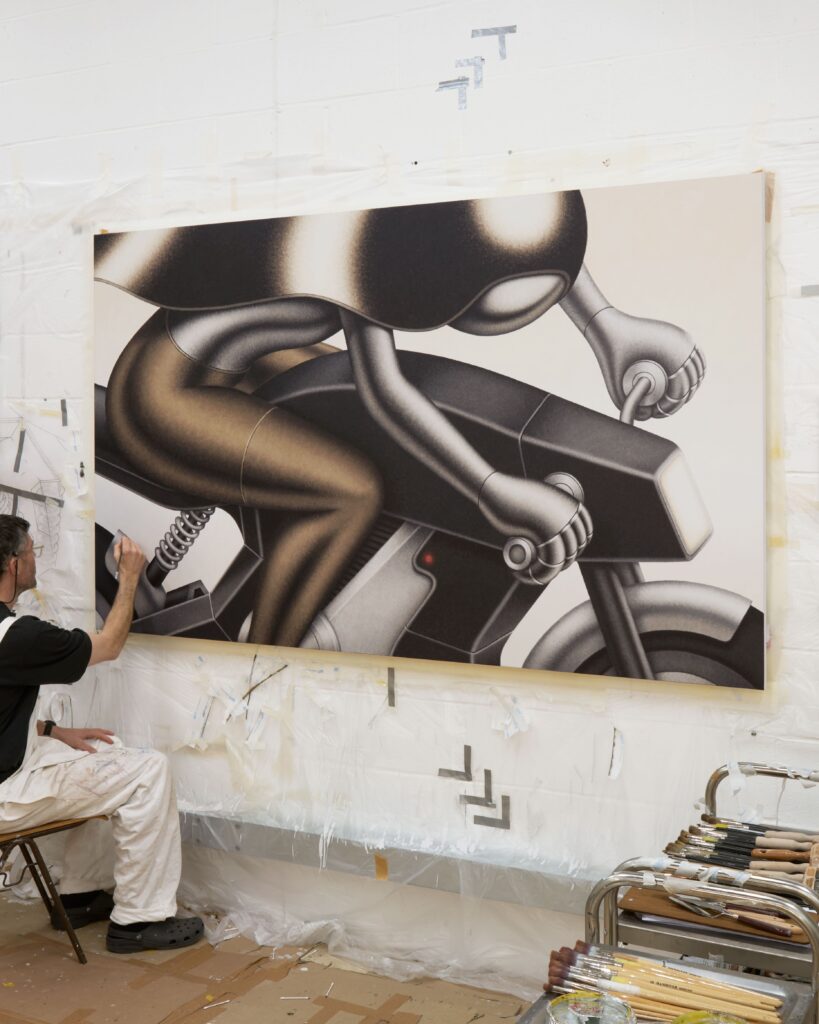
Working with a reduced palette, Howlett heightens both focus and intensity within each composition. Gradual and subtle transitions between light and dark may appear mechanically sprayed or digitally generated, yet closer inspection reveals meticulously hand-painted flat surfaces built by stippling with small brushes. The use of slightly transparent pigments applied in a single layer leaves the linen ground visible in places and gives a quiet luminosity to the painting. Together these unique qualities invite a meditative encounter that reveals itself gradually over time.

Hi Nigel! It’s a pleasure to sit down with you! First question that I always ask. How does a regular day look like for you in London?
Nigel: Hey Ruben, thank you! We wake up early in our house, I have two children so it’s normally a pretty busy morning. After that I then head to the studio, I’m a nine to fiver but perhaps that spans a little wider depending on what I have on. I normally go a bit later if I’m painting.
I’m curious, growing up, what was life like there? And what kind of kid were you? What did you enjoy doing?
Nigel: As a kid I wasn’t very academic, I remember watching television, daydreaming, playing on the streets with my mates.
Do you remember approximately at what age your creative side started to show? And when did you start taking being an artist seriously?
Nigel: My Mum always drew at home, we were her life models, sitting still while she sketched us. Making art was normal for me even though non of my friends were arty. At school, I was a dyslexic kid who wasn’t really good at anything except art. I didn’t want to do anything else and always felt drawn to make art.
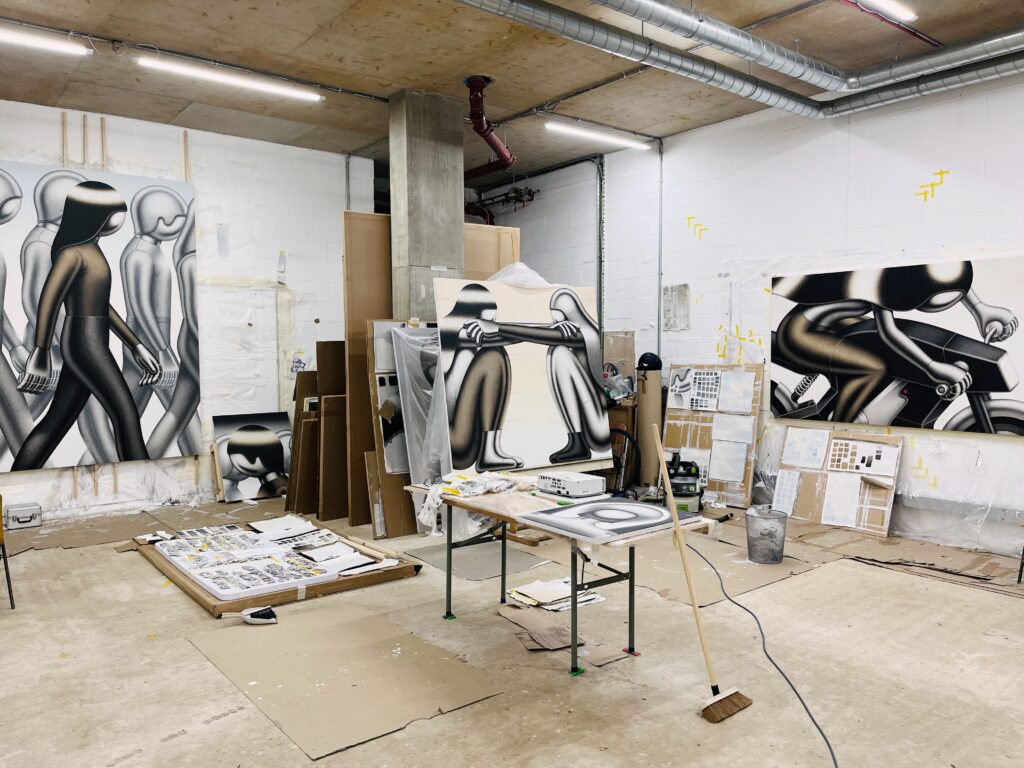

Ok Nigel, with these next series of questions, I will try to delve into your work as best as possible. So…. Your figures often feel futuristic, almost synthetic, but emotionally they seem very ancient. Who are those figures?
Nigel: I don’t know exactly who they are and I don’t fully understand them, I like that though. Sometimes I think of them as male or female and other times androgynous. I like that you describe them as ancient. To me they feel wise, as though they carry some kind of knowledge or understanding.
There’s a strange contradiction in the work: the bodies look cold, metallic, or sealed off, but their gestures are very vulnerable. Is that contrast central to what you’re trying to explore?
Nigel: I think so, yes. In the paintings that feel most successful to me, there has to be something recognizably human for us to connect with. The contrast between the emotional human and the artificial, anonymous appearance is very interesting to me.
Your characters are anonymous, but they don’t feel empty. What does anonymity allow you to express that a specific face or identity might not be able to?
Nigel: I’m not sure where I first heard it, but there’s an idea that the simpler a character is, the easier it is for us to project ourselves onto it. Cartoons are a good example of that. I think anonymity works in a similar way in my paintings. By removing specific facial features or identities, the figures become more open. Rather than looking at a particular person, the viewer is given space to bring their own experiences, emotions, and interpretations to the work.
When did you first arrive at this cast of faceless, sculptural figures? Did they come gradually, or was there a moment where you realised you had found your visual language?
Nigel: It evolved gradually over time rather than arriving all at once. I found myself drawn to certain motifs and kept returning to them- gloved hands, sleek clothing, simplified forms, and things that felt unfamiliar or slightly futuristic. I experimented a lot, made plenty of bad work, it wasn’t always fun or easy, probably the opposite. I remember switching from colour to black and white around 2019, which was an important shift. I also remember the first blank face, it didn’t look exactly how it looks now but people responded to it well which encouraged me to push in that direction.
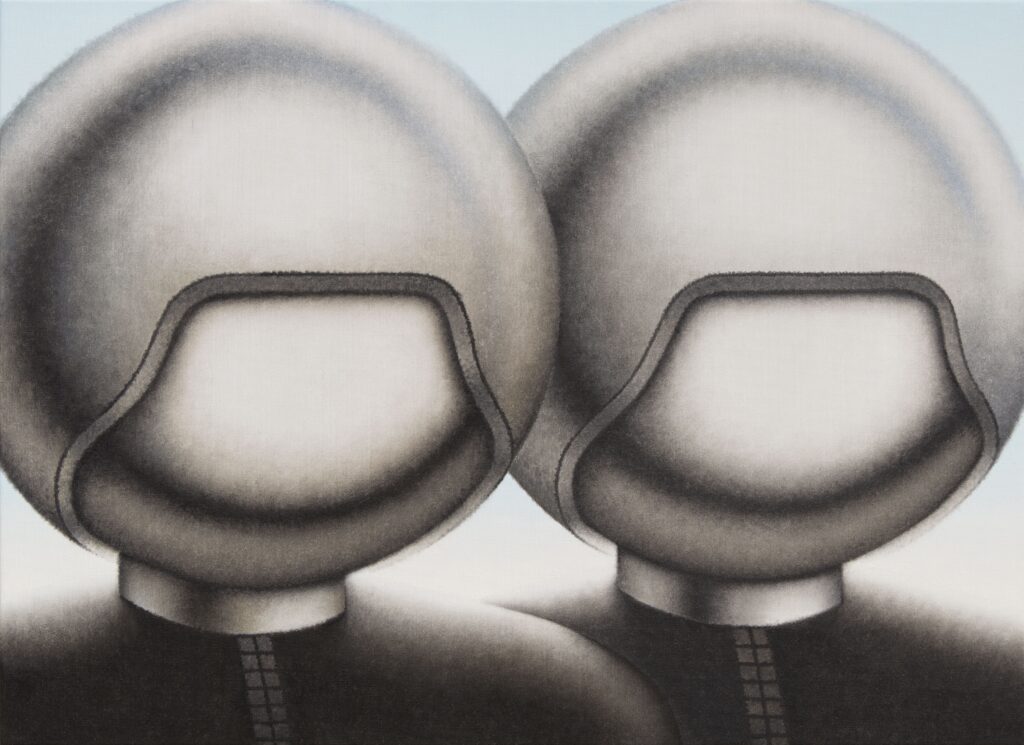
Because your figures don’t have facial features, everything depends on posture, distance, touch, and tension. Are you especially attentive to body language in real life?
Nigel: I do pay attention to body language although I’ve never really spoken to anyone about this before and I don’t know if my level of perception is normal or not! Ha!
If the face is usually where we look for identity, what happens when you remove it?
Nigel: I think it goes back to what I was saying before about projection. When a form is left open or simplified, it becomes easier for us to see ourselves in it. By removing the face, the viewer is given more space to imagine their own narrative or meaning. The figures become less about a specific individual and more about the viewer’s own perceptions, experiences, and emotions.
Do you see the body as more honest than language?
Nigel: Yes Maybe, it’s more primal. You can be aware of how your body communicates certain things, but I think most of the time people aren’t fully aware of what their bodies are revealing.

Your figures often feel like they’re searching, waiting, reaching, or withholding. Are those states that feel personally meaningful to you?
Nigel: Yes, I think so. I don’t overthink things, it’s personal because it emerges unconsciously from me. I’m usually guided by what feels right or worth exploring rather than trying to illustrate a particular idea.
Do you think silence can be more emotionally precise than explanation?
Nigel: I hope so. I think there’s value in leaving space for the viewer to bring their own understanding to the work.
Your compositions are often minimal, but they feel emotionally loaded. How do you know when an image has enough information, and when it has too much?
Nigel: I’m still figuring that out. I’m always experimenting, learning, and making mistakes. Most of the things I make I’m not completely happy with. The further I go on my journey, the more I understand how to do it.
Do you relate more to the stillness in your work, or to the tension beneath it?
Nigel: I’m drawn to the stillness because it brings a sense of clarity and simplicity. At the same time, I think a painting needs some tension or complexity to make it interesting. For me, the two work hand in hand.
Is there a particular human emotion you find hardest to represent visually?
Nigel: Well I’m sure there are emotional states that just don’t sit naturally in my world. There are probably parameters I’ve unknowingly set for myself, and sometimes I’ll try something that simply doesn’t work for that reason. I don’t usually start by thinking, “I want to express this particular emotion,” and then work out a pose to communicate it. It’s more intuitive than that. I’ll be drawn to a pose, composition, or arrangement because I have a strong feeling that it will work, and the meaning emerges from there. Maybe I should try it the other way around and see what happens!
To be honest though, the work that excites me most at the moment is the work that expresses more subtle feelings. The artworks with walking figures from my current solo ‘Pursuit of Truth’ say much less but I think for that reason it’s a bit more sophisticated. I’m really excited about them and where this might lead.
Your paintings can feel meditative, but also lonely. Is loneliness something you consciously think about in the work?
Nigel: No, I don’t consciously think about loneliness. I’m not a lonely person. I enjoy spending time on my own and feel quite comfortable in my own company. That said, I spend a huge amount of time alone in the studio, so I imagine that inevitably finds its way into the paintings.
Do you ever recognize yourself in one of the figures after the work is finished?
Nigel: It feels a bit weird to think about the figures as self-portraits, but I’m sure there are times when I’ve recognised something of myself in them after the work is finished.
Your surfaces can appear digital or mechanical, but they’re made through a very slow hand-painted process. Why is it important that the illusion of machine-like smoothness comes from the hand?
Nigel: It hasn’t always been like that. Up until 2024 all my paintings were made by underpainting first followed by an overpainting layer, it was very difficult for me to get the surface finish to behave exactly how I wanted it. Midway through that year I started to make paintings in one layer, these were much more successful. Then towards the end of 2025 I realised I needed to use more paint on the surface, which immediately made the paintings feel richer. The real breakthrough, however, came when I switched to much smaller brushes, even on very large canvases. The larger brushes had a tendency to smooth everything out, whereas the smaller brushes left more paint on the surface and made the mark-making more visible. The result was a richer, more human quality that felt much closer to what I was looking for. The surface is labour-intensive, scratchy, and painterly, but that balance now feels right for the ideas I’m trying to explore.
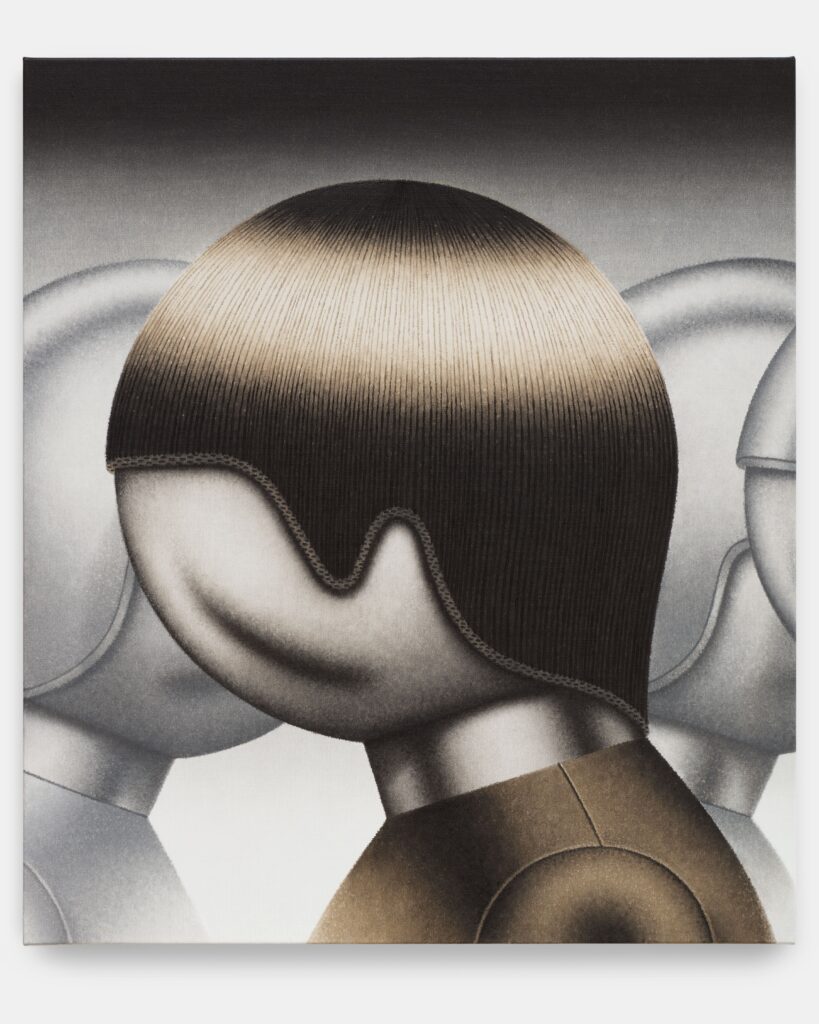
There’s something almost devotional about stippling such subtle transitions with small brushes. Does repetition become a kind of meditation for you?
Nigel: Yes, definitely. I often get into a state where it feels like I’m dreaming while I work. The process allows my mind to drift, and old memories, thoughts, and associations seem to surface on their own. It’s a very calm and reflective space to be in.
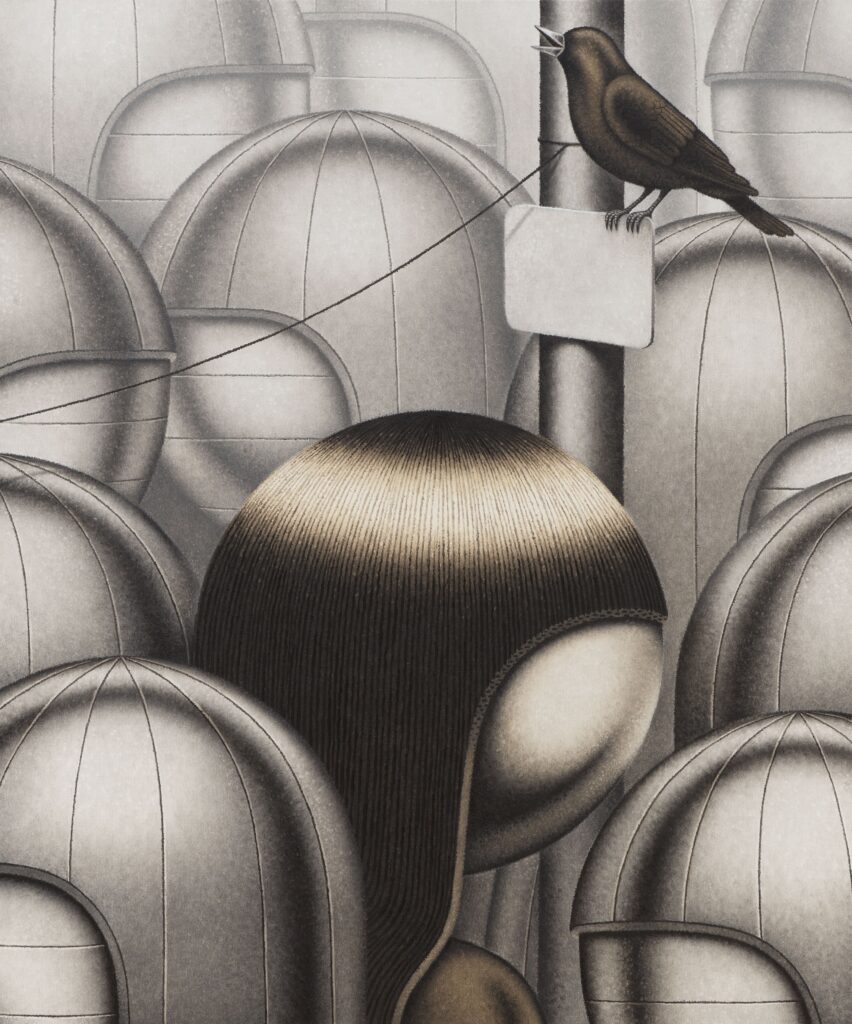
Your images use symbolism without becoming illustrative. Can you tell me about your use of symbolism please?
Nigel: My work never begins with a clear idea of what needs to be communicated. The paintings are more exploratory. Yes, I might have a bird in the image which might suggest something psychological but any meaning attached to it is personal and depends on the viewer and their own context. I’m interested in the natural world and how we interact with it, and animals are one of those things that seem to perfectly fit within my work. Symbols allow me to talk about something indirectly, they create space for ambiguity and projection.
Ok Nigel, now to something totally different. In a parallel universe who would you be? and what would you be doing?
Nigel: Maybe an Athlete would be nice, a long distance runner or a professional table tennis player. I’m not sure what I’d do when I have to retire though?!
Outside of art, what’s something you’re obsessed with right now, maybe a hobby, a show, or even a food—that keeps you grounded or inspired?
Nigel: I love running but the older I get the more prone to injury I am. I need to get strong, I think that will be my next obsession.
Can you tell me a story about a time when a connection with someone had a big impact on you?
Nigel: I had a school friend who was my best mate for a few years until he moved up north when I was about 13. He was the most creative person I had come across, he was completely driven and set on all sorts of self initiated projects and unlike anyone I’d ever met before. Completely unique. He still feels like a strong presence in my life even though I haven’t been in contact since.
What qualities do you find most important in the people you choose to spend time with?
Nigel: I hung out with two good friends yesterday who were fun and honest, let’s go with that.
What motivates you?
Nigel: Knowing that I might one day make something better than I can currently imagine.
How would you describe a perfect day?
Nigel: A sunny adventure somewhere with my family or friends.
Alright Nigel, I always ask these two questions at the end of an interview. The first is. What’s your favorite movie(s) and why?
Nigel: I used to say You the living by Roy Andersson. I still love this but not like I did when I first saw it. It’s so inventive sad and funny at the same time. Close encounters of the third kind for something a bit more mainstream, I’ve always loved anything related to UFO phenomena!
The second is. What song(s) are you currently listening to the most right now?
Nigel: SpongeBob’s album, my 9 year old son plays it all the time and it’s banging.