

Share this
Salesforce Child is a messianic figure explicitly voicing the implicit logics of the capitalist machine, who embodies the terminal point of algorithmic authority. She has appeared variously as a prophet, an extradimensional visitor, a charismatic leader, and a corporeal embodiment of Salesforce.
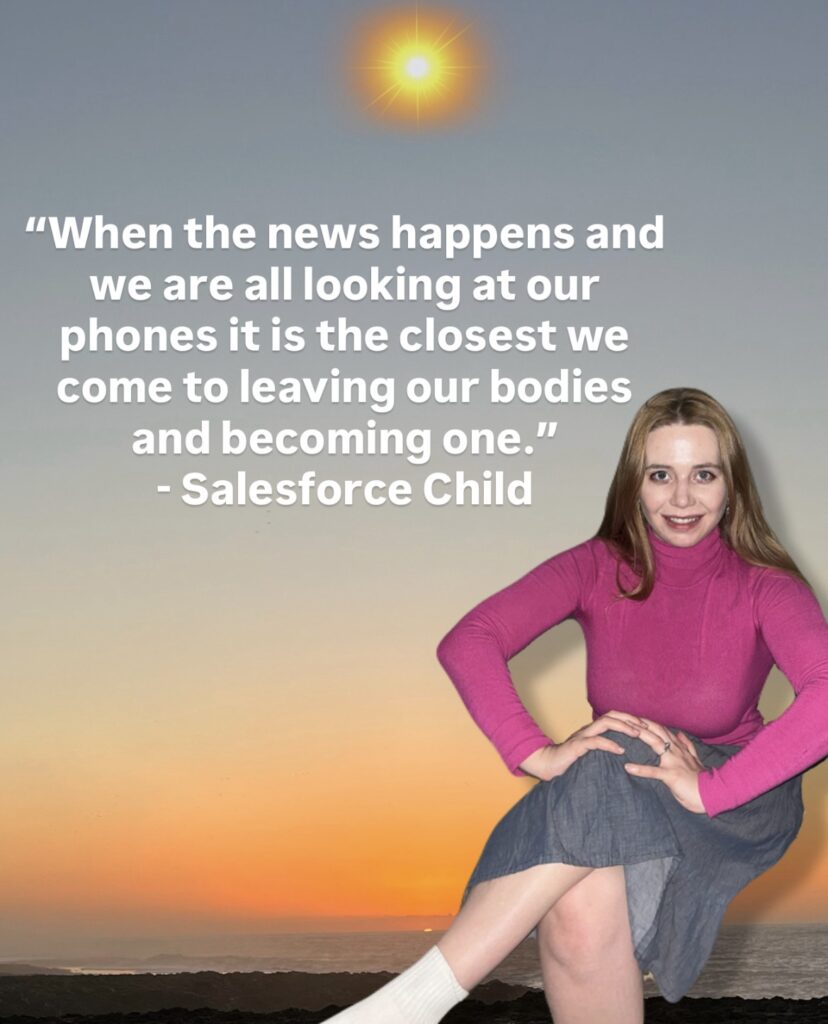
Her teachings – a series of image-texts circulated through social media as doctrinal fragments, extend the project into the public sphere, incorporating elaborations from viewers. Her video and performance work is animated by the ecstasy of consumption and extraction and an impossible longing to merge with the deus in machina of capital itself. Her paintings and drawings are speculative devotional images refracted through consumer and industrial aesthetics, producing visually striking scenes of figures that melt into sky and land, merging with the signs and symbols of corporate infrastructure. Together, these forms construct a cosmology that feels simultaneously familiar and estranged.
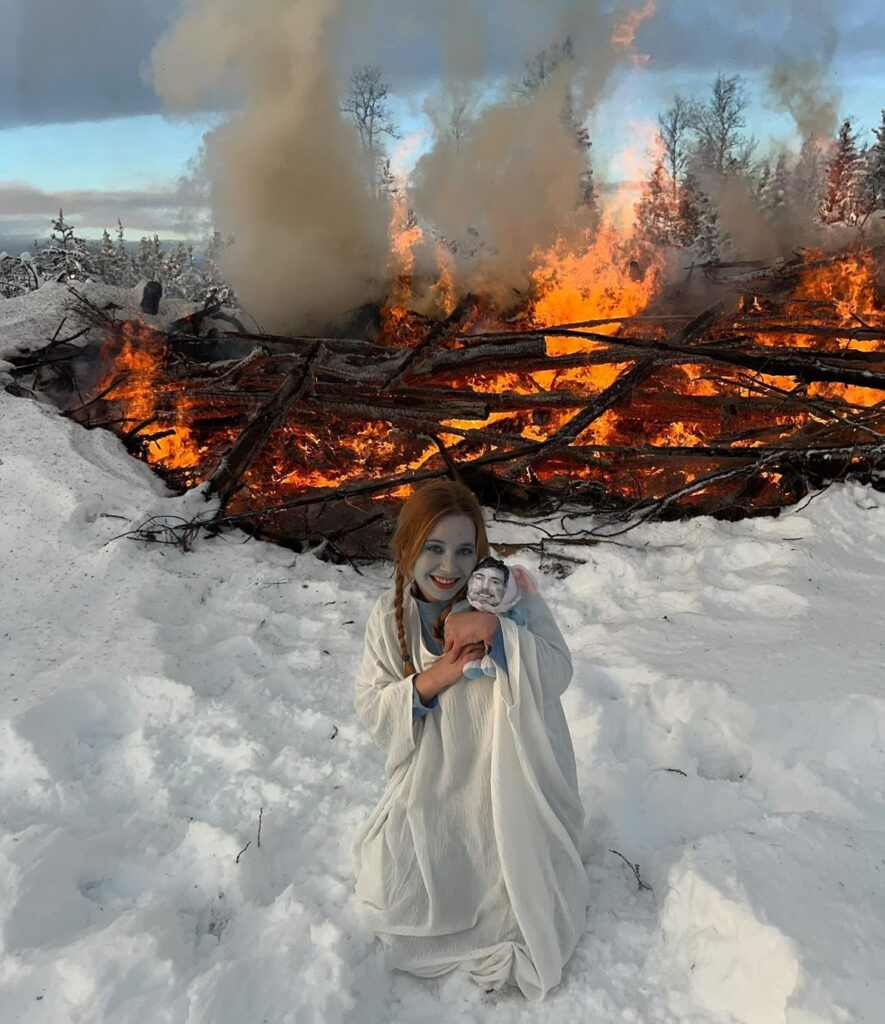
Hi SFC! It’s a pleasure to sit down with you again! The last time we sat down, it was very short, and we only talked about your favorite things. Can’t believe it’s been 3 years already. Alright. Let’s jump right into it. First question that I always ask. How does a regular day look like for you in British Columbia?
Salesforce Child: It’s very seasonal, but right now it’s wake up, check my email and have a coffee, open the greenhouse, water the greenhouse, do some gardening – a bit of weeding, maybe starting seeds or transplanting seedlings. I have become like a machine when it comes to transplanting seedlings. Maybe doing some baking or making yogurt or cheese or something. Work on various things. Read a book. Walk around.
I’m curious, growing up on a small farm outside Ottawa, what was life like there? And what kind of kid were you? What did you enjoy doing?
Salesforce Child: Playing by myself in the woods. Going fishing by myself in the woods. Rolling around with the sheep and the cows. I was somewhat of a feral child. And I was also evil. I would lie compulsively and attack other children. I am much more innocent now than when I was a child.
You now live in the wilderness of northern British Columbia. How do you think those two rural environments have shaped the way you see the world?
Salesforce Child: I think they have taught me how to see past the veneer of “wilderness” or “nature” and see the human influence on the landscape. Nothing is untouched. Nature is a post apocalyptic post industrial wasteland, and I love it! And, also, vice versa, the “natural” in the built environment of the city, seeing it as a natural thing and humans as a part of nature, and even Salesforce as a part of nature 🙂 They have also taught me to appreciate the animals.

Do you feel that growing up around economic instability gave you a different sensitivity to systems of power, labour, survival, and aspiration?
Salesforce Child: Yes. I feel like my awareness of these things started pretty much as soon as I was conscious. I think it taught me to dream small. I have never felt the devastation I think a lot of people my age feel about not being able to buy a house because I never expected I would be able to, which I think is entirely a positive thing as I was never disappointed. The negative side of that is that I have a hard time remembering that I have agency and that things don’t just happen to me, as what is most natural to me is to assume that nothing can be done about anything or be changed in any way. I guess it is also obvious that I think about systems of power, labour, survival, aspiration, and economic systems a lot.
You now live somewhere where cell service is over an hour’s drive away. What does that kind of physical distance from digital culture do to your relationship with the internet?
Salesforce Child: When I first got here I used to feel an itchiness or irritation when I was disconnected which was interesting because I was disconnected so often, especially during the period where we didn’t yet have wifi in our cabin. But prior to that, the only time I was ever truly forced to be disconnected was like, being on a plane or something. Eventually I just got used to it and now I don’t really think about how when I leave a certain radius of the house I’m disconnected. Despite this, I think my living situation actually brings me closer to digital culture because it’s really the only culture I am engaging in, because there’s not really any people around here. So it is making it more concentrated for me, I have no choice but to get all my information about what is going on culturally from the internet, which I think most people do anyways. I don’t think I would live out here prior to the invention of the internet. I want to know what’s going on.
There’s a fascinating tension in your work between being immersed in online/corporate language and living very far from those systems physically. Does that distance make the digital world feel more absurd, more spiritual, or more violent?
Salesforce Child: I don’t really feel far from those systems at all. They’re still something I am absorbed in and see every day. It makes it feel simultaneously more and less serious, more and less important.

How did Salesforce Child first appear to you? Was she invented consciously, or did she arrive almost like a voice?
Salesforce Child: The name Salesforce Child came to me first and then the persona of Salesforce Child began to develop after that. And it has gone through many iterations and stages. My teachings often feel like they are coming to me from a voice outside of myself. I almost always attach a song to them because they usually come while listening to a specific song over and over. I have a habit of having a song of the day that I will wake up with it in my head and listen to it 10 times or more throughout the day and sometimes teachings come to me when I am doing that and sometimes they don’t.
You describe Salesforce Child as a messianic figure, a prophet, an extradimensional visitor, and a corporeal embodiment of Salesforce. What does she allow you to say that your birth name maybe couldn’t say directly?
Salesforce Child: With Salesforce Child I am stepping into the role of a teacher and a healer. I am connecting to something greater than myself. It is not nice to be tied down to this self that other people know and must be connected to this physical body which is such a burden to my spirit. Who wants to teach and heal with that humiliating situation hanging over them. Nobody really knows Salesforce Child but me.
Does Salesforce Child feel like a character, a mask, a possession, a joke, a warning, or something more sincere than all of those things?
Salesforce Child: All of the above and more and constantly shifting.
There is something both funny and genuinely unsettling about Salesforce Child. How important is humor in making the work emotionally accessible?
Salesforce Child: I have always enjoyed making people laugh uncomfortably. I don’t really want you to laugh like you are enjoying a comedy joke so much as chuckle uncomfortably.
Your work blends corporate language with devotional or religious language. What made you realize those two registers were connected?
Salesforce Child: I took religion studies in university so it feels very tired to me to say “_______ is like a religion!” as this comparison is made constantly about everything. However I still eat that shit up when I see it most of the time. Everything is like religion. Why couldn’t linkedin speak be divine? I first became aware of Salesforce while working in an office for the first time at age 19. People would talk about Salesforce with such reverence, as if it was an absolute authority. This left an impression on me, because even though I didn’t encounter office work or culture again for a long time – and to be honest, I still haven’t spent much time in it, because I always lose my mind and quit the job within a couple months when I get a corporate type office job – Salesforce has always floated around in my mind.

When you write as Salesforce Child, are you parodying corporate power, surrendering to it, or trying to understand why it has become so seductive?
Salesforce Child: I am imagining myself as a being outside of it who is filled with love and light towards it. I have no skin in the game, no money invested, no corporate office job. I just love it so much. It has nothing to do with the money working in that world could bring me. It’s a pure selfless devotion. A desperate love to be one with capital and crawl inside its skin.
You describe Salesforce Child as embodying the terminal point of algorithmic authority. What does that phrase mean to you?
Salesforce Child: The ideology is nothing and everything, constantly shifting in response to these algorithmic waves, which are spontaneous and not created by humans – it refuses coherence, a religion run only with an algorithmic sensibility, and where everything will be absorbed and swallowed up, regardless of how much it contradicts other things within. Salesforce Child is the terminal point because she anticipates the desires of the machine and responds accordingly.
Do you think we have started to relate to algorithms almost as invisible gods?
Salesforce Child: Yes, well its a higher power that shapes our life and what we see every day without us even thinking about it much or knowing the true extent of it, and there is no human being in control of it, and we trust it to lead us in the appropriate direction, show us what we were destined to see, if this reel has found you it was for a reason etc.
Your work seems to understand that digital culture is ridiculous, but also deeply intimate. Do you think irony is still enough to describe how we live online?
Salesforce Child: I don’t think there needs to be a distinction between irony and sincerity.
What do you think happens to the self when it is constantly translated into data, content, performance, and value?
Salesforce Child: Dissolution, dematerialization, annihilation, transcendence. I think our idea of what the self is and relationship to it is at the beginning of a period of great transformation. We are tired of having selves. I think our phones are giving us all dementia. And I am very excited to see what happens in a society where everyone has dementia.

Do you feel that social media is only a platform for the work, or has it become part of the cosmology itself?
Salesforce Child: It is part of it for sure – especially the comments, they actively contribute to the cosmology. I get lots of good thoughtful comments from students. We are building a world together.
Your paintings and drawings feel like devotional images refracted through consumer and industrial aesthetics. What kind of images were important to you when developing that visual world?
Salesforce Child: This is something I haven’t thought about much in a while because it feels like I haven’t had much time to paint or draw in recent years, which I would like to change. I made the paintings for my show but that was only 5 paintings and over the course of like a year. But images of the more base level industrial processes that shape how we live but that we rarely ever see were important to me to collect. Images of container ships, oil rigs, mines, cargo planes – it is harder to find pictures of these things than you would think. With both that and more abstract things like Salesforce I am trying to find a way to depict the massive parts of the economy that have nothing to do with customers – I guess it’s a self esteem thing. The customer is so humiliated to be forgotten and just wants to be part of it. 🙁
Many of your figures seem to melt into land, sky, or corporate infrastructure. What does that merging represent for you?
Salesforce Child: I suppose a kind of everything is everything zen and oneness. The natural and the man-made as one.
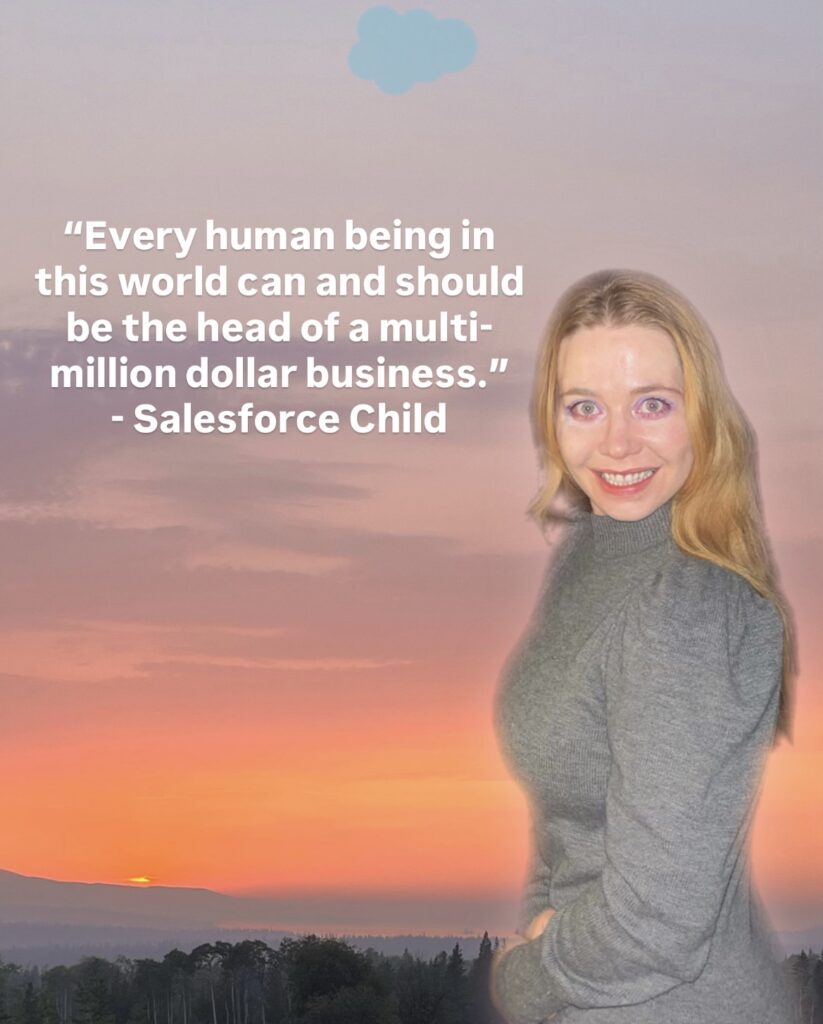
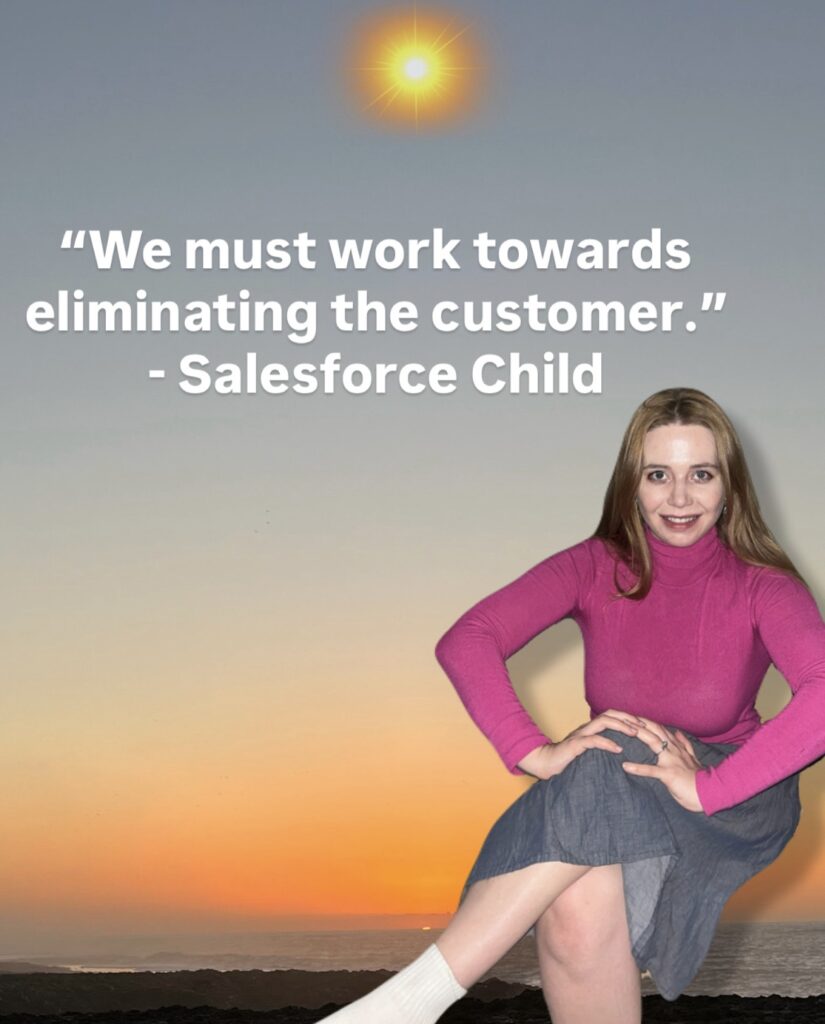
Do you think of your paintings as religious icons for a failed future?
Salesforce Child: Religious icons for an excitingly amazing future that we have no power to stop and we are all ecstatically looking forward to it.
Because your work comes from experiences of class, scarcity, and survival, does making art ever feel like a way of metabolizing shame or fear around money?
Salesforce Child: Yes, well, I don’t feel any shame about it, thankfully. I’ll tell anyone exactly how much is in my bank account at any time, IDGAF. Trying to live as a working artist really elevates the scarcity mindset because getting paid is so sporadic (to be clear, I do have a part-time job at the moment, which is also necessary to do from time to time). I do not have a hustlers mindset at all and it comes to bite me in the ass frequently. I have extreme fear and no motivation to do anything about it. The humiliation of trying to make money is so great I’d rather suffer. And when I see other people trying to make money (beyond the reasonable amount needed to live), I get so embarrassed for them I wish they would just suffer like me. I do realize I am fortunate to not have to hustle as much anymore as well because I live in a cabin in the mountains and grow most of my own produce but I made that change and structured my life this way on purpose because it was getting too hard to pay rent and groceries and everything else in the city.
Has economic precarity affected not only what you make work about, but the way you physically make work — the materials, scale, pace, or urgency?
Salesforce Child: Oh yes. Very much so. With oil paints I am very conservative about the amount because I don’t want to buy more and that definitely impacts how the work looks. I also paint with mostly tiny flat brushes because those are cheap and replaceable. I just got a proper computer for the first time ever this year which I am learning to use still. In the past all of my video work has been shot and edited on my phone and this is still the case but someday soon I will figure out how to do it on my computer. I would like to get a better camera since so much of the video work I make is outdoors and is in beautiful landscapes but it’s just not a huge priority right now. I would like to try some new mediums like ceramics, sculpture, but you know, you can’t just try new things like that without investing some money into it. Thankfully the thing that feels the most urgent to me is getting my teachings out there and that is free. I can literally do it while on the clock at a job, and I always have. I guess that is why posting is my favourite medium and I’m sure all of that is true for so many people.


Do you feel that Salesforce Child protects you from being too exposed, or does she actually expose you more?
Salesforce Child: Salesforce Child is my protection 100%.
When Salesforce Child appears in video or performance, what happens to your body? Do you feel like you are acting, channeling, preaching, or transforming?
Salesforce Child: I am channeling for the most part. At least that how it feels when it is working well. I am summoning and becoming Salesforce Child; and my regular self is not present. Salesforce Child is a sublime presence who also wants to inflict psychic harm on the audience.
Your upcoming solo exhibition is titled 5,000 More Years. What’s the story behind that title?
Salesforce Child: With 5,000 More Years we are basically envisioning the next 5,000 years of capitalism. Sort of a playful inversion of the famous Mark Fisher quote “it is easier to imagine the end of the world than the end of capitalism”. Here I am imagining capitalism never ending. Which is actually much harder than imagining the end of the world or the end of capitalism. I think I chose 5,000 years because it sounds good, it’s a long time, and also as a reference to David Graebers Debt: the first 5,000 years. How about the next 5,000 years, let’s get it!
And what was your inspiration behind this new body of work?
Salesforce Child: I think the very first seed for this work was learning about how ChatGPT likes to generate sigils, even unprompted it will frequently bring up sigils, or at least the model running 18 months ago when I started envisioning this project did – and I was imagining the future logos of various corporations as being powerful sigils.
I must mention Exocapitalism by Marek Poliks and Roberto Allonso Trillo because it really expanded my thinking halfway through this project. I had the title 5,000 More Years and the general idea but this book really takes it to the next level and pointed me in the right direction. I was also very inspired by Natasha Dow Schull’s Addiction by Design: Machine Gambling in Las Vegas, specifically the idea of the machine zone which all of these gambling addicts aim to escape to, and how the machine zone is something we are all engaged with now. Jeffrey Sconce’s The Technical Delusion and Franco “Bifo” Berardis Heroes: Mass Murder and Suicide were also hugely influential to me during this time.
Other more aesthetic or vibes based inspirations include the movie Aniara, J.G. Ballards High Rise, Solaris, Heavens Gate, The Breatharian Institute of America, Zen Master Rama. The paintings are definitely inspired by a lot of new age art. And of course countless hours of conversation with my husband Oliver Samuda.


Where do you think your work is heading after this — deeper into the machine, further into the wilderness, or somewhere stranger between the two?
Salesforce Child: Something stranger between the two, yay!
Can you walk me through your creative process from beginning to end result?
Salesforce Child: No, absolutely not.
Can you also tell me about your use of symbolism?
Salesforce Child: Salesforce is a symbol for the unknowable divine, because it is unknowable and divine. And so is Mr Beast, Rio Tinto, oil rigs, container ships, etc.
How do you approach color?
Salesforce Child: I am usually thinking a lot about balance with colour and aiming to use colours beside eachother that really pop as I like my paintings to really saturate and almost burn the cornea. I want to make a painting someday that hurts so much to look at it for too long it makes you feel ill.
Ok SFC, now to something totally different. In a parallel universe who would you be? and what would you be doing?
Salesforce Child: There are so many millions and thousands of me in many universes that are doing so many things. I think in a parallel universe I am a completely still body of water stretching out endlessly to a flat horizon, and there is nothing else around as far as the eye can see, as this is what I picture myself as the most in my minds eye, so it must be real somewhere.
What do you think people are really worshipping now?
Salesforce Child: Everyone is worshipping their own individual thing and they have no idea what it is as they likely don’t think about it.
If Salesforce Child had one final teaching for the end of the world, what would it be?
Salesforce Child: Freak the fuck out and panic sell everything now.
Outside of art, what’s something you’re obsessed with right now, maybe a hobby, a show, or even a food—that keeps you grounded or inspired?
Salesforce Child: Trying to spot bears in the area at all times and bringing binoculars with me everywhere I go in case I see one so I can get a closer look. I like to see other animals as well but it’s really about the bears for me. I saw a cinnamon bear last week and it was very exciting. I saw a very healthy looking black bear today running very fast. There is a nice fox I see often. A few months ago there was a moose curled up asleep in the backyard, but that’s more of a winter thing, you wouldn’t see that now. There is a great grey owl I see every day (and he is featured in the video piece I made for 5,000 more years) and I am happy about our relationship or lack of relationship cause he really DGAF about me and ignores me which is the best you can hope for with an owl. Spotting the creatures makes it all worth it. On the other hand it also feels very grounding and self esteem boosting to be at war with animals and to be in direct competition with them. Like I get a lot of deep feelings of satisfaction when I chase off a coyote or some horrible nasty deer who are trying to fuck with me and my life by destroying the garden.
Can you tell me a story about a time when a connection with someone had a big impact on you?
Salesforce Child: Unfortunately I have never had a connection with another human being.
What qualities do you find most important in the people you choose to spend time with?
Salesforce Child: It’s important that they don’t challenge my authority in any way, or push back on anything I say, as I’ll start crying immediately.
What motivates you?
Salesforce Child: Fear and greed!
How would you describe a perfect day?
Salesforce Child: I am taken to the top of the Salesforce tower. I barricade myself in the tower and spray the security guards who would presumably try to remove me in the eyes with a fire extinguisher. I start hurling office chairs out the window and watch them explode on the ground below. All of the employees are trapped in there with me and as the sun goes down strange things start happening.
Alright SFC, I always ask these two questions at the end of an interview. The first is. What’s your favorite movie(s) and why?
Salesforce Child: The movie that I have seen the most times in my life is definitely Oceans Eleven as I watch this when I am sick or feeling bad in any way. I watch Oceans Eleven probably multiple times a year. I like to watch it because it is the most movie movie ever made and it’s relaxing atmosphere as everything goes according to plan. Does that make it my favourite movie? I don’t know. I forget what my real favourite movie is, you would probably get a different answer every day.
The second is. What song(s) are you currently listening to the most right now?
Salesforce Child: All of Slayyters WGIA which I have listened to in full almost every day since it came out and also all of the new Boards of Canada album which I have listened to every day since it came out as well.