
Share this
David Taylor is a Scottish-born designer known for his highly distinctive approach to creating objects that blend art and functionality. Based in Sweden, Taylor specializes in crafting unique pieces that view function through a sculptural prism, his work is mainly presented in metal and most recently focusing on aluminum with a diversity of other materials taking supporting roles. His work is transformative, taking the mundane and imbuing it with a sculptural quality that challenges traditional notions of utility and beauty.

Taylor’s work is characterized by a mix of industrial aesthetics and handmade craftsmanship. He often uses patina, oxidation, and associated techniques to emphasize the natural properties of metal, which gives his pieces a rough, unfinished look that is central to his design philosophy. Despite this industrial edge, his work maintains an elegance and thoughtfulness that make it more than just functional.

Hi David! It’s a pleasure to sit down with you! First question that I always ask. How does a regular day look like for you in Sweden?
David: Outside of the routine of family life? That’s quite a rare thing when you spend your time making things you’ve never made before to have a regular day. There’s never any routine in that. It’s sort of like meeting a parade of problems and issues to be dealt with in order to reach where you want to be, and there’s no way of just falling back on routine for that. Most days involve at least one walk in the forest with my partner and during the summer we always make time for a swim in the lake when the kids are at school. I spend quite a lot of time in my workshop doing stuff but as far as a typical day, shit, sometimes I long to have that rhythm.
Growing up, what kind of kid were you? What did you enjoy doing, and how did you spend your time?
David: I grew up in Scotland in the early 80s, there was no easily accessible entertainment, content wasn’t invented yet. Other easy distractions like TV games and videos, those were for rich kids. I had a hands on approach to life, I loved building bicycles, tree houses, I did a LOT of skateboarding. I went around with a bicycle gang and did stuff and got into trouble. It was kind of normal childhood for that decade I suppose. But fun was something you created by looking for it and exploring its limits, it wasn’t an on demand thing.

I’m curious, seeing that you’re originally from Scotland, that brought you to Sweden?
David: I moved to Sweden because I fell for a Swedish architect! It was her practice that provided an avenue into the world of design. I used to pore over her design and architecture mags. In Scotland I worked as an electrician with high-tension cables and distribution networks. Arriving in Sweden, I couldn’t continue to do that because so much of the communication around the job was done over the radio, and I couldn’t speak the language, so I had to find something else to do. Design/art/sculpture rather neatly bridged the language barrier.
Alright, so do you remember approximately at what age your creative side started to show?
David: I don’t think it started rather that it didn’t stop. We are born to explore but our naive curiosity sort of fizzles out around puberty, for me it didn’t.
And when did you start showing an interest in designing objects, and particularly interior design objects?
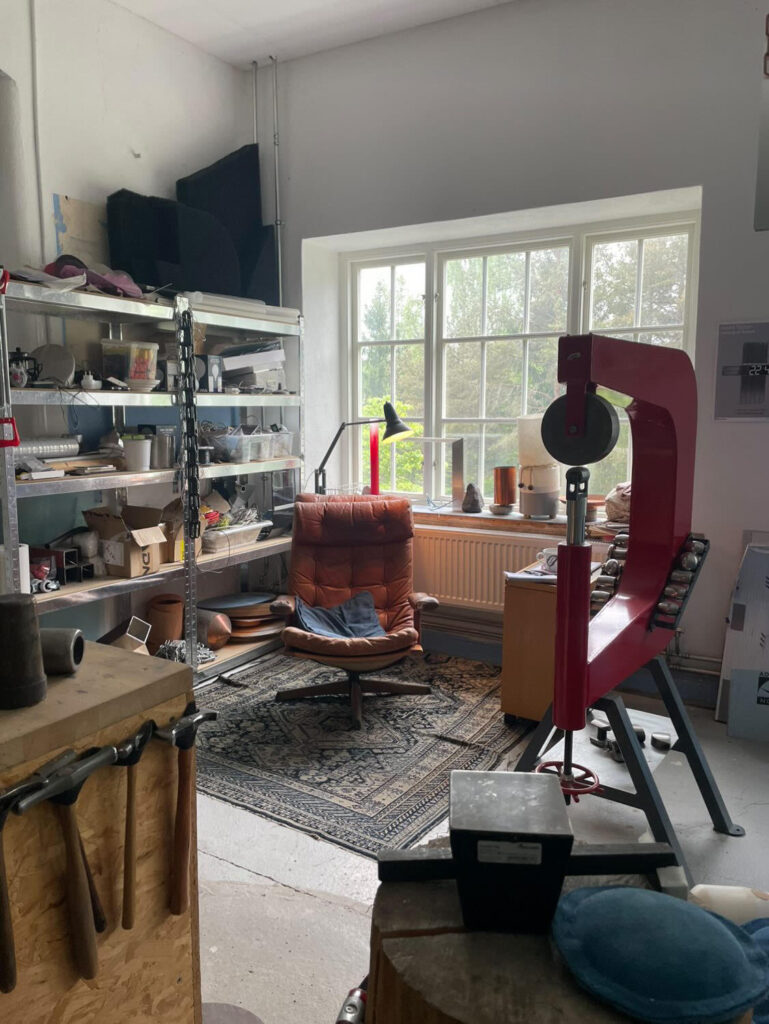
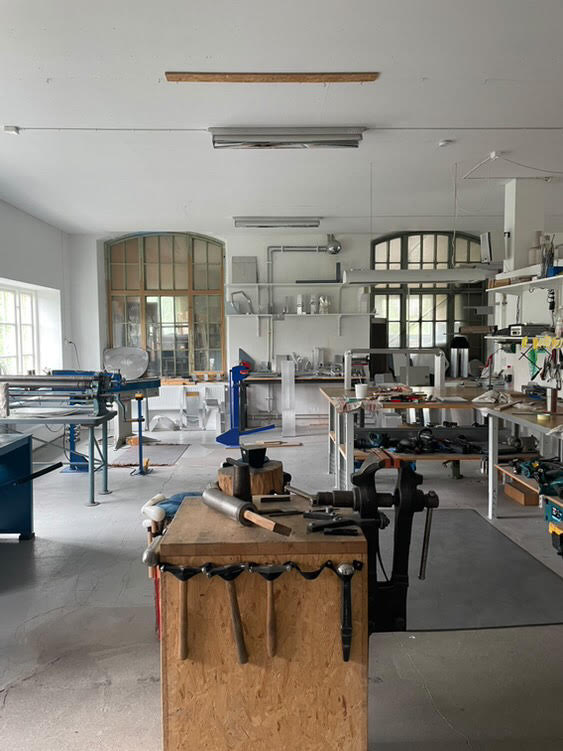
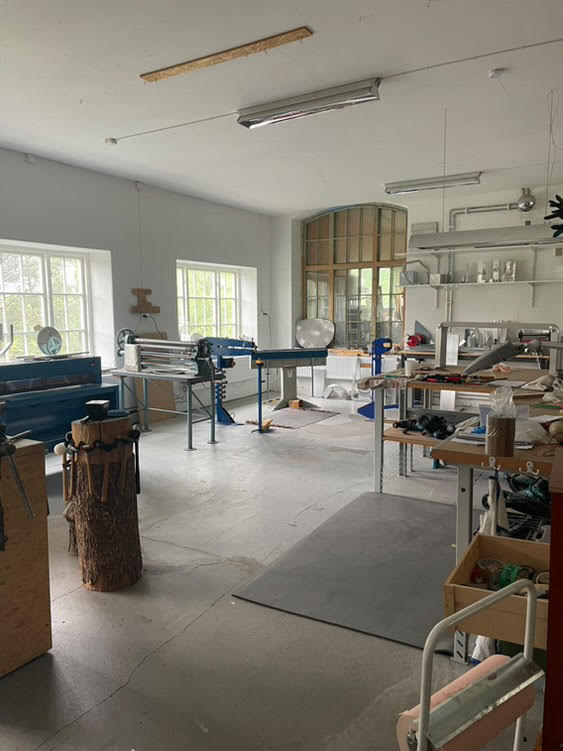
David: I don’t recall a point when I noticed I was working creatively. I guess I never really grew out of playing. Being curious, the love of getting dirty and making stuff are pleasures that I have always enjoyed, so is welding and hammering and being in my studio, listening to loud music, drinking tea, dancing…I enjoy working (mostly!) Lots of things I really enjoyed as a kid I still enjoy today and have been incorporated into the way I work so I guess I never really grew up and got a job, if you look at my studio it’s a more of a playground than a workplace.
So what do you think it is about functional design and sculpture that makes it your preferred medium of expressing yourself, and not painting or ceramics for example?
David: I like the kind of challenges involved in finding solutions, I like making things and tinkering around. There is a logic to everything I do, and a technical sensibilty to it as well. It’s not an inspirational thing rather than a process where one thing leads to another. I could never work with ceramics I really don’t like the dryness the clay brings to your hands and painting… seriously? A blank canvas would give me a nose bleed!

Alright David, these next questions will be regarding your work, which blurs the line between functional design and sculpture. How do you approach the balance between form and function in your pieces?
David: Functional sculpture is a really interesting and exciting area to work in because there’s so many parameters that you need have a relationship to. I like the aspect of function and way it can be used to invite the viewer into the conversation, and that invitation is not only relevant for those who are aware or interested in design, it’s history and development., it’s universal. If I make something and it’s a lamp or a chair, when the viewer sees it for the first time, they understand what it is.
They see a chair, they see a lamp, they understand that there is a function or at least an allusion to function, this is where conversation begins. In that moment we’re in agreement about what it is we’re looking at. It doesn’t have to be translated or seen through a prism, explained or anything like that. It’s an immediate reaction to something you recognize. And I find this really appealing, this moment of agreement, where we both understand the same thing. Opinions, taste, and how willing the viewer is to embrace my view will cause divergence but we started at the same point. I think this moment of recognition and understanding is fundamental too how I approach and edit work that goes on to exhibition.

You often use materials like metal, concrete, and glass. What draws you to these materials, and how do they influence your creative process?
David: I’m drawn to predictable materials like metal, metal always does what you tell it to do. You take a bit of wood for example and you leave it for a couple of days on a shelf, you come back and it’s warped or changed in some way and in a manner that you have no control over. You put a ceramic pot into the oven to glaze and it collapses for no reason. You ever tried working with glass? It’s got a life of its own!!
Metal doesn’t do that, metal obeys! With metal you’re the king. It’s not some kind of a relationship your in with a bit of metal where there’s give and take. There’s no discussion with metal. It’s not like you’re in some kind of co-lab with metal. Metal just shuts the fuck up and does what it’s told and I like that loyalty. I like that metal understands who’s the boss. Same with concrete, concrete doesn’t shit you around concrete is concrete end of story.
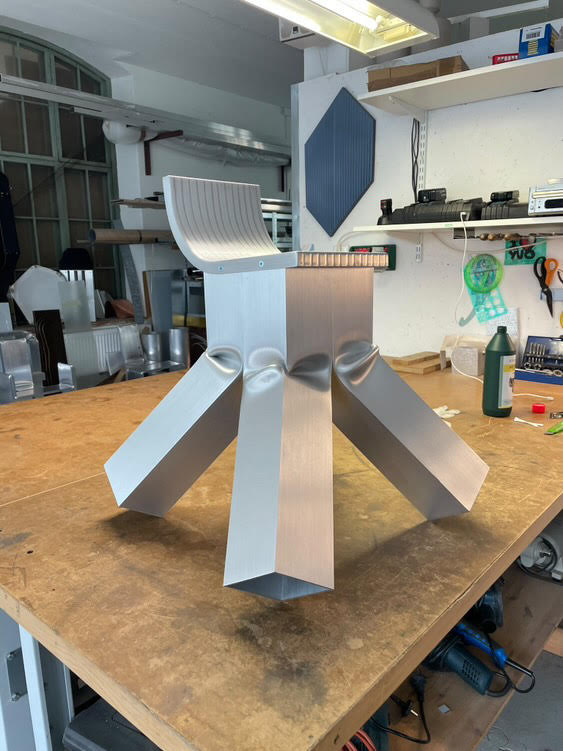
I work with aluminium for many reasons. The malleability of the material and the light colour reminds me of silver. And with my background as a silversmith, I appreciate these characteristics. Aluminium is easy to work with and light. The scrap is reused and aluminium is really easy to recycle. That appealing surface finishes can be achieved by simple methods is important for me as the optics are a crucial part of my work and how it presents itself in the space it occupies. But mainly I like aluminium because it is so neutral. I think that aluminium is an interesting metal for what it is not. It is not brass or silver, gold or iron. Metals with clear identities that seem to always have always existed. Aluminium feels modern, new and unexplored.
Aluminium is ubiquitous. It is everywhere. It is a standard material that you can buy easily all over the world in a standard format. It is also cheap compared to other metals. You get a lot of aluminium for the money and that allows a greater room for failure, which is a vital component in all experimental work.

Your designs have a raw, industrial aesthetic. Can you talk about how you develop that particular style? What influences shape this look?
David: I think the rawness you talk about comes from the materials I use and how the viewer associates with these materials. Personally I see a warmth and generosity in the work where brutality is tempered with fluidity. A softening of corners and feeling of lightness where pieces are slightly lifted from the surface they stand on. I like the contrast, hard-soft, cold-warm. I really like the early work of Ron Arad, the whole Droog thing, Jonas Bolin, Ingo Maurer, I mean Rory Graumans iconic 85 lamps is still my all-time favorite lamp.

How has your Scottish heritage and your current life in Sweden influenced your approach to design?
David: I don’t feel that my Scottish background influences my process or the decisions I make in the production of work, however the expansive and highly refined repertoire of expletives that come into use when things don’t go as expected has rich West Coast of Scotland pedigree
Many of your pieces seem to challenge the viewer’s expectations of utility. How do you decide when an object is meant to be more art than design—or do you see them as one and the same?
David: The viewers expectations are not really a consideration when I work, I know it sounds arrogant but when I’m working I’m not thinking about what anyone else wants, it’s not really part of the process.

You use a lot of unconventional techniques like patina and oxidation. Can you describe how these methods contribute to the personality of your pieces?
David: I’ve worked on and off with scrap, found objects, reappropriated material and debris from demolished buildings for years. Every piece of material you hold in your hand has history and potential. The history is already there and the potential not yet reached so you do what you have to do to discover what that potential is and how to achieve it, so everything (within reason) is on the table techniques wise.

How has your design philosophy evolved since you began your career? Are there any pivotal moments or projects that have significantly changed your approach?
David: My work has been fluid since leaving art school 25 years ago. Working with products, sculpture, studio crafts and public space commissions.
Up until 2008 I worked mainly as a silversmith. I made silver objects and they were experimental to a degree but silversmithing is a fairly conservative area of the crafts The work is very controlled, the material is very expensive and my clients had certain expectations… I mean they want their stuff to look good but there’s not a great deal of experimentation going on when objects are being made in silver.
In 2008 we experienced a huge crash in the global financial markets which meant that pretty much all of my regulars, you know, the ones who could afford commissioned silverware, suddenly had other stuff to worry about so pretty much overnight I had no work. To deal with this I really had to start from the beginning, rethink my process and approach my work from a new angle.
The price of silver had just quadrupled, I had no customers but I had a range of usable skills. One my first moves was to try to find an alternative material to work with, something cheap, I had no idea what, but some kind of alter ego to silver had be found. My local hardware store furnished me with a bag of cement, it was here the process of reinvention started.
When you work with silver you make very careful sketches that become very careful drawings, you plan your work, you buy your material, you carefully cut it all into the right shapes to avoid as much waste as possible and then you just make the thing, during the making process there’s no margin for experimentation, you make it as you planned it and the end result looks like your drawing.
With the bag of cement however, I just added water and winged it, with no clients and a bag of cement I really rediscovered the fun in making, I started incorporating found objects, scrap metal, stones and anything that was cheap or free and not wood (I’m not a fan of wood) was folded into the work. Next door to my studio was a glazier and they had a lot of aluminium scrap and I had a stockpile of brass sheet so all these elements were exploited to make more complex and visually arresting objects. 2008 was a pivotal year for me, it was when I stopped working in silver and started looking for something more challenging.

You’ve collaborated with various galleries and design brands. What do you look for in a collaboration, and how do those partnerships influence your work?
David: I look for balance and if balance is not there I’m not interested, of course there is give and take but mutual respect and a willingness to discuss is a must. It’s also important to work with people who are in a position to make decisions and not just report to up the ladder and wait for feedback. Honesty and transparency is essential as a collaborator, you have to be able to see the whole picture and how your input relates to it both in the long and short term. I pass on projects that I don’t believe in, that I can’t give 100% to or feel that I am not really the right person. Don’t get me wrong, I’m not afraid of a challenge and it’s has to be waaaaayyyyy cool if I’m going to swallow the no budget but “Good for your career” nonsense from a heavy weight brand. I’ve got bill to pay like everyone else. But if it’s fun and interesting and means a bit of thought is needed then I’m in.
Your designs often provoke reflection on everyday objects. What do you hope people take away from interacting with your work?
David: We are surrounded by objects, things compete for attention and everywhere we look there is stuff, I think there is meaning in elevating stuff so that it becomes worthy of our scrutiny allowing stuff into our lives. Everyone has a favorite mug or piece of jewellery. I think it’s possible to surround ourselves with a favorite everything from socks to toasters and not settle for generic blandness. If we could have a connection with everything we own, remember where we bought it, and why, who made it, what it cost, why we like it I think we would make more conscious decisions about our stuff instead of just buying crap because it’s cheap or solves a non existent problem.
I’m not a huge believer in the benefits of mindfulness especially in relation to what I do, I’m very reactionary in my practice but I believe mindfulness in consumption is essential and designers of all types have a roll in promoting that. About 20 years ago I engaged in a “no throw policy” with regard to food. The concept is simple, I never throw away food, I eat everything I buy. This resulted in me buying better ingredients and making better food, it raised my awareness and made me more picky. Instead of buying lots of cheap food (canned ravioli, frozen meals, cheap meat products) and ending up throwing half of it away I bought less but higher quality ingredients, you don’t buy a bunch of expensive organic veggies just to chuck them out, they have value, they represent something, they are worth the effort and the end cost is the same because there is no waste. We should have a no throw policy when it comes to stuff…

As someone who pushes the boundaries of design, how do you see the future of object design evolving? What excites you about it?
David: I consider myself an artisan or a sort of artist, a designer? Perhaps a functional sculptor, definitely a materials nerd. A technique- and process-interested sudoku-loving tea drinker and former cat owner. I have a very specialized skill set that I enjoy exploiting and using to test ideas, the work that I make, in truth, is more of a byproduct from an ongoing evaluatory process than the result of research aimed at reaching a conclusion. I mean it flows without a goal. As we head into an era where AI is expected to outmaneuver human creativity I think aimlessness is a strength and I feel optimistic. Artists, musicians, designers, experimenters, innovators, punks and weirdos.
We all live in the cracks, in the space in between. It’s the radicals and the boundary pushers that form the future and give the solid mass of indifference a direction. As with every innovation AI will be leveraged to give individuals and corporations an advantage over their competitors, to achieve more, generate greater profit, to grow. But if you are not motivated by growth or profit, if fulfillment is more important than success and material gain then AI is not going to screw you over. If you don’t need a goal or a road map and you don’t allow yourself to be told what you should want and what you need in your life then you’ve gained so much freedom.
Imagine a bowl full of marbles, each marble a company or a group, a trend, a tv show, a band, whatever category you like, as the marbles become larger and fewer as they grow and swallow up each other so does the space in between, the space in between is where it’s at. The next big fashion trend is not being developed by a billion dollar fashion house but on the streets of Guangzhou and is spread on Tik Tok. The music industry wouldn’t exist without the dingy clubs and the energy of the experimental sub genre. It’s the space in between that excites me because it’s not a closed space it’s totally open to everyone.

Can you walk me through your creative process from beginning to end result?
David: My approach is purely practical and often physical and not theoretical in any way. I want a result I can feel and hold. I see the space that I work in as a place of refuge, as a place of calm, my man cave, it’s a playground. I don’t write about my work too much and I don’t describe it in any detail to anyone who’s not interested. What I do is I come in to the studio mostly without an agenda and I use the material and the tools at my disposal to learn something. I love the freedom that the studio offers, it’s like an airline ticket to anywhere.
And I love that excitement of not really having a direction. It’s like taking your first steps in a foreign country where you don’t know the language and time just stretches out in front of you. So there’s no doctrine, there’s no red thread, there’s no vision. There is purely the here and now and the joy of experimenting and making stuff that I’ve never done before where loud music and tea drinking are part of the vibe. Pretty much everything I make, I’m making for the first and the last time. Making a series of three pieces is mass production in my world. I have a really comfortable chair, I take a break, do a sudoko, I work and enjoy my time at work. And that’s pretty much the whole point of my practice. The creative process is just a series of reactions to the results of open questions like “what if I do this”
Of course I have to earn money so I do commissions and have exhibitions and things like that but my creative process is not a linear thing with a number of steps that I follow, I’ve made work in the past in order to experience the making physically in my body as well as in my head. The result is that I know how it feels to make that object not necesserally that it’s finished or resolved it in any other way but I know how it feels. I know all this sounds a little spaced out but I’ have no better way of describing what I do, I mean I think if I fully understood what I’m doing it would probably be time to move on.

Can you also tell me about your use of symbolism?
David: Symbolism appears very much where you want to see it, especially in functional objects that have a recognizable symbolic value or liturgical purpose, I don’t seek symbolic references but if it’s there it’s there and I will exploit it.
So with what we just talked about, what are you hoping to convey?
David: Hoping to achieve something is not really the way I work, hope implies an element of uncertainty and I’m not uncertain, I’m convinced when I start a project so I’d have to say I hope (sorry couldn’t resist) my work conveys conviction.

Now to something totally different…. In a parallel universe who would you be? and what would you be doing?
David: I’d love to be Jack from the British criminal series “Silent Witness.” He’s a big strong MMA fighter and a straight-talking, quick-witted academic at the same retaining a humble self distance and a sensitivity for the needs of others. A multifaceted modern man who I’m pretty sure smells good. And if I was Jack I’d be playing professional golf, it’s seriously well paid, the concept is pretty easy to grasp and you can be really good at golf without having to sacrifice beer, kebabs and other unhealthy stuff.
Can you tell me a story about a time when a connection with someone had a big impact on you?
David: Years ago I’m like 20 or so, I saved up and bought an old rusty Volkswagen camper van and had big plans to “see the world” I just had to fix it up a little first. Every time I fixed something I found something else that needed fixing and it was beginning to take more time than I expected but for such an ambitious trip the camper van had to be in good condition.
My step mother had a birthday party around this time and the whole village was there, my Dad introduced me to Jimmy, Jimmy was an old guy who lost his twin boys when he got divorced, the boys mother had taken them to South Africa and Jimmy had no money and couldn’t afford to visit them. But Jimmy was a welder so he used his skills to weld together a sailing boat in sheet steel and when it was built he set off to South Africa to see his kids. It took him 2 years to build the boat and about 6 months to get there.
I told Jimmy about my plans with the camper van and all the repairs it needed and rounded of with “so as soon as she’s ready I’ll be off” I guess I was expecting some kind encouragement but Jimmy just said “bullshit!, you’re going nowhere” I’d garnered a bit of an audience as I talked about my plans I was shocked and embarrassed by Jimmy’s comment, but he continued “What’s gonna happen is you’re gonna piss around with that camper van for months and every day your dream is going to feel a little bit less realistic until you talk yourself into thinking it was a stupid idea to begin with. Then you’re going to meet somebody or get a better job or some other thing that makes it easy to be sensible, and that’s going to be your excuse for you not doing what you really want to do. But do you really want know why you’re not going to do it? You’re scared. You’re scared because you’re small and the world is big and you don’t want to put yourself in a situation where you feel out of your depth, challenged or not in control. If you really want to go, get in your van and go. Don’t sit there and telling me about your dreams, just go and fuck off and live them.” (I’ve tweeked his speech a bit for dramatic effect but you get the just of it, it was a Hollywood moment)
He really pissed me off and hung me out to dry but that public humiliation was an important lesson. My step Mums birthday was in Mid August by mid september I’m rolling into Istanbul in my camper van, I’m still on that journey….

That’s a dope story.. Ty for sharing it with me… What qualities do you find most important in the people you choose to spend time with?
David: That is such a hard question to answer because everyone has such an extensive collection of positives and negative charactaristics and so much of how you get along with a person depends on so many random factors. One thing that all my friends have in common is generosity, generosity comes in so many forms but I think we are always generous with the people we like and love. When I meet someone who I instinctively feel an aversion to I try to be generous and it usually works itself out.
Anybody you look up to?
David: Everyone who gets up in the morning and contributes to making the world a better place in spite of the hurdles that are continually thrown in their way. Everyone who can sing. I have a lot of respect for people who struggle to achieve things whether they reach their goal or not. I really look up to people who understand things that I don’t. Show me someone who gets Microsoft Teams and I’ll vote for them for President.

What motivates you?
David: I’m a very unmotivated person until I’m trying to prove someone wrong or understand why something that should work doesn’t. If someone says “You can’t do that” I’ll make it my life’s mission to do it. Some kind of strange revenge complex I suppose.
How would you describe a perfect day?
David: Drinking sangria in the park..
Alright David, it’s been a long one, thank you for hanging in there with me….! I always ask these two questions at the end of an interview. The first is. What’s your favorite movie(s) and why?
David: Just rewatched “All the Presidents Men” with my son, he was totally engrossed as he was watching for the first time and the discussion afterwards was really cool. That shared experience really elevates this movie and knowing watching it together will probably become a core memory for him sort of gives me goosebumps, Indiana Jones and the Temple of Doom is a close second.
The second is. What song(s) are you currently listening to the most right now?
David: …really digging Jane Weaver and Kalabrese right now, when I’m working it’s usually some derivative of electronic music, Micro House, progressive stuff like that. Not too challenging but atmospheric and a little stressed.