
SCANNER
UNDERCOVER’s Long Love Affair with Twin Peaks Isn’t Over – It’s Evolving
Why Stüssy and GORE-TEX Still Believe in the Outside World
ARoS Opens the Sky: James Turrell Completes His Most Expansive Work to Date
Una Rutina Gives a Raw & Unfiltered Look at Medellín, Colombia
The Mountain Is the Message: Moncler Grenoble FW26
Palace Presents Spring/Summer 2026 Collection
The North Face Red Box: A 90s Pulse, Rewired for Now
When Tomas Gittins Lets the Painting Look Back
Sawyer Gilley on Sex, Power, and Why Hollywood Is Lying
Why Jean-Michel Basquiat Always Started with the Head
OVERSTANDARD – Culture & Creativity
  • FASHION
  • ART & DESIGN
  • INNERVIEWS
  • ARTICLES
  • PHOTOGRAPHY
Tag:

Giorgio Armani

    ARTICLESFASHION

    Giorgio Armani, 1934–2025: The Designer Who Redefined Elegance

    by OS Staff September 4, 2025
    written by OS Staff

    The Armani Group has confirmed the passing of Giorgio Armani at the age of 91. With him goes not just a designer, but a man who quietly reengineered what the world understood as elegance. Armani didn’t shout his vision; he dismantled the noise around luxury and replaced it with something cleaner, sharper, and infinitely more enduring.

    When Armani emerged in the late 1970s and 80s, fashion was still intoxicated with excess: big shoulders, gilded trims, ornamentation that often drowned the wearer. Armani moved in the opposite direction, stripping everything back until only line, cut, and proportion remained. His mantra was clarity. His medium was restraint. The result was a new language for dressing that spoke directly to a generation stepping into boardrooms, red carpets, and city streets with equal urgency.

    The unstructured suit became his revolution. By softening tailoring—removing padding, easing seams—he liberated both men and women from the stiffness of formality. Paired with the hushed neutrality of what became known as “Armani gray,” these pieces created an aesthetic that was at once radical and timeless. Executives and Hollywood stars alike adopted the Armani look; Richard Gere in American Gigolo practically became a moving advertisement for the brand, while the wardrobes of entire corporations seemed to bend toward his vision of power dressed in quiet tones.

    But Armani’s impact can’t be reduced to suits. He expanded into eveningwear, sportswear, fragrance, interiors, even architecture—yet the throughline remained the same: luxury without ostentation, glamour without glitter. Armani gave permission for elegance to breathe, for minimalism to feel sensual, for confidence to come not from decoration but from presence.

    Culturally, Armani belonged to the same era as cinema auteurs and music icons who redefined what cool looked like. He understood image as much as fabric, often collaborating with filmmakers, outfitting stars, and embedding his clothes in the visual language of modernity. The Armani woman was intelligent, ambitious, and self-possessed; the Armani man was urbane, refined, but never loud. In a decade obsessed with spectacle, Armani’s clothes were the eye of the storm.

    Today, when we talk about quiet luxury, stealth wealth, or the cult of minimalism, we are really speaking Armani’s language. His designs prefigured this cultural shift by decades, showing that the absence of noise could be the loudest statement of all. Every contemporary designer who pares things back to “just the essentials” owes something to Armani’s insistence that less could, in fact, be more.

    Even as trends swung wildly—from maximalist streetwear to logo mania—Armani’s work remained consistent, a North Star of discipline in an industry addicted to reinvention. His shows, his boutiques, his brand universe: all carried the same whispering authority. They didn’t chase attention; they commanded it by staying true to his original vision.

    Armani’s passing is the end of an era, but his influence is inescapable. It lives in every drape of fabric that falls just so, in every silhouette that privileges movement over rigidity, in every designer who tries to make clothes that feel lived-in yet powerful. He redefined not just how people looked, but how they felt in their clothes: less adorned, more themselves.

    To remember Giorgio Armani is to remember the possibility of luxury as clarity, of elegance as restraint, of fashion as something that doesn’t decorate life but gives it shape. At 91, he leaves behind not just a global empire, but a philosophy that will continue to ripple through wardrobes and runways for generations to come.

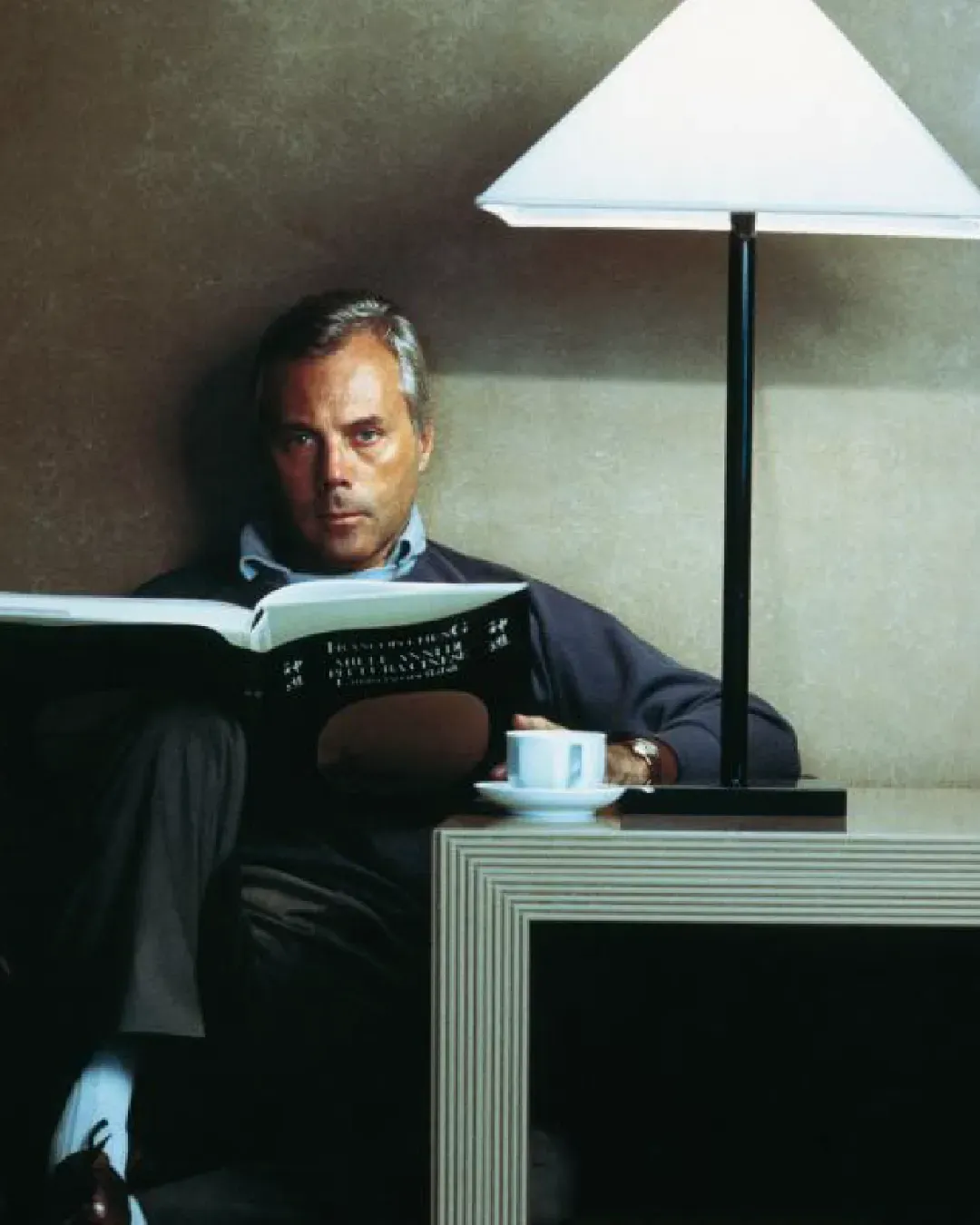
    Ph. Giorgio Armani

    Share this:

    • Tweet
    • Telegram
    • WhatsApp
    • More
    • Print
    • Reddit
    September 4, 2025 0 comment
    0 FacebookTwitterEmail
  • LIFESTYLE

    Giorgio Armani at 91: Reinventing Italy’s Oldest Club, Capannina di Franceschi

    by OS Staff August 29, 2025
    August 29, 2025
    0 FacebookTwitterEmail
  • FASHION

    Giorgio Armani and Kith Unveil “The Archetype”: A Cinematic Exploration of Modern Masculinity

    by OVERSTANDARD September 6, 2024
    September 6, 2024
    0 FacebookTwitterEmail

SIGN UP FOR OUR NEWSLETTER

Categories

  • ART & DESIGN
  • ARTICLES
  • CINE
  • CULTURE
  • FASHION
  • GAMING
  • INNERVIEWS
  • LIFESTYLE
  • MUSIC
  • NFTs
  • PHOTOGRAPHY
  • SPORTS
  • TECH
  • TOYS

Categories

  • ART & DESIGN (717)
  • ARTICLES (28)
  • CINE (174)
  • CULTURE (225)
  • FASHION (2,013)
  • GAMING (57)
  • INNERVIEWS (393)
  • LIFESTYLE (103)
  • MUSIC (92)
  • NFTs (102)
  • PHOTOGRAPHY (53)
  • SPORTS (33)
  • TECH (108)
  • TOYS (118)

Recent Posts

  • UNDERCOVER’s Long Love Affair with Twin Peaks Isn’t Over – It’s Evolving
  • Why Stüssy and GORE-TEX Still Believe in the Outside World
  • ARoS Opens the Sky: James Turrell Completes His Most Expansive Work to Date
  • Una Rutina Gives a Raw & Unfiltered Look at Medellín, Colombia
  • The Mountain Is the Message: Moncler Grenoble FW26

© OVERSTANDARD

OVERSTANDARD – Culture & Creativity
  • FASHION
  • ART & DESIGN
  • INNERVIEWS
  • ARTICLES
  • PHOTOGRAPHY