Share this
by Lena Katharina Streckert
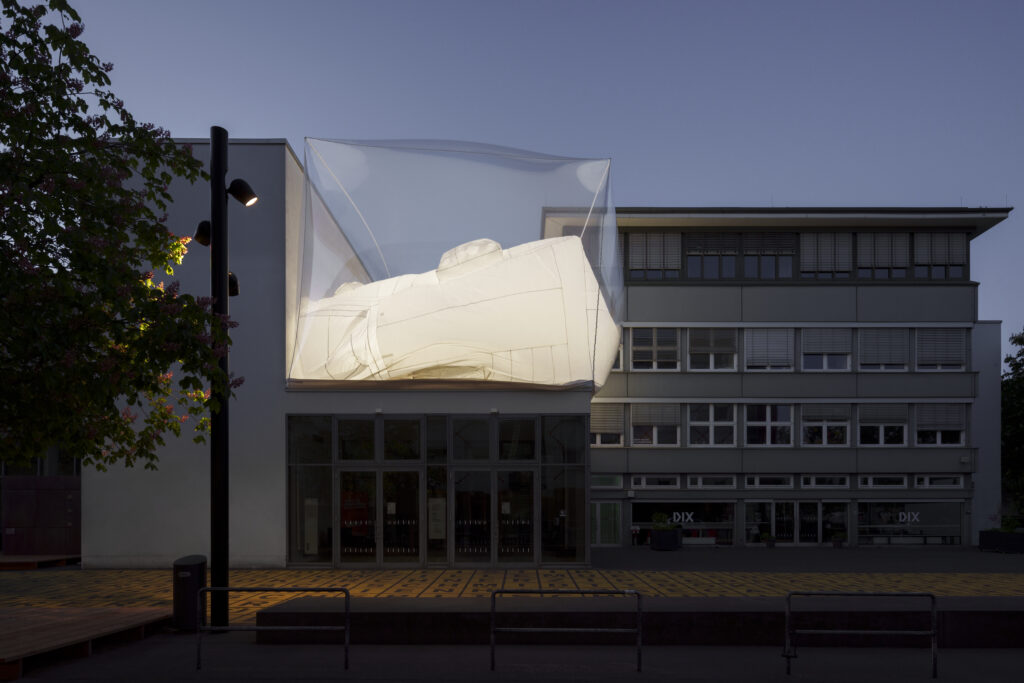
I first came across a work by Daniel Hölzl quite by chance in 2021, on my way to a yoga class at the Lobe Block in Berlin’s Wedding district. High up on the concrete façade of the award-winning, brutalist terraced building hung a small, almost rectangular, white balloon. It confused me, yet at the same time I found it very aesthetic, almost organic – a feeling that many of his works would evoke in me in the future. Back then, I didn’t yet know that the work was by Daniel, but it stayed with me.
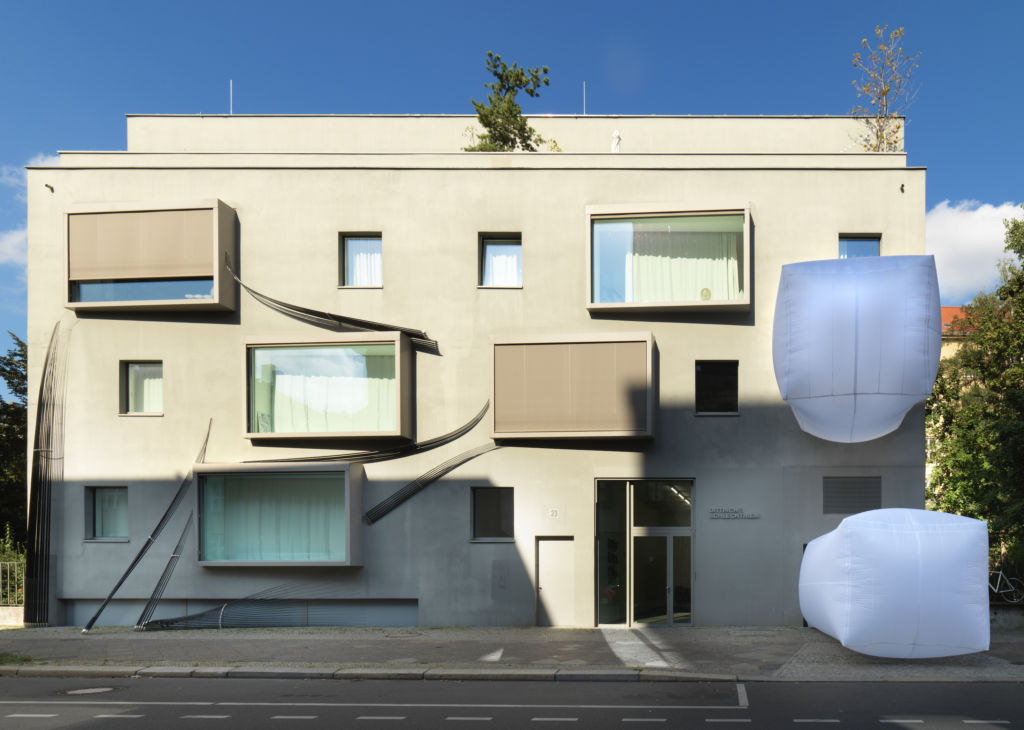
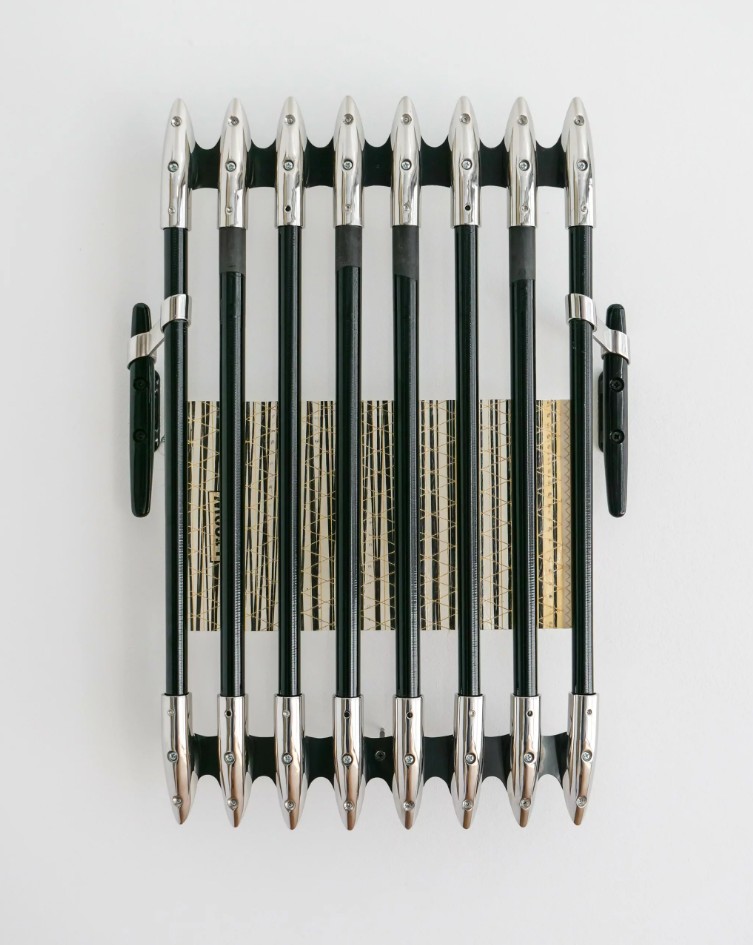
During Berlin Gallery Weekend, I walked past DITTRICH & SCHLECHTRIEM, where, on the gallery building’s wall, alongside deformed carbon-fibre fishing rods and stainless-steel boat railing elements, two similar white, yet larger, inflatables made of parachute silk were mounted. I was standing in front of Hölzl’s exhibition BAIT. From that point on, I kept coming across his works again and again.
Profile picture: Maria Lunetto
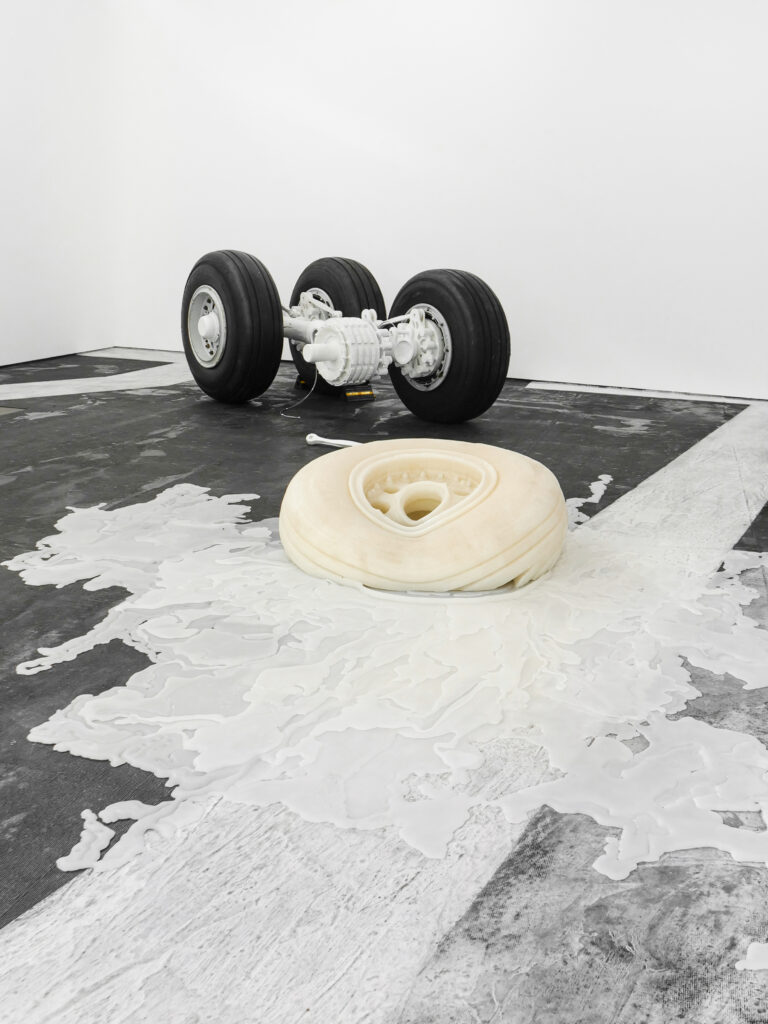
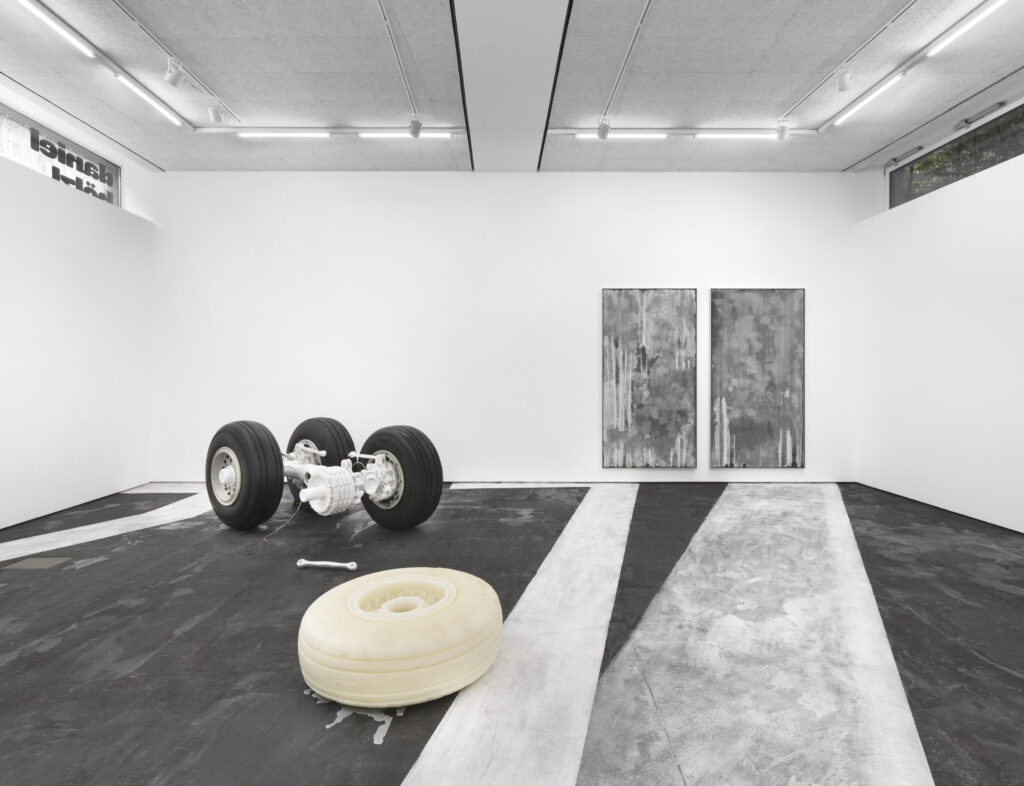
In his solo show GROUNDED (2022), Hölzl transformed the DITTRICH & SCHLECHTRIEM gallery space into an immersive landscape of aircraft fragments, recycled carbon and paraffin wax. It featured an aircraft skeleton protruding nose diving into the room, floor installations made of recycled shredded carbon fibres and a slowly melting copy of an aircraft tire made of paraffin wax.
A few months later, on the day of the Art Cologne set-up, I looked down at the hall’s floor, when I suddenly saw liquid wax flowing towards me. I followed the trail and once again saw a large replica of a dissolving aeroplane tire by Daniel Hölzl. That, if nothing else, was my sign to take a closer look at his body of work.
The more I learnt about his ideas and thought process, the more layers began to unfold. Behind every material there seemed to lie another story; behind every object another cycle. His works deal with materiality, transformation, energy, progress and destruction — but most of all, with the idea that everything is interconnected.
For OVERSTANDARD I talked with the artist about precisely these connections, about his exhibition PROPEL (2025), and about why matter perhaps never truly disappears, but merely takes on ever-changing forms.
Your work is so multifaceted, yet united by the theme of material cycles. What is so fascinating to you about them?
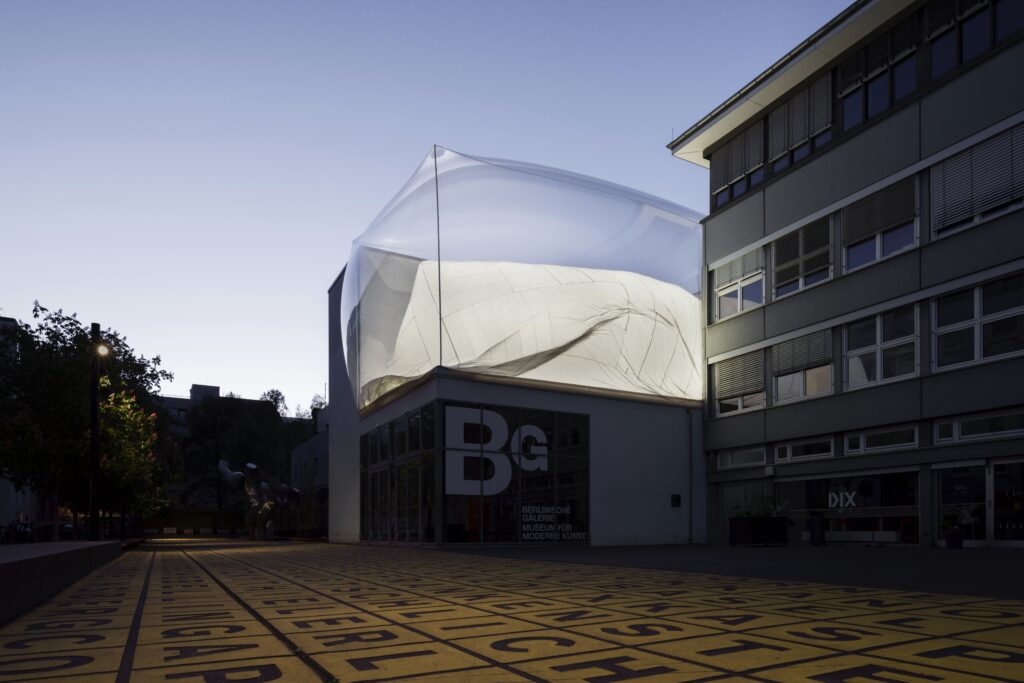
Daniel Hölzl: There are many series of mine that build on this idea of the cyclical nature of a material. The inflatables, for example, recycle themselves. The last and largest inflatable was on display at the Berlinische Galerie in 2025. It consisted of eight former artworks, soft architectures – various 1:1 replicated spaces from Berlin such as living rooms or lifts – which I cut into individual pieces and then sewed back together in a Tetris-like manner to create one large site-specific inflatable.
The works ‘consume’ themselves, so to speak. I deliberately work with recycled materials, which are often incorporated into new works over the course of years and thus continue to exist. The paraffin that was cast into the shape of an airplane tire for my first solo exhibition GROUNDED has since been used in all my paintings. Transformation thus takes place before, during, and after an exhibition and that’s what interests me regarding the potential of materials.
What was the central focus of the exhibition?
Daniel Hölzl: It was about the question of what happens to materials like aeroplanes when they ‘die’ after their final flight. The moment an aeroplane is forever grounded, it is no longer an aeroplane. What happens to these huge amounts of matter after that? Modern airliners are largely made of composite materials consisting of carbon fibres glued together with epoxy resin. At some point, the question arises: what happens to these non-degradable components later on? The big problem today is actually that we don’t really know how to truly recycle them. At present, the most common practice is to park grounded aircrafts in a desert. The core question of the exhibition was in regards of the death of the sum, but not of its parts.
Would you say that these matter cycles are natural or man-made processes?
Daniel Hölzl: Both, and it gets interesting when they overlap. Every plant, every flower, every growing organism is partly made up of carbon. Everything that dies eventually leaves these compounds behind.
Your work often explores contrasts, such as movement versus stillness, or progress and destruction. What appeals to you about this?
Daniel Hölzl: I’m generally interested in dynamic spaces versus static places of retreat. This applies to architecture just as much as it does to means of transportation. In my series AFLOAT, I produce works using parts from former sailing boats and carbon fibre racing sails.
Take a modern catamaran, for example: you have a huge sail – total freedom, wind power, super-efficient, brilliant engineering. Yet at the same time, this gigantic sail is made entirely of petroleum products. It’s precisely this contradiction that interests me. This romanticisation of freedom – flying, sailing, alone in the clouds or at sea – and inevitably the materiality behind it. Often, material just catches my eye and later the research leads me in different directions. It can be as simple as; I see something in a hardware store, or I stumble over fishing rod in a sports shop.
These contradictions keep reappearing in your work — soft, ephemeral and hard, industrial materials, progress and failure, control and loss of control. How do these dualities play out for you?
Daniel Hölzl: I try to play with materials and contrasts in all my work. In GROUNDED, for example, I built a paper mache replica of an aeroplane landing gear, attached three real tires to it and misplaced a fourth entirely different tire. This tire was a replica made from around 300 kilos of recycled paraffin. A heating plate was built into the floor under the replica. As a result, the tire slowly melted over the course of the exhibition, which lasted almost two months. I provided a framework, but the material did the rest and continued to change the room and how visitors moved within it.
Wax is a recurring material in your practice. You use it to cast replicas, but also for your wax pictures. Where does the wax originally come from?
Daniel Hölzl: It comes from old church candles. Of course, everyone can decide for themselves how significant the ‘sacred’ aspect of this is. But I do find it particularly fascinating that one can immediately drift off in different directions. On the one hand, there is, of course, the religious significance of candles. At the same time, however, millions of years of stored energy are being melted or even burned. Paraffin is a side product of petroleum refining so it has come a long way but can release its energy very quickly.

Not only your solo show GROUNDED but also PROPEL featured wax replicas, for example in the PITOT series. Yet something does happen to those object copies due to the change in material to deformation…
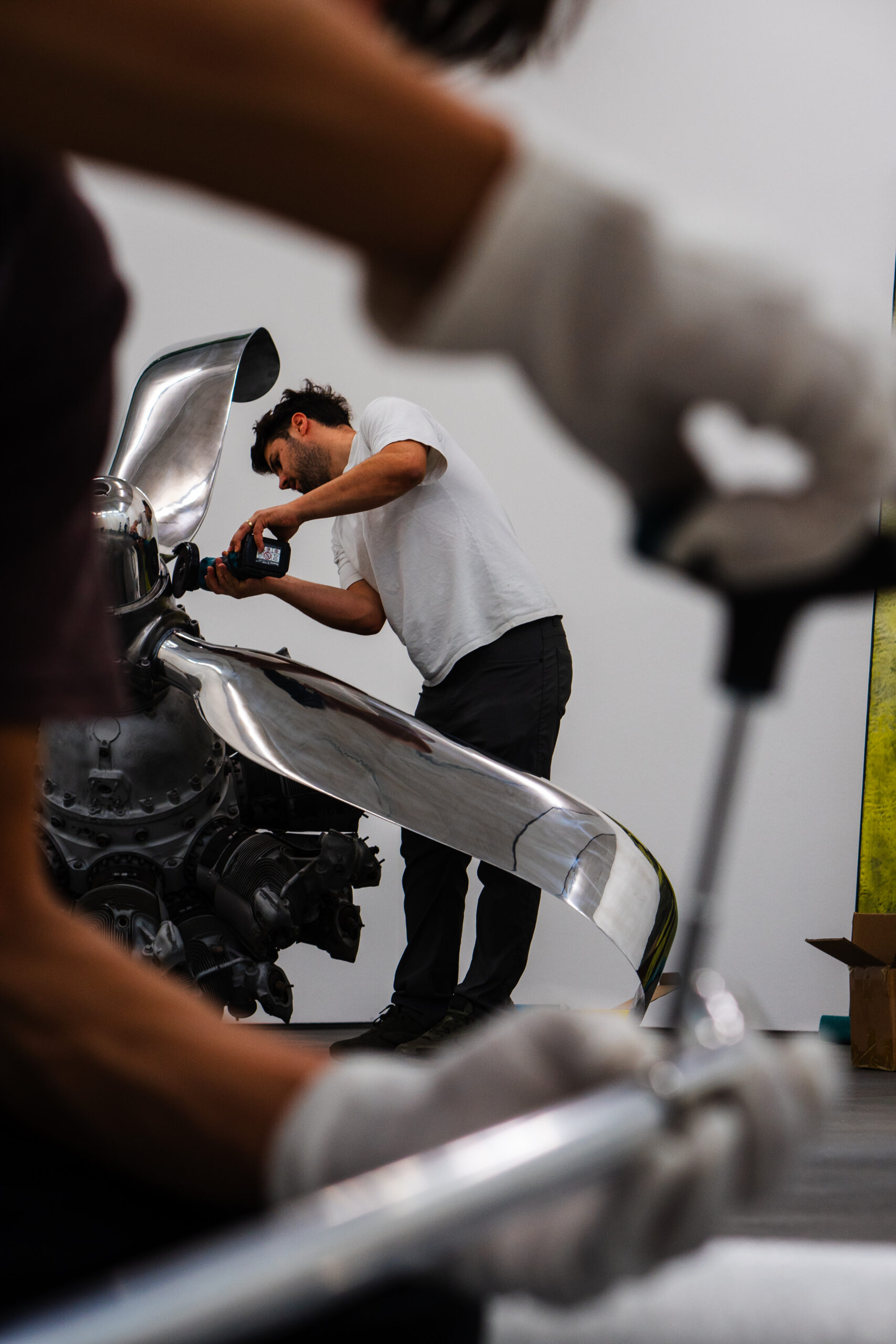
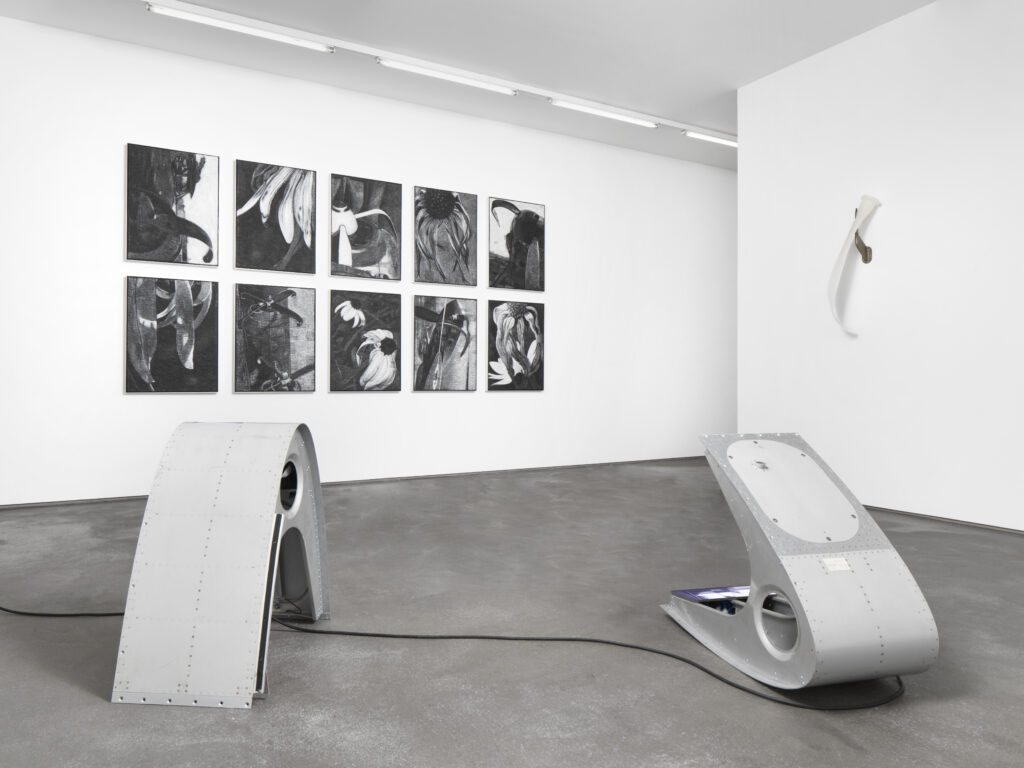
Daniel Hölzl: Maybe a shift in perspective. Similar to what I did previously with the aeroplane tire in 2022, in 2025 I cast propellers in recycled paraffin. For the exhibition, I created three identical wax replicas this way. I then impaled them like pieces of meat. This also relates to the idea of vanitas symbols or paintings, in which the same objects appear time and again: wilting flowers, skulls, meat, bones — in other words, things that address transience or decay. Wax often plays a role in these too.
The propellers hang on so-called Pitot tubes, which are airspeed indicators. Normally, these are located at the front of the aircraft’s nose and measure its speed. Their tips are heated to a high temperature during flight to prevent ice crystals from forming at high altitude. I rotated the tubes 90 degrees upwards and then literally melted the wax propellers onto these tips. So, as if skewered on a butcher’s hook. Due to gravity and the different positioning, all three propellers deformed differently.
Even after they have settled and hardened again at room temperature, there is always the potential for them to continue changing. As a result, they no longer appear rigid or technical, but suddenly soft and almost organic. I’m also interested in the fact that the function of these objects shifts. The Pitot tube is actually a safety instrument. Through this work, it suddenly becomes something aggressive or physical — almost like a hook or a weapon.

How do the two solo exhibitions build on one another?
Daniel Hölzl: GROUNDED focused heavily on the question: what happens to a material after it has lived its live as an airplane? What remains on the ground? PROPEL builds on that but shifts the focus more towards movement and propulsion. The title does mean something like ‘moving forward’. The question was therefore more: What drives us? Why are we constantly moving on? And how are progress, euphoria and failure interconnected?
We’ve talked a lot about time, and how some of your works change over the course of an exhibition. How important are time and temporal transformation to you?
Daniel Hölzl: An exhibition allows you to make processes visible that would normally be far too slow to perceive. At the same time, you can also show things that change extremely quickly. Energy stored over millions of years can be released in a matter of seconds. And some of my wax works could, in theory, disappear if placed in the wrong climate. The canvases on the other hand, made from recycled carbon, will stay carbon for eternity. Black pigment, obtained by filtering air pollution, becomes “paint”, industrial waste is given a new life, carbon fibre becomes canvas as recycled fabric and sculptures melt in my exhibitions. Time always means transforming and this influences the materials used in my installations.
How much do you leave to chance when it comes to the behaviour of the material?
Daniel Hölzl: The material, after the initial placement, performs on its own. Every person who enters the room sees a slightly different work. If you give so much credit to the material and say that it comes with its own history, then I think it’s only fair to give the material a certain degree of autonomy. It is precisely this loss of control that interests me. I can create conditions, but I can never fully control how something develops. There is always room for the unforeseen.

What do you hope to evoke in the viewers?
Daniel Hölzl: I’m less interested in conveying a clear message to visitors. Rather, I want to create spaces in which these contrasts and contradictions become visible. Through these contrasts, but also through the way the works change over the exhibition period, a sense of disturbance may arise, because we often have a strong fetishisation of permanence or infinity. I’m interested precisely in that moment when you realise that nothing is static.
Despite all these conceptual layers, however, it’s also important to me that the works are visually interesting. People often immediately think of concept, material research, history or some other theoretical level. And of course I’m interested in all that. But ultimately, for me, a work of art must still be able to stand on its own. For me, art must enable moments of distortion, that shake us and thus promote original thoughts.
What role does the theme of failure play in your work?
Daniel Hölzl: A very big one. I’m particularly interested in the early attempts at flight. Back then people observed birds and tried to understand how flying works. Then they immediately started jumping off hills in homemade contraptions and often crashed. Today that seems almost comical. Berlin has an incredible amount of history in this regard that I addressed in PROPEL: from the gliders of Otto Lilienthal to the early attempts of motorised flight in Berlin-Johannisthal. This euphoria of progress was always linked to failure and there was always beauty in that too.

In PROPEL, you also use historically charged objects such as the engine of a “candy bomber”. How important is this historical dimension to you?
Daniel Hölzl: Very important. The engine comes from a Douglas DC-3. What’s fascinating about this aircraft is that it was developed in the US before the Second World War and was initially one of the first truly profitable passenger aircrafts. During the war, it was mass produced and used as a transport aircraft. Later it was deployed during the Berlin Airlift. The term “candy bomber” is absolutely loaded and many things could now be said, but even the name is already a juxtaposition in itself. I spent almost a year searching for this engine and ended up buying it off a museum that had been storing it outside for years. The matching propellers, in turn, came from a collector in Amsterdam. It was important to me that these parts were historically accurate even though I later on polished and deformed the propeller blades.
The exhibition also featured the series FLOWERS, in which images of wilting flowers are displayed alongside images of bent propellers. When you look at the works side by side, the distinction almost blurs. How did the bent propellers come about, and what is the connection to the petals?
Daniel Hölzl: In technical and historical museums, you often see crashed propeller planes where the rotor blades have been bent by the impact. As tonnes of aluminium and steel hurtle forward, the propellers dig into the ground and are bent backwards in the process. These shapes look almost organic or flower-like. At some point, I therefore made this connection.
What interests me is this ‘full circle moment’. A flower stores solar energy, eventually dies and, over millions of years, becomes part of crude oil. Machines or aeroplanes are later made from and powered by this fuel. And these machines eventually crash into the very same ground from which this energy was initially harvested. I found that somehow totally absurd and fascinating at the same time.
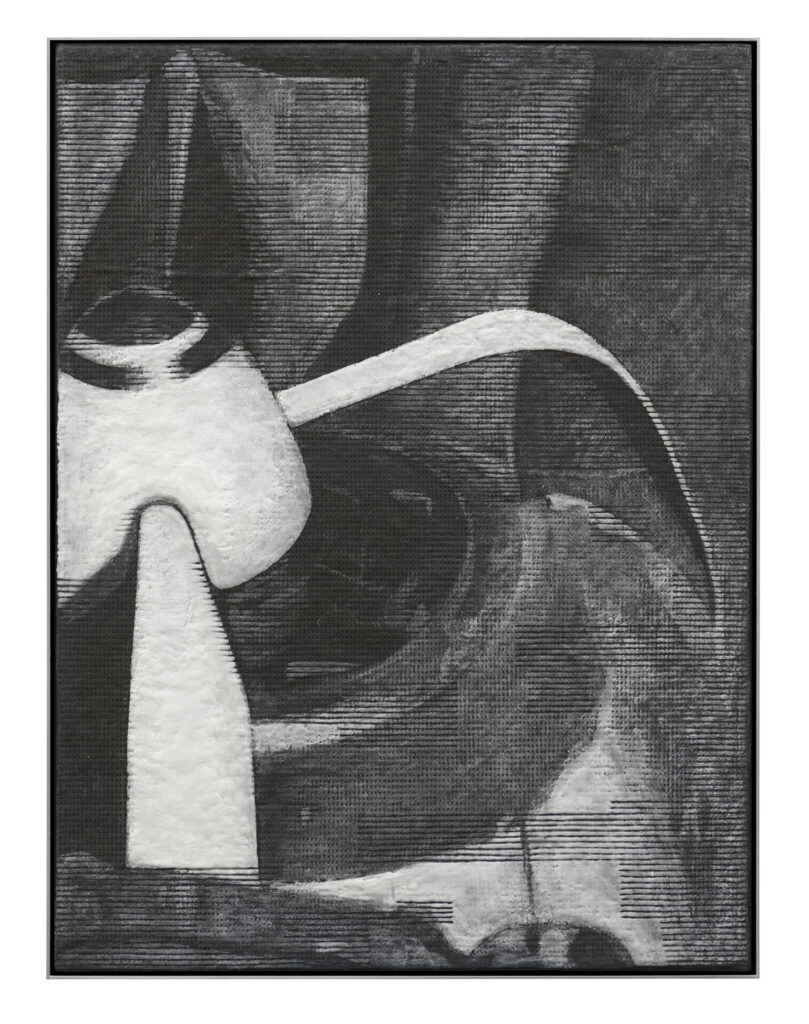

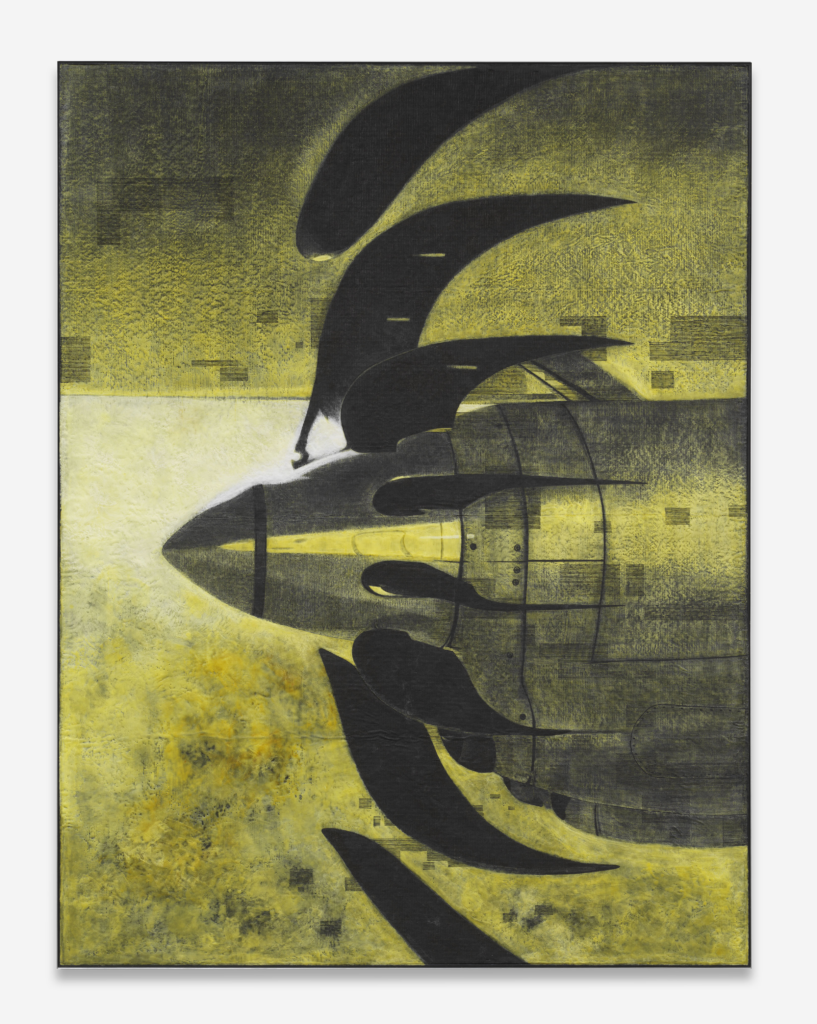
In our current globalized world, petroleum is present as a fuel and raw material for countless products. Its form and significance are constantly changing within various cycles. I am interested in the stories and temporalities embedded within it. My series FLOWERS explores this: as said Plants store energy, becoming fossilized material, this fuel powers airplanes. Bent propellers from crashed aircrafts resemble withering petals, so I use both images of wilting flowers and archival photographs of deformed machines as my motives when painting with recycled paraffin on shredded airplane parts. I’m interested in that moment when technology suddenly seems organic again—almost as if it was returning to a natural cycle.
Do you think materials ever truly come to rest?
Daniel Hölzl: I think the truly wonderful and also utterly terrifying thing is that materials never really come to rest. If you take an ancient stone statue, there’s always this hope of eternity. You build something out of stone because it’s meant to last forever. And yet, even that stone will one day crumbles away again. If you attribute a cyclical nature to the material, you also have to realise that eventually even this statue will turn back into sediment. Every mountain crumbles away at some point. For us humans, these timescales are simply far too vast. We live too briefly to really witness it, but nevertheless it is inevitable.
One final question: if matter is constantly transforming – what will eventually happen to your works?
Daniel Hölzl: Hopefully I get to experiment with new things and recycle my old works many more years. But eventually my wax paintings will go back to being black canvases once they are exposed to a constant temperature of 60 degrees Celsius. And perhaps even one day someone will find this huge aeroplane engine with artificially bent propellers and might mistake it for a piece of a real crashed aeroplane. But because thoughts like these are part of the concept from the very beginning, this is not scary to me.I do nevertheless believe that many works of mine arise from a fear of finitude. This linear way of thinking – that everything, as we know it, simply ends at some point – tends to stress me out. That’s why I’m much more interested in the idea of cycles.