
Share this
New York has always looked different after dark. The streets loosen. The lights turn theatrical. Bodies move with another kind of confidence. The city becomes less a machine and more a pulse.
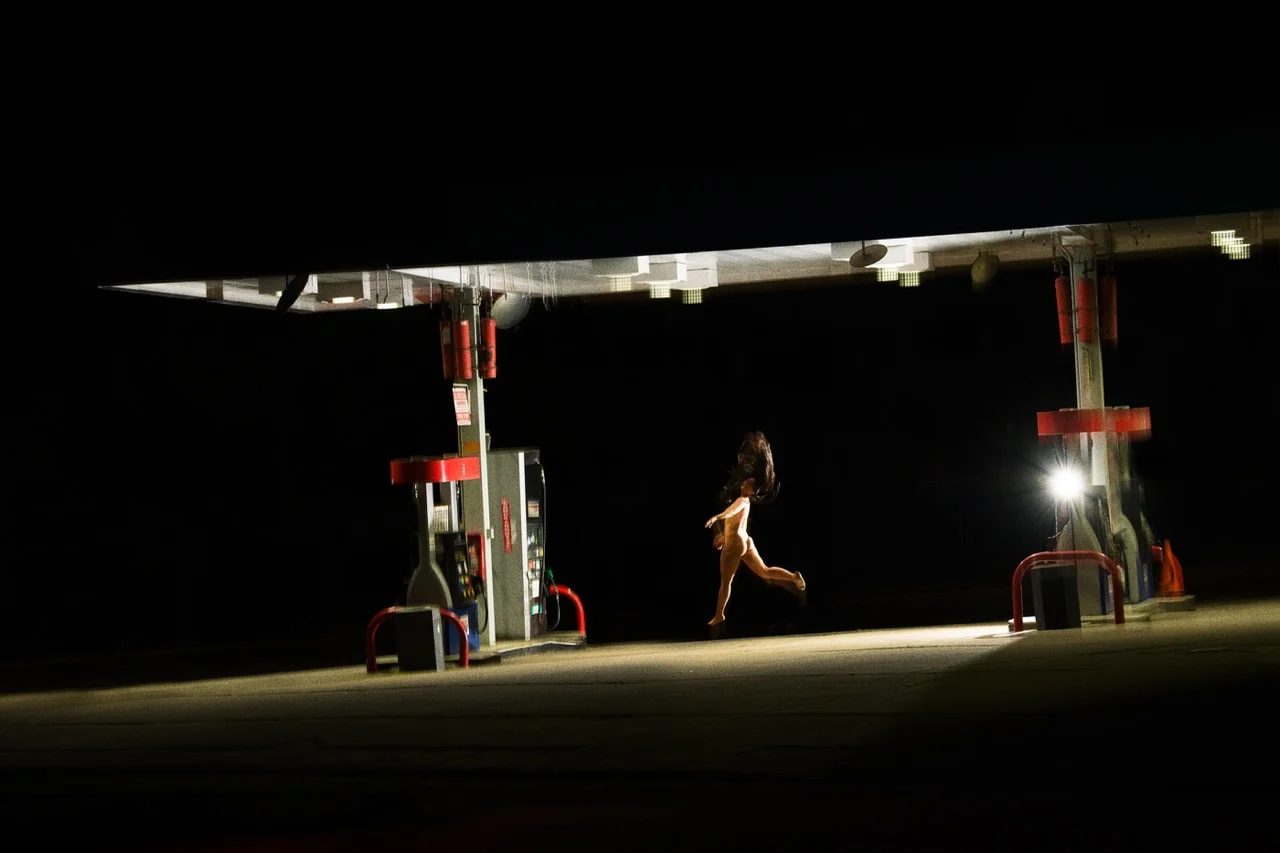
That nocturnal electricity runs through Ryan McGinley’s Night Shift, now on view at Jeffrey Deitch in New York. For the series, McGinley returns to the city that shaped so much of his early visual language, photographing between 9pm and 5am across all five boroughs. The result is not a clean portrait of New York, but something more unstable: a city caught in motion, half-awake, half-dreaming.

McGinley has long understood the body as a carrier of freedom. His photographs often feel like fragments of escape: young people running, falling, laughing, climbing, disappearing into landscapes or weather. In Night Shift, that energy is brought back into the urban night. The landscape is no longer the open road or the American wilderness, but neon, halogen, brake lights, sidewalks, graveyards, waterfronts, amusement rides, smoke, and concrete.
The technical language of the work matters. Using slow shutter, long lenses, and radio flash, McGinley lets light stretch, blur, and flare around his subjects. Bodies seem to dissolve into the city around them. A figure does not simply stand in front of New York; it becomes part of its nervous system. The photographs feel luminous and hallucinatory, as if the city itself were breathing through colour.

There is also a sense of return. McGinley’s early work was deeply connected to downtown youth culture, queer visibility, friendship, risk, and the raw intimacy of being young in New York. With Night Shift, he does not simply revisit that past. He recodes it. The city is older, stranger, more surveilled, more expensive, more mythologised. But at night, something still opens.
The series moves through places charged with personal and cinematic resonance: waterfront piers, smoke-filled streets, graveyards looking toward the skyline, and the glowing architecture of Coney Island. These are not postcard views. They are emotional coordinates, places where the city’s beauty feels mixed with loneliness, desire, danger, and play.
What makes Night Shift compelling is that it does not treat New York as a fixed icon. It treats it as a living body after hours. The city appears not as a monument, but as a playground, a stage, a memory field, and a site of private transformation.
In McGinley’s night, New York is still restless. Still seductive. Still capable of making people disappear into light.


Photography courtesy of RYAN MCGINLEY and JEFFREY DEITCH