Share this
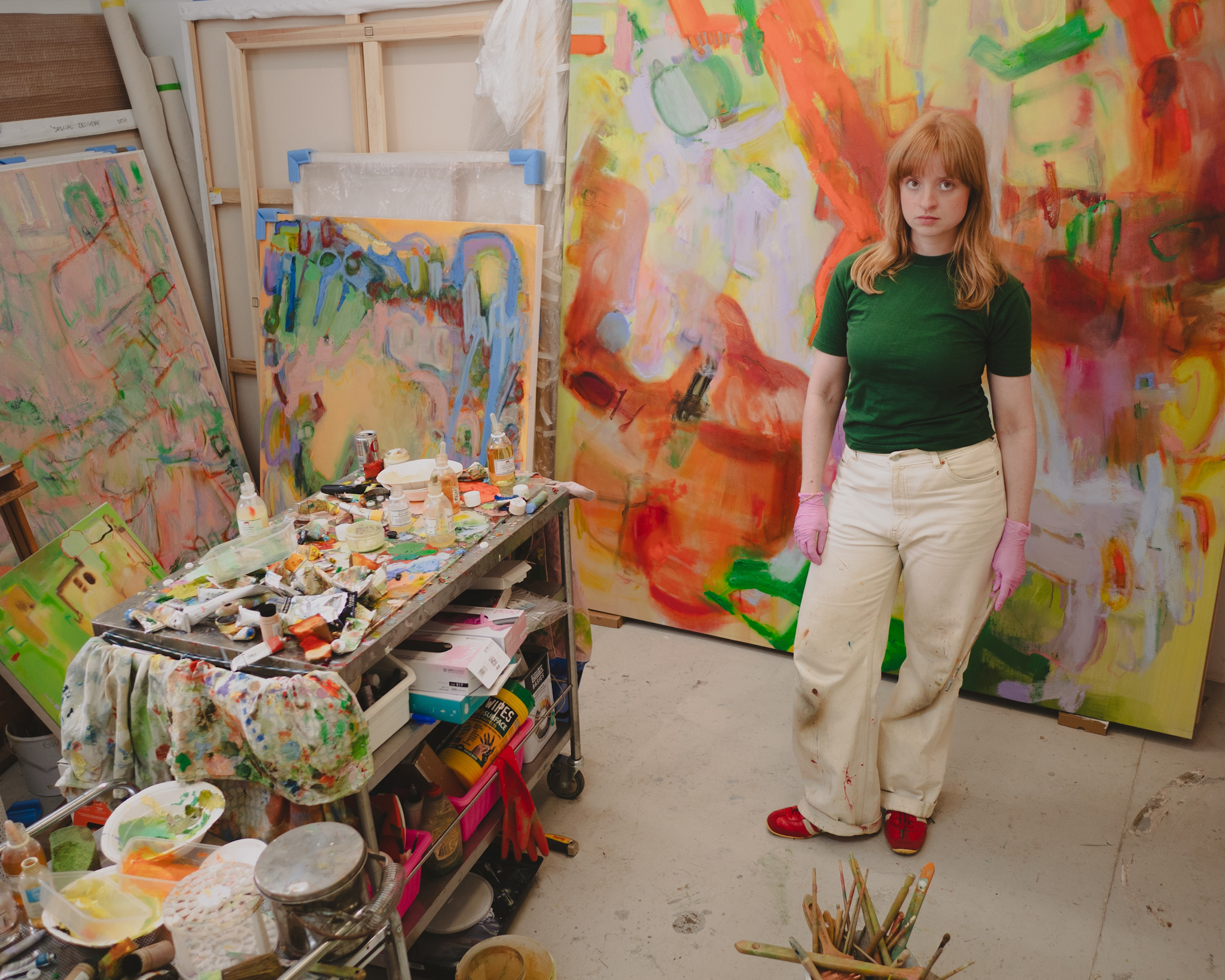
There is something quietly disarming about the way the London-based painter Bunny Hennessey ,speaks about her work: colour as something that “carries time,” painting as a surface where sensation can be relocated, almost offloaded from the body. Her canvases, vivid, unstable, and strangely architectural, hover between excess and control, where appetite, memory and perception are continuously processed rather than resolved. Raised above a bookshop in coastal Devon and currently completing her MFA at Slade School of Fine Art, Hennessey approaches painting less as a statement than as an ongoing negotiation: a way of staying with intensity just long enough for it to shift, without ever fully settling.
Interview by Lucía Garcia Martin
Bunny, hello. How are you, and where are you writing to us from today?
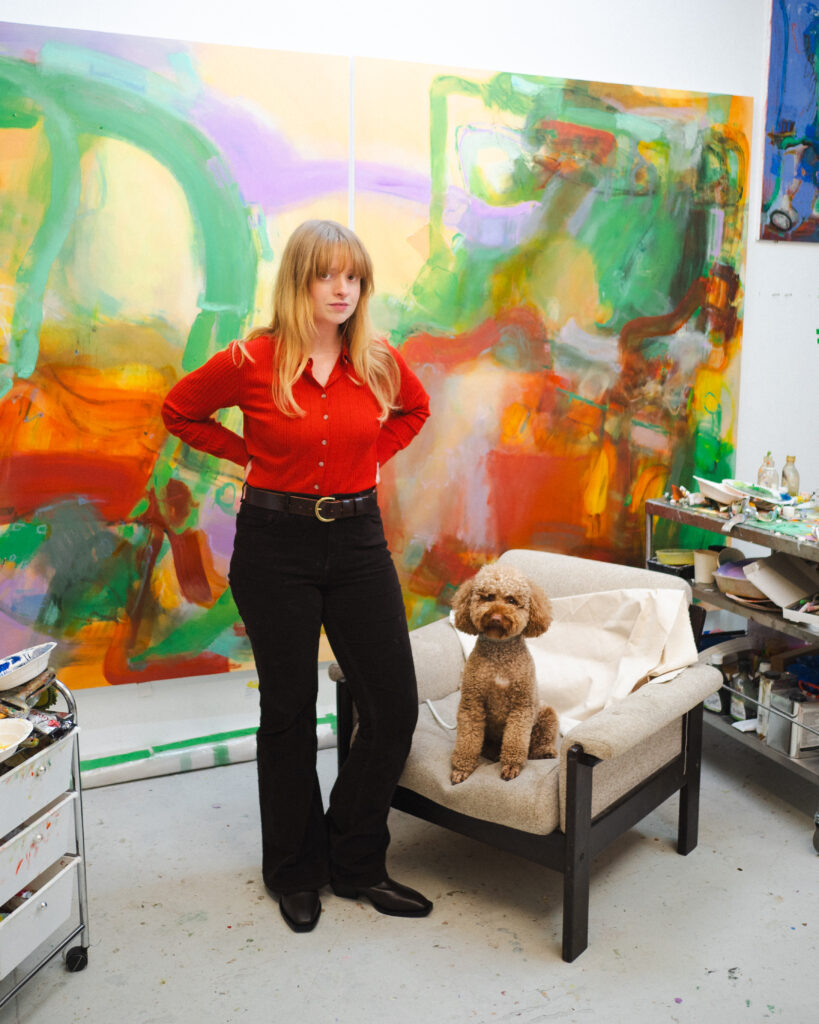
Bunny: I’m on the train to Paignton in Devon to see my parents. It’s quite a magical journey, the track runs right along the coast so it feels like you’re traveling over the sea. I always pretend I’m in Spirited Away for that stretch. I’m also quietly convincing myself there’s some kind of destiny in being a painter from Paignton, if you just silence the g.
Describe yourself in one sentence, but not as a biography.
Bunny: I absorb things quite deeply and overthink the everyday, but I try to stay light with it, and painting is where it settles.
The first sensation I had when encountering your paintings was that of dawn, that heightened moment when color feels almost excessive, slightly unreal. Do you ever think about transitional times of day, such as sunrise or dusk, in relation to your palette?
Bunny: I’ve been thinking about colour as something that carries time inside it. Some colours feel steady, almost constant, and others feel rare, like they’re about to disappear. At the moment I keep returning to violets and lavenders. They have that slightly unreal quality, like the brief edge of dusk when everything feels backlit and heightened, and then within minutes it slips away and the world flattens again.
I sometimes think of colours as moving at different speeds. Greens, blues, earth tones feel slower, more settled. Oranges, reds, pinks, violets feel faster, like they’re arriving and leaving at the same time. But it’s never consistent. An acidic green can feel incredibly urgent, especially when grass has just been watered and everything is almost too alive. Red feels like a kind of internal flush, something that rises rather than sits.
I try to catch these moments but they never quite hold. My camera roll is full of failed attempts at capturing something that has already moved on. I think that’s what draws me back to painting. It lets me stay with that heightened state a little longer. Living somewhere with strong seasons reminds me how quickly things shift, how something dull can suddenly become luminous. That sense of change feels quietly hopeful to me, and I think that’s what I’m chasing in colour.
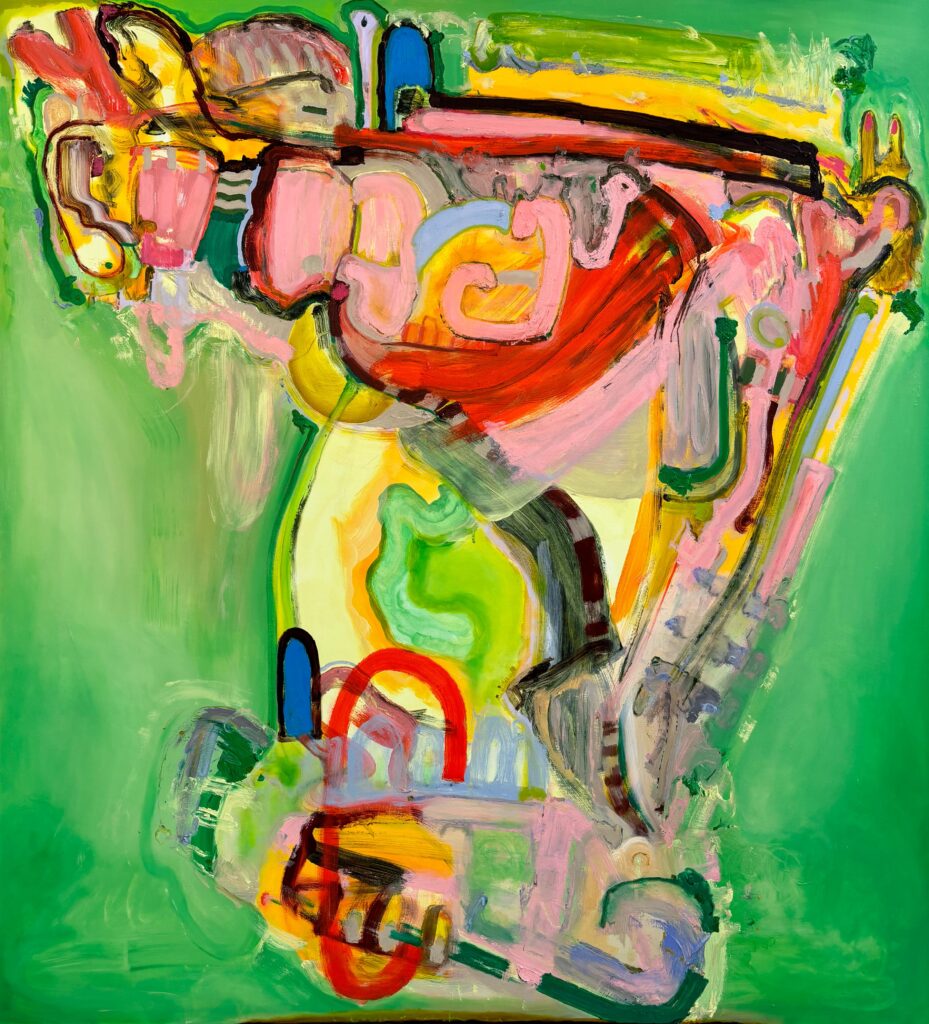
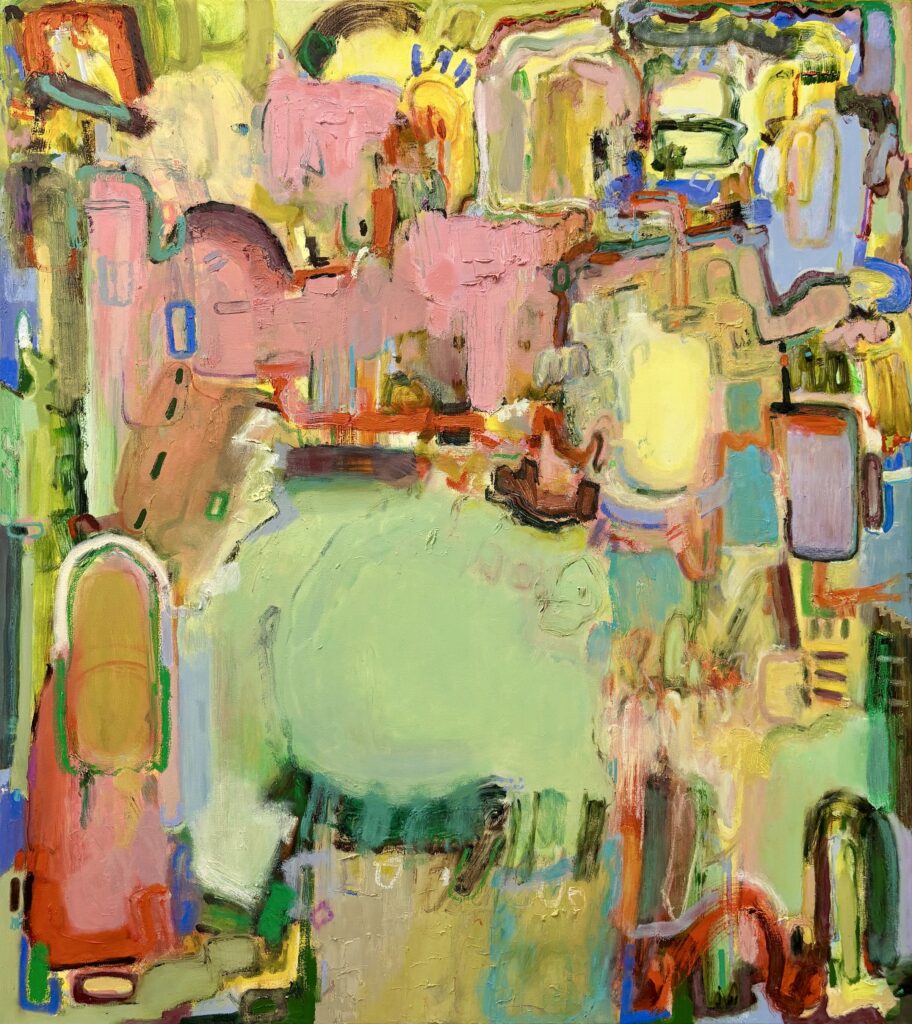
Do you see your paintings as moments of emergence, or of containment?
Bunny: My immediate thought is – can’t a painting be both? I think I move between those two states constantly. There’s an urge to make a complete mess, to let things spill and overrun, and then an equally strong need to contain it. I get quite preoccupied with limits at the start, canvas size, doorways, how it will leave the studio, how much paint I can actually hold. Once those edges are set, something opens. I can move more freely because I know where things stop.
I think I need that boundary. I’m a bit like a robot vacuum, I want to bump into the edges to understand the space. That’s probably why I’ve never been drawn to sculpture. I feel very at ease with the rectangle. It gives me something to press against, somewhere to push from. Even when I work on murals and the scale expands, it’s still held within a wall, a room, a structure.
So for me emergence and containment aren’t separate. One depends on the other. Without some kind of framework everything would just keep going, the painting would never land, like a song that refuses to end.
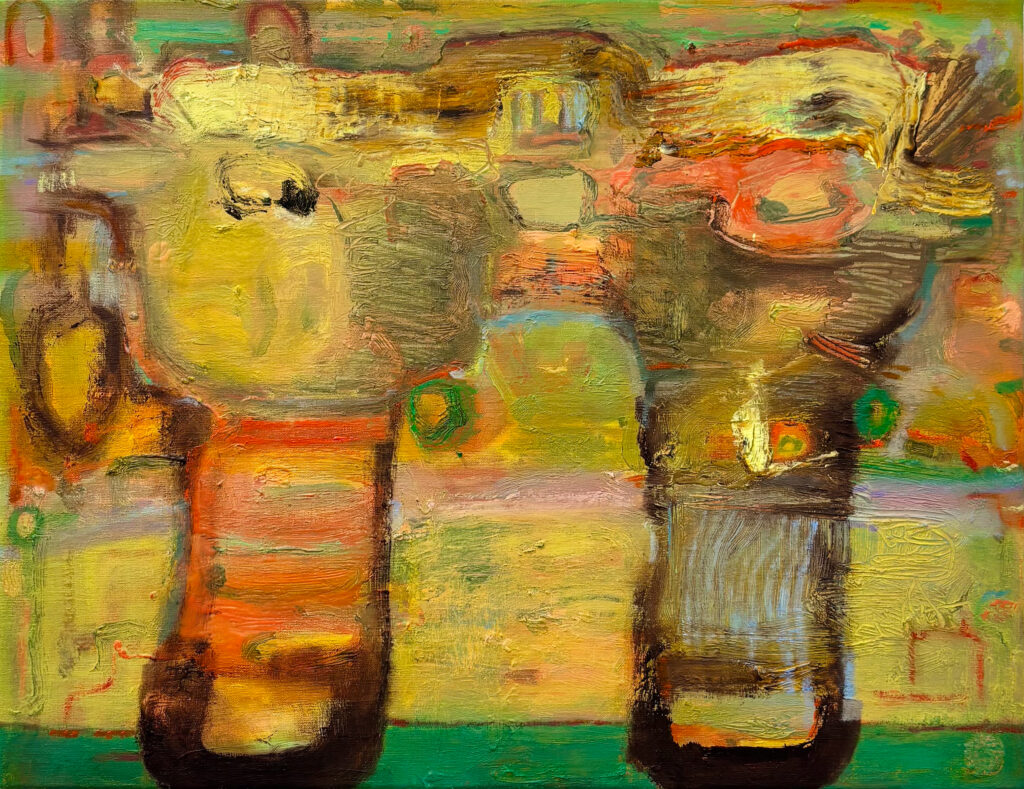
What is the most recent book you’ve read, or the one currently on your bedside table? Has it shifted your way of thinking in any way?
Bunny: I usually have three or four books on the go. My bedside table is a stack, and I listen to audiobooks while I paint. I’m the daughter of booksellers, I grew up above my parents’ shop, so it feels fairly inevitable. I’m in the middle of the series On the Calculation of Volume by Solvej Balle, where the protagonist is caught in a time loop, repeating the same day. It’s written in a deeply sensorial way, and it’s made me think about how much can be extracted from something that initially feels almost empty. The day doesn’t repeat so much as thicken. It starts to behave strangely.
It’s shifted how I think about time, especially how it stretches and distorts depending on attention. Traumatic moments can feel slowed to an almost unbearable clarity, while painting can do the opposite, hours pass without me noticing. Grief seems to lengthen time in a more diffused way. I’m interested in how a painting might hold that, not as a sequence, but as a kind of pressure or density, where different speeds of experience sit on top of each other.
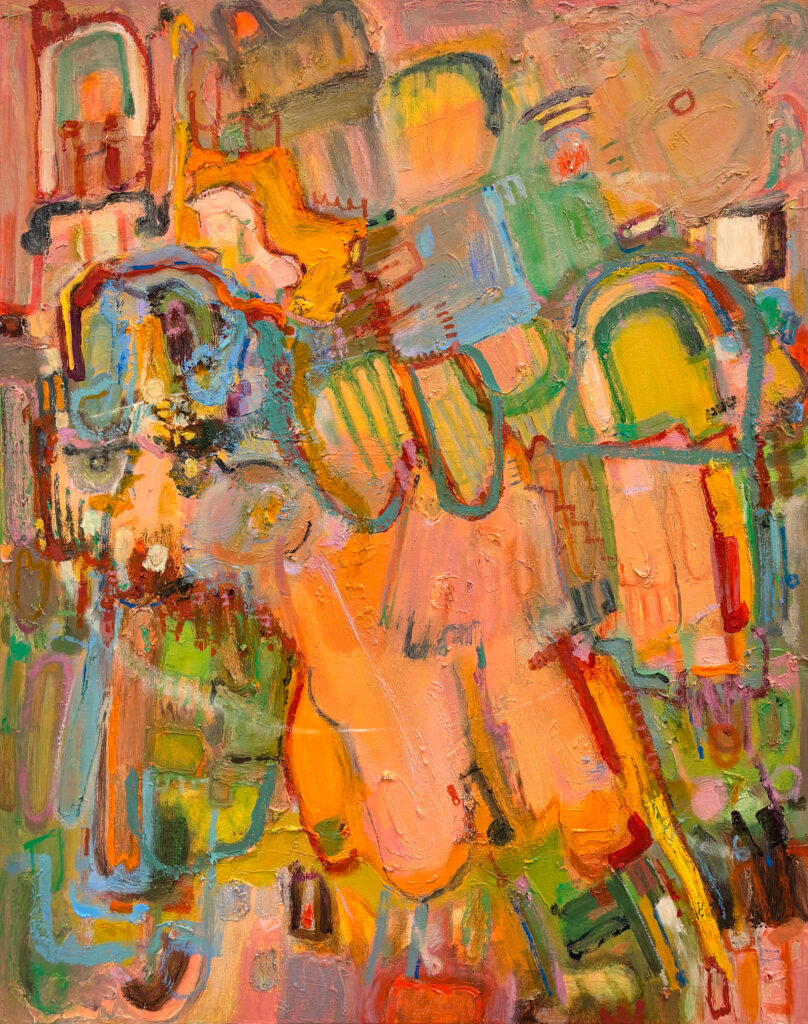
Instead of asking the classical question “What does your work say about you?”, I’d like to reformulate it…Is there something in your work that you are not yet ready to fully confront?
Bunny: I don’t tend to approach painting as a way of fully confronting something. If that was the aim, I’d probably choose something less ambiguous, maybe writing, something that can arrive at a clearer conclusion. Painting allows me to stay with things that are still shifting.
And I do wonder if we have to confront everything. It feels a bit assuming to think I’d know all the answers before I even begin. I’m more interested in what happens when something is left open, when it’s allowed to move, to change shape, to be approached from different angles over time. There’s a kind of gentleness in that.
I was thinking about this after seeing Pina Bausch’s Sweet Mambo. It was incredibly moving without offering a fixed narrative. Nothing was explained, but there was enough to enter into, to recognise patterns, to feel like it could keep going. That feels closer to how we actually experience things, not as neat arcs, but as something continuous and slightly unresolved.
I think I want the paintings to operate like that. Not as something I’ve pinned down, but as something I’ve been in dialogue with. Ideally they move beyond me, they hold something I don’t fully understand yet, and they’re able to meet someone else there too.
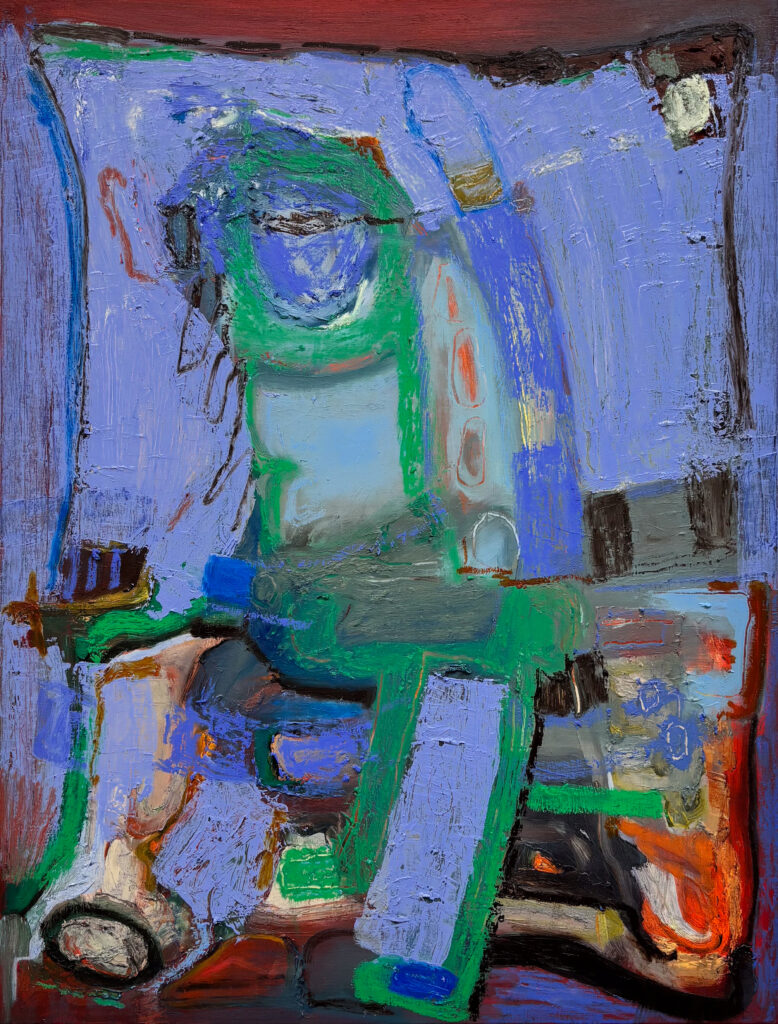
Do you consider your process a form of performance, even if the viewer only encounters its residue?
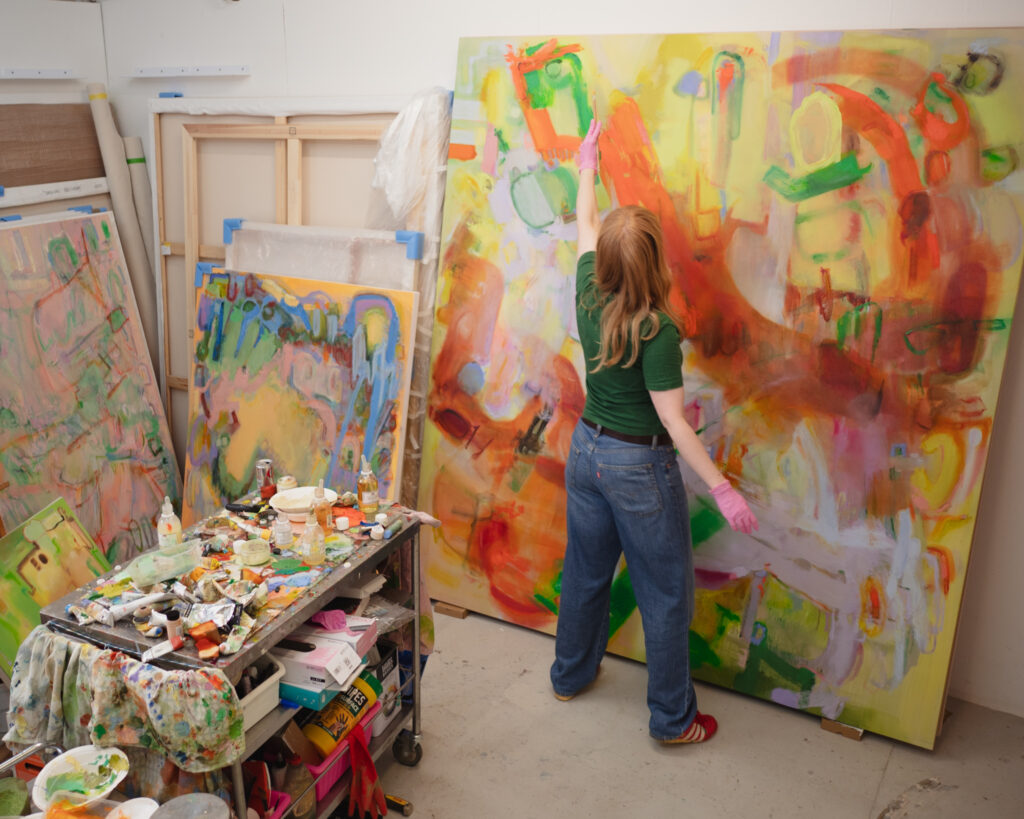
Bunny: Painting does feel like a residue of a performance in a way. I want to be convinced that the presence of the artist is still there, in the brushstrokes, the scrapes, the drawn elements, the places where something has been pushed or taken away. It feels like an extension of the body. I sometimes scratch into the paint with my nails or rub areas back with rags. It’s all quite physical, even if the end result is still.
At the same time, I don’t quite think of it as performance. I’m slightly in awe of people who perform live, the idea of putting your body on the line like that, night after night. Painting feels almost the opposite. It happens in private, in the studio, which can feel more like a cave than a stage. There’s a kind of distance from yourself too. In performance you’re seen immediately through other people’s eyes, whereas in painting I’m constructing something I can return to, inspect, adjust. It’s a slower kind of reflection.
But then the painting leaves the studio and everything shifts. It goes out into the world and I find myself on the other side of it, standing with the audience, looking back at something that no longer feels entirely mine. That’s when it starts to feel like a performance after the fact, slightly disembodied, like watching something that has already happened. I think what I’m really trying to do is catch something that feels worth showing, even if it comes from something quite ordinary.

Do you see pain, madness, and sensuality as interconnected states? Are they separate conditions, or different expressions of the same energy?
Bunny: I’m a bit wary of those categories. They feel slightly theatrical to me, and tied to a mythology of the artist that I don’t recognise in my own practice. I’m not especially interested in the extreme.
What I pay attention to instead are the smaller internal shifts. Pressure building somewhere, a sense of excess, something needing to be moved or released. Those states don’t always arrive with a name, but they have a physical presence. Painting lets them surface without having to decide what they are too quickly.
I think once you name something as pain or madness it can close it down. I’m more interested in what happens before that point, while it’s still unstable, still changing shape.
I love the titles you choose for your paintings. Titles such as All You Can Eat suggest appetite, excess, even consumption. In your work, is the body a site of desire, or of saturation?
Bunny: I’ve always thought painting is quite a greedy act. It can feel like I’m forcing everything in at once. The titles come from that place. I think about how consumption goes beyond food, how we’re constantly processing and digesting what’s around us. Not just physically, but emotionally as well. It feels like a sign of a life lived, to have an appetite beyond the material, to want to experience as much as possible.
To me, the body in the work acts like a soft machine. It takes things in, breaks them down, rearranges them. I’m interested in that space, how I can push and shift what I feel without it taking over completely.
There’s also an element of desire in looking at a painting. That physical pull towards something, how it ripples through you. That force of attraction is like a strange one-sided meet cute. You’re drawn in without needing anything back. I think it satisfies that urge to fall in love repeatedly throughout life, without rejection, without the fear of it ending.

You grew up in coastal Devonshire. Does the sea, with its cycles, repetition, and turbulence, operate as a subconscious structure?
Bunny: I don’t think I fully appreciated growing up by the sea until I moved to London, and felt how claustrophobic everything can be here. In Devon the sea is just there. It cuts through ordinary routes, you’ll turn a corner on a familiar road and suddenly it opens out in front of you. It never really announces itself, it just arrives.
There’s something very physical about being near water. The smell, the tautness of your skin in the wind, the taste of salt sitting on your lips. Being in the sea is one of the few times I can forget my body, even though I’m not as brave with it as I should be for most of the year. If painting stops working, it’s usually a sign I need to get back in the water. It feels like a reset.
If you had to name your painting style yourself, without referring to existing categories, what would you call it?
Bunny: Organised Chaos

Your work holds a strong kinetic charge, yet it resists collapse. Is fragility something you consciously avoid?
Bunny: I’m not avoiding fragility so much as following whatever internal weather the painting has that day. The structure tends to mirror how I’m feeling, sometimes tight, sometimes on the edge of slipping. Maybe it’s telling that there is a sturdiness to it, I can be quite determined in character. But painting is where I let something softer in, where I can sit with a kind of tenderness.
Quite often I begin by staining the canvas while it’s still raw, letting the paint get very fluid so it bleeds and spreads beyond my control. At that stage it really does feel like the painting could fall apart. Then I have to gather myself and start repairing what’s there, without discarding something that might be more delicate or alive than anything I could plan.
I like taking the work close to collapse and seeing what refuses to disappear. The painting starts to organise itself after a while, almost like a body correcting its balance. What remains isn’t fragile exactly, it’s something that has passed through a moment of danger and decided to keep standing.
You’ve described the canvas as a surface that “holds sensation outside the body.” For you, is painting a form of containment, release, or displacement?
Bunny: All I really know is how I process what I experience, and quite often it feels like everything is turned up too high, like the volume has been pushed just a bit too far. Painting is a way of shifting something outward. It gives whatever is building in the body somewhere else to sit, so it’s no longer pressing in the same way.
I think I feel best when things are moving, when nothing is stuck for too long. Painting creates a kind of exit lane for that. Something can pass through, settle on the surface, and I can look at it from a small distance rather than carrying it around. It doesn’t disappear, it just changes location.
I’m not really trying to understand what I’m making while I’m making it. That feels too early. I’d rather let it arrive first, let it take up space, and then come back to it later. Painting lets me do that without needing to translate everything straight away. It holds something before it becomes clear.
What is the question that would make you slightly uncomfortable, but that you secretly wish someone would ask?Bunny: Ha, I think I’d rather not tempt it. Some things are better left as secrets.