Share this
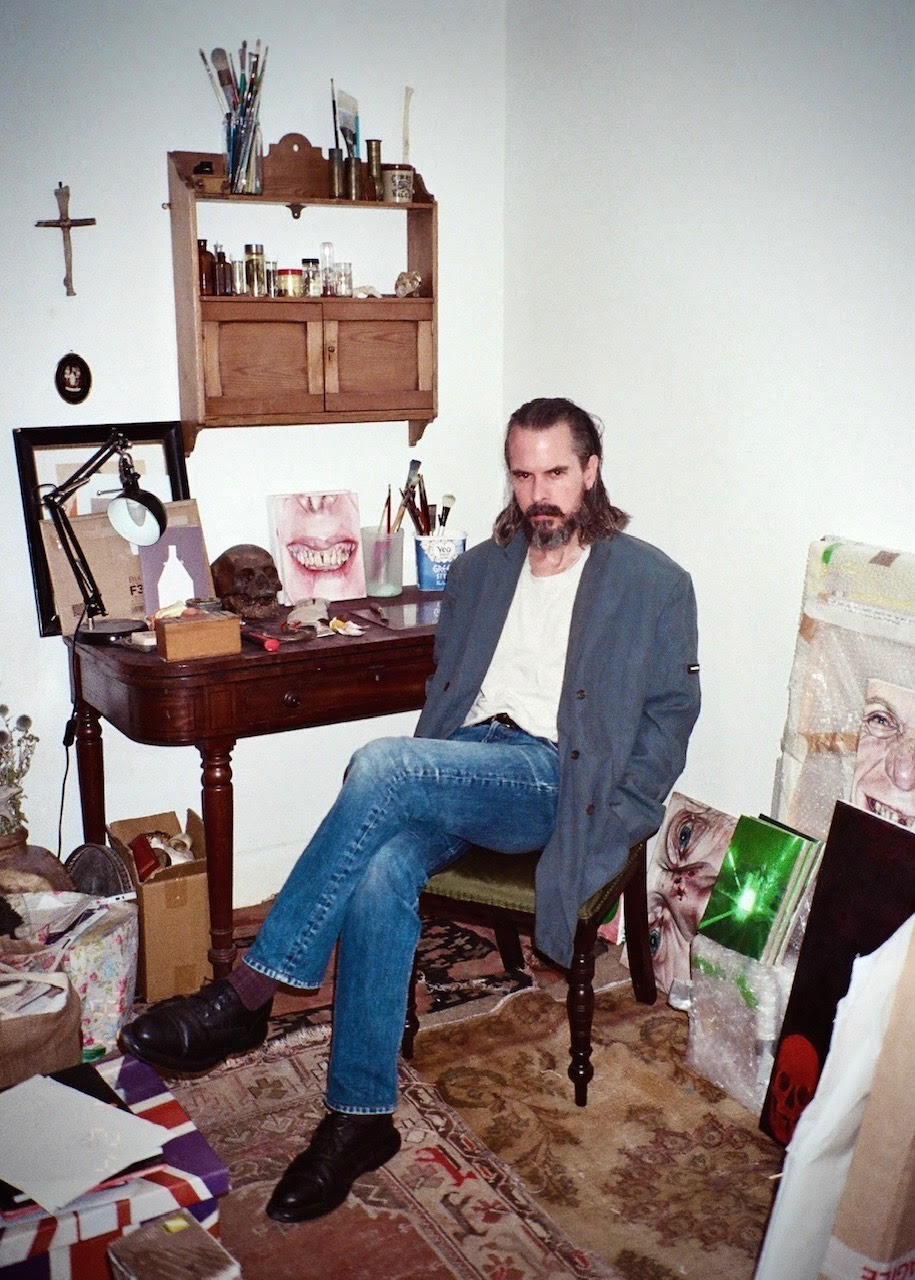
Jamie John Davies (b. 1986, Wales) is a London-based painter whose work examines the complexity of the human condition through found imagery and a layered, often discordant visual language. Informed by the philosophy of absurdism, his work explores the human drive to construct meaning, coherence, and purpose within a world that frequently resists such impositions.
Approaching human behaviour with analytical detachment, his practice explores the irrational and instinctive; tracing vestigial social imprints and culturally ingrained routines, born of a futile pursuit of meaning. The work often borders on the irreverent—not with the intention to provoke, but to defamiliarize; seeking to render the habitual as strange and foreground its underlying contradictions.
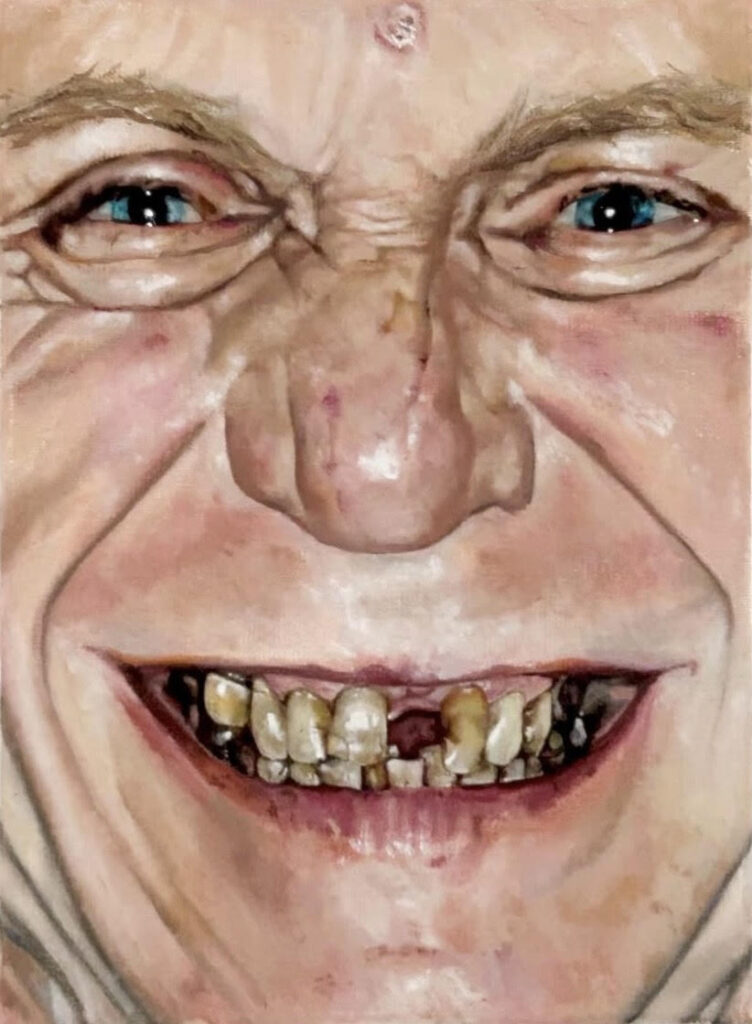
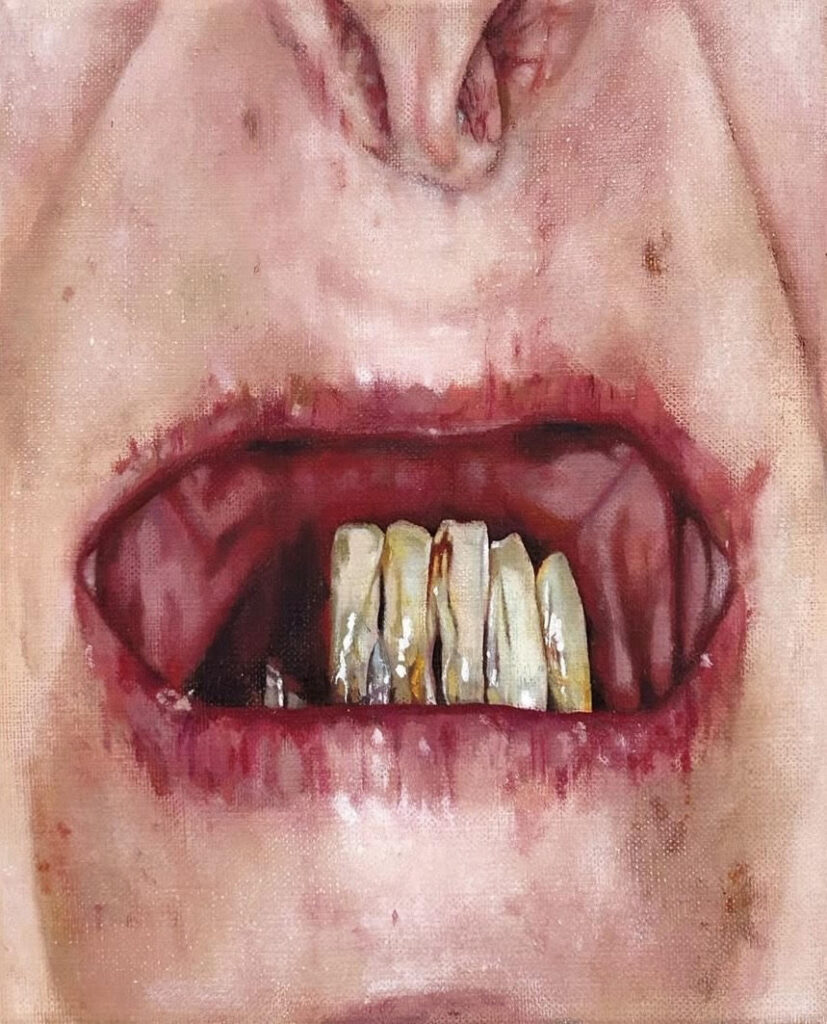
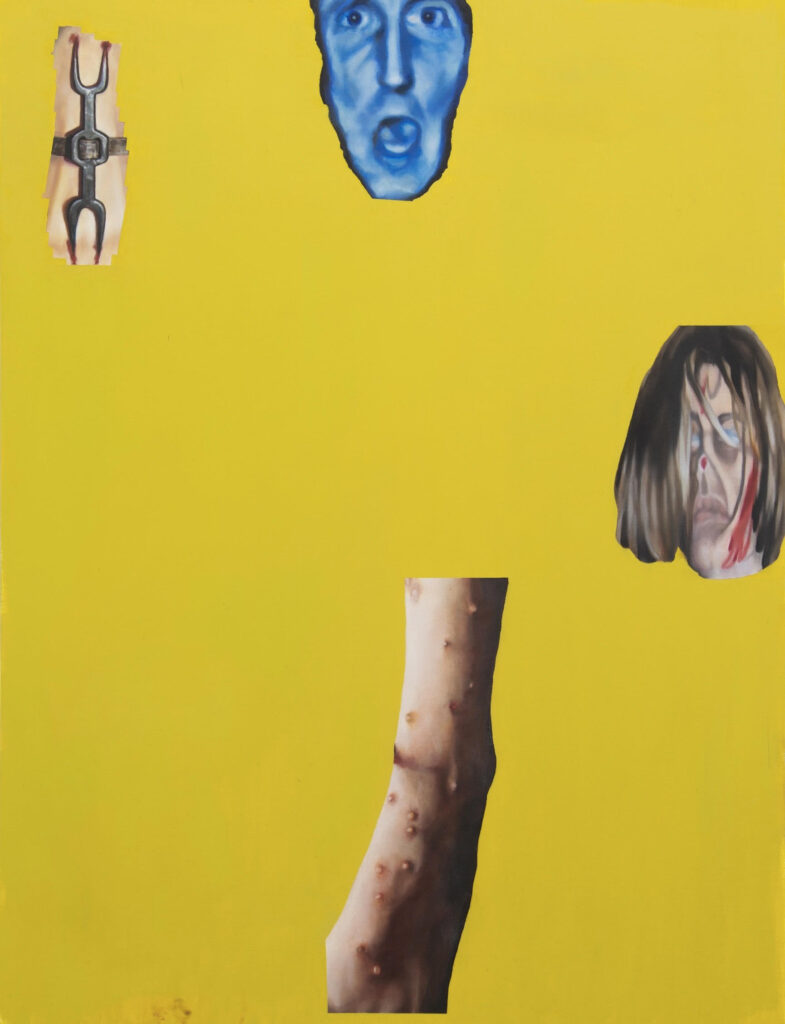
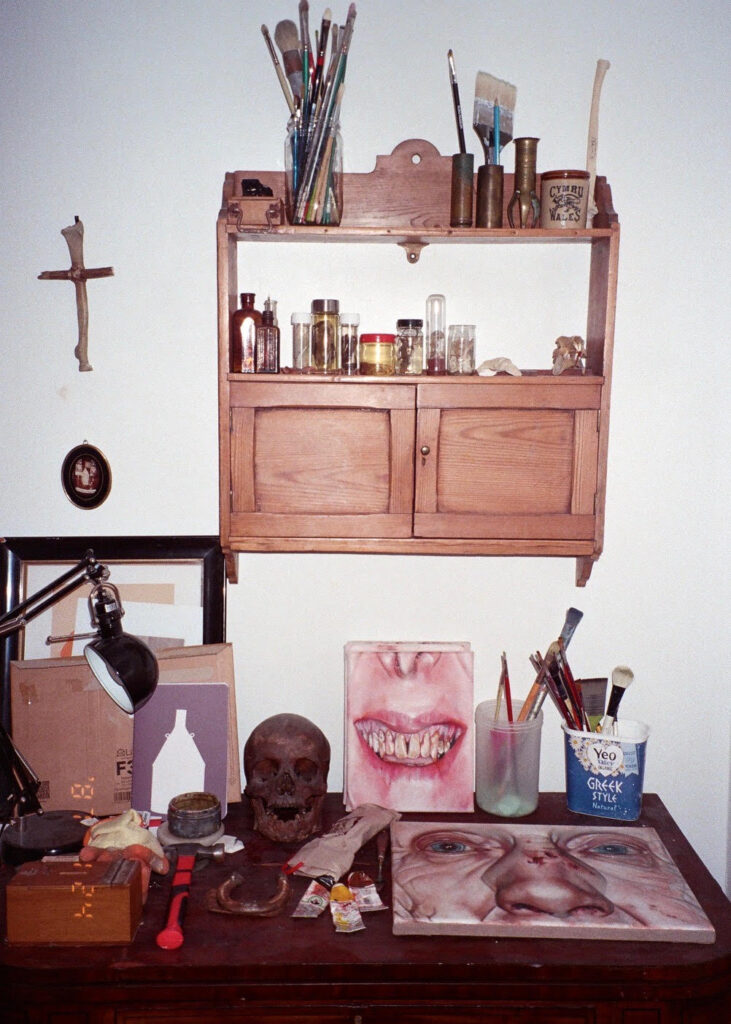
A recurring motif in his work is the depiction of abject aspects of the human body, such as blemishes, rashes, and missing teeth. Removed from conventional aesthetic or symbolic frameworks, these fragmented bodily elements underscore the strangeness of embodiment itself: the condition of consciousness tethered to a vulnerable physical form. In this context, the body is not idealised or expressive, but fragile—an unstable structure subject to degeneration, fallibility, and inevitable decay.
Hi Jamie! It’s a pleasure to sit down with you again! I’m curious, growing up in Port Talbot, what was life like there? And what kind of kid were you? What did you enjoy doing?
Jamie: Hi, thank you. It’s a pleasure to chat to you too. As a child I was sensitive, perhaps overly introspective, but with a mischievous streak. My school reports always complained of daydreaming. As a teenager I wasn’t much different, except perhaps more misanthropic and with a supercilious bent, so probably utterly unbearable. I love Port Talbot now, but I didn’t think of it with such fondness in my youth.
It can be a very bleak, tough place and there wasn’t a great deal to do there at the time. It’s a coastal town, but one that was heavily industrialised: the sea was brown with pollution, the sand was full of lugworms, and there seemed to be a constant, overarching atmosphere of violence that blanketed the place. I lived very near a moor and some days you’d find a burned-out car that joyriders had abandoned that you could play around with, maybe throw some rocks at. That was fun. Aside from that, I was very preoccupied with thinking that all my neighbours were murderers or witches, which was entertainment enough.
Do you remember approximately at what age your creative side started to show? And when did you start taking being an artist seriously?
Jamie: For as long as I can remember. A priest once told my parents I’d grow up to be an artist, based on what he perceived to be a special way I held a pen, which is funny; it was preordained. I was fortunate that my parents were very encouraging in my creativity. In my first year of school, I painted a foetus in powder paint, carefully choosing a different pink for the umbilical cord and feeling immensely proud of myself.
The piece was selected to go on the classroom wall, and I remember thinking it was a monumental accomplishment. I think I felt like I’d unlocked a way to successfully express something, or at least show off, as a weird, shy little introvert. You could let the work do the talking while you shyly skulk about in the background. Frankly, I wish I’d retained that confidence.
Ok Jamie, with these next series of questions, I will try to delve into your work as best as possible. So…. Your work is rooted in absurdism. How did this philosophical lens first enter your practice, and how does it shape your relationship to painting?
Jamie: I read a lot of Camus when I first moved to London in my early twenties. I wouldn’t necessarily say absurdism entered my practice so much as it gave some form to something I’d always felt, or at least it was the thing that came closest. I’d been prone to a sort of existential worry from a very young age. I remember being about six years old in the school playground and suddenly being struck by the notion of mortality, and it absolutely floored me. This proved formative in how my thinking developed and naturally imbues everything I do to some degree. So, Absurdism didn’t really change my outlook,it just gave it some shape, understanding, or at the very least gave that thinking a theoretical name. The experience of pursuing meaning in a world of indifference, and the inevitable futility of that pursuit, is at the core of much of my work.
What draws you to explore the irrational and instinctive aspects of human behavior, and how do you go about translating that into visual form?
Jamie: I’ve always been fascinated by the multiplicity of self, that there is no single self, but a shifting mass of selves, some of which are visible, some buried, some obedient and others untamed. I’m intrigued by both sides of that dichotomy. Who are you when you’re alone? I find it oddly comforting that everyone, no matter how ordinary they appear, carries a complex interior world that remains largely inaccessible to others.
Even something as ordinary as witnessing someone dance for the first time—how they dance, that point of abandon divulges something of them that is real and underlying but is ordinarily concealed. We live by a strange pact of pretence: we present our sanitised selves while hiding our baser aspects, but everyone knows they’re there. It’s universal, and there is truth in that lie. A violent outburst, a scandal, some strange lapse at work can tear through the performance of ‘normalcy’ and plainly expose the raw or irrational. And these ruptures don’t just expose the individual; they are also a revelation in a broader societal context. A murder, for instance, doesn’t just expose something of the murderer; it also exposes the latent violence in us all.
In a similar way, I’m intrigued by the persistence of superstition. Even the smallest superstitious quirk, saluting a magpie, avoiding stepping on the third drain, can puncture the veneer of our reasoning, unmasking how we’re still susceptible to a kind of primitive irrationalism we assume a sense of superiority over. Visually, I’m drawn to things that exaggerate these base aspects of humanity.
For years I’ve painted from images from medieval re-enactments or wax museums, the cruder and less historically accurate the better. They caricature the past in a way that lets us imagine that we’ve now reached a sort of civilised zenith, as if our toothless, animalistic, savage selves are entirely other, when they’re not. X is a perfect example, as it is essentially a contemporary iteration of the medieval town square, where you can trade, gossip, grift and watch an execution, if you wish. You only have to turn on the news to see how barbarous we still are.
What does horror mean to you in the context of painting? Are you thinking more about visual discomfort, existential dread, or something else entirely?
Jamie: I have an odd relationship with horror, which might surprise people who know me, as I am very much inclined towards the macabre, but the word ‘horror’ itself makes me think of something loud, and with quite a rigid visual language that I often find to be quite boring.
Even when I watch horror films, I rarely feel anything. I enjoy some of them, and celebrating Halloween is fun, but once you see the mechanics meant to provoke fear, it loses its power and gets reduced to a sort of giggle. What I’m more interested in is a subtler form of discomfort, where something has just shifted enough that it unsettles you in a way that you can’t quite find the rationale for. I remember experiencing that feeling profoundly when I first saw Ryan Trecartin’s work; your brain gets hijacked into a kind of otherness that still has the illusion of familiarity, as it features recognizable tropes of the American high school, for example, but it’s off enough that it becomes dizzyingly discombobulating.
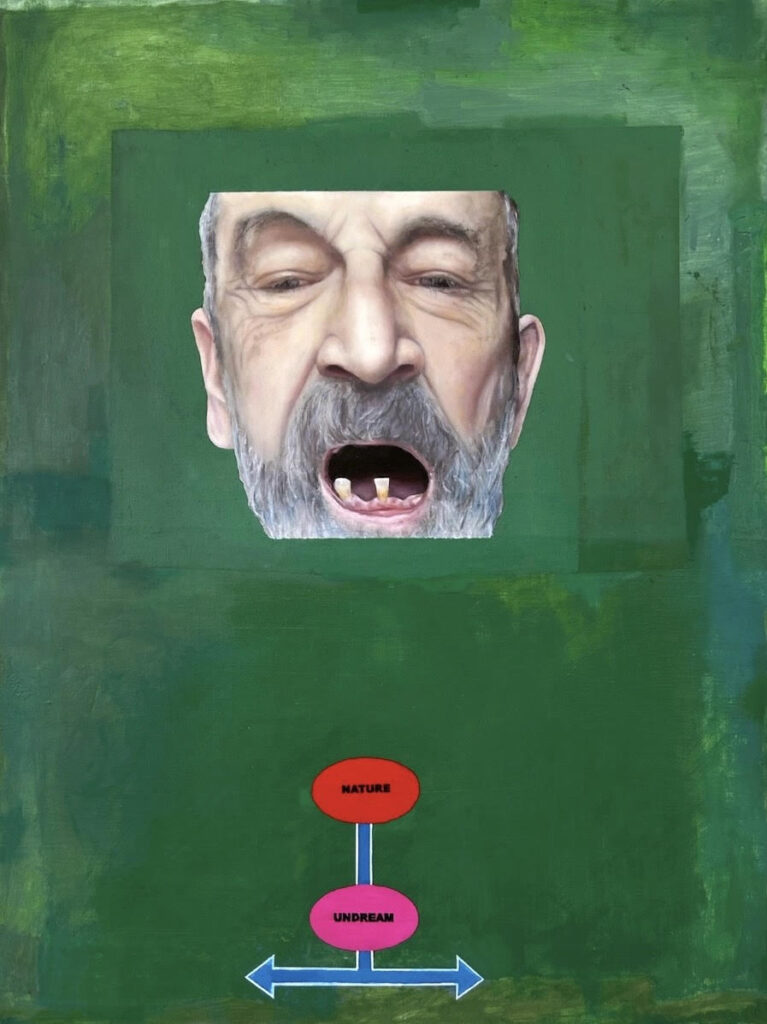
That’s closer to what I’ve been pursuing recently in my language-based, flowchart paintings, which I’m working on at the moment. They borrow a visual language from corporate presentations, TED talks, and psychoanalytical jargon, but the dislocation of the actual words used becomes disorientating, the brain scrambles to look for succinct connections, for a meaning that isn’t there.
This effect is harder to attain than I’d anticipated, and although the words and imagery are purposefully arbitrary in meaning, they are nonetheless very carefully considered. So, I’ve never really intended to make work with the aim of generating fear, but I am interested in exploring defamiliarisation, in estranging the ordinary, and sometimes fear arrives as a byproduct of that process. The same could be said for my interest in exploring the human propensity for cruelty; there is an aspect of it that can very much become horrifying, when reflected back at us.
You’ve told me this horror element can often be misread. What kinds of misreadings do you encounter most often?
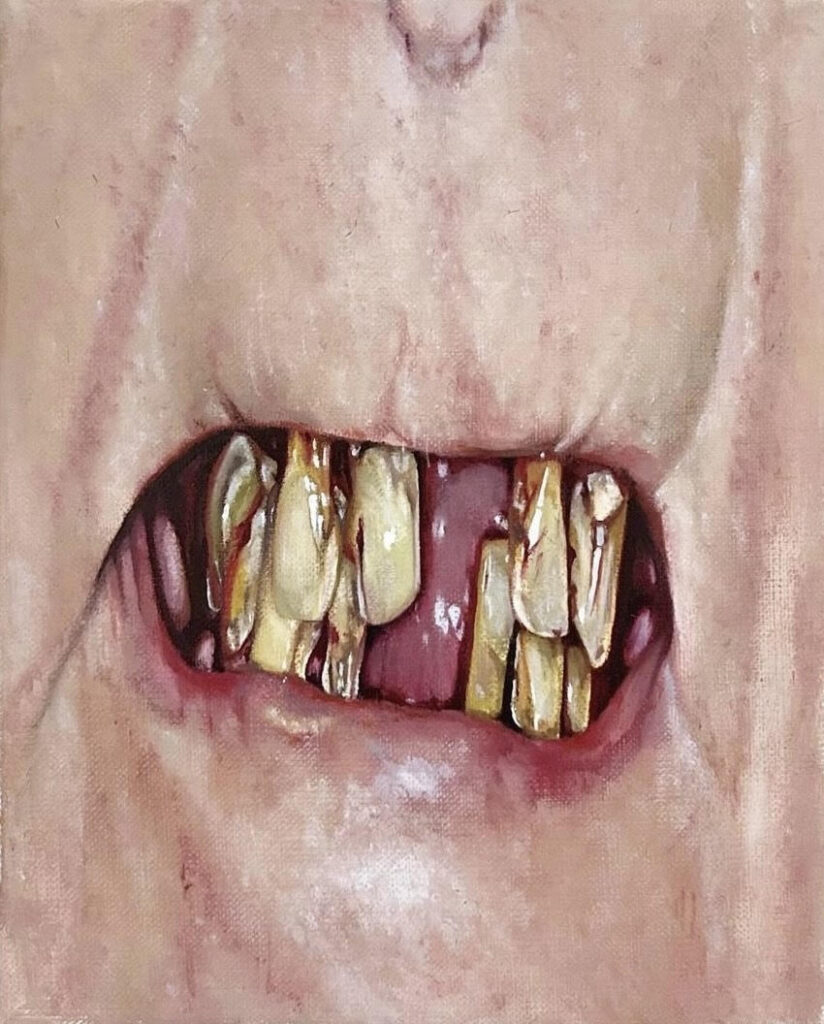
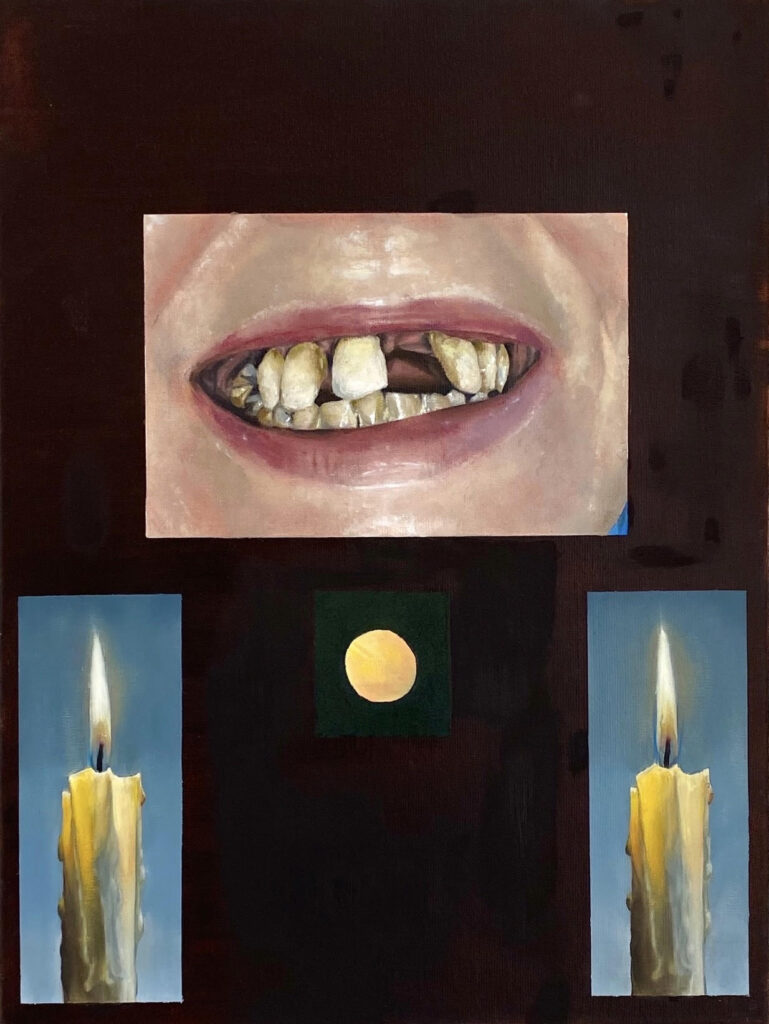
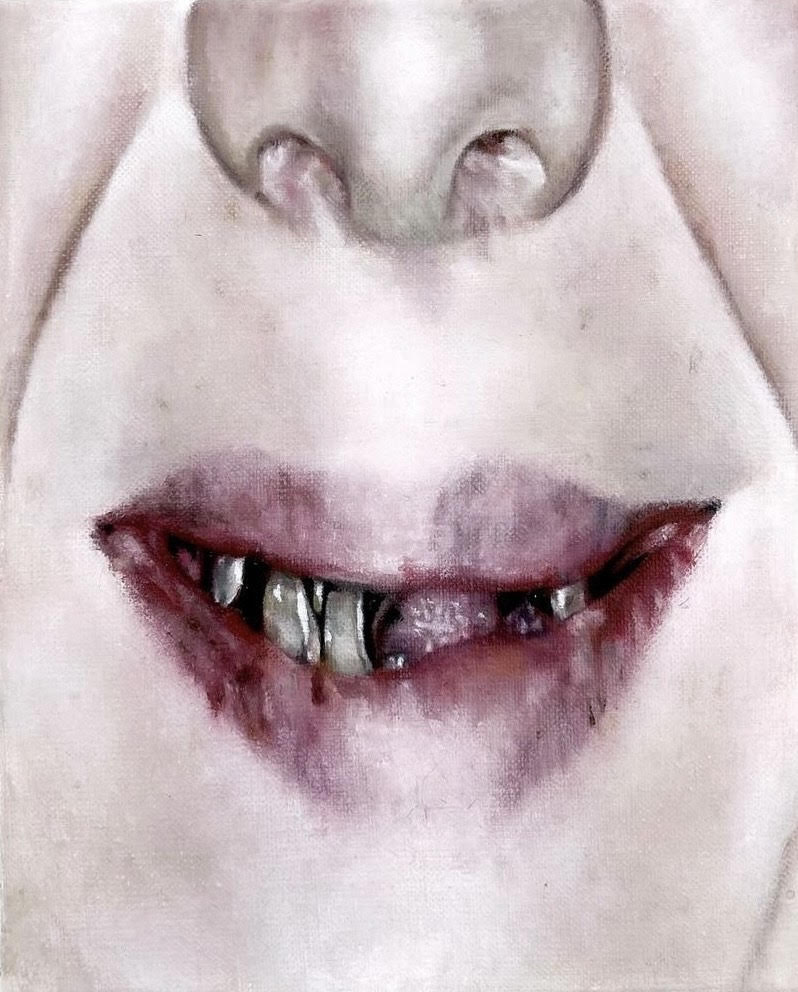
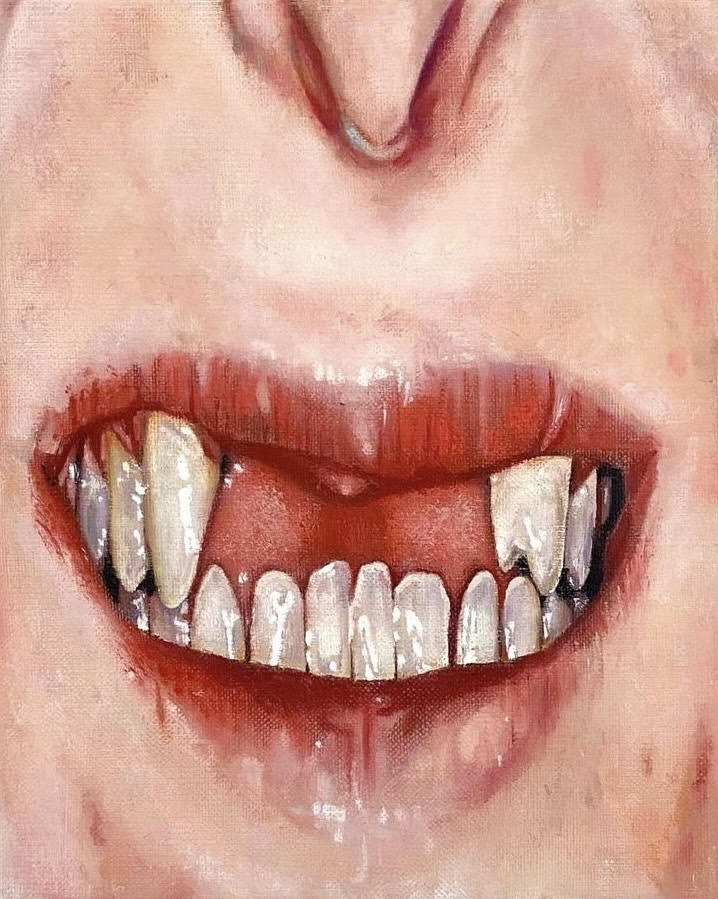
Jamie: I’m not sure it’s strictly true to call them misreadings. I’ve come to accept that you have no real dominion over how a work is read; it refracts differently in each person, and I’ve found a certain comfort in ceding that control once the work is out of my hands. I think every reading is valid. I also purposefully introduce a degree of obfuscation into my work, which intensifies this. That said, my ongoing series of mouth paintings is a useful example to discuss here, as they are often interpreted through a horror lens, because they are undoubtedly unpleasant to look at.
The most common response I’ve experienced is just “yuck”. On one occasion someone even assumed they were vampire mouths. But this series actually began with a dream I had in which my teeth had turned to chewing gum and I was pulling them out in long, pinging, elastic strands. When researching this I discovered that versions of this dream are surprisingly common, and I became fascinated by this universality. I started wondering what the shared psychology behind it might be. Perhaps it points to a collective sense of bodily vulnerability, or to a certain estrangement from our own animal nature? I don’t know.
The reference images I used were primarily sourced from the ‘before’ photographs used in dental company promotions. What struck me about these images was a particular contradiction they contain: individuals revealing a feature they likely feel a profound shame over, yet being asked to present that in the form of a smile. There’s also something faintly animal in these gestures, a defensive baring of teeth, but here the teeth are pitifully damaged and incapable of threat.
So, although visually ‘horrifying’, these works are ultimately an exploration of shared human fragility, a poignant awareness of our failings, a tenderness toward human weakness, and a sense of collective self-empathy. Many of my paintings operate in this way, utilising imagery that, without contextual framework, can contain opposing possibilities, just as a burning torch, another motif I’ve been referencing more recently, can signify human endeavour and enlightenment, or destruction and violence.
With that in mind, can you tell me about some of those themes, that are important for you to document?
Jamie: For me painting is a very internal process. I may worry later about how the work will be received, but in the act of painting I’m not considering an audience at all, not out of flippancy or dismissiveness, but because the act of painting to me feels more like a solitary, inward-looking conversation with myself, so clarifying things through fixed thematic distinctions can feel a bit tricky.
Of course, there are common threads that run through the work, which are broadly rooted in what it is to live, to be human and to navigate the world, but I find it hard to express these with any degree of linguistic clarity, because in a sense the works are mostly attempts for me to grasp, or to reach some kind of understanding of, a feeling I have from living that can’t be sufficiently articulated with language. There is a futility in that process that is deeply human, and that futility, in turn, becomes part of the work. It creates a sort of perpetual loop of questions that are unanswerable, and the failing itself becomes significant.
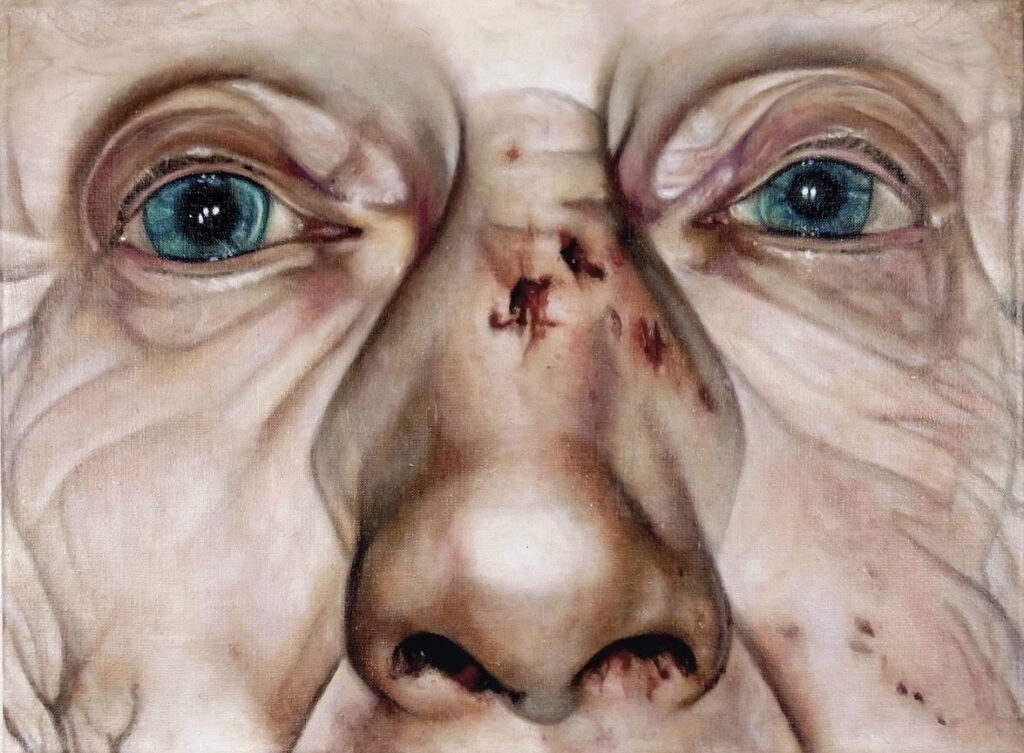
You often depict what could be called abject aspects of the human body—blemishes, rashes, missing teeth. What compels you toward these physical details?
Jamie: I’m really fascinated by the very idea of having a body, as broad as that sounds. The fact that I can will it into movement, and yet sometimes it feels completely alien or separate from me. At times, the body can feel comforting and familiar, and other times suffocating and abstract. Am I the body, or am I simply the operator?
In art, the body is so often made heroic, idealised or eroticised, but I’m more interested in it as just one element of a broader natural order, completely at its mercy.
I’m drawn to the body in its most unremarkable reality: a biological thing, subject to inevitable degradation and failure.
I’m especially interested in depicting the aspects of the body that in some may provoke a sense of shame; blemishes, rashes, missing teeth, because they can become stark reminders of our vulnerability and the instability of identity itself. Also, there’s nothing more satisfying to paint than a blister.
You speak of “vestigial social imprints” and culturally ingrained routines. Are there specific rituals, habits, or modern behaviors that particularly fascinate you?
Jamie: I’ve always been aware of a feeling I have, of observing my body living an existence outside of myself. It’s like zooming out to such an extreme degree that part of me becomes a non-participating spectator of some other part. That sense of detachment makes even the smallest social exchanges feel faintly alien: a handshake, queuing politely, clapping after a performance, ordering at restaurants, giving and receiving wrapped gifts, boarding a bus. The social choreography of it all is so tightly coded that it begins to feel like a pantomime. So much seems to happen by degrees of automation, as if these gestures are some vestiges of older scripts that we perform dutifully and without question, for the most part. Lately I’ve been drawn to collective rituals that hinge on some form of union, nightclubs, for instance. Stripped of familiarity, the whole thing is a peculiar scene: a crowd of bodies, in a hot space, just moving about. It seems so obscure when viewed so plainly but is instantly recognisable to centuries of history. Costumes change, the music is different, but the instinct is the same and it suggests a persistent social function; to align ourselves physically with others as a way of reinforcing the collective experience of living.
How does your Welsh background or your life in London seep into the work—if at all?
Jamie: I don’t think it’s in the work necessarily, but I think it’s very much impacted how I navigate being an artist. I’m from an industrial, working-class town in Wales; art wasn’t really about. I don’t think I even stepped foot into a gallery until after the age of 18, and that then felt like an overly reverential, hallowed event. I remember visiting Wales after having moved to London and a friend asking me, “In art galleries, do they always play classical music?”. Obviously, this is just my mate being a dolt, and it’s funny, but there’s some poignancy to it. It was a reminder that art often seemed like something for other people, and for me the shadow of that unfortunately still lingers. I can still feel a certain discomfort when visiting galleries, heightened further when exhibiting. It almost feels like something I must behave around. For a long time, I was self-conscious about my accent, as if it might give me away as some interloper. I recognise now that at least some of these feelings are just my own insecurities, but maybe there is something intrinsically Welsh in them. I read some quote recently about Welsh people having some perfect ratio of pride and inferiority, and thought that was pretty funny.
Are there any artists, philosophers, or thinkers—past or present—who have particularly influenced the way you see or make work?
Jamie: The writer Dennis Cooper has had a big influence on me. I really admire his conviction and his fearlessness; there’s an honesty in his refusal to self-censor that I find incredibly compelling. His work is wholly unsubtle, unsanitised, and his seeming lack of compromise is something I feel vaguely envious of. I’m always drawn to that stuff, I think I’m too apologetic by nature… but I’m trying. Artistically, I feel similarly drawn to Paul McCarthy for the same reasons, and am particularly fond of his works on paper.
There’s a tension in your work between layering and discordance. Is this dissonance intentional? What role does discomfort or contradiction play in your compositions?
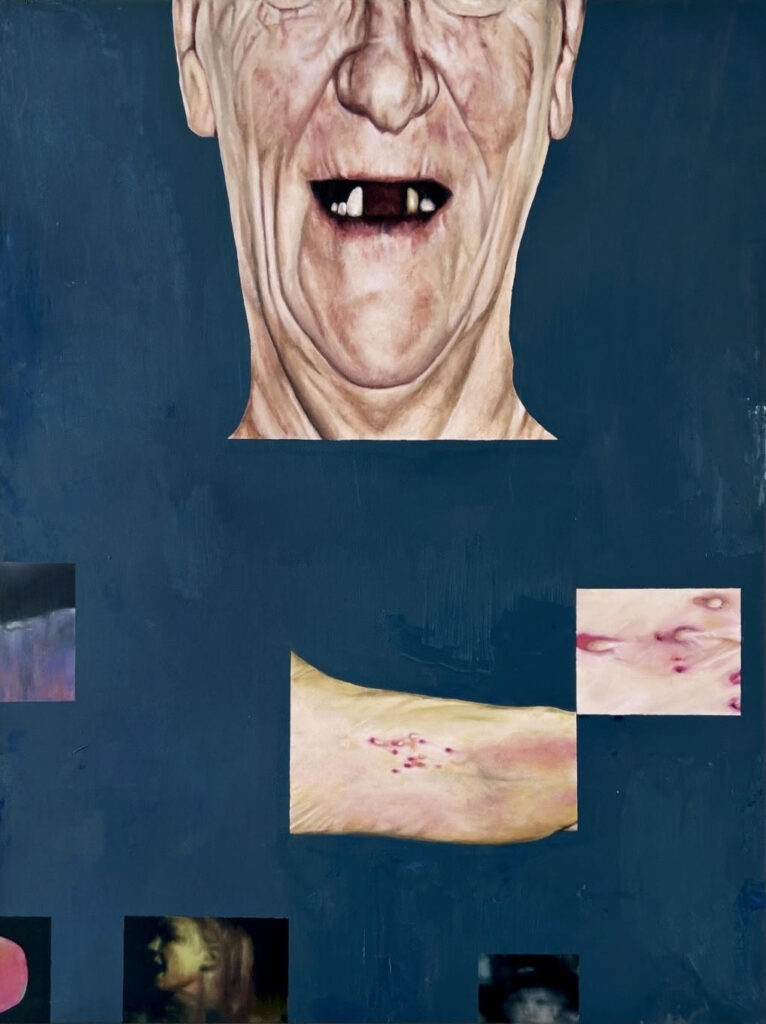
Jamie: Yes, I aim for a certain dissonance, though again it tends to be subtle rather than overt or jarring; something slightly misaligned, or uncentred, for instance. I spend a lot of time thinking about the journey of the eye when planning paintings, trying to create compositions on which the gaze doesn’t settle particularly comfortably, or where some kind of visual conflict emerges. I often use repeated imagery in paintings because I’m interested in how this naturally makes the eye bounce back and forth between the repetitions, looking for comparisons or errors, unable to set. I don’t really want the viewing experience to be one that is particularly restful or passive.
With that in mind. Can you walk me through your creative process from beginning to end result?
Jamie: Most paintings begin as loose notes in one of my many notebooks, often just a sentence or a compositional detail stolen from something mundane like a public noticeboard. From there, I build digital collages that serve as templates for the painting. Lately I’ve tried to be less rigid with adhering to these digital renderings; to leave space for spontaneity, which isn’t my natural inclination as someone who’s ordinarily very disciplined and regimented. This opens a greater allowance for failure, and often reveals something more human than precision can. I usually paint in two distinct modes, one I think of as work: highly controlled, where I’m focused on accurately rendering visual elements in a deliberately labour-intensive way. The other I think of as play, in the Jungian sense, where I approach, for example, the backgrounds of my collage-based works with more freedom, looseness, and haphazardness.
How do you approach color?
Jamie: I’ve often beaten myself up for making paintings that felt overly saturated, and no matter how much I tried, I couldn’t steer clear of it. Eventually I realised it’s because they almost always reference either the digital consumption of images, or the experience of memory. Both exist in heightened states: the screen’s exaggerated colour profile, the mind’s tendency to recall events as richer and more vivid than they perhaps were; so I’ve succumbed to it.
The backgrounds of my collage-based paintings are often heavily worked, aiming for deliberately sickly interpretations of colours drawn from nature or the body; the green of lichen, the red of blood, for example.
Ok Jamie, now to something totally different. Outside of art, what’s something you’re obsessed with right now—maybe a hobby, a show, or even a food—that keeps you grounded or inspired?
Jamie: Well, I couldn’t really swim until a few years ago, I was just thrashing around wildly in shallow water, but I’ve been teaching myself over the last few summers and now I can swim and am just constantly wanting to be in the sea. It’s a whole new thing for me and that’s been my big obsession this summer. I did get stung by a jellyfish recently though, which has slightly tempered my enthusiasm.
In a parallel universe who would you be? and what would you be doing?
Jamie: I’d be out there stinging a jellyfish.
Can you tell me a story about a time when a connection with someone had a big impact on you?
Jamie: I once saw Kate Bush and she smiled at me.
What qualities do you find most important in the people you choose to spend time with?
Jamie: It’s interesting to think about because it’s made me realise that most of the people in my life have very similar qualities. Mainly they are people who are authentic, true to themselves, enthusiastic, not bored, a bit silly, and willing to endure my endless monologues about whatever obsession I’m consumed by at that moment.
Alright Jamie, I always ask these two questions at the end of an interview. The first is. What’s your favorite movie(s) and why?
Jamie: I’d say Taxi Driver and A Clockwork Orange. Both have a similar quality of unease but almost set at different volumes. A more recent favourite is Under the Skin. There’s something in there that resonates with me in relation to my work, and I found the scenes of the bikers driving around on those winding roads very haunting and unsettling in a way that I can’t fully comprehend.
The second is. What song(s) are you currently listening to the most right now?
Jamie: Well, for the past few months I’ve been banging on about how perfect a song A Lot’s Gonna Change by Weyes Blood is, and I think Titanic Rising as a whole is altogether extraordinary. Weyes Blood, Caroline Polachek, and Perfume Genius are all I’ve really been listening to while painting over the last year.