
Share this
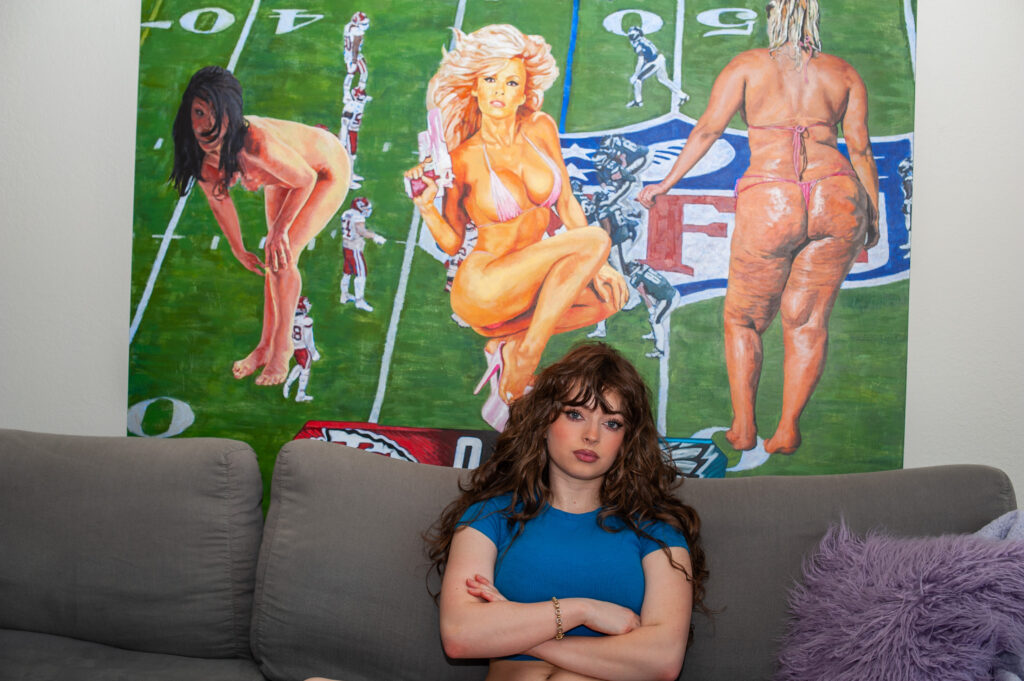
Sophie Jackson (b. 2003) is a Canadian artist fascinated by the interplay between personal identity and the digital age. Functioning in the contexts of a post-internet world, Jackson plays with social media and pop culture iconography to translate her own lived experiences into new visual narratives. Sophie lives and works out of Victoria BC, and is currently studying her BFA at the University of Victoria.
Hi Sophie! It’s a pleasure to sit down with you! First question that I always ask. How does a regular day look like for you in Victoria?
Sophie: Likewise! Lately, I like to start my days by listening to music, especially through vinyl. I try to limit my screen time in the morning (though this varies..) so using physical media while I make my breakfast or do my chores is a nice way of doing that. Then, it’s either getting whatever work I need done, enjoying some time outside, getting a lift in, and, maybe on a good day, some thrifting and hitting the town with some friends for the evening. I’m also a bit of a night owl, so I like to get a lot of my creative work done at night – I usually find myself making my painting references long after I probably should be asleep.


I’m curious, growing up, what was life like there? And what kind of kid were you? What did you enjoy doing?
Sophie: Victoria is great. I think as an adult, I often find myself making up for lost time here. Growing up, I tended to stick to myself, and didn’t spend a lot of time outside. While I think that helped in my development as an artist (all I would do is draw), nowadays I really do value friends, experiences, and community. Victoria is great in that it’s small enough to know many people here – although there are times that’s also a curse. For the most part though, I really love it here; there aren’t many places you can go downtown, and then to the lake or beach within ~15 minutes at any given time. I think in the future I will yearn for a bit more hustle and bustle, though. As a kid, I spent much of my time drawing, playing video games (I was obsessed with Pokemon growing up), reading comics, and spending probably way too much of my time online.
Do you remember approximately at what age your creative side started to show? And when did you start taking being an artist seriously?
Sophie: I think I started to really consider myself an “artist” around the 4th grade, when I copied my best friend’s sister’s My Little Pony drawings so many times that ponies turned into my mainstay for a bit. I tend to get obsessive about things, so naturally this reflex soon turned into me drawing at any moment I could. I remember attending an after-school art program in elementary school that I think really cemented in me this was my path. After the ponies it was Warrior Cats, which I got really into the fandom for, and learned how to animate through multi-artist projects.
My mom worked as a photographer growing up, which I think equally played a part in my love of the arts. She still takes my digitals now, sometimes. My great grandmother was also an oil painter, so I think I’ve always felt a push to go down this path. Since then, my definitions of being an artist have shifted and morphed – for a long time, I wanted to be an animator and cartoonist. At the moment, I find myself really enjoying fine art, especially painting, but I’ve never limited myself to a single medium. All I know is I’m an artist, and will be for life.

Ok Sophie, with these next series of questions, I will try to delve into your work as best as possible. So…. Your work sits between personal experience and the visual language of the internet. When did you first realize that social media could become material for your art?
Sophie: I think it’s really just another manifestation of my lived experiences. I view the internet the same as I would any other experience I want to show in my art – I spend, and have historically spent, a lot of time online, so it feels only natural. An artist I really love that explores the landscape of the internet is Victoria Vincent/Vewn – she has definitely played a role in how I incorporate the subject into my work, and my film “Influenced” I did a couple years ago was heavily inspired by her.
I think the internet as a subject is also something that connects a lot of people together – even if the things I speak on are not something all people can relate to, they can instantly recognize the look of a Windows XP backdrop, or popular internet personalities like Trisha Paytas. It helps tie the work together and provides an in for people.
With that in mind… You were born in 2003, meaning you grew up almost entirely inside the digital age. Do you feel like the internet shaped your sense of self before you had time to define it yourself?
Sophie: Definitely. I honestly don’t think young kids should be online, especially not social media. Your brain is way too malleable, and the internet has a tendency to put people in boxes. I think the internet is great for discovering things, but it becomes dangerous when you start to define yourself as an archetype of one thing. I find that self-limiting, and at times can bring along negative baggage with it, which you can then wrongfully associate with yourself. It took spending time offline for me to truly discover who I really was, without people telling me what I should be. Finding a community online can certainly be beneficial, but there’s a balance you have to strike. I think part of that balance can only be formed through time spent in the real world.

You’ve mentioned translating lived experiences into new visual narratives. How do you decide which parts of your life are ready to become work?
Sophie: t’s cyclical, and usually ideas come to me in the in-betweens of my life, after a chapter closes. I find it usually takes me some time to reflect on something before I feel inspired to make work about it – I also don’t like feeling forced to make certain things. No disrespect to people asking me to paint them, but realistically I can’t ever promise people that will happen. Ideas have to simmer. There are other times I get ideas directly after a moment, though, so it really varies. Usually the need to make work on something is dependent on how strong my feelings are toward it.
Right now, I’m reflecting on a lot of my life over the past few years. I think I tend to gravitate toward personal hardships in my practice, both as a way to remedy them, and share my voice a bit, too. I had some very difficult revelations and experiences over the past year, and I’m finally starting to feel ready to illustrate the feelings I carried from that visually. And as hard as it is to do, I think there is an innate beauty in that vulnerability and authenticity.
Is making art a way of understanding yourself, protecting yourself, or exposing yourself?
Sophie: I think a bit of all three. There are times the work I make scares me to show because it is so vulnerable, but when I have an urge to create something, unfortunately I must follow it. In this way, art is a great therapeutic tool for me, especially when the work is more personal, and it’s healing to see people connecting their experiences to mine. It also reaffirms to me that nothing is that serious, and I’m not alone in many of my hardships. On that same coin, the nice thing about art is I still have the agency to determine how much I show, or talk about a piece – there are elements in certain pieces that I’ve never discussed publicly, but have deep personal connections to me – but not everything needs to be explained. Sometimes there’s a beauty in presenting things to others, but still having a piece of me I keep sacred. And it’s especially cool to have people connect with it without needing to give all those details.

You’ve said you’ve been thinking a lot about the feminine experience. What does that phrase mean to you personally?
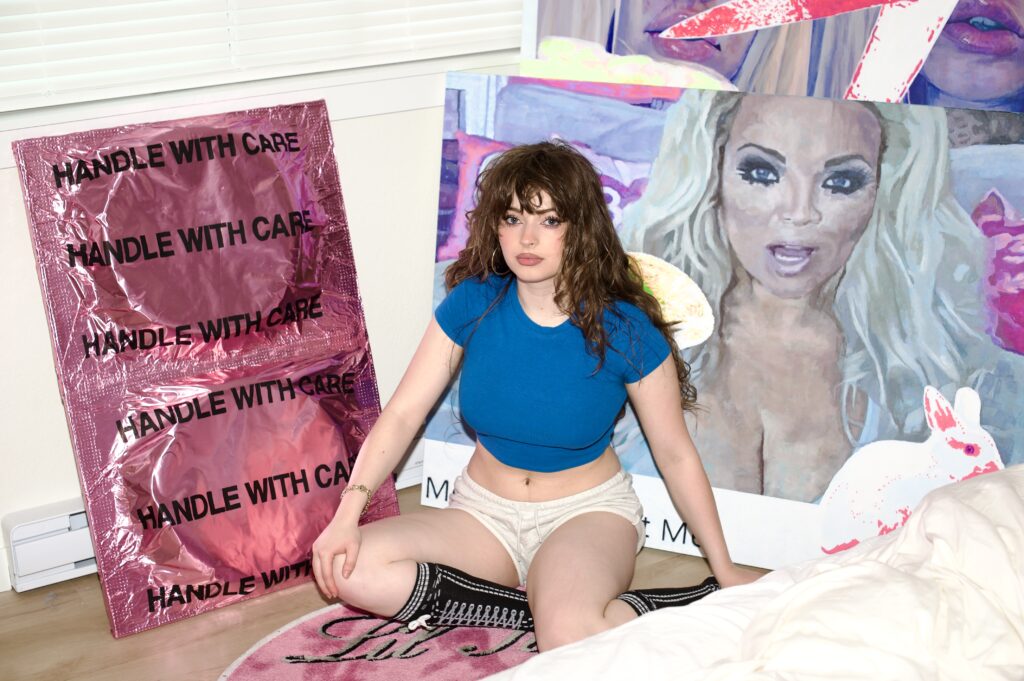
Sophie: To me, the feminine experience is everything involved with being a female-presenting person, and the beauty and pain that comes alongside that. I’m especially interested in exploring my own personal experiences, and the hardships that have shaped me into who I am today. I’m trying to shape a visual language that reaffirms women as unapologetic, loud, and distinct in identity – all things I’ve found the patriarchy seeks to diminish. I like to contrast my works with “girly” elements a lot, like the colour pink, or materials like glitter – in doing so, I form my own agency of choice, and reclaim elements that were once pushed as the only option. Now, I can define them, and they do not signify my inherent intelligence or social value.
Do you feel the feminine experience is often performed online before it is privately understood?
Sophie: Definitely. I think the internet just further amplified what has been happening societally to women since the inception of patriarchal values. There is so much pressure on young girls online to behave or act in a certain way, and even now I still am unlearning many of these standards. On an even larger scale, young people yearn to feel like they belong, so it’s entirely natural to want to follow the current trends and “do’s and don’ts” of womanhood. This not only causes people to conform to standards that actually disadvantage them as a larger collective, but hinders them from discovering their own individuality. Womanhood becomes less an individual, guiding experience, and more an impersonal performance to the masses. I’ve noticed this is especially evident in the rise of purity culture and “trad-wifeism” online.

In your work, how do you approach the difference between being seen and being understood?
Sophie: There’s a bit of a letting go that’s necessary when showing my work to the world. I tend to be a control freak and perfectionist so this is an unnatural feeling for me, therefore it’s helpful to practice potentially being misunderstood. I’ve also come to realize that my work does not always have the same meaning for different people, and that’s a good thing. I think it’s beautiful when people connect their own experiences to it.
I deem a work successful in a way if the definitions of “seeing” it and “understanding” it are different, at least on the surface. I also do kind of have a small intended audience that I hope will “see” the work in a negative view. When that audience makes themselves known, it’s kind of satisfying in a sickening way, lol. It lets me know the work gave a reaction, which is what I’m after.
There’s often a tension in digital culture between intimacy and performance. Do you feel social media has changed the way we experience closeness?
Sophie: I think social media has amplified the need to perform in every aspect of our lives. You can seek intimacy and connection at the click of a button, yet it will never be equivalent to the real world. This forms an even greater need for it. Sure, you can craft a perfect persona, but by having no real world experiences to actually base it off of, you limit yourself from any real human connection. Even still, the narratives pushed to perform in the real world, through social media, limit people’s perceptions of things such as intimacy greatly. It is less about actually connecting, and more about appeasing the voice of the algorithm, or copying someone from a video online.
I think social media and the porn industry have made it much harder to engage in closeness in real life. People claim to want connection, but it’s based on what they’re being fed rather than what their true inner self desires. And when you actually have an opportunity to connect, all you can think about are the narratives that have been endlessly shoved down your throat. Do this, definitely don’t do that, be yourself, but copy this. Being present in the moment is impossible when your brain is continually occupied by the expectations of others via a screen.
When you think about intimacy, are you more interested in romantic intimacy, emotional intimacy, physical intimacy, or the intimacy we have with ourselves?
Sophie: I consider all intimacy – be it romantic, emotional, physical, or personal – to function as a collective experience. At its core, it’s rooted in the innate need for deeper human connection. Currently, I’m most focused on the effects on physical intimacy in my work, and how this can translate itself emotionally through subconscious means. I’m also interested in capturing personal intimacy at a larger scale.
Hook-up culture is an interesting subject to me – it’s a concept that feels so foreign to its roots. I think the internet has equally played a part in the rise of “nonchalant” behaviors in the dating world and disposable views on sex. Equally, however, I think sex and intimacy are interesting ways of exploring the greater human psyche – sex is a distinctly primal act, and it carries so many thoughts and feelings with it, many of which we are not even fully conscious of until after the fact. It parallels the way I like to approach my work in many ways: exploring bold, sometimes vulgar themes, in an effort to understand the deeper human subconscious. I’m looking to push this area even further in my work in the future.
You’ve mentioned personal healing. What does healing look like in your work?
Sophie: Visualizing healing comes from a wide array of materials, but is often rooted in reclaiming old aspects of my life, on my own terms. I’m drawn to re-appropriating imagery or phrases from my past to redefine their value to me, in the present day. Through transforming old materials to fit new narratives, it allows me to recognize their purpose in that stage of my life, let go, and look at them from a fresh, neutral lens.

Do you feel your art comes more from wounds, memories, desires, or curiosity?
Sophie: I would say it mostly comes from wounds, memory, and desire. My wounds fuel the fire to create the work, my memories inform the landscape and contextualities, and my desires form the voice.
Are there certain emotions you find easier to express visually than verbally?
Sophie: Rage, anxiety, desperation, lust.
Pop culture iconography often carries nostalgia, fantasy, and pressure all at once. What symbols or images from pop culture have stayed with you most deeply?
Sophie: The symbols I’m drawn to the most are often images from my childhood. This can be content online, tv shows I used to watch, games I used to play, et cetera. But a key component is I usually had a prior connection to the media.
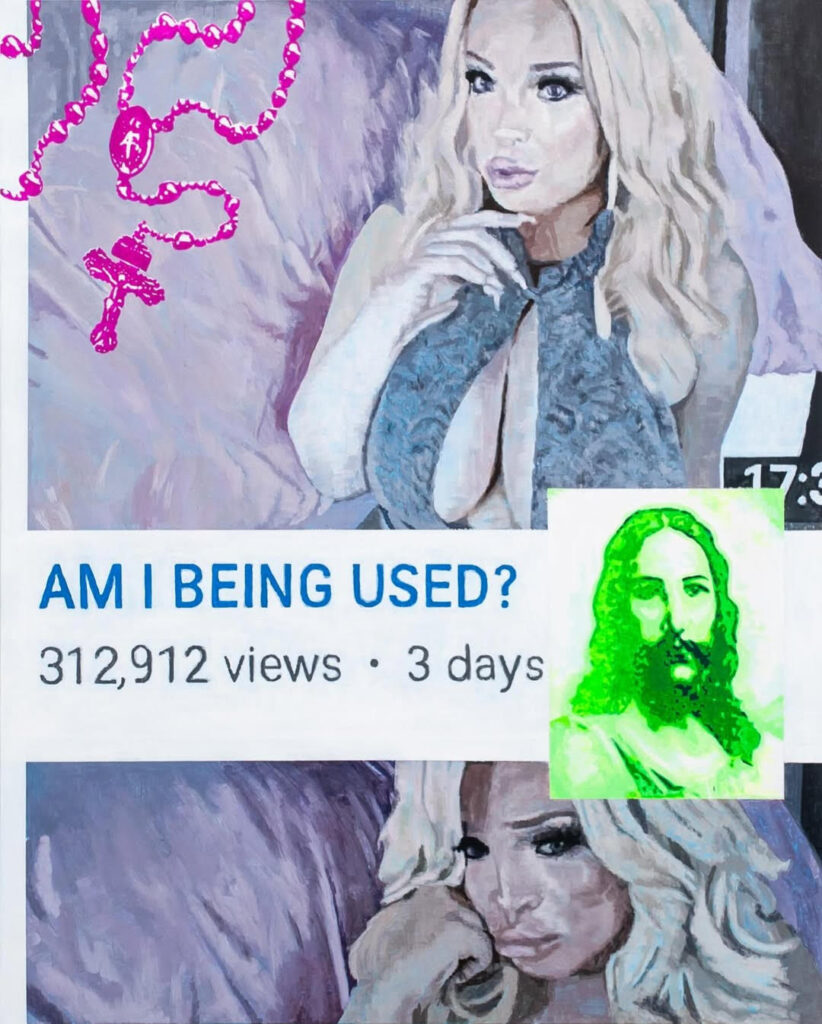
Recently, I’ve been drawn to Trisha Paytas as a muse. Specifically, I’m interested in how she titled her old YouTube videos to not only grow an audience, but more profoundly, how it revealed inner personal qualms and larger thought processes of young women as a collective during the early 2010s. I’m equally interested in how she used her personal appearance as a strategic device, to aid in this messaging. There’s a parallel in how she “performs” to larger cognitive patterns of young women online, and specifically how the patriarchal lens plays a hand. There’s a beautiful tragedy that takes place through the messaging of her videos, and that’s what I’m interested in capturing. On the surface, something like a YouTube thumbnail can be perceived as not that deep, but I think it’s a disservice to not dig deeper. There’s a wealth of knowledge we can gain from content as “simple” as ragebait.
Do you see your work as a critique of digital culture, or more as a reflection of what it feels like to live inside it?
Sophie: A bit of both. It’s like hell: it sucks, but we’re in it, so might as well find a way to live with it.
What parts of yourself do you feel the internet amplified — and what parts did it distort?
Sophie: I definitely felt an urge to push my sexuality from a young age online. There was a point in my life (before I even turned 18, mind you) I surely thought OnlyFans would be in my future. I remember being so excited to turn of age so I could get “rich” quick. I never ended up going down that path, but it certainly wasn’t helpful when anytime I would post myself in revealing ways, that would get the most traction online. As a young girl just wanting to feel validated, it can be a very slippery slope.
Nowadays, I still enjoy getting done up and posting cute pics, but I’ve tried to deconstruct the need to constantly look “pretty” or “Instagram-ready”. I’ve come to learn that depth is just as, if not more, valuable than outward appearances. And you can absolutely have both – but denying yourself soul in the pursuit of aesthetics is a tragedy. Your looks are truly the least interesting thing about you.
Do you ever feel vulnerable using your own experiences as material?
Sophie: It’s definitely scary. I tend to be a private person, so even now I’m selective about what I say or declare as personal in my pieces. Sometimes, though, it’s necessary to give details, and more often than not this ends up being rewarding. Having people connect to the work is worth the discomfort a million times over.
Has making work about femininity and healing changed the way you relate to your own body, identity, or past?
Sophie: Yes, it definitely helps me in reframing aspects of my life or views of myself. I give myself a lot more grace than I maybe would’ve in younger years. I think educating myself on the patriarchy and the “why” of things in women’s lives and my own also played a part in that.
Looking ahead, how do you want your exploration of intimacy to evolve in your future work?
Sophie: I’m interested in exploring the parallels intimacy and sexuality have to our own inner processes and minds. For a while now, I’ve been engaged in capturing the feelings associated with “doomscrolling” online – a meditative, out of body state, where the brain shuts down and is replaced with instinctual actions. I think there is an overlap between this dynamic and hookup culture.
We’re in an era of both dopamine excess and withdrawals – young people yearn for closeness and validation, but the effects of social media have shifted the landscape of attaining this on a broad scale. Moving forward, I want to both commentate on the growing dilemma of dopamine addiction and equally allow a space for a fresh, more present dynamic, focused on the emotional undercurrents intimacy brings.

Is there a version of yourself you feel you had to let go of in order to make the work you’re making now?
Sophie: I used to be very preoccupied over what people thought of me. I was also very male-centered, and at one point I had even let conservative values overshadow my own. I’m still defining who I am, but I’ve drastically improved (and am staunchly a leftist). Making work that is unapologetically feminine and sexually-charged, it was necessary for me to deconstruct my notions of what a woman “should” be societally, and what is and isn’t “permissible”. As I delve further into my work, this need only continues to amplify. Nowadays I understand that my existence as a woman is enough, and the act of performance is based on personal choice, not the approval of others.
I had to accept that many people will put labels on my work or hold preconceived notions about my character or personal life because of the subject matters I push, or would like to push in the future. While I understand much of this is deeply rooted in misogyny, it takes active effort to separate yourself from patriarchal standards. It is easier to shrink: my work can’t afford to let me do that. I trust that the right people will get it.
What has art allowed you to say that you maybe weren’t ready to say directly?
Sophie: A lot of frustration.

Do you think healing has to be beautiful, or can it be ugly too?
Sophie: I think true healing has to be a little ugly. It’s impossible to reach the inner root without first breaking down everything you’ve known before it – anything else would be too shallow.
I think healing IS beautiful. The ugliness is a part of that beauty. Being deeply vulnerable, allowing yourself to feel flaws in their entirety, to push through hardship to reveal a deeper self – it’s one of the most beautiful processes a human can undergo. And I think anyone who’s gotten to the other side can agree. But that ugliness is non-negotiable.
What does safety mean to you?
Sophie: My definition of safety has changed a lot throughout my life. Certain things and people I considered safe in the past would not fit that criteria anymore. Safety for me nowadays is less rooted in origin, or specific individuals. I judge safety on trust, honesty, clarity, consistency. It’s an encompassing feeling, rather than a designated label. It can come from anyone or anything, but it takes time to build.

Is there anything about the feminine experience that you feel people still misunderstand or simplify?
Sophie: I think the fact it is still such an individual experience. My experience as a white cis woman is vastly different from that of a trans woman, or women of colour. There are distinctly different hurdles and societal expectations for different women. It’s necessary to view womanhood from an intersectional standpoint, and also to support and amplify the voices of your sisters.
Can you walk me through your creative process from beginning to end result?
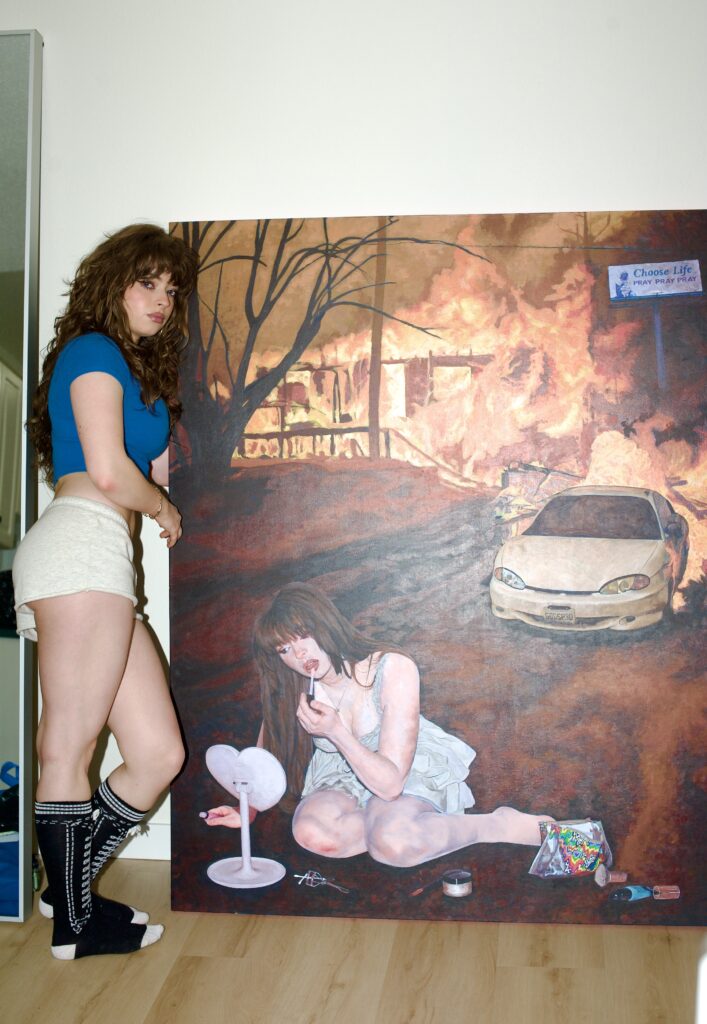
Sophie: My pieces often start in my notes app, from a word, phrase, or imaginary image I probably tried to describe at 3AM. Once I have the concept, I pull imagery from what I’m drawn to in that moment, or that furthers/contrasts the messaging of the phrase. I like to put opposites together a lot. I then collage it all together in Photoshop, project it onto whatever surface I’m using, and paint it from the reference on my iPad.
P.S. I love my projector – anyone that says it’s cheating just isn’t about it like that. Work smarter not harder!
Can you also tell me about your use of symbolism?
Sophie: I use symbols for what words can’t accomplish. While text is a frequent addition to my works, I think there is a complexity and nuance to images that grants them an even further advantage, in terms of messaging. Images hold history, contextual complexities, and can transform entire dynamics of a piece. I’m very selective about the images I use, and everything has a reason or purpose, even if it’s just to boost the aesthetics. There is always an underlying theme, or message I’m trying to convey through my work.

How do you approach color?
Sophie: Colour is intuitive for me, though I also like to plan beforehand. I find I unintentionally return to the same colours frequently. But largely it is narrative focused, and based on what the piece needs for its “punch”. Colour theory is a very helpful tool: I often lean on complimentary combos to further the visuals. It’s a lot more formulaic and linear than people realize.
So with what we just talked about, what are you hoping to convey?
Sophie: You’re allowed to take up space, and should never apologize for doing so. And equally, art does not always have to be serious – but, even so, the unserious can also be that serious.
Ok Sophie, now to something totally different. In a parallel universe who would you be? and what would you be doing?
Sophie: I would probably be producing or making music. The only caveat is I can’t sing, so I need to figure that out first. But maybe one day.
Outside of art, what’s something you’re obsessed with right now, maybe a hobby, a show, or even a food—that keeps you grounded or inspired?
Sophie: I love an album. The primary way I listen to music is through albums, not playlists (partly because I’m too lazy to make playlists often enough). Recently I’ve been diving into D’Angelo’s discography. Voodoo has been on repeat – there’s a sensuality and rawness to it that’s one of one. I wish I had discovered his music further before he passed, but it’s a blessing to listen to it even now. RIP.
Also been listening to a lot of OutKast as of late. I think I care less about the medium for my inspirations and more about the vision and authenticity artists create through their work. In that sense, Andre 3000 and Big Boi are two of the best painters of all time. Painters for the ears. Whenever I’m in doubt I put Speakerboxxx/The Love Below on and continually am inspired by it. I listen to a lot of hip hop and R&B in general. I also go to a lot of concerts, I love live music. Outside of music, I also love collecting trinkets, and I’m really into fashion.

Can you tell me a story about a time when a connection with someone had a big impact on you?
Sophie: My dating life has continually informed and inspired my art. A person I dated years ago played a big role in my views on feminism today. There was a time in my life I was still quite young and naive, and this person placed a lot of conservative and misogynistic views onto me. Since deconstructing these sexist ideologies, it’s motivated me to become the antithesis of them. I now greatly value my personal autonomy and hold my beliefs high.
What qualities do you find most important in the people you choose to spend time with?
Sophie: Authenticity, integrity, humour. I also feel some of the most valuable connections I make are from people not necessarily working in my field – and that’s not a diss to creatives, because those relationships are equally important and valuable to me – but I’ve really come to appreciate diverse perspectives and opinions and I grow from broadening that.
Anybody you look up to?
Sophie: In terms of artists, I love Takashi Murakami, Trey Abdella, Victoria Vincent, Andre 3000, Tyler the Creator, Doechii. Also, I look up to my friends a lot.
What motivates you?
Sophie: The things I have yet to accomplish.
How would you describe a perfect day?
Sophie: Wake up early, naturally. Walk to cafe, strawberry matcha. Hit the beach, people watch. Go thrifting or hit a lift. Go home, minimum 2.5 hours getting ready. Dinner res at 7. Sunset pics with digicam. Afterwards, straight to club. The DJ plays my whole playlist. Go home to my bed. Screen time: <1 hour. That’s perfect.
Alright Sophie, I always ask these two questions at the end of an interview. The first is. What’s your favorite movie(s) and why?
Sophie: I really love and connect with The Truman Show. I think its messaging is only becoming more relevant with time. I’m also a big fan of Wes Anderson – Fantastic Mr. Fox and The Grand Budapest Hotel are some of my favourite films. My comfort movie is Clueless – the fashion and unapologetic girlhood in that film still inspires me to this day.
The second is. What song(s) are you currently listening to the most right now?
Sophie:
She Lives On My Lap – OutKast
Other Side Of The Game – Erykah Badu
Africa – D’Angelo
Pressha – Jill Scott
London Summers – Odeal
These are all perfect songs to me.