Share this
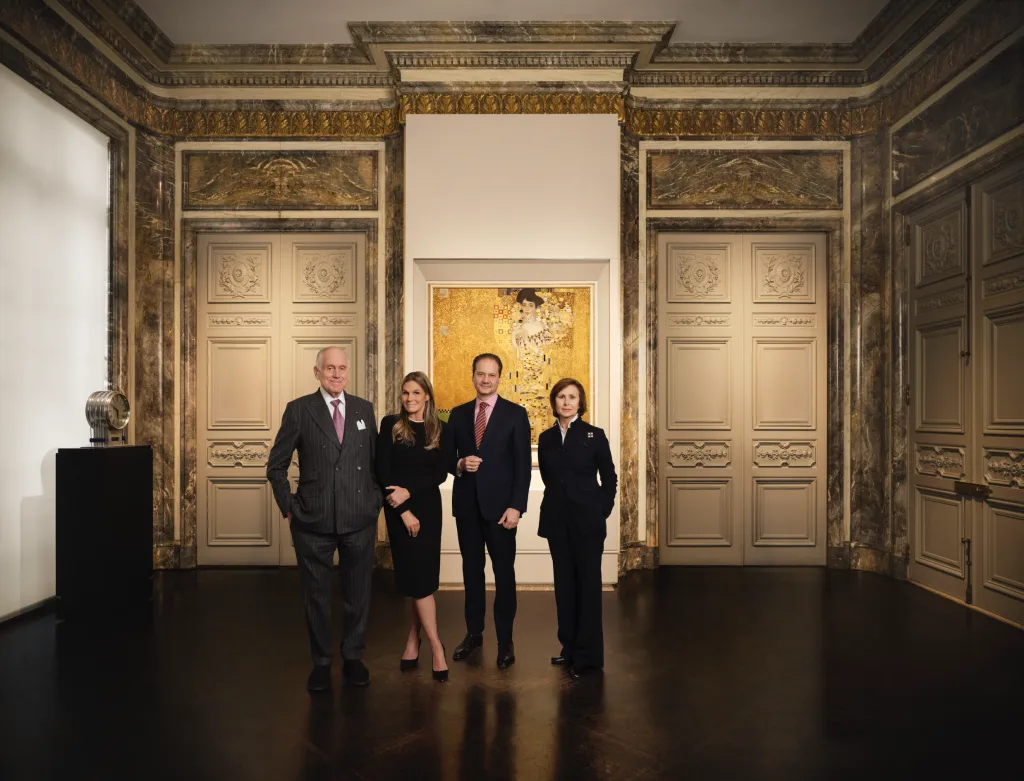
Ph: RONALD S. LAUDER, AERIN LAUDER ZINTERHOFER, MAX HOLLEIN and NEUE GALERIE director RENÉE PRICE. Photography by THOMAS LOOF, courtesy of the MET
Ronald Lauder’s museum of Viennese and German modernism will merge with The Met in 2028, preserving its Klimts, Schieles, Café Sabarsky, and Fifth Avenue atmosphere
Some museums feel less like institutions than private worlds. Neue Galerie New York has always been one of them: an intimate Fifth Avenue house of gold, shadow, Viennese modernism, German expressionism, and old-world ritual, where a visit could move from Klimt and Schiele to coffee and cake at Café Sabarsky without ever quite leaving the same dream.
Now, that world is entering a new chapter. Neue Galerie and The Metropolitan Museum of Art have announced a landmark merger, scheduled for completion in 2028, that will bring the museum’s collection, endowment, and historic Beaux-Arts building under The Met’s stewardship while preserving Neue Galerie’s distinct identity.
The museum, housed in the William Starr Miller House on Fifth Avenue, will eventually be renamed The Met Ronald S. Lauder Neue Galerie. Before that transition, renovations are set to begin on May 27, 2026, with reopening expected in autumn 2026.
Founded by collector and philanthropist Ronald S. Lauder with dealer Serge Sabarsky, Neue Galerie has become one of New York’s most focused and atmospheric museums, dedicated to early 20th-century Austrian and German art. Its holdings include work by Gustav Klimt, Egon Schiele, Oskar Kokoschka, Ernst Ludwig Kirchner, Max Beckmann,and Gabriele Münter, with Klimt’s Portrait of Adele Bloch-Bauer I at the centre of its mythology.

What makes the agreement interesting is that it does not appear to absorb Neue Galerie into The Met as just another department. The museum’s galleries, staff, exhibitions, design shops, bookstore, and Café Sabarsky are expected to remain in place, while The Met brings greater infrastructure, research capacity, digital reach, and global visibility.
The merger also expands the story of the collection itself. As part of the agreement, Ronald S. Lauder and Aerin Lauder Zinterhofer will donate 13 major works from their private collection, including Klimt’s Die Tänzerin, Kirchner’s Die Russische Tänzerin Mela, and Beckmann’s Galleria Umberto, alongside promised gifts by Otto Dix, Franz Marc, and George Grosz.
In art-world terms, this is not simply a merger. It is an act of preservation. Neue Galerie has always been built around a very specific mood: Vienna around 1900, Weimar Germany, modernism as beauty and fracture, elegance haunted by collapse. The danger with institutional change is that such atmosphere can be flattened. The promise here is that The Met’s scale will protect, rather than dilute, the museum’s smaller intensity.
A Special Advisory Board, chaired by Lauder, will oversee the transition and future direction of the museum. That detail matters, because the question is not only where the collection will live, but how its atmosphere will survive: the intimacy, the scholarship, the café, the feeling of stepping into a concentrated world of ornament, anxiety, psychology, and gold.