(A few thoughts by the curator on the ongoing exhibition Trust Issues, on view through April 17, 2025, at Kornfeld Galerie, Berlin)
By Nina Chkareuli-Mdivani
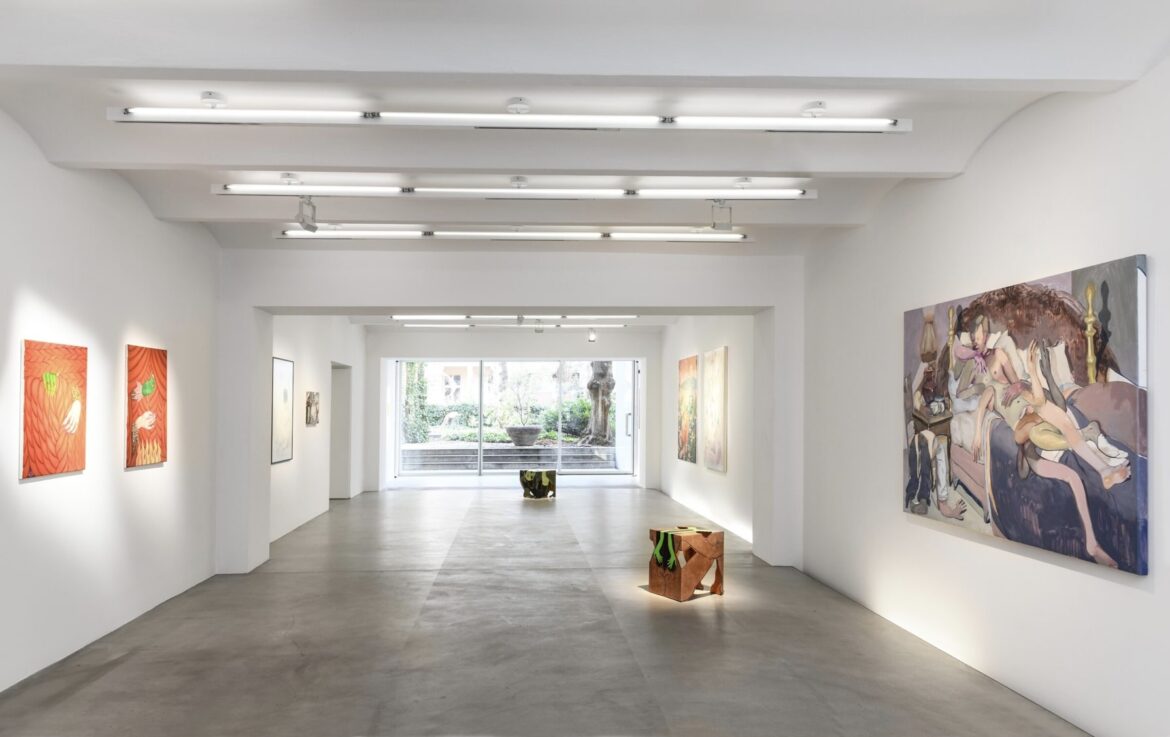
In her diary entry for January 5, 1965, Susan Sontag advised herself to think of a novel in cinematic terms, considering a close-up, medium-shot, and a long shot. In this messay, I will try to do the same with the exhibition while keeping it transparent enough for the viewers who can make sense of the show by accompanying images. Three artists presented in Trust Issues are Saelia Aparicio, a multidisciplinary artist based in London, and two painters – Mexico City-based Gonzalo Garcia and Tbilisi-based Rusudan Khizanishvili. All three capture contemporary anxiety, control society, manipulation, and hope – all characteristics of our post-truth reality.
Long shot view
We keep hearing about the layers when it comes to the works of art. Here let us find a thread connecting several works on view in Berlin. A connecting thread is also a suitable metaphor because the exhibition’s initial title a year and a half ago was Continuum of Trust rather than simpler, yet not less loaded Trust Issues. Trust issues refer to our collective loss of belief in the systems, structures, authorities, and maybe even values that previously have been foundational for our political, but also emotional, and mental stability. The strength of conviction in justice, state, and family ties has been eroded as countries and continents have been divided across various lines, all on the backdrop of what British writer and thinker Mark Fisher has termed as reflexive impotence and depressive hedonia, a willful narcosis. It seems that the digitalization of our shared public spaces alongside the atomization of societies that are driven by individual rather than collective achievements and Stalinist Capitalism has brought with it a new set of challenges for which are just starting to build up defense mechanisms. As Oswald Spengler wrote in his immensely successful book The Decline of the West, which came out in 1918-1922 and was perceived as a harbinger of the new philosophy of culture: “What is truth? For the multitude, that which it continually reads and hears.” Spengler has not imagined the technologies of control that the U.S. broligarchy is currently employing for the benefit of populism and propaganda. Nonetheless, the German philosopher describes exactly this state of being when algorithms rule us, a detached spectactorialism in Fisher’s terms, an easy revivalism, and nostalgia as described by cultural theorist Svetlana Boym.
1 Susan Sontag, As Consciousness Is Harnessed to Flesh, Journals & Notebooks 1964-1980. P.68
2 For more on Stalinist Capitalism, please read Capitalist Realism: Is There No Alternative? By Mark Fisher.
3 Oswald Spengler, The Decline of the West, vol.1 p. 201.
Medium shot view
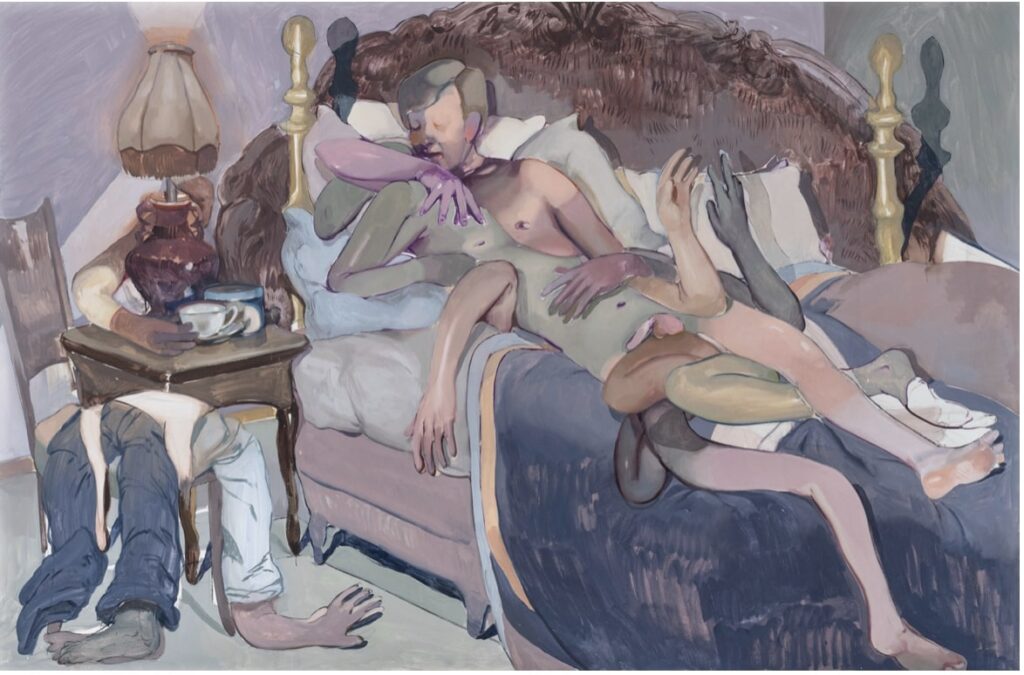
There are a few archetypal figures tacitly present in this show, not all of them are figuratively there, although their presence is palpable. One is of a father figure or a figure standing to uphold the authority, to show the structure. For Gonzalo Garcia, this father figure is tied to Arturo Ripstein’s The Castle of Purity, a 1973 film based on a criminal case that took place in Mexico City in 1959. In the film, we see a family shut away by the father within a derelict house for the protection of the purity of the children, while the family manufactures rat poison to make ends meet, and the father engages in all types of unpure behaviors outside. Luis Buñuel’s surrealism makes an appearance here as the unreal engages with the quotidian. This same subtle conversation takes place in Gonzalo Garcia’s painting, The Twisted Bed, 2024.
Garcia paints a scene of intimacy that is distorted to a degree when it’s hard to attribute a pair of limbs or a missing head to a protagonist. To him, this distortion is directly related to the political encroachment on private spaces by the government, by authority, by imposed constraints. Garcia connects to the events that took place on October 2, 1968, at the Plaza de las Tres Culturas, when hundreds of Mexican students were massacred and arrested by the Mexican Armed Forces. The undercurrent of unease surrounding the painted body and the postmodern table melting into another disfigured abstract figure recalls Gonzalo’s merging of political and personal and his preoccupation with how a contemporary artist can overtly address the cultural zeitgeist. Paternal political systems are interacting here with physical bodies as public spaces are becoming unsafe. This Intimate space becomes charged with violence; sensuality meets danger.
Close-Ups
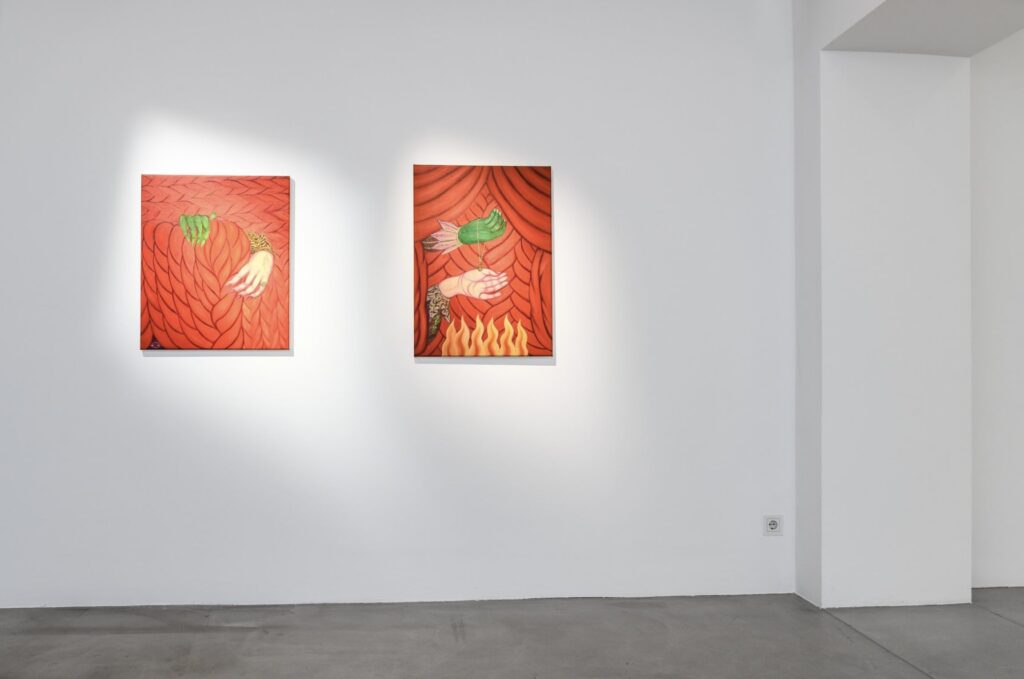
Rusudan Khizanishvili’s diptych Giving Hand, The Eye, 2024, and Giving Hand, Me Flame,2024 both work with hidden imagery of manipulation and theatricality. Hands are moving behind the red curtain, tacitly symbolizing the red color of the Soviet Union and referring to the anti-government protests taking place in Tbilisi, Georgia, starting from the spring of 2024 when the works were painted and continuing to the present day. Two mismatched hands refer to the two identities within Georgia, one old and one young, one medieval and one contemporary; the ritual of betrothal has not taken place at least back in our country.
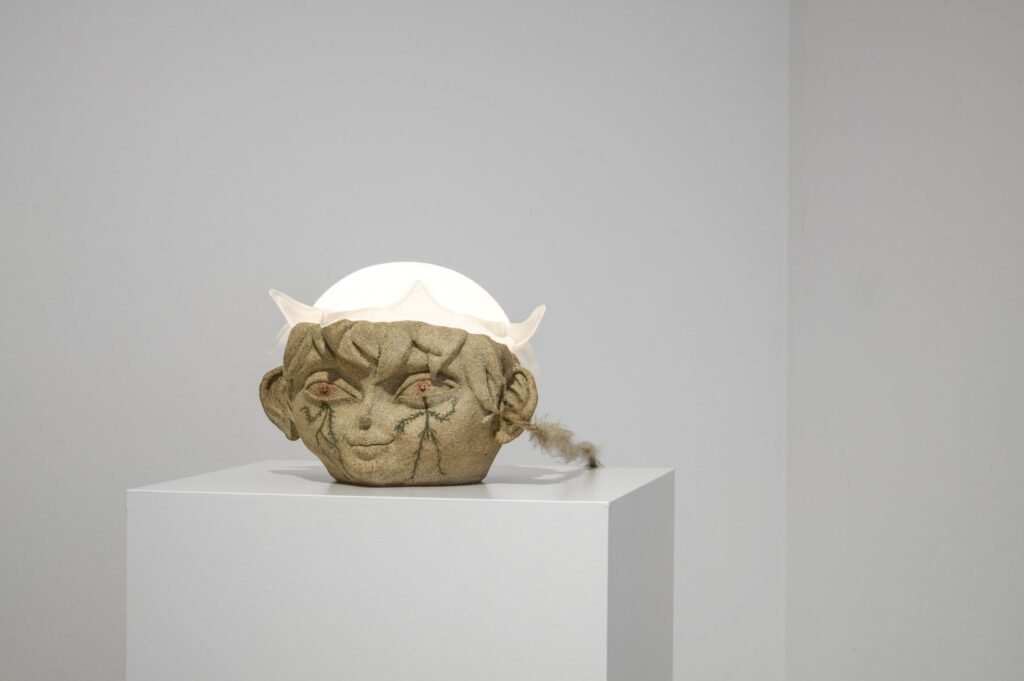
Saelia Aparicio’s sculptures reference an archetype of a magician, of an openness that could lead to violence but also to unique discoveries through experimentation and risks. In her own words, Aparicio explains:
“In my practice, trust issues emerge in the tension between what appears stable and what is actually fragile or precarious. I work with found materials, often discarded, that have already gone through multiple cycles of use and trust. I’m interested in how something can seem reliable while concealing vulnerabilities or, conversely, how what seems fragile can prove resilient. I also distrust binary systems of categorization—useful vs. useless, natural vs. artificial, productive vs. obsolete. My work often explores the complexity of the in-between states, where things resist clear classification and reveal their layered histories and new possibilities.”
Transgressing through Resistance
It is stimulating to think along these lines with the three artists and imagine a way to be reinforcing and resilient by creating a non-linear narrative. Accountability, effectiveness, and integrity should be our calls to action. Transgression, as defined by George Bataille, is a form of rebellion, a return to animal nature against the constraints imposed by the control societies of the late Capitalism. Through listening to artists, we might arrive at the possibilities of new critiques and new outcomes.
4 Georges Bataille, Eroticism: Death and Sensuality, 1986.