Share this
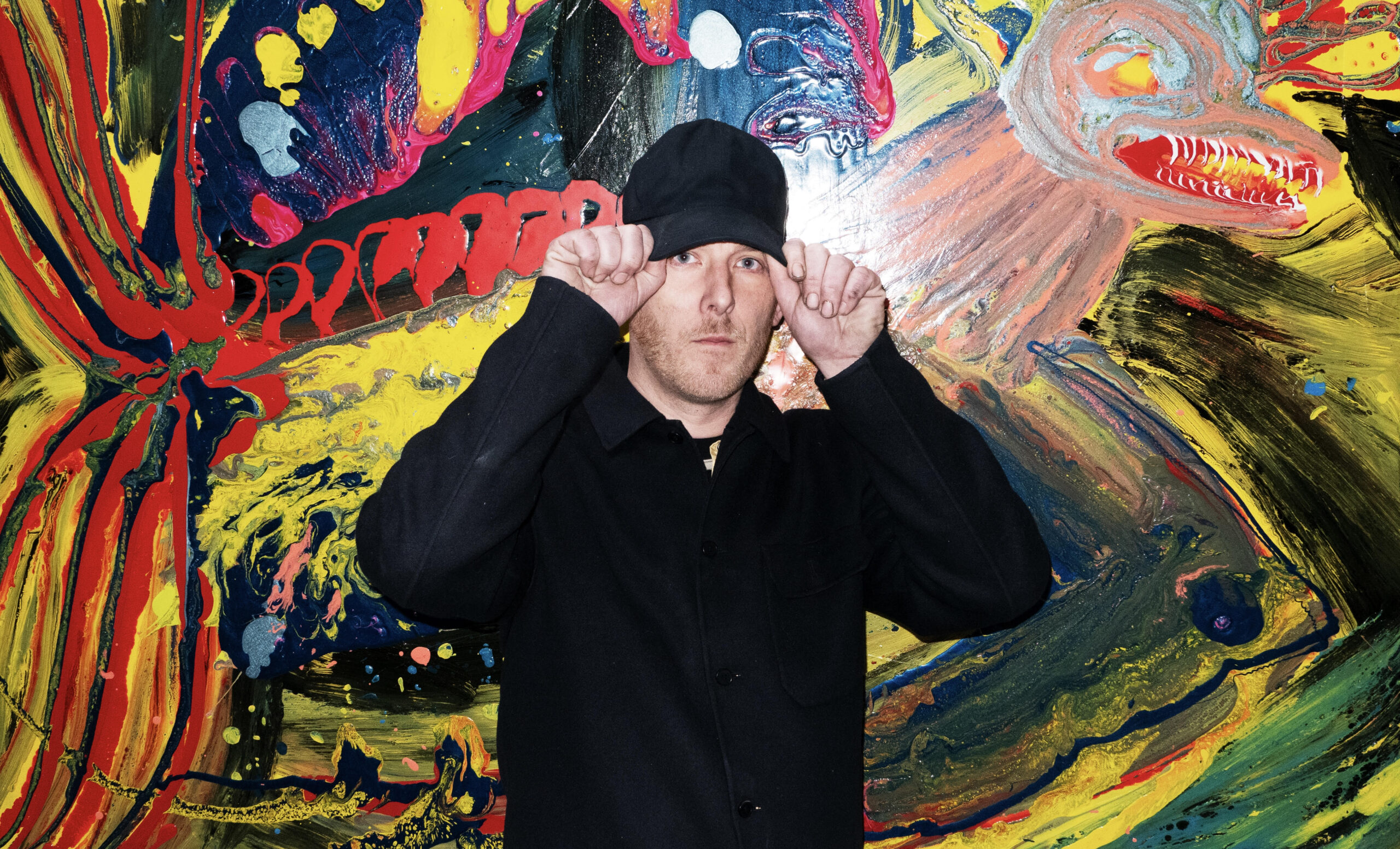
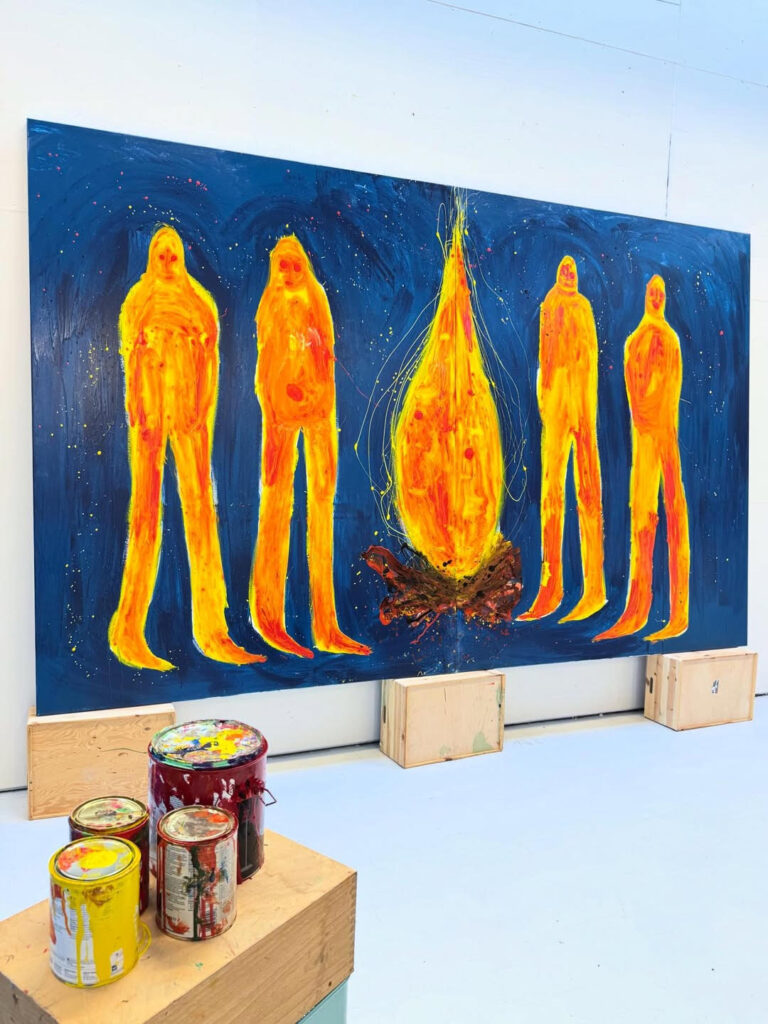
Frederik Næblerød (b. 1988) doesn’t so much “work across” painting, sculpture, ceramics, and installation as he collides them, pushing material until it starts to behave like a mood. His universe is loud, physical, and insistently human: part craft, part myth, part urban signal, charged with the kind of immediacy that hits you before you’ve found the words for it.
There’s an obvious line to Nordic expressionism, Asger Jorn’s restless intelligence, Munch’s psychic weather, Per Kirkeby’s density, but Næblerød isn’t interested in heritage as a comfort blanket. He treats tradition like something you can drag into the present, rough it up, and make speak in a new accent. You feel it in the speed of the mark, the appetite for risk, the way figures seem to flare up and dissolve again, as if the work is catching itself mid-transformation.
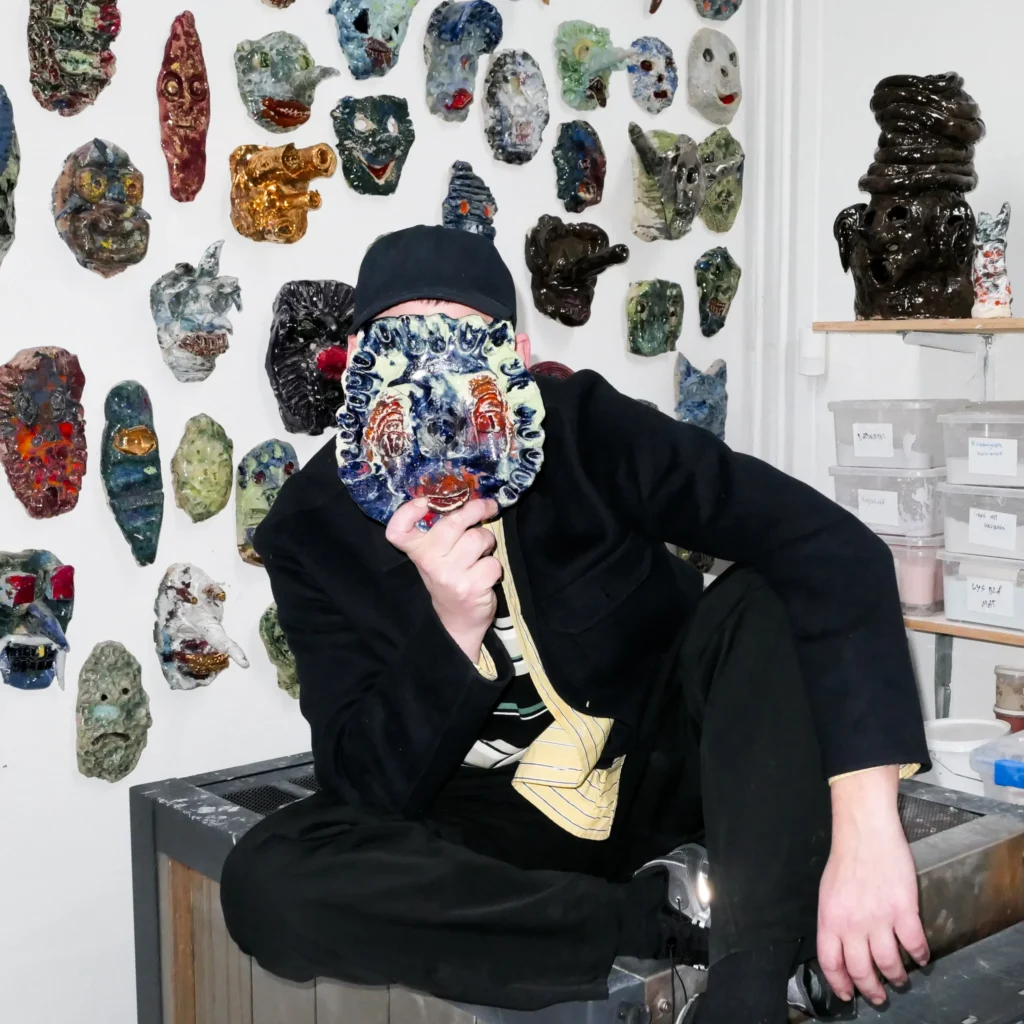
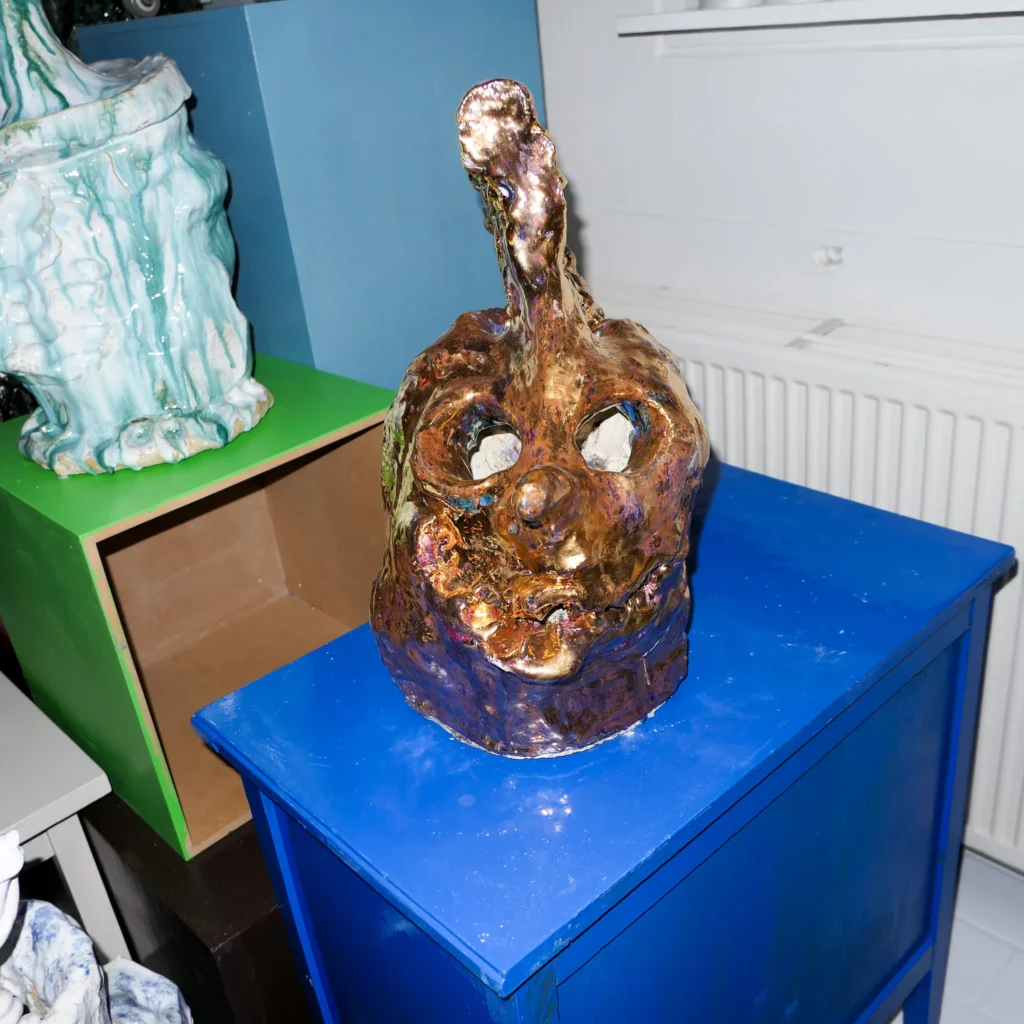
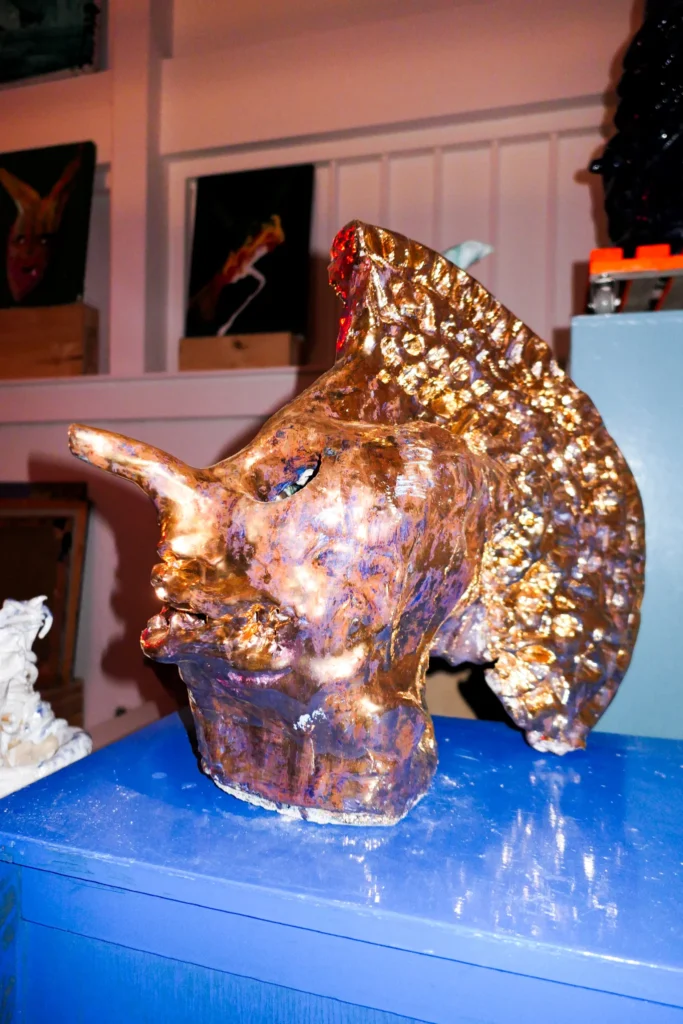
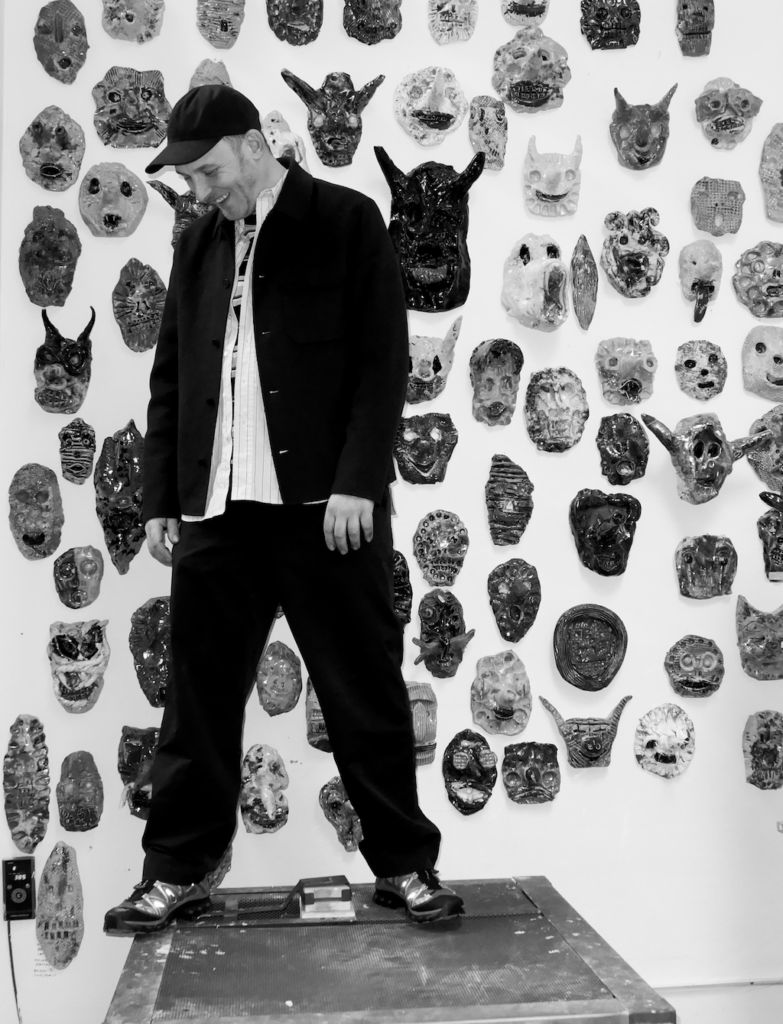
That sense of transformation runs through one of his recurring motifs: the mask. In Næblerød’s hands it’s less a disguise than a device, a way of testing what a face can hold, what identity leaks when it’s under pressure. The mask becomes a portrait and a shield at once, a surface where protection and exposure happen simultaneously. It’s where tenderness and threat sit in the same expression.
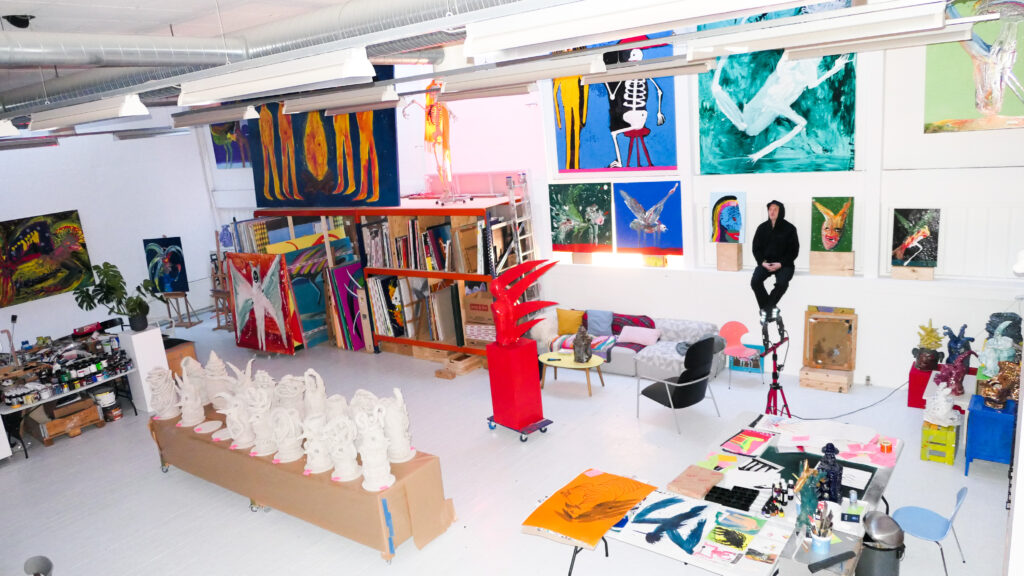
If the work carries the seriousness of the studio, it also keeps the pulse of the street. Næblerød’s early relationship to graffiti culture still shows up as urgency: the understanding that no wall is neutral, no space is innocent, and that scale can be emotional, not just impressive. There are echoes of artists like Dubuffet and Baselitz in the bodily logic of it all, but also a contemporary heft, where institutional rooms meet something closer to music, noise, and sweat.
What makes Næblerød compelling right now is that the work refuses to choose between beauty and abrasion. It can be grotesque and funny, brutal and sensitive, as if it’s trying to hold the full temperature of living, and to insist that art, at its best, is a place where we can still feel something unfiltered. Expressionism, here, isn’t nostalgia. It’s a tool: a way of building a new language for an overheated time.
In the conversation that follows, Næblerød talks about working fast, trusting instinct, carrying graffiti’s urgency into museums, and why he’s drawn to friction — the moment a space shifts, and the viewer shifts with it.
Hi Frederik! It’s a pleasure to sit down with you again! First question that I always ask. How does a regular day look like for you in Copenhagen?
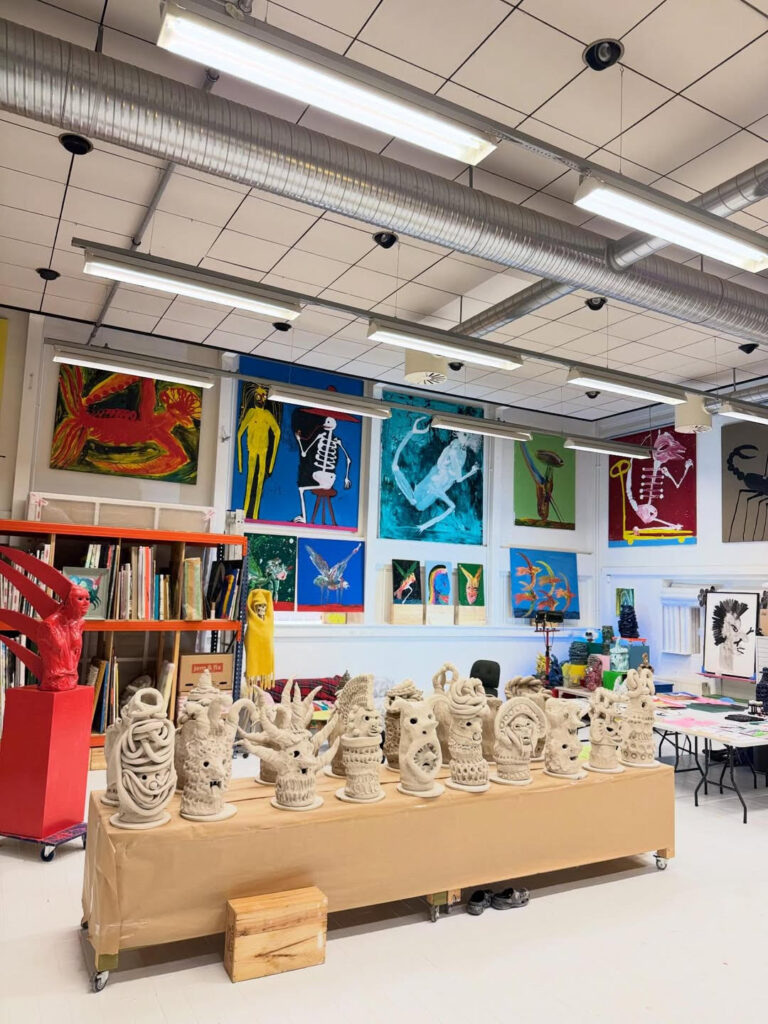
Frederik: I wake up early, cycle to my studio in Sydhavnen, and continue working where I left off the day before. Last year, I spent many months at ARKEN, where my exhibition included a live atelier, so my studio was effectively there for nine months. Now I’m back in Sydhavnen, which gives me a different kind of calm and rhythm. I usually work on many projects at once. Right now, that includes sculptures for the Miart art fair in Milan and Chart Art Fair in Copenhagen, works for an exhibition in Italy, a commission for a church, and a series of sculptures for an exhibition in Finland. I usually work until late, cycle home, and start again the next day.
I’m curious, growing up, what was life like there? And what kind of kid were you? What did you enjoy doing?
Frederik: I had a lot of freedom growing up. School wasn’t really my world but I was constantly drawing, and it became my way of being present in the world and of understanding it.
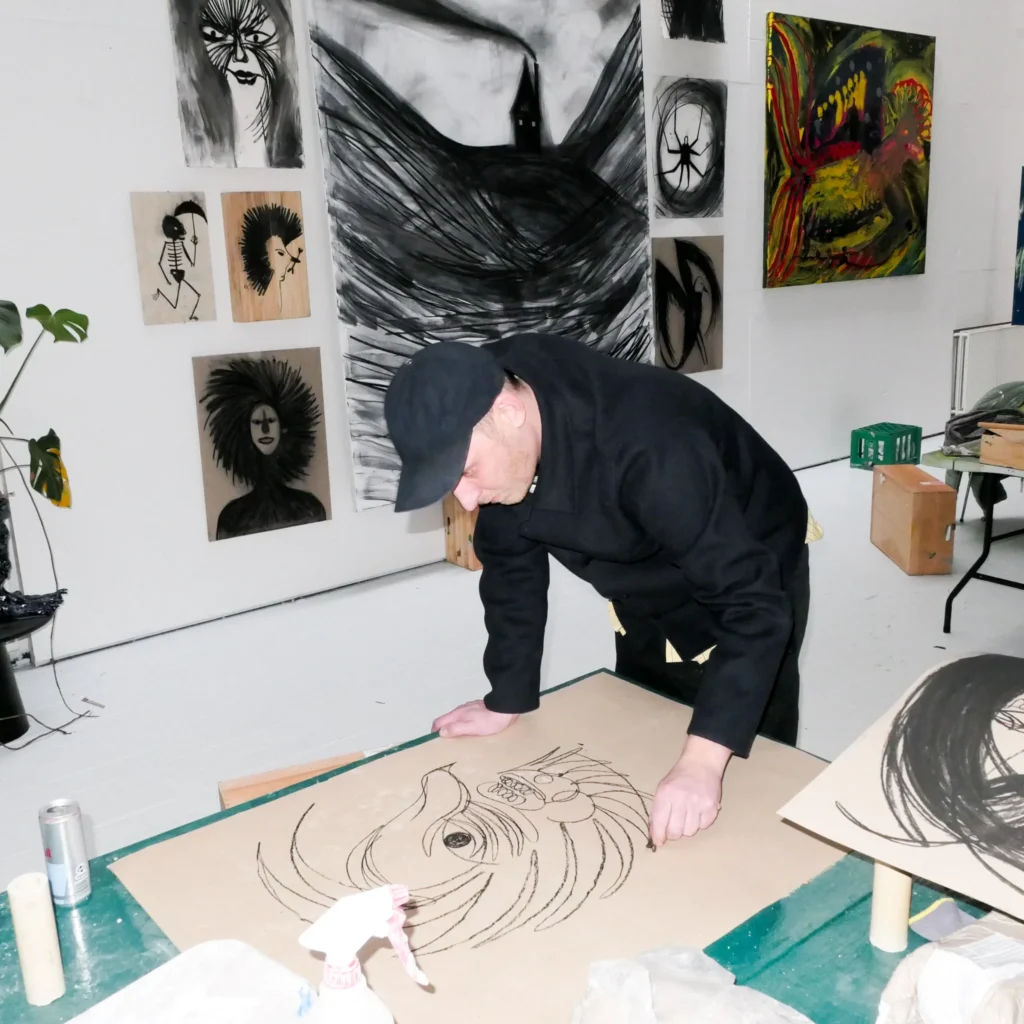
Do you remember approximately at what age your creative side started to show? And when did you start taking being an artist seriously?
Frederik: Through my cousins, I became part of the graffiti scene from the age of ten, which made me see my creative work differently and more consciously. That experience shaped my understanding of expression, rhythm, and instinct. When I was accepted into the Royal Danish Academy of Fine Arts in Copenhagen, everything fell into place. It was life-transforming. There, I was taught about materials and developing my own visual language. I met other artists, and together we explored painting and ceramics, taking risks and experimenting freely in ways I hadn’t known before. While studying, the gallerist Alice Folker discovered my work, and I was offered gallery representation. That moment marked a shift from an internal necessity to a professional path, but the core impulse remains the same: working intuitively, emotionally, and with deep attention to material and the world around me.
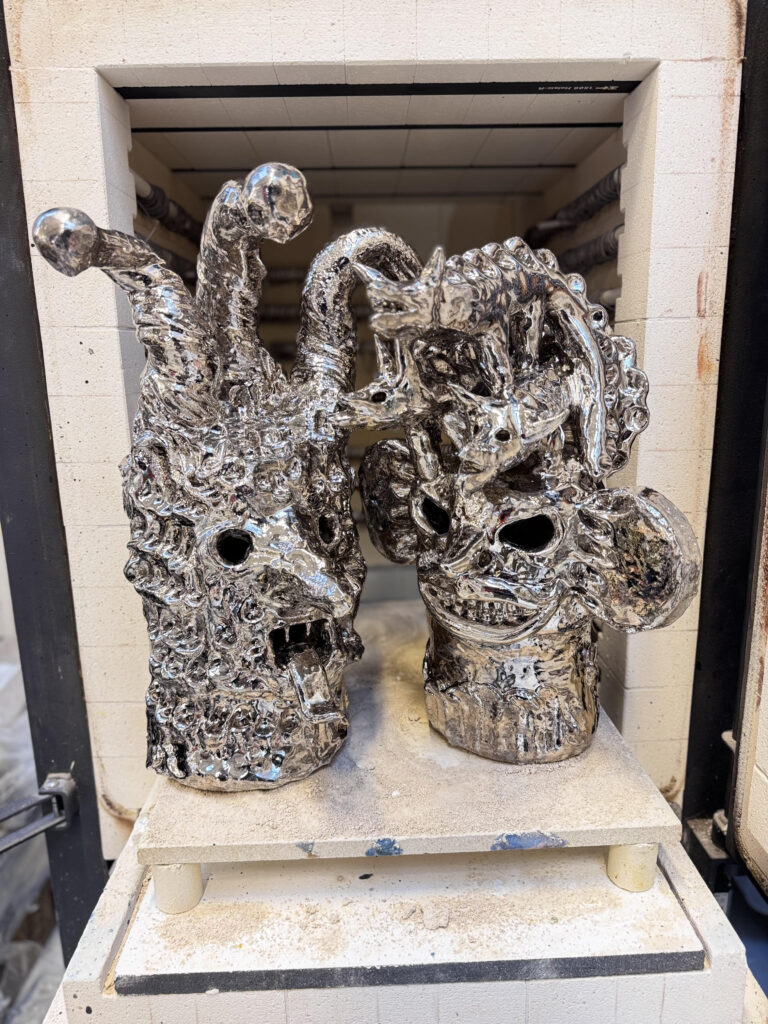
Ok Frederik. Let’s start at the beginning…. Before galleries and institutions, there was graffiti. What did the street teach you that art school never could?
Frederik: Making graffiti with my cousins and closest friends gave me the courage to trust my instinct. We responded directly to the city, to surfaces, to passersby, and to each other. The street teaches you that nothing is neutral; not a wall, not a space, not an audience. Everything carries weight and demands a response. With graffiti, I was drawn to the colour, the spontaneity, and the raw presence of working on large walls. Those years shaped my visual language which is grounded in immediacy and emotion, one I continue to carry with me, even as my work moves into institutional contexts.
Graffiti is fast, risky, and temporary. Do you still carry that urgency into the studio?
Frederik: Absolutely. I still work fast and trust my intuition. Even when works develop over long periods, that first impulse is essential.
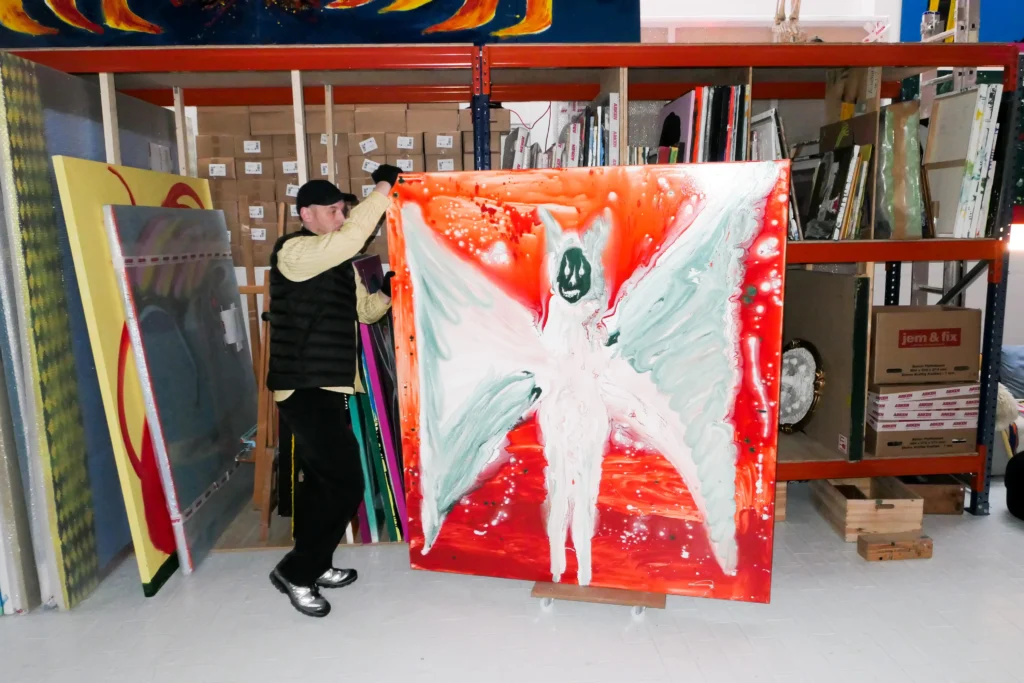
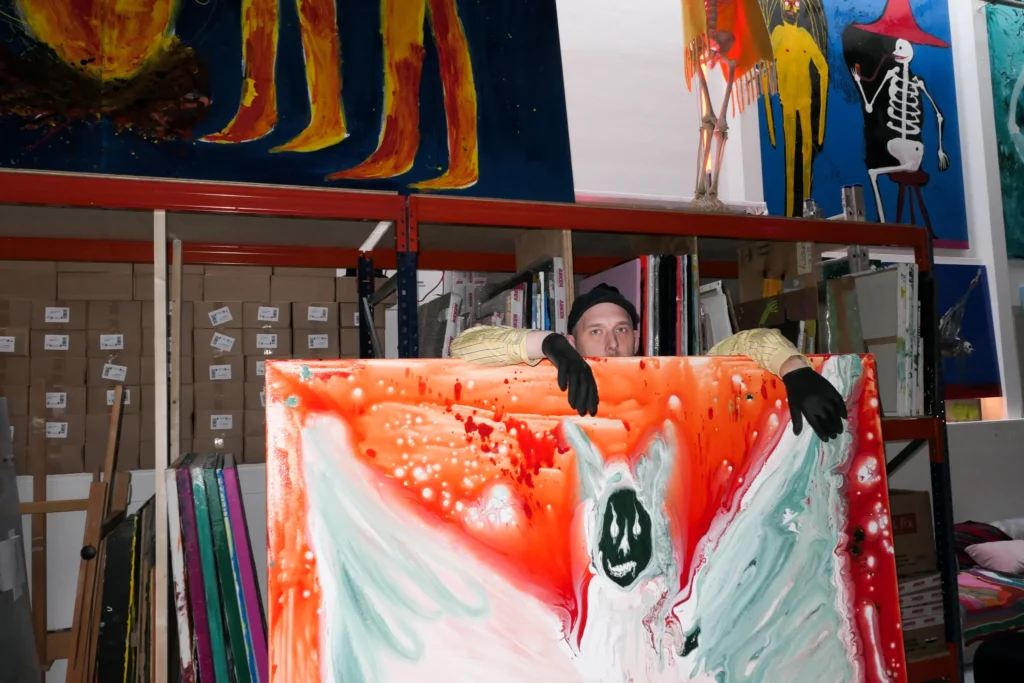
In graffiti, the wall already belongs to someone. Do you approach institutions the same way?
Frederik: Yes. I have deep respect for history, architecture, and institutions, but I also believe the artist’s role is to activate a space and start a conversation. I’m interested in friction — in entering a space and allowing something to shift in order to create a response in people.
Do you ever miss the anonymity of graffiti?
Frederik: My work has evolved, and I’m fully engaged in my practice today. The dialogue has changed, but the intensity remains.
If you could bring one rule from graffiti culture into the contemporary art world, what would it be?
Frederik: For me, it is trusting my own intuition. That belief has stayed central to how I work.
Your work is often described as chaotic. How do you relate to that description?
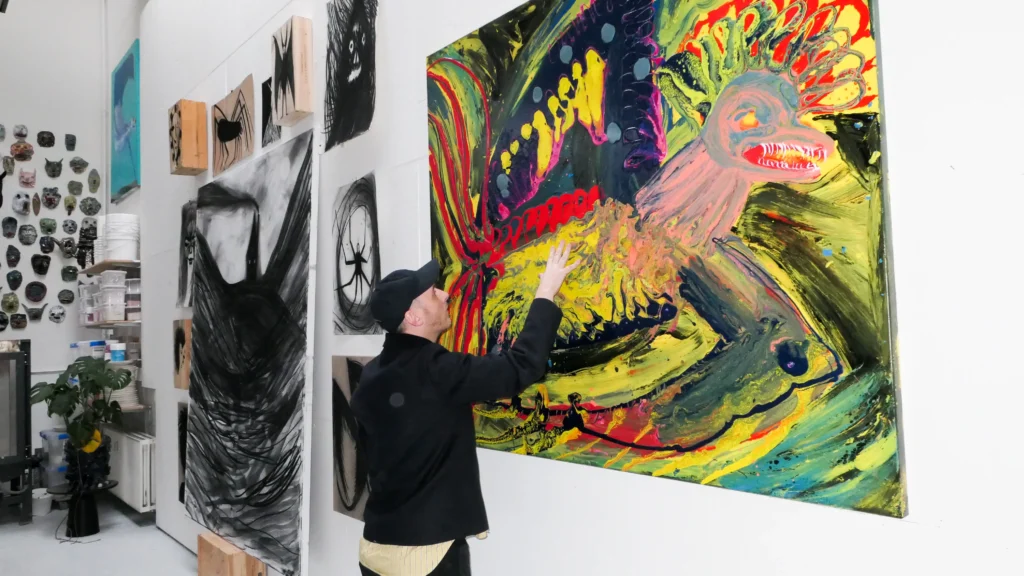
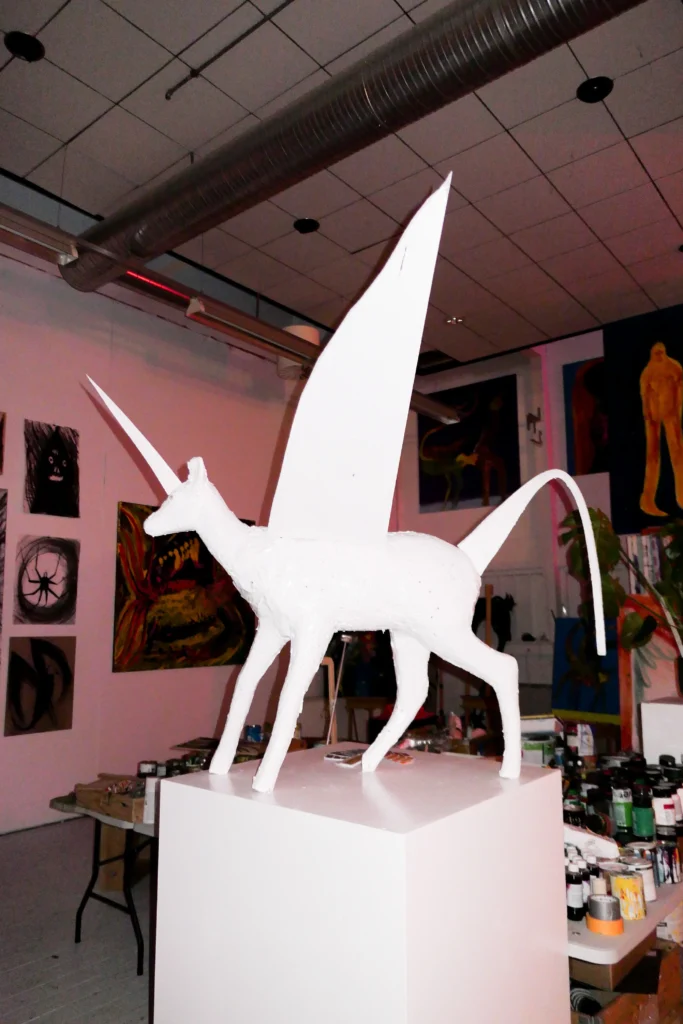
Frederik: I don’t see my work as chaotic. As Asger Jorn said, “Art is the ability to structure chaos, to give form to emotion.” I work with complexity, emotion, and human states, which can appear intense or unpredictable on the surface. But for me, the work is structured and deeply personal. I use my own experiences, frustrations, and joys in the process, which makes the works feel raw and direct. Sharing that vulnerability publicly comes at a cost, but it has also opened meaningful encounters and conversations. I hope the work is met with openness rather than judgment. Forexample, birds are a recurring motif because they symbolize something fundamental for me: creating without limits.
So how do you live with your work existing inside major institutions while feeling anti-institutional?
Frederik: Institutions are a vital part of how my work lives in the world. I feel a deep sense of responsibility and honour when my work enters a museum context and is shown alongside my colleagues and peers. My collaborations with institutions, most recently ARKEN Museum of Contemporary Art, have been among the most formative and meaningful experiences of my practice. I value the rigorous dialogue with curators and art historians, and the way exhibitions are shaped through shared research, trust, and long-term thinking.
What parts of your practice are compromised when a work enters the museum or the market?
Frederik: I don’t see my practice as being compromised by institutions or the market. On the contrary, I want the work to live fully in the world. My ambition has always been for my paintings and sculptures to be encountered in museums, galleries, public spaces, and people’s homes. What matters is that the work generates presence, emotion, and dialogue.
I’m increasingly focused on public and site-specific projects. I recently completed a mural for ARKEN Walk and am currently working on a commission for a church. Going forward, I am eager to realise ambitious institutional projects — large-scale murals, sculptural works, and permanent public commissions — where art becomes part of daily life and remains open to interpretation over time.
Is there anything you refuse to do, regardless of opportunity?
Frederik: I stay open to opportunities and decide case by case, based on integrity, context, and curiosity.
Your visibility has grown fast. How has that changed you?
Frederik: I’m grateful for every opportunity and for the way people engage with my work. My exhibition at ARKEN showed me just how powerful art can be — how it can move people physically and emotionally. In a world increasingly dominated by screens, I want my work to remind people of the irreplaceable power of imagination, community, and shared human experience.
Has success given you freedom or pressure?
Frederik: I’m grateful to be able to live as an artist, and that gratitude keeps me grounded. Tracey Emin said, “The best work you can do is to reveal yourself,” and that idea is central to my practice. I put myself into my work, my experiences, frustrations, and joys, so that each piece feels raw, immediate, and intimate. I want my work to be honest and present, to engage the viewer, and to create a space where they can feel, reflect, and connect with the human experience.
Your practice feels compulsive. Is making a release or a confrontation?
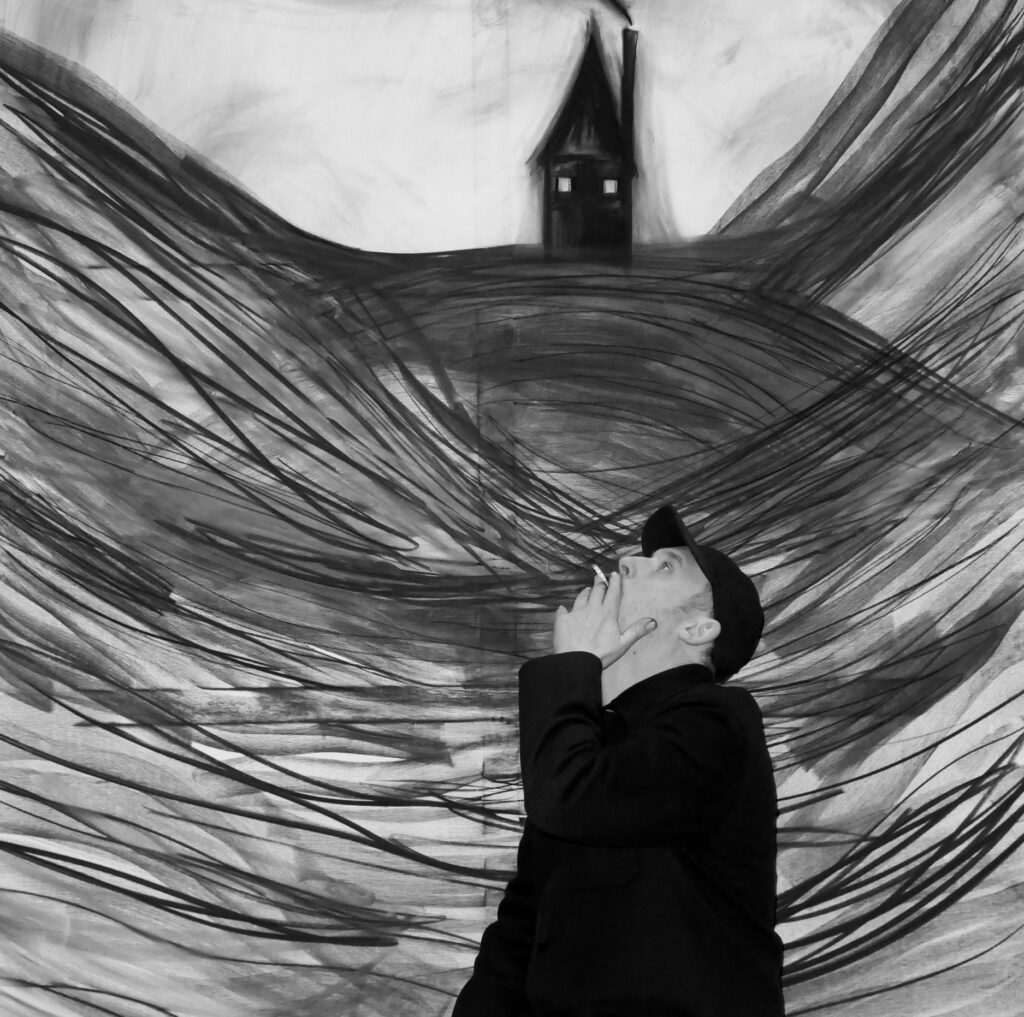
Frederik: When I create a new work, the motifs appear as an inner slideshow of images passing by. I choose the one that feels right and bring it to the canvas. Every mark, every figure, must pulse with life. When I work in oil, lacquer, or ceramics, I think about how the material can move, breathe, and respond. My practice is both release and confrontation. It is about presence, intensity, and insisting on life.
You work across many media. How do you know when a work is finished?
Frederik: The tension between media keeps me alert and present with the material and process. Some paintings emerge quickly and intensely, while others develop over months. Clay has its own tempo, with processes that cannot be rushed. I work physically and directly, letting the material offer resistance. The work emerges through dialogue between intention and resistance, through building, deconstructing, repeating, and insisting. I have immense respect for the material’s voice and for what it can reveal about human experience, vulnerability, and strength.
Failure — what role does it play?
Frederik: Life moves up and down. My practice unfolds over time and across media. Painting, sculpture, ceramics, and installation are not separate disciplines for me, but different ways to explore the same question: what it means to be human, how we experience the world, and how we reflect it back. I use my own experiences, feelings, and reflections directly in the work, and things often evolve over months or years. A gesture, a mark, or a color can become a trace of encounters with people or places that have left an impression.
Humor and aggression coexist in your work. Why?
Frederik: Humor is central; life is hard enough, and art must create space for reflection, presence, and a kind of uplifting recognition.
Do you feel responsible for meaning?
Frederik: I hope people feel seen, met, and inspired when experiencing my work. The works carry humor, and vulnerability, insisting on presence.
How do you imagine your work aging?
Frederik: Recently, I visited Louisiana, where Giacometti’s Walking Man stood across from Marlene Dumas’ Mourning Marsyas. Dumas’ work explores courage, punishment, and the consequences of standing by one’s convictions. It is a tribute to those who dare to speak truth to power, to insist on justice, and the pain of standing alone. I hope my works will one day be placed in similar dialogues.
If everything you’ve made disappeared tomorrow, what would still matter?
Frederik: The act of making. My intuition. And the relationships formed along the way.
When do you feel most at peace?
Frederik: My atelier in Sydhavnen gives me calm. It is a sanctuary, not just for my own work, but for collaboration and conversation. People visit, ideas intersect, and new works and stories constantly emerge.
What do you need more of right now?
Frederik: More collaborations with institutions in the US, Africa, Europe, Asia, and Australia. I would love to travel more with my art. Art changes people, and people change societies. I want to contribute wherever I can.
What do people consistently misunderstand about your work?
Frederik: I like to exaggerate, add “salt and pepper,” and to provoke a feeling. I believe art can confronts us with both the sweet and bitter parts of life.
What don’t you care if people ever understand?
Frederik: Art is crucial in a time when everything is fleeting, and the world is marked by division, hate, and war. It can bring us together, open dialogue, and create encounters across differences. Art awakens feelings rarely given space in daily life and opens doors to inner layers of ourselves that only this space can reach. In many ways, art is more important today than ever.
Do you trust materials more than ideas?
Frederik: I value both deeply. But something happens when I start working with paint or clay — the material begins to speak back. Questions are never exhausted, and the process forces me to relate to myself, others, and the world around me.
How do you approach color?
Frederik: Color is essential. It hits before thought. I try to let color and the logic of the material work together in both sculptures and paintings.
What does a perfect day look like?
Frederik: Working until I forget that time exists.
Favorite films?
Frederik: “Gummo” by Harmony Korine.
What are you listening to right now?
Frederik: Right now I listen a lot to the Turkish singer Baris Manco, and if I’m in a mood for a more monotonous style I prefer the German artist Luke Hess.