
Share this
The first time I met Lulu Wang, I didn’t know what to expect. I had been invited to the Institute of Contemporary Arts by my friend and artist Hongxi Li. Her friend Lulu Wang was performing. We had never properly met.
I arrived in central London, walking from Piccadilly Circus, past the National Portrait Gallery and down towards Trafalgar Square, cutting across the open square and along the red stretch that leads towards Buckingham Palace. From there, I made my way into the ICA. As I stepped through the doors, I spotted Hongxi in the distance. She was standing with a small group of people. I walked over, said hello, and she introduced me to Lulu. Lulu turned towards me, smiling. There was something immediate in her energy — warm, open, with a sense of excitement.
Looking around the room, it became clear this wasn’t just a casual gathering. People were dressed with intention, moving with a sense of purpose. There was a shared anticipation in the room. I followed Hongxi and Lulu upstairs into a back room where performers were getting ready. Clothes were being adjusted, conversations moving between focus and excitement. It felt focused — like everything was about to shift.
At some point, Lulu mentioned needing someone to photograph the performance. “I can shoot it,” I said. Hongxi nodded. “Yeah, Brynley’s a photographer.” Lulu smiled. “That would be great.” And just like that, I was part of it. We moved back downstairs into the main room. Chairs were laid out, lights were set, and the space was filling quickly. I hadn’t read the programme. I hadn’t asked many questions. I just sat down and waited. Then the lights shifted. The room dimmed. The stage brightened. The performances began as part of Diasporas Now.
One after another, artists performed, moving through sound, voice, projected visuals, and movement. It didn’t behave like a film, where you expect the next scene, or music, where you feel the build before it breaks. It asked for a different kind of attention: still, patient, open. You had to stay with it. Watch closely. Let it unfold. Then Lulu stepped onto the stage. I raised my camera and began to shoot.
She moved like a sci-fi presence. Her face caught the light and shimmered as she moved, while the long fabric of her dress extended across the space. She didn’t just occupy the stage. She moved through it, shaping it. The performance, “Hourglass”, unfolded through repetition and gesture. At one point, she poured sand in a circular motion, walking its edge, building what felt like a physical trace of time itself.
The room was quiet enough to hear it — the soft hiss of sand hitting the floor, and the faint scrape of her steps. Towards the end, she lifted a reflective sphere above her head. From the orb, glitter fell in a steady stream, catching the light as it dropped, a soft hiss filling the silent room as everyone looked up at her, held there on the plinth.
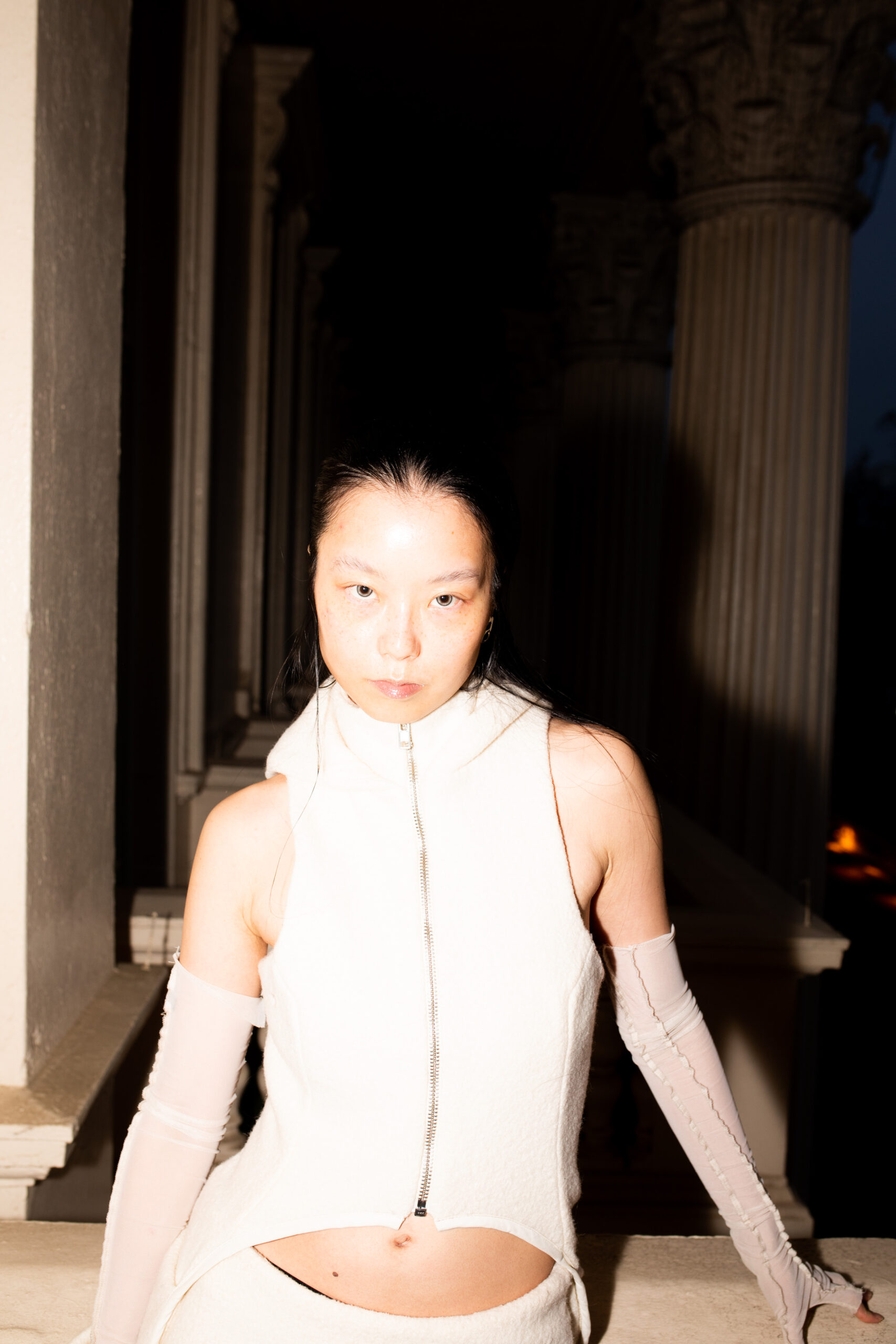
She held the entire room without saying a word. The next day, we met again to shoot. We made our way through the ICA and up to one of the highest rooms, with a balcony overlooking central London, the Mall stretching out below and Big Ben in the distance. And then we started working. Or something close to it. There was no rigid structure. She moved, and I followed, adjusting, reacting, trying to keep up. My flash fired as I moved. It felt less like directing and more like responding — a rhythm forming between us.
She knew exactly how to move through a frame. We shot for hours. By the end, I was exhausted, but completely locked in. Walking away, one thought stayed with me: If I could keep working like this, with people like Lulu, something real could happen. Because what I had stepped into wasn’t just a performance. It was a world already in motion — and I had stepped into it mid-flow.
Text and photography by Brynley Odu Davies.
Press shoot looks by:
SELASI (@selasi),
Issey Miyake (@isseymiyakeofficial)
EMILY FRANCES BARRETT (@emilyfrancesbarrett),
Shot at the Institute of Contemporary Arts @icalondon

You recently completed your new performance titled Hourglass at the Institute of Contemporary Arts. Where did the idea for this work first come from?
Lulu: Hourglass is a mixed-media live installation and performance that operates as a meditative timing machine, built through the body, movement, natural elements, and technology, where time is not measured but experienced through both human and non-human sensibilities.
The idea came from my experience of burnout. My life had been running on speed and output, constantly moving, producing, keeping up. At some point, I realized I had internalized that rhythm so deeply that I stopped questioning it. It creates a quiet exhaustion that sits in the body.
I light incense every day. There was one moment where I sat watching the smoke move. Nothing dramatic, but it was the first time in a while I wasn’t trying to catch up with anything. Time was passing, and I was there with it. That stayed with me. Hourglass grew from there. It became a way to return to that state, a form of retreat and recalibration.
The work begins with a virtual version of me watching from the screen. At the same time, my body builds piles of sand, marking time, then trying to catch it, chasing it in a loop. The avatar becomes a second consciousness, observing the anxiety play out. The body keeps pushing until it can’t.
The tension between losing time and sitting with it runs through the work. Moving from restlessness into stillness, I hold the sand as it falls through my hands, resisting control. You can’t hold it or speed it up. It keeps moving. By the end, I become an hourglass, embracing that flow instead of fighting it.
Sound shapes the temporal structure. Improvisation has always been central to my practice, and in this piece I moved fully away from composed music. Collaborating with musician RIEKO and percussionist softchaos, we developed a live dialogue between movement and sound. Rather than following a fixed structure, time unfolds through listening and response, continuously negotiated in the moment. Styling is also an important part of the work. I imagine myself as a futuristic ritual traveller, wearing SALASI’s white long hooded dress and EMILY FRANCES BARRET’s silver accessories.
Incense became another way of sensing time. Historically used as a timing method, it carries an intangible quality. Scent has no edges. It spreads, lingers, disappears. It creates an internal experience of time, something you breathe rather than observe.
There is a connection here to Daoism, particularly the idea of wu wei, acting without force. Letting things unfold rather than structuring them. Moving from owning the sand to flowing with it required me to let time be, and to let myself be within time. Hourglass is a flowing stillness. It’s about staying with time respectfully and gratefully to return to our inner connection.

Once a performance ends and the room empties, what does that moment feel like for you?
Lulu: It’s the closest point where I feel both completely drained and fully present. Performance takes a lot from me, physically and mentally. Sometimes it makes you feel like you are another person, or another phenomenon. It’s different from a painting or an image that already exists. Performance is live, it runs through my energy.
It’s also very emotional. When the space clears and I’m left alone, there’s a strange afterimage that stays. If I look at the empty room, I start to see fragments of what just happened. Moments from the performance come back, but also people’s faces, small reactions, the way they were present in it. It feels like the space is still holding moments, even though physically it’s empty.
I stay with that feeling for a bit, letting it settle. Everything feels very clear and very raw at the same time.Sometimes I don’t think about anything. I just go home and stay with my cat JoJo.
You grew up in Shanghai and now live and work in London. What have been some of the biggest cultural differences between the two cities for you as an artist?
Lulu: Growing up in China and then relocating to the UK made me very aware of how context shapes behaviour, language, even the body. You adapt without always realising it. Over time, I noticed that different versions of myself emerge depending on where I am, who I’m with, and what’s expected of me.
That fluidity can be empowering, but it can also create a sense of fragmentation, a feeling that there isn’t a single, fixed self to return to. This has deeply informed my practice. Rather than defining identity as something stable or authentic, I approach it as something transitional. The body becomes a site where multiple identities can coexist, overlap, or contradict each other.
My interest in post-humanism and digital avatars comes from this experience. When identity is already shifting across cultural contexts, extending it into virtual space feels like a natural continuation. The avatar becomes another version of the self that evolves through life experience.

How has your experience of living between cultures shaped the way you think about identity in your work?
Lulu: When I moved to London from Shanghai in 2018, it felt like a deep re-rooting, a transformation in how my life is structured. In Shanghai, my identity is rooted in family. It’s where everything feels instinctive and understood without explanation. There’s a sense of being held within something already there.
In London, I’ve built my own ecosystem. The people around me are formed over time, through care and shared experience. It’s a chosen family shaped through collaboration and mutual support. Last summer was the first time I returned home in six years. Walking through the city, I felt like a stranger in a place that used to feel completely familiar.
I have loved gaming and anime since I was a kid, because they transport me to different worlds. but in recent years I’ve also been studying traditional Chinese practices like tea ceremony and incense. I returned to Chinese philosophy, especially ideas around balance and coexistence. Being away from home has made me more curious about my roots, and more intentional about learning my heritage. Eventually my childhood love and my interest in traditional culture naturally merged in my work.
London is my second home now, but that distance creates a pull to trace my heritage and reshape it within my life here. This shift feeds directly into my work. Identity becomes something that moves between inherited and constructed states. That’s why my work often involves transformation, hybridity, and movement across physical and digital spaces, traditional and surreal.
How do you prepare for a performance? What does your process in the studio usually look like when developing a new piece?
Lulu: Preparing for a performance sits between logic and emotion. On one side, it’s very structured. I work on everything myself from creative direction to production: building the set, developing the outfits, thinking through lighting, coordinating collaborators. There’s a lot of decision-making, a lot of logistics. I have to make sure things are well prepared.
Rehearsal is completely different. It’s about energy. Especially with improvisation, it becomes an exchange between me, the space, and sometimes other performers. It’s less controlled, mostly intuitive. That’s where the work actually starts to breathe and grow.
My process usually begins with something quite personal. A memory, a feeling, something I’ve read, or just moving my body in the studio. Then it turns into questions. I don’t start with things I’m certain about, I start with things I’m familiar with, alongside uncertainty.
From there, it expands visually. I build worlds in my head and then start testing. I draw, take photos, sometimes use AI to simulate environments or characters from sketches. I’m very influenced by sci-fi, Japanese anime, gaming culture, but also martial arts Chinese dramas in the 90s and 2000s. There’s something about transformation and heightened reality that I’m drawn to.
Experimentation is my favourite part because it feels limitless and fun. I design characters fully from makeup to costume, sometimes working with stylists, but often directly with brands or just style myself. I love collaborating with fashion and design, it is also a big part of how I construct identity in the work. Simultaneously, I work with 3D modelling, digital fabrication and sensor system building. My studio is a mix between a lab and an otaku room.

Were there any artists or performances that changed the way you thought about what art could be?
Lulu: Pina Bausch was my very first and favourite artist when I started performance making. Her work changed how I understand the emotional force of performance. She showed me that movement can hold psychological weight, tenderness, absurdity, violence, intimacy all at once. Her work exposes human relationships in a very raw and delicate way. That stayed with me. It made me think about the body not just as form, but as memory, tension, and emotional landscapes.
Years ago I went to an opening in London of Anna Uddenberg. It shifted how I see sculpture and the body in relation to power, design, and contemporary desire. Her work feels hyper-constructed, seductive, and slightly uncomfortable. I’m drawn to how she pushes the body into something post-human, shaped by systems, consumption, and performing. It resonates a lot with my own interest in hybrid identities through the morph between body and materials.
I grew up with manga and anime, and that influence runs deep in how I build characters. I was obsessed with CLAMP, Masamune Shirow, and Hideaki Anno. I used to save all my pocket money to buy the original illustration books when I was a kid. Their work made me think about performance as world-building, a space where structure and chaos can co-exist. Where you can construct a parallel reality through energy, rhythm, image, and presence. That became a foundation for me. I create characters that are partly myself, but also speculative built from “what if” scenarios.
How did the Diasporas Now residency come about, and what were you hoping to explore during that time?
Lulu: The residency came organically. I was invited by Hannah Geddes to co-curate ‘Speaking Futures x Diasporas’ Now at the ICA last year, and alongside that we were offered space for our collective practice. It was the first time Diasporas Now had a long-term base and we’ve always been nomadic, it brought a new sense of grounding. That’s where the idea of a “collective residency” came from.
What interested me was how an institution could hold live art and artists differently, not as a temporary venue but as an ongoing system supporting growth, care, and long-term collaboration. We’ve always worked both inside and outside institutions, collaborating while questioning how the institutional system functions and who they are for. The residency offered the opportunity to prototype a framework where artists and collectives could share authorship and build cultural infrastructure together.
It was a period of growth with my Diasporas Now peers. I spent a lot of time with RIEKO shaping the future direction of the collective, with support by Hannah and Bengi Ünsal. We wrote our first Diasporas Now manifesto, developed merchandise with the ICA shop, and worked on our final ideas together. With RIEKO and Paola Estrella, we also initiated our first collective performance last summer with Joshua Woolford, Furmaan Ahmed, and Abi Asisa. With our recent final artist takeover in March, we also invited back all the artists from the past events to celebrate this wonderful journey together. Looking back, I’m proud of what we built over one year and feeling grateful for the amazing people I’ve worked with.

During the programme, you also organised talks and workshops. What kinds of conversations were you trying to create?
Lulu: I wasn’t interested in plain conversations or panels that confirm what everyone already agrees on. During Speaking Futures x DN programme I worked closely with Hannah on curating the programme. We brought together artists, performers, and thinkers across different disciplines, like Julianknxx, BULLYACHE, John Akomfrah, Joshua Woolford, Ivan Michael Blackstock, Meneesha Kelly and more. The focus wasn’t just presentation, it was more about building conditions for exchange, for challenge, for unfinished work to exist in public.
The conversations also became more porous, moving between live elements, works-in-progress, discussion, improvisation, sometimes discomfort. I’m interested in friction, in what happens when perspectives don’t immediately align. I also wanted to bridge the gap between the emotional experience of art and the reality of building a life as an artist. Not surface-level but true inspirations with honesty, heart to heart.
What do you think people often underestimate about the life of an artist?
Lulu:How much of it is about building and holding your own structure. There’s a perception that it’s all freedom and expression. In reality, most of it is invisible labour. You’re constantly organising, negotiating, producing, sustaining relationships, finding resources. At the same time, you’re expected to stay open and sensitive. That tension is real. Being an artist isn’t just about making work. It’s about building an ecosystem that allows the work to sustain and evolve.
What has been the most difficult moment in your journey as an artist so far?
Lulu: The hardest part is holding onto your direction when there are external expectations. Sometimes opportunities coming with timelines that don’t align with mine or require compromise of my practice. At one point, I had to confront that directly. I knew I was building something long-term, not just responding to what was available. That meant slowing down and making decisions that didn’t immediately make sense from the outside. It’s not a single moment that resolves. It’s something ongoing, learning to stay with uncertainty without letting it dictate the work.
What keeps you motivated to continue performing and creating new work?
Lulu: Creating is how I think about life and stay connected to the world. I’ve lived different lives before becoming a full-time artist, and it made me realise this is how I’m meant to exist. There’s a quiet sense of mission in it. Making work feels like breathing. It’s how I learn and how I stay present.
You mentioned your love of video games. If you could wake up inside any game world, which would you choose?
Lulu: Pokémon for sure. It was the first game I ever played when I was about five, and it was my first encounter with the idea that a world could be so magical and fun. There’s something about that universe, it’s fantasy but it’s also about connection, companionship and spirit. Fun fact that the original Red and Green were released on the same day as my birthday in Japan, what a coincidence. I still remember hiding under my duvet at night so my parents wouldn’t find me playing overnight and trying to catch Mew. I love darker games too like Death Stranding, Diablo, The Last of Us, Resident Evil, Silent Hill, too many of them, but I wouldn’t want to live in those worlds, well you know.
When you look back on your career in the future, what do you hope you’ll feel proud of?
Lulu: I hope I’ll be proud of the honesty, and the courage to make the work I truly wanted without compromise. I trust my instincts to follow ideas through, especially when they don’t fit existing categories. It’s tempting to make work more legible, more acceptable, but I’m more interested in holding onto its full complexity. I hope the work gives others the confidence to build their own language, even if it doesn’t exist yet.
Three words that define your edge?
Lulu: Stay true. Stay sharp. Stay curious.