
Share this
Sophie Dherbecourt’s work lives in the unstable space where identity starts to slip, split and reform. Working through a contemporary surrealist lens, the artist creates hybrid figures that feel at once tender and unsettling, as if vulnerability and self-protection are constantly reshaping each other in real time. Her recent work leans further into darkness, intuition and emotional ambiguity, giving form to psychological states that resist neat explanation. Rather than offering fixed meanings, Dherbecourt’s images seem to hover in metamorphosis — charged, porous, and alive with the tension of becoming.

Hi Sophie! It’s a pleasure to sit down with you! First question that I always ask. How does a regular day look like for you?
Sophie: I recently moved to London, so I’m still navigating change and adapting. It’s great to live here, I walk a lot, I go to my studio in the morning, work all day, talk with my studio mates, have lunch by the canal and head home in the evening. I organize my time like “office hours” so I can still enjoy and make space for social time when I’m done painting
I’m curious, growing up, what was life like there? And what kind of kid were you? What did you enjoy doing?
Sophie: I grew up in northern france, I was pretty shy and introverted, obsessed with cartoons and drawing. I remember loving my poetry notebook at school, when I was around 10, we had poems to illustrate and I was completely dedicated to making the most of it. I think I still have it somewhere.
Do you remember approximately at what age your creative side started to show? And when did you start taking being an artist seriously?
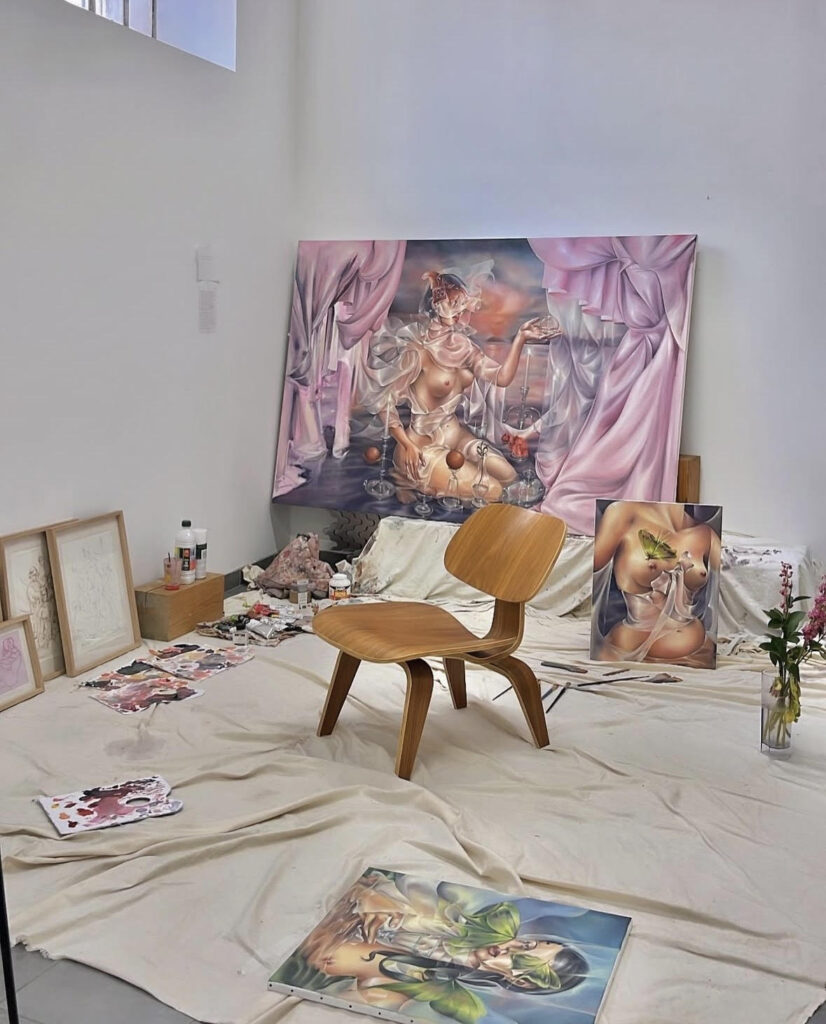
Sophie: My first memories of doing anything creative must have been around six. I was a big daydreamer, my family always says I had la tête dans les nuages. I remember the feeling of escaping reality by diving into a drawing or a coloring book. painting came into my life in my late twenties and became something serious around that time. during lockdown, I was able to create an entire body of work and sell it through an online catalogue. the word artist came later when I realized my process wasn’t just about crafting but about bringing an idea into reality through my hands, mind, and heart.
Ok Sophie, with these next series of questions, I will try to delve into your work as best as possible. So…. Your work often sits between vulnerability, protection, and transformation. When did you first realize those tensions were becoming central to your visual language?
Sophie: After my first solo show in 2023, I started to feel unaligned with my work, my palette and my themes. I felt a new hunger and an attraction to more elusive sensations. this shift felt inevitable and I discovered something more complex and layered. my intuitive desires became my compass. I began paying closer attention to the things I watch, listen to, or feel drawn to, keeping them close even when they don’t immediately make sense, allowing them to infuse and transform my vision. I also became more conscious of my envy and rage, in both their bright and darker aspects. vulnerability became the only way through, and transformation has been especially present over the past year. I started drawing with charcoal and black stone; my approach changed, and I began seeking the wit of the gesture rather than perfection.


You’ve described identity as something multiple rather than fixed. What keeps drawing you back to that instability?
Sophie: I think we are constantly evolving; you never meet the same person twice, and even an action cannot truly be repeated. We are complex and layered, just as my drawings have become more free and elusive. the psyche is expansive, just as our bodies evolve and through that we move through life existing in many forms.
Your recent work seems to be moving into a darker, more surreal space. What shifted in you, emotionally or artistically, that made that turn feel necessary?
Sophie: Discovering the work of surrealist artists like Suzanne Van Damme, Leonora Carrington and Jane Graverol was eye-opening and necessary at a time when my own reality felt suffocating. this movement brings an additional layer of inexplicable magic. I’m drawn to working with the invisible, imagining forms where there are only ideas or concepts. I’m passionate about mystical, mythological, and folkloric histories: the way tales shape morality, society, and the human psyche, for both adults and children. there’s something both dark and deeply beautiful in that. surrealism opens a space that allows me to access a kind of poetry, one that helps me feel the invisible and explore my conscious/subconscious mind.

What does “darkness” mean to you in your work? Is it fear, intimacy, desire, grief, protection, or something harder to name?
Sophie: I would describe it as meeting my own shadow. allowing myself to witness my fears and the parts of me I am not proud of is one of the most healing processes i can go through. this shadow work carries many complex, long-repressed emotions. once they are witnessed and brought into consciousness, they become elements i can compose with, they give contrast and depth, which I find fascinating. I guess moving toward a darker aesthetic allows me to find a different kind of light.
Do you feel that the darker direction has allowed you to say things that a more direct or polished visual language couldn’t?
Sophie: Yes, definitely. It allows me to feel more aligned with my own transformation. entering a new era of work is a beautiful thing to witness, even if it can feel unsettling, I can’t create and explain at the same time. I think I have to let intuition lead first and only then make sense of it.

Has this recent shift made you feel more exposed as an artist, or more protected?
Sophie: It has made me feel more aligned, so there’s a sense of being fully embodied. what you see and feel in my paintings probably makes it easier to understand me, so in that sense, there is exposure. but because I feel so aligned with it, it also feels very protective.
Your work engages with surrealism, but it doesn’t feel nostalgic or referential, it feels psychological. What does surrealism offer you as a way of telling the truth?
Sophie: Surrealism offers me a portal to go further and free myself from the tangible. It allows me to tap into subconscious imagery, to step away from logic and return to a more childlike way of thinking. It doesn’t always have to make sense, it needs to be felt. It’s like music or a Sylvia Plath poem: your mind may not understand everything but the work still finds its way through you.

Why do hybrid or transforming forms feel like the right vessel for emotional experience?
Sophie: My inspirations often come from non-pictorial sources, most often music or specific emotional experiences. these are intangible and I feel the need to give them a form. I’m trying more and more to free my work from logic; it’s a transformative process. I approach the canvas without holding back, if it needs to be lush and strange, it will be. not because I fully understand it, but because I feel it. I often sense that my hand and my body more generally, knows more than my mind.
Are those morphing bodies and unstable forms a way of escaping fixed identity, or of revealing something more honest beneath it?
Sophie: I think it’s about expressing multiplicity and the complexity of the self, as well as the impossibility of limiting identity. It’s about being more than one thing and portraying a backdrop for the living experience.
When you create these altered or hybrid figures, do they begin as self-portraits in some emotional sense?
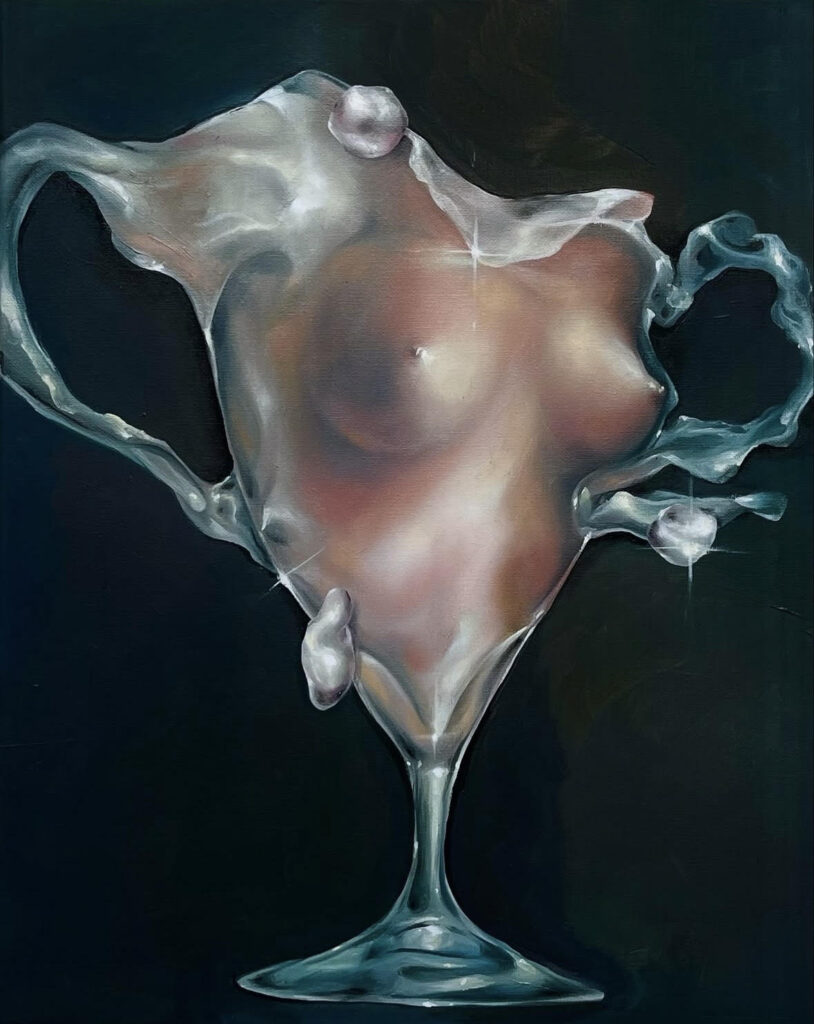
Sophie: I often think of my paintings as jewelry boxes or lockets, where you find memories and fragments: sparkles, pearls, pebbles, traces of faces, ethereal creatures. these elements come from emotional experiences and they need a place to exist. I put them into a painting so I don’t forget the feeling itself, like keeping a lock of hair inside a locket.
You mentioned the importance of intuition while making art. How do you recognize when intuition is leading the work, rather than doubt or overthinking?
Sophie: There’s a kind of dance that exists between control and freedom, intuition and doubt. I often compare it to walking on a tightrope. intuition feels quiet and grounding, while overthinking is loud and urges me to act quickly. doubt is important tho, it helps refine your skills, but it’s just as important to let the work breathe and be free rather than perfect. I am learning when to hold on and when to let go.
.Do you trust your first impulses more now than you did a few years ago?
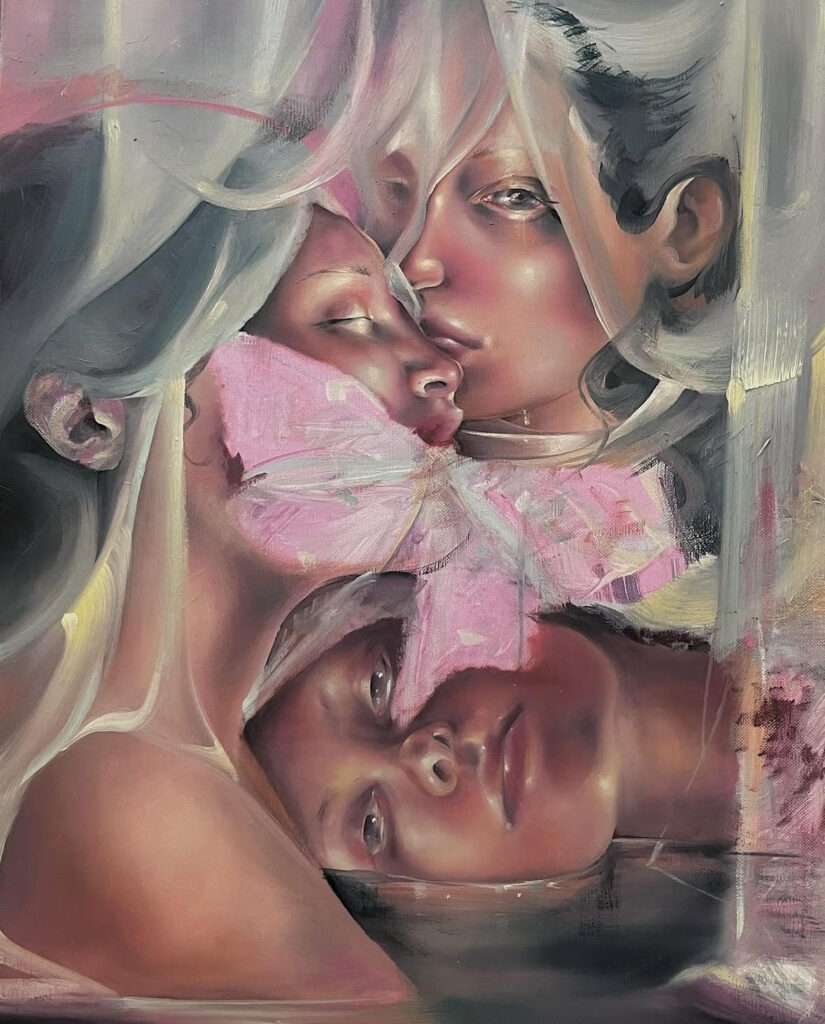
Sophie: Yes most of the time. I think they are often the most interesting and that’s why I love drawing so much, the first line is the most honest. It doesn’t need to be polished or perfect. I hope to bring that same mindset into painting. for now, I draw before I paint, so my gesture is already shaped, but maybe one day I’ll paint directly and experience intuitive immediacy.
Has intuition ever led you somewhere unsettling, somewhere you didn’t initially want to go?
Sophie: Yes it took me time to develop a strong sense of intuition, it’s an inner dialogue I try not to betray. I remember the fear of rejection in my work, worrying about how others would perceive it, that’s why I resisted developing the darker side of my art. but by reconnecting with my instinct, my work began to come from a genuine place of curiosity and wandering, rather than a search for validation. allowing myself to get lost as an artist helped me find something that truly belongs to me. even if an idea seems like a bad one, another will come, letting your work fail sometimes is one of the most freeing things i can do.

What kinds of emotional states are hardest for you to translate into images?
Sophie: I think I haven’t really explored joy in its simplest form yet, maybe because I still associate it with something loud and colorful, while I’m more used to exploring quiet, contradictory states. but I am a playful and often funny person and I do find joy in my process. I just don’t feel finished exploring melancholia and the transformative nature of grief and loss.
Is there a feeling or experience in your recent work that you still don’t fully understand, but keep returning to?
Sophie: It’s more about the process itself, the urge to fill the entire canvas, and the fear of leaving parts too raw or empty. lately, though, it has felt important to leave some areas as they are, because they often hold more truth than a second, more “perfected” layer. again, it comes back to that balance between holding on and letting go.

Do you feel your work reveals parts of you that you would struggle to articulate in conversation?
Sophie: Yes I think so. It’s interesting to feel how I’m perceived through my work. with my last body of work, I feel grounded in what emerged, it feels honest.
What are you allowing into the work now that you might have resisted before?
Sophie: I enjoy playing with the small space between “what am I looking at?” and “why am I drawn to this?” when it doesn’t fully make sense. I think beauty and art often lie in suggestion. I’m drawn to work that is vague, evocative and that challenges the viewer’s perception.
Do you think art can access truths that language can’t?
Sophie: Art is a pathway to feeling things we might not allow ourselves to feel. It has a kind of precision that language can sometimes lack.
What do you need to feel in order to know a work is alive?
Sophie: Honesty and vulnerability.
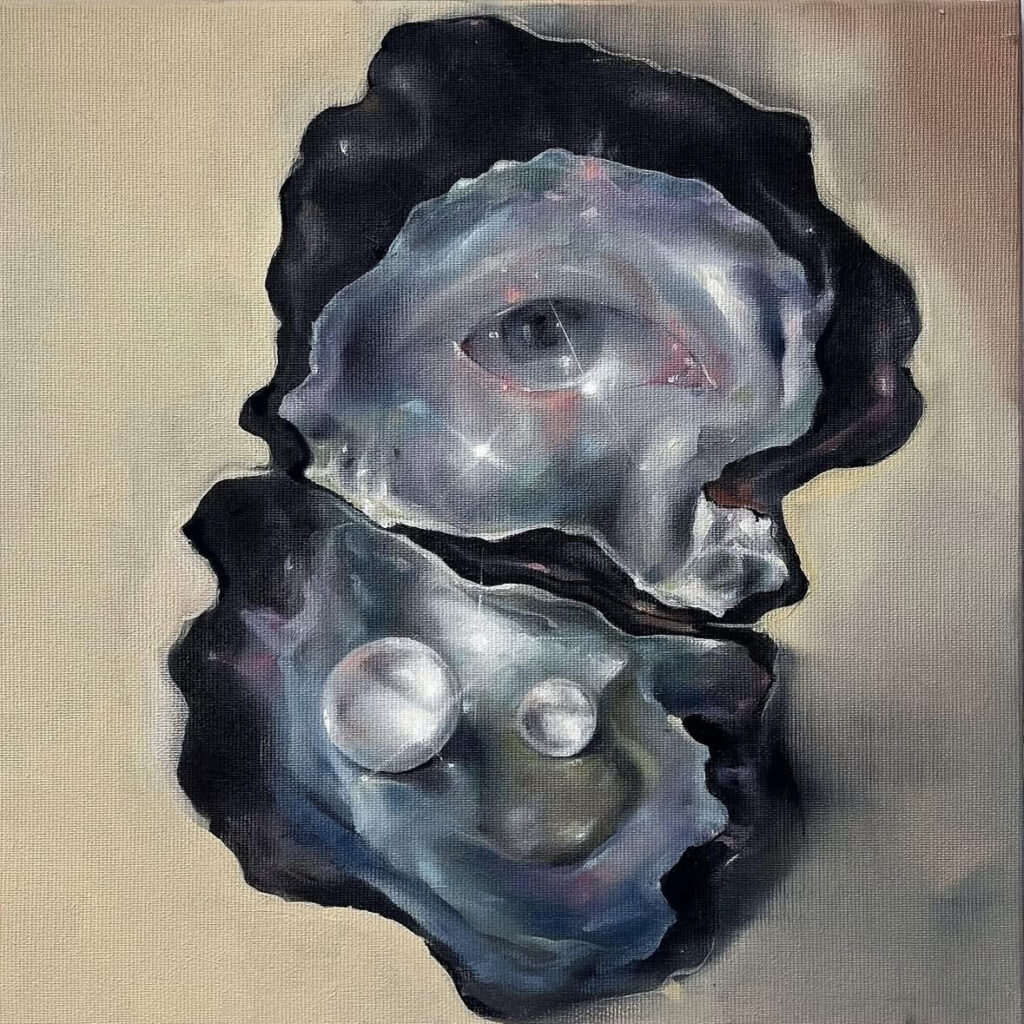
As your work continues moving deeper into this darker, more intuitive territory, what are you hoping to protect, and what are you finally ready to let mutate?
Sophie: I hope to remain suggestive and open. I like when there’s freedom in the result, when different narratives can emerge depending on the viewer’s own experience. at that point the painting no longer belongs to me; it becomes something personal to whoever is engaging with it.
Can you walk me through your creative process from beginning to end result?
Sophie: I love to archive and curate. I journal a lot so I can see the way my ideas shift over time. I’m drawn to experiences that move me and I try to understand why so I can translate that into my work. going through complex emotions already feels like a painting in my mind, then I explore its contradictions on canvas.

How do you approach color?
Sophie: It’s such a powerful emotional vector and it’s the one I struggle with the most. I used to be naive about it and I think I still am. I question my palette with every painting. I’ve moved from bright, highly saturated colors to more earthy, muted tones that create a different kind of contrast. I like challenging the potential of less saturated pigments, there’s an elegance to them, and they tell a different story. It’s interesting how my approach to color has evolved alongside my mental health. through experience, including more difficult moments, I’ve gained depth and now my palette feels like it has something new to express.
So with what we just talked about, what are you hoping to convey?
Sophie: I like to think of my art as a portal that allows the viewer to feel things they might not usually allow themselves to feel. It’s not about making sense of everything but about creating a bodily and emotional experience.
Ok Sophie, now to something totally different. In a parallel universe who would you be? and what would you be doing?
Sophie: I think i’d be a tall bird with a long beak who always seems a bit confused.
Outside of art, what’s something you’re obsessed with right now, maybe a hobby, a show, or even a food—that keeps you grounded or inspired?
Sophie: Cooking bone broth, The Eden Project by James Hollis, creating my friends in The Sims and making them go through a very long maze.
What qualities do you find most important in the people you choose to spend time with?
Sophie: Empathetic curiosity, kindness and openness, also the capacity to listen.

Anybody you look up to?
Sophie: My friends, especially the women in my circle who show up imperfectly and honestly. they become militant figures, mothers, healers. they challenge norms and carry both intelligence and spirit. I feel very lucky to witness their evolution and to be part of their lives.
What motivates you?
Sophie: That life has more imagination than we do.
How would you describe a perfect day?
Sophie: With coffee, space to express yourself, lots of water, anything aesthetically baroque or romantic, a good conversation and a little walk.
Alright Sophie, I always ask this questions at the end of an interview. What song(s) are you currently listening to the most right now?
Sophie: “I’d Rather Be Yours Than Mine” by Sophia Stel and the album « Come Down to Dawn » by the KLF.