
Share this
Tallulah Dirnfeld is a New York-based artist known for her emotionally charged oil paintings that blend surrealism with psychological depth. A self-taught painter with a background in horror film production, Dirnfeld creates haunting, dreamlike scenes that explore themes of memory, identity, and femininity. She is a member of the Artemis Council at the New Museum and has exhibited in group shows across the United States and Europe. In 2024, Dirnfeld presented her debut solo exhibition at Sade Gallery in Los Angeles and in 2025 presented her solo exhibition I Was Always Good at Abigail Ogilvy Gallery in Los Angeles.

Hi Tallulah! It’s a pleasure to sit down with you! First question that I always ask. How does a regular day look like for you in New York?
Tallulah: Hello! Well, I keep my days pretty structured. I naturally wake up at 7 AM and go for a walk, usually about two hours long and through Central Park. When I’m back home, I’ll put on an audiobook and start painting. I wrap around 7 PM and meet up with friends, usually for dinner, sometimes a play or an opening. I’m in bed by 11 PM. Every day is a perfect day really.
I’m curious, growing up, what was life like there? And what kind of kid were you? What did you enjoy doing?
Tallulah: Growing up in New York was both very chaotic but sort of lonely. I went to a pretty formal all girls school on the Upper East Side, and I was definitely the most… unusual of the forty girls in my grade. 18 couldn’t come fast enough, I was beyond ready to leave and move across the country for college.

Do you remember approximately at what age your creative side started to show? And when did you start taking being an artist seriously?
Tallulah: I don’t think there was a single moment. I always did things a bit differently, like playing with dolls well into high school. Dolls and make-believe were a creative exercise I wasn’t ready to let go of when all my peers were already primed for reality. I also loved to paint. I’ll never forget in the 11th grade, my art teacher displayed my paintings in the hall, but she had to take them down after a week because they disturbed the younger students… as I was saying I was the unusual one. This all led me to film school, after which I worked in film and television development. I liked that it was both creative and structured, but I never stopped loving painting. Four years ago, I left the entertainment industry to focus on painting full time.
Your paintings feel emotionally very open, even when the imagery is surreal or dreamlike. Do you usually begin with a feeling, a memory, or an image you can’t shake?
Tallulah: I begin with an image that is closely tied to a feeling.


You’ve described working with memory, identity, and femininity. Which of those feels most urgent to you right now, and has that changed over time?
Tallulah: I don’t typically choose themes ahead of time. I recently moved back to the same street where I grew up in New York after living in California for a decade, and it feels like time has flattened. Right now, I’m in a place where all those themes are pushing through in my life all at once. Memory and identity for obvious reasons, I’m seeing my femininity a lot through the lens of the girl I was when I was growing up on this street and how she’s intersected with the woman I am today.
You’re self-taught, which often means inventing your own rules. What did teaching yourself make possible that a more formal training maybe wouldn’t have?
Tallulah: Formal training would have been nice, but I value working based on trial and error and intuition. Most of what I’ve learned in life comes from lived experiences and intuition. I don’t see why painting has to differ.

Was there a moment when you realized painting could hold darker or more psychologically complicated material than you could express in words?
Tallulah: When I was working in entertainment, I was at Blumhouse making horror films. I often thought about terrifying moments that show a kind of psychological truth, the unnameable things that draw people towards images that are intense or complex. Painting is similar. Putting feelings into words simplifies them. It’s easier for me to understand these complex emotions as an image.
A lot of your work seems to sit in that space where something beautiful also feels off. Do you think that tension comes from lived experience for you?
Tallulah: Yes.
When you paint from memory, are you trying to recover something truthfully, or are you more interested in how memory distorts, edits, and performs?
Tallulah: I don’t believe you can reveal something in a completely honest way. I’m much more curious about distortion and stylization of these memories, as that in itself can reflect something more truthful. It is all perspective in the end, really. Even my most truthful remembering of something may not at all be someone else’s experience of it, so how honest is the truth really?
Your work often touches girlhood, posture, presentation, and femininity in a way that feels both intimate and critical. Did you grow up feeling inside those expectations, outside them, or both?
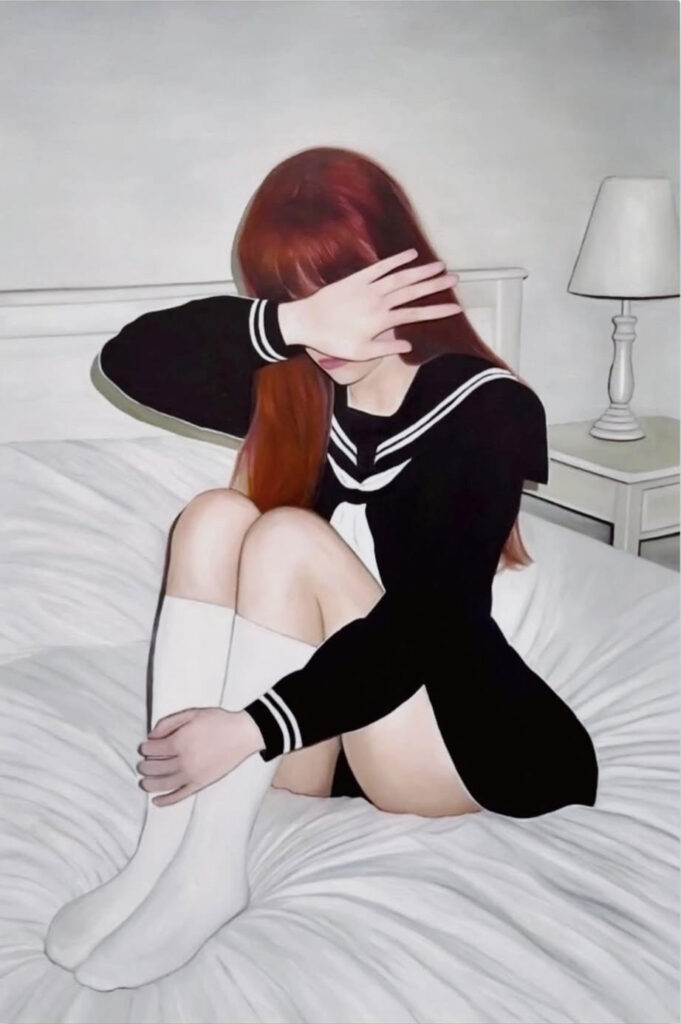
Tallulah: I wore a uniform skirt every day until I turned 18 and there was a serious emphasis on manners, more explicitly, on being “ladylike.” However, I also had certain experiences that gave me a tougher, more masculine edge. I spent a lot of my childhood in defense mode, but the autonomy of adulthood has given me a chance to find a softness that I didn’t have in my youth. I now embrace being grateful, positive, and loving. Through that, I discovered my femininity in a way I couldn’t access while growing up.
Are there personal memories or emotional states that still feel too close or too volatile to paint directly?
Tallulah: Yes, anything that feels too immediate or unresolved is not something I’m interested in painting.

What kinds of experiences do you think taught you earliest that femininity could be theatrical, coded, or even frightening?
Tallulah: All women have a moment where they realize they can sort of bend the world to their liking with their feminine power, as well as the moment when they realize the inherent danger of being a woman, the fear that someone’s desire for you can turn dark. Going through girlhood in New York, I saw a lot of different ways to be feminine, as well as different reactions to that femininity, from a very young age. It became unavoidable as I became conscious enough to observe those around me.
You come from a background in horror film production. What did horror teach you about tension, pacing, or the unseen that painting now lets you explore differently?
Tallulah: It taught me that what you don’t show is just as powerful as what you do show. If you can create a strong reaction in someone, it’s successful. Let the viewer fill in the gaps.
Horror often relies on revelation, while painting holds everything still in one image. What can a painting do with dread that film can’t?
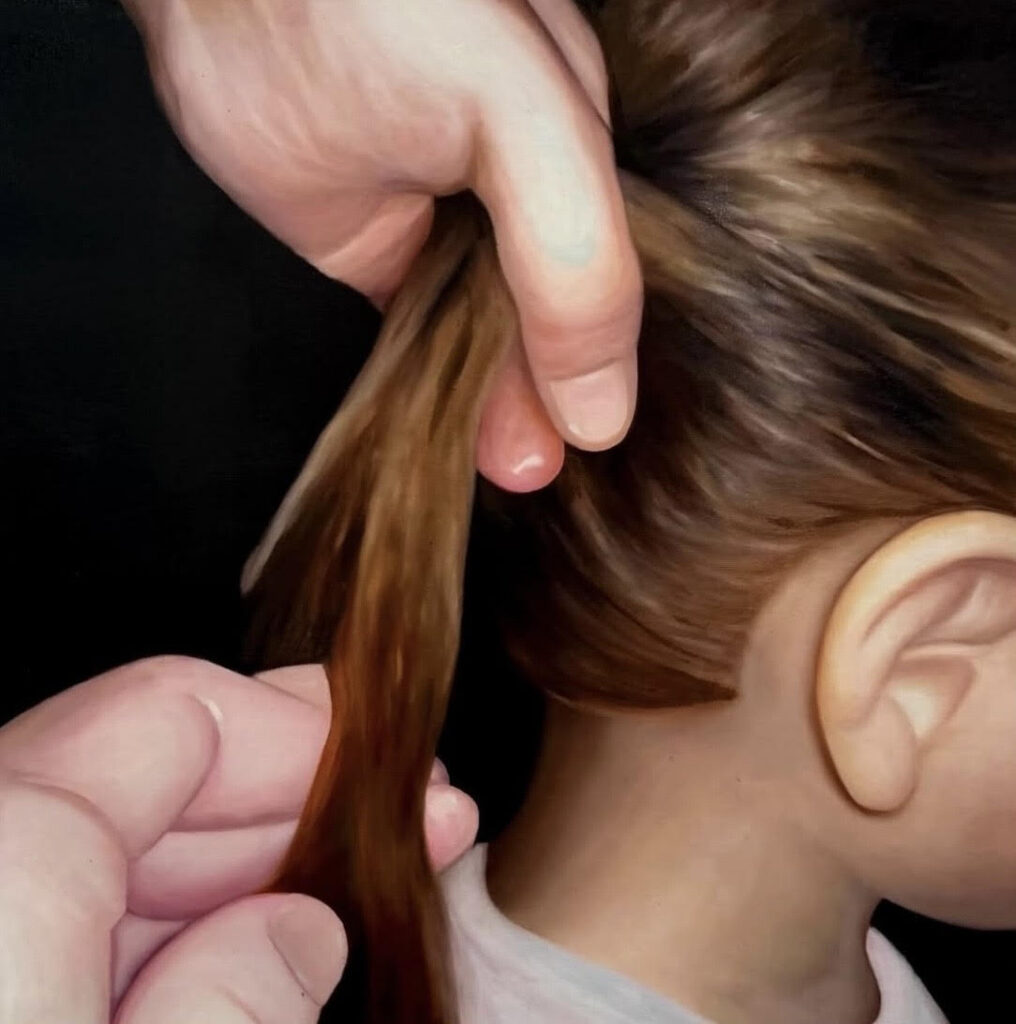
Tallulah: In a film, tension builds and then breaks. In a painting, it captures the observer in one image. It can feel suffocating.
Your work doesn’t feel horror in a literal sense, but it does feel haunted. What kind of haunting are you most interested in: memory, beauty, family, gender, desire?
Tallulah: I have hundreds of dolls that I find very cute, yet when others see them, they are scared. I might have some wires crossed, to be honest.
Do you think fear is ever clarifying?
Tallulah: Yes, it always cuts through.
There’s often a sense in your work that the body is being staged, cropped, or composed rather than simply depicted. What draws you to that kind of control?
Tallulah: The body is every woman’s primary mechanism for control. My paintings give me an outlet to explore that further.

In one interview, you spoke about surfaces that feel almost too perfect, as if everything has just been straightened into place. What is it about perfection that feels so psychologically charged to you?
Tallulah: I am very controlling and a perfectionist. I manage to hide it well most of the time, but there’s a tension between being extremely type A and keeping it hidden from others. It takes a lot of effort. I find that tension interesting.
Your paintings seem interested in the line between adornment and discipline. Do you see beauty as a form of pleasure, pressure, or both?
Tallulah: You don’t find beauty without strong discipline.
When you paint femininity, are you trying to unravel it, honor it, resist it, or all three at once?
Tallulah: I’m more interested in holding contradictions instead of resolving them.

Can you walk me through your creative process from beginning to end result?
Tallulah: I begin with inspiration that often comes from dreams, memories, fashion, toys, and poems. I sketch the composition, take reference photos, and collage them. Then I paint using that image as a reference.
Can you also tell me about your use of symbolism?
Tallulah: I usually use simple objects and focus on them. I repeat symbols without overthinking. I’m happy to have other people explain the meaning of them to me.
How do you approach color?
Tallulah: I like cool tones. They create a sparse and distant feeling. I’m attracted to the harsh and revealing appearance of flash photography.

So with what we just talked about, what are you hoping to convey?
Tallulah: In general? To do your path and walk it in love.
Ok Tallulah, now to something totally different. In a parallel universe who would you be? and what would you be doing?
Tallulah: I would love to be my Tallulah look-a-like Blythe Doll. She has red hair with bangs and wears a striped long-sleeve shirt, a black pleated skirt, and Mary Janes. She usually sits on my shelf, but sometimes I take her out.
Outside of art, what’s something you’re obsessed with right now, maybe a hobby, a show, or even a food—that keeps you grounded or inspired?
Tallulah: Disney World.
Can you tell me a story about a time when a connection with someone had a big impact on you?
Tallulah: Not really.
What qualities do you find most important in the people you choose to spend time with?
Tallulah: I value honesty, consistency, loyalty, and humor. I care about my friends and feel very open with most people as soon as I meet them. But once trust is broken, it’s hard for me to go back.
Anybody you look up to?
Tallulah: I love my mom.
What motivates you?
Tallulah: Central Park

How would you describe a perfect day?
Tallulah: Any day where I get to post on my Instagram is perfect.
Alright Talullah, I always ask these two questions at the end of an interview. The first is. What’s your favorite movie(s) and why?
Tallulah: Scream… My first scary movie. I loved the thrill of being made afraid in a controlled environment. It blossomed a life-long love for horror movies. Heathers… Cruel teenage girls, uniforms, murder, Winona Ryder… the movie has everything.
The second is. What song(s) are you currently listening to the most right now?
Tallulah: Turn on the Lights – Future
No Cure for the Lonely – Swans
Clarity – Zedd
Flirted With You All My Life – Vic Chesnutt