
Share this
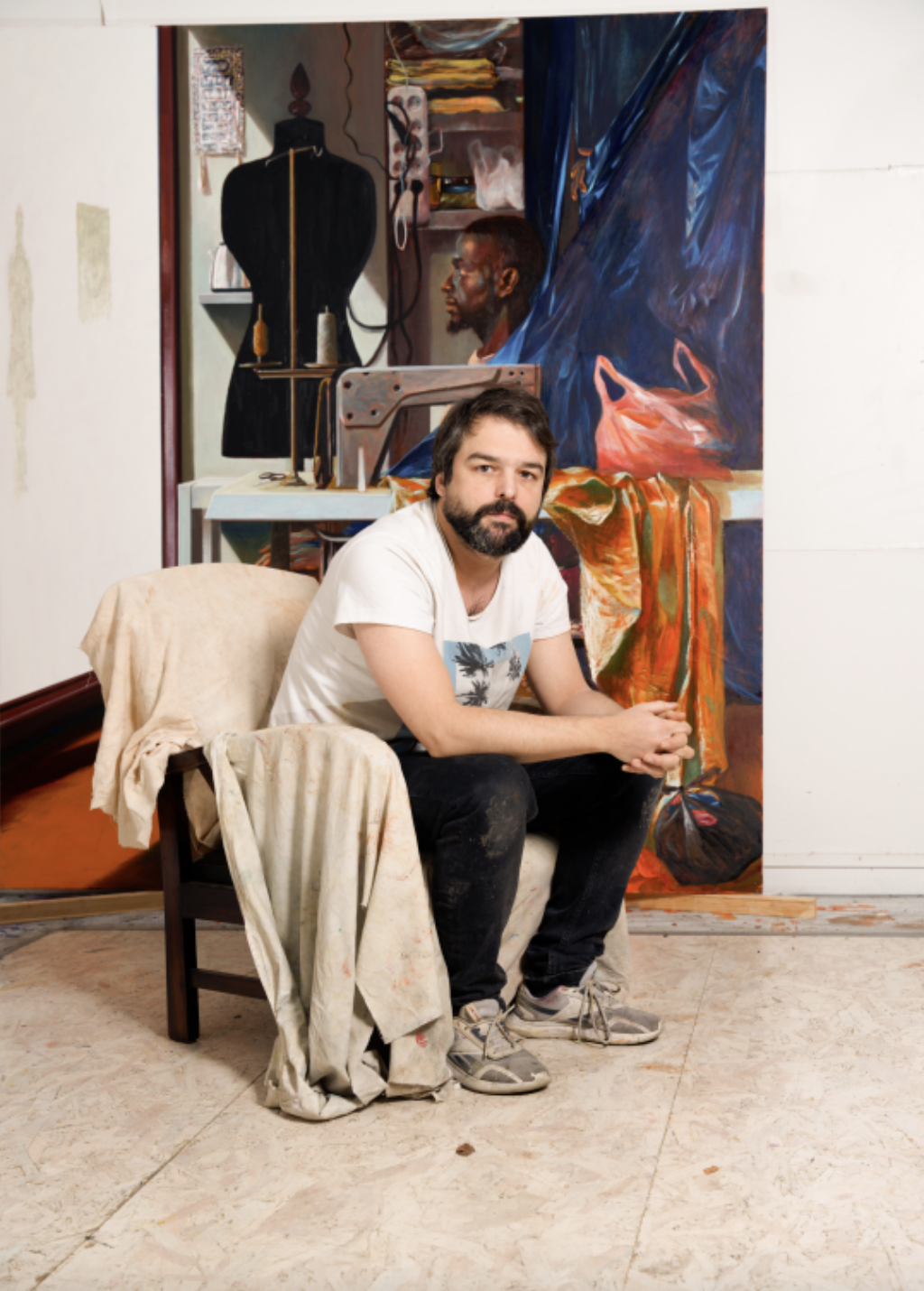
When I met Laurent Proux at Semiose Gallery, in Paris, where his solo show The Nature Poem runs until October 11, the paintings felt at once lush and unsettling — bodies folding into light, shadow, and wilderness, as if the human form were dissolving back into the world. Talking with Proux was as rewarding as walking through the exhibition itself: generous, layered, and full of strange connections.
Born in Versailles in 1980, Proux studied at the École Nationale des Beaux-Arts de Lyon and the Hochschule für Bildende Künste in Hamburg, later completing a residency at the Casa de Velázquez in Madrid.
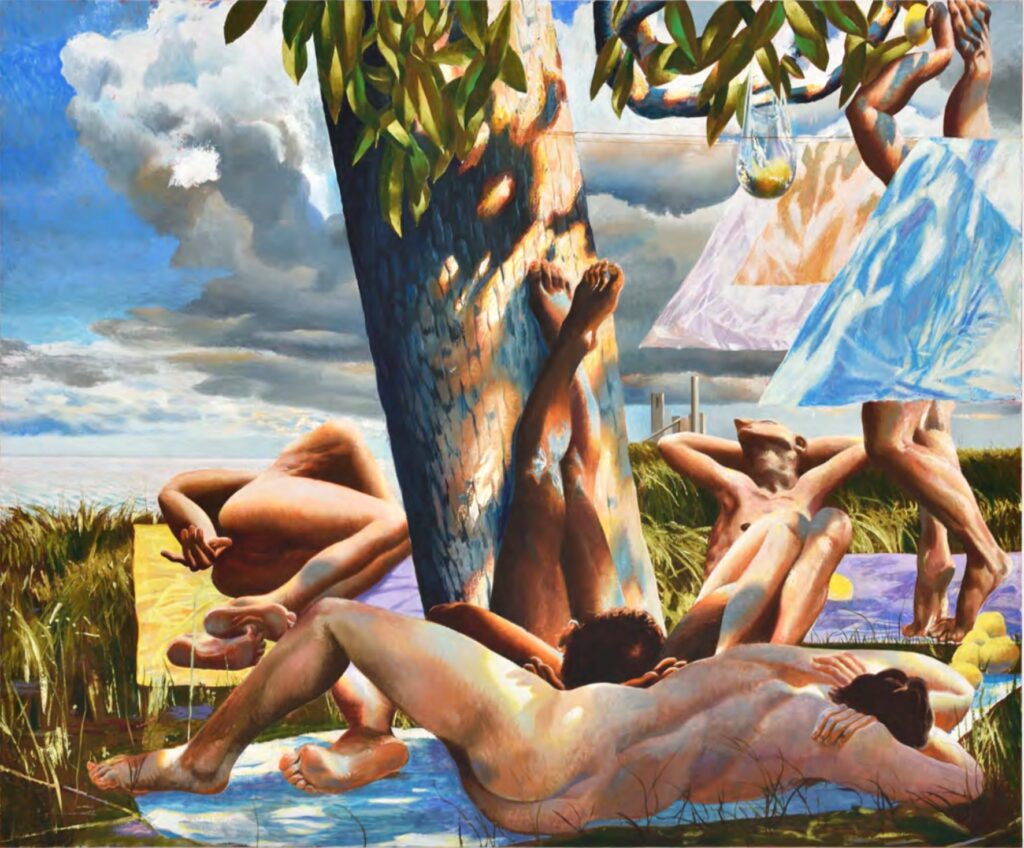
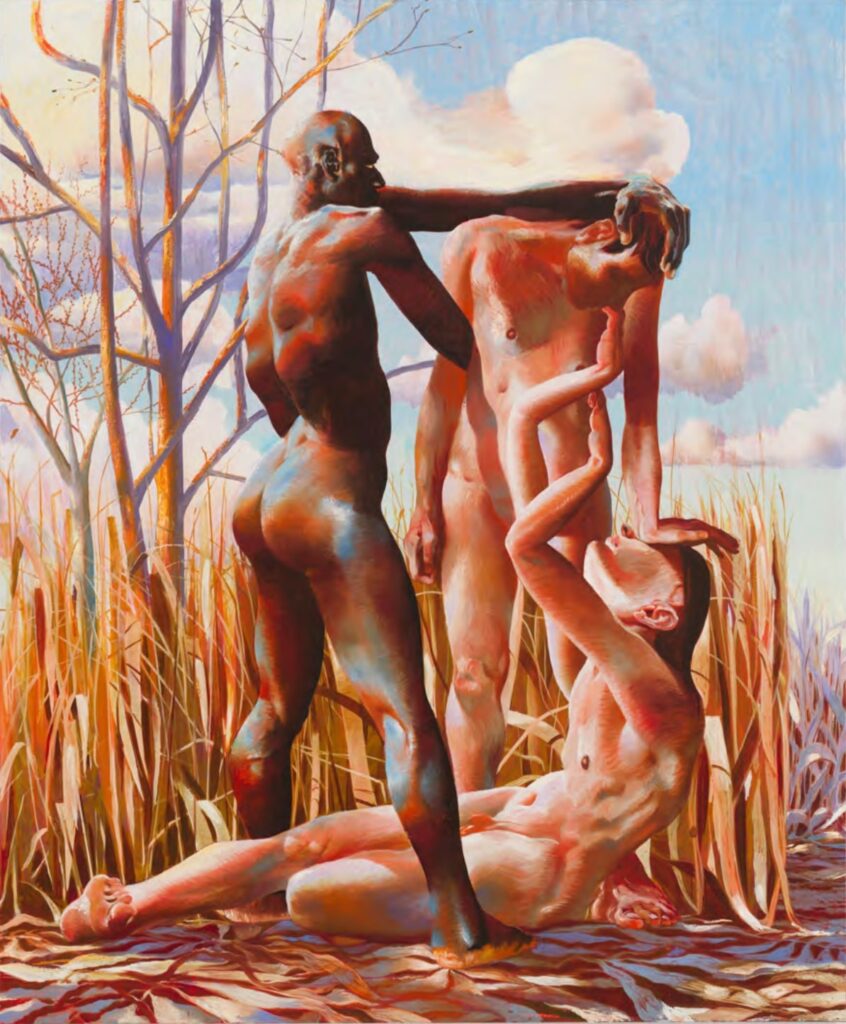
Across his canvases, the body is never fixed — it’s fractured, hybrid, or entangled, sometimes merging with vegetation, sometimes with machines, sometimes with itself. There’s a charge between tenderness and unease, intimacy and alienation, that pushes his work beyond figuration or abstraction and into a liminal, dreamlike space.
Over the years, Proux has turned from industrial afterimages — empty data centers, phone shops, deserted workstations — to a more expansive painterly language, where the boundaries between figure and environment collapse. His references stretch from Mannerist torsions to Henri Rousseau jungles, but his questions are contemporary: how labor, technology, and desire reshape the way we see and inhabit the world.
In The Nature Poem, those questions take root in forests and under sunlight. The works seem to ask what happens when the human body doesn’t just move through the world but becomes it.
Profile picture : Pauline Assathiany.
Hi Laurent! It’s a pleasure to sit down with you! First question that I always ask. How does a regular day look like for you in Paris?
Laurent Proux: I’m not someone who jumps into work the moment I wake up. My studio is about forty minutes from where I stay, so every morning begins with that journey. On the train I read, sometimes I sketch, but mostly I just watch people. That crowd of the underground — it’s already a kind of theater. I like observing faces, gestures, clothes, the way people carry themselves. It’s part of how I prepare myself without even realizing.
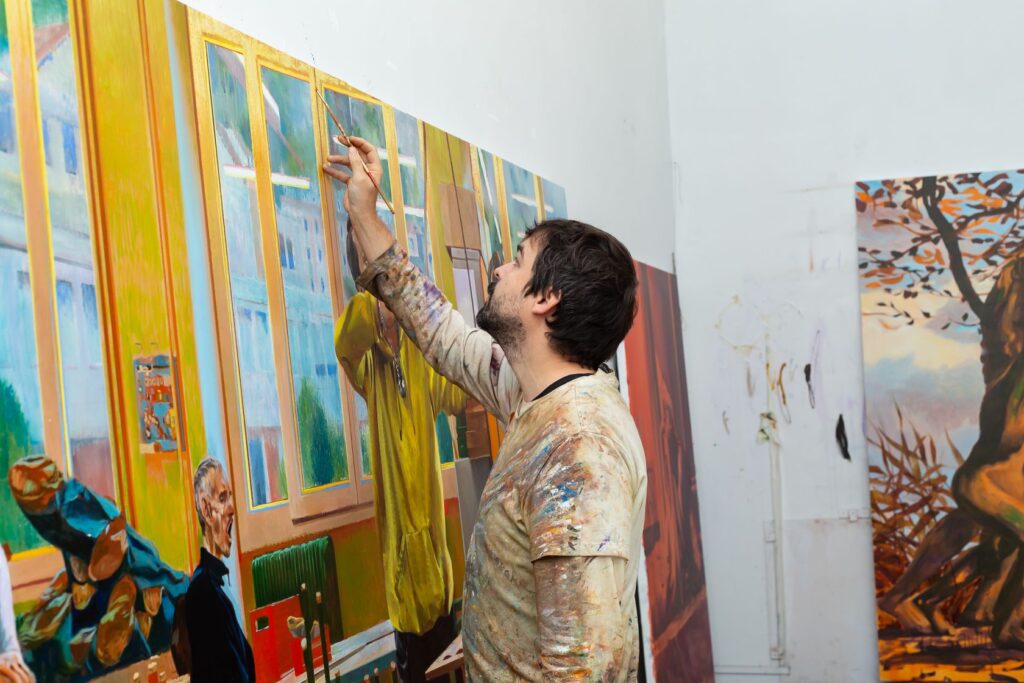
When I arrive in Montrouge, in the south of Paris, I don’t go straight to the canvas. I procrastinate. I’m lazy at first. I waste time on my phone, trying to squeeze every possible distraction out of late capitalism, scrolling, whatever keeps me from facing the canvas. Because even if it’s art, it’s still work, and nobody really likes to work.
But then something shifts. After an hour, sometimes two hours of nothingness, I get restless. And it’s exactly in that boredom that the spark appears. Suddenly I feel drawn to start. What was empty becomes fascinating. Once I begin painting, I forget everything else, and I work long, long hours — often until nine or ten at night. So my rhythm is strange: resistance in the morning, obsession at night. I often compare it to sport — like a football player warming up. At first it feels pointless, but then the body takes over, and you don’t want to stop.
I’m curious, growing up in Versailles, what kind of kid were you? What did you enjoy doing, and how did you spend your time?
Laurent Proux: Versailles is beautiful — everyone knows the castle, the gardens — but growing up there was not so romantic. It’s very conservative, very proper. The kids all went to church, there was a sense of strict tradition. My family didn’t fit that mold; we weren’t religious. So I grew up a little outside of that, which gave me distance.
I was contemplative, quiet, more on the dreamy side. I had a brother, but I played mostly alone. I was the kind of boy who could spend hours making up stories with objects, turning the simplest things into landscapes or characters. I invented little theaters in my head. I liked to sing to myself, to drift.
Boredom was my real companion. But boredom in a positive sense — the emptiness where imagination is born. When you’re a child and you’re bored, you don’t just sit still; you create. And for me, imagination was my way out.
School was not easy. I was dyslexic, bad at writing, bored by classes. The teachers couldn’t hold me. So I didn’t exactly “choose” art the way people choose careers. I didn’t weigh law against medicine and pick painting. I had no other option. I wasn’t good at anything else. Art was survival, the only possible path.
Do you remember approximately at what age your creative side started to show? And when did you start taking being an artist seriously?
Laurent Proux: I was bored at school, and not good for writing or follow exercises. Art comes from being bored. I choose to be an artist because I had no other interests or couldn’t do something else. There isn’t one exact moment. It didn’t begin at twelve or fifteen. I was always drawing, but to take it seriously as a life, that came much later — around 20. Before that I was experimenting, working, but without the sense that this was my path.
Recognition also came slowly. My first solo show was in 2009 at Semiose Gallery, so something was already happening. But I would say it wasn’t until 2019 that the work started to gain real visibility, that people began following it in a new way. So like my days, my career also had this long empty beginning, and then suddenly intensity.
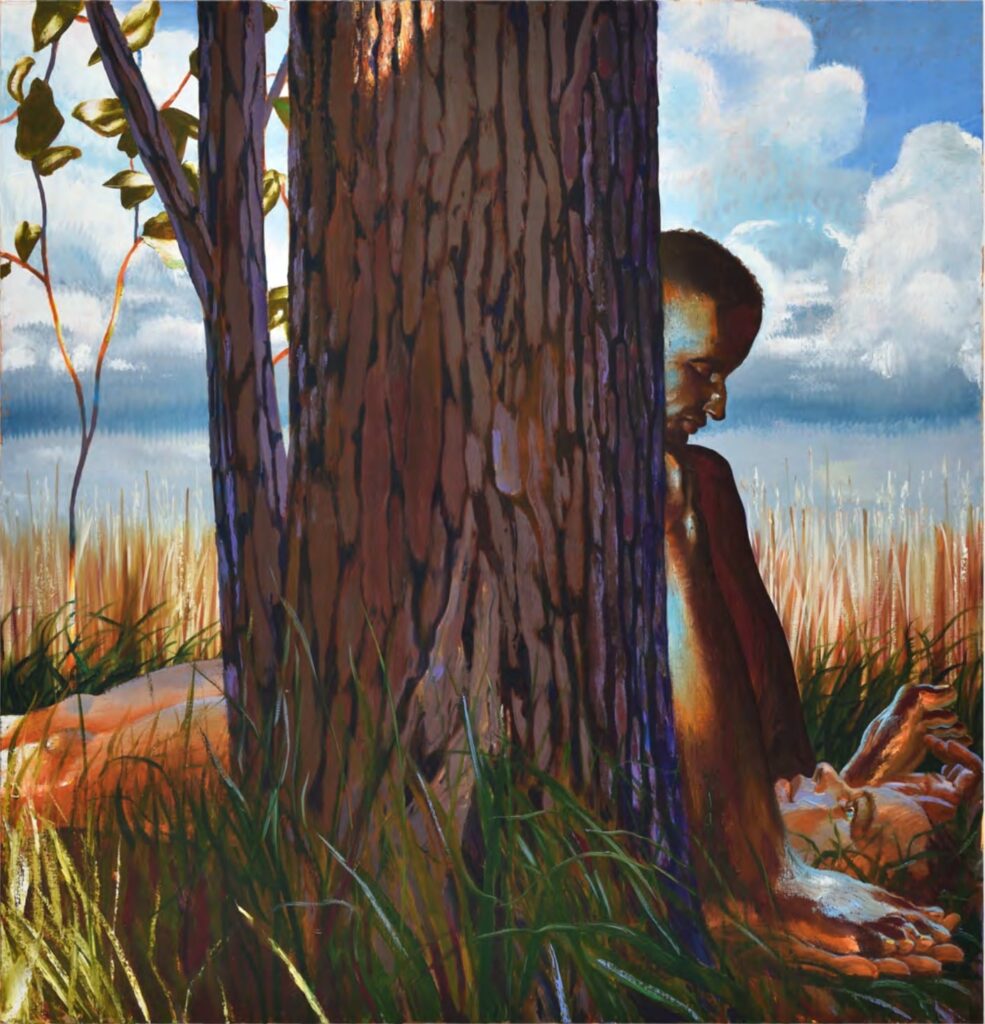
You studied in Lyon and Hamburg. How did those places shape you?
Laurent Proux: Lyon is characterised by its industrial development and bourgeois culture.. Everyone was competing, showing off their intellectual superiority. My father worked in industry, so my background was far from that environment. I felt out of place, and that’s why my first subjects were industrial: factories, machines, deserted workspaces. It was a way of fighting against the art-school bubble, of bringing social content into painting, of showing something other than the polished art-world life.
In Hamburg, I had Werner Büttner as a teacher. He was an old punk, still anarchic in spirit. He taught me that painting doesn’t always need to be solemn, that irony and wit can be just as powerful as seriousness. That was important for me — I realized a joke can also make a great painting.
So if I summarize: Lyon forced me to think about subject matter, about painting something real, like industry. Hamburg gave me freedom, humor, lightness. Together they shaped how I now approach painting: socially grounded, but not heavy-handed.
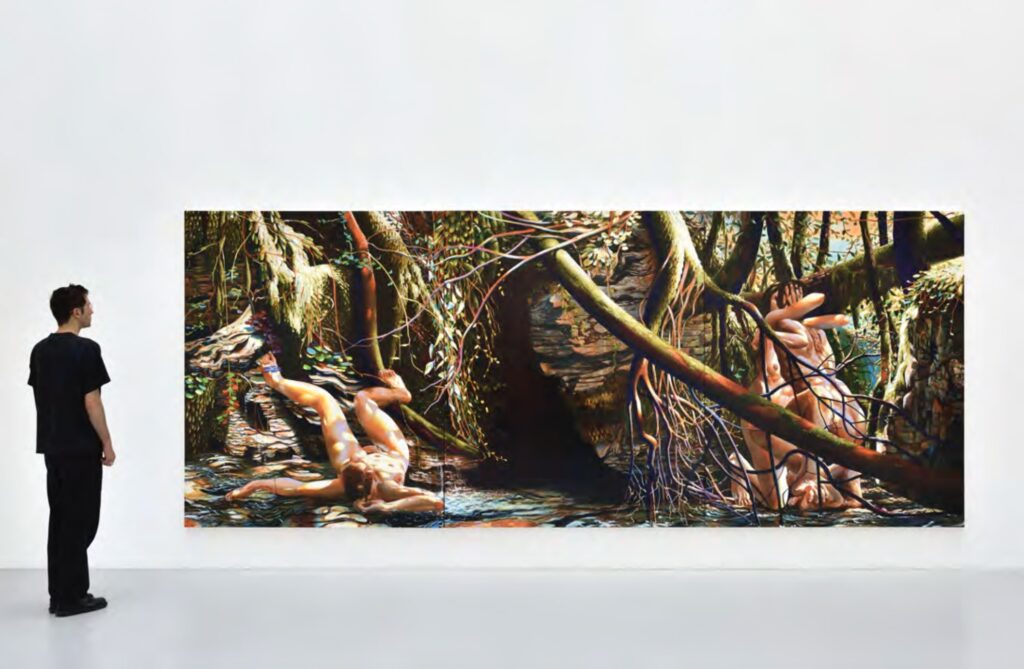
Ok Laurent, with these next series of questions, I will try to delve into your work as best as possible. So… Your work often navigates between figuration and abstraction, staging the body in states of dislocation or transformation. What draws you to this tension?
Laurent Proux: For me it’s not really figuration versus abstraction — nothing I paint is truly abstract. It’s more about dream and reality.
In nature, the body dissolves into the landscape. It’s ecstatic, orgasmic even, like you become part of something larger. In industrial spaces, the opposite happens: the body is reduced to a machine part, alienated, absorbed into production. These are two extremes of experience, and I’m fascinated by the tension between them. Painting allows me to hold both: the dreamlike epiphany of being one with nature, and the harsh alienation of labor.
Many of your figures appear fragmented, entangled, or dissolving into their environments. Tell me about that… Do you see this as a reflection of contemporary life, or more as a timeless condition of the human body?
Laurent Proux: It reflects contemporary life. Our bodies today are constantly mediated by technology. Think of a selfie — you extend your arm, take a picture, send it instantly to Tokyo or Sydney. How long is that arm then? Suddenly your body extends across the world.
This constant fragmentation — cameras, screens, frames — it’s a new condition. People in the 19th century, even the early 20th, didn’t experience their bodies this way. It’s specific to our time, and I think about that when I paint.
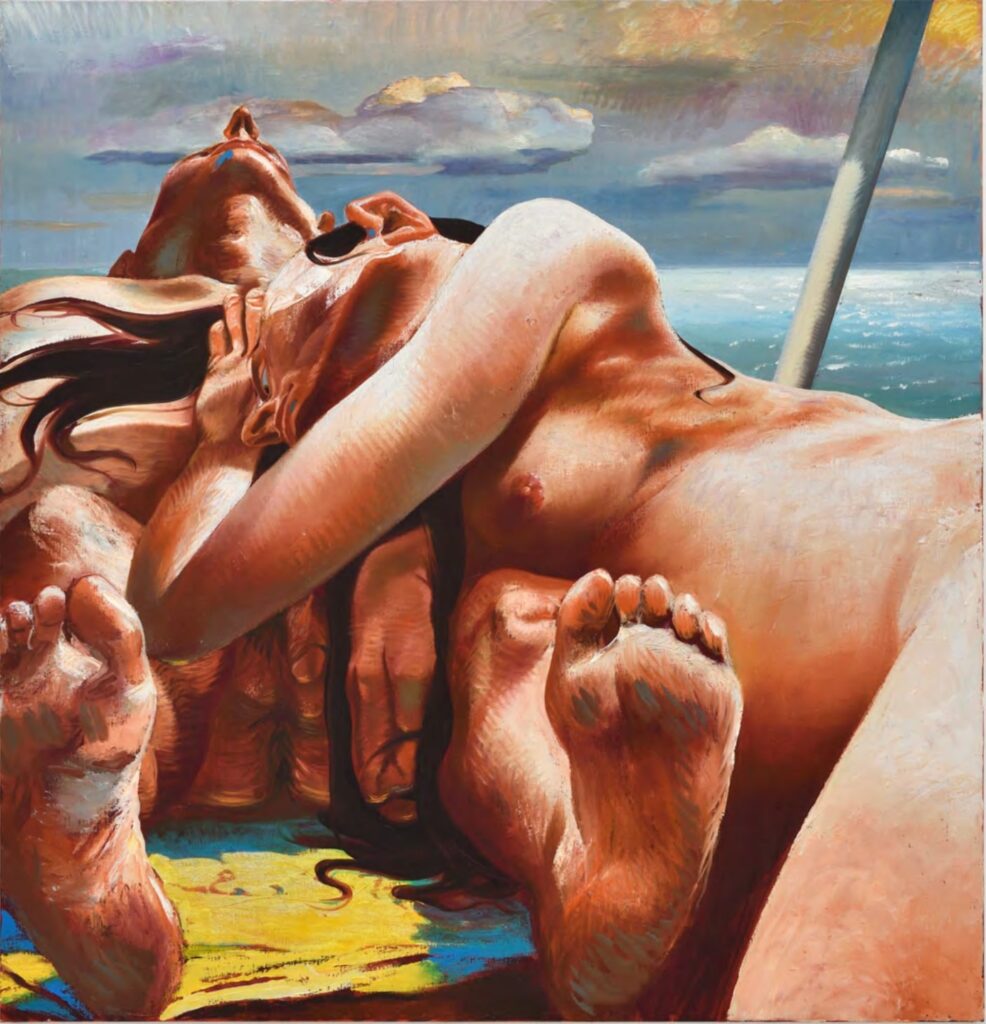
So who are those figures in your work?
Laurent Proux: They’re nobody and everybody. Sometimes I use myself, sometimes a model for a detail, but mostly they are anonymous. The important thing is that the viewer recognizes themselves.
I often say the real body in the painting is the body of the viewer. The figures are like gloves: you slip them on to enter the painting. That’s why the anatomy is sometimes impossible — because it isn’t about accuracy. It’s about invitation.
Of course, in rare cases I’ve painted specific people. In my show at Musée de l’Abbaye in Saint-Claude, I made a tribute to workers, and people recognized them. But usually, no. It’s not about portraiture, it’s about presence.
How do you build your scenes?
Laurent Proux: Through play. I cut paper body parts — a leg, an arm, a torso — glue them together like puppets. Then I move them around like a miniature theater, creating small stages. I add more characters, rearrange them, see what happens. When something sparks, I start drawing, then painting. Sometimes I do have a vision. But more often it comes from this collage game. It’s playful, physical, like building a puppet show until the scene reveals itself.
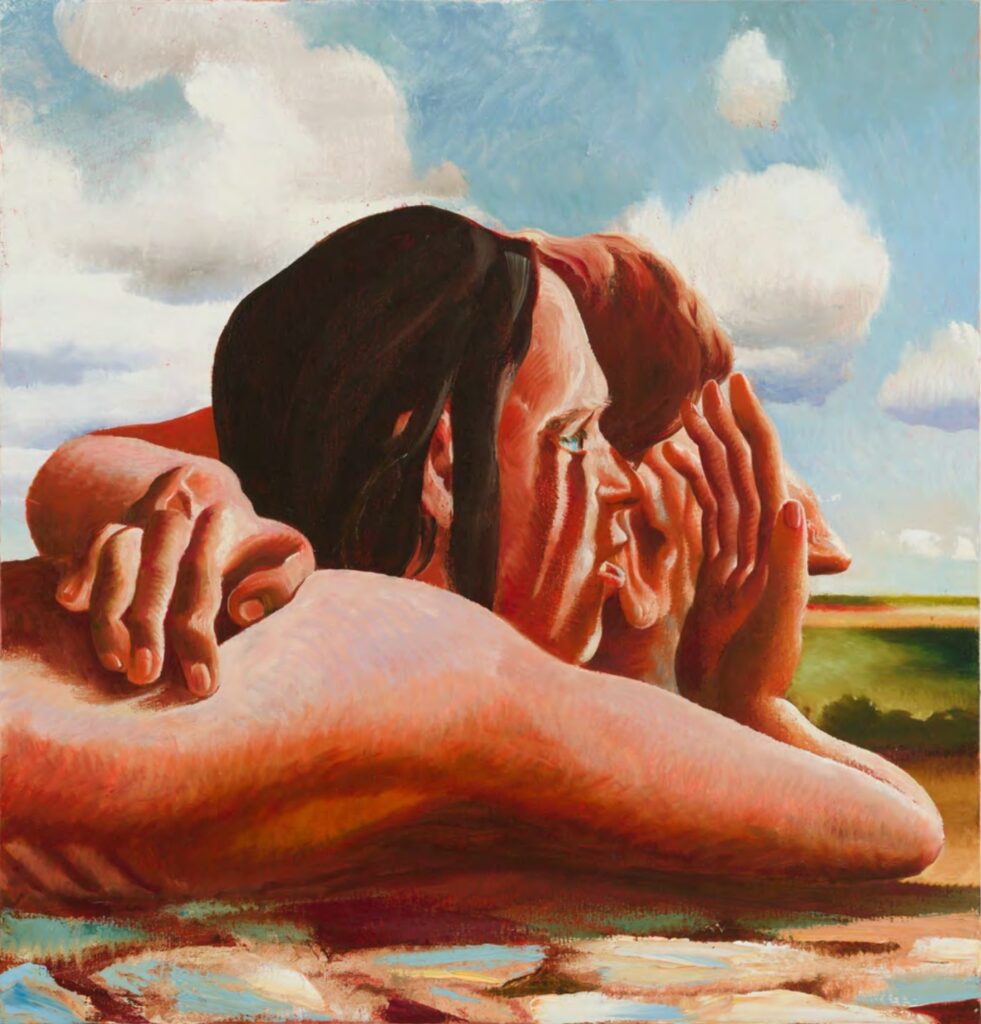
There’s a recurring dialogue in your work between industry and wilderness. What is it about this encounter that resonates with you?
Laurent Proux: They’re two opposing utopias. Nature offers abundance without work — water, fruit, shade. It exists without us. Industry dreams of another kind of abundance: machines that repeat endlessly, producing without effort.
Both are illusions. Nature isn’t always generous; machines don’t always work. Both can be nightmares. But I like to stage their contradictions. Sometimes moss in my paintings looks plastic, sometimes factories resemble forests. When the two blur, something strange and powerful appears.
With that in mind, early on, you painted industrial spaces and deserted workstations—ghostly places of labour. What made you shift from these sites of absence to more theatrical and corporeal tableaux?
Laurent Proux: People were seeing the factories depicted into my paintings as ghostly, but for me it was full of evidence of human activities. Even machines were here to reflect the human being. I felt that I’d overlooked this in my work, so I began centering bodies in my paintings, starting with Intérieur, South Side, Chicago (2019), which featured three bodies and a tree.
After that I decided to continue both sides, instead of choosing one of them only, creating both inhabited natural landscapes and industrial landscapes. The theatrical part was to create a dialogue between both corpuses.
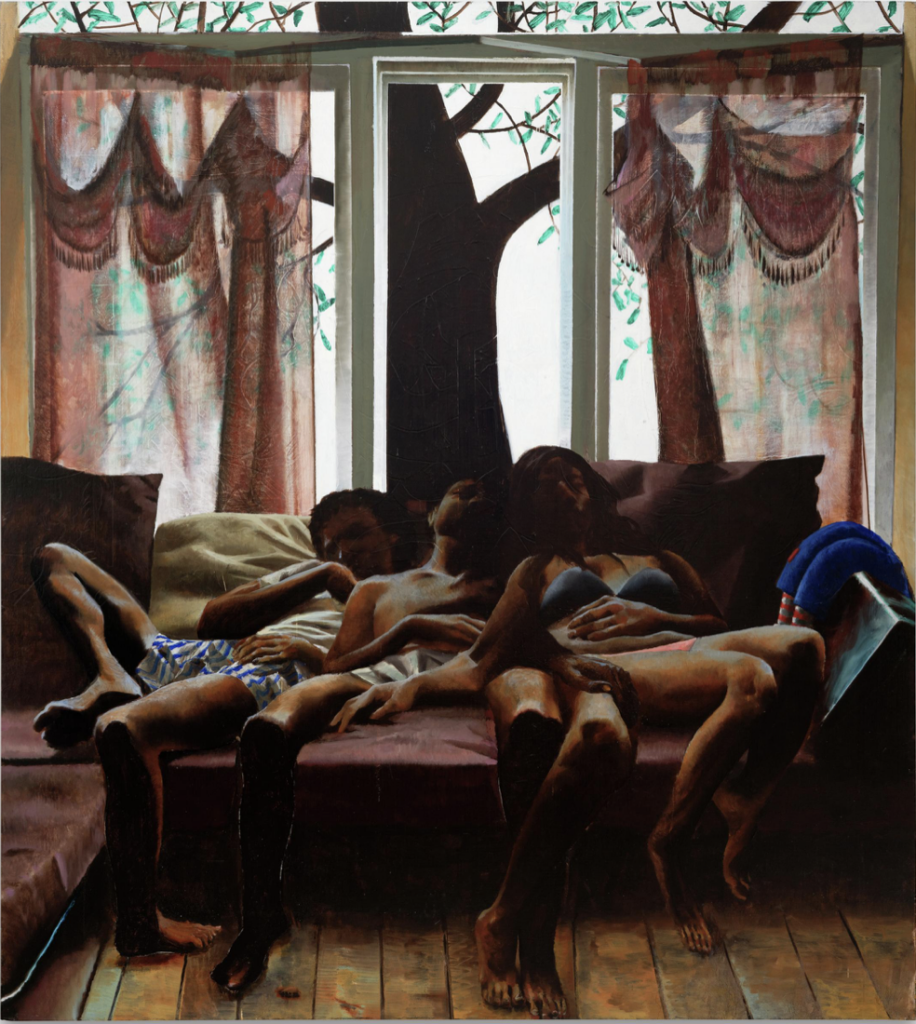
How do you approach integrating art historical references—from Mannerism and Uccello to Rousseau—into a contemporary visual language?
Laurent Proux: For me, any part of art history could be used to approach what I want to represent. If I make a group scene, one can think of Uccello, but also Manet or Deïneka, while my rocs may evoke Altdorfer or Courbet. The associations are free for me. But this is not intended as Post-modern quotation. No, it’s rather a way to build specific analogies between reality and pictorial effects, based on past artistic research. What I’m really looking for is to find a pictural gesture equivalent to a specific real thing.
Desire, labor, technology — which of these matters most?
Laurent Proux: Desire. Desire produces reality. Deleuze said that, and I believe it. Labor and technology are part of my story. I grew up in the 1980s, surrounded by TV, robots, cartoons. My father came from the factory floor. But behind all of that, it is always desire. Desire drives labor, desire drives machines, desire produces the world we live in.
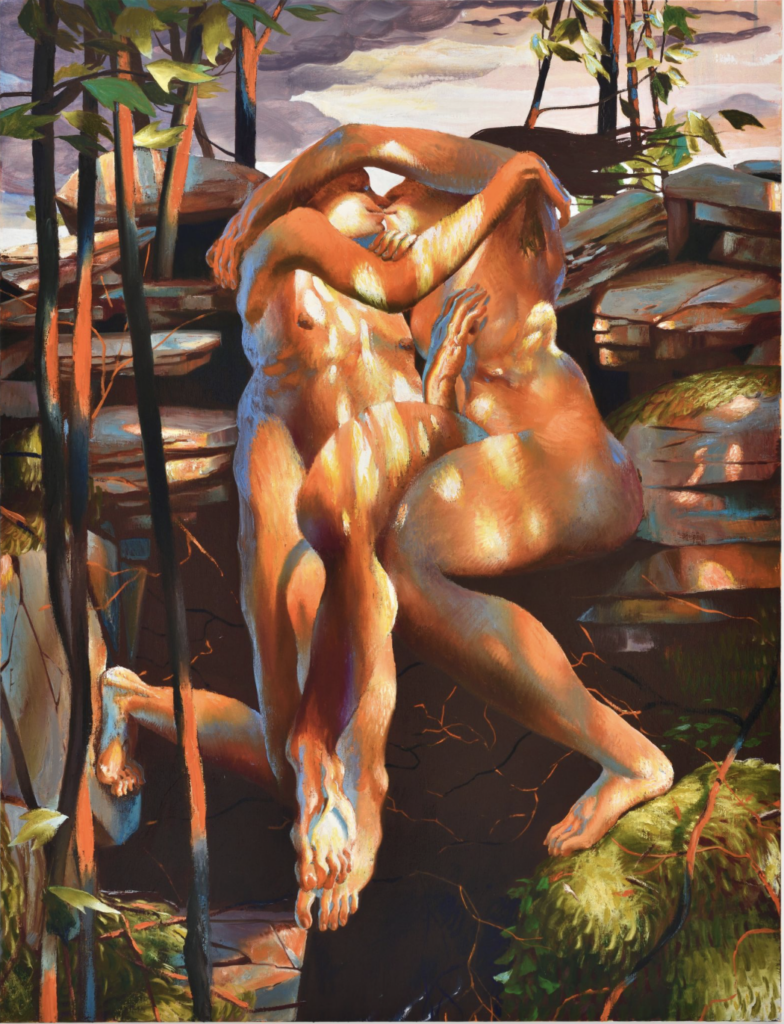
Your paintings hold tenderness and unease at the same time. Do you see painting as a space for contradictions?
Laurent Proux: Always. Contradiction is more interesting than reconciliation. Beauty, for me, is convulsive — violent and tender at once. That’s why my figures are distorted. Distortion isn’t about making monsters. It’s about intimacy. A fold of skin, the angle of an arm, the space behind an ear — these are small places that hold memory and tenderness.
Renaissance poets used to write entire poems about an ear, a birthmark, even a toenail. That’s the intimacy I want. Painting allows for that. It holds contradictions: pleasure and pain, violence and sweetness, eroticism and estrangement. That’s why it’s powerful.
Viewers are rarely given direct eye contact in your paintings. Is this refusal of the gaze a way of protecting your figures, or of placing the viewer in a more vulnerable, voyeuristic role?
Laurent Proux: To avoid psychology. I don’t want portraits that invite analysis of character. I want figures absorbed in their own world. Only once did I paint direct eye contact — a realistic work of a vulnerable figure. The gaze was a way of protecting them, of saying, “I know you’re watching.” But normally I avoid it. The figures exist in their situation, not as actors addressing the audience.
When arms transform into something reptilian or oddly deformed, are you thinking of metamorphosis as a symbol of liberation, or of something uncanny?
Laurent Proux: The deformations are more expressive to me. It’s a way to drive pathos from a point to another. Then it could be seen as forms of liberation or alienation or pain, etc. It’s a vehicle for emotions. When someone look at a painting, the only existing body it’s his own. That’s why there can be contradictory emotions within the same figure in my paintings.
Do you see sensuality in your work as an alternative to tragedy, or as something that contains traces of both?
Laurent Proux: Sensuality is very important for me. Maybe it is why I’m a painter. As a mater itself, painting is made with oil pigments and is nothing very pleasant. But when a painting starts getting more sensuality, it’s worth all the work and pain.
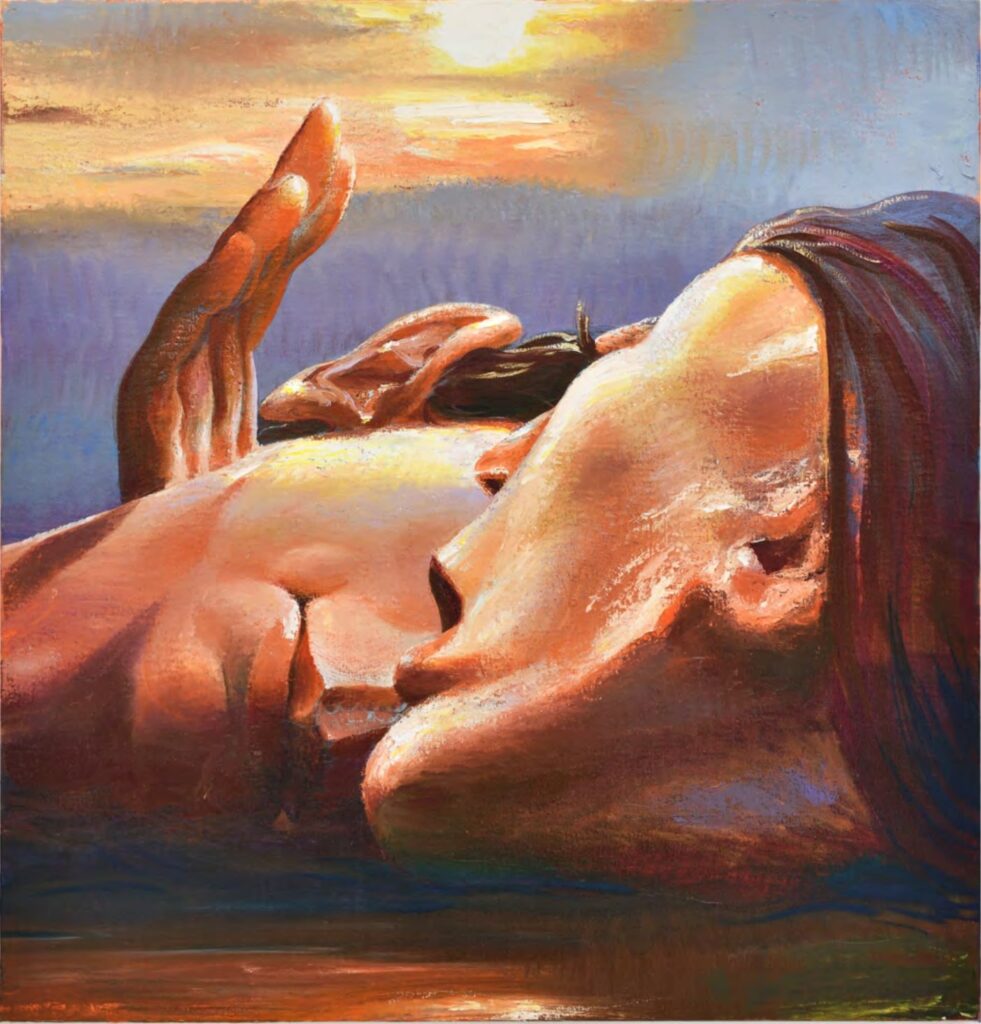
Leaves, shadows, rocks, and undergrowth all become active forces in your paintings. Do you view these elements as symbols of protection, concealment, or absorption?
Laurent Proux: Indeed! Not because they are with us, but because they are existing without us. This independency is exactly the horizon of our servitude. Maybe this is the tragical beauty of a blade of grass.
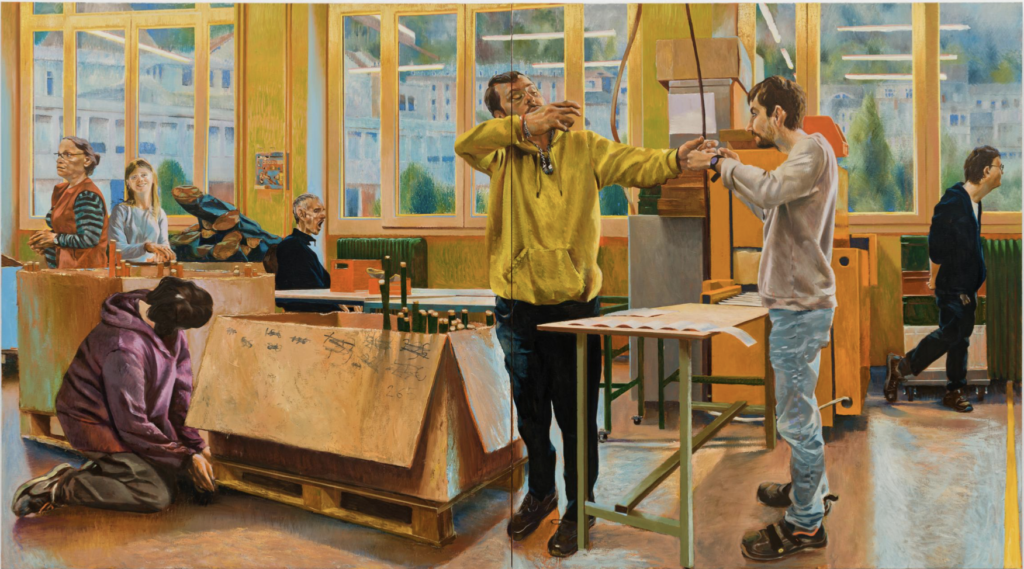
You took part in a residency in the Jura region, immersed in its industries and encircled by its forests—an experience that culminated in your first institutional solo exhibition at the Musée de l’Abbaye in Saint-Claude, L’Arbre et la Machine. What did you take away from that experience?
Laurent Proux: I made 8 or 9 large paintings about the factories and the workers of this area. Those paintings were more realistic. It was what I had to do to make a tribute to them. From that very intense first series, I took away from that experience that painting is not only a relation to the viewer, but also that the figures depicted in my painting have rights. That the painting is a relation. That is what I bring in my show The Nature Poem at Semiose.
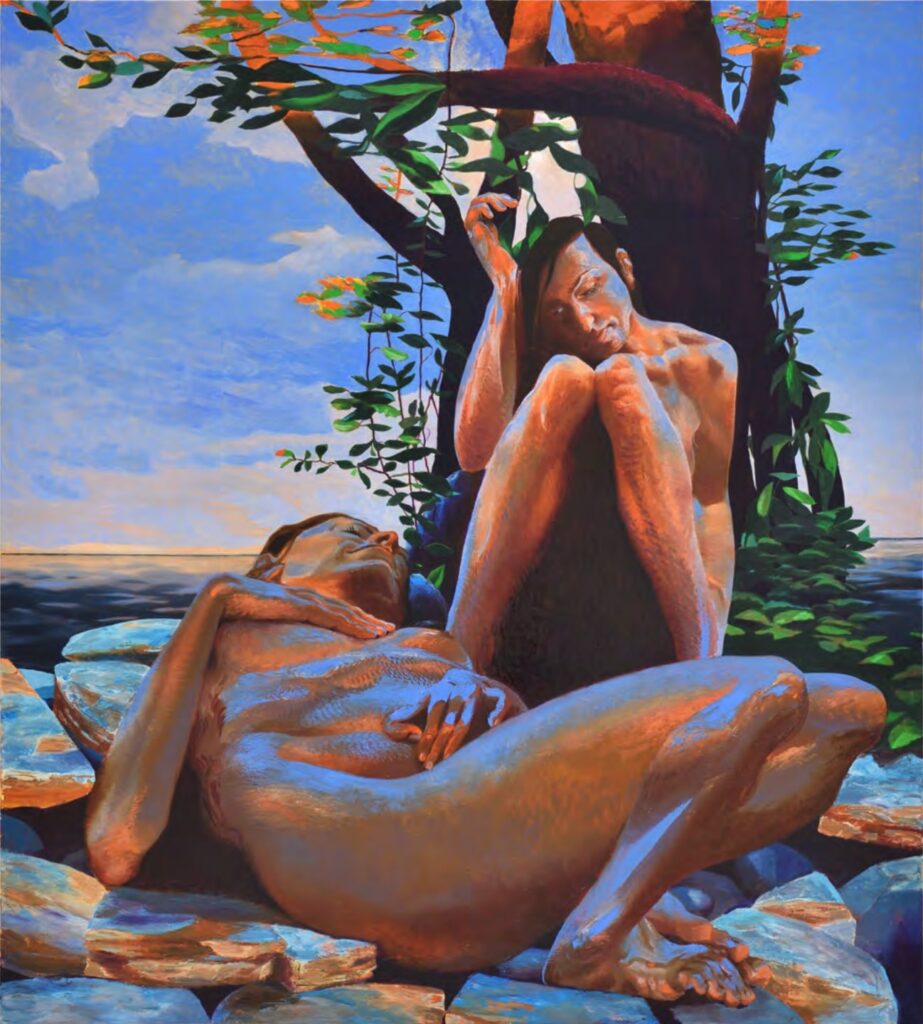
With that in mind… Your current show at Semiose Gallery, is titled The Nature Poem. Where does that come from?
Laurent Proux: From Richard Brautigan. The word “poem” in Greek means fabrication, something made. Nature, on the other hand, is what grows without us. Together they form a paradox: creation without fabrication. That’s exactly the gap I’m interested in — between art and nature, between what is made and what simply exists.
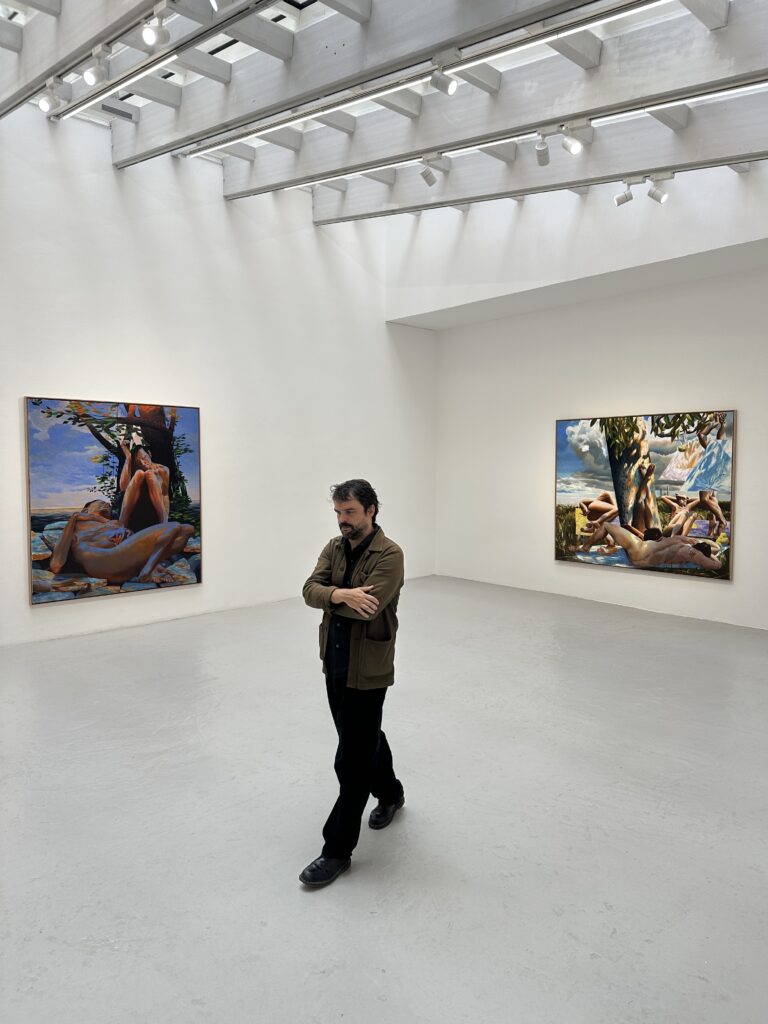
Light seems to play a crucial role in works like in Sunburn (2023) and The Nature Poem (2025) exhibitions. How do you think about light—as atmosphere, as metaphor, or as a structuring device in your compositions?
Laurent Proux: In Sunburn, the light functions as a Director on the stage, and the figures the garnish, the food of the sun. For The Nature Poem, I wanted to have a softer light, like the blue tone in To the night (2025) or the fallen light in the tryptic painting (The Nature Poem, 2025). I wanted to give to the elements depicted in the painting a more physical presence. Most of the time, the sun is not only a device, but also a character.
So, with what we just talked about, what are you hoping to convey?
Laurent Proux: That the reality is still existing and that we can experience with it. That tiny things as to be carefully carried with a lot of attention. If you think about a painting, even the best painting in the world is made from little, tiny gestures.
Outside of art, what’s something you’re obsessed with right now—maybe a hobby, a show, or even a food—that keeps you grounded or inspired?
Laurent Proux: I’m a boring person. I read old books, I return to the studio. But recently I discovered something new: I went cycling along the Danube, from Vienna to Hungary. I was sure I’d hate it, but it was beautiful — the slowness, the rhythm, the sense of floating speed. It showed me another way of being in the world. Sometimes you need that — another rhythm, outside of painting.
Ok Laurent, now to something totally different. In a parallel universe who would you be? and what would you be doing?
Laurent Proux: I’d be rain. Just to experience something totally different, to live in another kind of body, another kind of perception.
What qualities do you find most important in the people you choose to spend time with?
Laurent Proux: Attention, and fantasy. Attention because it’s rare — to truly listen, to care. Fantasy because I admire people who can invent something bizarre or unexpected in the moment. I don’t have that quality myself, so I value it in others.
Anybody you look up to?
Laurent Proux: Kerry James Marshall.
What motivates you?
Laurent Proux: Love.
How would you describe a perfect day?
Laurent Proux: A day of painting.
Alright Laurent, I always ask these two questions at the end of an interview. The first is. What’s your favourite movie(s) and why?
Laurent Proux: The Deer Hunter by Michael Cimino. It still makes me cry. It’s brutal and tender at once, which is how I see painting too.
The second is. What song(s) are you currently listening to the most right now?
Laurent Proux: Bernard Parmegiani’s De Natura Sonorum. It’s the music that opens The Shining. I often paint with it playing. Oil paint smells, the studio is messy, but then the sound comes, vibrating, convulsive, and it aligns everything.