
Share this
Photo: Max Avdeev.
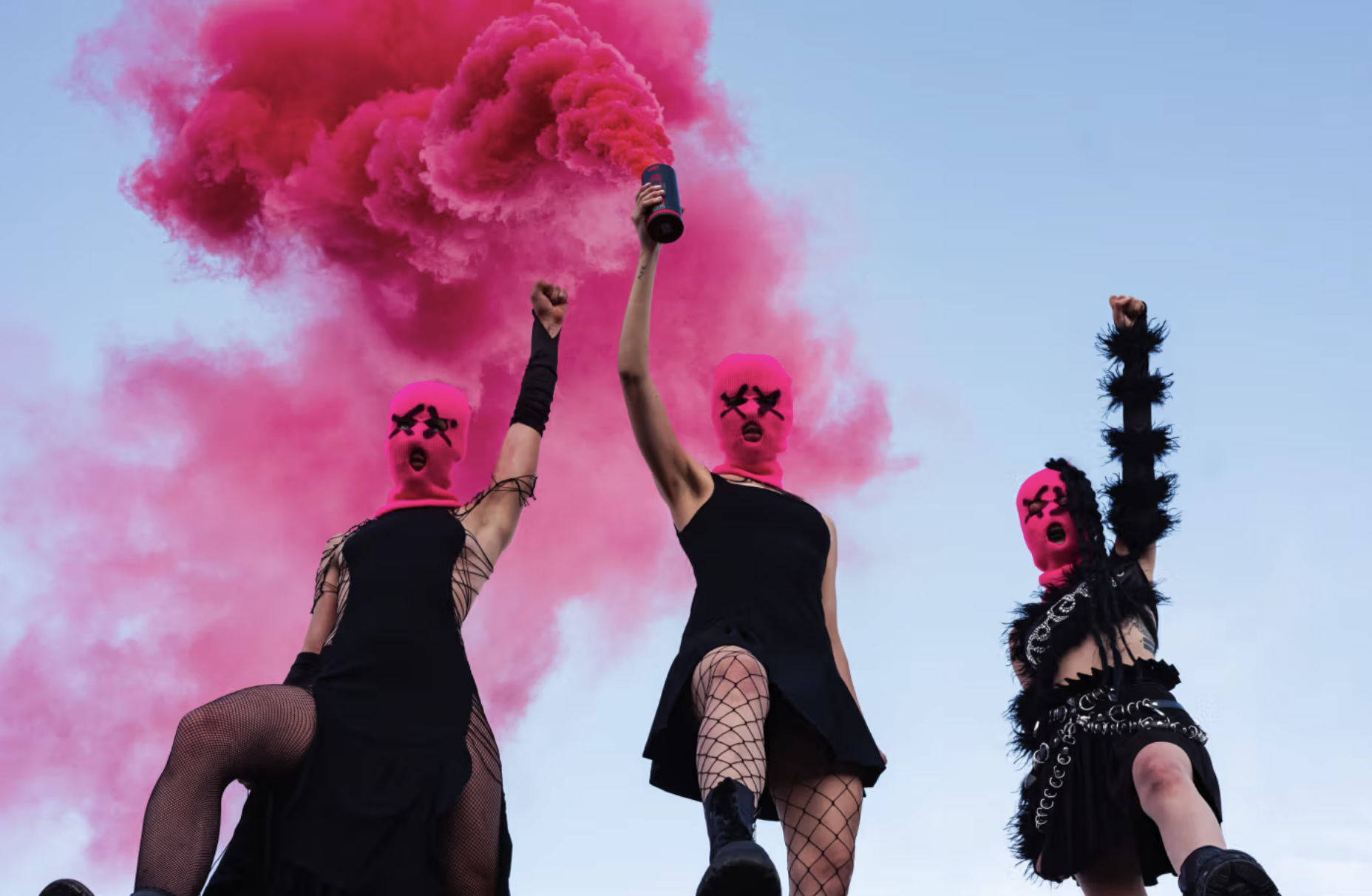
Pussy Riot has always existed in the space where art, protest, and provocation collide. Now, that space has been legally erased inside Russia. A Moscow court has officially designated the feminist punk collective an “extremist organisation,” a ruling that effectively bans Pussy Riot from operating in the country and criminalises any association with the group.
The decision, pushed through by Russia’s Prosecutor General and approved by the Tverskoy District Court, marks one of the most severe escalations yet in the Kremlin’s ongoing crackdown on dissent. Under Russia’s extremism laws, the designation doesn’t just target Pussy Riot as a band — it places members, collaborators, supporters, and even symbolic references at legal risk. In practice, this means that sharing their music, wearing their imagery, or expressing support online could be treated as a criminal act.
Pussy Riot first came to international attention in 2012, when members staged a now-infamous performance inside Moscow’s Cathedral of Christ the Saviour, criticising Vladimir Putin and the Russian Orthodox Church. That moment — part performance art, part political confrontation — cemented the group’s status as both cultural agitators and public enemies of the state. What followed were prison sentences, global headlines, and the birth of Pussy Riot as a symbol of artistic resistance.
More than a decade later, the Russian state is still responding — not with rebuttal, but with erasure. The extremist label arrives amid a wave of politically motivated prosecutions linked to anti-war speech, feminist activism, and artistic expression, especially since Russia’s full-scale invasion of Ukraine. In recent years, Pussy Riot members have been sentenced in absentia, declared “foreign agents,” and forced into exile.
For founder Nadya Tolokonnikova, who now lives outside Russia, the ruling confirms what Pussy Riot’s work has long suggested: that art remains threatening to authoritarian power. The designation attempts to push the collective out of public life entirely — to make them unmentionable, unsearchable, and untouchable. Even accessing some of their videos online is now criminalised under Russian law, regardless of intent.
The implications stretch beyond Russia’s borders. Extremist classifications can travel through diplomatic and legal channels, meaning the ruling could complicate movement, collaboration, and visibility for Pussy Riot internationally. It’s a reminder that the Russian government’s definition of extremism has expanded to include music, performance, feminism, and dissent itself.
Photo: Max Avdeev.