
Share this
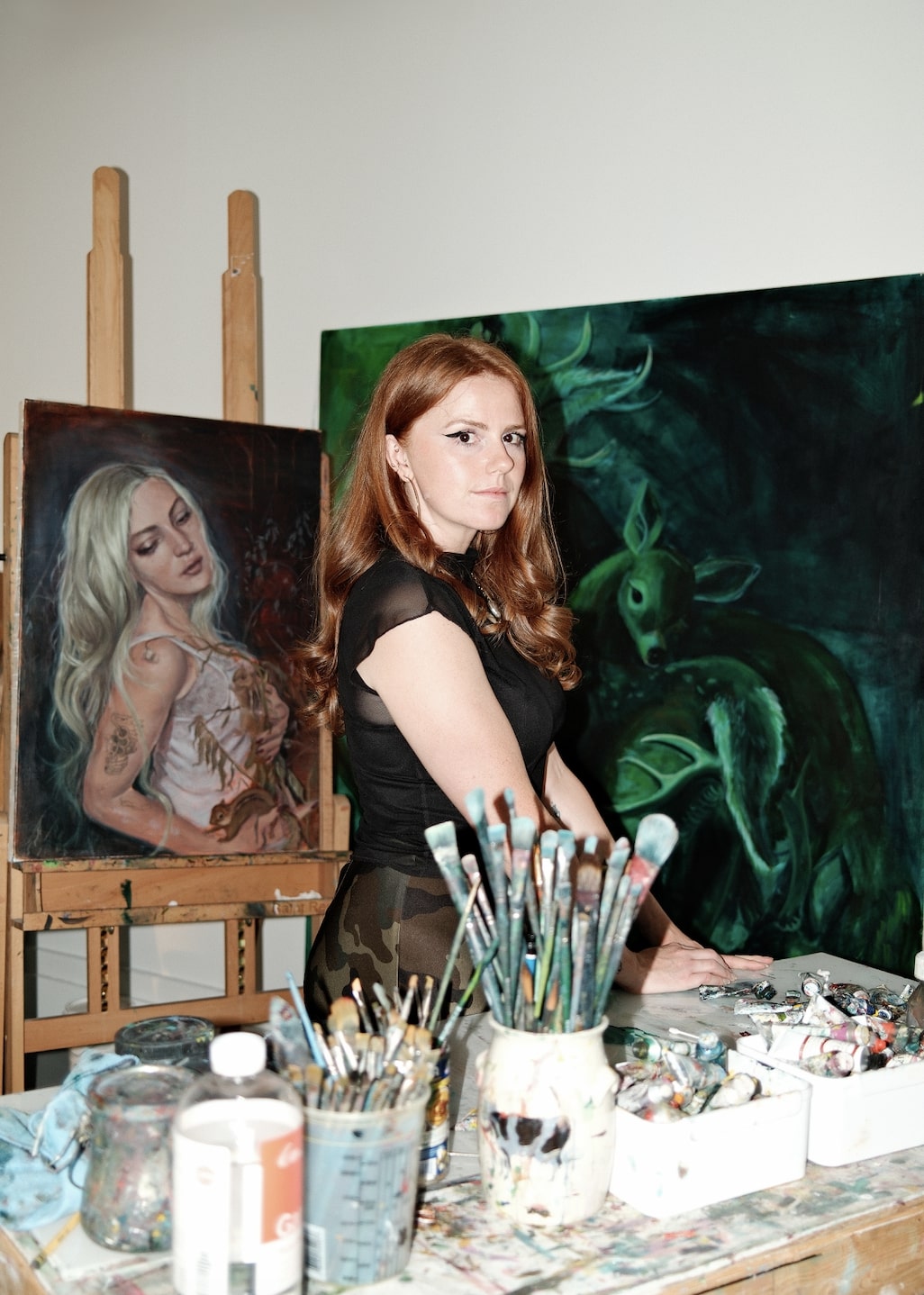
Samantha Joy Groff (b. 1993, Franconia, Pennsylvania) is a Pennsylvania based artist who specializes in figurative painting and film featuring rural women. She received her MFA from Yale School of Art in 2022 and earned a dual undergraduate degree from Parsons School of Design in integrated fashion design and film studies. Exhibitions include Artforum must-see, Prophecy of the End at Nicodim, New York (2024) h; The Ballad of the Children on the Czar, Galeria Nicodim, Bucharest (2024); HUNTRESS, Half Gallery, Los Angeles (2024, solo); Samantha Joy Groff, Devin B. Johnson, Katherina Olschbaur, Nicodim, New York (2023); Dark Pastures, Half Gallery, Los Angeles (2023, solo); Samantha Joy Groff: True Riches, Nicodim Upstairs, Los Angeles (2022, solo); Town Gossip, Martha’s Contemporary, Austin (2022, solo); Stilltsville, Half Gallery, Miami (2022); YOU ME ME YOU curated by Rachel Keller, Nicodim, Los Angeles (2022); and Vibrant Matters, Jeffrey Deitch, New York (2022). Her work is in the permanent collections of Flint Institute of Art, Michigan; Pond Society, Shanghai; and the Longlati Foundation, Hong Kong. Samantha was chosen among the 20 artists for Art In America’s New Talent issue 2024, and named one of 5 Art Phenoms Who Turned 2024 Upside Down by Artnet. Her work is also featured in magazines such as Art In America, Artnet, Fad Magazine, and Document Journal.
For more on Samantha Joy Groff, visit her official website or follow her on Instagram @redneckhotwife.
Profile picture by Veronica Lescalllette
Hi Samantha! It’s a pleasure to sit down with you! First question that I always ask. How does a regular day look like for you in Pennsylvania?
Samantha: A regular day starts with me battling bed inertia with my desire for coffee– I am not a morning person. Once I can’t fend off my fiending for coffee, technically a half-decaf coffee, I get up. I have coffee on the porch and read with my two cats, Pudding and Beans. My neighbors love them and bring them treats. Beans sometimes wanders into an AA meeting at the church next door. I usually go for a walk on a trail by my house. I live by a beautiful creek.
My favorite time to walk is summer during dusk when the sky is light purple, the honeysuckle is pungent in the air, and the fireflies are out. I can guarantee seeing one or eight deer while I am walking. If not a walk, a workout. Not because I am athletic, but because I am naturally wired for sound. I am a live wire, and once the live wire dampens, I am ready for the studio. That energy isn’t helpful in the studio, unless I’m drawing, because it’s too intense for the type of painting I do. Then I head to the studio and grab another decaf coffee; sadly, there isn’t much good coffee around my way. The first hour of work usually involves me taking CBD to calm down and assessing the mess I left from the day before. Without fail, I will spill something, kick something over, or drop something; some days, I do all three.
Then painting happens, or drawing– I could spend 4 hours sketching the groundwork for a painting, completely covered in charcoal, and not be done. Sometimes I talk on the phone or listen to a podcast, but I purposely don’t have internet, and all social media apps are blocked. I’ve stopped listening to music because I get too agitated or picky if I don’t like the song. I work until late, usually midnight, but any later, I start making stupid mistakes. If I don’t work late, I’ll head home or see some friends. My day ends with, of course, some sort of sweet treat. If I am not in the studio, I like to be outside or with my family. I’m from a big, close-knit family, so I feel spoiled. Sometimes we’ll end up at a demolition derby, or this weekend it was a goat cuddling event at a farm to find new models!
I’m curious, growing up, what kind of kid were you? What did you enjoy doing, and how did you spend your time?
Samantha: As a child, I was a bit paradoxical. I was incredibly silly and hyper around people I liked, but shy anytime else. I’d do anything for a laugh, a total clown, yet I always had my nose in a book, which hasn’t changed. I have only brothers, so I spent a lot of time clowning and roughhousing. I loved animals, dancing, and drawing. I would draw these insane, elaborate, fancy poodles I dreamed up wearing jewelry and their fur dyed pink. The poodles would have on high heels and carry designer purses.
I loved going to my uncle’s farm to pet the cows, we called it moo cow street, and it’s something my dad and I still do. As a teen, I was still a paradox but raging with angst and too much caffeine. I was emo, a ballet dancer, and went to heavy metal shows on weekends with my friends. I was extremely self-critical, secretly in honors classes and a compulsive doodler. I was surrounded by chaos and precarity, a hot mess, so now I give my younger self grace. I am all these things as an adult, but much better at warming up to new people. Waitressing in NYC at 18 helped when my rent depended on being friendly to strangers.
Do you remember approximately at what age your creative side started to show? And when did you start taking being an artist seriously?
Samantha: I was always creative, started dancing around 5, and was drawing as long as I can remember. Humor requires creativity, which was always my strong suit. Starting in middle school, I would get awards in public school for my school projects, which was nice to be recognized. You can still see my anime version of Johnny Depp in Pirates of the Caribbean, which I created in seventh grade at my middle school, I think.
Photography was my main artistic outlet as a teen. I went to college for design because it was important to get a job, which I still stand by. I think having experiences outside of just the fine arts track builds experience and perspective. I didn’t take art seriously until my best friend and fellow artist, Nathalie encouraged me to apply to grad school when I was working a corporate job. She believed in my work, and so I took the risk. I didn’t have studio practice until I was 27. I would occasionally paint as a hobby, so once in graduate school, it became a lot of learning on the job. I’ve been catching up ever since, but it’s never too late to start.
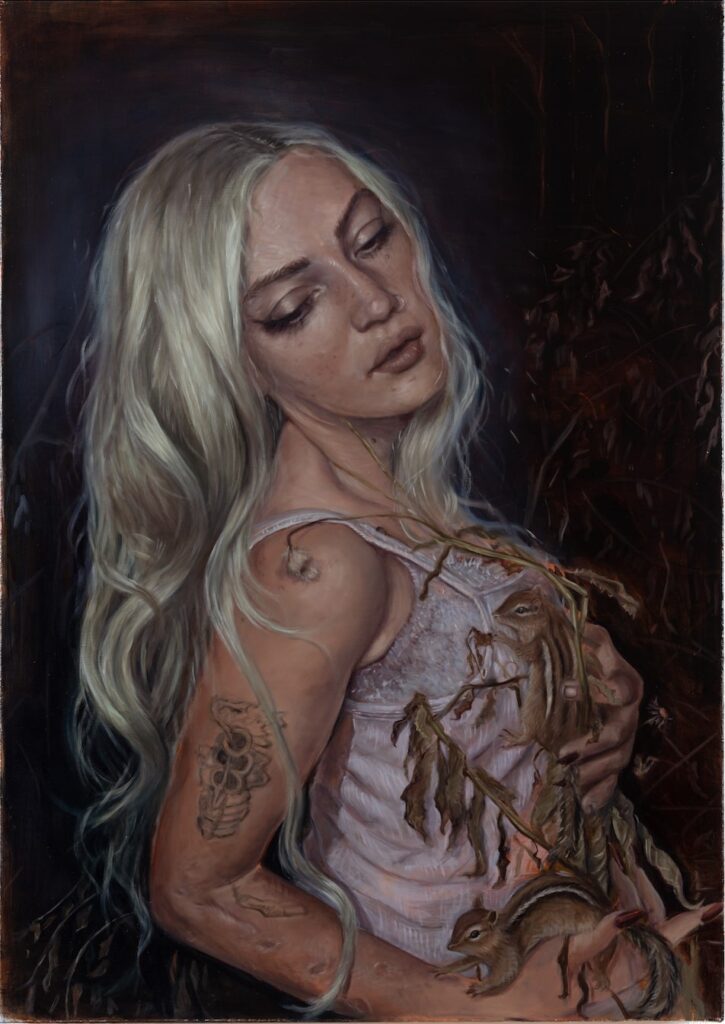
Ok Samantha, with these next series of questions, I will try to delve into your work as best as possible. So…. Your work often explores rural female life and Christian mysticism. How has your Mennonite upbringing shaped your artistic voice?
Samantha: In terms of Mennonite, I grew up on the line of being an outsider of a small religious group, yet still an insider compared to normal people’s standards. Since my family is Mennonite, I grew up culturally but not strictly in the religious tradition. It shaped the culture of where I grew up, similar to how Utah culture is influenced by Mormonism.
They bought all the liquor licenses in my town to prevent bars from opening, and they also prohibited big corporate chains from entering, which is punk rock by today’s standards. My grandma covered her hair and took me to quilt circles, and my cousin’s dress was plain. It’s such a rich heritage, but the art is mainly focused on craft. I am inspired by the symbolism that animals and flowers take on in their quilt making, hex signs and Fraktur which is a type of illuminated manuscript. Growing up, the culture slowly eroded as globalization, technology, and certain ways of life quickly died out with the elders, without much protest. It’s the backdrop of all my work, so there is tension between faith and worldly desires that I work out through figure paintings.
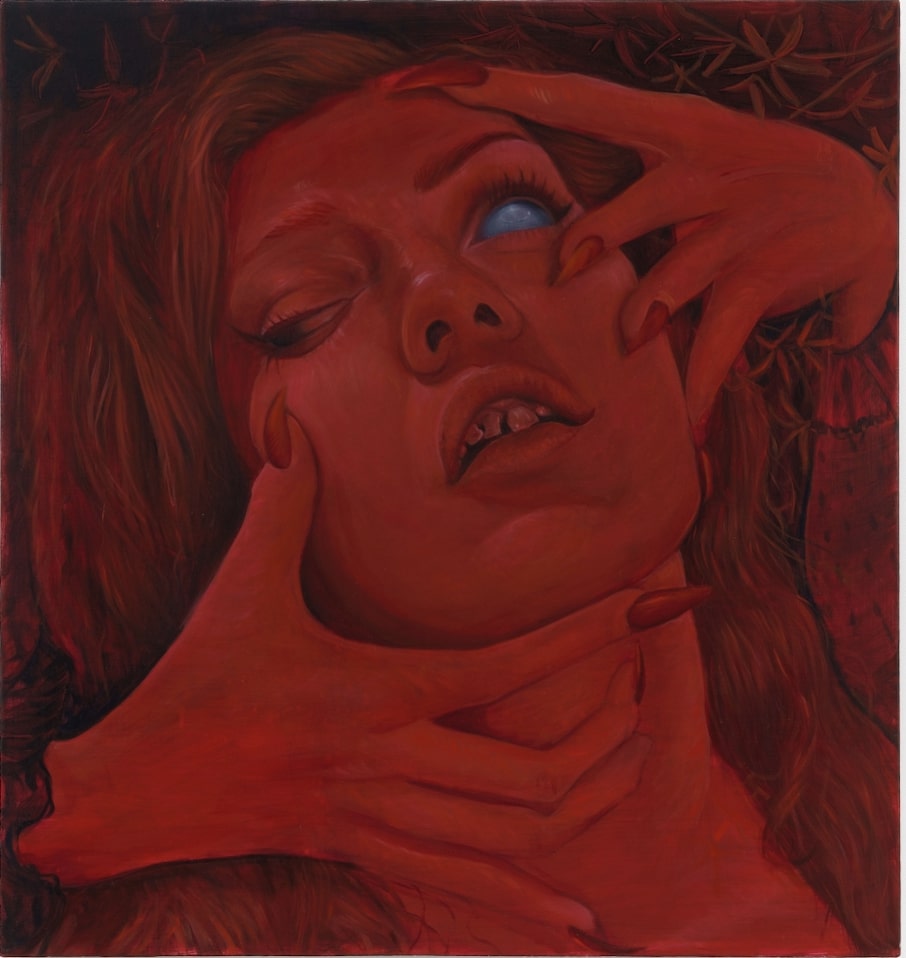
There is a lot of suspicion surrounding worldly things in Mennonite religion. The church decides as a group what should be allowed (phones, internet, dress, etc.), which I feel instilled a healthy amount of suspicion of modernity in my own life. There is an inherent paranoia in my paintings. It’s also a stoic group of people, pacifics and very kind but there is little emotional expression outward. If you know me, I have a similar demeanor. I think that helped develop my artistic voice when I couldn’t stop pushing things down; it had to come out somewhere. I’ve channeled it through vivid underpaintings and sensual and somewhat grotesque imagery.
In terms of Christian mysticism, which is separate from my Mennonite upbringing (this is not part of their faith), it’s more of an approach to combining my research with paintings. I’ve been interested for many years in the idea of a direct experience with God, and even took some theological classes in grad school on the topic. Think St. Teresa Ávila, and John of the Cross. This desire for direct contact and how to express that desire through painting intrigued me. I created the constraints of my everyday life, a rural female existence, instead of a holy person.
I am exploring themes of otherworldly experiences in theconfines of my reality. What’s it feel like to be in empty fields at night, to stumble on strange things? Some of my paintings try to emulate the idea of rapture or religious experiences of ecstasy. I was heavily inspired by the work of William Blake. The witnesses in my work are the animals, and the plants surrounded the women, again, not the typical witness. Although it is said there is nothing you can do to evoke a divine experience, these paintings are experiments in the what if.
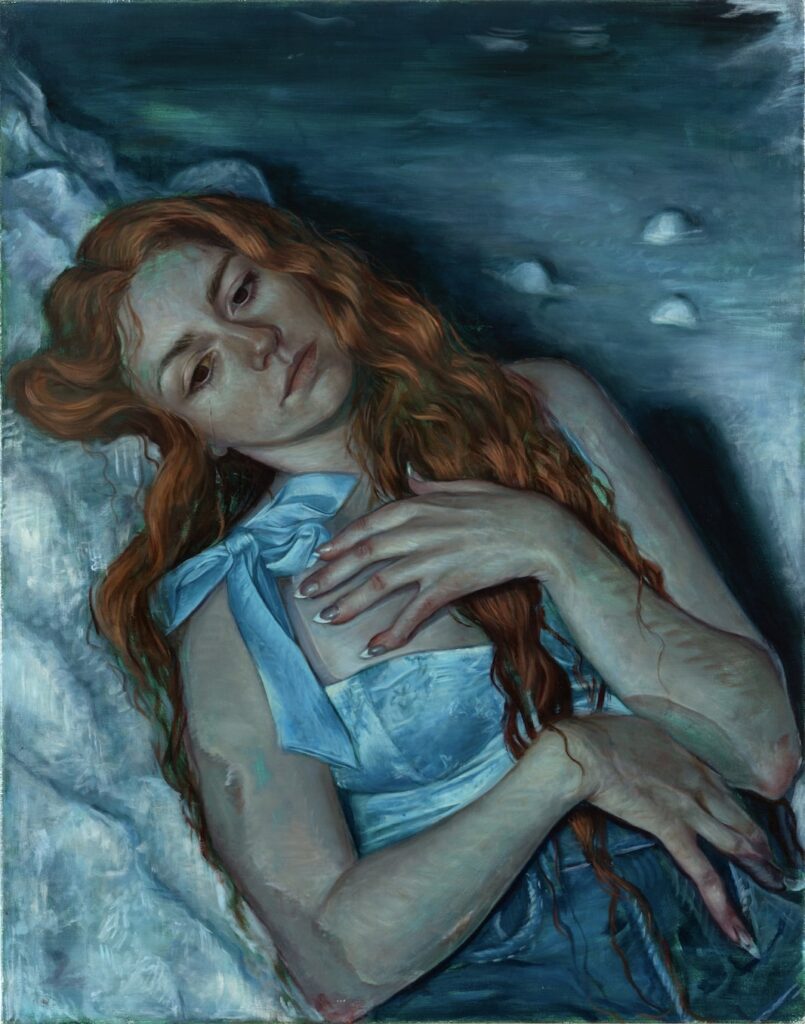
Can you talk about your process of staging and costuming your paintings? How do fashion and film influence your work?
Samantha: Since I studied fashion and film, and also worked in both briefly, both inform my approach to making images. They capture the cinematic quality to my painting practice, especially when it comes to framing. Rather than the typical pastoral landscape, I am choosing a more claustrophobic close-up of the pastoral to evoke discomfort. I am also selecting compositions as if they are frames that feel just before or after the action. A frustrating denial of the full picture.
Another way film influences my work is that it is informed by the personal rather than autobiographical, which remains somewhat mysterious. Film taught me that you have absolute control over every decision, and that building the mise-en-scène for the viewer is crucial. The world I am building through these artworks is constructed through lighting, scenes, and characters that hold a unique quality. Since I spent so much time in my early years making films, it was easy to translate that vision to painting.
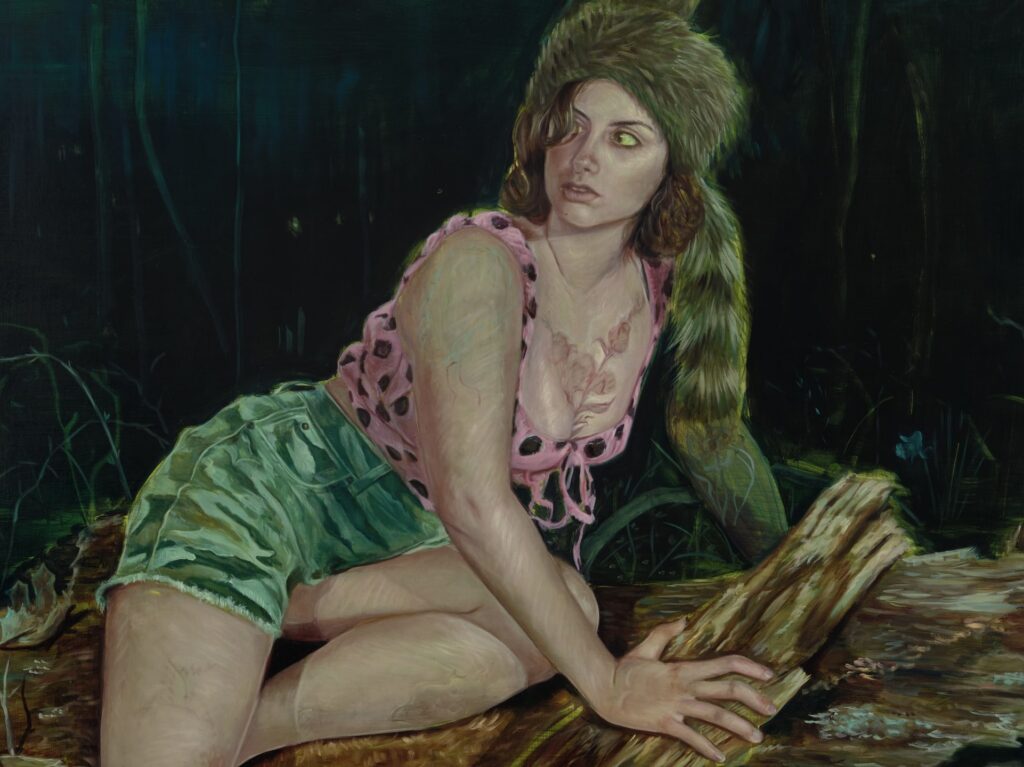
Fashion wasn’t something I was heavily involved in, mainly because I couldn’t afford it, but I do love costuming. I love exaggerating the form that fashion plays with. Fabric and clothes also convey class, and most importantly, uniform. I come from a religion that has a unique notable uniform dress with women who wear prayer caps and plain dresses. I’ve created my uniform within the paintings to establish a through line between subjects and the scenarios they are in. Many of my portraits are influenced by court portraits of wealthy women, in their lavish dress. The clothing choices for my subjects are often the cheap contemporary versions of fancy dress, and they look out of place in the outside exteriors where they are placed.
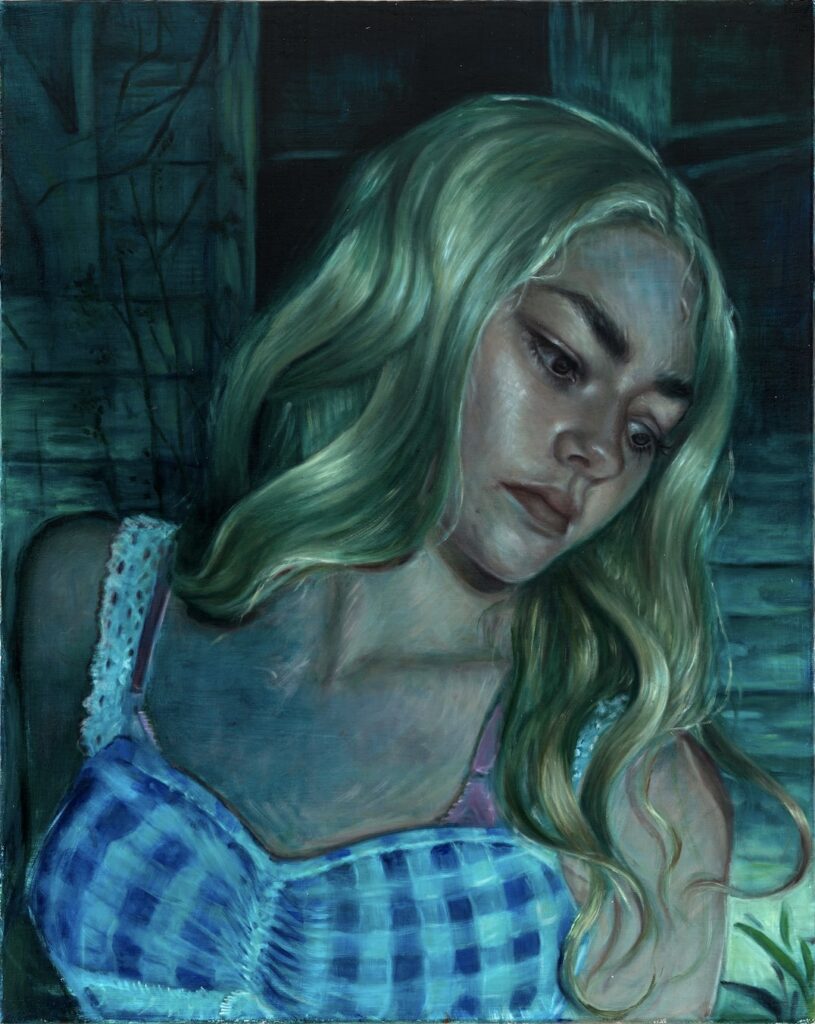
So who are those women?
Samantha: This is a difficult question. Not all the subjects that pose for me are women, but once I start painting them, my ideas of femininity and womanhood are projected onto their bodies. It reminds me of how John Currin says in an interview about his paintings, “They weren’t so much about women as about myself.“ One of my long-time collaborators is a trans masc person who performs and plays with their femininity on our shoots. When we collaborate on shoots, it muddies the water of what gender expectations are present in the painting with exciting results.
Most importantly, it’s rare to see blue-collar women, especially rural women, in the media and popular culture unless it’s negative. It’s my mission to change and complicate that narrative. Because of that, everyone that I shoot with has a personal story we can connect on, which is probably why I am told the paintings feel so emotionally charged. Their hardships are woven in, and can be found in small details.
I’d rather show than tell, and more is to be said about an unresolved feeling than about a painting that tries to explain. I am comfortable with the ambiguity. To label these individuals, they are rural heroines, survivors, former addicts, harm reduction outreach specialists, former Mennonites, current Mennonites, sex workers, antitheists, transmascs, lawyers, dancers, actors, single mothers, sisters, the working class, correctional officers, cousins, neighbors, friends, and everything in between. But once painting subjects, they transform into conduits for a larger emotional experience I am attempting to evoke. What ties it all together is the rural backdrop that I call home.
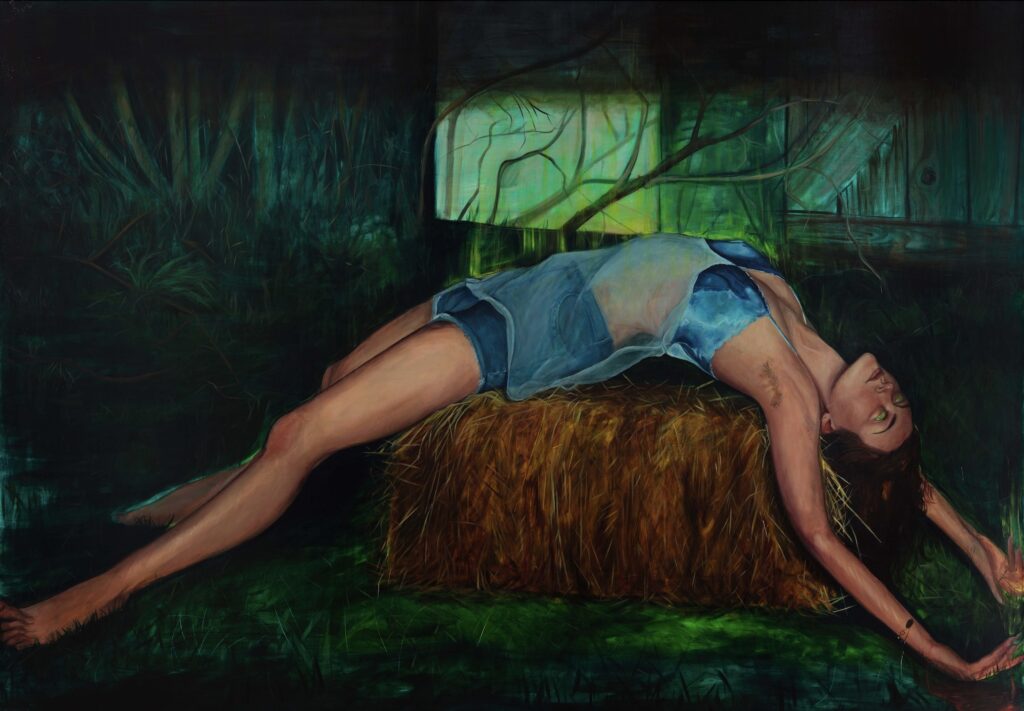
Your figures often appear in unconventional, sometimes uncomfortable poses. What’s the story there?
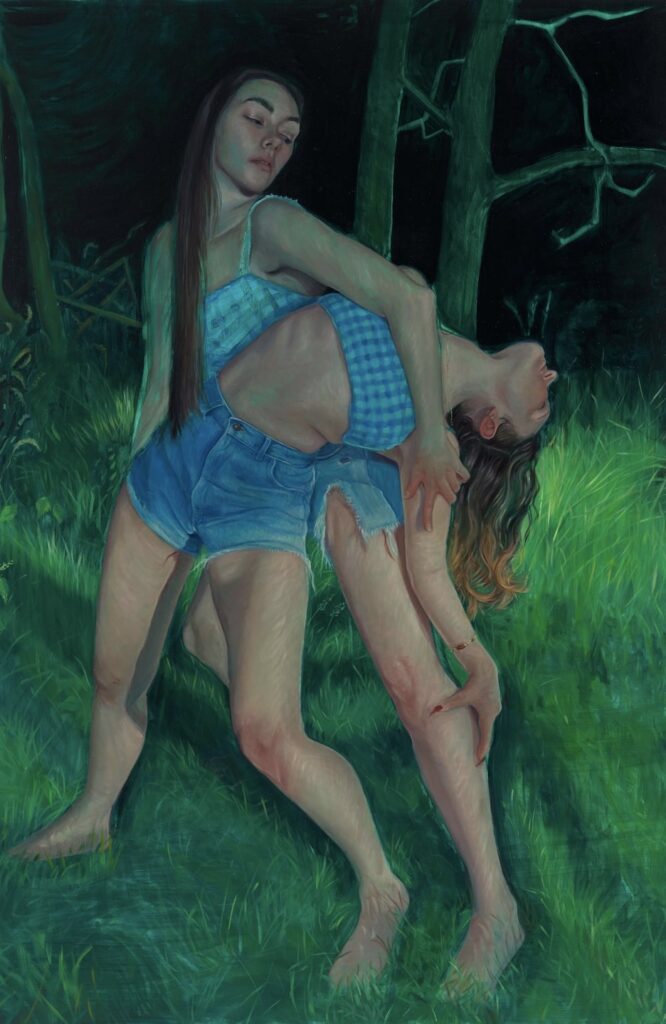
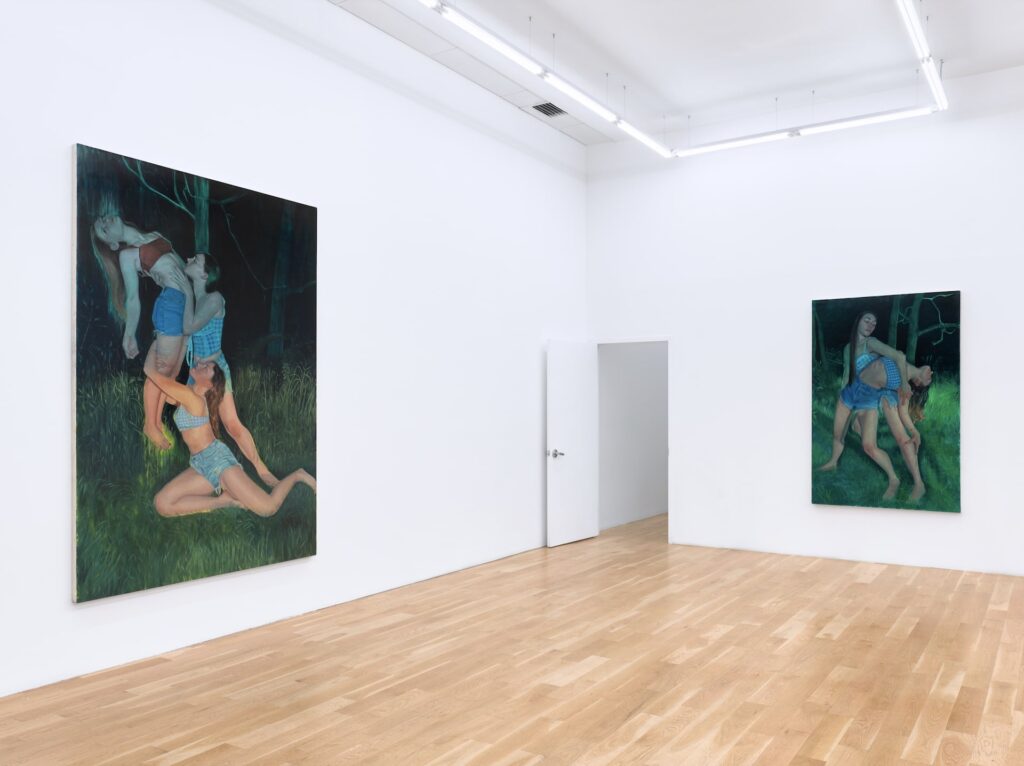
Samantha: I am glad you find the figures uncomfortable; that means they’re coming across as intended. My figures are composed, bent, or breaking to try to trigger the viewer’s bodily discomfort. To push the line between beautiful and grotesque. My goal as an artist is to convey the sense of claustrophobia and unsettle the notion that the pastoral is idyllic. To upset the historical genre of pastoral painting and reveal the psychological discomfort that comes from personal narrative. It lends itself to the idea that when a horse breaks its leg, the humane thing to do is to put it out to pasture. It also speaks to the hierarchy of bodies in the paintings and triangulates the viewer. By viewing these paintings, you almost become a bystander to what’s going on.
Your work deals with themes of power, endurance, and survival. Can you tell me about why those themes are important for you to document?
Samantha: When it comes to depicting the figure, there is no neutral ground; therefore, there is an inherent power structure at play. As the author of these works, the dominatrix in me wants to grab you by the neck and rub your nose in it metaphorically. Make you come down on a level. It’s the antithesis of the royal court paintings I am referencing, or the Renaissance ideals; simply put, it’s not polite.
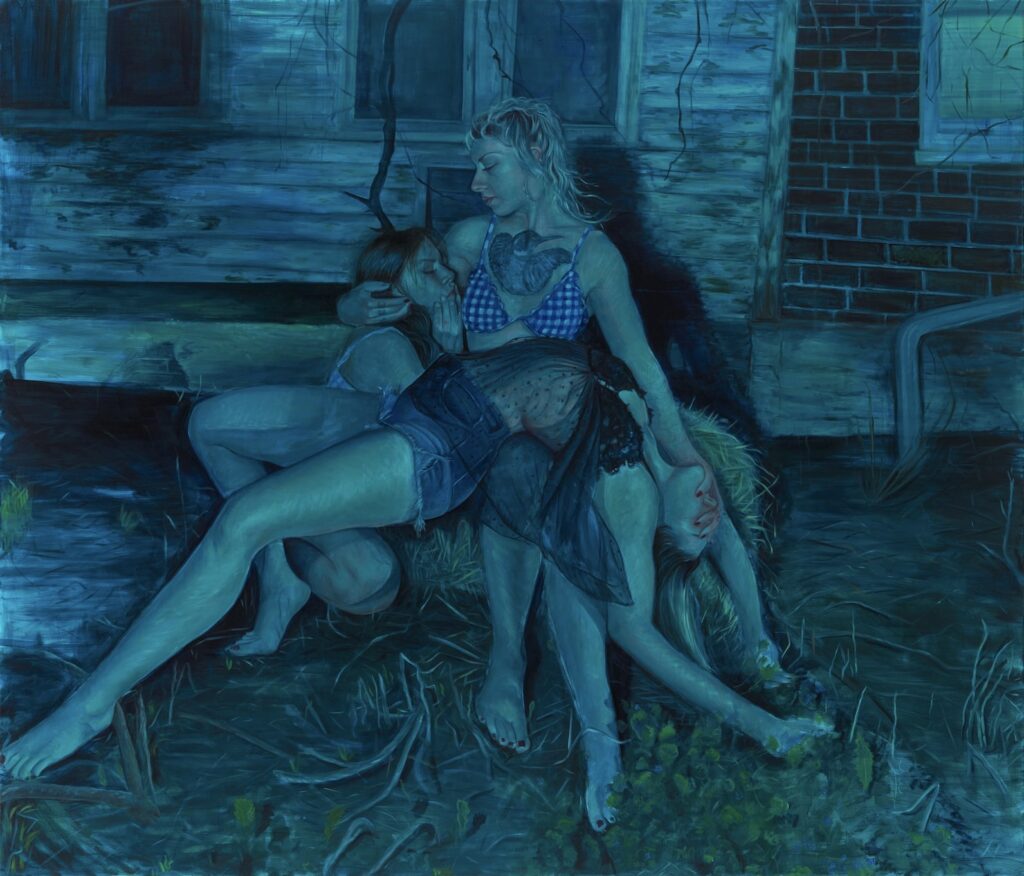
There is a literal endurance I am portraying, as my models endure the elements to create these works, and an idea of withstanding and surviving. It resists the concept of the pastoral, a place of complacency and serenity. The animals, plants, and models are entwined in a knot of competing desires. Sometimes a woman is holding an animal lovingly, which in real life would be dangerous. She is forcing her maternal desire onto that wild animal. Or the animal is a witness to an event on the same level as the humans in the paintings.
I think the lines between predator and prey get muddied, not just between the human subjects but the animals as well. Even the viewer is implicated in that; they seem to be stumbling into an unsettling environment, as voyeurs. I love exploring this theme as a way to endure certain psychological hardships while also participating in them.
Can you walk me through your creative process from beginning to end result?
Samantha: My creative process is overly involved, and I love every minute of it. I start with these strange sketches where the body has no constraints, and I can bend and elongate limbs as needed. Then, once I choose a composition, I figure out the location, which is season-dependent. I hate waiting for the weather to change, but I’m not skilled at inventing exteriors, and I refuse to try AI. Then I coordinate with people who will fit the idea I have, and we meet on a set I create. Shooting references for paintings is crucial. Hay bales, stagnant water, tall grass, snow- I insist on seeing it live. It’s almost like endurance for them,and for my models willingness to withstand the elements I am grateful. I have lights, my camera and tons of clothing, taxidermy and props to make ideas happen. We have to improvise if I’ve drawn the body bent
in unreal ways. Then I get to the studio with the references and draw to scale. Make at least 6 different color studies to see how colors interact before moving to the real canvas. I’ll map out the painting by hand begrudgingly because the mistakes in form make the painting more human and less projector. Then I finally get to painting.
Can you also tell me about your use of symbolism?
Samantha:I think my use of symbolism stems from Barthes’ Mythologies. I am trying to construct meaning through signs to produce an ambiguous feeling for the viewer.
How do you approach color?
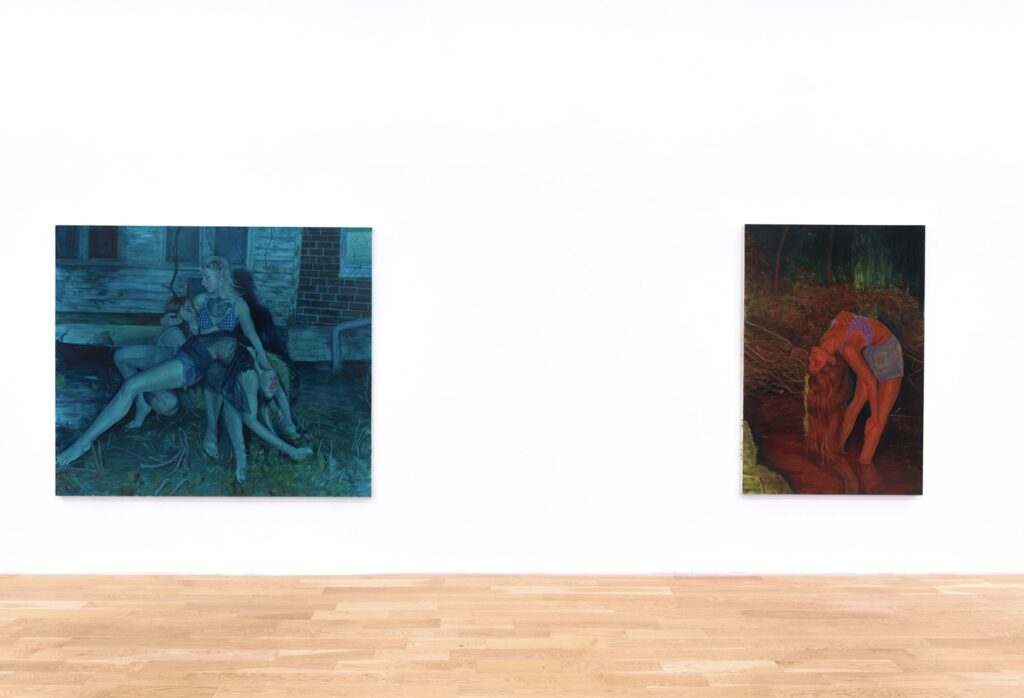
Samantha: I approach color more on instinct than theory. I have very specific colors I gravitate towards, most notably phthalo green, that I use as an underpainting. I swatch out the same painting many times to see how each color can shift the mood of the image on top. Color is really a means to evoke. I am working on reigning in color saturation to create a more harmonious palette.
So with what we just talked about, what are you hoping to convey?
Samantha: I hope to evoke a psychologically fractured existence that doesn’t fit neatly into the dominant narrative of rural women presented in popular media. I hope to fight against the ideas of faith that assert a narrow idea of femininity and modesty; the women I feature are often antagonistic and emotionally indulgent. To convey a desire for a religious ecstatic experience through the ritual of painting.
I am attempting to continue in the tradition of regional painting of the pastoral but subverting it with the urgency of the present, particularly through the lens of lived experience. The language of historical painting often romanticizes the working rural body. The rural subject is frequently depicted in the context of their work. My practice asks what would happen if I zoomed in and focused on the psychology of the pastoral with an insider’s gaze. If not rolling corn fields, but close-up on the subject out of their work clothes, not working, and pushing how the world perceives that worker or people from that place in a very generic way.
The pastoral is perhaps idyllic to outsiders or those who engage from a distance, and I wanted to explode that notion from the inside. The work refutes the pastoral as idyllic nature and presents it as disturbing and sublime. By subverting the rural landscape while still featuring the female subjects that inhabit it, I am peeling back on a much more emotionally charged existence. The pastoral of my grandmother’s generation and the farm she grew up on is gone. The contemporary rural is corporate farms squeezing family farms, mono-crops and Monsanto, harmful pesticides– far from the bucolic scenes of paintings past. This artifice and tension I engage in working through the lens of personal narrative.
Outside of art, what’s something you’re obsessed with right now—maybe a hobby, a show, or even a food—that keeps you grounded or inspired?
Samantha: Opal App- I am an Opal evangelist. Block those parasitic, time-sucking, soulless social media apps, and get your life back. Your art and life deserve your full attention. I even block Safari in the studio.The perfect Oatmilk Latte- I am always on the prowl for the perfect coffee, and it’s my quest anytime I travel. By far the best is from Dark Heart Coffee in Loveland, CO. Brett Easton Ellis – I get on writer kicks, right now it’s Brett. I’ve been reading and rereading all his books since I learned about his background and time at Bennington College with Donna Tartt. He captured a time, place, and social class so completely with a minimalist confidence that is inspiring in my work. How much do you need to reveal in order to capture a place or feeling?
Bunny Yeager– an absolute dreamboat of American Cheese! I love pin-up photography, but Bunny has the unique experience of both sides of the camera as model and photographer. You can tell her subjects are particularly comfortable with her as a female photographer, and the result is a relaxed, joyful glamour. It’s a great reminder to myself when I am trying to capture my subjects in their glory.
Ok Samantha, now to something totally different. In a parallel universe, who would you be? and what would you be doing?
Samantha: In another universe, I would be a Vegas showgirl or a trashy personal injury lawyer. I love the glamour and theatrics of both. Two iconic figures of Americana. So maybe both. After retiring from my showgirl career, I’d pass the bar and have one of those tacky billboards on the highway. I’ve been told I would have made a great lawyer. I’d have an incredible ranch outside of Las Vegas, with lots of rescue animals and foster kids.
What qualities do you find most important in the people you choose to spend time with?
Samantha: They must be DTC – Down to Clown. If you aren’t laughing and willing to make an ass out of yourself, I can’t relate. I like to be around people who have strong values, are honest and have high agency. So we can help each other on the journey called life. I think we underestimate how much people can be energy vampires. As a former codependent, I am trying to unlearn that. I also love it when people think outside the box. Not a lot of my friends are artists; they’re more bookish than creative. I am obviously kind of out there, so we don’t have to agree, and honestly, I learn so much from others who don’t share my same outlook. I think we forget that sometimes. I love hearing about the rabbit hole of research you went down.
What motivates you?
Samantha: I am like a dog with a bone. I won’t drop it. Once I decide to do something, I get tunnel vision. My art practice feels vulnerable and imperfect; therefore, I haven’t said all I can say with painting. I have that Protestant work ethic instilled in me. I’ve been called to do something, some call it a vocation. That lights a fire under my ass. Even if it’s unpopular, I can’t dilute the message because in other avenues of my life, I’ve tried that and it feels inauthentic. I’m in the pursuit of excellence, and I have yet to master my craft. I am also inspired by learning and other people’s ideas. My curiosity helps, like when I read something or see a great painting, it’s not enough. I will nose out how they did that, or the why, because it moved me. So basically, I am obsessive. It’s a blessing and a curse since I frequently get analysis paralysis. I live in my head. I have to move my body to get out of it —walking, running, biking, or roller skating to get momentum back.How would you describe a perfect day? It’s Easter, my favorite day of the year.
Alright Samantha, I always ask these two questions at the end of an interview. The first is. What’s your favorite movie(s) and why?
Samantha: The Holy Mountain by Jodorowsky. Not only is it visually stunning, but it is also an absolute testament to his vision. It’s based on the Ascent of Mount Carmel (IYKYK) which is something my work also tries to connect with. It weaves religious mysticism with narrative. I love his quote, “‘I never seek money. I make films to lose money. “I love that idea because it feels like indulging in your vision, giving it all to create something.
That’s probably why my process is so elaborate, I’m frugal in every other aspect of my life except when making. Twin Peaks, David Lynch. It’s a TV show, not a movie, yes– but it captures the feeling of something evil or unknown lurking underneath a small town that I keep revisiting. It has symbols that feel only slightly revealed. It’s a complete immersion in Lynch’s world: the story, characters, symbols, and soundtrack. David Lynch’s filmography and book shaped my artistic voice as a young artist, to the point that I once was in a David Lynch inspired art show in college during his painting exhibition in Philadelphia.
The second is. What song(s) are you currently listening to the most right now
Samantha: For Whom the Bell Tolls– Metallica. This is my spirit song, not the lyrics per se, but the level of intensity. Copperhead Road- Steve Earl I’m Gonna Hurt Her on the Radio – David Allan Coe – I love a petty man. Waymore’s Blues ft. John Anderson – Waylon Jennings (It has to be the live version!)d