
Share this
Ho-sa Wang is a Taiwanese artist based in London. He recently graduated from the Slade School of Fine Art, where he became well known amongst his peers and lecturers for his intense dedication and work ethic. Regularly producing large-scale, physically demanding paintings throughout his time studying at Slade School of Art. His graduation work was recently acquired by the UCL Public Art Collection for the permanent collection.
I have personally known Ho-sa for several years and have always admired his work ethic and dedication. This interview was a chance to understand more about his path, his thinking, and what drives him to paint and make art in the way that he does.
Interview & photographs by: Brynley Odu Davies.
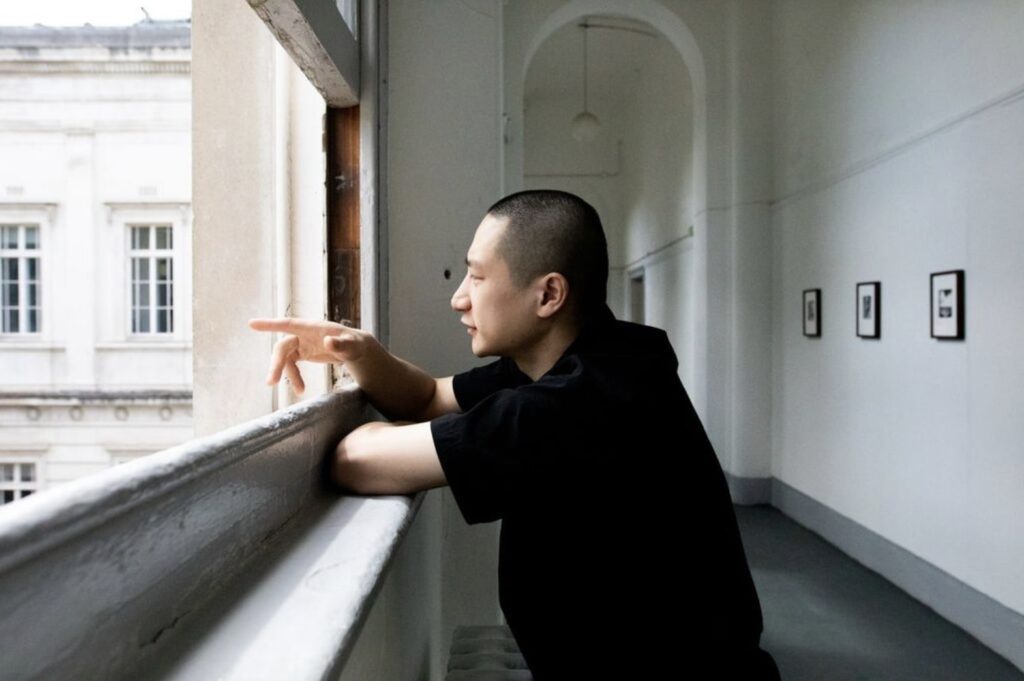
Hi Ho-sa, it’s a pleasure to sit down with you! Let’s jump right into it. What led you to create paintings and art in the way that you do?
Ho-sa: In my bedroom, there is a note listing the categories of what algorithms do: prioritisation, classification, association and filtering. I often feel that my approach to making both mirrors and resists these processes. I collect, sort and discard information, then I toss it into a blender with intuition.

Can you tell me about what your degree show is about?
Ho-sa: Angus Cook’s text for the Blood of Two exhibition, particularly the reference to metaphysical poetry and the idea of ‘yoking’ disparate elements together, is the starting point. The notion of ‘yoking’ encouraged me to start pairing or yoking ideas that relate to my interest in extremity, limitation and the opposition.
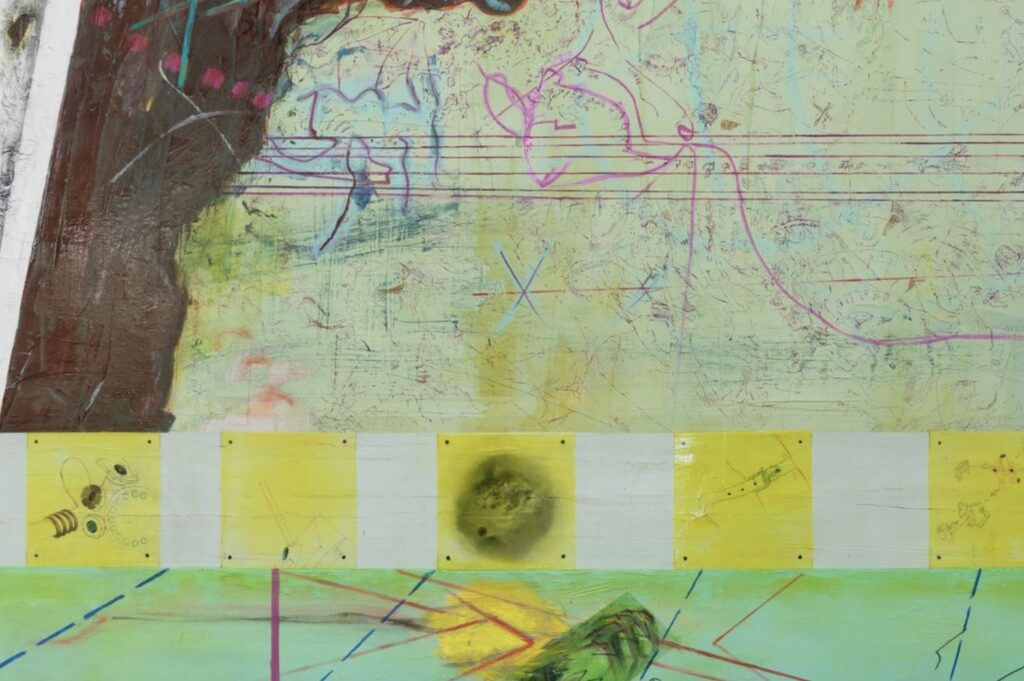
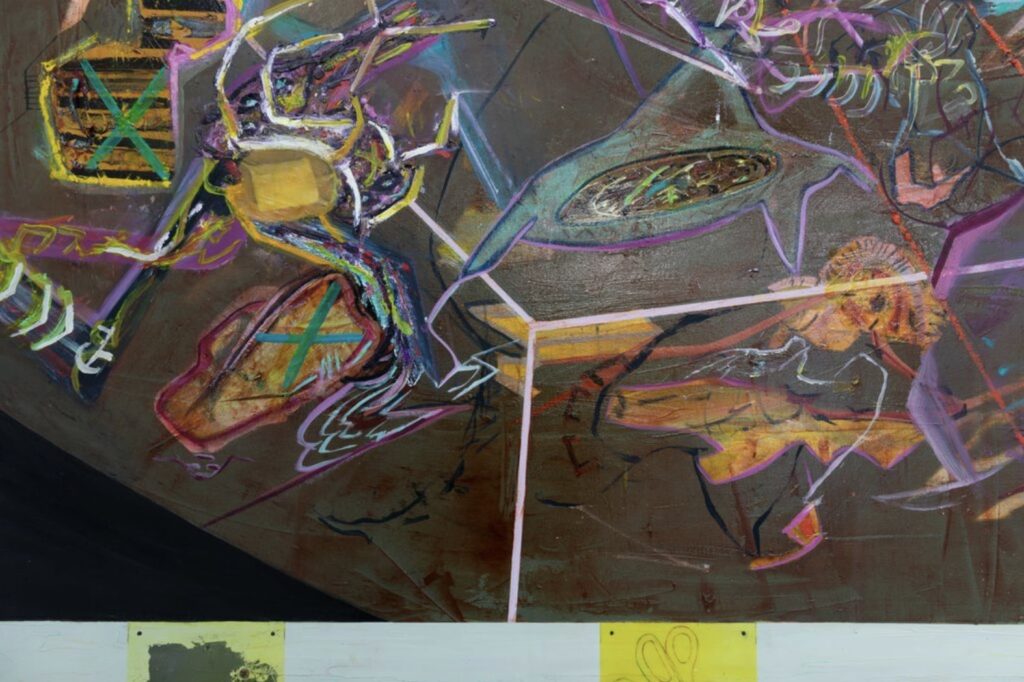
I suppose the paintings in the show follow the concept of ‘transitive painting’, which involves an effort to incorporate social networks via internal and external passage into painting as an object. In terms of internal passage, forces such as torque and peripheral impact are not merely depicted, but act as a driving force on my thinking and the way I apply paint. At a certain stage of the painting L-135, I attempted to measure the ‘angles’ between certain words or meanings associated with these forces. The impossibility of this task resulted in an accumulation rather than a narrative—like the mixer at the back of a concrete truck rotating endlessly or recalling Voyager 1 & 2’s ‘Golden Record’; however, not meant for extraterrestrial communication, instead functioning as an index of the painting’s internal logics.
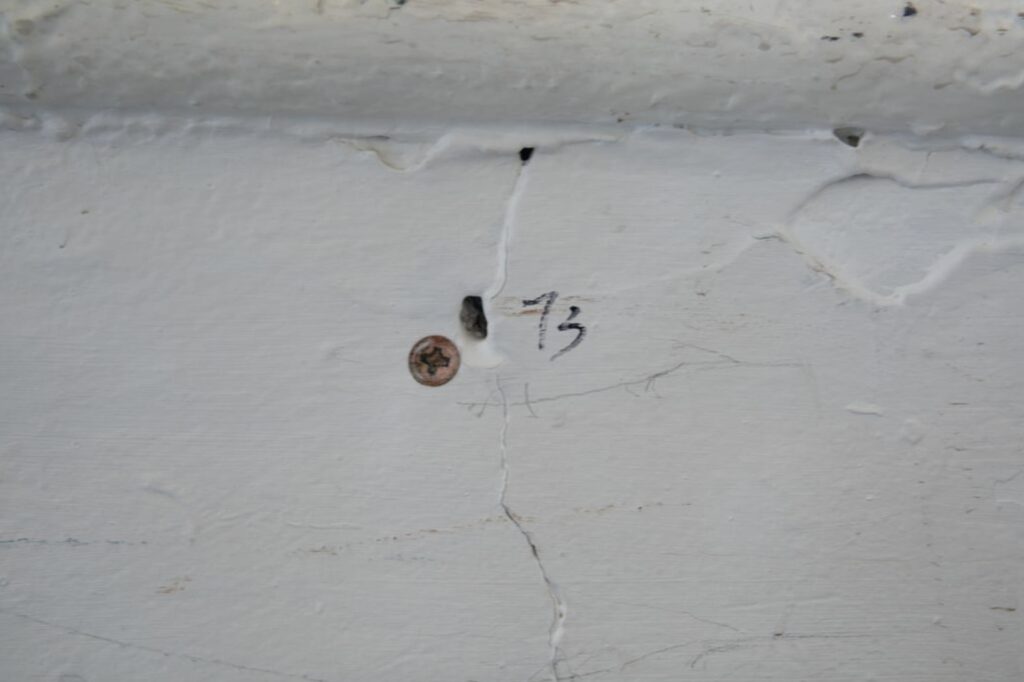
Externally, there is attempt to integrate the work’s relation to space, location in space and the digital network. The two-channel video L-135 (Video)—adjacent to and embedded within the painting—presents a sequence of 199 photographs of holes found in the building, with each hole’s measured location visualised through a synchronised moving diagram using the painting’s colour palette. Similarly, the tilted line of the wedge-like painting L-3 (Wedge), alongside the two digital screens, anchors the viewer and the paintings to the work’s place of origin, claiming a piece of the building’s wall as an additional layer of the paintings.
The circular monitor embedded within the painting—a glowing gyroscope—serves as a little reminder of how unstable we are in space. In reverse, elements of the painting—often painted screws— are photographed and reproduced as stickers, then placed around the building, mostly beside the holes as a kind of exchange. I believe there is a lot more to discover when you see the show. I’ve always tried to leave a sense of trickery in my work; perhaps what I’ve described here is more of a piece of shredded tissue left in the trousers after a spin cycle in the washing machine – a consequence of centrifugal force rather than a driving premise.

Your paintings require many hours of focused work. How do you stay motivated during those long sessions?
Ho-sa: I can only focus on one work at a time, and there is always something new emerging from it. The curiosity and the excitement of experimenting without the fear of failure motivate me. Often, there is a stage of total destruction, where I change the entire colour palette or even the concept. There’s a quote I keep returning to: ‘who will ever know what it is to know nothing’. I think my response to it—the mindset of creating something no one (including its creator) can access—calms me down and keeps me going.

Having lived in Taiwan, China, Germany, and now London, how have these different places influenced your art or outlook?
Ho-sa: There are many gaps between these places, contradictions and questions that may never be resolved. I suppose this experience constantly reminds me to consider the opposite, or what could be reversed or subverted.

What do you spend your time researching when you’re not in the studio?
Ho-sa: An artist should remain curious about the world; however, I think it is equally crucial to know where not to invest time and energy. My interests tend to gravitate towards science and sports, likely due to my early focus on these fields. This year I’ve been learning more about metrology, the science of measurement, and for a period, I was looking into certain mechanical components related to my interest in rotational force.
I also found myself repeatedly drawn to the gambler’s ruin theory, a mathematical model that demonstrates how greed inevitably leads to total loss, and to the quote by Kusyszyn: ‘During gambling, money loses its economic value’, which captures the distorted link between casino chip value and real-world value.
In many ways, I see parallels between these ideas and art—particularly in how they shape, distort and reframe our perception and understanding of the world.
As you’ve graduated from Slade, what are you most excited about for your future
Ho-sa: There is a gap between learning using my mother tongue and my art education in the UK. The longer I live with it, the more control I gain over how much I sift, and I am excited about it.
What do you like to listen to when you’re working?
Ho-sa: I find it a bit distracting to listen to music when I need to concentrate. However, there was a time when I really enjoyed playing some of Ludwig Göransson’s soundtracks from the film Tenet while taking naps in the studio; they helped me fall asleep almost instantly.
Ok, last question Ho-sa. What does a typical day look like for you when working on your art in London?
Ho-sa: If I’m not in the studio or library, I’m probably cycling somewhere. I enjoy the freedom a bike offers in a busy city.