

Share this
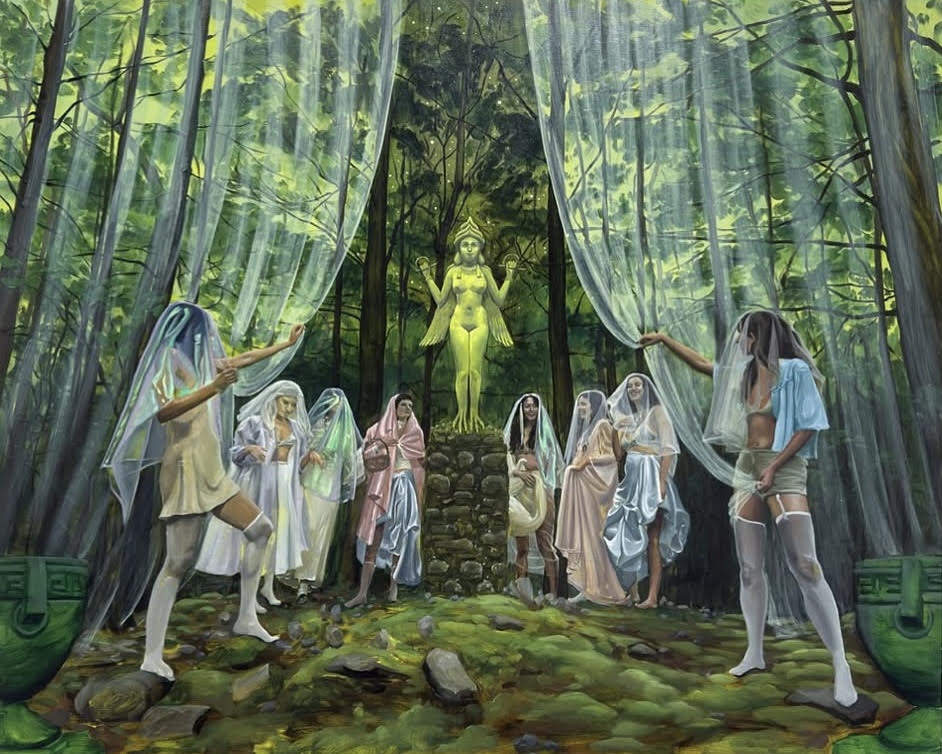
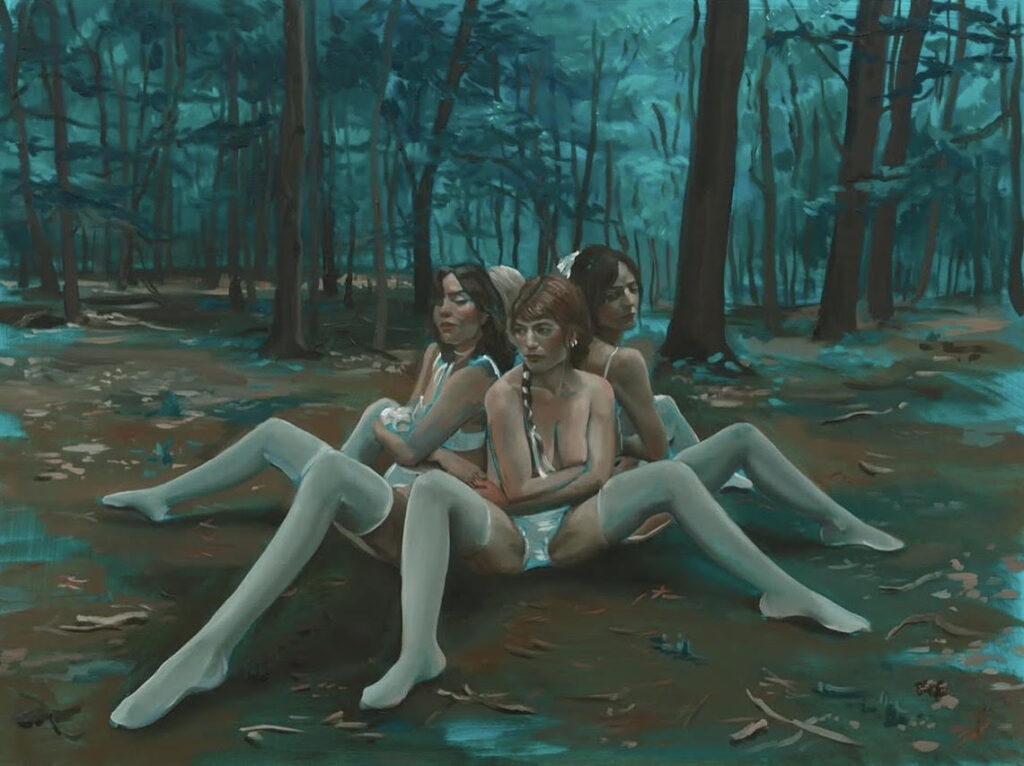
Emily Coan’s paintings exist in a space where femininity refuses simplification. Born in St. Petersburg, Florida, and now based in New York’s Hudson Valley, the artist builds lush, glazed oil paintings that feel at once mythic, intimate, and quietly defiant. Her figures move through fairytale-like worlds charged with ambiguity, desire, and a form of feminine power that resists being softened or dismissed.
Originally trained in sculpture at the University of Florida, where she received her BFA in 2013, Coan later moved to New York City in 2015 to focus on painting. Since then, her work has drawn attention for the way it reclaims subjects so often trivialized or maligned, turning them into something stranger, sharper, and more enduring.
Profile picture by Elizabeth Celeste Ibarra.
Hi Emily! It’s a pleasure to sit down with you! First question that I always ask. How does a regular day look like for you in Hudson Valley?
Emily: Thank you for inviting me! I live a really beautiful life in the Hudson Valley. Often I wake up in the late morning, drink coffee my husband Jake made for me with my cat on my lap, workout, and go to the studio for the afternoon and evening. I have many amazing friends here, so many evenings I spend with people – whether that be dinner, a fantasy book club meeting, a moon ritual, or a ballet class. My husband and I also spend a lot of time together at home.
I am not living this glamorous vision during crunch time when a show is due. In that case, I am a studio goblin never seeing the light of day, crying from stress, insomnia, and shoulder pain, and burrowing in my studio while unintentionally huffing my own paint fumes until I am feral. Altogether, I spend a lot of time alone at the studio and make up for it by enjoying people I love as often as possible.

I’m curious, growing up in Florida, what was life like there? And what kind of kid were you? What did you enjoy doing?
Emily: My childhood was complicated. I was born in Florida, lived in Pennsylvania for 7 years, and when my parents divorced, I moved back to Florida but spent summer and holidays with my dad in Pennsylvania. So my Florida experience wasn’t the whole thing. My life was split and its parts were mutually exclusive.
I was a shy kid who enjoyed sewing and drawing. I wore princess dresses and was obsessed with the Wizard of Oz. Then I became kind of emo, and then I figured out how to become popular, so I did that. High school was fun for me because I got to be popular and captain of the cheerleading team after being a freak for so long. Being a teenager in Florida at that time was so fun – we got out of school at 1pm and would go to the beach or on someone’s boat until I had to be home for dinner at 6. I feel bad for the kids walking around Walmart after school here. That was not my experience.

Do you remember approximately at what age your creative side started to show? And when did you start taking being an artist seriously?
Emily: I was always drawing and making art, but it wasn’t encouraged very much. I never had art lessons. It was just something I always came back to. I actually dressed up as an artist for career day in fourth grade, but I didn’t actually think I could be an artist because I was a girl.
In high school, I began to realize that art was the most important to me. Although very academically inclined (I graduated second in my class), I would switch certain subjects to be able to take more art classes. I began taking it seriously and thinking of myself as an artist my senior year in high school. At college orientation, I was invited to sign up as an art major, and never looked back.
Ok Emily, with these next series of questions, I will try to delve into your work as best as possible. So…. You studied sculpture before moving more fully into painting. Do you still feel like a sculptor when you build a painting?
Emily: To be honest, I never felt like a sculptor. There’s a certain sensibility I felt I always lacked, whether that is true or not. I chose the sculpture program because I liked the professors and was invited, and that turned out to be the right move for me.
In the sculpture program, I was able to learn how to make work conceptually and understand the art world’s recent past. I also took many photography electives. The photography directly enters into my painting work because I stage all of my own reference photos in a filmic type of way. And I bring my knowledge of building out series conceptually from the sculpture training.
Your work often moves inside this fairytale-esque, almost enchanted space. What does fantasy allow you to say that realism perhaps doesn’t?
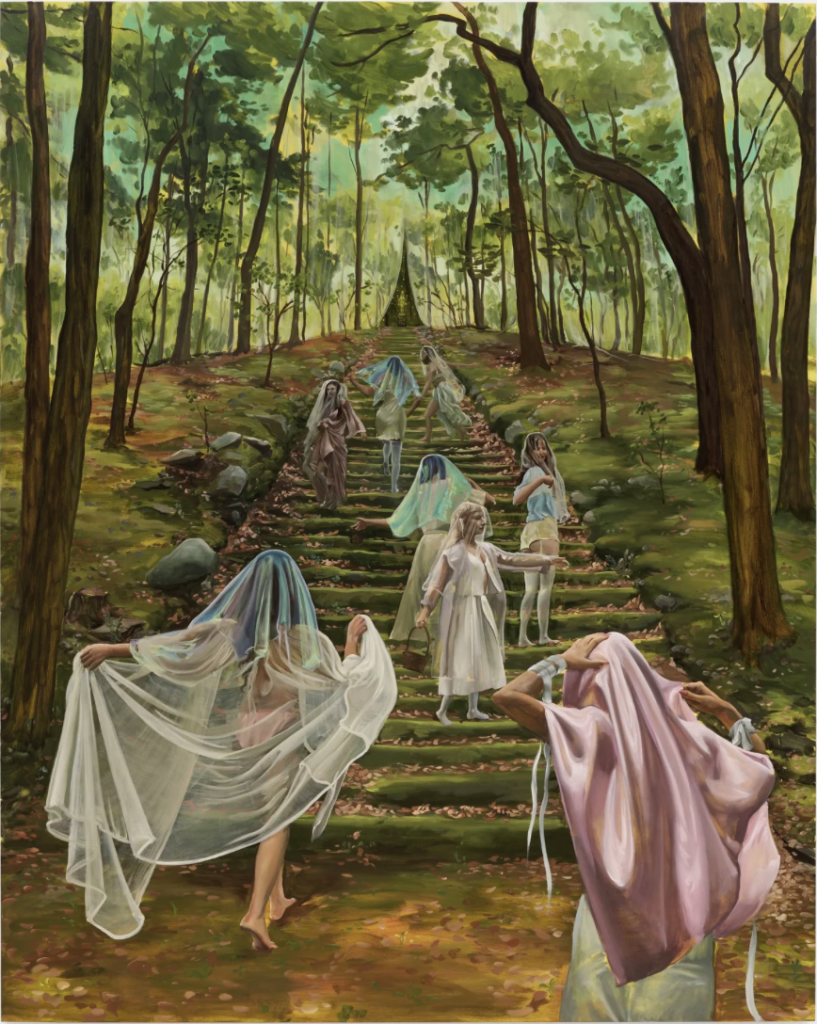
Emily: In my day-to-day life, I’m a very direct communicator which sometimes gets me into trouble. If you work with fantasy, you can be somewhat direct but with a layer or filter over the whole thing. Also, this reality is so dense that fantasy feels more enjoyable, even when it tackles difficult themes.
You return to femininity in a way that feels both loving and confrontational. What first made you want to take on a theme that is so often dismissed or trivialized?
Emily: I remember being so excited to be a girl/woman in this lifetime when I was a child. I literally have memories of feeling like that. I think femininity is wonderful but it has been heartbreaking over and over again to see it trivialized and dismissed in my lifetime. I love this thing, but how it is perceived within the outer world has friction with my embodied experience. That’s fertile ground to explore.
When you think about feminine power, what kind of power are you most interested in: seduction, softness, ritual, endurance, collaboration, threat, transformation?
Emily: I’m genuinely interested in it all, but ultimately I’m most interested in transformation.


There’s often a tension in your work between beauty and something more psychologically charged underneath it. Are you trying to seduce the viewer first, and then complicate that seduction?
Emily: I was trying to do that. Now I’m not. At this point, the seduction lies in luscious application of paint and technical beauty. I feel more comfortable with allowing beauty, and also allowing & claiming this robust undercurrent of power and intensity.
I’m moving away from my “maidenhood” experience and my paintings are following me. I have a lot going on in my private world. I’m moving a lot of energy there and transforming deep down. I used to project that onto my body. Now that I’m older, the new challenge is: how does this translate to who I am now?
Your paintings can feel intimate, but they also seem to operate like allegories. Do you think of your figures as characters, self-fragments, archetypes, or something else entirely?
Emily: On some level I think of them as epic poems in painting form. They are sort of allegorical, but they are very very loose. At first I wrote more detailed and narrative-driven stories for the paintings, but that doesn’t exactly work for this medium. I realized I needed to have a very loose narrative and let there be surprises, and not take things so literally. These are paintings, not written stories, nor even films. The narrative format has to be altered to fit the medium.
What I want to get at is a feeling, or an impulse, on which the viewer can project their own story. Maybe they are like scrying mirrors. Ultimately, everything the viewer sees is about their own perception. My images just set the parameters for that personal viewing experience. I cannot control anything beyond that.


How much of your own biography tends to enter the work, even when the paintings appear fictional or mythic on the surface?
Emily: Everything is inspired by personal experience, even if it is altered in some form on the surface. The personal is also universal.
You’ve spoken through your work about femininity, women’s labor, and protection. Why do garments, surfaces, and adornment seem to carry so much symbolic charge for you?
Emily: I have experienced how adornment and garments alter others’ perception of me and my body. I work in painting which is related to the body and the conjuring of reality onto a flat surface. They just go together for me.
There’s something compelling in the way your work can make traditionally “feminine” things feel powerful rather than decorative. Was that reversal something you had to learn personally too?
Emily: Adornment and beauty were always important to me, ever since I was a little girl. There’s something powerful in things that we are drawn to, even if they are trivialized by society. There’s something about the cultural narrative of women being mere decorations, when in reality I could sense from an early age that they used the decoration to the service of their own will. That is powerful, and that is counter to the narrative I was sold consciously. That schism is interesting to me.
Do you feel you are reclaiming imagery that has historically been used to reduce women, or are you inventing a completely different visual language for femininity?
Emily: I’m not reinventing the wheel, I’m changing the context.
A lot of your recent work seems to imagine feminine energy outside of male approval or male centrality. Was arriving at that space artistically also part of a personal shift for you?
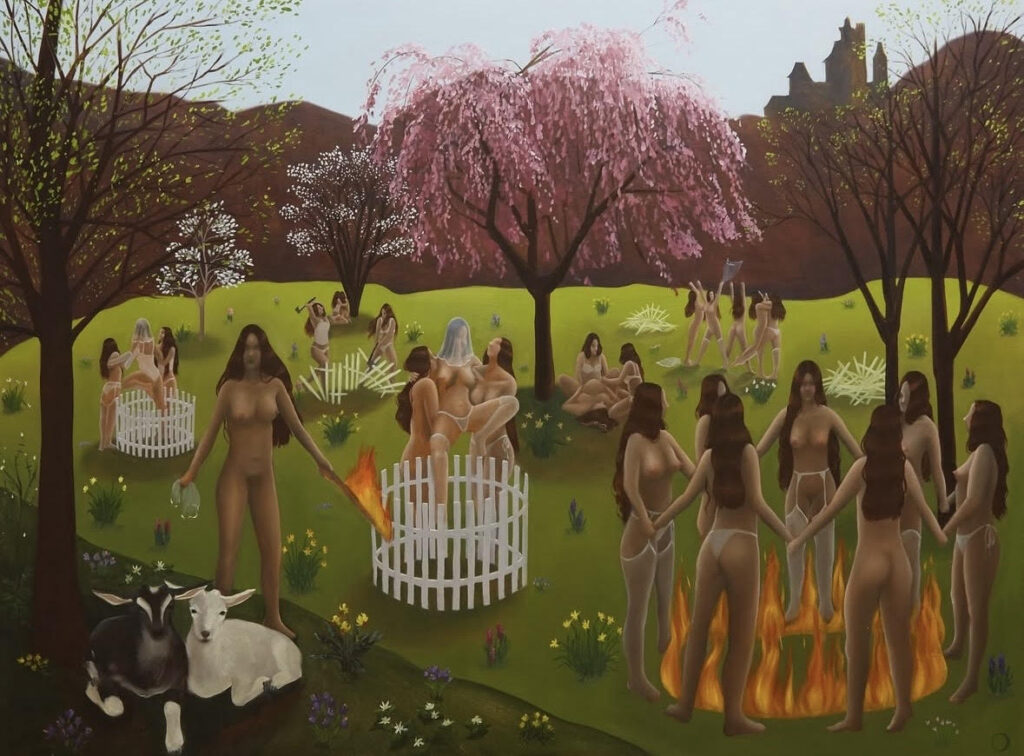
Emily: I think it probably was. I have shifted further away from that need for external validation. So much of the external is under the dominion of male-centric bias. My recent work has a sort of female utopian feeling to it. I genuinely wasn’t even considering men at all at any point in the process of making the Spider Silk series.
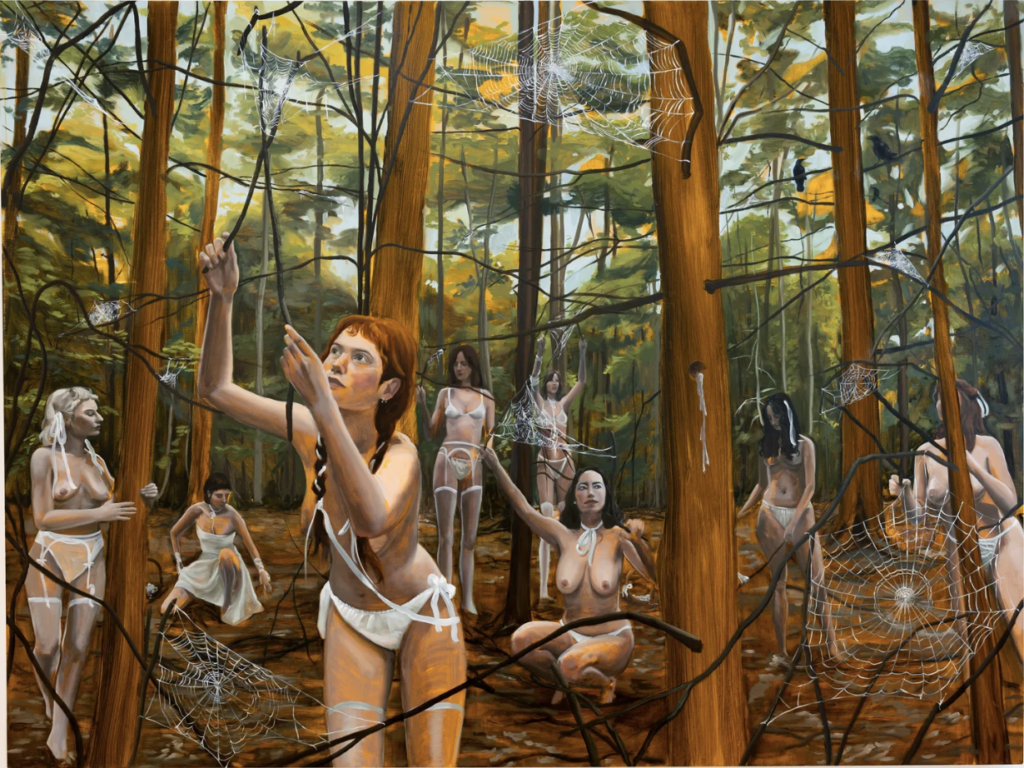
Your worlds often feel communal rather than solitary. What interests you about women together, rather than women being viewed individually?
Emily: My work before the Spider Silk series was solitary. It took place in an imaginary space within my own psychology and featured many body doubles of myself interacting. It was like trying to create relationships without going outside of myself, and it was suffocating.
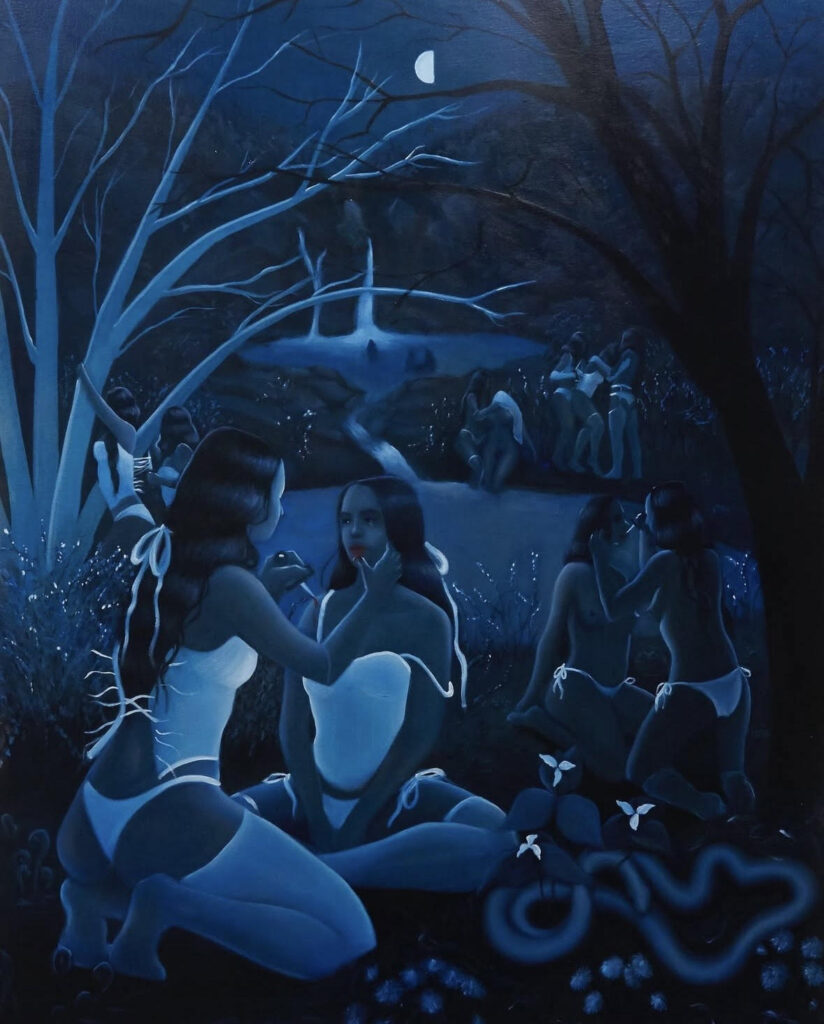
So often you see the solitary, special, woman as a feminine blip to distract you in a masculine cinematic story. I want to take that format and change it: like a Sophia Coppola film, the masculine action-driven arc is not necessary. The feminine world is compelling enough to spend a lot of time in. Shifting to this phase where I work with actual people in my life as subjects for the paintings has been invigorating. They bring their own personalities to the work and that makes it much more expansive and interesting.
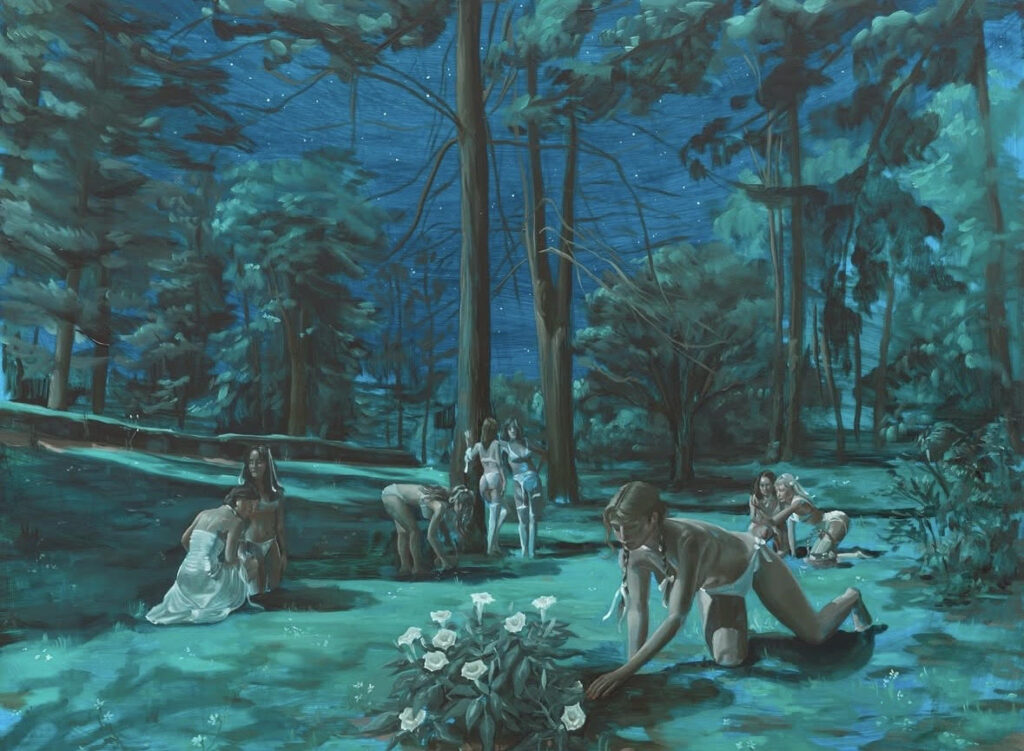
Your work doesn’t shy away from sensuality, but it also doesn’t feel simply “sexy.” What do you think gets flattened or misunderstood when female sensuality is looked at too quickly?
Emily: America is so prudish. On the left and the right. Often it feels like anything by a woman artist not only gets critiqued by an impossible and ever-shifting bar of “feminism,” but also gets automatically tossed into the “good woman” or “bad woman” bin. Equating sensuality to sex is so reductive.
There is a whole embodied and sensual experience about being a human being. Look at those paintings again and imagine – what would it feel like to be free with my friends in the woods? It’s a wonderful fantasy – not only because we are taught to have shame about our uncovered bodies, but also because frolicking in the woods is not an experience that most people have in a country where land is parcelled out and privatized!
Have there been moments in your life when femininity felt like a performance imposed on you, rather than a language you chose for yourself?
Emily: Absolutely. But I choose not to have bitterness towards femininity itself. Femininity in and of itself need-not be male-mediated. I choose to be critical of the system that requires certain performances of me, instead.
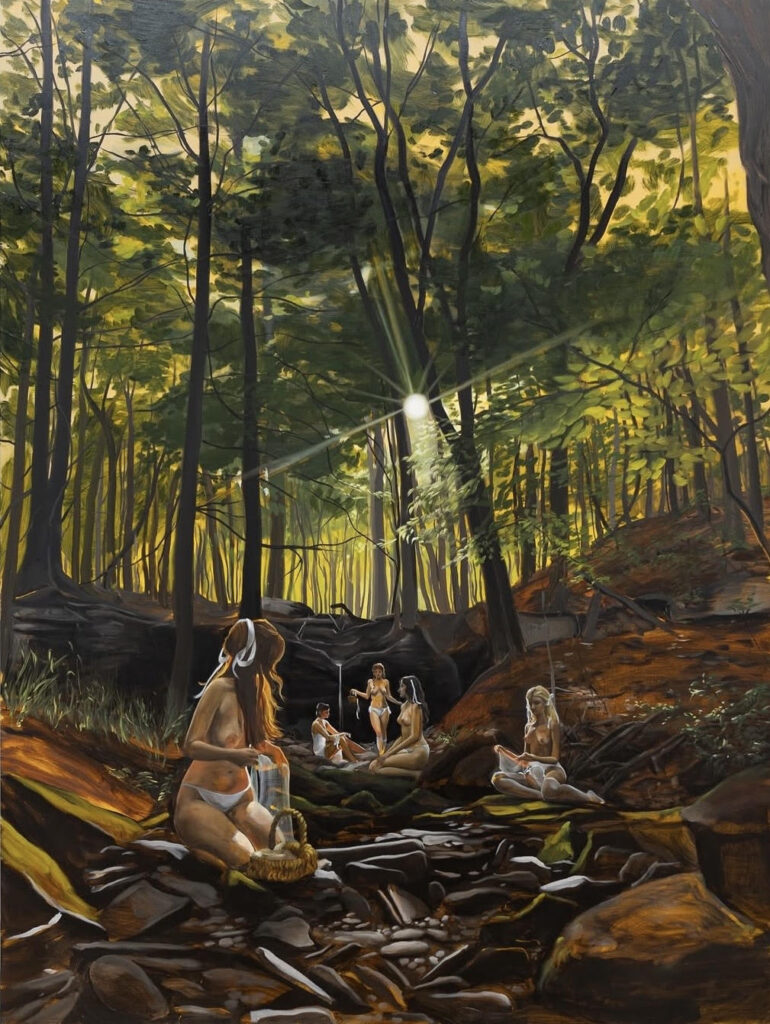
Your work engages with themes that can trigger shame, desire, projection, and judgment. Has making these paintings changed your own relationship to shame?
Emily: It’s been fascinating that the works are a projection magnet. These themes seem so uncontroversial to me, yet they trigger so many people. Shame has been a major theme in my life, and I have changed my relationship to it quite a lot through both my deep dark personal work, and my paintings which are a reflection of that deep dark work. I often notice a lot of people’s shame gets triggered by my work, and sometimes they want me to deal with it for them by calling me wrong. I cannot deal with it for them and I refuse to take on their conservative limitations.
Is there anything about being a woman artist right now that still frustrates you in ways people don’t always see from the outside?
Emily: There is so much that has frustrated me, but as I grow more mature I recognize that I must not make those frustrations the story. I am an extraordinarily talented and ambitious artist and wanted to move forward as such.
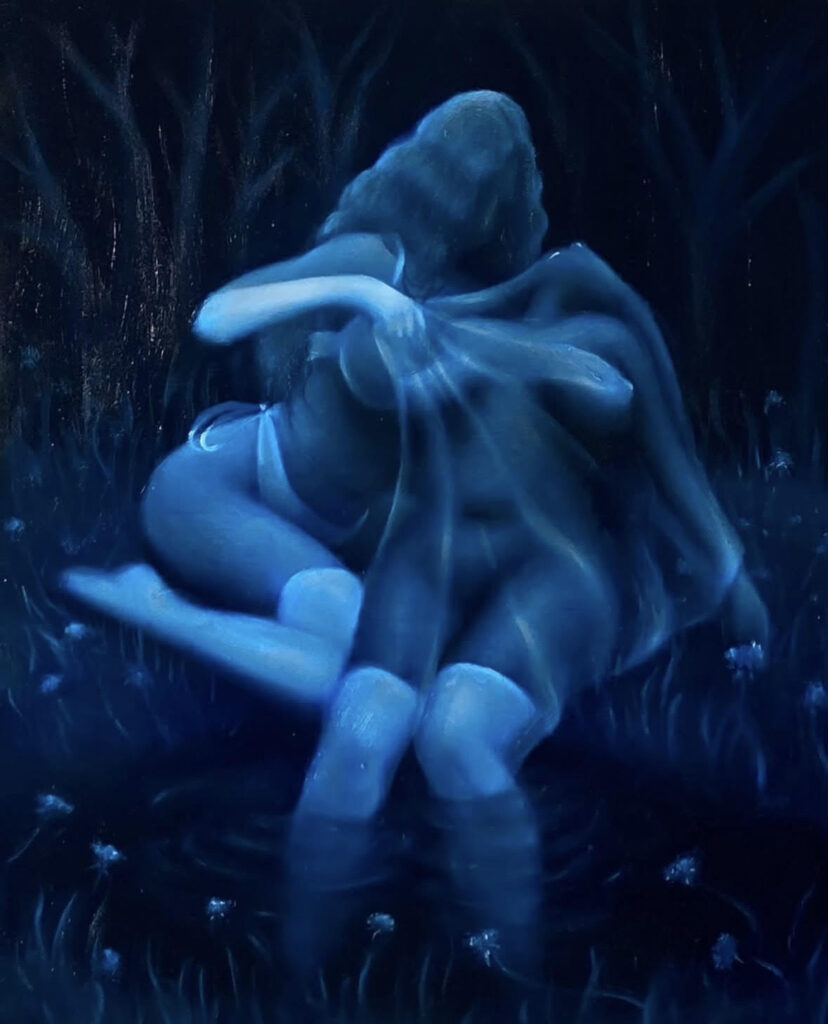
What do you protect most fiercely in your practice: your time, your inner world, your image-making, your softness, your ambition?
Emily: I probably protect my inner world most. Mostly because I don’t think most people would be interested.
What is the question about femininity, womanhood, or power that you still feel you haven’t answered yet in your work?
Emily: I have a clear vision of myself as a young woman and as an old woman. The midlife area is shrouded in mystery. My new body of work will be my first attempt to respond to this midlife area.
And on the most personal level: what are you still trying to free yourself from?
Emily: Fear.
Can you walk me through your creative process from beginning to end result?
Emily: First I read and live my life. I research what I am interested in. I go about my life and get interested in things and feel things and experience things. I wait for the idea to drop down. Usually I don’t get it all. I have to really sit and wait and also work for it. That usually means writing and living and sitting in it. I wait to receive. Then I receive more. It’s been a long time by the time I get the whole idea down, and I have usually written a lot in my phone notes at 2am and written a lot in my notebook.
Then I have the idea. I set a shoot location and date and make google slide presentations to send to the participants with the concept for the story, styling suggestions, color palettes, and visual inspiration. I compose real people like a choreographer. We have fun. We eat lunch. We shoot images. I take the photographs into the studio. I look at everything a lot. I strain my eyeballs and my brain trying to imagine what I want. I compose the best possible images with the source material. I experiment with different color palettes on small canvases.
I tone the canvases. I draw the compositions. I begin painting – first with the biggest brushes possible. I make interesting marks. I try to cover the canvas and treat the whole image equally. Weeks and months go on. I work on all of the canvases. I refine with each layer. I use the fat over lean rule. I bring some areas into more detailed focus while letting the original marks from early layers be as they are. I can feel it building up when I’m about to be finished. I stop before I go too far. Then I show it.

How do you approach color?
Emily: With a lot of care. Color is challenging and much more complex than one would imagine.
So with what we just talked about, what are you hoping to convey?
Emily: Experience. Maybe wisdom.
Ok Emily, now to something totally different. In a parallel universe who would you be? and what would you be doing?
Emily: I could be a million different things! In this universe I am hell bent on being a visual artist. Maybe in another I decided to be a director. Or a costume designer. Or a singer.
Outside of art, what’s something you’re obsessed with right now, maybe a hobby, a show, or even a food—that keeps you grounded or inspired?
Emily: I’ve been taking ballet lessons for the last 2.5 years. I love it. Ballet is so beautiful and challenging. To make it look easy, you have to be incredibly skilled. It’s like painting in that way.
Can you tell me a story about a time when a connection with someone had a big impact on you?
Emily: I met my husband 10 years ago at an art opening in Bushwick when I was a feral studio-assistant art-ho club-rat. We literally had zero mutuals. He came up to me and asked me if I thought a sculpture was carved or cast. We spent the whole evening going to more art openings, a plant store, a bar, and my friend’s metal shop, and then never stopped hanging out. He was the most unusual person I had ever met – like a living vibration. We really have grown up together and have influenced each other in countless ways. That night totally changed the trajectory of my life.
What qualities do you find most important in the people you choose to spend time with?
Emily: Everyone I spend time with is magical or charismatic, fun, smart, and very generous.
Anybody you look up to?
Emily: Louise Bourgeois. I also really love Ambera Wellmann’s work. I’ve been following her career for a decade now and she just keeps outdoing herself. It’s very cool to watch.
What motivates you?
Emily: The life force within me.
How would you describe a perfect day?
Emily: Perfect painting day – Anything could happen but I reach the flow state and then step back and blow myself out of the water with what I’ve made. Perfect leisure day – Going swimming and laying in the sun with friends – with good food and a single, strong cocktail.
Alright Emily, I always ask these two questions at the end of an interview. The first is. What’s your favorite movie(s) and why?
Emily: The Love Witch dir. by Anna Biller (2016) because of her astute understanding of the dark feminine archetype, as well as her strong visual language and attention to detail. I also love Peau D’Ane dir. by Jaques Demy (1970) which inspired Biller, and Cocteau’s La Belle et La Bête (1946) which inspired Demy.
The second is. What song(s) are you currently listening to the most right now?
Emily: I’ve been listening to Sugar Pie DeSanto, Minnie Riperton, and Lana’s new song “White Feather Hawk Tail Deer Hunter.”