We Make Years Out of Hours fills Berlin’s historic hall with 400,000 wooden cubes, song, labour, and the quiet politics of building together
At first, it looks almost like a playground. A vast museum hall filled with thousands upon thousands of small wooden cubes, waiting to be stacked, shifted, held, carried, or ignored. But in Lina Lapelytė’s world, play is never only play. It is a way of asking what we do with time, how we move together, and what kind of fragile structures we are willing to build before they disappear.
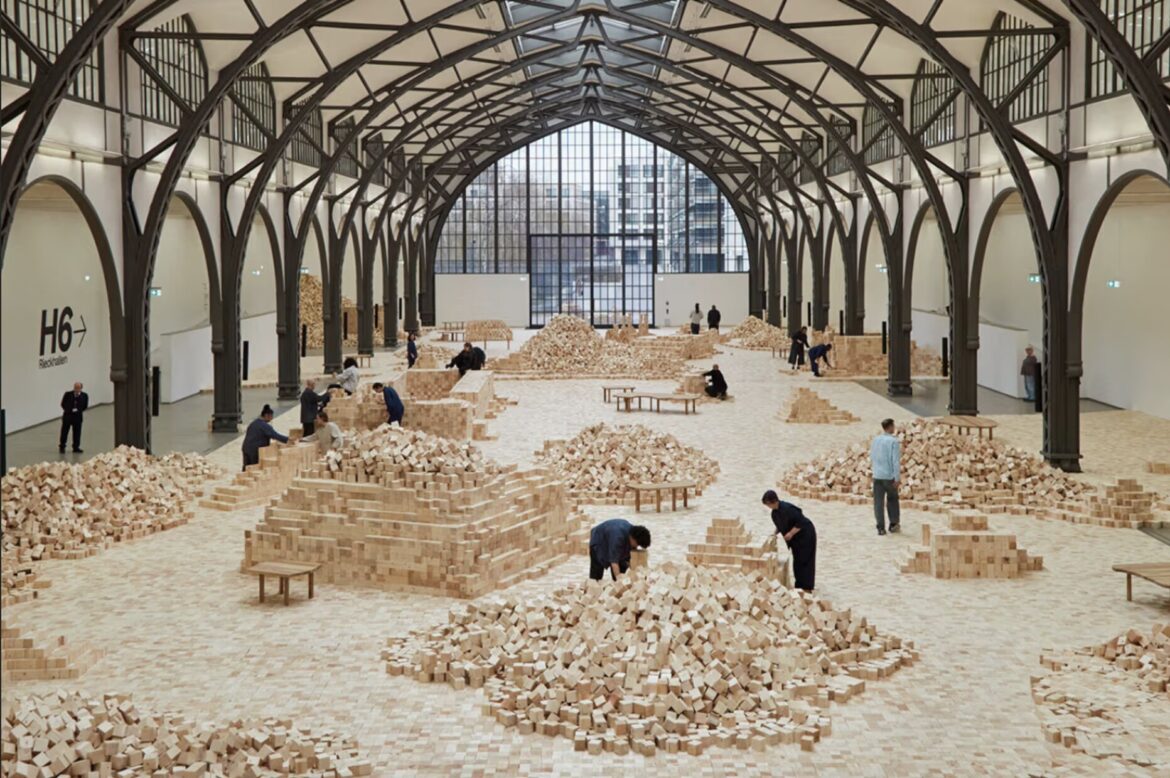
For the second CHANEL Commission at Hamburger Bahnhof – Nationalgalerie der Gegenwart in Berlin, the Lithuanian artist and composer presents We Make Years Out of Hours, a large-scale performance installation that transforms the museum’s 2,500-square-metre Historic Hall into a shifting wooden landscape. The exhibition runs from May 1, 2026 to January 10, 2027.
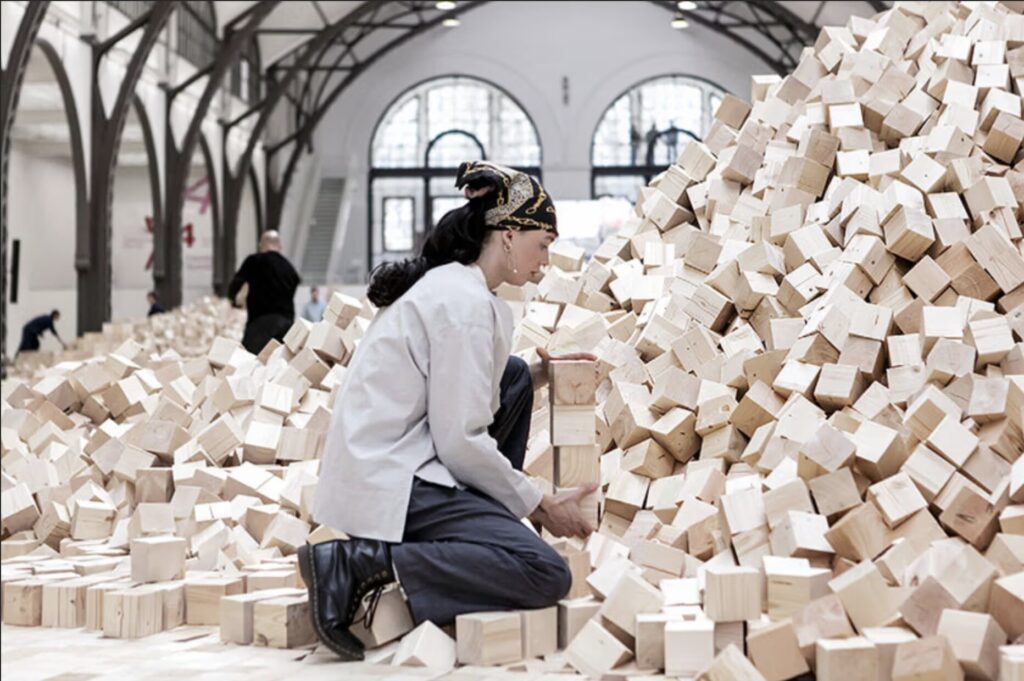
The work is built from 400,000 spruce and pine cubes, each measuring 10 x 10 x 10 cm. Spread across the floor, stacked into piles, and moved by performers and visitors, the blocks form temporary architectures that never fully settle. Something is built, then undone. A structure appears, then gives way to another. The museum becomes less a place for fixed objects than a site of continuous negotiation.
That openness is central to the piece. Visitors are not only asked to observe; they can enter the work, touch it, rearrange it, help construct it, or simply watch others do so. The gesture is simple, but the implications are larger. Who decides what gets built? Who carries the material? What remains after collective effort, and what disappears almost immediately?
Sound moves through the space as another form of construction. Twelve performers sing within the installation, giving the hall a polyphonic atmosphere. The lyrics draw from poems by 15 international writers, including Khalil Gibran, Etel Adnan, Forugh Farrokhzad, Mahmoud Darwish, Ocean Vuong, Ilya Kaminsky, and Arundhathi Subramaniam, forming a libretto around community, love, loss, formation, and hope.
Lapelytė, born in Kaunas, Lithuania in 1984, has long worked between performance, music, and social choreography. Her practice often brings together trained and untrained performers, using collective singing as a way to question silence, vulnerability, and the fragile mechanics of being together. Her work has previously been shown at the Venice Biennale, BAM, MOCA, and the Bourse de Commerce in Paris.
What makes We Make Years Out of Hours feel powerful is its refusal of monumentality in the usual sense. It is huge, but not heroic. It fills the hall, but does not freeze itself into permanence. Instead, it treats small gestures as the real architecture: one cube placed on another, one voice joining a choir, one person making room for someone else.